

What do you think?

The Chronicles of Amber #1
Les neuf princes d'Ambre
Ambre est un royaume médiéval ; comme tous les autres il possède une capitale, un palais, une cour, une famille royale et des intrigues. Mais Ambre est aussi bien plus : lieu mythique considéré comme le centre de l'univers. Seul lieu réel, tous les autres n'en sont qu'un reflet, dans l'ombre, comme la Terre. Considérée comme très intéressante par la plupart des princes d'Ambre, elle leur sert de résidence secondaire, voire de cachette. Car la vie d'un prince ou d'une princesse n'est pas de tout repos. Seuls dépositaires du pouvoir quasi divin de se déplacer entre les mondes, ils n'en restent pas moins humains : au mieux rivaux, ils sont le plus souvent ennemis jurés. En effet, depuis la disparition mystérieuse d'Obéron, le père de cette grande famille, le trône est vacant et la succession des plus agitée.
250 pages, Mass Market Paperback
First published June 1, 1970
About the author
Roger Zelazny
748 books3,985 followersRoger Joseph Zelazny was an American fantasy and science fiction writer known for his short stories and novels, best known for The Chronicles of Amber. He won the Nebula Award three times (out of 14 nominations) and the Hugo Award six times (also out of 14 nominations), including two Hugos for novels: the serialized novel ...And Call Me Conrad (1965), subsequently published under the title This Immortal (1966), and the novel Lord of Light (1967).
Ratings & Reviews
Friends & Following
Create a free account to discover what your friends think of this book!
Community Reviews
Displaying 1 - 30 of 2,917 reviews

June 28, 2010
Roger,
No, it would be no problem at all! I'd be happy to respond to the first draft of your new fantasy novel.
Lets start with the good: I enjoyed your method of immersing the reader in your fantasy world. The protagonist's case of amnesia makes it so he must learn all the same things the reader needs to know. Protagonist Corwin regains his memory gradually, creating a sense of mystery throughout the first hundred pages that is quite entertaining.
Then. . . well, you lost me. I mean, it's so esoteric. SHADOW REALMS, one for every combination of things that could be. Nine princes who can travel at will between these Shadow Realms. But there's really only ONE REAL WORLD, the world of Amber, of which all the other worlds are shadows. All of these princes want to be the king of Amber, and they struggle against each other for the throne . . .
Well, one issue I have is that I'm not sure why I should side with Corwin. I'm not entirely convinced he's the "good guy." It's sort of like voting for Zeus instead of Hera. They're all egomaniacal wackjobs.
And then you tell us, most of the way through the novel, each one of these brothers could technically make their own perfect reproduction of the original world of Amber, and ALL be kings of identical territories, AND COMPLETELY BYPASS ALL OF THIS FIGHTING TO THE DEATH?! So WHY. The FUCK. Should your reader care? As Tim Gunn would say, "This part has me worried."
Before attempting to get this published, I HIGHLY recommend reconsidering how omnipotent this set-up will make your protagonist. At the very least, don't point out to your reader how ludicrous this whole war is.
Another big issue I had was with your voice in this novel. I mean, sometimes you're all "If thou will help me to smote down ye evyl brother Eric, your noble brother Corwin shall be beholden to you." Then, a scene later, you're all, "I snuck out of the prison because I'm just that good. Dig? Solid." Are we casual? Are we not casual? Let's just decide. Either could work, but both don't.
Also, you should know my interest tapered off drastically at the exact moment when things should've started getting exciting. The actual battle over Amber seemed . . . well, dull. First off, it's narrated kind of like an eight-year-old would narrate an action figure battle: "seven of the big furry red guys were killed. Three of their soldiers died. Seventy of the goodguys got blown off the snowy mountain. I stabbed some guy in the neck." You start a hell of a lot of sentences with "I did this." I was distracted by this. I could not visualize much of anything. I was tempted to skim.
I'm sure this is your rough draft, despite the artificially yellowed pages and cool imitation 70's cover, mostly because of the excessive typos. My personal favorite: "the doors of good food." Did you mean Odors? I think so. I would fix that, and also doublecheck your punctuation. Commas seem like an unpredictable force in this book, happening sporadically and without logic. So, as I tell all my writing students, allways proofread. By the way, I loved the ironic quip on the front about "Hugo and Nebula Winning." After a few more drafts, that may become a reality, but remember my mantra: revise, revise, revise!
No, it would be no problem at all! I'd be happy to respond to the first draft of your new fantasy novel.
Lets start with the good: I enjoyed your method of immersing the reader in your fantasy world. The protagonist's case of amnesia makes it so he must learn all the same things the reader needs to know. Protagonist Corwin regains his memory gradually, creating a sense of mystery throughout the first hundred pages that is quite entertaining.
Then. . . well, you lost me. I mean, it's so esoteric. SHADOW REALMS, one for every combination of things that could be. Nine princes who can travel at will between these Shadow Realms. But there's really only ONE REAL WORLD, the world of Amber, of which all the other worlds are shadows. All of these princes want to be the king of Amber, and they struggle against each other for the throne . . .
Well, one issue I have is that I'm not sure why I should side with Corwin. I'm not entirely convinced he's the "good guy." It's sort of like voting for Zeus instead of Hera. They're all egomaniacal wackjobs.
And then you tell us, most of the way through the novel, each one of these brothers could technically make their own perfect reproduction of the original world of Amber, and ALL be kings of identical territories, AND COMPLETELY BYPASS ALL OF THIS FIGHTING TO THE DEATH?! So WHY. The FUCK. Should your reader care? As Tim Gunn would say, "This part has me worried."
Before attempting to get this published, I HIGHLY recommend reconsidering how omnipotent this set-up will make your protagonist. At the very least, don't point out to your reader how ludicrous this whole war is.
Another big issue I had was with your voice in this novel. I mean, sometimes you're all "If thou will help me to smote down ye evyl brother Eric, your noble brother Corwin shall be beholden to you." Then, a scene later, you're all, "I snuck out of the prison because I'm just that good. Dig? Solid." Are we casual? Are we not casual? Let's just decide. Either could work, but both don't.
Also, you should know my interest tapered off drastically at the exact moment when things should've started getting exciting. The actual battle over Amber seemed . . . well, dull. First off, it's narrated kind of like an eight-year-old would narrate an action figure battle: "seven of the big furry red guys were killed. Three of their soldiers died. Seventy of the goodguys got blown off the snowy mountain. I stabbed some guy in the neck." You start a hell of a lot of sentences with "I did this." I was distracted by this. I could not visualize much of anything. I was tempted to skim.
I'm sure this is your rough draft, despite the artificially yellowed pages and cool imitation 70's cover, mostly because of the excessive typos. My personal favorite: "the doors of good food." Did you mean Odors? I think so. I would fix that, and also doublecheck your punctuation. Commas seem like an unpredictable force in this book, happening sporadically and without logic. So, as I tell all my writing students, allways proofread. By the way, I loved the ironic quip on the front about "Hugo and Nebula Winning." After a few more drafts, that may become a reality, but remember my mantra: revise, revise, revise!

March 17, 2011
I got this at random while hunting the science-fantasy shelves of a no longer existing bookshop opposite Ealing Broadway station around 1981. I used to go through the tube station twice a day on my way to and from school. Twenty years later an IRA bomb blew up about 20 yards from the front door. 45kg of homemade plastic explosive.
Anyway - the book - I was immediately taken with it. It's written in the first person and starts in the real world where our Prince Corwin (just Corey at this point) is suffering amnesia in a way that was far less cliched (or even not at all) back in 1970 when Zelazny wrote him.
Corwin has a lively, "cool", interactive voice that leads you through the story. We discover, along side him and his recovering memory, that he's part of a large family with at least 8 brothers, all princes in a royal family that seems to lord it over ... well ... everything.
Zelazny gives us a multiverse that Corwin and his family can navigate simply by travelling through it and adjusting the world as they go, thus moving from one reality to another by degrees.
This first book is all about discovery. Corwin is reclaiming his memory and his birthright while finding out why he was sidelined in a hospital on the fringes of reality. He storms back into his brother's court, bluffing to cover the remaining holes in his memory.
He finds himself in the midst of a power struggle that has flared in the wake of their father's disappearance. Some of Corwin's siblings are reaching for the throne and the rest lining up behind them.
There's also a puzzling dark power rising, but that's mainly for later books.
Lots of fighting, large battles fought, escapes, returns, revenge in this one. We're also given interesting shades of magic. Firstly the 'trumps' - decks of cards with the family's likenesses on them that can be used to talk to each other and also to summon one to another. Then 'the pattern', a maze that can be walked with great difficulty and allows at the centre, a more general teleporting (though there's much more to it).
All in all, a great mix of swords & sorcery & sci-fi & urban fantasy.
You can get all ten volumes of the series in The Great Book of Amber. I've read them all! Go me. I found the quality tales off (pun intended) throughout, so the rating for the whole cycle (two cycles really, as the last 5 books have a different main character) averages to a 3*.
Join my Patreon
Join my 3-emails-a-year newsletter #prizes
...
Anyway - the book - I was immediately taken with it. It's written in the first person and starts in the real world where our Prince Corwin (just Corey at this point) is suffering amnesia in a way that was far less cliched (or even not at all) back in 1970 when Zelazny wrote him.
Corwin has a lively, "cool", interactive voice that leads you through the story. We discover, along side him and his recovering memory, that he's part of a large family with at least 8 brothers, all princes in a royal family that seems to lord it over ... well ... everything.
Zelazny gives us a multiverse that Corwin and his family can navigate simply by travelling through it and adjusting the world as they go, thus moving from one reality to another by degrees.
This first book is all about discovery. Corwin is reclaiming his memory and his birthright while finding out why he was sidelined in a hospital on the fringes of reality. He storms back into his brother's court, bluffing to cover the remaining holes in his memory.
He finds himself in the midst of a power struggle that has flared in the wake of their father's disappearance. Some of Corwin's siblings are reaching for the throne and the rest lining up behind them.
There's also a puzzling dark power rising, but that's mainly for later books.
Lots of fighting, large battles fought, escapes, returns, revenge in this one. We're also given interesting shades of magic. Firstly the 'trumps' - decks of cards with the family's likenesses on them that can be used to talk to each other and also to summon one to another. Then 'the pattern', a maze that can be walked with great difficulty and allows at the centre, a more general teleporting (though there's much more to it).
All in all, a great mix of swords & sorcery & sci-fi & urban fantasy.
You can get all ten volumes of the series in The Great Book of Amber. I've read them all! Go me. I found the quality tales off (pun intended) throughout, so the rating for the whole cycle (two cycles really, as the last 5 books have a different main character) averages to a 3*.
Join my Patreon
Join my 3-emails-a-year newsletter #prizes
...

August 25, 2024
“Besides, I like libraries. It makes me feel comfortable and secure to have walls of words, beautiful and wise, all around me. I always feel better when I can see that there is something to hold back the shadows.”
Sadly, this quote was the only highlight of Zelazny’s Nine Princes in Amber for me.
I absolutely adored Zelazny’s A Night in the Lonesome October and Doorways in the Sand, and although I didn't quite love Jack of Shadows, I found enough in it to like. But this one was Zelazny phoning it in, maybe trying to hammer out a book to meet a publishing deadline or something. It’s a book that left me vaguely puzzled about why I should care about anything or anyone in it, failing to make me feel engaged or connected with any of the characters or that titular place of Amber.
A book like this can probably translate spectacularly to screen, with its nonstop action and rapid pace. A bug battie that can be filmed better than it was written; snappy dialogue in contemporary (well, to Zelazny) lingo; a few colorful visuals. But depth-wise this is a very shallow end of the pool, safe for splashing toddlers who can’t yet swim. Actually, the sketchiness of the characters may even apply better to a video game, where just a few outlines are needed and the rest you can fill in your imagination as the protagonist player.
But it is a book, and in it I would like a bit more than sketches — since at this point the paper-thin worldbuilding and flat characters distinguishable by names alone made it impossible for me to care. Corwin or Eric for the throne of Amber (the place I’m told is spectacular but I really don’t see it know anything tangible about it to support the claim) — who cares, they both seem to be one-dimensional jerks, and I guess by convention we are supposed to root for the protagonist one simply for the reason of him being the protagonist. One jackass or another - who cares?
Possibly the two indistinguishable Amber Princes. I don’t care enough to research 🤷♀️

(Also, the pages of “we went to one battle and a few thousand died, and another battle and a few thousand died and another battle and a few thousand died but I managed to occasionally feel a bit not okay about it” should be listed among the crimes against good storytelling).
Magic is done in a vague way. Powers exist in a vague way, because they do. Plotholes are, I think, supposed to be ignored due to fast pace of the plot. Worldbuilding, as I already mentioned, is painfully thin. Plot resolutions are beyond ridiculously convenient. And the language clashes between 1970s slant and vague attempts at “higher fantasy” speech without rhyme or reason were just distractingly annoying.
1.5 stars (out of eternal love for Lonesome October somehow penned by the same guy).
(I will read the second book in case it is better, but if not then I’m out).
——————
Also posted on my blog.

November 19, 2011
Man, all the good stuff has been said to let me be brief:
OVERALL FEELING: One of my favorite fantasy pieces; sort of starts out as a PI man who lost his memory and has to figure out that he's the prince of another world.
CONCEPT: What if Gods who looked like people created this world and all the other worlds through their Godly thoughts? And what if their father disappeared and there was a fight for the throne which shook all the worlds? And what if this Godly war led to doorways being opened which should not have opened which could kill off these Gods?
MARKETING APPEAL: The Amber series is greatly loved; I imagine that it sold well; it took a first person point of view of a wise cracking PI type fantasy hero who discovered the realm of Amber; a conflict of sibling gods who are out for dominance and then discover a great evil. Superbly written.
[image error]
FAVORITE METAPHORS: “The night was bargaining weakly with the sun. The rising sun cast billions of bright shards into the foaming swell of the waters, and our eyes were dazzled by their dance so that we could not see beneath the surface.”
“The devil danced in his blue eyes . . . “
“I saw the fleet, sailing on a great ocean the color of blood. FAVORITE ACTION PASSAGE: As soon as we came to a halt, I flung open my door and leaped out --- barefooted yet! ... it!”
“ We pushed on, slowly, and there was blood on every step for as far back as I could see. There's a moral there, somewhere.”
FAVORITE DESCRIPTIVE PASSAGE: “It was about eight o'clock when the cab deposited me on a random corner in the nearest town. I paid off the driver and walked for around twenty minutes. Then I stopped in a diner, found a booth and had juice, a couple of eggs, toast, bacon and three cups of coffee. The bacon was too greasy.”
“Very, very much would they pay. An anger, a terrible one, flared within the middle of my body.”
“Answers? None.”
[image error]
DIALOGUE: I really liked the dialogue. It was terse and to the point with witty remarks all over the place, as well as some deep insights. Does a good job of not telling too much in the dialogue. No one is an idiot or constant talker. All, are sort of street smart. Corwin also has this fatalist attitude that I like. At times, he wonders as to the words he uses which makes it feel only more so that you are involved in the discussion with him (even if you can't talk back and ask questions). Good threats, too.
"Blood!" I called out. "Give me blood and vengeance this day, my warriors, and you will be remembered in Amber forever!" And as a man, they raised their weapons and cried out, "Blood!" And gallons --- no, rivers --- of it were let that day. We destroyed two more of Caine's raiders, replenishing our numbers from those of the survivors of our own fleet. As we headed toward a sixth, I climbed the mainmast and tried to take a quick count.
"Catch them, you fool!" And he did.
All I have to say is that Zelazny is my my favorite fantasy writer next to only one other writer: George Martin who is known for his incredible A SONG OF ICE AND FIRE series. This is surely one of the best series in fantasy even though it was written in the 1970s.
Note that the book directly after this one is Zelazny's “The Guns of Avalon”. A three part graphic novel was created from this tale in the 1990s and talks of a movie have been in the work for, well, decades.
CHARACTERS/DIALOGUE: A minus to A; STORY/PLOTTING: A minus to A; FRESHNESS (for its time): A to A plus; SETTING/TONE: B plus to A minus; NARRATIVE FIRST PERSON FLOW: A minus; OVERALL GRADE: A minus to A; WHEN LAST READ: 2001 (read three times) (revised review early April 2012).
OVERALL FEELING: One of my favorite fantasy pieces; sort of starts out as a PI man who lost his memory and has to figure out that he's the prince of another world.
CONCEPT: What if Gods who looked like people created this world and all the other worlds through their Godly thoughts? And what if their father disappeared and there was a fight for the throne which shook all the worlds? And what if this Godly war led to doorways being opened which should not have opened which could kill off these Gods?
MARKETING APPEAL: The Amber series is greatly loved; I imagine that it sold well; it took a first person point of view of a wise cracking PI type fantasy hero who discovered the realm of Amber; a conflict of sibling gods who are out for dominance and then discover a great evil. Superbly written.
[image error]
FAVORITE METAPHORS: “The night was bargaining weakly with the sun. The rising sun cast billions of bright shards into the foaming swell of the waters, and our eyes were dazzled by their dance so that we could not see beneath the surface.”
“The devil danced in his blue eyes . . . “
“I saw the fleet, sailing on a great ocean the color of blood. FAVORITE ACTION PASSAGE: As soon as we came to a halt, I flung open my door and leaped out --- barefooted yet! ... it!”
“ We pushed on, slowly, and there was blood on every step for as far back as I could see. There's a moral there, somewhere.”
FAVORITE DESCRIPTIVE PASSAGE: “It was about eight o'clock when the cab deposited me on a random corner in the nearest town. I paid off the driver and walked for around twenty minutes. Then I stopped in a diner, found a booth and had juice, a couple of eggs, toast, bacon and three cups of coffee. The bacon was too greasy.”
“Very, very much would they pay. An anger, a terrible one, flared within the middle of my body.”
“Answers? None.”
[image error]
DIALOGUE: I really liked the dialogue. It was terse and to the point with witty remarks all over the place, as well as some deep insights. Does a good job of not telling too much in the dialogue. No one is an idiot or constant talker. All, are sort of street smart. Corwin also has this fatalist attitude that I like. At times, he wonders as to the words he uses which makes it feel only more so that you are involved in the discussion with him (even if you can't talk back and ask questions). Good threats, too.
"Blood!" I called out. "Give me blood and vengeance this day, my warriors, and you will be remembered in Amber forever!" And as a man, they raised their weapons and cried out, "Blood!" And gallons --- no, rivers --- of it were let that day. We destroyed two more of Caine's raiders, replenishing our numbers from those of the survivors of our own fleet. As we headed toward a sixth, I climbed the mainmast and tried to take a quick count.
"Catch them, you fool!" And he did.
All I have to say is that Zelazny is my my favorite fantasy writer next to only one other writer: George Martin who is known for his incredible A SONG OF ICE AND FIRE series. This is surely one of the best series in fantasy even though it was written in the 1970s.
Note that the book directly after this one is Zelazny's “The Guns of Avalon”. A three part graphic novel was created from this tale in the 1990s and talks of a movie have been in the work for, well, decades.
CHARACTERS/DIALOGUE: A minus to A; STORY/PLOTTING: A minus to A; FRESHNESS (for its time): A to A plus; SETTING/TONE: B plus to A minus; NARRATIVE FIRST PERSON FLOW: A minus; OVERALL GRADE: A minus to A; WHEN LAST READ: 2001 (read three times) (revised review early April 2012).

June 4, 2013
What a weird, weird book.
Nine princes in Amber begins with the protagonist, Corwin, waking up in an hospital room, with no memories of himself or his past.
Soon after that he realizes he's been drugged for days and flees the building, meanwhile collecting bits of informations about his former life.
Within a few chapters he learns he's one of the nine living princes of Amber, the only true world (of which every other world is but a Shadow. Literally.) and that this makes him basically a god.
These princes can, in fact, modify Shadow worlds with just a minor effort of will(but not Amber itself), travel freely between universes and do a number of other nifty things.
The rest of the book covers, more or less, his struggles to regain his memories and win the throne of Amber itself, now held by Eric, one of his brothers.
Too bad that, while having a great premise and being full of good ideas, the book fails (quite badly) to deliver.
Its first and most obvious fault is that it's so very hasty: Corwin goes from "I wake up without knowing who I am" to "I single-handedly wage war to decide the fate of all the universes" in about 30 pages!
It never takes time to build pathos or put some meat on the characters, and the result is that after a flying start the narration falls flat.
The whole second half of the book is made almost entirely of battles resolved in one-line sentences.
Just imagine a few dozen pages full of something like "We went there to fight A. Three hundred died. Then we fought B. Then C came and we fled. Then we fought C and a two thousand died."
Another big point is that this book does a lousy job of explaining things. Don't get me wrong I love books where you have to figure out things yourself, but here there's just a lot of random stuff thrown at you that you're supposed to take as a given.
Why are the princes so powerful?
What allows them to change reality?
Why can they change some things and not others?
Why on Earth do they all want Amber's throne? (since they could create an infinite number of worlds perfectly identical to it by simply wishing it)
Why doesn't gunpowder burn in Amber? (while matches work perfectly instead)
The list could go on and on and on. At times you are given pathetic explanations on the lines of "Princes of Amber can change reality because they can". Why thank you very much, Mr. Zelazny.
Plot resolutions are often plain ridiculous and lack any logic.
At some point in the book there's a battle on this loooong and narrow staircase climbing a mountain. These stairs are so narrow that only the two soldiers on the front can fight, and everyone else (we're talking a few thousands on each side) just stands there watching.
No one takes a bow, nor throws a fucking rock for that matter.
I'd write more about such plot holes but I don't want to make spoilers and I think I made my point already anyway.
Last but not least, the language is a mix of archaic English and 70s slang. If ever there were any doubts that the two are not meant to go together, Nine princes in Amber wiped them away.
Apart from being very VERY annoying, this quaint (for want of a better and non offensive word) linguistc mix makes absolutely no sense.
Just think about it: our Earth is but one of an infinite number of Shadow world of which most characters (which, remember, are immortal gods) barely suspect the existence.. why the hell would they use American Idioms??
A couple times is mentioned how they are actually speaking Amber's language.. and I must say I'm really, really curious as to how does "I dig thy stuff, brother" translate in Amberian(can't remeber the actual name).
The language is not the only part pervaded with random elements of American culture; the princes, for example,just can't help smoking about 20 packs of (branded) cigarettes per page. Where do they get them? No idea.
I was constantly reminded of an uber-cheesy sci-fi movie from the 70s.
It's not an entirely terrible book and it holds some very cool concepts, but I hardly find it deserving all the praise it gets.
Nine princes in Amber begins with the protagonist, Corwin, waking up in an hospital room, with no memories of himself or his past.
Soon after that he realizes he's been drugged for days and flees the building, meanwhile collecting bits of informations about his former life.
Within a few chapters he learns he's one of the nine living princes of Amber, the only true world (of which every other world is but a Shadow. Literally.) and that this makes him basically a god.
These princes can, in fact, modify Shadow worlds with just a minor effort of will(but not Amber itself), travel freely between universes and do a number of other nifty things.
The rest of the book covers, more or less, his struggles to regain his memories and win the throne of Amber itself, now held by Eric, one of his brothers.
Too bad that, while having a great premise and being full of good ideas, the book fails (quite badly) to deliver.
Its first and most obvious fault is that it's so very hasty: Corwin goes from "I wake up without knowing who I am" to "I single-handedly wage war to decide the fate of all the universes" in about 30 pages!
It never takes time to build pathos or put some meat on the characters, and the result is that after a flying start the narration falls flat.
The whole second half of the book is made almost entirely of battles resolved in one-line sentences.
Just imagine a few dozen pages full of something like "We went there to fight A. Three hundred died. Then we fought B. Then C came and we fled. Then we fought C and a two thousand died."
Another big point is that this book does a lousy job of explaining things. Don't get me wrong I love books where you have to figure out things yourself, but here there's just a lot of random stuff thrown at you that you're supposed to take as a given.
Why are the princes so powerful?
What allows them to change reality?
Why can they change some things and not others?
Why on Earth do they all want Amber's throne? (since they could create an infinite number of worlds perfectly identical to it by simply wishing it)
Why doesn't gunpowder burn in Amber? (while matches work perfectly instead)
The list could go on and on and on. At times you are given pathetic explanations on the lines of "Princes of Amber can change reality because they can". Why thank you very much, Mr. Zelazny.
Plot resolutions are often plain ridiculous and lack any logic.
At some point in the book there's a battle on this loooong and narrow staircase climbing a mountain. These stairs are so narrow that only the two soldiers on the front can fight, and everyone else (we're talking a few thousands on each side) just stands there watching.
No one takes a bow, nor throws a fucking rock for that matter.
I'd write more about such plot holes but I don't want to make spoilers and I think I made my point already anyway.
Last but not least, the language is a mix of archaic English and 70s slang. If ever there were any doubts that the two are not meant to go together, Nine princes in Amber wiped them away.
Apart from being very VERY annoying, this quaint (for want of a better and non offensive word) linguistc mix makes absolutely no sense.
Just think about it: our Earth is but one of an infinite number of Shadow world of which most characters (which, remember, are immortal gods) barely suspect the existence.. why the hell would they use American Idioms??
A couple times is mentioned how they are actually speaking Amber's language.. and I must say I'm really, really curious as to how does "I dig thy stuff, brother" translate in Amberian(can't remeber the actual name).
The language is not the only part pervaded with random elements of American culture; the princes, for example,just can't help smoking about 20 packs of (branded) cigarettes per page. Where do they get them? No idea.
I was constantly reminded of an uber-cheesy sci-fi movie from the 70s.
It's not an entirely terrible book and it holds some very cool concepts, but I hardly find it deserving all the praise it gets.

November 12, 2009
See my review under the one volume (omnibus) set...one of my favorite series. This is another classic that ought to be called a classic!
Update:
I read this one first...back when. It was in the 1970s. I have since grown a bit, aged quite a bit and...possibly even matured a little. I still love these books. I have also discovered audio books (this too happened some years ago and has been detailed elsewhere. My wife became very ill and was bed fast a long time, she also came to the point where she really couldn't read, so I began tracking down audio books for her. First I got books on cassette and later on CD. Since I had the books anyway I listened to them in my work vehicle).
Since that time I have found I really like audio books and have often bemoaned that these books, the Amber Series were never done in audio.
Well now it has been and as soon as Audible offered the books I began downloading them. The reader (of the first series) a voice actor named Allessandro Juliani does a good job and the story has drawn me in again as it did when I was young. Plot driven yet with a main character painted in bright detail these are (in my humble opinion) exceptional books(at least the first series) and I am very happy they are finally available in audio.
Recommended in any form you care to read them, print book, Ebook or audio book I think most fantasy fans will truly enjoy them.
Update:
I read this one first...back when. It was in the 1970s. I have since grown a bit, aged quite a bit and...possibly even matured a little. I still love these books. I have also discovered audio books (this too happened some years ago and has been detailed elsewhere. My wife became very ill and was bed fast a long time, she also came to the point where she really couldn't read, so I began tracking down audio books for her. First I got books on cassette and later on CD. Since I had the books anyway I listened to them in my work vehicle).
Since that time I have found I really like audio books and have often bemoaned that these books, the Amber Series were never done in audio.
Well now it has been and as soon as Audible offered the books I began downloading them. The reader (of the first series) a voice actor named Allessandro Juliani does a good job and the story has drawn me in again as it did when I was young. Plot driven yet with a main character painted in bright detail these are (in my humble opinion) exceptional books(at least the first series) and I am very happy they are finally available in audio.
Recommended in any form you care to read them, print book, Ebook or audio book I think most fantasy fans will truly enjoy them.

April 17, 2018
*** 4 ***
"...“I like libraries. It makes me feel comfortable and secure to have walls of words, beautiful and wise, all around me. I always feel better when I can see that there is something to hold back the shadows.” ..."
Nine Princes in Amber is the first installment in a series of 10 rather shortish books. They are divided into 2 arcs and the first one is told from Corwin’s perspective, while the next set make his son's story the main event. Although we see the happenings from this family line's POV, the real center of both arcs is the internal struggle of the family to deal with their inherited familial need to dominate the others of their bloodline by any means possible - betrayal, treachery, backstabbing, all breaks of honor and what we consider human empathy in all circumstances, all in the battle to capture and keep their birthright, the Crown of Amber, once belonging to their father, Oberon, who is currently and has been for a very long time missing, presumed dead. Whoever ends up with the crown will have to dodge the treachery of all his siblings and their allies, while ruling Amber and trying to protect its people from problems starting to emerge from the Shadows and the forces of Chaos.
"...“there is Shadow and there is Substance, and this is the root of all things. Of Substance, there is only Amber, the real city, upon the real Earth, which contains everything. Of Shadow, there is an infinitude of things. Every possibility exists somewhere as a Shadow of the real.” ..."
In this volume we are introduced to Corwin, who awakens in a hospital after an apparent car "accident", heavily drugged and kept this way on purpose, with severe amnesia and no idea of who he is, where he is, and only with an insistent sense of danger and the knowledge he needs to get out of there. In the beginning of the book he has to figure out who he is, find a way to go some place safe, discover who his enemies are, get some allies, play an obviously dangerous game by bluffing his way through it, and once he finds out not only who he is but also what he is, he has to make some martial decisions which would have sweeping consequences for many, many people... But most of all, he has to confront his brother Eric and take the Crown. Turns out, because of Eric and his mental influence, Corwin has been stuck on Earth for centuries, having a real-life first hand knowledge of things like the plague, the reign of Queen Elizabeth, Napoleon, the life in concentration camps, and all the wars in between. As he starts to remember, he discovers that he is one of the nine princes of Amber, the only World which is Real and True, while all other worlds, including our Earth, are just shadows thrown by it. It is the only "substance" while all the rest are "Shadows"... The opposite and opposing entity to Amber is Chaos. And Chaos is starting an offensive on the g-d-like siblings of Amber. Are they going to get to a point where they will put their in-fighting to the side in order to protect the World?
"...“I walked among Shadows, and found a race of furry creatures, dark and clawed and fanged, reasonably manlike, and about as intelligent as a freshman in the high school of your choice-sorry, kids, but what I mean is they were loyal, devoted, honest, and too easily screwed by bastards like me and my brother. I felt like the dee-jay of your choice.” ..."
Yep, those Amber G-ds sure are assholes!!!
The siblings are all gifted with what to us is like super-powers, for them just part of their heritage. In most of the Shadow Worlds they are looked upon and worshiped as a pantheon of g-ds. The ones of The Blood are capable of traveling between the worlds by manipulating matter, adding and subtracting in a formula meant to solve for the destination they desire. I find this system absolutely fascinating and love the heck out of it. It is different, it is imaginative and very original, having in mind that the first book was created in the late 60's and published as a complete work in '71. It is a kind of a hybrid between Science Fiction and Fantasy and as every first work is not perfect, but it sure is entertaining. He does have all the female siblings as a second thought and females are not very present in the story, but I hope we get there eventually. What I love about this author the most is his ability to write in a minimalistic manner and short format, while packing every page with world-building and action. I have said before, he knows exactly the limits to keep us interested and never get bored!!! I can't wait to return and see what happens with the familial MMA cage match that is The Princes of Amber!!!
"...“What an enormous chutzpah you possess," I told him. "What makes you better than the rest of us, and more fit to rule?" "The fact that I was able to occupy the throne," he replied. "Try and take it.” ..."
Now I wish you All Happy Reading and may you always find what you Need in the pages of a Good Book!
"...“I like libraries. It makes me feel comfortable and secure to have walls of words, beautiful and wise, all around me. I always feel better when I can see that there is something to hold back the shadows.” ..."
Nine Princes in Amber is the first installment in a series of 10 rather shortish books. They are divided into 2 arcs and the first one is told from Corwin’s perspective, while the next set make his son's story the main event. Although we see the happenings from this family line's POV, the real center of both arcs is the internal struggle of the family to deal with their inherited familial need to dominate the others of their bloodline by any means possible - betrayal, treachery, backstabbing, all breaks of honor and what we consider human empathy in all circumstances, all in the battle to capture and keep their birthright, the Crown of Amber, once belonging to their father, Oberon, who is currently and has been for a very long time missing, presumed dead. Whoever ends up with the crown will have to dodge the treachery of all his siblings and their allies, while ruling Amber and trying to protect its people from problems starting to emerge from the Shadows and the forces of Chaos.
"...“there is Shadow and there is Substance, and this is the root of all things. Of Substance, there is only Amber, the real city, upon the real Earth, which contains everything. Of Shadow, there is an infinitude of things. Every possibility exists somewhere as a Shadow of the real.” ..."
In this volume we are introduced to Corwin, who awakens in a hospital after an apparent car "accident", heavily drugged and kept this way on purpose, with severe amnesia and no idea of who he is, where he is, and only with an insistent sense of danger and the knowledge he needs to get out of there. In the beginning of the book he has to figure out who he is, find a way to go some place safe, discover who his enemies are, get some allies, play an obviously dangerous game by bluffing his way through it, and once he finds out not only who he is but also what he is, he has to make some martial decisions which would have sweeping consequences for many, many people... But most of all, he has to confront his brother Eric and take the Crown. Turns out, because of Eric and his mental influence, Corwin has been stuck on Earth for centuries, having a real-life first hand knowledge of things like the plague, the reign of Queen Elizabeth, Napoleon, the life in concentration camps, and all the wars in between. As he starts to remember, he discovers that he is one of the nine princes of Amber, the only World which is Real and True, while all other worlds, including our Earth, are just shadows thrown by it. It is the only "substance" while all the rest are "Shadows"... The opposite and opposing entity to Amber is Chaos. And Chaos is starting an offensive on the g-d-like siblings of Amber. Are they going to get to a point where they will put their in-fighting to the side in order to protect the World?
"...“I walked among Shadows, and found a race of furry creatures, dark and clawed and fanged, reasonably manlike, and about as intelligent as a freshman in the high school of your choice-sorry, kids, but what I mean is they were loyal, devoted, honest, and too easily screwed by bastards like me and my brother. I felt like the dee-jay of your choice.” ..."
Yep, those Amber G-ds sure are assholes!!!
The siblings are all gifted with what to us is like super-powers, for them just part of their heritage. In most of the Shadow Worlds they are looked upon and worshiped as a pantheon of g-ds. The ones of The Blood are capable of traveling between the worlds by manipulating matter, adding and subtracting in a formula meant to solve for the destination they desire. I find this system absolutely fascinating and love the heck out of it. It is different, it is imaginative and very original, having in mind that the first book was created in the late 60's and published as a complete work in '71. It is a kind of a hybrid between Science Fiction and Fantasy and as every first work is not perfect, but it sure is entertaining. He does have all the female siblings as a second thought and females are not very present in the story, but I hope we get there eventually. What I love about this author the most is his ability to write in a minimalistic manner and short format, while packing every page with world-building and action. I have said before, he knows exactly the limits to keep us interested and never get bored!!! I can't wait to return and see what happens with the familial MMA cage match that is The Princes of Amber!!!
"...“What an enormous chutzpah you possess," I told him. "What makes you better than the rest of us, and more fit to rule?" "The fact that I was able to occupy the throne," he replied. "Try and take it.” ..."
Now I wish you All Happy Reading and may you always find what you Need in the pages of a Good Book!

November 6, 2023
Sword-and-sorcery fantasy is not my thing, but I have wanted to read Roger Zelazny’s Chronicles of Amber series since I was in high school. I just never got around to it.
The first book, “Nine Princes in Amber”, published in 1970, starts off almost in a different genre.
A guy wakes up in a hospital with amnesia. He was in a car accident, which nearly killed him, but doctors are stymied as to how and why his body has healed so quickly. One night, after shaking down the head doctor on duty for information, he checks out and heads to an address of a woman who claims to be his sister.
The first part of this book reads like a noir thriller. It could almost be an Elmore Leonard novel. Then Zelazny flips readers’ expectations. Suddenly, we’re in Tolkien territory.
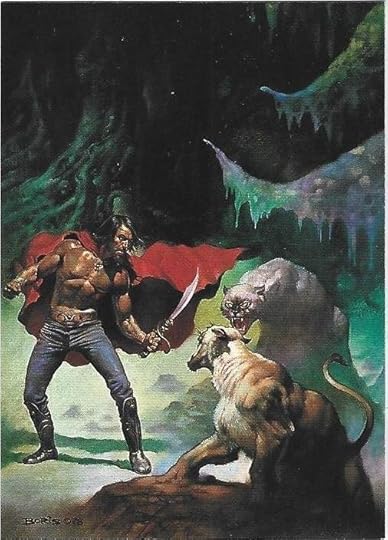
Original cover art by legendary fantasy artist Boris Vallejo
In a nutshell, Prince Corwin (the guy with amnesia) is one of nine heirs to the throne of Amber, the most perfect city/world in the universe. All other worlds (including ours) is an imperfect “shadow” realm based on Amber.
The King—-Corwin’s father—-is either dead or missing, which leaves a power vacuum. For millennia, Corwin and his brothers have been vying for the throne. Eric, Corwin’s older brother and most powerful, has waged war in Amber and the Shadow realms. Corwin allies with another brother, Breys, but Eric’s forces are too much for them.
Corwin is captured and thrown into a dungeon after having his eyes plucked out, but this is a minor setback…
A quick and entertaining read, “Nine Princes in Amber” sets the stage for the 10-book series, continued in “Guns of Avalon”.
The first book, “Nine Princes in Amber”, published in 1970, starts off almost in a different genre.
A guy wakes up in a hospital with amnesia. He was in a car accident, which nearly killed him, but doctors are stymied as to how and why his body has healed so quickly. One night, after shaking down the head doctor on duty for information, he checks out and heads to an address of a woman who claims to be his sister.
The first part of this book reads like a noir thriller. It could almost be an Elmore Leonard novel. Then Zelazny flips readers’ expectations. Suddenly, we’re in Tolkien territory.
Original cover art by legendary fantasy artist Boris Vallejo
In a nutshell, Prince Corwin (the guy with amnesia) is one of nine heirs to the throne of Amber, the most perfect city/world in the universe. All other worlds (including ours) is an imperfect “shadow” realm based on Amber.
The King—-Corwin’s father—-is either dead or missing, which leaves a power vacuum. For millennia, Corwin and his brothers have been vying for the throne. Eric, Corwin’s older brother and most powerful, has waged war in Amber and the Shadow realms. Corwin allies with another brother, Breys, but Eric’s forces are too much for them.
Corwin is captured and thrown into a dungeon after having his eyes plucked out, but this is a minor setback…
A quick and entertaining read, “Nine Princes in Amber” sets the stage for the 10-book series, continued in “Guns of Avalon”.

August 13, 2014
All roads lead to Amber..
Nine brothers fight for the inheritance left behind by the disappearance of their father. The ultimate prize is the throne of Amber, the one real world, of which all other worlds are mere shadows and reflections.
Nine Princes of the Amber is an interesting fantasy introduction with an intriguing concept. I really enjoyed reading the early parts, where the prince Corwin wakes up in a hospital on Earth with no memory of his past. I expected a more traditional fantasy when picking up this book, but instead got a story of Corwin and his companions travelling between worlds and attempting to reach Amber while also struggling to regain his memory and understanding of what’s going on.
This combination of science fiction and fantasy was pretty interesting, and made even more so by the fact that the protagonist himself, as a result of his amnesia, holds as little information as the reader to begin with about the world of Amber and how it works. Thus the reader is able to follow Corwin’s journey and learn with him.
Unfortunately, Zelazny’s writing is not very good, at least not at this early stage. It seems to blend many different styles of writing, which often ruins the atmosphere of the story and the setting, and also contains a number of mistakes throughout the book. Additionally the simplicity of the plot and the shallowness of characterisation made the quality suffer slightly. However, these are all negatives that can be easily corrected in sequels, and I’m ready to give dear Roger the benefit of doubt because of how intriguing the concept is.
Overall, this is a very short and enjoyable introduction to one of the great fantasy series of the previous century.
Nine brothers fight for the inheritance left behind by the disappearance of their father. The ultimate prize is the throne of Amber, the one real world, of which all other worlds are mere shadows and reflections.
Nine Princes of the Amber is an interesting fantasy introduction with an intriguing concept. I really enjoyed reading the early parts, where the prince Corwin wakes up in a hospital on Earth with no memory of his past. I expected a more traditional fantasy when picking up this book, but instead got a story of Corwin and his companions travelling between worlds and attempting to reach Amber while also struggling to regain his memory and understanding of what’s going on.
This combination of science fiction and fantasy was pretty interesting, and made even more so by the fact that the protagonist himself, as a result of his amnesia, holds as little information as the reader to begin with about the world of Amber and how it works. Thus the reader is able to follow Corwin’s journey and learn with him.
Unfortunately, Zelazny’s writing is not very good, at least not at this early stage. It seems to blend many different styles of writing, which often ruins the atmosphere of the story and the setting, and also contains a number of mistakes throughout the book. Additionally the simplicity of the plot and the shallowness of characterisation made the quality suffer slightly. However, these are all negatives that can be easily corrected in sequels, and I’m ready to give dear Roger the benefit of doubt because of how intriguing the concept is.
Overall, this is a very short and enjoyable introduction to one of the great fantasy series of the previous century.

March 5, 2018
⚔ Zelazny Freaks Regulars buddy read with my fellow Freaks Regulars Evgeny, Choko, Eilonwy, Elena and Lee Who Just Came Back from the Dead ⚔
Pre-review rating: 3.33567458 stars.
Post-review rating: 3 stars. Because I'm barbarous like that.
Okay, let's get something out of the way real quick: yes, this is everyone and their barnacle's mostest favoritest fantasy series ever, and the one that, in most cases, introduced them to the genre, and the one that inspired countless fantasy writers. It also happens to be the one I obviously very read wrong.

Yeah yeah yeah, I know, this is quite outrageous and stuff. Hey, you might want to be careful with that finger of yours, you're going to end up spraining it if you don't stop wiggling it around like that.
Now please do try and refrain from playing Friendly Neighbourhood Troll (FNT™), and lecturing me on allllllllllllllllllll the glorious things I obviously missed while reading this book. Why? Because 1/I'm in a most nefarious mood today, so you might want to take a step back before I unleash the crustaceans and stuff, 2/Sorry I slightly forgot what #2 was and 3/I already KNOW that this delightful tale is packed with dazzingly marvellous stuff. How do I know, you ask? Sigh. With all due respect , you really ask the silliest questions sometimes, my Flimsy Decapods. Because I bloody shrimping READ IT, that's why! *softly screams "DUH" at the top of her super sexey branchiae*
The truth is, I haven't entirely lost it yet (don't worry, it won't last) and do realize that there is some supremely good stuff here. Ergo, I presently find my little self in quite the predicament. I mean, this book is mostly brilliantly brilliant indeed. Zelazny managed to build a deliciously rich, complex world in 150 miserable little pages. When it takesmost some authors (who shall remain unnamed because I can't be ALL malevolent ALL the time please excuse the digression and stuff) 100+ books (and a half) in a series not to do the same, um, you know, thing.

I know, right? And just you wait, for there's more captivating stuff on the way! I'm notnearly done yet! Be glad and rejoice!
So the world building is pretty luscious and the story is original and fun and intriguing and the plot is fast-paced and there are deviously deceitful characters with potentially great potential and yes I am aware I already said most of this down there ↓↓ but who the fish cares anyway and there is lots of Yummy Swashbuckling Type Stuff (YSTS™) and I am most pleased that some of my subaquatic cousins are featured in the story and there are heavenly Kentucky Fried Lizard Parts, too and also bid red guys + little hairy ones and commas are overrated anyway.

This "but" here ⤴ might seem quite innocently inconspicuous to you, and yet it is most completely responsible for the distressing (if a little Zelaznian) predicament I mentioned earlier. Because you see, my Flaky Arthropods, notwithstanding the Stupendously Stupendous Stuff (SSS™) this book is packed with, some stuff is indeed rotten in the state of Amber *cheerfully waves at her good chum Will S.*:
① Anyone who has read Doorways in the Sand or Roadmarks will tell you that Zelazny loves nothing better than to keep hisvictims readers' little grey cells on their toes and stuff (because yes, little grey cells have toes). So I obviously expected some serious head exoskeleton scratching to happen here, and this most delectable assumption was confirmed in the first chapters in the book. But then it all went poof and all was revoltingly crystal clear and despicably simple and my pincers were therefore left with nothing to scratch and got all itchy as a result and that is never good for puny humans in the immediate vicinity of my humble shrimpy abode but I slightly digress. Long paragraph tiny: too straightforward this story was, when most splendidly befuddling I expected it to be. Quite disappointed this sad state of affairs left me.

Yes, some people manage to express their emotions in the most restrained way *and* be super stylish at the same time.
② The return of the Ironing Boards of Doom (IBoD™). Yes, I am afraid this is the awful truth indeed, as the characters in this book seem to have been infected by the much-feared Flat as a Herd of Ironing Boards Virus (FaaHoIBV™). Which is a teensy little bit slightly infuriating since they were all so promising initially. But depth they utterly lack and emotions they are unable to express and act like lifeless machines most of the time they do. So give a fish about them I never really came to. Which sucks big time. Especially since there's some potential harem material here *waves at prospective boyfriend Corwin* Now if that's not overwhelmingly depressing, I don't know what is.
③ Was this book written by Zelazny's evil twin, I wonder? The writing is shockingly uneven and unbalanced throughout the book. You get loooooonnnng passages aboutnot necessarily fascinating stuff, and then less than a ridiculous paragraph about a battle: "we met. We fought. I won." Okay then. Then there are the dialogues. One minute the characters are all, "I fear to fetch us steeds." "And I, also" and the next they are all, "Hey man, I don't dig this. Hey man, I don't dig that. Guys this, guys that, here a guy, there a guy, everywhere a guy…" which kinda sorta makes me go all…

Get the gist of my predicament now? You don't? Oh, well.
➽ And the moral of this Please Someone Tell Me Where I Can Take How To Write Concise Reviews 101 Classes This Is Getting Hopelessly Hopeless and Tiresomely Tiresome Crappy Non Review (PSTMWICTHtWCR101CTIGHHaTTCNR™) is: have no fear, ZelaznianFreaks Enthusiasts, for I shall most promptly read book 2 and see the glorious Zelaznian light in all its splendour, after which we shall all live shrimpily ever after and stuff. Then again maybe not.
✎ Book 2: Guns of Avalon - currently reading.

[Pre-review nonsense]
Actual rating: 3.33567458 stars. A most pathetic rating indeed. Bad, bad Sarah.
I should have rated this book 4 gloriously glittering stars. Why? Because I say so, that's why. And also maybe perhaps because this book is fun and entertaining and features Cool Devious Cunning Treacherous Characters (CDCTC™) galore (+ also possibly harem material) and it's action-packed, too and the world is pretty fishing original, too and the body count is off the charts, too and hahaha, too and stuff, too.
Okay, given how great this book sounds when I describe it, it seems pretty obvious I read it wrong. Then again maybe I read it right, but rated it wrong? Or did I actually read it wrong but rated it right? Hmmm...I think this demands further investigation. Please excuse me while I energetically scrutinize the unfathomable depths of my exoskeleton in search for an answer to this most puzzling enigma.

Yes, this is what I look like when I'm in Full Energetically Scrutinizing Mode (FESM™). Pretty hot, huh?
➽ Full I'm Doing the Preemptive Kidnapping Poof Gone Harem Thing on Corwin Because You Never Know and Stuff Crappy Non Review (IMtPKPGHToCBYNKaSCNR™) to come.
Pre-review rating: 3.33567458 stars.
Post-review rating: 3 stars. Because I'm barbarous like that.
Okay, let's get something out of the way real quick: yes, this is everyone and their barnacle's mostest favoritest fantasy series ever, and the one that, in most cases, introduced them to the genre, and the one that inspired countless fantasy writers. It also happens to be the one I obviously very read wrong.
Yeah yeah yeah, I know, this is quite outrageous and stuff. Hey, you might want to be careful with that finger of yours, you're going to end up spraining it if you don't stop wiggling it around like that.
Now please do try and refrain from playing Friendly Neighbourhood Troll (FNT™), and lecturing me on allllllllllllllllllll the glorious things I obviously missed while reading this book. Why? Because 1/I'm in a most nefarious mood today, so you might want to take a step back before I unleash the crustaceans and stuff, 2/Sorry I slightly forgot what #2 was and 3/I already KNOW that this delightful tale is packed with dazzingly marvellous stuff. How do I know, you ask? Sigh. With all due respect , you really ask the silliest questions sometimes, my Flimsy Decapods. Because I bloody shrimping READ IT, that's why! *softly screams "DUH" at the top of her super sexey branchiae*
The truth is, I haven't entirely lost it yet (don't worry, it won't last) and do realize that there is some supremely good stuff here. Ergo, I presently find my little self in quite the predicament. I mean, this book is mostly brilliantly brilliant indeed. Zelazny managed to build a deliciously rich, complex world in 150 miserable little pages. When it takes
I know, right? And just you wait, for there's more captivating stuff on the way! I'm not
So the world building is pretty luscious and the story is original and fun and intriguing and the plot is fast-paced and there are deviously deceitful characters with potentially great potential and yes I am aware I already said most of this down there ↓↓ but who the fish cares anyway and there is lots of Yummy Swashbuckling Type Stuff (YSTS™) and I am most pleased that some of my subaquatic cousins are featured in the story and there are heavenly Kentucky Fried Lizard Parts, too and also bid red guys + little hairy ones and commas are overrated anyway.
This "but" here ⤴ might seem quite innocently inconspicuous to you, and yet it is most completely responsible for the distressing (if a little Zelaznian) predicament I mentioned earlier. Because you see, my Flaky Arthropods, notwithstanding the Stupendously Stupendous Stuff (SSS™) this book is packed with, some stuff is indeed rotten in the state of Amber *cheerfully waves at her good chum Will S.*:
① Anyone who has read Doorways in the Sand or Roadmarks will tell you that Zelazny loves nothing better than to keep his
Yes, some people manage to express their emotions in the most restrained way *and* be super stylish at the same time.
② The return of the Ironing Boards of Doom (IBoD™). Yes, I am afraid this is the awful truth indeed, as the characters in this book seem to have been infected by the much-feared Flat as a Herd of Ironing Boards Virus (FaaHoIBV™). Which is a teensy little bit slightly infuriating since they were all so promising initially. But depth they utterly lack and emotions they are unable to express and act like lifeless machines most of the time they do. So give a fish about them I never really came to. Which sucks big time. Especially since there's some potential harem material here *waves at prospective boyfriend Corwin* Now if that's not overwhelmingly depressing, I don't know what is.
③ Was this book written by Zelazny's evil twin, I wonder? The writing is shockingly uneven and unbalanced throughout the book. You get loooooonnnng passages about
Get the gist of my predicament now? You don't? Oh, well.
➽ And the moral of this Please Someone Tell Me Where I Can Take How To Write Concise Reviews 101 Classes This Is Getting Hopelessly Hopeless and Tiresomely Tiresome Crappy Non Review (PSTMWICTHtWCR101CTIGHHaTTCNR™) is: have no fear, Zelaznian
✎ Book 2: Guns of Avalon - currently reading.
[Pre-review nonsense]
Actual rating: 3.33567458 stars. A most pathetic rating indeed. Bad, bad Sarah.
I should have rated this book 4 gloriously glittering stars. Why? Because I say so, that's why. And also maybe perhaps because this book is fun and entertaining and features Cool Devious Cunning Treacherous Characters (CDCTC™) galore (+ also possibly harem material) and it's action-packed, too and the world is pretty fishing original, too and the body count is off the charts, too and hahaha, too and stuff, too.
Okay, given how great this book sounds when I describe it, it seems pretty obvious I read it wrong. Then again maybe I read it right, but rated it wrong? Or did I actually read it wrong but rated it right? Hmmm...I think this demands further investigation. Please excuse me while I energetically scrutinize the unfathomable depths of my exoskeleton in search for an answer to this most puzzling enigma.
Yes, this is what I look like when I'm in Full Energetically Scrutinizing Mode (FESM™). Pretty hot, huh?
➽ Full I'm Doing the Preemptive Kidnapping Poof Gone Harem Thing on Corwin Because You Never Know and Stuff Crappy Non Review (IMtPKPGHToCBYNKaSCNR™) to come.

June 30, 2021
Ron Burgundy, Brian Fantana, Brick Tamland and Champ Kind are riding in the RV with cruise control on and discussing Nine Princes of Amber by Roger Zelazny.
Ron: Odin’s beard! That was some high fantasy.
Brian: Or was it urban fantasy? Zelazny does reference aspects of our world so maybe it’s not exactly high fantasy.
Brick: Low fantasy then?
Champ: Whammy!
Ron: Medium high fantasy then. I liked the princes on the cards, reminded me of trading cards – did I ever tell you I have some rather important and expensive baseball cards? In my collection, which I keep in a rich mahogany case, and my card holders are in vintage English leather.
Brick: I like how Amber is yellow.
Brian: Amber is this great city and all other worlds are shadows of Amber – first published in 1970 this may be one of the earlier descriptions of a multiverse.
Ron: Amber is actually pronounced HAMBUR and is German for … um … a giant’s penis.
Brick: hehehehhehehhhehehe! Ron said penis.
Champ: This book needed more women, you know I’m all about the ladies!
Brian and Champ fist bump and make the fireworks gesture.
Ron: Corwin was a good protagonist, a very manly and able hero. He was something of a big deal.
Champ: Good swordplay, lots of action, the athlete in me appreciated all that. Having the princes be superhuman was cool also.
Brian: I also liked the amnesia in the beginning, Zelazny had some noir storytelling that brought the reader in.
Ron: The assault on Amber and the fighting at the end was something to behold. All in all, a fine fantasy, high or otherwise.
Brian: Say Ron, who’s driving?
Ron: Oh, not to worry my friend, I have the cruise control turned on, miracle of the modern age.
Brian: But Ron, cruise control only regulates speed, someone must still steer the vehicle!
All scream!

Ron: Odin’s beard! That was some high fantasy.
Brian: Or was it urban fantasy? Zelazny does reference aspects of our world so maybe it’s not exactly high fantasy.
Brick: Low fantasy then?
Champ: Whammy!
Ron: Medium high fantasy then. I liked the princes on the cards, reminded me of trading cards – did I ever tell you I have some rather important and expensive baseball cards? In my collection, which I keep in a rich mahogany case, and my card holders are in vintage English leather.
Brick: I like how Amber is yellow.
Brian: Amber is this great city and all other worlds are shadows of Amber – first published in 1970 this may be one of the earlier descriptions of a multiverse.
Ron: Amber is actually pronounced HAMBUR and is German for … um … a giant’s penis.
Brick: hehehehhehehhhehehe! Ron said penis.
Champ: This book needed more women, you know I’m all about the ladies!
Brian and Champ fist bump and make the fireworks gesture.
Ron: Corwin was a good protagonist, a very manly and able hero. He was something of a big deal.
Champ: Good swordplay, lots of action, the athlete in me appreciated all that. Having the princes be superhuman was cool also.
Brian: I also liked the amnesia in the beginning, Zelazny had some noir storytelling that brought the reader in.
Ron: The assault on Amber and the fighting at the end was something to behold. All in all, a fine fantasy, high or otherwise.
Brian: Say Ron, who’s driving?
Ron: Oh, not to worry my friend, I have the cruise control turned on, miracle of the modern age.
Brian: But Ron, cruise control only regulates speed, someone must still steer the vehicle!
All scream!
June 7, 2016
Tolkien, Feist, Erikson - and Zelazny - all masters of epic fantasy, possessed of towering imaginations allied with the authorial skills to honor their visions.
Just finished what I estimate to be my 6th re-read of this book. It's still fresh, still gripping, still enthralling. I never tire of this tale of Corwin, prince of Amber. Lost to amnesia, thrown back into a multiverse of plotting princes and princesses who if not actively stabbing each other in the back will pause to gossip about the state of play while drinking a fine whiskey and enjoying a good cigarette.
The only problem is, while Corwin has been lost on Earth for about four hundred years without his memory he's picked up a few vices his siblings lack - compassion, a sense of honor, and a penchant for duty...
Just noting that some readers have remarked that if a number of princely types were to be contesting for the empty throne of Amber, and were also blessed with the capability of finding shadow realms that looked just like Amber where they could rule forever - why didn't they - after all it would be so much easier.
Let me introduce you to the distinction between the real and the unreal. The Real world is 'Amber,' the shadows are just that - pale reflections of the real world - i.e. not the real world.
The value of ruling in the real world is qualitatively different from the value of ruling in a shadow world. Not the same, like chalk and cheese.
For any of the contenders for the throne of Amber, this distinction is an acute one that pervades their world view.
Imagine if you will, you are an immortal, and you have the option of choosing between real sex and masturbation for the rest of your immortal life.
Which do you choose?
And now you understand why the princes fight to win the throne of the one real Amber, and forsake the fake illusions of the shadow worlds they could easily rule.
Recommended as a classic of epic fantasy.
Re-read this on Kindle after my dog literally ate my paperback ...
Just finished what I estimate to be my 6th re-read of this book. It's still fresh, still gripping, still enthralling. I never tire of this tale of Corwin, prince of Amber. Lost to amnesia, thrown back into a multiverse of plotting princes and princesses who if not actively stabbing each other in the back will pause to gossip about the state of play while drinking a fine whiskey and enjoying a good cigarette.
The only problem is, while Corwin has been lost on Earth for about four hundred years without his memory he's picked up a few vices his siblings lack - compassion, a sense of honor, and a penchant for duty...
Just noting that some readers have remarked that if a number of princely types were to be contesting for the empty throne of Amber, and were also blessed with the capability of finding shadow realms that looked just like Amber where they could rule forever - why didn't they - after all it would be so much easier.
Let me introduce you to the distinction between the real and the unreal. The Real world is 'Amber,' the shadows are just that - pale reflections of the real world - i.e. not the real world.
The value of ruling in the real world is qualitatively different from the value of ruling in a shadow world. Not the same, like chalk and cheese.
For any of the contenders for the throne of Amber, this distinction is an acute one that pervades their world view.
Imagine if you will, you are an immortal, and you have the option of choosing between real sex and masturbation for the rest of your immortal life.
Which do you choose?
And now you understand why the princes fight to win the throne of the one real Amber, and forsake the fake illusions of the shadow worlds they could easily rule.
Recommended as a classic of epic fantasy.
Re-read this on Kindle after my dog literally ate my paperback ...
March 17, 2022
Since reading A Night in the Lonesome October I have been determined to read more books by Zelazny and I picked this one at random. I am glad I did.
The opening chapter was a complete surprise for me. I was expecting fantasy (that came later) and I got a man in a hospital bed with amnesia and two broken legs in plaster. Things get stranger when he decides his legs are fine, that he is just under the influence of too many drugs and he leaves the hospital to search for the person who put him there. What a splendid start to a book!
The fantasy came next as our main character, Corwin, discovers he is one of the nine princes of Amber and sets out to mark his own place in the succession to the kingdom. There was some beautiful world building and I loved the magic of the cards and the way they could be used to travel. I wanted much more of this.
I am certain many current fantasy writers have adopted ideas from this book whether they intended to do so or not. The prison scenes reminded me so much of Gavin Guile, as did Corwin himself, and magic cards crop up in different ways in many stories.
The book was short but action packed and very readable. I loved it and I hope the rest of the series is as good.
The opening chapter was a complete surprise for me. I was expecting fantasy (that came later) and I got a man in a hospital bed with amnesia and two broken legs in plaster. Things get stranger when he decides his legs are fine, that he is just under the influence of too many drugs and he leaves the hospital to search for the person who put him there. What a splendid start to a book!
The fantasy came next as our main character, Corwin, discovers he is one of the nine princes of Amber and sets out to mark his own place in the succession to the kingdom. There was some beautiful world building and I loved the magic of the cards and the way they could be used to travel. I wanted much more of this.
I am certain many current fantasy writers have adopted ideas from this book whether they intended to do so or not. The prison scenes reminded me so much of Gavin Guile, as did Corwin himself, and magic cards crop up in different ways in many stories.
The book was short but action packed and very readable. I loved it and I hope the rest of the series is as good.

October 6, 2016
I remember, like it was yesterday, the moment I picked up this book in a library. Only it wasn't yesterday, it was about 15 years ago, but what is time when you're in love. I did fall in love with this series. Having read this book for the first time all that time ago, my initial reaction was a very favourable one. I thought this novel was absolutely mind-blowing. My thoughts today? They’re pretty much the same, in all honesty I can say that my original impression never really changed. If anything, I’ve grown to love this novel even more. While I was reading Nine Princes in Amber for the first time, I felt like something life-changing has just happened to me. Perhaps I was not mistaken. I remember telling everyone at some high-school part how cool this book is. They all seemed to agree with me as far as the coldness of the whole concept of shadowy words goes. I’m not sure did I actually get anyone to read it, but it is never too late, right? That is why almost two decades later, I’m writing this review. This is still one of my favourite fantasy series of all time.
I love the genre mixing in this one, the way this novel opens as (an attempted) murder mystery and all of the sudden takes a turn towards fantasy is ingenious. Our protagonist Carl (who will later on discover his real name is Corwin) wakes us in a hospital, having no recollection of himself. His amnesia lasts for quite some time, making the events in the novel more mysterious and interesting. We’re in there with him, struggling to make sense of things, trying to unravel the complexities of his situation. Corwin escapes the hospital without much ado and having found the address of his sister, gets to her home shortly. Corwin may have lost his memory but not his style. He relies on his instincts to get as much information out of his nervous sister Flora as he can. Corwin at the start of The Nine Princes in Amber reminds me on heroes of noir novel, he seems like a tough and resourceful kind of guy that, like a cat, always lands on his fit and lives to fight another day. However, very early in the story Corwin gets his rug pulled under his feet and all it takes is one word: Amber.
I swear I could feel the hairs on my hands standing while I was reading about his initial reaction to this word and the funny thing is that in that this early in the story he (and we as readers) is totally clueless about what this word means, but as the mere mentioning of this word caused a storm in his head, he feels it must be an answer to all the questions he yet has to learn how to form. All roads lead into Amber. We won’t learn what that means for a while. Yet, I could sense it must be something big. His strong reaction suggested as much and Corwin is depicted as someone whose instincts are right one. He intuitively knows that he is not to trust his siblings and that they might in fact be trying to kill him. Wasn’t it a clever plot device to have a protagonist who is unaware of the fantasy elements in the story itself? The realization of the complexity of his world is something that he comes in terms with step at a time and in this way, we as readers, are saved from reading long explanations and descriptions. We’re showed, rather than told- and some say this is indicative of good writing. While they might not always be the case, I dare say it is in this novel.
Anyhow, soon after Corwin’s ‘not so warm’ heart to heart talk with Flora, another character steps in the game. Random, his younger brother, true to his name, arrives out of the blue and brings trouble with him. The mystery of Amber is about to be told, but I won’t speak about how it will happen, because I want to avoid spoilers. If you’re thinking of reading this book, don’t go on and read some synopsis that reveals the plot. Where is the fun in that? I know there is a good change you’ve heard about it before. Even greater is the chance that having looked up the novel, you have had already came across the information, but just in case you didn’t- don’t read it. All you need to know is that you’re in for a ride. The Nine Princes In Amber starts up as a crime novel, but it ends up being an amazing fantasy one with an awe-inspiring cast of characters. So, who are the nine princes in Amber? I won’t tell you that. Are they well portrayed? They sure are. Are they about to do fantastic things? Yes, they will. There you go, it’s all you need to know as readers. Instead of giving up too much information, let’s just get back to talking about why and how this novel rocks.
First of all, I thought the premise of the book was absolutely brillant. If I’m not mistaken, at that particular point in time (seventies), parallel universes weren’t really the thing. Sure, the parallel universes aren’t something that is/was unheard of in fantasy, but the way this novel explored it was (and it still IS) something quite original. I’m not sure that even today I can think of a novel that has managed to achieve something that feels this credible, this well plotted and constructed. There is something almost psychological about the way it explains parallel universities and often in my life (I did say it was life-changing and you see I didn’t lie), I’ve wondered how much are we the creators of our own reality, how much of what we see is just our projection and just how much of the world gets changed with our projection. Roger deserves to be praised for the power of his imagination. The idea behind this series is really something and the way it gets developed is truly wonderful, but I’m getting ahead of myself.
The second thing that I really love about this novel is protagonist, Corwin. His character development in this one is perfect. It is not by any means drastic (that is reserved for the sequels), in fact, it is so subtle you can almost miss it. The way amnesia affected Corwin’s personality is fascinating. In a way he preserved his personality even when he lost his memory (and old soul one might say) and that was certainly showed in a convincing manner, yet this amnesia made him question not just everyone else but also first and foremost himself. The way he acts is the way he always acted but there is a worm of a doubt. Corwin is starting to question himself. What will come of it? If you’re anything like me, by the time you finish this novel, you will surely be very eager to learn. I don’t think I have ever had a crush on a literary character, but this one really got under my skin. He is still in there somewhere.
Thirdly, the apple doesn’t fall far from the tree. If Corwin is a great character (and he is masterfully developed and portrayed), then trust that his family might be a subject of interest. On other words, leave it to his family to make the things a lot more interesting. This is a highly dysfunctional and Machiavellian family, but what a joy to read about them. Court and dagger sort of thing but done in Roger’s style! Every sibling was as fascinating as the next one and among much cruelty, there is also sincere respect. They are who they are. Who they are isn’t always pretty- most of the time, it is kind of disturbing. There are no classical good guys in this one, not even the protagonist himself- but if you’re me, you’ll see him in a good light.
Finally, there is the language- pure poetry. This novel is absolutely lyrical. The way that lyricism clashes with Machiavellian politics creates quite an interesting contrast. The story is told from Corwin’s point of view, so he as characters, thanks to his creator, sounds deviously charming and painfully eloquent pretty much all of the time. Not that I think of it, it must be why he is so darn loveable, even when he is…. Well, read a see how that one might end. The style of writing is absolutely perfect for this novel because it gives it both its dreamy quality and its credibility (considering who Corwing is). Roger wrote this one beautifully and the sequels are not any different.
That's basically it, my favourite things about this novel are: the setting (the very idea and premise of this story), Corwin (such an amazing character), Corwin’s family (basically all the important characters in the novel) and the beautiful writing. Yes, that sums it up nicely! I’m not sure why it took me more than 1500 words to say that. ;) I guess I was feeling like elaborating a bit on it.
You know, I’m seriously thinking of writing a review for every book of this series. Why not? I did enjoy the whole series a great deal, so I might as well write about it.
I love the genre mixing in this one, the way this novel opens as (an attempted) murder mystery and all of the sudden takes a turn towards fantasy is ingenious. Our protagonist Carl (who will later on discover his real name is Corwin) wakes us in a hospital, having no recollection of himself. His amnesia lasts for quite some time, making the events in the novel more mysterious and interesting. We’re in there with him, struggling to make sense of things, trying to unravel the complexities of his situation. Corwin escapes the hospital without much ado and having found the address of his sister, gets to her home shortly. Corwin may have lost his memory but not his style. He relies on his instincts to get as much information out of his nervous sister Flora as he can. Corwin at the start of The Nine Princes in Amber reminds me on heroes of noir novel, he seems like a tough and resourceful kind of guy that, like a cat, always lands on his fit and lives to fight another day. However, very early in the story Corwin gets his rug pulled under his feet and all it takes is one word: Amber.
I swear I could feel the hairs on my hands standing while I was reading about his initial reaction to this word and the funny thing is that in that this early in the story he (and we as readers) is totally clueless about what this word means, but as the mere mentioning of this word caused a storm in his head, he feels it must be an answer to all the questions he yet has to learn how to form. All roads lead into Amber. We won’t learn what that means for a while. Yet, I could sense it must be something big. His strong reaction suggested as much and Corwin is depicted as someone whose instincts are right one. He intuitively knows that he is not to trust his siblings and that they might in fact be trying to kill him. Wasn’t it a clever plot device to have a protagonist who is unaware of the fantasy elements in the story itself? The realization of the complexity of his world is something that he comes in terms with step at a time and in this way, we as readers, are saved from reading long explanations and descriptions. We’re showed, rather than told- and some say this is indicative of good writing. While they might not always be the case, I dare say it is in this novel.
Anyhow, soon after Corwin’s ‘not so warm’ heart to heart talk with Flora, another character steps in the game. Random, his younger brother, true to his name, arrives out of the blue and brings trouble with him. The mystery of Amber is about to be told, but I won’t speak about how it will happen, because I want to avoid spoilers. If you’re thinking of reading this book, don’t go on and read some synopsis that reveals the plot. Where is the fun in that? I know there is a good change you’ve heard about it before. Even greater is the chance that having looked up the novel, you have had already came across the information, but just in case you didn’t- don’t read it. All you need to know is that you’re in for a ride. The Nine Princes In Amber starts up as a crime novel, but it ends up being an amazing fantasy one with an awe-inspiring cast of characters. So, who are the nine princes in Amber? I won’t tell you that. Are they well portrayed? They sure are. Are they about to do fantastic things? Yes, they will. There you go, it’s all you need to know as readers. Instead of giving up too much information, let’s just get back to talking about why and how this novel rocks.
First of all, I thought the premise of the book was absolutely brillant. If I’m not mistaken, at that particular point in time (seventies), parallel universes weren’t really the thing. Sure, the parallel universes aren’t something that is/was unheard of in fantasy, but the way this novel explored it was (and it still IS) something quite original. I’m not sure that even today I can think of a novel that has managed to achieve something that feels this credible, this well plotted and constructed. There is something almost psychological about the way it explains parallel universities and often in my life (I did say it was life-changing and you see I didn’t lie), I’ve wondered how much are we the creators of our own reality, how much of what we see is just our projection and just how much of the world gets changed with our projection. Roger deserves to be praised for the power of his imagination. The idea behind this series is really something and the way it gets developed is truly wonderful, but I’m getting ahead of myself.
The second thing that I really love about this novel is protagonist, Corwin. His character development in this one is perfect. It is not by any means drastic (that is reserved for the sequels), in fact, it is so subtle you can almost miss it. The way amnesia affected Corwin’s personality is fascinating. In a way he preserved his personality even when he lost his memory (and old soul one might say) and that was certainly showed in a convincing manner, yet this amnesia made him question not just everyone else but also first and foremost himself. The way he acts is the way he always acted but there is a worm of a doubt. Corwin is starting to question himself. What will come of it? If you’re anything like me, by the time you finish this novel, you will surely be very eager to learn. I don’t think I have ever had a crush on a literary character, but this one really got under my skin. He is still in there somewhere.
Thirdly, the apple doesn’t fall far from the tree. If Corwin is a great character (and he is masterfully developed and portrayed), then trust that his family might be a subject of interest. On other words, leave it to his family to make the things a lot more interesting. This is a highly dysfunctional and Machiavellian family, but what a joy to read about them. Court and dagger sort of thing but done in Roger’s style! Every sibling was as fascinating as the next one and among much cruelty, there is also sincere respect. They are who they are. Who they are isn’t always pretty- most of the time, it is kind of disturbing. There are no classical good guys in this one, not even the protagonist himself- but if you’re me, you’ll see him in a good light.
Finally, there is the language- pure poetry. This novel is absolutely lyrical. The way that lyricism clashes with Machiavellian politics creates quite an interesting contrast. The story is told from Corwin’s point of view, so he as characters, thanks to his creator, sounds deviously charming and painfully eloquent pretty much all of the time. Not that I think of it, it must be why he is so darn loveable, even when he is…. Well, read a see how that one might end. The style of writing is absolutely perfect for this novel because it gives it both its dreamy quality and its credibility (considering who Corwing is). Roger wrote this one beautifully and the sequels are not any different.
That's basically it, my favourite things about this novel are: the setting (the very idea and premise of this story), Corwin (such an amazing character), Corwin’s family (basically all the important characters in the novel) and the beautiful writing. Yes, that sums it up nicely! I’m not sure why it took me more than 1500 words to say that. ;) I guess I was feeling like elaborating a bit on it.
You know, I’m seriously thinking of writing a review for every book of this series. Why not? I did enjoy the whole series a great deal, so I might as well write about it.

August 15, 2024
Tell me if you know the feeling: with most books I read, I always think at some point, 'Damn, I can never write like that.' But when I read Zelazny, my thought is, 'Oh, I could definitely write better myself, and this is a classic of the genre!' I’m not implying I’m any good; it’s just that bad. And you know what? It makes me feel better about myself, and that’s important, so thank you, man. This book is just nonstop action, with so much packed into its meager 125 pages. Everything in this world has skin-deep complexity—I assume it’s like reading comic books. And yet, it was dumb fun. Will the writing get better in the next 9 books? Some reviewers swear it does. Let’s see.

Read
May 6, 2024
Watch my video review by clicking here.
I hated literally every single thing about this book. Might have been great when it came out, but it's certainly not in 2024.
I hated literally every single thing about this book. Might have been great when it came out, but it's certainly not in 2024.

December 19, 2007
currently reading for the September 2009 read for the Zelazny group. Wow! It's still a fantastic read after all these years. That's amazing.
I re-read this every 5 years or so. It's the start to one of the best series I've ever read. Zelazny is a super writer & this book started a series that has spawned a lot of other books. There are 4 other books that follow this one with Corwin as the hero, then Zelazny did another 5 about Corwin's son, Merlin. Gregory Betancourt is up to book 4 (let's hope the last, #5, gets published since the publisher folded) on Corwin's dad, Oberon. Some don't like Betancourt's books, but I think he's done a great job. A lot better than most of the novels others have finished for Zelazny. He's kept to the story line & a similar writing style.
Zelazny & some others worked out the Visual Guide to Amber & Zelazny wrote 6 more short stories that fill in some of the holes between the series. I think all of them are in 'Manna from Heaven'
I re-read this every 5 years or so. It's the start to one of the best series I've ever read. Zelazny is a super writer & this book started a series that has spawned a lot of other books. There are 4 other books that follow this one with Corwin as the hero, then Zelazny did another 5 about Corwin's son, Merlin. Gregory Betancourt is up to book 4 (let's hope the last, #5, gets published since the publisher folded) on Corwin's dad, Oberon. Some don't like Betancourt's books, but I think he's done a great job. A lot better than most of the novels others have finished for Zelazny. He's kept to the story line & a similar writing style.
Zelazny & some others worked out the Visual Guide to Amber & Zelazny wrote 6 more short stories that fill in some of the holes between the series. I think all of them are in 'Manna from Heaven'

November 14, 2014
Kada citam neke od ovih starijih knjiga prosto mi je tesko da poverujem da za ovih 40 godina nisu ostavljeni u prasini i da su pojedine (mnoge) knjige bolje od danasnjih.
Ako uzmemo ovu knjizicu prosto je neverovatno da na svega 170tak strana imamu pricu dubine i tezine daleko vece nego mnoge epske knjige na 400 i vise strana. Mada sa druge strane moglo bi se reci da je minus sto imamo malo likova ali su barem svi odlicno razradjeni.
Ako niste citali obavezno overite, ako jeste vreme je za obnovu znanja :)
Ako uzmemo ovu knjizicu prosto je neverovatno da na svega 170tak strana imamu pricu dubine i tezine daleko vece nego mnoge epske knjige na 400 i vise strana. Mada sa druge strane moglo bi se reci da je minus sto imamo malo likova ali su barem svi odlicno razradjeni.
Ako niste citali obavezno overite, ako jeste vreme je za obnovu znanja :)

May 7, 2017
"If danger was the price of memory and risk the cost of opportunity, then so be it. I'd stay."
- Roger Zelazny, Nine Princes in Amber

Let me throw my biases out in front. I am not a fan of fantasy. I have a sister-in-law who reads a lot of fantasy and has shelves and shelves of elves and elves and I mock her almost to tears about it. I view a lot of the genre filled with derivative crap. But, I have found a couple gems. I loved Tolkien's The Lord of the Rings, White's The Once and Future King, and Wolfe's The Book of the New Sun. Anyway, I was asking a bunch of friends for their recommendations for BIG BOOKS and one of my friends recommended The Great Book of Amber. My first impulse was to say no, but he asked why not? I respect this friend and figured I'd at least give the Corwin books (the first five books of the Amber Chronicles) a shot this year.
So, Nine Princes. It was interesting. Not great, but Zelazny has an almost Hemingway/hard-boiled way with dialogue and prose. The structure of the book (amnesia of the main protagonist) was a novel way to introduce the series and allowed the world/universe to unfold gradually. These books are obviously creative genre pulp, and probably very good fantasy. I'm not sure yet, however, if I would say they are GREAT literature. But so far, I'm intrigued enough to read the next several. If for no other reason than it does what trash/pulp novels are supposed to do: entertain, without too deep or hard a commitment. Under that consideration, it was a success.
- Roger Zelazny, Nine Princes in Amber
Let me throw my biases out in front. I am not a fan of fantasy. I have a sister-in-law who reads a lot of fantasy and has shelves and shelves of elves and elves and I mock her almost to tears about it. I view a lot of the genre filled with derivative crap. But, I have found a couple gems. I loved Tolkien's The Lord of the Rings, White's The Once and Future King, and Wolfe's The Book of the New Sun. Anyway, I was asking a bunch of friends for their recommendations for BIG BOOKS and one of my friends recommended The Great Book of Amber. My first impulse was to say no, but he asked why not? I respect this friend and figured I'd at least give the Corwin books (the first five books of the Amber Chronicles) a shot this year.
So, Nine Princes. It was interesting. Not great, but Zelazny has an almost Hemingway/hard-boiled way with dialogue and prose. The structure of the book (amnesia of the main protagonist) was a novel way to introduce the series and allowed the world/universe to unfold gradually. These books are obviously creative genre pulp, and probably very good fantasy. I'm not sure yet, however, if I would say they are GREAT literature. But so far, I'm intrigued enough to read the next several. If for no other reason than it does what trash/pulp novels are supposed to do: entertain, without too deep or hard a commitment. Under that consideration, it was a success.

September 29, 2011
I hate, hate, HATED this book. I hate this series, but at least the other books are better than this horrendous beginning.
Nothing in this book makes any sense. The system of magic (if there is one) has no parameters or rules--one minute the prince can travel between worlds in a car that he can also change around at will, the next he can't do anything, the next he's walking through doors drawn in the walls, the next he's doing something else weird and nonsensical.
The only motive anyone has in this book is a loosely-defined desire for the throne of Amber, which is the only real world in existence. There are nine princes and, I think, some princesses, and some of them are dead, and one of them has the throne but the main character (another prince with highly selective amnesia) wants it.
The dialogue in this book is patently ridiculous, but it improves in sequels. The characters seem to alternate between "old-ish" English (I can't really elaborate on this) and modern talk, even going so far as to incorporate slang.
As I said before, magic in this book is vague. It is used as a deus ex machina several times (main character in trouble, new character shows up with special magic trick to bail him out, new character disappears forever) but with no consistency; one day the character(s) can alter the fabric of reality itself and the next day they can't do anything useful. There are no rules to the magic except when rules are convenient to move the plot.
Again, the sequels improve on all of these, but not enough for me to enjoy this series, and especially this terrible, extremely highly overrated book.
Nothing in this book makes any sense. The system of magic (if there is one) has no parameters or rules--one minute the prince can travel between worlds in a car that he can also change around at will, the next he can't do anything, the next he's walking through doors drawn in the walls, the next he's doing something else weird and nonsensical.
The only motive anyone has in this book is a loosely-defined desire for the throne of Amber, which is the only real world in existence. There are nine princes and, I think, some princesses, and some of them are dead, and one of them has the throne but the main character (another prince with highly selective amnesia) wants it.
The dialogue in this book is patently ridiculous, but it improves in sequels. The characters seem to alternate between "old-ish" English (I can't really elaborate on this) and modern talk, even going so far as to incorporate slang.
As I said before, magic in this book is vague. It is used as a deus ex machina several times (main character in trouble, new character shows up with special magic trick to bail him out, new character disappears forever) but with no consistency; one day the character(s) can alter the fabric of reality itself and the next day they can't do anything useful. There are no rules to the magic except when rules are convenient to move the plot.
Again, the sequels improve on all of these, but not enough for me to enjoy this series, and especially this terrible, extremely highly overrated book.

October 23, 2023
When Carl Corey wakes up in the hospital, recovering from a car accident and suffering from amnesia, he checks himself out and strides off into a centuries old conflict...
This is my third time through Nine Princes in Amber and I still love it quite a bit. Over fifteen years since my second reading when I was a beardless 30 year old boy just beginning to enjoy Goodreads.
The beginning is so good that it was borrowed for Planescape: Torment. An amnesiac wakes up somewhere and has to figure out who he is and who wanted him dead. The fact that he's of a royal family that schemes with one another to control Amber, the city upon which all others are modeled, is the icing on the cake. It's the first book in the Corwin Cycle of five books and the first of the ten Amber books published while Zelazny was alive but it stands pretty well on its own.
I'll breeze over a lot of stuff for the people who haven't read this yet. I love that Corwin, Carl Corey's true name, bluffs his way through over half the book. Since so much time passed since my last reading, I felt like I had amnesia too.
In an age where 'epic' has come to mean 'long', it's unbelievable how much Zelazny packs into this, from the lore of Amber to the multidimensional scope of things, all in less than 200 pages. He also plants seeds for the next four books and beyond. It's evident that Zelazny read more than just science fiction and fantasy. His style reminds me more of Raymond Chandler than anything else, full of colorful similes while blood is being spilled by the gallon.
What else can I say without giving away too much? I know Zelazny and George RR Martin were tight so I have to wonder if the scheming Amber kids had some influence on GRRM's ASoIaF. Zelazny also died before he could wrap everything up so I wonder if GRRM is planning that as well. The climax hits pretty hard and the ending nicely sets up the next four books.
Five out of five stars.
This is my third time through Nine Princes in Amber and I still love it quite a bit. Over fifteen years since my second reading when I was a beardless 30 year old boy just beginning to enjoy Goodreads.
The beginning is so good that it was borrowed for Planescape: Torment. An amnesiac wakes up somewhere and has to figure out who he is and who wanted him dead. The fact that he's of a royal family that schemes with one another to control Amber, the city upon which all others are modeled, is the icing on the cake. It's the first book in the Corwin Cycle of five books and the first of the ten Amber books published while Zelazny was alive but it stands pretty well on its own.
I'll breeze over a lot of stuff for the people who haven't read this yet. I love that Corwin, Carl Corey's true name, bluffs his way through over half the book. Since so much time passed since my last reading, I felt like I had amnesia too.
In an age where 'epic' has come to mean 'long', it's unbelievable how much Zelazny packs into this, from the lore of Amber to the multidimensional scope of things, all in less than 200 pages. He also plants seeds for the next four books and beyond. It's evident that Zelazny read more than just science fiction and fantasy. His style reminds me more of Raymond Chandler than anything else, full of colorful similes while blood is being spilled by the gallon.
What else can I say without giving away too much? I know Zelazny and George RR Martin were tight so I have to wonder if the scheming Amber kids had some influence on GRRM's ASoIaF. Zelazny also died before he could wrap everything up so I wonder if GRRM is planning that as well. The climax hits pretty hard and the ending nicely sets up the next four books.
Five out of five stars.

December 20, 2008
A couple of weeks ago, I posted a review of Les Trois Mousquetaires, where I argued that it was the spiritual father of the modern French trash novel. Since then, I've been having three parallel discussions with my wife, Jordan and notgettingenough about what it is that makes something into a trash novel. Three out of the four of us incline to the view that it's the quality of being mass-produced; a trash novel is one that has been hastily constructed according to an existing formula, with a minimum of independent thought. In practice, this means that most trash novels are genre fiction, since formulas typically belong to a specific genre. Notgettingenough, the outlier, is reluctant to accept that the label 'trash novel' has any meaning. She argues that some generally accepted masterpieces were produced quickly, and that an author of sufficient talent can turn out something in a few weeks which is better than a 'literary' novel that might have taken years to write. True, but I would say these cases are rare, and don't invalidate the basic argument. They mainly show that some people are far more gifted than others.
But there are certainly books and authors that lurk uneasily in the no-mans-land around Trashville proper. Zelazny's Amber series comes to mind. This book, the first one, is IMHO a good, original fantasy/SF novel. It's exciting, quite well-written, and contains a bunch of ingenious ideas. (Those magic packs of cards! The fight on the Endless Stair!) But, as the series progressed, I thought it got more tired and stale with each book that appeared, and I would, alas, have to classify the last ones as formulaic trash. Zelazny was no longer creating, just recombining, and it became horribly like listening to a group of D&D players discussing the week's happenings in their current game.
I wonder what this example shows? Perhaps any novel, or indeed any work of art, turns into trash into if it's copied enough times, or copied with sufficient lack of skill. The funny thing is that it can happen even when the person doing the copying is the one who wrote the original template.
But there are certainly books and authors that lurk uneasily in the no-mans-land around Trashville proper. Zelazny's Amber series comes to mind. This book, the first one, is IMHO a good, original fantasy/SF novel. It's exciting, quite well-written, and contains a bunch of ingenious ideas. (Those magic packs of cards! The fight on the Endless Stair!) But, as the series progressed, I thought it got more tired and stale with each book that appeared, and I would, alas, have to classify the last ones as formulaic trash. Zelazny was no longer creating, just recombining, and it became horribly like listening to a group of D&D players discussing the week's happenings in their current game.
I wonder what this example shows? Perhaps any novel, or indeed any work of art, turns into trash into if it's copied enough times, or copied with sufficient lack of skill. The funny thing is that it can happen even when the person doing the copying is the one who wrote the original template.

December 30, 2024
This book starts relatively easily, a modern U.S. hospital facility. Turns out it is a psychiatric hospital. The main character, Corwin, is suffering from amnesia, which is a fantastic device for the reader to learn as he does. Corwin concludes someone is out to get him, so he devises a plan to get more information and then to enact revenge. He also discovers the peculiar effect a particular deck of Tarot-like cards has for him.
Way back, I enjoyed Zelazny a great deal. As I was growing up, the local library always had at least one of the Amber series available, so I read them piecemeal. Even back then, that was a frustrating approach, and by modern definitions of fantasy, I would think that the series could irritate with its emphasis on dynamic family politics and a lack of continuity between books. Personally, I suspect it was authors such as Zelazny, who tends to create and develop in broad strokes, that helped develop some of my reading intolerances (eyeing Wheel of Time and The Way of Kings here).
The general premise is that there is a family whose blood enables them to travel the multiverses once they travel the Great Pattern of Amber, though I believe Zelazny doesn't call it that multiverse travel. Traveling to the desired version of reality is tends to be surreal, with such changes as different definitions of people, different political organizations and technology, etc. Zelazny largely sidesteps the idea of worlds with very small changes, and makes the rule that the family itself is not duplicated, being of core reality. (confused yet? imagine me at 11).
Zelazny is full-on Zelazny here, with arch dialogue that attempts to be both witty and cagey, and descriptions of traveling that verge on the purple. This time I paid better attention than when I was younger, when I distinctly remember trying to understand and then just writing it off as insignificant. Young-carol. had a point, though.
On the Reactor site, formerly Tor dot com, there's fragments of letter, calls, and interviews Zelazny gave about Amber to Theodore Krulik, who had done a number of biographical pieces on him. https://reactormag.com/a-few-words-fr... shares Zelazny's thoughts on this series. I found it particularly interesting that he was following a 'pants' approach to Nine Princes, and wasn't particularly happy with it at completion, although that would change.
Because of the amnesiac framing, this one is definitely the most accessible and explanatory. I'd strongly recommend starting here, or starting at book 6, with Merlin if you wish to be contrary.
many thanks to nastya and Nataliya for your inspiration to re-read
Way back, I enjoyed Zelazny a great deal. As I was growing up, the local library always had at least one of the Amber series available, so I read them piecemeal. Even back then, that was a frustrating approach, and by modern definitions of fantasy, I would think that the series could irritate with its emphasis on dynamic family politics and a lack of continuity between books. Personally, I suspect it was authors such as Zelazny, who tends to create and develop in broad strokes, that helped develop some of my reading intolerances (eyeing Wheel of Time and The Way of Kings here).
The general premise is that there is a family whose blood enables them to travel the multiverses once they travel the Great Pattern of Amber, though I believe Zelazny doesn't call it that multiverse travel. Traveling to the desired version of reality is tends to be surreal, with such changes as different definitions of people, different political organizations and technology, etc. Zelazny largely sidesteps the idea of worlds with very small changes, and makes the rule that the family itself is not duplicated, being of core reality. (confused yet? imagine me at 11).
Zelazny is full-on Zelazny here, with arch dialogue that attempts to be both witty and cagey, and descriptions of traveling that verge on the purple. This time I paid better attention than when I was younger, when I distinctly remember trying to understand and then just writing it off as insignificant. Young-carol. had a point, though.
On the Reactor site, formerly Tor dot com, there's fragments of letter, calls, and interviews Zelazny gave about Amber to Theodore Krulik, who had done a number of biographical pieces on him. https://reactormag.com/a-few-words-fr... shares Zelazny's thoughts on this series. I found it particularly interesting that he was following a 'pants' approach to Nine Princes, and wasn't particularly happy with it at completion, although that would change.
Because of the amnesiac framing, this one is definitely the most accessible and explanatory. I'd strongly recommend starting here, or starting at book 6, with Merlin if you wish to be contrary.
many thanks to nastya and Nataliya for your inspiration to re-read

November 26, 2013
A guy wakes up in a hospital, sure he doesn’t belong there but unable to remember anything about himself. A combination of luck and sharp thinking brings him back into contact with his family -- a group of backstabbing double-crossers all in competition for the throne of Amber, the only Real city in the universe. (Everywhere else, including Earth as we know it, is but Shadow.) Naturally our hero wants the crown for himself. But getting it is going to require real struggle, real sacrifice, and all-too-real pain.The first 50 pages of this book and the last 5 pages were absolutely brilliant 5-star storytelling.
But everything in between? Sadly, not quite so much, for me, anyway. The rest of this book was a frustrating combination of vivid and inspired, but also dead boring. Too much time passes too quickly as Corwin, our hero, allies himself with various brothers, gathers armies from various Shadowlands, wages war on land and on sea, and eventually finds himself jailed. Years and years pass in a huge blur, during which time, as a reader, I connected with no one and felt no particular investment in the story. I couldn’t care less about Amber or even Rebma, its undersea companion nation where the story spends a little more time.
But then those last few pages? Breathtakingly ingenious and pure Zelazny.
So I’m in for at least the next volume, and trusting that maybe now it will get to a closer, more “real” story where I actually get to know and care about some of the characters, especially Corwin.
Fingers crossed.

July 23, 2010
When I was a teenager (long ago in a country far, far away), I read Roger Zelazny's wonderful Amber series from start to finish in one huge gulp. Unfortunately, since then, the Amber books have only been in print as one big doorstop edition -- not the type of thing my 8th graders would pick up to read readily.
Imagine my eyes when my wife dragged me to an antique store here in Maine (OK, "junk" store) and I wandered into the used paperback books section and found 8 out of the 10 original paperbacks, all at $2 each. Whoa! I bought them ipso fasto and then went to Barnes & Nobles on-line to find sellers who would have the remaining two. These cost me more due to the $3.99 shipping and handling (a.k.a. "highway and robbery"), but it was worth it to have the whole set in paperback form to add to my classroom library (where, no doubt, some of them will be lost or stolen this year... sob).
Anyway, I decided to reread the first book in the series -- Nine Princes in Amber -- so I could book talk the entire series to my class this September. Amazingly, it held up over time. About the only 70s hangover (it was originally published in 1970) it suffers is the characters' constant lighting up of cigarettes and downing of drinks (wait, that still applies -- and it's not like cigarettes are going the way of the Edsel, either).
I think it's a classic in its genre if only for the imagination that went behind the worlds Zelazny created (Amber, the Forest of Arden, Remba, etc.). I know the aficionados all say his Lord of Light is the classic, but that was more onerous to me. This one's a STORY. It's got plot. It's got nine brothers at each other's throats for the throne, each constantly changing alliances with the other for self-gain. And Corwin is just tough-guy fun to be around.
I also love the concept of each prince (and princess -- as there are six of those as well) being a face card as a trump in decks carried by each of them. If you're in a tight spot and they are reachable, you can try to contact one by looking at the card. Sometimes the card will come to life and you can communicate, reaching a hand to it and thus being pulled to wherever that brother or sister happens to be.
OK, so it appeals to the fantasy kid in me. Its medieval intrigues recast into the 20th century shows psychology as well as brute force at its Machiavellian best. The question is, will the 21st-century kids like it? I'll report back in the fall....
Imagine my eyes when my wife dragged me to an antique store here in Maine (OK, "junk" store) and I wandered into the used paperback books section and found 8 out of the 10 original paperbacks, all at $2 each. Whoa! I bought them ipso fasto and then went to Barnes & Nobles on-line to find sellers who would have the remaining two. These cost me more due to the $3.99 shipping and handling (a.k.a. "highway and robbery"), but it was worth it to have the whole set in paperback form to add to my classroom library (where, no doubt, some of them will be lost or stolen this year... sob).
Anyway, I decided to reread the first book in the series -- Nine Princes in Amber -- so I could book talk the entire series to my class this September. Amazingly, it held up over time. About the only 70s hangover (it was originally published in 1970) it suffers is the characters' constant lighting up of cigarettes and downing of drinks (wait, that still applies -- and it's not like cigarettes are going the way of the Edsel, either).
I think it's a classic in its genre if only for the imagination that went behind the worlds Zelazny created (Amber, the Forest of Arden, Remba, etc.). I know the aficionados all say his Lord of Light is the classic, but that was more onerous to me. This one's a STORY. It's got plot. It's got nine brothers at each other's throats for the throne, each constantly changing alliances with the other for self-gain. And Corwin is just tough-guy fun to be around.
I also love the concept of each prince (and princess -- as there are six of those as well) being a face card as a trump in decks carried by each of them. If you're in a tight spot and they are reachable, you can try to contact one by looking at the card. Sometimes the card will come to life and you can communicate, reaching a hand to it and thus being pulled to wherever that brother or sister happens to be.
OK, so it appeals to the fantasy kid in me. Its medieval intrigues recast into the 20th century shows psychology as well as brute force at its Machiavellian best. The question is, will the 21st-century kids like it? I'll report back in the fall....

September 20, 2017
There must be some bad chemistry between Roger Zelazny and I. I read his award-winning novel Lord of Light and was seriously underwhelmed. I explained why in my review, but still got pasted for bad-mouthing an American classic from an Indian viewpoint. Anyone interested in seeing the roasting I got can visit the comment thread on my review of that book.
I thought well, maybe I have been less than fair: this gentleman being one of the greats in the field of SF and fantasy, I should give him another chance - and picked this book up from the library. No luck! I ended up being disappointed again, less so than before maybe because my expectations were lesser.
The story as such is pretty simple. There are nine princely brothers who want to rule the kingdom of Amber (which is the only real realm, all others - including our earth - being shadows of it), and our first-person protagonist Corwyn is one of them. The problem is, currently power is held by Eric, another prince, who doesn't want to let go. So what happens when many people want a single seat of power happens in this novel too - war, murder and mayhem.
The story starts abruptly with Corwyn trapped in our world without a memory. How he escapes from his confinement in a hospital and manages to reach Amber with the help of another brother Random is told entertainingly. The action moves at breakneck speed - to quote Stephen King, "the goofy speed of a silent film" - and is quite entertaining. However, once they reach Amber it becomes more of traditional fantasy fare, though still enjoyable.
There are a lot of exciting fantasy devices - the Tarot pack which the princes use for communication; the Pattern where Corwyn regains his memory, in the undersea kingdom of Rebma, which is a mirror image of Amber; the fight on the endless stairs to the city - but it all felt too skeletal for me, like the outline for a novel. I am not a fan of large tomes, but in this case, I felt the novel would have benefited from a bit of fleshing out.
Sorry, Mr. Zelazny, I think I am not the ideal reader for your novels.
I thought well, maybe I have been less than fair: this gentleman being one of the greats in the field of SF and fantasy, I should give him another chance - and picked this book up from the library. No luck! I ended up being disappointed again, less so than before maybe because my expectations were lesser.
The story as such is pretty simple. There are nine princely brothers who want to rule the kingdom of Amber (which is the only real realm, all others - including our earth - being shadows of it), and our first-person protagonist Corwyn is one of them. The problem is, currently power is held by Eric, another prince, who doesn't want to let go. So what happens when many people want a single seat of power happens in this novel too - war, murder and mayhem.
The story starts abruptly with Corwyn trapped in our world without a memory. How he escapes from his confinement in a hospital and manages to reach Amber with the help of another brother Random is told entertainingly. The action moves at breakneck speed - to quote Stephen King, "the goofy speed of a silent film" - and is quite entertaining. However, once they reach Amber it becomes more of traditional fantasy fare, though still enjoyable.
There are a lot of exciting fantasy devices - the Tarot pack which the princes use for communication; the Pattern where Corwyn regains his memory, in the undersea kingdom of Rebma, which is a mirror image of Amber; the fight on the endless stairs to the city - but it all felt too skeletal for me, like the outline for a novel. I am not a fan of large tomes, but in this case, I felt the novel would have benefited from a bit of fleshing out.
Sorry, Mr. Zelazny, I think I am not the ideal reader for your novels.

February 10, 2020
That was kind of a fun-ish romp. It wasn’t as great as I expected it to be, even though the writing style is one I very much like. Even so, as short as this novel is (155p) I felt it kind of dragged for long sections where nothing much happened. In a few spots there was too much exposition that didn’t move the plot along.
I’m not sure I liked Corwin very much. He was quite resourceful and much more humane (haha!) than his brothers. I won’t continue with the series right now, but the novels are short enough that I could imagine inserting them between other books in the future.
I’m not sure I liked Corwin very much. He was quite resourceful and much more humane (haha!) than his brothers. I won’t continue with the series right now, but the novels are short enough that I could imagine inserting them between other books in the future.

January 2, 2009
4.o stars. Excellent novel that, despite its age, retains much of its originality and all of its fun. A pioneer among the novels involving the "multiverse," this story portrarys multiple dimensions (or multiuple realities) in fantasy rather than science fiction terms.
Corwin, an immortal and powerful (think god-like) prince of Amber awakes in a hospital with no memories of who he is or how he got there. He quickly escapes and comes to learn that he is heir to the throne of Amber (the one true world when all of the other realities, including our Earth, are just shadows). Corwin's other brothers and sisters are engaged in an epic struggle accross shadow realms in an attempt to claim the throne of Amber for theselves. Only one can win. Recommended.
Nominee: Mythopoeic Fantasy Award (1970).
Corwin, an immortal and powerful (think god-like) prince of Amber awakes in a hospital with no memories of who he is or how he got there. He quickly escapes and comes to learn that he is heir to the throne of Amber (the one true world when all of the other realities, including our Earth, are just shadows). Corwin's other brothers and sisters are engaged in an epic struggle accross shadow realms in an attempt to claim the throne of Amber for theselves. Only one can win. Recommended.
Nominee: Mythopoeic Fantasy Award (1970).

February 15, 2015
kompletan prvi dio Amberskih kronika je jedan stvarno izvrstan fantasy i tu nemam više riječi dodati osim da je Zelazny majstor majstora kada je u stanju napisati i izvrstan SF i izvrstan F.
opća kultura - pročitati obvezno!
(kad mi već GR nutka da ovo pročitam da mu napišem kako sam već i zaboravio :) )
opća kultura - pročitati obvezno!
(kad mi već GR nutka da ovo pročitam da mu napišem kako sam već i zaboravio :) )

February 15, 2015
wow, i don't think anyone ever regrets picking this book up.
it's just so good
it's just so good
Displaying 1 - 30 of 2,917 reviews