In this beautifully illustrated and deeply philosophical graphic memoir, legendary artist Ai Weiwei explores the connection between artistic expression and intellectual freedom through interwoven stories from all the seasons of his life.
As a child living in exile during the Cultural Revolution, Ai Weiwei often found himself with nothing to read but government-approved comic books. Although they were restricted by the confines of political propaganda, Ai Weiwei was struck by the artists' ability to express their thoughts on art and humanity through graphic storytelling. Now, decades later, Ai Weiwei and Italian comic artist Gianluca Costantini present Zodiac, Ai Weiwei's first graphic memoir.
Inspired by the twelve signs of the Chinese zodiac and their associated human characteristics, Ai Weiwei masterfully interweaves ancient Chinese folklore with stories of his life, family, and career. The narrative shifts back and forth through the years—at once in the past, present, and future—mirroring memory and our relationship to time. As readers delve deeper into the beautifully illustrated pages of Zodiac, they will find not only a personal history of Ai Weiwei and an examination of the sociopolitical climate in which he makes his art, but a philosophical exploration of what it means to find oneself through art and freedom of expression.
Contemplative and political, Zodiac will inspire readers to return again and again to Ai Weiwei's musings on the relationship between art, time, and our shared humanity.
Ai Weiwei (Chinese: 艾未未; pinyin: Ài Wèiwèi, English pronunciation; born 28 August 1957) is a Chinese contemporary artist, documentarian, and activist. Ai grew up in the far northwest of China, where he lived under harsh conditions due to his father's exile.
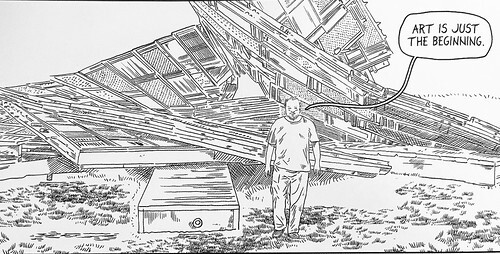
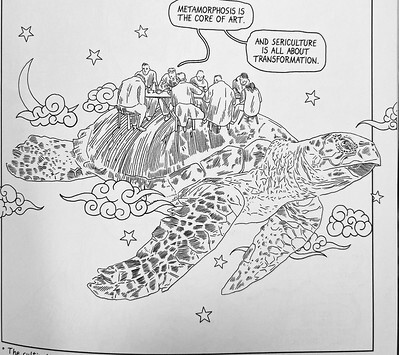
Midway through his graphic memoir, Zodiac, Ai Weiwei states that all artists should also be activists lest they simply be a ‘dead artist’ even while living. ‘Metamorphosis is the core of art,’ he explains later and sees the importance of creating and experiencing art not only as a transformation of the self but also society at large. This is certainly the case with Ai Weiwei who one cannot mention in terms of his art—be it his sculptures, photographs, documentaries or other installation pieces—without also discussing his activism, as if the two were simply dual appendages of the same body. His arrest in 2011 became a flashpoint for human rights and other activist organizations and as he was held for 81 days without a charge he quickly became a world renown symbol of artistic resistance and the importance of freedoms of speech and expression. Here Ai Weiwei along with Elettra Stamboulis tells his life story in graphic format with illustrations by Gianluca Costantini being both a memoir and a profound and philosophical musing on art, resistance and the importance of making your voice heard despite the powers that would rather have it be silent. This makes a great companion piece to his previous memoir, 1000 Years of Joys and Sorrows: A Memoir from 2021. Told in a conversational style between Ai and his son or with interviewers and other artists, interspersed with mythological tales and framed around reflections on the zodiac signs in relation to activism, this is a fascinating and thought provoking look into the life and mind of this great artist. ‘Art is just the beginning’
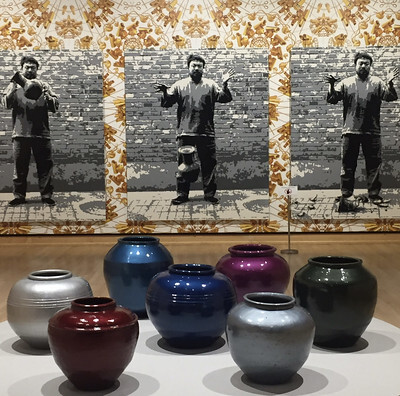
I was lucky enough to see an exhibit of Ai Weiwei’s work when several pieces of his collection came to Grand Rapids, Mi in 2017. I’ve long been fascinated with him both as an artist but also as a symbol for the possibilities of art as activism and bold statements of freedom so this was a really engaging and enjoyable look at his life as well as his reflections on his own works. ‘Power is so afraid of art and poets,’ Ai tells us, ‘art has the possibility to defend very essential rights’ and he examines how many pieces of his own work set out to do just that. There are some great commentaries on works like his fairytale project at Documenta 12, the message behind his sunflower seeds, his work on the Birds Nest olympic stadium, or his collection of names of students killed in the Sichuan earthquake about which he says ‘All the silence from the State apparatus cannot erase the persistent memories of the survivors. We have to remember at least their names.’ He reflects upon his imprisonment, the demolition of his studio by the government, his inability to leave China after he was released and more. I also enjoyed that the book was structured around ideas of the zodiac, reflecting his own sculpture piece Circle of Animals/Zodiac Heads. Photo from when I saw the Ai Weiwei exhibit in Grand Rapids
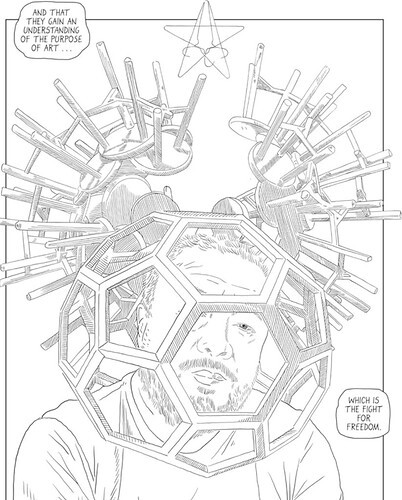
‘Art is against repetition. It’s about leading us toward more dangerous ways of experiencing ourselves.’
Beyond his own life, Ai Weiwei also discusses the works of other important activists such as Nobel Peace Prize laureate Liu Xiabo or Ai Weiwei’s own father, Ai Qing who faced imprisonment and exile as well. Through it all he discusses how art is always a fight for freedom. I really enjoyed this book and learned a lot reading it. It is really well paced and covers a lot of ground, both historically and philosophically. I love his love of poetry and belief in the power of art, it is truly inspiring. The artwork in this collection is wonderful too, often representing famous photographs of Ai Weiwei and his works while also moving into really surreal imagery. This is a great format for this work as it, too, is a work of art but is also very accessible to get the message across to a wide range of readers across a wide age range (this would work great in a high school classroom, for instance). Perhaps my favorite moment of the book comes early on, however, in his discussion on why cats are left out of the Chinese zodiac. He explains to his son that he loves cats because they are ‘n animal that cat open doors, but they are different from human beings because they don’t close the doors behind them.’ He sees this as a symbol of great art: ‘The key is to keep the doors open…like the cats, we have to keep the door that we call freedom of speech and thought open.’ So perhaps we should all be more like the cat and keep the door open for art and freedom of expression. Zodiac is a lovely graphic novel.
4/5
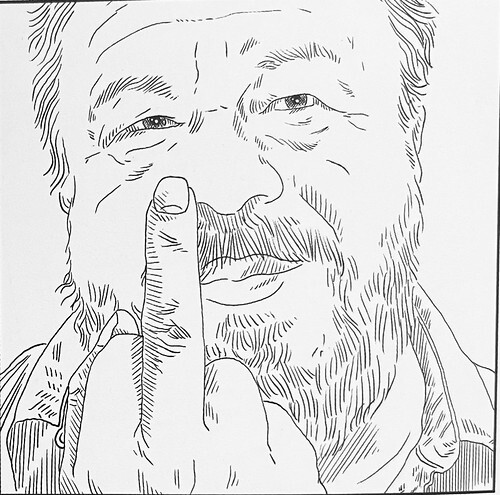
What would a book on Ai Weiwei be without his iconic middle finger?
I've been following Ai Weiwei's work since about 2010, and was absolutely delighted to learn he was releasing a comic memoir. I managed to snag a signed copy though the Comix Experience Graphic Novel of the Month Club and I will treasure it. This book is organized into 12 chapters, each themed around one animal from the zodiac. It weaves together slice of life moments from Ai Weiwei's day to day life, stories of his father (the revolutionary poet Ai Qing), memories of Ai's time as an art student in New York, his incarceration, time spent with his mother, his partner, and his son, conversations with artist friends and some of his international exhibitions. It is not a tight narrative; it wanders, it indulges in myths and fairy tales, it is open ended and I enjoyed it so much. It was written along with Elettra Stamboulis, and draw in a delicate lose line art style by Gianluca Costantini. A few of the lines from the end of the book haven't left my head since I read them: "Freedom of speech and human rights are not given to anybody for free. They always come through fighting and struggle" (101); "Any artist who isn't an activist is a dead artist" (165) and "... the purpose of art, which is to fight for freedom."(166)
Ai Weiwei uses the Chinese zodiac as a structure to string together some rambling thoughts about folklore, art, the Chinese government, his life, and his philosophy.
I think I would have gotten more out of this if I were more familiar with him before starting the book. It doesn't seem intended as an introduction for those of us with only a passing interest in or understanding of the man, his work, and his activism.
I unfortunately found this graphic novel to be confusing and inaccessible. The content constantly jumps around with very little coherence, causing me to check if I had accidentally missed a page on several occasions. Furthermore, the parts that are coherent are confusing and difficult to parse, which, when combined with the barebones and bland illustration style lead to a deeply boring graphic novel that I had to slog through, even though it was short.
Through 𝘞𝘢𝘬𝘪𝘯𝘨 𝘓𝘪𝘧𝘦 imagery where dreams and imagination combine to weave an intricate tapestry of all the moments where Weiwei felt most alien, we are graciously given a tapestry collecting the harsh brutality of the Chinese police, censorship and where his art stands between the world and China all done through the examinations of the zodiac animals.
Though heavy-handed at times, Weiwei tries to embed what he has learned and what he has seen sporadically throughout his years as an artist, a prisoner, and a human being.
I didn't know what to expect from this graphic novel. I'm a huge fan of the artist and was extremely lucky to see his expo made for Marseille, so I was really excited. I was expecting it to read like a memoir, but it feels more like stepping into a contemplative journey through time, art, and personal struggle. This graphic novel, far from being a conventional memoir, is an intricate tapestry that weaves together Ai Weiwei's reflections on life, art, and freedom through the mythical lens of the Chinese zodiac.
From the outset, Zodiac captivates with its unique narrative structure. The story unfolds not linearly but as a series of vignettes, blending Ai Weiwei's past experiences with Chinese zodiac mythology, cultural tales, and intimate conversations with family and friends. These elements come together to paint a broader picture of the Cultural Revolution's impact and the relentless spirit of those who dare to challenge it.
Each page of this memoir is a testament to the enduring power of art and expression. While the narrative takes readers through various periods of Ai Weiwei's life, it also delves into the philosophical, exploring the artist's and his contemporaries' motivations, struggles, and triumphs. The art, while simple in its black-and-white presentation, is intentionally styled to focus the reader's attention on the narrative's depth and complexity. While I personally hoped for more intricate visuals, the starkness of the illustrations serves to amplify the memoir's thematic weight, compelling readers to engage more profoundly with the text and its underlying ideas.
Zodiac is not just a book but an experience, one that demands revisiting. Its layered narrative and philosophical underpinnings offer new insights with each reading. Although it can be consumed quickly (I read it in an hour), the true value lies in its lingering effect, inviting readers to ponder and reflect long after the last page is turned.
In sum, this book is a compelling blend of art, history, and philosophy, offering a rare glimpse into the mind of one of the most influential contemporary artists. It's a work that challenges, enlightens, and inspires, much like Ai Weiwei himself.
Recommended for those who appreciate graphic novels with a deep, introspective edge and anyone interested in the intersections between art, society, and personal narrative.
I found Zodiac very inaccessible, which may be due to me not being that familiar with Ai Weiwei's work. This memoir may have been created primarily for his fans, but from my perspective it was barely intelligible. Even though I understand we're presented with vignettes from Weiwei's life, I had a hard time following each chapter, with conversations seemingly randomly jumping from topic to topic. At times it even felt like Weiwei tried to advertise his creations rather than explain the story behind them. The art style and layout didn't help much; panels were largely the same size throughout, speech bubbles were often placed confusingly and the overall art ended up being kind of bland, even though some illustration had great composition, only let down by the barebones linework.
I have to say that Zodiac made me wanna check out some of Ai Weiwei's work and read up on Chinese history. I also liked the structure in conjunction with the zodiac fable as well as the overall glimpses into Chinese culture, what art means to Ai Weiwei and some of his contemporaries and the inextricable link between art and politics. To be honest, I don't feel equipped to adequately review the contents of this graphic memoir because I don't think I'm the target audience, but I do wish Zodiac would be more accessible for people not familiar with Weiwei. Ultimately, it's more of a 2.5- than a 3 star-read for me, but fans of Ai Weiwei might absolutely love it.
I've been a fan of Ai Weiwei since before I started my Master's degree in museums. While I don't agree with him on everything, I greatly respect his activism and the way he presents the intersection of art, history, and human rights.
A fascinating graphic memoir from famed Chinese artist and activist, Ai Weiwei.
This memoir is a deeply philosophical look at intellectual freedom, art, and 20th century Chinese history, told through the framework of the Chinese zodiac. I enjoyed this, but it definitely aired more heady and required a knowledge of modern Chinese history and politics that not everyone will have. That said, if you like 20th century Chinese history and politics (think The Cultural Revolution and Mao Ze Dong), then Weiwei's personal experience of artistic expression and repression will be right up your alley.
So other than a brief foray into The Walking Dead, I have never read a graphic novel. This is going to be a book I will continue to refer back to from time to time. It has so much to say.
First, each chapter is an animal of the Chinese zodiac. The novel alternates between explaining the animal characteristics and the memoir of WeiWei. I actually would have preferred, since my knowledge of this subject is limited, if there would have been more explanations of each animal. Every other chapter, again all labeled with an animal as it progresses through the Calander, the definition and details to the specific animal is not included, but a story about a personal struggle between oppression and art. This to me makes it feel more like two different stories mixed in the same book. But it is absolutely full of art, metaphors and history.
The main theme throughout is the power of art. You can reach so many people through art, influence so many people. It is a form of expression and sometimes something you have to fight for. Art was both a blessing and a curse (because of the consequences) for the people struggling through the years in China, specifically as seen through the eyes in WeiWei's experiences.
The insights and quotes that this graphic novel includes are amazing. Quotes like, "The truth is that you never know when destiny comes knocking on your door." And regarding art, quotes like "Any artist who isn't an activist is a dead artist." Like I said before, there is so much good stuff in every nook and cranny of this graphic novel that every time I go back to read it, I am sure there will be new things discovered.
I don't know that I'm completely sold on graphic novels. I prefer the traditional kind. But this book is really a fantastic read.
What a gorgeous and moving volume this is. Full 5⭐️ for the artwork, the history, the poetry, the story of an artist trying to create in the midst of a movement for freedom and still be a father, son and partner. A magnificent memoir told in black and white ink work and brief, stirring words. Not to be missed.
I really wanted to like this. I love the art of Ai Weiwei, comics, and the idea of structuring a book around the animals of the zodiac . . . but I don’t think this could be any more mediocre. The art, the lettering, the content. It’s all just so . . . “meh.”
It was an interesting book— I learned a lot about Weiwei and the zodiac. The structure of talking through and around the myths was really cool but I wish it felt a little more cohesive. The narrative jumped around a lot and at times it was difficult to tell when we were and if someone was alive of not (specifically his conversations with his father).
The art was underwhelming. I don’t really understand the urge to do a graphic memoir in a realistic style. I always appreciate a visual but it felt like some color or a more vivid style would be more suited to the narrative, which holds art as a key to justice. Which is not to say her art was bad! Some of the perspectives she chose were cool! I just wanted something a bit more.
Graphic memoirs tend to be one of my favorite genres, but this book just didn’t do it for me. I found it rather inaccessible, like I just wasn’t smart enough to understand what was going on. Oddly enough, I rarely find that to be the case with other memoirs, even by people whose fields are difficult to comprehend. Yet they seem to want to make their readers understand. Ai Weiwei wants to make us think, yes — about art, about what art means, about the human rights violations that the Chinese government has been guilty of and continues to perpetrate, about the importance of the rich history of Chinese culture. But he does so in a way that makes him seem like he’s above the rest of us, and that I find a bit off-putting.
Perhaps I would have enjoyed this memoir better if I were a follower of Ai Weiwei’s art, or if I were an art student in general. I picked this memoir up mainly because I enjoy this genre, but also because I am interested in Chinese culture. I felt this memoir read more like a college class, with Ai Weiwei lecturing us on his work and how it fits in with Chinese culture and resistance.
I haven’t done a review of a book in quite a while though I’ve been reading a lot. However, I couldn’t but hit the keyboard when I read the graphic novel Zodiac: A Graphic Memoir Al WeiWei. The cover is a rich gold but the insides are black and white with the narrative illustrated by the inimitable Italian comic artist Gianluca Constantini. The memoir is also a collaboration between WeiWei and Elettra Stamboulis, a comics author, curator, translator, and activist who has been involved in curatorial and creative practices developed with Gianluca Costantini for the Komikazen International Festival of Reality Comics (2005–2015). It is an explosive combination of artistic minds that is on view for the readers more so because of the intricate lines and hatching with which Constantini unravels and illustrates the tapestry of WeiWei’s life.
The book is woven using the 12 signs of the Chinese Zodiac - Mouse, Ox, Tiger, Rabbit, Dragon, Snake, Horse, Sheep, Monkey, Rooster, Dog, and Pig. WeiWei did not have much of a relationship with his father, a poet who joined the Chinese Communist Party but ended up persecuted and punished as a counter-revolutionary. The. story begins in China in the heat of Mao Zedong’s Cultural Revolution where reading anything other than what the Party determined as politically correct is dangerous. William Blake is banned, for instance, and Weiwei’s memory is of his poet-father telling him not to read. Cut to 2015 and WeiWei is telling his son about his life, and his views on the tangled web of relationships between art, time, folklore, symbols, ideas, and the reality of partaking of a shared humanity.
WeiWei’s son dares to ask questions being curious about everything but WeiWei is nuanced in his responses, even cautious. However, he passes on his acquired and accumulated wisdom to his son through storytelling and providing intricate exegeses of stories from Chinese folklore and the meaning of the Zodiac signs, relating these to the history of China and its politics, the necessity to survive socioeconomic calamities contrived by powerful rulers and to defend the right to freedom of expression which is under threat in a variety of forms and systems in different parts of the world. Art is the true mouthpiece of freedom of expression and art is the Cat that escaped being confined to the Zodiac.
I am a cat lover and so WeiWei’s understanding of the freedom of the Cat and how it came to be as explained by Chinese folklore left me struck by a lightning bolt right between the eyes. The sign of the power to forbid books is the sign of the Mouse and is the sign of betrayal. The Chinese Mouse is the proverbial Judas and represents every tyrannical, representative power that seeks to crush the rights of human beings to self-expression and dissent.
The story goes that Cat and Mouse were good friends. Neither could swim. The Jade Emperor invited all the animals to a race to determine which ones would be keepers of the year. They had to cross a river and Cat and Mouse climbed the back of Buffalo who agreed to help them cross. Mouse pushes Cat into the water and is first in the race. “The Cat never arrived at the finish line but remained free” outside of the Zodiac system. The Cat is “an animal that can open doors but they are different from human beings because they never close the doors behind them.” The Mouse is the sign of war and politics and resorts to trickery to be first, it loves winning and maintaining the position of the top dog. The world is ruled by mice.
Each chapter in the book is related to a particular animal in the Chinese Zodiac and the book is a journey that takes one further out into the river of life and philosophy, beginning with waters that reach the ankles, then the knees, the hips, the chest, the face, and the artist is then carried along on its currents and life becomes equivalent to artistic musings, endeavors and fearless expression that opens the minds of those who encounter it and forces them to think and imagine alternate possibilities and realities. The artist is to be a mouse-catcher and mouse-killer and WeiWei realizes this as his forte. The mice trapper-killer is also a giant killer. “Like the cats, we have to keep the door that is called freedom of speech and thought open” when the mice come to close it through trickery, betrayal, show of force, threat of imprisonment, torture, surveillance, death, and exile.
In his memoir, WeiWei lauds writers and activists who paid a heavy price for standing up for art and their beliefs. WeiWe mentions several artists and poets, Chinese and otherwise, like Liu Xiaobo, including Joseph Beuys and his famous performance with a dead hare/rabbit (representing immortality) and the planting of 7000 oaks to signify immortality through the magical idea of nature. WeiWei also speaks of some of his significant works like ‘Sunflower Seeds’, his installation of 1001 wooden chairs at Documenta 12, and Large, his installation at Alcatraz prison.
I am not going to describe more of this book which is multi-layered and will make you pause over each frame seriously and lovingly crafted by the graphic artist Constantini. The text is also weighed well and is, in a sense, sparse but evocative and fragrant, lingering in one’s senses like a time bomb that explodes at unexpected moments setting off cogitative or meditative tremors in one’s being. Through it all resounds and resonates WeiWei’s objective as an artist and storyteller: “What I was interested in was that an artist has to be the beginning of a story, not the end. We should ignite stories and let people meet.”
Well, I’ve read about WeiWei and seen his works second or third-hand, virtually, and remotely. But his memoir allows me to meet him across continents and time and space through text and image and I can carry his thoughts and aesthetic traces in me and let them form fresh rivulets that make me alive to art and magnify freedom of expression which particularly bursts forth when constrained, as the Oulipian writers and artists knew so well. (end)
Uneven in tone and content. I love Ai Weiwei but this disappointed me because it seemed so haphazard, like it had been rushed to print before it was ready. I would have liked to see more of Weiwei’s childhood and his father’s exile.
Ai Wei Wei, Elettra Stamboulis and Gianluca Costantini made a graphic novel together. It’s about Ai Wei Wei’s youth, his relationship with his father, about his time in NYC as a youngster, his relation with his son, etc. He dreams a dream about China, contemporary and also Ancient Chinese culture and the days of Mao. Wei Wei uses his art and the poetry of revolutionaries, like his father, as a reflective tool.
The graphic novel is beautiful. It’s pure and simple, only a series of black and white line drawings. The book is divided into 12 chapters, each corresponding with an animal of the Chinese Zodiac. Ai combines Chinese folklore with personal anecdotes. The energy underneath the book is cyclical, Ai meanders about the passing of time and how the teachings of his father influenced him as a boy and how he, with his teachings influences his son.
It’s funny and often carries a lot of self relativism. Joseph Beuys, Wittgenstein, Liu Xiaobo and many others play small parts in the various chapters. In a way it’s a very personal story, on the other hand it also surpasses Ai Wei Wei and it becomes something bigger; it reminds me of this sentence that I have read once: The Story of One Man, is the Story of Two Man, is the Story of all of Human Kind.
And in a way this is true. There is a lot to discover in this book. And it touches upon larger thematics for sure. But it is a graphic novel and it remains a bit of a weird artsy fartsy book :-)
In this graphic memoir Ai Wei examines his personal history and relationship with his homeland, his art, his activism, his family, all through the tales of the Chinese Zodiac. It was fascinating to hear the origins of these tales for the first time, as well as to learn more of Ai Weiwei's story.
His struggle for freedom and outreach is always been something I have admired of him. I was first exposed to Ai Weiwei through a documentary on Netflix that featured him being taken a prisoner by his own country for 'tax evasion'. It was a very insightful documentary and again, I admired his fight for freedom of speech and bringing light to atrocities hidden in the shadows.
Overall, this was a great read and I loved the art illustrations within it. Very well designed and cleverly told.
I wish this was written in mandarin. The English narration was monotonous and distant from the richness of Chinese history, folk tales and phrases referenced. It felt like a too-literal translation that lacked feeling. Sadly, I would have had a hard time reading it if it was in chinese 😔
From an American perspective, Ai Wei Wei comes off to me as too naive about the power of art without movement and material resources. But from his perspective as the son of an "enemy of the party", it's understandable why he believes so deeply in freedom of thought and expression and the danger it poses to oppressive regimes. Different methods of repression require different tools and frameworks of thought to challenge them.
Rooster was my favorite, but I am a Rooster and I may be biased. As a collection of short stories there was a lot to like, but there never felt like enough time or space within the stories themselves to unpack everything, and as a whole I found the sum of the twelve stories to feel somewhat muddled as the result. For Ai Weiwei, an author with so much to say, the page constraints felt like a hinderance. I wonder if this would have been more successful if each chapter was a standalone graphic novel, or if there was a central narrative running throughout, to tie things together.
After hearing Ai Weiwei speak at an event promoting his newly released memoir, I'd say that this book is very Ai Weiwei. It is filled with philosophy, autobiographical recollections, but meanders through time and is restricted by the themes of the Chinese zodiac animals. Filled with beautiful illustrations and deep inquiry into the role of the artist and the importance of free expression in a society, I feel this book is worth picking up.
Extraordinary. quiet domestic scenes reflect on the past, reflect on a particular character attached to different animals of the zodiac. There is a great deal about Mao, as well as the current authoritarian regime, with truly chilling parallels to the moral panic around books we are wading through right now. Weiwei is a gifted artist, which is a sort of background concern here, but his freedom to be expressive is centered.
I really enjoyed this! I intend to look up Ai Weiwei's other autobiography and also his artwork. Unlike some Goodreads reviewers, I liked how some of the images were sort of vague and not anchored in reality. So glad I read this.
This is not the normal type of graphic novel, I would read. However I like to challenge myself sometimes and step out of my comfort zone. And I really enjoyed it! Ai Weiwei, is such an interesting person, what a life he has lived.
This book is part memoir, part philosophy, and very well written and paced. Fans of Asian culture or politics will likely enjoy this as well.
As for myself I enjoyed this some much I will likely read his other memoir as well.



![Profile Image for s.penkevich [hiatus-will return-miss you all].](https://i.gr-assets.com/images/S/compressed.photo.goodreads.com/users/1735525095i/6431467._UX200_CR0,11,200,200_.jpg)