One of America's most celebrated critics here brings his customary wit and erudition to bear on a particularly provocative the response of literary Modernism to a changing environment wrought by technology. In the early decades of the twentieth century, Hugh Kenner, observes, technology "tended to engulf people gradually, coercing behavior they were not aware of." The Modernist writers were sensitive to technological change, however, and throughout their works are reflections of this fact. Kenner shows, for example, how Eliot's lines "One thinks of all the hands/That are raising dingy shades/In a thousand furnished rooms" suggest the advent of the alarm clock and, beyond that, what the clocks "the new world of the commuter, in which a principal event was waking up in the morning under the obligation to get yourself somewhere else, and arrive there on time . In fascinating examinations of Pound, Joyce, and Beckett, in addition to Eliot, Kenner looks at how inventions as various as the linotype, the typewriter, the subway, and the computer altered the way the world was viewed and depicted. Whether discussing Joyce's acute awareness of the nuances of typesetting or Beckett's experiments with a "proto-computer-language," Kenner consistently illuminates in fresh new ways the works of these authors and offers, almost incidentally, a wealth of anecdotes and asides that will delight the general reader and the literary specialist alike.
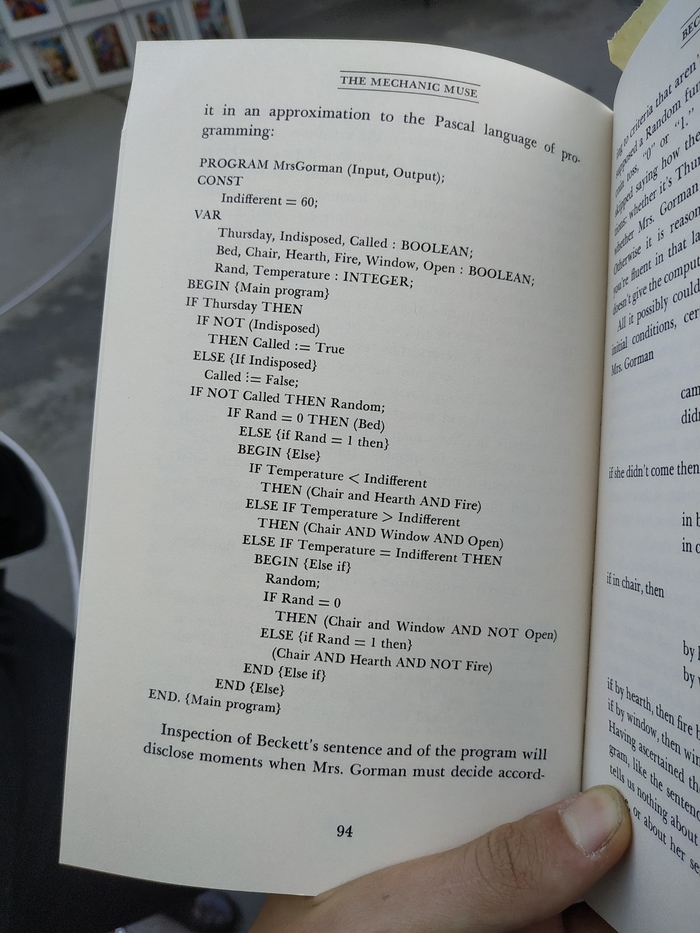
Brilliant, eminently readable collection of essays exploring the aesthetics of media within the modernist canon. As with McLuhan, Kenner's writing straddles scholarly erudition and conversational musing, a fertile junction sadly lost amidst the subsequent institutionalization of Media Studies. Would anyone think today of writing out a Pascal translation of Beckett's Watt?
In one of Kenner's previous books, 'The Counterfeiters', he had concluded on an extended reflection the artifices of technology growing to assume all the behavior and activity of humanity in modernity, where Andy Warhol's irony consists in minute adjustments and machines creating brute-force algorithms to achieve humanity via the Turing Test. This book is an exposition of that development within Kenner's four favorite modernist writers - Eliot, Pound, Joyce and Beckett. Eliot is cast as an observer, whose astral imagination derives from the surreal encroachment of technology onto human life in so short a span between, say, 1900 and 1920; conversely, Pound's constant innovations and starting of movements is cast as an application of the technological mood onto the form of literature itself - the rabid vitalism of vorticism, for instance, is itself a machine to advance culture, and Pound's experimentation with visual forms of poetry are made possible only by the typewriter that has become as much a part of his poetic authorship as his own mind.
Joyce, meanwhile, not only observes a technological society, but his observations are entire mechanical in themselves -- many of Ulysses' pastiches are not of form but of print genre, and everything from his irish-isms to his epiphanies rely essentially on the novel as a printed physical work, a result of technology. The final link in the linear sequence for Kenner, then, is Beckett, whose writing is itself a total mechanization of thought, fulfilling the quest to create works of 'nothing' by creating all characters, language and thought presented as machines. The tale that Kenner spins, then, is roughly one of artists responding to and then ultimately embracing the mechanization of society through technology, with all the soft McLuhanisms that this entails. He concludes on an epilogue speculating about the positive character of this turn, reflecting on the basic sham of faith in linguistic reference of pre-modern man; the poetic audacity of Joyce and Beckett to so radically play with and fight for/with meaning is the role of a prophet not unlike that which the romantic poets a century prior had announced.
I wonder what there is to do with media analysis of this variety; it all seems to go back essentially to Heidegger's essay on the subject but Kenner here is writing very in step with McLuhan (a friend and frequent correspondent of his). Certainly, in the works of Beckett and various poetic moments of the other great modernists, the literary effect of this anxious worldview is quite affecting, but written out in essay format (even when it's dressed up in Hugh Kenner's witty spiels) it seems to reek of a vague sophistry, this rather undiscerning obsession with the concept of mechanism that always seems to reduce to the same favorite (and improfound) sources like Saussure and mathematics. This book is interesting but I would suggest taking care not to let this rather reductive narrative about technology serve as a very complete exegesis of any of the authors referenced, or indeed history/language writ large.
At a time when art and human expression seem threatened by an overwhelming growth in the realm of what machines can do, Hugh Kenner's book on the relation between technological progress and literary modernism seemed useful. Written in 1987: "Technology alters our sense of what the mind does, what are its domains, how characterized and bounded..."
It's short and, like all of Kenner's criticism, meticulously well written. For me the highlights were the chapters on Eliot and Beckett. Kenner finds the specificity of Eliot's experience of modernity, really adds depth to the personal side of The Waste Land. In Beckett he finds boolean algebra, various algorithms.
I'm not sure I drew any lessons for the present, other than a renewed unwillingness to accept technologists' pretensions of reaching ahistoric universality. Even mathematical truth reaches us only filtered through the trivia of history. One is left with, Kenner's phrase, "faith in the possibility of insight."
Witty, and convincing in weaving the works of Eliot, Pound, Joyce and Beckett with the communications technology of their periods. The Beckett chapter was less convincing, but I did especially like the Joyce section.
So graceful, convincing and lucid that at times Kenner's observations of the glow of electric lights, telephone noises, etc almost compete poetically with the rendering of the writers he is writing about. The introduction and chapters on Eliot and Pound are the most insightful.