

What do you think?

God Is Red: A Native View of Religion
This work critiques the Western spiritual worldview and its effect on Native Americans and the society as a whole, promoting an alternative Indian conception of religion. The author argues throughout that religious beliefs can't be separated from history and relates Christian doctrine to historical events from its origins in the Middle East to the American war in Vietnam.
Paperback
First published January 1, 1972
About the author
Vine Deloria Jr.
60 books343 followersVine Victor Deloria, Jr. was an American Indian author, theologian, historian, and activist. He was widely known for his book Custer Died for Your Sins: An Indian Manifesto (1969), which helped generate national attention to Native American issues in the same year as the Alcatraz-Red Power Movement. From 1964–1967, he had served as executive director of the National Congress of American Indians, increasing tribal membership from 19 to 156. Beginning in 1977, he was a board member of the National Museum of the American Indian, which now has buildings in both New York City and Washington, DC.
Deloria began his academic career in 1970 at Western Washington State College at Bellingham, Washington. He became Professor of Political Science at the University of Arizona (1978–1990), where he established the first master's degree program in American Indian Studies in the United States. After ten years at the University of Colorado, Boulder, he returned to Arizona and taught at the School of Law.
Deloria began his academic career in 1970 at Western Washington State College at Bellingham, Washington. He became Professor of Political Science at the University of Arizona (1978–1990), where he established the first master's degree program in American Indian Studies in the United States. After ten years at the University of Colorado, Boulder, he returned to Arizona and taught at the School of Law.
Ratings & Reviews
Friends & Following
Create a free account to discover what your friends think of this book!
Community Reviews
Displaying 1 - 30 of 246 reviews

January 9, 2024
This book makes the case that traditional American Indian religion is best suited to meet human needs because of its emphasis on place and community. Christianity in contrast is based on time and history—a history that grew out of another land. Thus Indians can better cope with ecology and community issues. The Christian concept of God working in history through individual relationships with God leads to exploitation and indifference to community relationships.
This recent 2023 fourth edition of this book is unchanged from the 2003 third edition. Thus the summary history of the American Indian Movement and the literature/media review provided in the early chapters do not account for recent history since 2003. The body of the book after these introductory chapters concentrate on comparing traditional religions with Christianity with most comparisons intended to show the deficiencies of the Christian religion.
The book’s narrative is long, circular, and wanders occasionally into extraneous subjects where the author argues that scientists should pay more respectful attention to Indian creation myths. Thus there is discussion of astronauts from outer space, pre-Columbian contacts between the continents, and mythical cosmological happenings involving planets and stars.
This recent 2023 fourth edition of this book is unchanged from the 2003 third edition. Thus the summary history of the American Indian Movement and the literature/media review provided in the early chapters do not account for recent history since 2003. The body of the book after these introductory chapters concentrate on comparing traditional religions with Christianity with most comparisons intended to show the deficiencies of the Christian religion.
The book’s narrative is long, circular, and wanders occasionally into extraneous subjects where the author argues that scientists should pay more respectful attention to Indian creation myths. Thus there is discussion of astronauts from outer space, pre-Columbian contacts between the continents, and mythical cosmological happenings involving planets and stars.

January 13, 2014
This scholarly work by Vine Deloria, Jr. is a difficult read. You must really have a desire to learn Native American history accurately, and Vine Deloria is the right person for this endeavor as he was a Native American author, theologian, historian, and activist. I can imagine that this book is being used in colleges in their Native American classes, and I believe I would have preferred to have studied this with a professor than to have read it on my own, as I would have learned so much more than I had.
While this book took in the history of the Native Americans, even the political movement of the 70s, I will stick with the religious aspects of the book.

White Belly, photo by Edward Curtis
Many Native Americans rejected Christianity for various reasons but many were forced into Christianity. Holy grounds had been taken away, as were their religious ceremonies. Still, those who were the strongest, held onto their beliefs and fought for their rights.
There are many differences in Native American spirituality and the Christian religion, but I don't wish to take up all of them. For one thing, the Native Americans didn't have a personal God in the same sense as the Christians, nor did they believe that they needed a personal savior. It was never in their teaching; it didn't make sense to them.
In their religion there is no concept of "the fall," so the whole of creation was good and everything had to work together for the good of all. As Young Chief said: "The Great Spirit tells me to take care of the Indians, to feed them. The water says the same thing. Feed the Indians well. The grass says the same thing. Feed the Indians well. The ground says, The Great Spirit placed me here to produce all that grows on me, trees and fruit. The same way the ground says, It was from me man was made. The Great Spirit, in placing men on earth, desired them to take good care of the ground and to do each other no harm."
When Young Spirit said that the trees talk to him, he meant just that, for Walking Buffalo remarked, "Did you know that trees talk? Well they do. They talk to each other, and they'll talk to you if you listen. Trouble is, white people don't listen. They never learned to listen to the Indians, so I don't suppose they'll listen to other voices in nature. But I have learned a lot from trees; sometimes about the weather, sometimes, about animals, sometimes about the Great Spirit."
Vine Deloria believes that white man has become alienated from nature and believes he must tame it. As a result the earth is being destroyed.
Chief Luther Standing Bear wrote:
"We did not think of the great open plains, the beautiful rolling hills, and the winding streams with tangled growth as 'wild.' Only to the white man was nature a 'wilderness' and only to him was the land infested with 'wild' animals and 'savage' people. To us it was tame. The earth was beautiful and we were surrounded with the blessings of the Great Mystery."
As for a need to analyze or understand God, there is no reason to do so to the Indian. Deloris writes, "There is no discernible reason for primitive or tribal peoples to abandon their ceremonial life and spend their time trying to arrive at a clear description of a deity and its several powers. Religion for them is an experience and they have no reason to reduce it to systematic thought and the elaboration of concepts."
And as for death. Indians believe that they will return to nature and that their bodies will become dust but that their souls will either go on another journey or will come back to their tribe.
My thought is, if you are close to nature and believe in caring for it and for all life on it, you are close enough to God.
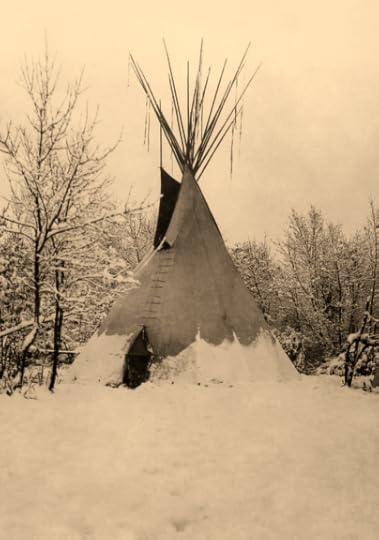
Winter Apsaroke, photo by Edward Curtis
While this book took in the history of the Native Americans, even the political movement of the 70s, I will stick with the religious aspects of the book.
White Belly, photo by Edward Curtis
Many Native Americans rejected Christianity for various reasons but many were forced into Christianity. Holy grounds had been taken away, as were their religious ceremonies. Still, those who were the strongest, held onto their beliefs and fought for their rights.
There are many differences in Native American spirituality and the Christian religion, but I don't wish to take up all of them. For one thing, the Native Americans didn't have a personal God in the same sense as the Christians, nor did they believe that they needed a personal savior. It was never in their teaching; it didn't make sense to them.
In their religion there is no concept of "the fall," so the whole of creation was good and everything had to work together for the good of all. As Young Chief said: "The Great Spirit tells me to take care of the Indians, to feed them. The water says the same thing. Feed the Indians well. The grass says the same thing. Feed the Indians well. The ground says, The Great Spirit placed me here to produce all that grows on me, trees and fruit. The same way the ground says, It was from me man was made. The Great Spirit, in placing men on earth, desired them to take good care of the ground and to do each other no harm."
When Young Spirit said that the trees talk to him, he meant just that, for Walking Buffalo remarked, "Did you know that trees talk? Well they do. They talk to each other, and they'll talk to you if you listen. Trouble is, white people don't listen. They never learned to listen to the Indians, so I don't suppose they'll listen to other voices in nature. But I have learned a lot from trees; sometimes about the weather, sometimes, about animals, sometimes about the Great Spirit."
Vine Deloria believes that white man has become alienated from nature and believes he must tame it. As a result the earth is being destroyed.
Chief Luther Standing Bear wrote:
"We did not think of the great open plains, the beautiful rolling hills, and the winding streams with tangled growth as 'wild.' Only to the white man was nature a 'wilderness' and only to him was the land infested with 'wild' animals and 'savage' people. To us it was tame. The earth was beautiful and we were surrounded with the blessings of the Great Mystery."
As for a need to analyze or understand God, there is no reason to do so to the Indian. Deloris writes, "There is no discernible reason for primitive or tribal peoples to abandon their ceremonial life and spend their time trying to arrive at a clear description of a deity and its several powers. Religion for them is an experience and they have no reason to reduce it to systematic thought and the elaboration of concepts."
And as for death. Indians believe that they will return to nature and that their bodies will become dust but that their souls will either go on another journey or will come back to their tribe.
My thought is, if you are close to nature and believe in caring for it and for all life on it, you are close enough to God.
Winter Apsaroke, photo by Edward Curtis

February 21, 2014
This is a dense book that deals with a lot of issues, and I'm not going to be able to cover them all here because I have limited space and my reviews are long enough anyway. So, I'm not going go into depth on Native American history leading up to the 1970s, the legal basis for depriving the Native Americans of their land (though see Conquest by Law for an in-depth treatment on that), the romanticization of long-dead Indians while ignoring modern Indians' struggle for justice, and so on. They are in there, though.
The main interest I had in this book was in the religious analysis, which probably isn't surprising considering the title, so the initial modern history lesson in the beginning of the book kind of threw me off. But after setting the stage, it veers off and starts talking about Christianity in relation to Native religions, and that's where my interest really picked up.
G-d Is Red has a pretty uniformly negative view of Christianity. It starts off talking about a difference between religions with a temporal focus, like Christianity's view of the creation of the world, its doctrine as a series of revealed truths which resonate down to the present day, and its teleological and eschatological focus, and religions with a spacial focus that have a specific land where its practitioners live and specific holy places where the rites are practiced, like the old sacrificial cult of the Temple in pre-exilic Israelite religion--and I'm not just inserting that for egotistical reasons, because Deloria does make a connection that Judaism is one of the few mainstream religions that still has a lot of the characteristics of a tribal religion. Christianity's claim to apply to all people of all times makes its practitioners have an extremely difficult time understanding how other people can be tied to the land to the extent that, say, they're willing to turn down a large amount of money because they'd rather keep their land even when a lot of them are desperately poor, as happened with Blue Lake and the Taos Pueblo.
Deloria heavily criticizes this temporal focus, both for its supposed tendency to make Christians focus on the concerns of the next world at the expense of this one, and for its lack of any tie to the land along with the focus on stewardship or subduing the earth, leading to a lack of ecological awareness and directly contributing to the upcoming ecological catastrophe.
The main criticism, though, is about Christianity's universality. If Christianity is universal and is the true and correct religion, then how come its history is so filled with horrors? And if all those horrors were committed by people who aren't real Christians, then where are the real Christians and why didn't they stand up and try to stop all the murderers, or at least to speak out? This is an old criticism and dealt with extensively elsewhere, but what I liked was Deloria's mention that in claiming no innate cultural attributes, Christianity is vulnerable to taking on attributes of whatever culture it's practiced in. It's very easy to see the American culture in megachurches, television faith healers, stadium prayer revivals, and Christian rock, but a more nefarious example is how Christianity has been used to justify bigotry, torture, murder, slavery, and genocide throughout history. It's supposed to be transformative, but there's little evidence of that. In his words, Christianity can describe ideal behavior but cannot produce it.
The book then contrasts tribal religion with that, saying that since tribal religion is focused on the needs of a particular people and isn't generalizable outside that group, it doesn't produce the religious animus that Christianity does. Since the important point of the religion is the daily practice and the tribal rituals, and not the absolute truth of its claims about the past, increasing scientific discoveries do not automatically produce the somewhat-uncomfortable attitude that Christianity has with modernity. Tribes might war, and they might conquer each other, but they wouldn't try to impose their own religion on each other because the very idea makes no sense. The other tribe has different ancestors, so the idea of imposing on them other practices wouldn't even make sense. And the tie of tribes to particular land means that Native Americans are the spiritual owners of America, which is part of why the image of the Indian is evoked so often in ecological terms.
There are some obvious problems here, of course. Plenty of Christians are concerned with daily practice, plenty of Christians manage to maintain their religion while treating its claims as metaphors, and Deloria himself mentions that modern Native Americans with a more Western worldview are concerned about the scientific truth behind the claims of their ancestral religions. Some of these objections are dealt with, but in the interests of space I'll just mention that and go on.
I admit I've had some of these thoughts before, but in the modern world it's harder to talk about ancestral religions without dealing with the modern concept of race, and that leads you to creepy neopagan groups that bristle when black people want to join or the various neo-Nazis that give Asatru a bad name. The lack of community in Western culture is something that a lot of sociologists have noticed in books like Bowling Alone: The Collapse and Revival of American Community, though. I admit that one of the best places I ever lived was in a small mountain town in Japan, where our students' grandparents farmed rice and the graves of their ancestors dotted the mountainsides around the town, but modern global capitalism is engaged in a relentless assault on the ability to live that kind of lifestyle with its requirements that everyone be always ready to learn a totally new skill and relocate to somewhere far away from friends and family. And it might have just as likely ended up with me being shut out of community life for being an outsider. At least if I'm experiencing modern alienation, I can be assured that my neighbors and I are together in our apartness.
There are some major flaws in the book, though. The first and most blatant is the bizarre diversion off into Immanuel Velikovsky's Worlds in Collision and its theories about Venus being a comet and Venus and Mars ping-ponging around the solar system to produce many of the ancient accounts of miracles. Deloria even directly states that science is confirming more of his beliefs, and soon his theories will become accepted truth. The thing is...no, they won't. Velikovsky's theories are complete rubbish. You may say that I'm inculcated with Western views of scientific truth, and you'd be right, but this whole section hacked a star off the book all by itself because it's total nonsense.
Another one is how Deloria talks about tribal religions being designed for a particular people inhabiting a particular place, and not having the kind of universal claims that Christianity does, but then he treats them as some kind of block group with universal characteristics set up in contrast to Christianity. As one example, the Aztecs went out and conquered other tribes around them, and they did subject those tribes to their religion by demanding members of those tribes be surrended for their sacrificial rituals. That's part of why Cortés had such an easy time of it, because all the surrounding tribes hated the Aztecs so much that they were happy to help anyone who might be trouble. I don't know enough about the breadth of Native religions to provide an accurate commentary, but considering the hundreds of tribes that existed I wouldn't be surprised if it were possible to find counterpoints to all of Deloria's points just by looking hard enough even if the general shape of his arguments is correct.
G-d Is Red is thought-provoking and dense, but I'm not really sure that it's that deep. It's also quite dated in its analysis of modern culture: the comments on the shape of women's rights and the loss of Christianity's influence look hilarious in light of the Republican Party's hatred of all that is good and pure, for example. Nonetheless, I'm glad I saw a recommendation to read it when I went to the National Museum of the American Indian, and if any of arguments within interest you I'd suggest that you read it too.
The main interest I had in this book was in the religious analysis, which probably isn't surprising considering the title, so the initial modern history lesson in the beginning of the book kind of threw me off. But after setting the stage, it veers off and starts talking about Christianity in relation to Native religions, and that's where my interest really picked up.
G-d Is Red has a pretty uniformly negative view of Christianity. It starts off talking about a difference between religions with a temporal focus, like Christianity's view of the creation of the world, its doctrine as a series of revealed truths which resonate down to the present day, and its teleological and eschatological focus, and religions with a spacial focus that have a specific land where its practitioners live and specific holy places where the rites are practiced, like the old sacrificial cult of the Temple in pre-exilic Israelite religion--and I'm not just inserting that for egotistical reasons, because Deloria does make a connection that Judaism is one of the few mainstream religions that still has a lot of the characteristics of a tribal religion. Christianity's claim to apply to all people of all times makes its practitioners have an extremely difficult time understanding how other people can be tied to the land to the extent that, say, they're willing to turn down a large amount of money because they'd rather keep their land even when a lot of them are desperately poor, as happened with Blue Lake and the Taos Pueblo.
Deloria heavily criticizes this temporal focus, both for its supposed tendency to make Christians focus on the concerns of the next world at the expense of this one, and for its lack of any tie to the land along with the focus on stewardship or subduing the earth, leading to a lack of ecological awareness and directly contributing to the upcoming ecological catastrophe.
The main criticism, though, is about Christianity's universality. If Christianity is universal and is the true and correct religion, then how come its history is so filled with horrors? And if all those horrors were committed by people who aren't real Christians, then where are the real Christians and why didn't they stand up and try to stop all the murderers, or at least to speak out? This is an old criticism and dealt with extensively elsewhere, but what I liked was Deloria's mention that in claiming no innate cultural attributes, Christianity is vulnerable to taking on attributes of whatever culture it's practiced in. It's very easy to see the American culture in megachurches, television faith healers, stadium prayer revivals, and Christian rock, but a more nefarious example is how Christianity has been used to justify bigotry, torture, murder, slavery, and genocide throughout history. It's supposed to be transformative, but there's little evidence of that. In his words, Christianity can describe ideal behavior but cannot produce it.
The book then contrasts tribal religion with that, saying that since tribal religion is focused on the needs of a particular people and isn't generalizable outside that group, it doesn't produce the religious animus that Christianity does. Since the important point of the religion is the daily practice and the tribal rituals, and not the absolute truth of its claims about the past, increasing scientific discoveries do not automatically produce the somewhat-uncomfortable attitude that Christianity has with modernity. Tribes might war, and they might conquer each other, but they wouldn't try to impose their own religion on each other because the very idea makes no sense. The other tribe has different ancestors, so the idea of imposing on them other practices wouldn't even make sense. And the tie of tribes to particular land means that Native Americans are the spiritual owners of America, which is part of why the image of the Indian is evoked so often in ecological terms.
There are some obvious problems here, of course. Plenty of Christians are concerned with daily practice, plenty of Christians manage to maintain their religion while treating its claims as metaphors, and Deloria himself mentions that modern Native Americans with a more Western worldview are concerned about the scientific truth behind the claims of their ancestral religions. Some of these objections are dealt with, but in the interests of space I'll just mention that and go on.
I admit I've had some of these thoughts before, but in the modern world it's harder to talk about ancestral religions without dealing with the modern concept of race, and that leads you to creepy neopagan groups that bristle when black people want to join or the various neo-Nazis that give Asatru a bad name. The lack of community in Western culture is something that a lot of sociologists have noticed in books like Bowling Alone: The Collapse and Revival of American Community, though. I admit that one of the best places I ever lived was in a small mountain town in Japan, where our students' grandparents farmed rice and the graves of their ancestors dotted the mountainsides around the town, but modern global capitalism is engaged in a relentless assault on the ability to live that kind of lifestyle with its requirements that everyone be always ready to learn a totally new skill and relocate to somewhere far away from friends and family. And it might have just as likely ended up with me being shut out of community life for being an outsider. At least if I'm experiencing modern alienation, I can be assured that my neighbors and I are together in our apartness.
There are some major flaws in the book, though. The first and most blatant is the bizarre diversion off into Immanuel Velikovsky's Worlds in Collision and its theories about Venus being a comet and Venus and Mars ping-ponging around the solar system to produce many of the ancient accounts of miracles. Deloria even directly states that science is confirming more of his beliefs, and soon his theories will become accepted truth. The thing is...no, they won't. Velikovsky's theories are complete rubbish. You may say that I'm inculcated with Western views of scientific truth, and you'd be right, but this whole section hacked a star off the book all by itself because it's total nonsense.
Another one is how Deloria talks about tribal religions being designed for a particular people inhabiting a particular place, and not having the kind of universal claims that Christianity does, but then he treats them as some kind of block group with universal characteristics set up in contrast to Christianity. As one example, the Aztecs went out and conquered other tribes around them, and they did subject those tribes to their religion by demanding members of those tribes be surrended for their sacrificial rituals. That's part of why Cortés had such an easy time of it, because all the surrounding tribes hated the Aztecs so much that they were happy to help anyone who might be trouble. I don't know enough about the breadth of Native religions to provide an accurate commentary, but considering the hundreds of tribes that existed I wouldn't be surprised if it were possible to find counterpoints to all of Deloria's points just by looking hard enough even if the general shape of his arguments is correct.
G-d Is Red is thought-provoking and dense, but I'm not really sure that it's that deep. It's also quite dated in its analysis of modern culture: the comments on the shape of women's rights and the loss of Christianity's influence look hilarious in light of the Republican Party's hatred of all that is good and pure, for example. Nonetheless, I'm glad I saw a recommendation to read it when I went to the National Museum of the American Indian, and if any of arguments within interest you I'd suggest that you read it too.

April 18, 2008
I really was amazed with the things Vine Deloria Jr. can tell you that you never thought to ask. His writing is a strong call to the kind of self-analysis that helps white Americans to grow up, examine their values, and shamed-faced ask the questions that have never occurred to them before. I feel like I could listen to these thoughts for the rest of my life on loop and only be the better for it.

December 28, 2023
It uproots western theology with totality of wisdom. An astounding feat.

October 5, 2007
I put this on the back burner, as it's not exactly "read for 10 minutes before bed" material, but it has given me many new things to think about. So far, his main point has been the difference between an emphasis on history and an emphasis on place. He argues that Native American religious belief is based on a strong connection to place, while many other belief systems emphasize history (especially Christianity, but he also mentions many other major religions). I'm pretty sure you could say the same for most indigenous belief systems. He argues that this greatly affects the ethical and moral behavior of the believers; Native American beliefs are more directed towards community, place, and current needs, while the rest of us are more directed towards moral codes that we usually don't feel a need to follow very closely. He believes that a return by Native Americans to their indigenous belief systems will help bring communities back together and work to heal some problems. At least that's what I've gathered from the first few chapters! In addition, one of the things that has really struck me is his statement that in this land (the US), God is red--ie, the indigenous belief system of all the land that we drive over, build houses, malls, and schools on, and generally foul up is that of its indigenous people. The rest of us are aliens! This book especially struck me on this point, as I picked it up at a bookstore on the Umatilla Reservation in Eastern Oregon and read it while in what was the homeland of the Nez Perce (until the white people decided it was choice territory and forced them into Idaho).

May 9, 2009
Angry and polemical. Deloria has some painfully valid points, but he throws the baby out with the bath water along with the tub, shampoo and shower curtain. In relegating all but native religion to a nightmarish Oral Roberts/Jerry Falwell bogeyman of conservative evangelicalism, he damns his own thesis which, ostensibly, calls for respect and mutual flexibility. I don't deny the horrors that American Christianity has brought upon the First Peoples, but I do resent Deloria's assumption that Christianity is merely the sum of its worst adherents.
May 16, 2011
I really was expecting to hear the native view of God with stories from the various tribes. Instead it seemed to be an attack on Christian religions, and while I think there's a lot to be criticized about the way Christian religions are run, I could read that in any number of other books. I wanted a NATIVE view. I probably should have give this 1 star.

April 28, 2012
The view of religion presented in this book was unlike anything I have heard taught in school (or church). I started reading this book while taking a comparative religions class. I wish I would finished it before the class ended; it would have given me much more to discuss. For instance, in class we learned about the evolution of religion, and how religions naturally go through several stages, ending in a monotheistic savior-God style of religion... hmm. Deloria attacks this type of thinking and shows how academic religious studies have primarily been conducted with a bias towards Western religions.
The book also explores the strong relationship Natives Americans have with the geography in which they have lived, as well as the plant and animal kingdom they encounter. Their religions are meant to help people survive harmoniously with the land. Also, unlike Western religions, those of the Native Americas lack theological dogma. Deloria shows how this lack of theology created healthier societies that were able to survive sustainably for long periods of time.
While he doesn't come out and say one style of religion is better than the other, he does build a case against Western religion - Christianity in most cases. I don't think this book would be an enjoyable read for anyone who follows a strong Christian belief system. Having said this, I think it would be a great read for anyone who lives in the US, as it offers a deeper understanding of why Natives to this day value their ancestral land so dearly.
The book also explores the strong relationship Natives Americans have with the geography in which they have lived, as well as the plant and animal kingdom they encounter. Their religions are meant to help people survive harmoniously with the land. Also, unlike Western religions, those of the Native Americas lack theological dogma. Deloria shows how this lack of theology created healthier societies that were able to survive sustainably for long periods of time.
While he doesn't come out and say one style of religion is better than the other, he does build a case against Western religion - Christianity in most cases. I don't think this book would be an enjoyable read for anyone who follows a strong Christian belief system. Having said this, I think it would be a great read for anyone who lives in the US, as it offers a deeper understanding of why Natives to this day value their ancestral land so dearly.

July 17, 2021
For those of us in North America (and likely South too), a residual guilt remains over our treatment of American Indians. It’s a guilt that can become consuming, but it is something we clearly must face. Not only the past, but the reprehensible treatment of these First Nations peoples continues to this day. While Vine Deloria’s classic deals mainly with religion, it is primarily about Indians and their lives. This is a book that has been on my reading list for years, and it disturbed me as much as I feared it would.
There are places for debate, of course, but Deloria shows (as noted elsewhere: Sects and Violence in the Ancient World) what Christianity looks like from the outside. It has become an imperialistic, unforgiving, nearly inhumane religion. Offering theological justification for genocide and environmental degradation, it has brought us to the precipice of global warming and uncontrolled pollution of our only home. Deloria indicates that the Indian way was more holistic and that it has the capacity to heal the world. Of course, the Christian narrative predominates.
It’s difficult to summarize this important book in the usual space I allow myself in these reviews. It is wide-ranging but focused. And it is applicable anywhere that native peoples have been displaced by Christian conquerors. Deloria had a strong theological background and could speak to this aspect eloquently. Reading the book in the early post-Trump years revealed that it was in many ways ahead of its time. I will be going back to this book again. Often.
There are places for debate, of course, but Deloria shows (as noted elsewhere: Sects and Violence in the Ancient World) what Christianity looks like from the outside. It has become an imperialistic, unforgiving, nearly inhumane religion. Offering theological justification for genocide and environmental degradation, it has brought us to the precipice of global warming and uncontrolled pollution of our only home. Deloria indicates that the Indian way was more holistic and that it has the capacity to heal the world. Of course, the Christian narrative predominates.
It’s difficult to summarize this important book in the usual space I allow myself in these reviews. It is wide-ranging but focused. And it is applicable anywhere that native peoples have been displaced by Christian conquerors. Deloria had a strong theological background and could speak to this aspect eloquently. Reading the book in the early post-Trump years revealed that it was in many ways ahead of its time. I will be going back to this book again. Often.

March 4, 2013
Deloria gives a thorough, and often humourous, attack on American Christianity. In short, it has failed to save humanity, but has actually contributed to deep flaws within contemporary life. Many of Christianity's basis assumptions are suspect. His analysis of the problem -- separation from the land. Whereas Christianity may have made sense in a Near Eastern landscape, it has escaped its land and its ethnicity.
In response Deloria offers the spiritual practices of Native American religion, which remains rooted in the land.
I only gave the book two stars for two reasons. There is a section of the book wherein he entertains various, what I call "quasi-scientific" notions to explain the miracles of the scriptural tradition. He thinks that liberal Christian reading of these events as non-historical and metaphorical is part of Christianities problem.
But mainly he doesn't, to my mind, give enough of a positive presentation of Native American religion, spending the bulk of his time on the attack.
In response Deloria offers the spiritual practices of Native American religion, which remains rooted in the land.
I only gave the book two stars for two reasons. There is a section of the book wherein he entertains various, what I call "quasi-scientific" notions to explain the miracles of the scriptural tradition. He thinks that liberal Christian reading of these events as non-historical and metaphorical is part of Christianities problem.
But mainly he doesn't, to my mind, give enough of a positive presentation of Native American religion, spending the bulk of his time on the attack.

October 1, 2008
Vine Deloria Jr. does for spirituality and responsibility to the earth and community with God is Red, what he did for history and perception of policies in Custer Died For Your Sins he sets it straight. He offers an interesting missing piece and alternative history for all that seek to find the truth.

December 25, 2011
Honestly, read allison's earlier review below. She said everything I would say, but more eloquently than I could.
While I feel this is an important subject, circular and flawed logic is not the best way to examine it.
While I feel this is an important subject, circular and flawed logic is not the best way to examine it.

August 28, 2018
God is Red fascinated me. Vine Deloria Jr. (1933–2006) was a Yankton Sioux activist. His great-grandfather was a medicine man. His grandfather was a chief who became a priest. His father rose to an executive position in the Episcopal Church. Deloria graduated from a seminary, but chose not to become a minister, because of his father’s frustrations. He sought a path that could be of greater benefit to Native American people.
There are three editions of God is Red (1973, 1992, 2003), spanning a turbulent 30 year era — aim for the newest version. The book provides important views omitted from the glorious saga of Western civilization. Even the 1973 edition was well ahead of mainstream society in foreseeing ecological catastrophe, the destination of our runaway train. We’re not a good path. Why are we on it? That’s the question that drives this book. Deloria’s search for understanding is presented from a Native American perspective.
All civilized people are descendants of tribal ancestors. Unique religions emerged in each tribal homeland, fine-tuned to its landscape, ecology, and climate. Every homeland had sacred places where the community participated in special ceremonies. All members of the tribe had deep roots in the homeland, and all shared the same worldview. A tribal person “does not live in a tribe, the tribe lives in him.”
In modern society, neighborhoods are constantly-changing swarms of occupants having highly diverse incomes, ethnicities, religious beliefs, and political views. People may live side by side for years, yet have nothing in common, and sometimes intense differences. Many do not know the names or faces of most folks in their neighborhood. This is not a coherent community sharing a profound sense of responsibility for the wellbeing of their ecosystem.
The Western conception of time is not about the eternal cycles of passing seasons; it is linear — a bloody one-way pilgrimage from the miracle of creation to the tumultuous end of the world, a constantly intensifying cyclone of population, progress, pollution, and bad craziness. Humans are simultaneously the crown of creation, superior to all other life on the planet, yet each newborn inherently flawed, via the curse of original sin.
Jesus of Nazareth was a radical and intriguing Jewish thinker who lived in occupied Palestine. He was not fond of the Roman storm troopers, materialism, or greed. Just live simply and be nice. At that time, in the Mediterranean basin, and in many surrounding regions, the tribal era was long gone. It had mutated into a number of civilizations. Common folks lived under the thumb of elites. Life was harsh. Regional bloodbaths were common.
For a while, the members of the Jesus movement were all Jews. When Jesus died, his followers believed that was the long anticipated Messiah, and that he “would return almost immediately with an angelic army to judge the world.” So, they quit working. Before long, they went bankrupt. They had no doubt that he would return during their lifetime. They were wrong. He didn’t.
A bit later, they opened the door to allowing gentiles into the Jesus movement. From this point forward, it was no longer a community having a common ethnic identity. This was the first step on the path to becoming a multinational religion, the one and only absolute truth for everyone, in every place, for all eternity.
Over time, the Jesus movement expanded into other regions. In Rome, many joined the parade. Growing numbers led to the birth of a religious institution — the Roman Catholic Church. By and by, the Roman Empire was rotting away from decadence and delirium, softening it up for a spectacular blind date with vicious mobs of bloodthirsty barbarians. The collapse of the Empire created a power vacuum that was taken over by the Church, which proceeded to expand its domain and accumulate enormous wealth and power.
True believers waited for the return of the Messiah for years, then decades, then centuries. This was getting boring. One day, a revelation from God arrived — the Messiah could not return until all nations had heard the story of Jesus. So, believers shifted their preaching and teaching into high gear. Like the Roman Empire, the Roman Church became devoted to perpetual growth and the accumulation of wealth. Kings and Popes worked hand in hand to conquer, colonize, and convert distant lands. The missionaries wanted to save heathen souls, and the states wanted to relieve the converts of their valuable resources, exploit their labor, and collect taxes.
And so, Christendom spread across Europe, Africa, Australia, and Asia. Colonists eventually arrived in America. Epidemics of Old World diseases rapidly spread, killing maybe ninety percent of the Indians. The buffalo robe fad exterminated 40 to 60 million bison. Fur traders nearly eliminated the beavers. Loggers mowed down vast virgin forests. The cavalry slaughtered those Indians who resisted surrendering their freedom.
Tribal folks were not amused. They were confused, perplexed, and pissed. A missionary would convert them to the one true faith, and a year later the next missionary would inform them that the first one was a demonic fire hose of lies and deceptions. All the black robes read the same book, but none agreed on what it meant. WTF? Especially aggravating was the enormous gulf between the beautiful beliefs they taught, and the relentless brutality of the colonial society, and its frantic gang rape of their ecosystem. Meanwhile, back in Europe, instead of brotherly love, Christian nations endlessly waged war on one another.
When the Church shifted into globalization mode, and the Reformation shattered it into numerous denominations, the sweet teachings of Jesus largely got thrown under the bus. Many express deep concern for zygotes embedded in uterine walls, but display far less compassion for the infants that eventually squirt out of the womb. When American economic interests are threatened, reverence for human life stops, and the Marines are sent to mow down the enemy of the month, as well as innocent bystanders.
Deloria maintained a sense of humor. He had a lot of fun with his chapter on popular Christianity — the theme parks, Jesus freaks, pussy grabbing faith healers, shameless money-hustling televangelists, and mega-church prosperity cults. “The evangelical and fundamentalist wing of Christianity dwells on the figure of Jesus, and on the theology of old time religion. Yet their knowledge about Jesus, his times, and the early church is nearly nil.” Sunday school taught me nothing about the Crusades, the Inquisition, or the Thirty Years War.
Today we’re flying along on a joyride to Judgment Day, which is mere months or days away, maybe. In polite conversation, it remains rude to contemplate our responsibility for leaving behind a somewhat habitable planet for the kiddies. “It takes incredible willpower to pretend that history is the unfolding of a divine plan for humanity. In less than two and a half centuries, American whites have virtually destroyed a whole continent.”
Deloria concludes, “Who will find peace with the lands? The future of humankind lies waiting for those who will come to understand their lives and take up their responsibilities to all living things. Who will listen to the trees, the animals and the birds, the voices of the places of the land? As the long-forgotten peoples of the respective continents rise and begin to reclaim their ancient heritage, they will discover the meaning of the lands of their ancestors. That is when the invaders of the North American continent will finally discover that for this land, God is red.”
YouTube has a number of Deloria videos.
There are three editions of God is Red (1973, 1992, 2003), spanning a turbulent 30 year era — aim for the newest version. The book provides important views omitted from the glorious saga of Western civilization. Even the 1973 edition was well ahead of mainstream society in foreseeing ecological catastrophe, the destination of our runaway train. We’re not a good path. Why are we on it? That’s the question that drives this book. Deloria’s search for understanding is presented from a Native American perspective.
All civilized people are descendants of tribal ancestors. Unique religions emerged in each tribal homeland, fine-tuned to its landscape, ecology, and climate. Every homeland had sacred places where the community participated in special ceremonies. All members of the tribe had deep roots in the homeland, and all shared the same worldview. A tribal person “does not live in a tribe, the tribe lives in him.”
In modern society, neighborhoods are constantly-changing swarms of occupants having highly diverse incomes, ethnicities, religious beliefs, and political views. People may live side by side for years, yet have nothing in common, and sometimes intense differences. Many do not know the names or faces of most folks in their neighborhood. This is not a coherent community sharing a profound sense of responsibility for the wellbeing of their ecosystem.
The Western conception of time is not about the eternal cycles of passing seasons; it is linear — a bloody one-way pilgrimage from the miracle of creation to the tumultuous end of the world, a constantly intensifying cyclone of population, progress, pollution, and bad craziness. Humans are simultaneously the crown of creation, superior to all other life on the planet, yet each newborn inherently flawed, via the curse of original sin.
Jesus of Nazareth was a radical and intriguing Jewish thinker who lived in occupied Palestine. He was not fond of the Roman storm troopers, materialism, or greed. Just live simply and be nice. At that time, in the Mediterranean basin, and in many surrounding regions, the tribal era was long gone. It had mutated into a number of civilizations. Common folks lived under the thumb of elites. Life was harsh. Regional bloodbaths were common.
For a while, the members of the Jesus movement were all Jews. When Jesus died, his followers believed that was the long anticipated Messiah, and that he “would return almost immediately with an angelic army to judge the world.” So, they quit working. Before long, they went bankrupt. They had no doubt that he would return during their lifetime. They were wrong. He didn’t.
A bit later, they opened the door to allowing gentiles into the Jesus movement. From this point forward, it was no longer a community having a common ethnic identity. This was the first step on the path to becoming a multinational religion, the one and only absolute truth for everyone, in every place, for all eternity.
Over time, the Jesus movement expanded into other regions. In Rome, many joined the parade. Growing numbers led to the birth of a religious institution — the Roman Catholic Church. By and by, the Roman Empire was rotting away from decadence and delirium, softening it up for a spectacular blind date with vicious mobs of bloodthirsty barbarians. The collapse of the Empire created a power vacuum that was taken over by the Church, which proceeded to expand its domain and accumulate enormous wealth and power.
True believers waited for the return of the Messiah for years, then decades, then centuries. This was getting boring. One day, a revelation from God arrived — the Messiah could not return until all nations had heard the story of Jesus. So, believers shifted their preaching and teaching into high gear. Like the Roman Empire, the Roman Church became devoted to perpetual growth and the accumulation of wealth. Kings and Popes worked hand in hand to conquer, colonize, and convert distant lands. The missionaries wanted to save heathen souls, and the states wanted to relieve the converts of their valuable resources, exploit their labor, and collect taxes.
And so, Christendom spread across Europe, Africa, Australia, and Asia. Colonists eventually arrived in America. Epidemics of Old World diseases rapidly spread, killing maybe ninety percent of the Indians. The buffalo robe fad exterminated 40 to 60 million bison. Fur traders nearly eliminated the beavers. Loggers mowed down vast virgin forests. The cavalry slaughtered those Indians who resisted surrendering their freedom.
Tribal folks were not amused. They were confused, perplexed, and pissed. A missionary would convert them to the one true faith, and a year later the next missionary would inform them that the first one was a demonic fire hose of lies and deceptions. All the black robes read the same book, but none agreed on what it meant. WTF? Especially aggravating was the enormous gulf between the beautiful beliefs they taught, and the relentless brutality of the colonial society, and its frantic gang rape of their ecosystem. Meanwhile, back in Europe, instead of brotherly love, Christian nations endlessly waged war on one another.
When the Church shifted into globalization mode, and the Reformation shattered it into numerous denominations, the sweet teachings of Jesus largely got thrown under the bus. Many express deep concern for zygotes embedded in uterine walls, but display far less compassion for the infants that eventually squirt out of the womb. When American economic interests are threatened, reverence for human life stops, and the Marines are sent to mow down the enemy of the month, as well as innocent bystanders.
Deloria maintained a sense of humor. He had a lot of fun with his chapter on popular Christianity — the theme parks, Jesus freaks, pussy grabbing faith healers, shameless money-hustling televangelists, and mega-church prosperity cults. “The evangelical and fundamentalist wing of Christianity dwells on the figure of Jesus, and on the theology of old time religion. Yet their knowledge about Jesus, his times, and the early church is nearly nil.” Sunday school taught me nothing about the Crusades, the Inquisition, or the Thirty Years War.
Today we’re flying along on a joyride to Judgment Day, which is mere months or days away, maybe. In polite conversation, it remains rude to contemplate our responsibility for leaving behind a somewhat habitable planet for the kiddies. “It takes incredible willpower to pretend that history is the unfolding of a divine plan for humanity. In less than two and a half centuries, American whites have virtually destroyed a whole continent.”
Deloria concludes, “Who will find peace with the lands? The future of humankind lies waiting for those who will come to understand their lives and take up their responsibilities to all living things. Who will listen to the trees, the animals and the birds, the voices of the places of the land? As the long-forgotten peoples of the respective continents rise and begin to reclaim their ancient heritage, they will discover the meaning of the lands of their ancestors. That is when the invaders of the North American continent will finally discover that for this land, God is red.”
YouTube has a number of Deloria videos.

Read
October 15, 2023Other than a strange tangent about midway through the book, the book is quite enjoyable. It does to the Christian-conditioned mind what learning a new language might do: challenging implicit assumptions about how we perceive, synthesize, and act.
Deloris outlines key differences in the concept of religion between western religions and tribal religions in America (mainly using the concepts of space and time). Western religions are more focused on time while tribal religions are more focused on space. He contextualizes the religions both in history and modern day political decisions. I particularly appreciated many of the implications regarding our relationship with nature/ecological systems.
Also enjoyed the parts on death and sacred places.
“The task of the tribal religion, if such a religion can be said to have a task, is to determine the proper relationship that the people of the tribe must have with other living things and to develop the self-discipline within the tribal community so that [humans] acts harmoniously with other creatures.”
“That a fundamental element of religion is an intimate relationship with the land on which the religion is practiced should be a major premise of future theological concern.”
“Over a long period of time, however, the cumulative experiences of the community become a truth that has been manifested for the people.”
“…modern society has foreclosed the possibility of experiencing life in favor of explaining it. Even in explaining the world, however, Western people have misunderstood it.”
Deloris outlines key differences in the concept of religion between western religions and tribal religions in America (mainly using the concepts of space and time). Western religions are more focused on time while tribal religions are more focused on space. He contextualizes the religions both in history and modern day political decisions. I particularly appreciated many of the implications regarding our relationship with nature/ecological systems.
Also enjoyed the parts on death and sacred places.
“The task of the tribal religion, if such a religion can be said to have a task, is to determine the proper relationship that the people of the tribe must have with other living things and to develop the self-discipline within the tribal community so that [humans] acts harmoniously with other creatures.”
“That a fundamental element of religion is an intimate relationship with the land on which the religion is practiced should be a major premise of future theological concern.”
“Over a long period of time, however, the cumulative experiences of the community become a truth that has been manifested for the people.”
“…modern society has foreclosed the possibility of experiencing life in favor of explaining it. Even in explaining the world, however, Western people have misunderstood it.”

June 23, 2026
Really solid *except for* the stuff on Velikovsky and ancient aliens, especially when the point could've been made without recourse to any of it. I'm wondering if said material was addressed differently in the edition that followed this one.

December 20, 2010
Appreciate the alternative perspective Vine Deloria presents in this important work. God is Red is fresh as ocean air, laden with honest introspection uncommon in books treading religion. Deloria encourages critical dialogue with thought provoking alternative theories to many timely religious topics and debates which are more relevant today than ever. Christianity is a core topic throughout this work and Deloria encourages even the most devout to reflect unsparingly at the historical context in which Christianity has risen through history and in the America's. Honest self reflection is never easy, but for those wanting to delve deeper into sources of impetus to religion, Deloria encourages critical assessment of historical occurrences as they relate to religious expression.
"The analytical error of contemporary society is that they have not understood, in religious terms, the meaning of what they have already accomplished scientifically by revealing the world of sensory perceptions. In seeking an ultimate answer to meaning of existence, that is, in reading God's mind as early scientists described their work, modern society has foreclosed the possibility if experiencing life in favor of explaining it. Even in the explaining world, however, Western people have misunderstood it" (291).
I highly recommend this book.
"The analytical error of contemporary society is that they have not understood, in religious terms, the meaning of what they have already accomplished scientifically by revealing the world of sensory perceptions. In seeking an ultimate answer to meaning of existence, that is, in reading God's mind as early scientists described their work, modern society has foreclosed the possibility if experiencing life in favor of explaining it. Even in the explaining world, however, Western people have misunderstood it" (291).
I highly recommend this book.

August 31, 2008
Really solid book. Great reading and left me with much to think about.
Pretty intense book to read and then to watch THE SNOWBOWL EFFECT - a documentary about what's going on at the Snowbowl, a ski resort in the San Francisco Peaks just outside of Flagstaff. (Basically, Humphry's Peak is the central altar for the Hopi and a sacred place for 13 tribes in the Southwest. The Snowbowl wants to use reclaimed wastewater to make snow there for skiing. The wastewater is coming from businesses, the hospital, the morgue, sewage - a very big deal - and studies have found it contains harmful contanimants such as pharmaceuticals, hormones and cancer causing agents. Very long story, but if you try to understand the Indigenous worldview, the move by the US Gov't and the Snowbowl is a huge blow to native culture).
OK, the book. Deloria drives it home that Western Culture is basically secularized Christianity. We base our worldview on history, native people base it on space. Basically, in the end, he spells it out. We need to have a relationship with the world around us. If we don't, we won't be around for too much longer.
If I write a paper on the book, I'll post it. I will try to make it compelling - I promise.
Long day. Must sleep!
Pretty intense book to read and then to watch THE SNOWBOWL EFFECT - a documentary about what's going on at the Snowbowl, a ski resort in the San Francisco Peaks just outside of Flagstaff. (Basically, Humphry's Peak is the central altar for the Hopi and a sacred place for 13 tribes in the Southwest. The Snowbowl wants to use reclaimed wastewater to make snow there for skiing. The wastewater is coming from businesses, the hospital, the morgue, sewage - a very big deal - and studies have found it contains harmful contanimants such as pharmaceuticals, hormones and cancer causing agents. Very long story, but if you try to understand the Indigenous worldview, the move by the US Gov't and the Snowbowl is a huge blow to native culture).
OK, the book. Deloria drives it home that Western Culture is basically secularized Christianity. We base our worldview on history, native people base it on space. Basically, in the end, he spells it out. We need to have a relationship with the world around us. If we don't, we won't be around for too much longer.
If I write a paper on the book, I'll post it. I will try to make it compelling - I promise.
Long day. Must sleep!

February 4, 2010
An important book, especially for anyone who likes to rock-climb or got four-wheeling. Deloria is perhaps what today we call a religious extremist, but his university educated mind channels the point of view sorely lacking in today's discourse in religious tolerance: that of Native peoples. In a world where we are told that we need to listen to the shrill, self-serving tripe of "Creationists" demanding that we teach "Intelligent Design", this book presents, what may be fundamentally similar views and somehow manages to not sound willfully obstructionist. It is a demand for equal time, long overdue, in the serious arena of mutual religious respect that the world will need to muster if we are all going to survive. Environmentalists want to save forests and lakes and the rare animals because they are beautiful and represent a barometer of our environments health and biodiversity. For indigenous people, not just American Indians, it's a religious imperative who's origins predate ALL written records.

July 27, 2020
I am pleased that I read this book (only 28 years after publication!), but it was a bit of a struggle - partly because it was only available on Hoopla on my phone, but also because I no longer have much of an interest in religion. I did appreciate DeLoria’s descriptions (sometimes very long) of the ways Christianity differs from Native American religion or spirituality. I found two aspects particularly interesting. One was that Christianity has a time-based thought – in fact, just about everything that western Europeans think is time based. In religion we look back to a specific beginning and expect an end-of-time. In general, we measure everything in time - when it happened in relationship to now. Native American religion is more space related – there is no sense of end of time, and when a story happened is not particularly important – just that it happened. A story has no “once upon a time” but more “on the mountain (river, etc) there was….” The other thing that fascinated me was the sense of listening to a person’s story and accepting it as meaningful to them. Christians told their stories and the Native People listened and then, as with their own people, told one of their stories. But the Christians, instead of listening, objected and exclaimed that the story was wrong and false. Only their story was right.
There is a lot more in this book, but eventually I found myself scanning rather than reading carefully.
There is a lot more in this book, but eventually I found myself scanning rather than reading carefully.

February 26, 2019
There is a feeling people have when they find and accept Christianity as their chosen religion. The conceptual perception is known as being blessed. As humans, we all experience different levels of a heightened awareness. Yet, when someone finds God, they go through an exceptional display of public affection towards religion. Like a peacock parading around its glorious display of colorful wings, fundamental Christians strut their ideals to not just assure their stature as human beings, but to also elevate a sense of social status and assure you of this moral placard.
Vine Deloria, Jr. eludes to the idea of Christianity dominating culture, but “falling victim to cultural values.” These values are the same moral fiber that inflict our lives throughout history: war, racial tensions, sex, violence. In this work, he extrapolates more thought into attacking Christianity than defending native religion. Expunging on thousands of years of the history of Christian thought, he pairs it down between the individual and the community. Through recent events, Deloria considers Christianity as a product of the individual, a failure to societies in general. Comparatively with native religion, the relationship lies between a “particular” god and “particular” community. He calls the individual in a tribal religion to be ridiculous.
What seems to be contradicting between the individual and community, Deloria quotes Shooter, a Sioux Indian, to expand on the concept of individuality in tribal religion. “All birds, even those of the same species are not alike, and it is the same with animals, or human beings. The reason Wakan Tanka does not make two birds, or animals, or human beings exactly alike is because each is placed here by Wakan Tanka to be an independent individuality and to rely upon itself.”
Yet, he blames native religion for not preserving the ideals of the old ceremonies as they have been obscured with what is taught in the schools and church. But as he parallels his view on the Old Testament, it shows a universal aspect of understanding any religion. “The Old Testament is probably extremely accurate in many respects, particularly when describing those events that changed the way people understood their world. It is difficult for many people to accept the fact that the Old Testament is primarily an effort to record first Hebrew and then Jewish history and not a volume of Divine admonitions about the nature of ultimate reality. . . . Our responsibility today is to discern from the many different human traditions the probably historical sequences that have shaped our modern earth and come into closer understanding of the nature of the planet on which we live.”
Native religion is not about preserving historical value. It is a reaction to the respect of nature that surrounds them. It is also a reaction to the outside influences that shape their existence be it social conflict or political motivation. As Deloria, writes about the bullying effect of Christianity (destroying nature and erecting large buildings as churches, holding televangelism, etc.), this comes hot off the heels of the civil rights movement and the Vietnam War.
In 1972, there was a social conscious of the Indian Rights Movement. Deloria painstakingly addresses it almost as much as he addresses the history of Christianity. His only fault is that he claims he wished he would have kept up with the trends throughout the years of modern Christian fallacies that have plagued society.
God Is Red is a reaction to the uncertainty of the moment, utilizing history as its foundation. American life was at a murky crossroads. As President Nixon reduced troop numbers in Vietnam (549,000 in 1969 to 69,000 in 1972), anticipated fears of a never-ending war ramped back up with Nixon’s Christmas bombings. Popular culture mimicked these fears with M*A*S*H* replacing Vietnam for the Korean War and airing on TV. In England, Richard Adams perfectly put into prose the uncertainty of the times in Watership Down. In science fiction, John Brunner builds a frightening dystopian world in The Sheep Look Up. David Morrell pens the causality and human effects of post traumatic stress syndrome with First Blood.
California rockers like David Crosby tapped into natural elements as a guiding force, but never is as poignant as Native American rockers Redbone. They followed up their Message From A Drum with 1972’s Already Here. The Native American rock group made a name for themselves by tapping into the collective consciousness of native culture.
Unlike the capitalization of fear these novels presented, Deloria used God Is Red as a call for alarm. He explains that an “important way for Indian authors to change the opinions and behaviors of non-Indians was to attack the fundamental principles of non-Indian world view (A Conversation with Vine Deloria, Jr. 1977, Words and Places Program 8). He does so by looking at American perception of Indian culture from tribal treatise to the American Western.
In Chapter 2, “The Indians of the American Imagination,” Deloria makes a critical analysis not only of American culture but many Native American authors who write about Native culture, fact-checking misconceptions in their ideas. But then he points out the books that should be read for their proper perspective of Native culture. In this 1994 edition, he notices a new wave of popularity of Indian religions. “Tribal religions have been trivialized beyond redemption by people sincerely wishing to learn about them.” For Deloria, we still did not have it right.
Deloria made this book to be a living, breathing treatise on the history of Native religion overpowered by a dominant Christian political and social landscape. Maybe President Donald Trump should have consulted Deloria’s writings when he made his “Pocohontas” statement during a speech about Native Americans in 2017 (http://fortune.com/2018/02/14/donald-...). It further proves the importance of Deloria’s awareness and the future of Native American rights in society.
Vine Deloria, Jr. eludes to the idea of Christianity dominating culture, but “falling victim to cultural values.” These values are the same moral fiber that inflict our lives throughout history: war, racial tensions, sex, violence. In this work, he extrapolates more thought into attacking Christianity than defending native religion. Expunging on thousands of years of the history of Christian thought, he pairs it down between the individual and the community. Through recent events, Deloria considers Christianity as a product of the individual, a failure to societies in general. Comparatively with native religion, the relationship lies between a “particular” god and “particular” community. He calls the individual in a tribal religion to be ridiculous.
What seems to be contradicting between the individual and community, Deloria quotes Shooter, a Sioux Indian, to expand on the concept of individuality in tribal religion. “All birds, even those of the same species are not alike, and it is the same with animals, or human beings. The reason Wakan Tanka does not make two birds, or animals, or human beings exactly alike is because each is placed here by Wakan Tanka to be an independent individuality and to rely upon itself.”
Yet, he blames native religion for not preserving the ideals of the old ceremonies as they have been obscured with what is taught in the schools and church. But as he parallels his view on the Old Testament, it shows a universal aspect of understanding any religion. “The Old Testament is probably extremely accurate in many respects, particularly when describing those events that changed the way people understood their world. It is difficult for many people to accept the fact that the Old Testament is primarily an effort to record first Hebrew and then Jewish history and not a volume of Divine admonitions about the nature of ultimate reality. . . . Our responsibility today is to discern from the many different human traditions the probably historical sequences that have shaped our modern earth and come into closer understanding of the nature of the planet on which we live.”
Native religion is not about preserving historical value. It is a reaction to the respect of nature that surrounds them. It is also a reaction to the outside influences that shape their existence be it social conflict or political motivation. As Deloria, writes about the bullying effect of Christianity (destroying nature and erecting large buildings as churches, holding televangelism, etc.), this comes hot off the heels of the civil rights movement and the Vietnam War.
In 1972, there was a social conscious of the Indian Rights Movement. Deloria painstakingly addresses it almost as much as he addresses the history of Christianity. His only fault is that he claims he wished he would have kept up with the trends throughout the years of modern Christian fallacies that have plagued society.
God Is Red is a reaction to the uncertainty of the moment, utilizing history as its foundation. American life was at a murky crossroads. As President Nixon reduced troop numbers in Vietnam (549,000 in 1969 to 69,000 in 1972), anticipated fears of a never-ending war ramped back up with Nixon’s Christmas bombings. Popular culture mimicked these fears with M*A*S*H* replacing Vietnam for the Korean War and airing on TV. In England, Richard Adams perfectly put into prose the uncertainty of the times in Watership Down. In science fiction, John Brunner builds a frightening dystopian world in The Sheep Look Up. David Morrell pens the causality and human effects of post traumatic stress syndrome with First Blood.
California rockers like David Crosby tapped into natural elements as a guiding force, but never is as poignant as Native American rockers Redbone. They followed up their Message From A Drum with 1972’s Already Here. The Native American rock group made a name for themselves by tapping into the collective consciousness of native culture.
Unlike the capitalization of fear these novels presented, Deloria used God Is Red as a call for alarm. He explains that an “important way for Indian authors to change the opinions and behaviors of non-Indians was to attack the fundamental principles of non-Indian world view (A Conversation with Vine Deloria, Jr. 1977, Words and Places Program 8). He does so by looking at American perception of Indian culture from tribal treatise to the American Western.
In Chapter 2, “The Indians of the American Imagination,” Deloria makes a critical analysis not only of American culture but many Native American authors who write about Native culture, fact-checking misconceptions in their ideas. But then he points out the books that should be read for their proper perspective of Native culture. In this 1994 edition, he notices a new wave of popularity of Indian religions. “Tribal religions have been trivialized beyond redemption by people sincerely wishing to learn about them.” For Deloria, we still did not have it right.
Deloria made this book to be a living, breathing treatise on the history of Native religion overpowered by a dominant Christian political and social landscape. Maybe President Donald Trump should have consulted Deloria’s writings when he made his “Pocohontas” statement during a speech about Native Americans in 2017 (http://fortune.com/2018/02/14/donald-...). It further proves the importance of Deloria’s awareness and the future of Native American rights in society.
This entire review has been hidden because of spoilers.

May 24, 2023
Vine Deloria Jr. is accessible, precise, well read, and fair in his representations of much of Christianity. I found many passages in this to be extremely poignant in their formulation of problems that I have tried to put words to for some time. This is a valuable resource for anyone interested in native/indigenous critiques of Christianity, and a fundamental piece for thinking post/decolonial religion. It is written in a pretty casual style that is refreshing for a discourse that can be intimidating.

February 10, 2024
Heartbreaking, eye-opening, and a call for Christians to openly repent. The reason it is 4 stars is because he doesn't have any knowledge of the Eastern Christian tradition which limits him to a narrow view of Christianity. His view is justifiable considering the atrocities committed by so-called Christians in the West. Instead of "love your neighbor" the driving demonstration was to kill your neighbor because he is a savage and you deserve what he has.

November 13, 2025
this had potential … but he really should’ve fired his copy editor. maybe all his editors, actually.

October 18, 2007
I wish I had read the first edition of this book, instead of the revised 30th anniversary edition. I picked this book up because it is known as one of the foremost books on Native American religion. However, it read much more as an criticism of Christianity, which is fine, except that was not the book I was hoping for. Because must of the commentary examining Christianity concerned recent events, I am curious if the earlier editions focus more on Native American religion.
I would not hesitate to pick up an earlier edition of this book to see if it more adequately meets my expectations, but I did find this particular edition a disappointment.
I would not hesitate to pick up an earlier edition of this book to see if it more adequately meets my expectations, but I did find this particular edition a disappointment.

June 22, 2019
A disappointing read.
Other reviewers said it better than I could, but it bears repeating. The book reads like more of a rant on other cultures and religions, than a historically accurate in-depth account of native spiritual beliefs and customs.
The psychological analyses of the motivation behind white Americans' actions is also very shallow, outdated and at best speculative.
I don't believe that this kind of biased and bitter authorship furthers non-Indian people's understanding of Indian problems.
Other reviewers said it better than I could, but it bears repeating. The book reads like more of a rant on other cultures and religions, than a historically accurate in-depth account of native spiritual beliefs and customs.
The psychological analyses of the motivation behind white Americans' actions is also very shallow, outdated and at best speculative.
I don't believe that this kind of biased and bitter authorship furthers non-Indian people's understanding of Indian problems.
January 13, 2009
Don't fooled by the title. This book is only about the litagation the 652 federally recognized tribes have used to obtain the rights they deserve. Litagation that is still in the process in some cases. If you are a law student, Native American (American Indian) Studies Major, or highly political, you should read this book.

July 29, 2007
This book really changed my missiology. Deloria's work (primarily this book and Custer Died for your Sins) allowed a look at my own white, western, Amer-European culture, especially as it related to how my own belief system is perceived by the oppressed.

August 15, 2010
What a refreshing view! I'm going to reread this once I've finished because it has given me so many things to reflect upon.
If your theology could stand a review/renewal, try reading Deloria's GOD IS RED.
If your theology could stand a review/renewal, try reading Deloria's GOD IS RED.

August 26, 2022
God Is Red critically challenges our visions of Christian faith and the US as we know it, offering a powerful Indigenous voice to learn from. It provided me with a way to grapple with white and Western supremacy and to more deeply engage the physical places to which I am tethered.
Displaying 1 - 30 of 246 reviews