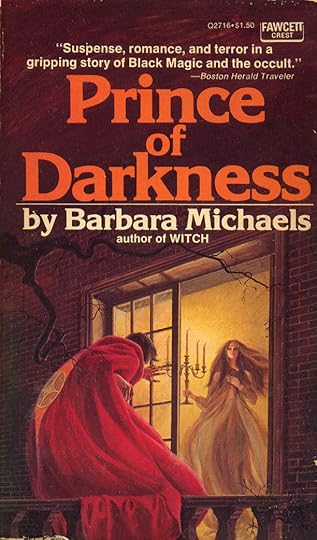
A stranger has come to Middleburg, Maryland, a visitor from abroad with a mysterious purpose. But this quaint, affluent community has dark secrets of its own. And when the interloper, Peter Stewart, becomes involved with the bewitching, seductive ward of noted local author Kate More, the townfolk fear the chilling past they are hiding will no longer be safe. For Middleburg has a colonial history of malevolent sorceries and obscene sacrifice. And when the terrible pot is stirred, murder may be the least of the evils to emerge from the unholy brew.
Barbara Michaels was a pen name of Barbara Mertz. She also wrote as Elizabeth Peters, as well as under her own name.
She was born in Canton, Illinois and has written over fifty books including some in Egyptology. Dr. Mertz also holds a Ph.D. from the University of Chicago in Egyptology.
I'm rereading the Barbara Michaels novels I haven't read since I was a teenager. This one has the same style of writing that always draws me into a Barbara Michaels/Elizabeth Peters novel, but the book itself wasn't nearly as strong as some of her others. Enjoyable, but if you're new to Barbara Michaels, don't start here.
This is the second book I read in my mini-Michaels-marathon (I got it from the library in a bound addition with Ammie, Come Home), and I have to admit, Prince of Darkness was always a problematic read for me, even when I read it as a teen. Prince of Darkness was written in 1969, and as I noted with Ammie, Come Home, there are aspects of it that are definitely dated. The worst problem is with the issue of race---at least one character uses the "n" word, and a few of them employ racist stereotypes, which was frankly hard for me to read. That the main characters don't share these views, and that the (unfortunately few) black characters are played quite sympathetically leads me to believe that Michaels was merely trying to illustrate the prejudices of this fictional small town. But it's still troublesome.
The other aspect of the Prince of Darkness that bothered me, as a teen and now, was the fact that we don't know as much either of the viewpoint characters (there is a shift in perspective halfway through the book). This is not to my personal taste, not in this case an instance of flawed writing; and if the character has a secret or two it's not as big a deal. In Prince of Darkness, we start off following Peter Stewart, an English con artist who moves to Middleburg, Maryland and attempts to gaslight the bookish heiress Katherine More. To begin with, we don't really know why Peter is there, or which components of his stated background are true; we do know he is sneaking around, planting evidence of supernatural infestation, in an attempt to convince Katherine her dead lover has returned. About Katherine herself, we know that her lover has died, and that she has become obsessed with a convoluted pagan cult, but throughout Peter's half of the book, we read a lot more about her beautiful relation, Tiphaine. Only at the midpoint, when we switch to Katherine's perspective, do we get a complete picture of why Peter was in town, and learn about Katherine's background as well.
If you've read and enjoyed Michaels's other books, I do recommend this one, which has her characteristic erudite characters, and a fine, spooky atmosphere. It's not the one I'd start with, however; I can appreciate what Michaels is attempting with the shifting perspectives, but for me, it doesn't always work.
Meh.... below average! I read it through yo finsih the Trilogy of books Mistress of Shadows. There was no supernatural element and the unravelling was tedious. Definite nope
I avoid evil themes but collected most of Barbara's novels. "Prince Of Darkness" gets three stars because the character is on constant, rigorous adventures and I liked the outcome; if not weak dealing with residual evil-doers. There were lovely descriptions of forest, sky, northern weather, cats, horses, and birds. The sinister-seeming prologue in which we meet the first protagonist is so cryptic, I think readers are supposed to imagine a dark quest. Not one whit of this novel is paranormal. It is about cults, though murderous and a thread of racial prejudice.
The principal downfall is that Barbara's vagueness deteriorated into an unexplained premise. I come away still not understanding the mission! That is major and I am a person who seizes upon details. When Peter explains who he is; my reaction was inability to believe him. Nothing explained why he attempted to scare Kate. I can say no more but the critique has to be made, when one finishes a book and is unable reconcile what the protagonist was doing! I understood one expedition but it raises a different flaw: it deflates the prologue. The physical appearance of that quarry could be no surprise.
The aspect I liked best is that Kate becomes the protagonist at the end. She very visibly shifts in our hearts, from seeming peculiar and cold, to being a highly warm and feeling person. Kate’s whole identity transforms, from the way her character had been presented to us, after we properly know her. This is a good approximation of real life. Barbara, however, neglected to include the cat in their departure from the scene. Kate would not overlook Pyewacket. This story’s topic was not my cup of tea but I am capable of giving novels a chance and acknowledging various things I enjoyed about them.
When Peter Stewart travels to a small Maryland town, he insinuates himself into the life of a local author, Kate More. He soon learns that the place is full of superstitions and secrets, and that he isn't the only one with plans for Kate.
This one had an interesting premise, but it was awkward overall. Peter is the viewpoint character for more than the first half of the story, but while we see what he does, we learn very little about his intentions or his motivation. He's not that charming or likable, so without enough knowledge about him to make him interesting, the book was difficult to engage with. I found myself putting it down over and over again.
Things pick up a lot when we switch to Kate's point of view, but again, the author holds back enough knowledge to make things a bit frustrating. I enjoyed Kate's section more than Peter's, though I'm not sure if it was the difference in tone as much as the fact that it finally felt like we were getting some questions answered.
The romance felt tacked on, especially considering some of Peter's actions. One aspect of the ending was predictable, but that didn't make it less enjoyable. The action scenes were described in an almost clinical way, though they still managed to feel muddy at times. Some questions were left unanswered. Most of those were minor points, but it left me feeling like things should have been more wrapped up.
I don't think this is written as well as other Michaels' books. The first part of it was from Peter's POV, and it was the weaker part. His actions and motivations towards Kate were not very well explained and left a big hole plotwise. The book improved when it switched to Kate's POV halfway through, although the pagan ritual seemed more campy than creepy.
A clandestine meeting in London with a private detective leads Peter Stewart to the small town of Middleburg, Maryland in search of an enigmatic professor. His goal in finding her is not clear from the outset, but disguised as a writer in search of inspiration, he blends in with the town’s odd inhabitants and quickly discovers that they may be hiding something diabolical. Snaking his way into the good graces of the town’s upper crust, he is permitted to take part in a ritual meant to raise the dead…
Written in 1969, this lovely novel bridges the divides between mystery, horror, and a touch of romance. Its been described as belonging to the category of “romantic suspense,” but I can’t say that I agree. The romantic aspects of the plot neither dominate nor motivate the characters much. Instead, I found that its eclectic genre-blending did wonders for moving the plot—and the ploy of our protagonist—and lends a natural feel to the narrative. Barbara Michaels earned a PhD in Egyptology, has written a boatload of novels, and has no problem keeping the reader engaged. This book is touted as one of her best and while she is no Lovecraft, this kind of novel is truly a precursor to Stephen King’s development of the mystery/supernatural-horror genre.
On the downside, some readers may be put off by the condescending pompousness of the narrator which characterizes ALL the personalities of this piece. Everyone seems to be deeply “in the know” about arcane folklore (granted, there is a Folklore Society to which some of them belong, but come on…do they all have to have PhDs?) and British literature. I also found their inflated diction to be a bit clunky, and their literary allusions to be obscure. However, I attributed this to Michaels writing in the late 60’s. To be fair, the characters do belong to an elite group of snobs. There is also at least one racial slur as well, so be aware of that element in the storyline as well. Otherwise, I look forward to reading more of Michaels’ work.
P.S. This is definitely a read-during-a-storm type of book, so hunker down on a gray day and enjoy it!
One of the few Barbara Michaels books that I only read once back in my teen years. There was on plot point that stuck with me through the years, but otherwise, reading it again now was like reading it for the first time. And considering how much I love Michaels/Elizabeth Peters, getting a second chance at a first reading was a gift.
That said, there's a reason why this did not make it into my reread stack of her books. The characterization of the hero and heroine was foggy--and not in the fun "which brooding man can be trusted and which one is a villain?" gothic way. It's just kind of confusing.
And while I know my teenage self was not critical of this, there is some overt and covert racism, as well as overt ableism that is not in any way challenged. The overt racism is clearly written as a commentary on the horrible character who drops the N word (as well as other horrific things that character says). The covert racism is a reflection of the fact that a white author was writing kind of ham-handedly about race in 1969. Michaels did make the only Black character in the book the most heroic person in the entire story, which I have no doubt was progressive at the time, but the treatment of race most certainly feels jarring to an adult reading this in 2021. As for the ableism--it was painful to read, although it was later revealed that an able-bodied person was pretending to be disabled. Still, the reactions of the "heroes" to this disabled person are not ok, though reflective of the time in which the book was written.
If you're a Michaels aficionado, read this to complete the collection. Otherwise, read something else of hers instead, like Vanish with the Rose, Be Buried in the Rain, or Stitches in Time. Prince of Darkness is not her best, though it will still keep you reading.
Очень странный текст. Предложения вроде связные, но вместе какая-то каша. Кривой перев��д? С бульварным романчиком в девяностые могли особо не заморачиваться. Судя по тому, что здесь в переводе в два раза меньше страниц, чем в Ведьме, а в оригинале в разных изданиях меньше уже в ней, без ножниц здесь не обошлось. Жаль, но ладно, не тот сюжет, чтобы искать, что там было в оригинале.
Оценю скелет, раз уж больше ничего не осталось. Он любопытный, но всё же сильно устарел. В первой половине наш герой сводит героиню с ума, пользуясь её нервным состоянием, вызванным относительно недавней смертью возлюбленного, подстраивая необъяснимые явления его призрака. В середине он достигает успеха, и не то чтобы насилует, но явно пользуется её полным нервным срывом. После чего она конечно же влюбляется, хотя он даже не извинился за своё поведение, поняв, что ошибся и мстить должен был не ей. В этот момент она мне как-то тоже резко разонравилась. Я могу понять, если её устраивает весь этот газлайтинг, пощечины несколько раз за пару дней и вообще постоянное хватание и выкручивание рук, мало ли у кого какие кинки. Деньги то её, как и карьера с образованием, совсем в зависимость не попадает и ладно, для того-то времени. Но он вредит котику! Так, что он потом явно страдает. Нет, что абьюзеры зверсов, что вздыхательницы по абьюзерам зверсов, не вызывают у меня никакого желания болеть за их выживание.
Эх, а ведь остальные её книги, даже постарше, нравились мне как раз хорошими отношениями главных героев, совершенно не мешающими интересно завёрнутым уютным готическим сюжетам. Хотя здесь и эта часть выступила не лучше, сатанинский культ получился какой-то смешной, как в детском кино, только с внезапной оргией. В общем, пока самая неудачная её книга, но всё равно буду читать дальше.
In an effort to re-read books I own for potential culling, I picked this one up expecting a quick read even though I had no memory of the book. First published in 1969, this was the 4th book written under Michaels' pseudonym and it is definitely a product of it's time. The explicit racism expressed by one of the villainous characters (use of the n-word against the African-American chauffeur) goes unremarked, the casual racism expressed by the main character against the same character, Hilary Jackson, is overlooked. All the times the characters talk about the "village idiot" are just completely taken as normal.
The plot is just nonsensical and Michaels used similar plots in later books to better effects. The whole story plays out in just a few days, but the way the characters act with the interloper, Peter Stewart, just doesn't ring true. They all act as if they know each other immediately and even though that is part of the plot, it bothered me all the way through the book. The romance is terrible and the climax was just ridiculous. It's no wonder I forgot how this book ended.
This almost feels like it was meant to be published under a pseudonym. Partially it's that the first half of the novel is told from a man's POV. Partially it's the large amount of narrative subterfuge going on so that we the readers never quite know what's going on with our POV character. It creates an odd remove that prevents one from really forming any sort of attachment to the characters and makes the love story almost impossible to believe in or root for. While I appreciate the author trying to tap into the satanic/folk horror strains that were prevalent at the time, none of it quite hangs together. Add in some awkward attempts to talk about race relations, homosexuality, and attitudes toward physical deformities and it ends up being a bit more cringe than intended. Ultimately this is one for the Barbara Michaels completist.
Iv’e read a couple of Barbara Michaels’ books before and enjoyed them for the melodramatic pulp fiction that they are. Unfortunately, Prince of Darkness was a bit of a disappointment. We’re never really informed of the mc’s reasons for traveling to Middleburg, Maryland to look up a woman who has a doctorate in Sociology and a dead boyfriend whom the mc resembles, until the mildly exciting conclusion. There’s also some racism and ableism and rich white people being awful. I would look elsewhere for a fun, spooky, pulpy read.
Good. This one took me longer to get into than either Ammie Come Home or The Dark on the Other Side. It moves a little slower. Something about this one kind of bounced me out too, like I couldn't get as invested in the story. I think it might have been the scope but I don't want to risk spoiling it. For all that, I still give it four stars because it was engaging and had several twists I did not forsee.
Picked up this book from my book shelves expecting to have goosebumps as I read. The mystery aspect of the story was not really “that” intriguing it it was interesting and enjoyable enough to keep me turning the pages.
At first, I thought Peter Stewart moved to Middleburg to study and write about the town’s folklore with the help of Katharine More. As he spend more time at Middleburg, his intentions became unclear to me. I was not confused but I just didn’t know what his goal was for wanting to be involved with the town and with Kate— I guess it’s all part of the mystery.
Second , the settings of the story was uncanny, but I was looking forward more to reading about supernatural characters (perhaps ghosts, spirits or vampires.) Unfortunately, the characters did not really meet my expectations (mostly because I read the book having a few expectation, but without having any idea what the book was about.)
This entire review has been hidden because of spoilers.
Gothic romances were my favorite genre as a teen. There were loads of them being published and republished. I stumbled on Barbara Metz, aka Barbara Michaels/Elizabeth Peters and started devouring her stories. Rereading this so many years later, it hasn’t’t aged well. The characters are stereotypes and the action is unbelievable. Sigh. I will read more, though.
I would give this 3.5 stars but that isn't possible. So because the last half if the book was better than the first half I gave it a higher rating. Barbara Michael's books can be hit or miss with its Gothic themes. This one, for me was hard to get into, until half way through, when Peter moved into Dr. More's house. Lots of obfuscation which eventually get sorted out in the end.
This was pretty silly in many ways, including the black mass, witchcraft and a bunch of rich dilettantes with too much money and too much time to get up to evil deeds. Very unfortunate racist references to African Americans in this novel. Of course, one turned out to be the hero. So there!
There are representation issues in great abundance, for anyone triggered by such. Otherwise, it's a moderately satisfying, moderately thrilling romance with paranormal overtones. No particularly likable characters, and it's a little bouncy in its narrative, but perfectly adequate for what it is.