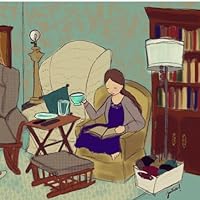
Seventeen-year-old Paula has just left behind convent boarding school - to go home. She hasn't been back home for more than two years, and isn't quite prepared for her five rambunctious brothers, two eccentric maiden aunts, bibliophile uncle, and 89 year-old Babbett, not to mention the demands laid on her by energetic Mama. Her father, Judge Eisenberth, at first seems to be the only one who understands her frustration. Even Adolf, her favorite brother, cannot fathom why she longs to go back to the convent and become a nun. Paula - and Adolf, who is going through his own trials - must face their problems and learn how to deal with everyday dilemmas as a part of the growing-up process. Set in 19th century Germany, this book is not only excellent as a "coming-of-age" story, but sheds a fascinating light on the everyday life and customs of the Rhineland.
German-born children’s author known for her "depictions of humane, realistic characters."
Benary-Isbert attended the College St. Carolus and the University of Frankfurt. She worked as a secretary at the Museum of Ethnology and Anthropology in Frankfurt, Germany from 1910-1917, when she married Wilhelm Benary. They settled in Erfurt, in East Germany.
When the Russians took over Germany, she fled to the apartment of a friend in West Germany. In 1948 she wrote Die Arche Noah (The Ark). In 1953 it received a first prize at the New York Herald Tribune's Spring Book Festival. Post-war Germany became a common theme in most of her works.
In 1952 she moved to the United States, where she was naturalized in 1957 and worked as a writer until her death. She received the Jane Addams Children's Book Award from the Women's International League for Peace and Freedom in 1957 for "Annegret und Cara".
Most of Benary-Isbert's books were originally written and published in German; some were later translated into English and published again.
I LOVED this! I knew before I was halfway that it was going straight to my top books of 2024 list. If you love Laura Ingalls Wilder, Louisa May Alcott, E. Nesbit, etc., please read this! It’s a charming story of a German family living in the Rhineland in 1865-1866. The patriarch, Jacob, is a judge in the town of Limburg and his extended family includes his wife, six children (a girl and 5 boys!), two old aunts, an old uncle, an 89-year-old servant who has been with the family for years, and various other servants. The story focuses on 13 year old Adolf and 17 year old Paula, siblings with a close connection between them. We follow Adolf, Paula, and their family through a whole year of life. I didn’t realize until I started reading that the family and town is Catholic so the liturgical year plays a big part in the family and the town’s life. Plus there are lots of details about food. Since my favorite Laura Ingalls Wilder book is Farmer Boy, one can imagine why I like reading about food. 😂
This book is perfectly charming and perhaps best enjoyed diving right in and getting to know the town and the family. This is a new all-time favorite book for me!
I have loved other books by Margot Benary-Isbert, and wanted to love this one. It's a rich detailed slice of life in the 1860s in a little corner of Germany, an independent duchy, which, in 1866 was annexed by Prussia. The story focuses on two teenage children of the local judge, an older girl just returned from two years in a French convent, and her brother, an introspective loner in the middle of five boys, struggling to find his place in his crowded family. They both learn lessons about themselves as the seasons (and the moon above -- hence the title) change. Then, when the Prussians arrive, the whole family must adjust to the new circumstances. The characters were sympathetic, the setting of the ancient riverside town was interesting and vividly realized, and yet the story simply did not come alive for me. It's telling that a week or so after finishing, I find myself unable to remember the main characters' names.
This is a very sweet and poignant book. Paula and Adolf - siblings, and the main characters - are wonderful examples of hard work, confidence, and facing up to responsibilities. It illustrates the truth that as we change and grow, we must sometimes leave things we love behind us. The perspective was not heavy-handed, but realistic and slightly melancholy.
Despite the sometimes sad tone, the end result was still a positive and uplifting story. Though it was not exactly a "Disney princess" ending, I still enjoyed it, and was pleased with Benary-Isbert's choice. It was touching, and perfectly fitting with the paradigm of the book.
I highly recommend it for fans of young adult fiction. I think fans of Louisa May Alcott would especially enjoy this story - it reminded me very much of "Eight Cousins" and "Jack and Jill."
A lovely book, somewhat reminiscent of a Jane Austen novel—although this book has more boisterous children and household duties, and fewer balls and parties than you’d find in Austen’s books. Also, the setting is in Germany during uncertain times in the 1860s. I absolutely loved the characters, and I appreciated the story’s emphasis on family and responsibility and community; also, the romantic elements were handled very well. The story is set in a Catholic community, so there are many references to Catholic festivals, beliefs, and traditions.
One word of warning: there are several untranslated quotes and statements sprinkled throughout the book, most of them in French but a few in German. With the ebook, this is not much of a hardship, since a Kindle can easily translate them for you. But on paper, it could be annoying! Also, if you’re unfamiliar with German nicknames, it might not be immediately obvious that, for example, Aunt Ulrika and Aunt Rikchen are the same person. (I used Google to help me sort it out, haha.) Otherwise, however, the book is not hard to read, and would be appropriate for kids 12 and up.
Probably 3.75 stars. I enjoyed it but wasn’t 100% sure where she was going the first 1/2 of the book or so. It was a sweet story of coming of age, growing in responsibly, learning to deal with loss, the importance of family and service. It’s also possible that I cried my eyes out at least once.
I’d consider this another winner from Benary-Isbert although it is quite different than the other four books I’ve read by her (and probably my least favorite of the five.) Still well worth the time it takes to read it.
Another story published by Bethlehem Books. This one (shown with a different book cover for the one we own) looked promising for a nice little historical fiction story of a girl and her rowdy brothers. Paula is a sweet girl just returned from her years of schooling and must learn to serve her family of a strict mother and a passel of noisy brothers (bearing much resemblance to the lost boys from "Peter Pan") who are always needing their socks darned. For that it was good but sadly there were too many things I don't agree with for me to give it a good rating.
What I Didn't Like: #1. This is a Catholic-faith-based book. Everything from rosaries to superstitions and hoping that prayers and works are enough to get you to heaven. :( Sometimes I can overlook these things, in my faith knowing the truth of salvation being the only way etc., but it was all throughout the story on every page. Paula even has been in the convent for 2 years (more the equivalent of a ladies school I learned in the book) and thinks of returning there for a continued basis as a nun. However, there were a few lines I enjoyed:
"Behind it stood the fundamental question of what God was trying to tell her through this experience, for she never doubted for an instant that it had a meaning and that from all this sadness she must distill some wisdom." (p. 232)
"But why did God send me Aqua in the first place when *He* knew the whole time where he belonged and that He would take him away from me one day?" ...Adolf had no idea that he was asking the same question as his big sister - Job's question, the ancient and forever unanswered question of all mankind."
#2. A long time ago I stopped reading romance books and this book is exactly the reason why. Teenage romance, heart-throbbing young "gentlemen", getting attached to someone you know you shouldn't marry, and allowing said "gentleman" show physical affection before marriage. Not only that, but the young man wasn't even of her own faith! She fell in love and got her heart broken, and then settles for and marries a man she respects who is 12 years older than her (reminding me greatly of the book "Emma").
#3. The relationship between the mother and daughter was a struggle for me. The mother had Paula doing so much of the housework...yet you didn't always hear of the mother working. And, Paula was put in charge of controlling her little brothers, with her getting in trouble at times whenever the boys did something wrong (because she didn't control them enough). :/ This is the reason people think stay-at-home daughters are only enslaved young women who work for their families. :P
#4. For a book that posts the date "1865 Germany" on the back of the book, I felt I learned nothing about this period or what was going on.
#5. There was French and German spoken here and there but there were no translations, leaving a poor helpless reader dejected and sadly lost in the most interesting or important parts of the story.
What I *did* like, however, was the fact that this coming-of-age story was told so well! Unlike other books, the author shared realistic feelings and emotions girls face. I loved the way I saw Paula grow in the story and learn with each new trial she faced from, from being patient and respectful of her mother, to learning to be more clear-headed when it comes to relationships with men. Not something you find in too many books! :) I was quite pleased with that at least. The relationships between the siblings and the aunts/uncles is quiet lovely really, even with the occasional squabbles between the boys. In the end you cannot help but love Paula's crazy aunts and grandmother, her wild brothers, and the beautiful country of Germany.
My favorite quote in the book: "There's no such thin as books that *ought to be read*. Every person has to make his own selection. First of all, he has to find out the books he wants to *live* with, and then every few years he must reread those he likes best or that mean most to him...it's the same with great music: the more you listen to it the more you get out of it." (p.124)
I sadly wouldn't recommend this book, and I will probably try to convince my mother to sell our copy. :/
This is a really good book. I recommend it to anyone who likes historical fiction. It is about a girl who comes home from convent school and immediately is swamped in drudgery and in parties that she has little interest in attending. She wants to go back to the convent and become a nun. As time goes by, she changes her mind on that, however, and a young Prussian hussar is stationed at their house. Oh, the anguish of first love, and love that cannot be. This story is about growing up in a Germany that no longer exists. It is happy, beautiful, sad, poignant, and content. I loved it.
I always love Margot Benary-Isbert's stories about post-war Germany so I was excited to try this historical work about the unification of Germany. It was pretty good, though I got kind of fed up with the heroine's passive acceptance of her lot as household drudge because she was the only daughter. She considered her two years in a French convent to be luxury because she got time to read and pray instead of doing housework and catering to her household full of brothers! I'm sure it was extremely accurate because it reminded me very much of my grandmother's stories of her childhood and how she resented her mother for all the household chores and child care she was was forced to do. (She never even had a photo of herself alone, only with the youngest brother who was her especial charge!) That was about 70 years later in America. I will also say that it's startling to read a book with a heroic character named Adolf. There is an interesting subplot involving this Adolf giving up a dog whom he found to its original master that reminded me of one of the later Anne of Green Gables books. That was my favorite part.