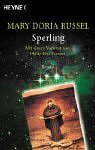
I've hit page 199 of 'The Sparrow' and the viscosity of the text is increasing.
By page 12, I had a lot of hope for this book. By page 88 I was really into the book, and thinking there was a good chance this was a 4 or 5 star book. At this point though, I'm not sure I can summon enough conviction up to finish it.
Russell takes a gamble with her story of telling it from the beginning and end toward the middle, and relies extremely heavily on foreshadowing. It’s high risk technique with a big payoff, and while it is somewhat effective at first in generating interest in the story, after about 130 pages of foreshadowing gloom and horror, it gets really tiring. It's like taking a bad page from some of the worst of Kurt Vonnegut's literary tics, only where Vonnegut comes off as pretentious or even pandering, Russell is coming off as being a bit of an amateur. Even worse, making the first third of your story foreshadowing with nothing happening is I think promising a payoff that is so large that I don't see at this point how she can deliver a sufficiently big twist or epiphany to justify it.
There are a lot of things to like about this book - its witty intelligent dialogue, its ambition, and its quality prose. But the chief merit of the book so far is the sensitivity to human culture that Mary Doria Russell brings to her work. Her skill and knowledge as an anthropologist shows, and in particular she envisions the social fabric of the world of 2016 in a way that is believable and seems to be almost prescient.
The same easy believability cannot be said for almost any other aspect of her work. Her characters are all little more than caricatures, with the sort of exaggerated easily identifiable physical features that you’d expect of characters in a comic book or role-playing game. The physicist is 6’6” and scarecrow thin. The mathematician is a petite and impossibly beautiful ex-prostitute. The pilot is impossibly ugly and speaks such an exaggerated Texan slang that the portrayal is embarrassingly close to racism. The main character Emilio is a roguishly charming and impossibly handsome Jesuit priest. He’s essentially an agnostic that wants to believe, who hubristically seizes on the mission to another world as a way to reconcile his own lack of faith in his God. His chief sounding board, and seemingly the author’s chief voice, is Anne – a 64 year old silver haired but still sprightly sexual doctor and hostess who is always ready with wit and wine. Both characters seem to be someone’s fantasy rather than real people, and tellingly Anne’s husband George is the least well drawn and least independent of the central characters.
I'm finding it increasingly difficult to suspend my disbelief. While I can easily believe the social developments that appear to have happened by 2016, it’s simply ludicrous to believe that by 2016 we will have sufficient in space infrastructure and technical process that a private organization will be able to mount an interstellar mission. It seems highly unlikely that a technological civilization would be found orbiting our nearest neighbor. It seems even more unlikely that news of the discovery of said alien civilization would create only a small and passing sensation in the press, or that any of the major world governments would simply allow such a singularly important event as contact with an alien species to be unregulated. I mean, I would think contact with a new sentient species would be perceived as a matter of the utmost delicacy, given that the potential extinction of either species is on the line should matters go wrong. But as Russell would have it, the discovery of mankind’s first extraterrestrial neighbor generates somewhat less interest than the Y2K bug.
Equally bad, it seems impossible to me that supposedly excellent scientists would fail to develop contact protocols and would arrive at a distant planet inhabited by a sentient species with no clear idea what they intend to do. This last one is for me the near mortal blow to the story. Not only are no contact protocols developed, and no plans made, and no experiments scheduled, and no egos bruised fighting over whose theoretical models should be attempted first, but upon reaching the planet, the team takes essentially no environmental precautions and stupidly starts sampling everything that looks remotely edible. This, quite unsurprisingly, leads to the death of one of the crew. This is a severe problem because we've been foreshadowing a tragedy the whole time and the author - somewhat unsuccessfully - has been trying to make the characters very sympathetic, congenial and witty so that this tragedy will produce some sort of big emotional payoff when its elements are finally revealed. In what amounts to the prologue chapter, Russell voices what appears to be something of a thesis statement. Through the thoughts of one of her most sympathetic characters she writes:
"The mission, he thought, probably failed because of a series of logical, reasonable, carefully considered decisions, each of which seemed like a good idea at the time."
But at this point I've not been seeing a lot of logical, reasonable, carefully considered decisions. I'm seeing characters behaving like such complete buffoons that the vibe I'm getting is more slasher film than tragedy, and if they keep acting so foolishly I'm going to be rooting for their gruesome deaths before it’s all over.
------------
Well, I'm finally done with 'The Sparrow'. For all that foreshadowing, Russell ends up spoiling most of the 'twists' either explicitly or by inference long before the story is complete. There isn't a really big epiphany at the end, and the last thing she chooses to resolve seems almost anticlimactic to the point of unbelievably.
Judged as a science fiction book or a non-science fiction book, this is a book with major flaws.
As a non-science fiction book, it's very difficult or impossible to have sympathy for the characters because their mistakes are in many cases so egregious and have so predictable of consequences. Some of the 'Mary Sue'-isms which would be forgivable in a sci-fi book are made to grate precisely because the author builds up how hyper-competent the people are, and then makes them jump through hoops of stupidity so as to achieve her tragic story goals. The slasher movie vibe was palpable. Ultimately, it's difficult to believe that anyone considers Emilio that saintly. Speaking as a religious person myself, I never got the impression that Emilio was acting with divine guidance and never understood why anyone would have seen him as such. His faith was childish in all the worst ways rather than all the better ones. He seemed infected with Hubris, projecting his hopes, desires, and needs on to God, and then blaming God when his Emilio's plans didn't work out. He never struck me as someone who walked with God or who had some spiritual gift the some real people have. And, I found it difficult to believe that Emilio, who has lived such a hard brutal life, if he had any faith, would let simple Latin male machismo get in the way.
As a science fiction book, the story fails for several reasons, not the least of which is none of the participants seems to be particularly skilled in hard sciences. The biology of the story was utterly unbelievable. You can't move from one end of the country to the other, much less to a foreign country, without spending at least the first six weeks sick as your body builds immunity to local pathogens and your digestive tract accommodates new flora. Yet, these people go to a whole new world and don't show the slightest concern for the fact that they'll be encountering microorganisms wholly unlike anything they've ever encountered, or that they'll be exposing the new world to the same. Old world explorers didn't have a clue about the consequences of exposing the New World population to small pox, but modern explorers have no such ignorance. The events of this story are scientific irresponsibility to the point of being criminal.
I could have rated this story just two stars or even less, based on the flaws and the fact that I nearly put this story down unfinished twice. But I think some consideration has to be given to the ambition, seriousness, and thoughtfulness of the author. This story gives me a lot more to chew over and has a lot better prose than most stories I'd just give two stars. So I'm tentatively giving the story three stars, even if it wasn't as enjoyable as most stories I'd actually say of, "I liked it."
This is Mary Doria Russell's first novel, and it shows. I can only hope that she has a long and productive career, because the talent is there to produce a true masterwork that puts her in the first rank among science fiction authors. However, this wasn't it.