Van Eyck left an indelible impression on Renaissance art and paved the way for future realist painters. This title in the Basic Art series features a detailed chronological summary of the artist's life and work, cultural and historical importance, illustrations from the artist, and more.
This is the second time I read this book. Like the other Taschen books I have read it is an excellent read and purchase. Taschen offers an excellent series. For about €10,- these compact editions offer high quality illustrations and the authors chosen for the monographies are reputed in their field.
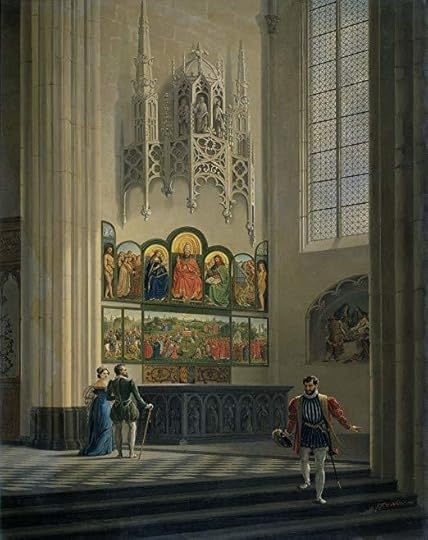
I picked this up again because I am soon traveling to Ghent to visit what promises to be an unforgettable exhibition. With half of the polyptych The Ghent Altarpiece, by the brothers Hugo and Jan van Eyck, restored, the organizers (I gather the MSK and St Bavo cathedral) have succeeded in gathering together about half of Jan Van Eyck’s works (around twenty are authenticated) for a few months as well as other complementary artworks and documents. Unfortunately, the altarpiece is shown partly in the museum (restored sections) and partly in the church for which it was commissioned (as yet unrestored sections with the exception of the Adoration of the Lamb) which may make the logistics of the visit not optimal.
This book is written by who I think is authoring the catalogue. This is then a highly recommended read prior to a visit to Ghent this year.
Borchert has organized his text and reproductions both thematically and according to genres. It is frustrating that given how acclaimed he was during his lifetime, as court painter and ambassador to the phenomenal Duke of Burgundy Philip the Good (1396-1467), that we have no more documentation on him. The Duke sent him on ‘secret’ assignments. We know of one of his trips – to Portugal – to paint the prospective Duchess. But he also went on other missions. His painterly abilities certainly left a trace of admiration, but the echoes were so widespread that without further proofs it is hard to say what was the direct bearing he had on other artists, in other lands.
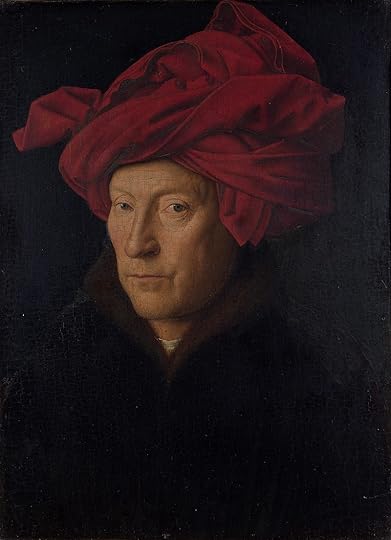
The two genres fully explored are the portraits and the altarpieces, which always depicted a Marian scene. I however suspect that the Louvre Madonna with Chancellor Rolin will not have travelled to Ghent but I hope that the possible self-portrait from the National Gallery in London will have jumped over the Channel.
As someone living in Madrid I would love to have his Arnolfini marriage, still in the Prado. This painting was part of the looting that King Joseph Bonaparte took with him back to France, and when intercepted by Wellington ended up in London. Velázquez, who as the court painter of king Philip IV was also the curator of the Royal Collection had it under his custody and that mirror in the back of Jan van Eyck's filtered onto the one in Velázquez's "Las Meninas".
In this second read I have paid more attention to the final chapter, that discusses Van Eyck’s workshop, and followers. In particular the section dedicated to the manuscript the Turin-Milan hours, which I also hope to see someday. Only Jan van Eyck would paint the Mass of the Dead with the upper corner of the Gothic arch traversing the golden frame of the painted page.
And again for someone living in Madrid, it is hard not to regret, selfishly, that king Philip II, who admired the Ghent Altarpiece and who had a copy of the painting made, did not succeed in convincing the owners to accept the copy ‘in lieu’ of the original . Otherwise ‘madrileños’ would have the Ghent marvel in the Prado instead of the copy in the Escorial.
And that is why, less selfishly, I am very glad I got my plane and train tickets to Brussels and Ghent.
For a ten dollar book this has some really great looking reproductions. I'm not normally an art book reader, but after reading The Recognitions I felt I should see what Van Eyck's artwork looks like, some really amazing stuff is in here.
Esplèndid llibre de Taschen sobre el fascinant Jan van Eyck... Ens solen fascinar els pintors tràgics, els més moderns, els més cars: de Monet a Van Gogh, a Picasso, Kandinsky, Rothko. I per suposat els canònics del Renaixement: Michellangelo, Da Vinci, Rafael. Però la tradició flamenca del segle XVII, amb Rembrandt, Rubens, Haals i Veermer, d'on sorgeix? I bé, pensem en l'art medieval com una col•lecció interminable de reproduccions sacres, planes, repetitives i merament decoratives; per contra, s'erigeix la figura de van Eyck com un miracle. Primer es diu de van Eyck que inventa la pintura a l'oli, i tot i que més tard es demostra que no, és evident que hi ha en el seu art un salt qualitatiu abismal respecte l'art sacre; que els retrats de van Eyck, els seus paisatges edènics, són tant el súmmum del sacre com l'inici brillantíssim d'una nova època, la Moderna. Pocs pintors arriben, amb una obra tant modesta en termes de xifres, a tanta profunditat.
Все хорошо, как и во всей этой серии книг. Разве что я пропустил описание работ по многочисленным Мадоннам, потому что там столько религиозных подробностей, что я просто засыпал. Ян ван Эйк - удивительный художник, так что всем советую ознакомиться с его работами.
Very insightful and a great deal of history and tracking van Eyck’s works. Would have also loved a more focus on the camera obscura breakthrough. Works before Hubert and Jan are worth the description of primitive art but how did the brothers innovate the technique, they for sure did it but how?
However, lovely dive into the 14/15 century art scene!
El pintor que solo pintaba a Putin en sus cuadros. Simplemente cheff kiss (la información técnica, ejemplos de cuadros y relación histórica). Sin embargo, he encontrado en falta más información biográfica y más sobre sus obras profanas.
This is your standard mass market artist overview with plenty of high quality color images. The writing is to the point, informative, and does what it needs to do. My only complaint is that several of the larger images are presented as two-page spreads, causing the centers of the images to be lost within in the binding of the book.
Interessant! Veel informatie en fijn dat er wordt ingegaan op de "symbolen" die Van Eyck vaak gebruikte in zijn schilderijen. Vaak wordt dit niet erkend of maar minimaal behandeld. De details en close-ups zijn héél mooi.