

What do you think?

Gli immortali
Un uomo vecchio e malato ma potentissimo, Leroy Weaver, ringiovanisce di colpo dopo una trasfusione di sangue. Il suo medico, Russell Pearce, intuisce che il responsabile del miracolo è un misterioso donatore, Marshall Cartwright. Un uomo i cui geni possono sconfiggere malattie e morte è una preda ambita, e ben presto si scatena la caccia per trovare Cartwright o i suoi eredi. Il romanzo si snoda in un vasto arco del nostro futuro, con un ritmo così incalzante che ha ispirato la TV americana diventando una serie di grande successo. In questa edizione, "Urania" lo offre ai lettori in una nuova versione, aggiornata dall'autore.
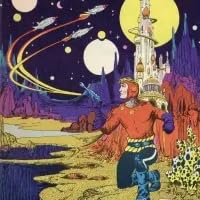
Copertina di Franco Brambilla
Copertina di Franco Brambilla
272 pages, Mass Market Paperback
First published November 1, 1962
About the author
James E. Gunn
276 books122 followersAmerican science fiction author, editor, scholar, and anthologist. His work from the 1960s and 70s is considered his most significant fiction, and his Road to Science Fiction collections are considered his most important scholarly books. He won a Hugo Award for a non-fiction book in 1983 for Isaac Asimov: The Foundations of Science Fiction. He was named the 2007 Damon Knight Memorial Grand Master by the Science Fiction and Fantasy Writers of America.
Gunn served in the U.S. Navy during World War II, after which he attended the University of Kansas, earning a Bachelor of Science in Journalism in 1947 and a Masters of Arts in English in 1951. Gunn went on to become a faculty member of the University of Kansas, where he served as the university's director of public relations and as a professor of English, specializing in science fiction and fiction writing. He is now a professor emeritus and director of the Center for the Study of Science Fiction, which awards the annual John W. Campbell Memorial Award for best novel and the Theodore Sturgeon Memorial Award at the Campbell Conference in Lawrence, Kansas, every July.
He served as President of the Science Fiction Writers of America from 1971–72, was President of the Science Fiction Research Association from 1980-82, and currently is Director of The Center for the Study of
Science Fiction. SFWA honored him as a Grand Master of Science Fiction in 2007.
Gunn began his career as a science fiction author in 1948. He has had almost 100 stories published in magazines and anthologies and has authored 26 books and edited 10. Many of his stories and books have been reprinted around the world.
In 1996, Gunn wrote a novelization of the unproduced Star Trek episode "The Joy Machine" by Theodore Sturgeon.
His stories also have been adapted into radioplays and teleplays:
* NBC radio's X Minus One
* Desilu Playhouse's 1959 "Man in Orbit", based on Gunn's "The Cave of Night"
* ABC-TV's Movie of the Week "The Immortal" (1969) and an hour-long television series in 1970, based on Gunn's The Immortals
* An episode of the USSR science fiction TV series This Fantastic World, filmed in 1989 and entitled "Psychodynamics of the Witchcraft" was based on James Gunn's 1953 story "Wherever You May Be".
Gunn served in the U.S. Navy during World War II, after which he attended the University of Kansas, earning a Bachelor of Science in Journalism in 1947 and a Masters of Arts in English in 1951. Gunn went on to become a faculty member of the University of Kansas, where he served as the university's director of public relations and as a professor of English, specializing in science fiction and fiction writing. He is now a professor emeritus and director of the Center for the Study of Science Fiction, which awards the annual John W. Campbell Memorial Award for best novel and the Theodore Sturgeon Memorial Award at the Campbell Conference in Lawrence, Kansas, every July.
He served as President of the Science Fiction Writers of America from 1971–72, was President of the Science Fiction Research Association from 1980-82, and currently is Director of The Center for the Study of
Science Fiction. SFWA honored him as a Grand Master of Science Fiction in 2007.
Gunn began his career as a science fiction author in 1948. He has had almost 100 stories published in magazines and anthologies and has authored 26 books and edited 10. Many of his stories and books have been reprinted around the world.
In 1996, Gunn wrote a novelization of the unproduced Star Trek episode "The Joy Machine" by Theodore Sturgeon.
His stories also have been adapted into radioplays and teleplays:
* NBC radio's X Minus One
* Desilu Playhouse's 1959 "Man in Orbit", based on Gunn's "The Cave of Night"
* ABC-TV's Movie of the Week "The Immortal" (1969) and an hour-long television series in 1970, based on Gunn's The Immortals
* An episode of the USSR science fiction TV series This Fantastic World, filmed in 1989 and entitled "Psychodynamics of the Witchcraft" was based on James Gunn's 1953 story "Wherever You May Be".
Ratings & Reviews
Friends & Following
Create a free account to discover what your friends think of this book!
Community Reviews
Displaying 1 - 30 of 43 reviews

September 11, 2021
From Marina Hyde's Guardian column, Sep 11 2021:
Anyway, you’ll be aware that the old immortality game is already being played by a number of other tech bros, from Google co-founder Larry Page to Peter Thiel, both of whom have siphoned serious millions into the idea that “death is a problem that can be solved”. Other figures have been linked to firms investigating the benefits of transfusing yourself with the blood of someone younger and poorer (I paraphrase, but only slightly).It occurs to me to wonder if any of these people read James E. Gunn's little novel?

August 25, 2013
These loosely linked short stories appeared in magazines in the 1950's, formed the basis of a TV series in the 1970's, and have apparently undergone some rewriting by Gunn in the past twenty years or so. I read a 1962 Bantam paperback, so I assume that I got something pretty close to the original version of this material.
Marshal Cartwright sells a pint of blood for $25. When it is administered to a dying millionaire, the patient has a remarkable recovery. Cartwright's blood contains a hemoglobin that can defeat death, although a steady supply is needed. So the chase is on to track down Cartwright and his descendants. Much like some other early work by James Gunn, The Immortals opens with scenes that could almost come from a crime novel rather than a science fiction story. Private detectives are hired, people are on the run, evil rich men will do anything to get what they want, no one can be trusted.
This is all pretty standard 1950's material until we jump ahead a few years, and Gunn reveals a dystopian vision of the future brought about partly by the frantic search for the Cartwright bloodline but also by the industrialization of the medical profession. The cities have turned into enormous medical compounds, guarded by armed militia, and slums. Amazing things are possible on the medical front, for those who can afford them. Gunn's vision of the medical industry could come from the platform proposals of the Republican National Committee, although some there might blanch at the thought that deadbeats who failed to pay their medical bills became residents of organ farms where their bodies were picked clean of usable parts until there was not enough reason to keep them alive.
Gunn writes suspenseful scenes and creates memorable images of destitution and corruption. Sixty years after it was written, The Immortals remains a grim but enjoyable read.
Marshal Cartwright sells a pint of blood for $25. When it is administered to a dying millionaire, the patient has a remarkable recovery. Cartwright's blood contains a hemoglobin that can defeat death, although a steady supply is needed. So the chase is on to track down Cartwright and his descendants. Much like some other early work by James Gunn, The Immortals opens with scenes that could almost come from a crime novel rather than a science fiction story. Private detectives are hired, people are on the run, evil rich men will do anything to get what they want, no one can be trusted.
This is all pretty standard 1950's material until we jump ahead a few years, and Gunn reveals a dystopian vision of the future brought about partly by the frantic search for the Cartwright bloodline but also by the industrialization of the medical profession. The cities have turned into enormous medical compounds, guarded by armed militia, and slums. Amazing things are possible on the medical front, for those who can afford them. Gunn's vision of the medical industry could come from the platform proposals of the Republican National Committee, although some there might blanch at the thought that deadbeats who failed to pay their medical bills became residents of organ farms where their bodies were picked clean of usable parts until there was not enough reason to keep them alive.
Gunn writes suspenseful scenes and creates memorable images of destitution and corruption. Sixty years after it was written, The Immortals remains a grim but enjoyable read.
December 30, 2010
Book # 13 in the shelf experiment
A curious sci fi novel that I'd definitely recommend to those interested in "science gone wrong" stories. The story is broken up into 4 parts, each one taking place 50 years apart from each other. In the first segment, a doctor discovers that a recent blood donor has properties to his blood that make him essentially immortal and that barring accidents, he will live forever. As this is news to the donor as much as it is to the scientific community, the immortal goes into hiding (with the aid of the doctor) and effictively disappears for the time being. The second segment involves an employee of a clandestine organization set up to locate and ultimately exploit the immortal or his decendents. The employee locates an immortal and tries to blackmail his organization into granting him immortality in exchange for the person. The third segment takes place after a number of immortals have been located and society, as a result, has crumbled under the leadership of a small group of power brokers who exploit the immortals for their own selfish benefit (denying the vast majority of humanity any hope of immortality themselves). The fourth segment involves a journey through a dystopian wasteland between a descendent of the first immortal, a doctor and the original doctor who discovered the immortals to begin with (he has now grown nearly two hundred years old).
I found this book particularly interesting as it dealt with not only questions related to life and death but also of the morality of health. Is health a right? Is immortality a burden or a curse? Are doctors mechanics or healers? This and a few more related ideas are explored in an effective and succinct manner and for anyone interested in the moral implications of scientific research, this a valuable and curious read.
A curious sci fi novel that I'd definitely recommend to those interested in "science gone wrong" stories. The story is broken up into 4 parts, each one taking place 50 years apart from each other. In the first segment, a doctor discovers that a recent blood donor has properties to his blood that make him essentially immortal and that barring accidents, he will live forever. As this is news to the donor as much as it is to the scientific community, the immortal goes into hiding (with the aid of the doctor) and effictively disappears for the time being. The second segment involves an employee of a clandestine organization set up to locate and ultimately exploit the immortal or his decendents. The employee locates an immortal and tries to blackmail his organization into granting him immortality in exchange for the person. The third segment takes place after a number of immortals have been located and society, as a result, has crumbled under the leadership of a small group of power brokers who exploit the immortals for their own selfish benefit (denying the vast majority of humanity any hope of immortality themselves). The fourth segment involves a journey through a dystopian wasteland between a descendent of the first immortal, a doctor and the original doctor who discovered the immortals to begin with (he has now grown nearly two hundred years old).
I found this book particularly interesting as it dealt with not only questions related to life and death but also of the morality of health. Is health a right? Is immortality a burden or a curse? Are doctors mechanics or healers? This and a few more related ideas are explored in an effective and succinct manner and for anyone interested in the moral implications of scientific research, this a valuable and curious read.

December 6, 2010
My brother and I both share a love of post-apocalyptic literature...well, I wouldn't say "love," as much as sci-fi appreciation. The Immortals appears to be a pulp book, written and produced in mass in the mid-19th century. My copy cost 30 cents when it was first written. I thought the book was wonderful. The author was imaginative with his characters, plot and structure. He asks the question, what happens if medicine is only for sale, which is still part of the discussion today.
Gunn looks at medicine as an ever evolving thing, especially when they find a way to reach immortality. In his fictional answer, he explores what would happen if only the rich received medical care. He imagines that the poor receive virtually no medical care, but the strong survive, and the rich receive medical care that can cure virtually anything, going against natural selection. The result is entertaining, thought-provoking and, at times, outlandish. It's everything I love about sci-fi novels, the ability to make you think by examining different realities.
I would strongly suggest sci-fi fans get their hands on this book, if they haven't already. It wasn't available in any of Montana's public libraries, so it may be worth digging for online or at used book stores.
Gunn looks at medicine as an ever evolving thing, especially when they find a way to reach immortality. In his fictional answer, he explores what would happen if only the rich received medical care. He imagines that the poor receive virtually no medical care, but the strong survive, and the rich receive medical care that can cure virtually anything, going against natural selection. The result is entertaining, thought-provoking and, at times, outlandish. It's everything I love about sci-fi novels, the ability to make you think by examining different realities.
I would strongly suggest sci-fi fans get their hands on this book, if they haven't already. It wasn't available in any of Montana's public libraries, so it may be worth digging for online or at used book stores.
January 29, 2018
I very much enjoyed this thought-provoking book. I'm working on a graphic novel dealing with immortals, and this is one of sci-fi's seminal works dealing with that topic (along with, eg, Heinlein's 'Time Enough For Love"). It's about immortality and the price that a biological immortal would pay living in our society--but more importantly it's a meditation on our attitudes to health, medicine and the practice of medical care ("too many doctors and not enough healers" is one of the book's recurring and organizing lines). Ever stopped for a moment to contemplate the origin and psychological effects of your own terror of aging and fear of death? Then read this classic.

November 23, 2015
Great old fashion story telling. Gunn puts together an interesting world through short stories which all focus around the same plot over time. Great quick read with multiple layers of lessons and messages to be gleaned.

March 8, 2024
review of
James Gunn's The Immortals
by tENTATIVELY, a cONVENIENCE - March 6-8, 2024
This is the 12th bk I've read by Gunn now. As I've noted before I had the pleasure & honor to have some small email correspondence w/ him during wch time we disagreed but I found him to be a good communicator & basically polite so I liked him. W/ this in mind, it's mildly irritating to me that I haven't yet felt moved enuf to add him to my pantheon of favorite SF writers ( http://idioideo.pleintekst.nl/Reviewe... ). This is probably the novel that's come closest yet to pushing me into that act of admiration. These are the bks I've read by him so far:
The Witching Hour: https://www.goodreads.com/book/show/6...
This Fortress World : https://www.goodreads.com/book/show/6...
Station in Space
Future Imperfect : http://www.goodreads.com/book/show/62...
The Joy Makers
The Listeners : http://www.goodreads.com/book/show/10...
Breaking Point : https://www.goodreads.com/book/show/6...
The Magicians : http://www.goodreads.com/book/show/30...
Kampus : http://www.goodreads.com/book/show/21...
The Mind Master : https://www.goodreads.com/book/show/7...
Crisis! : https://www.goodreads.com/book/show/1...
In my review of The Mind Master I wrote:
"I get the impression that Gunn, as a university professor, has had a somewhat pessimistic vision of the future based on what he perceives as the students' unchecked hedonism & lack of self-discipline for taking c/o serious business."
In the case of this bk, his dystopian predictions take an entirely different approach, one that I was surprised by & one that I found refreshingly close to my own criticisms of society. The copyright for this is 1962. SF is often noted for it prescience, that's definitely applicable here, Gunn cd see it comin'.
"The old man was seventy years old. His body was limp on the hard hospital bed. In the sudden silence after the cutout of the air conditioner's gentle murmur, the harsh uneveness of his breathing was loud. The only movement in the private room was the spasmodic rise and fall of the sheet that covered the old body.
"He was living—barely. He had used up his allotted three score years and ten. It wasn't merely that he was dying—we all are. With him, it was imminent." - p 12
I'm 70 yrs old, I've been morbid for most of my life, the 1st time I had suicidal ideations was when I was 14 & was upset over my girlfriend, the 1st time I slashed my wrists was when I was 18. These days I'm more inclined to notice other people roughly my age & to compare myself to them. In this case, I'm 'pleased' to read the description of the 70 yr old as much further gone than I am - it helps me feel less decrepid, less on the brink of not-waking-up-again. I'm not afraid of death but I'm not enthusiastic about not reaching the maximum potential of my life's work - wch cd go on indefinitely & is far more complex than I ever expect anyone to even begin to grasp.
A Dr. Pearce is attending this particular very wealthy 70 yr old.
"Pearce didn't believe that a man with money was necessarily a villain. But anyone who made a million dollars or a multiple of it was necessarily a large part predator and the rest magpie." - p 17
That's an interesting statement for Gunn to put in the mind of the protagonist. In my brief correspondence w/ Gunn in wch I defended my criticism of his bk Kampus , a novel in wch radical students cause destructive chaos to dominate society, he was honest enuf to reveal to me that he'd had what in those days wd've been called "Generation Gap" problems w/ his son over the son's political radicalism. Here, in a bk from 1962, slightly before various popular mvmts revolving around rejection of authority, consciousness expansion involving drug use, & anti-war activism, etc, he acknowledges wealth as largely predatory - an important ethical stance behind much of the radicalism that followed soon thereafter 1962.
This being largely a medical novel, Gunn puts in some medical history to establish the setting.
"Pearce thought about Richard Lower, the seventeenth-century English anatomist who performed the first transfusion, and the twentieth-century Viennese immunologist, Karl Landsteiner, who made transfusions safe when he discovered the incompatible blood groups among human beings." - p 19
"Protozoa don't die. Metazoa—sponges, flatworms, coelenterates—don't die. Certain fish don't die except through accident. "Voles are animals that never stop growing and never grow old." Where did I read that? And even the tissues of the higher vertebrates are immortal under the right conditions.
"Carrel and Ebeling proved that. Give the cell enough of the right food, and it will never die. Cells from every part of the body have been kept alive indefinitely in vitro." - p 25
I decided to research protozoa 1st. I didn't succeed in getting a clear answer as to whether protozoa die. I found this:
"Apoptosis and other types of regulated cell death have been defined as fundamental processes in plant and animal development, but the occurrence of, and possible roles for, regulated cell death in parasitic protozoa remain controversial. A key problem has been the difficulty in reconciling the presence of apparent morphological markers of apoptosis and the notable absence of some of the key executioners functioning in higher eukaryotes. Here, we review the evidence for regulated cell death pathways in selected parasitic protozoa and propose that cell death in these organisms be classified into just two primary types: necrosis and incidental death. It is our opinion that dedicated molecular machinery required for the initiation and execution of regulated cell death has yet to be convincingly identified." - https://www.nature.com/articles/nrmic...
So I decided to try metazoa next.
"Biitschli was the first to point out that unicellular organisms have an unlimited duration of life and this idea has become very popular through Weismann. All recent researches support the correctness of this idea. As a consequence we are forced to the conclusion that natural death is a phenomenon found almost exclusively in organisms which are composed of different organs. The idea that natural death is connected with the compound character of organisms is supported by two facts; namely, first, the observation that a cutting will survive the whole plant, while the cutting if not separated would have died with the whole plant." - https://www.pnas.org/doi/pdf/10.1073/...
This led to:
"Why unicellular organisms are considered immortal?
Actually, single celled organisms are considered to be biologically immortal. This is because they don't die as they grow old.
They usually undergo Mitosis (asexual reproduction) to reproduce, in which the organism itself gets divided into two (cell division).
This technically means that the same organism keeps getting split into new young ones (daughter cells). So there is no way we could say that the organism has died.
However biologically immortal does not mean that it can never die. The organism may die due to some other reason (external factors like injury,etc,.)." - https://www.quora.com/
As for voles? Online they're sd to die at one yr. It seems that organisms that can undergo mitosis are 'immortal' as long as nothing interferes w/ its reproductive process. Whatever the case may be, I find it interesting. Consider this:
"Nonpathogenic intestinal protozoa are single-celled parasites commonly found in the intestinal tract but never associated with illness. They do not harm the body, even in people with weak immune systems." - https://www.cdc.gov/parasites/nonpath...#
"Here’s what we know now: those specks are protists, not bacteria, and they have a symbiotic relationship rather than a parasitic one. The protists, organisms that each consist of just one single, microscopic cell and are not related to animals, bacteria, or fungi, produce enzymes that help termites digest the wood that they eat. This makes more sense to us today than it would have to 19th-century scientists because we know that animals host microbes, many of which are beneficial. Just as we have bacteria in our microbiomes that help with our digestion, termites have these protists.
"The termites need the protists because they eat wood containing chemicals that would be otherwise indigestible. With the help of the protists, termites eat something that’s abundantly available but would otherwise be inaccessible. These little microbes in the termite microbiome were recently captured in a video, which required innovative methodology to capture such minuscule beings." - https://www.mightymitetermite.com/blo...
No doubt it's very biologically naive for me to even imagine this, but, still, it's fun to do so: What if humans restructured so that we're entirely made up of single cell organisms that can take human shape & function in the ways that humans can? Instead of dying we'd just experience an ongoing refreshing mitosis.
Dr. Pearce's wealthy 70 yr old patient has been dramatically revivified by a transfusion of blood belonging to someone who's biologically immortal. Pearce wearily asks the pushy patient, Weaver, what he wants. Weaver wants to control the hinted-at immortality.
"We'd save the best men in the world, those who have demonstrated their ability by becoming wealthy. Oh, yes. Scientists, too—we'd select some of those. People who haven't gone into business—leaders, statesmen. . . ."" - p 36
Each part of the novel jumps ahead by decades. Part II:
"The search had been organized to last a hundfed years. Half of that period was already gone, and the search was no nearer success than when it had started. Only the ultimate desperation can keep hope alive without periodic transfusion of results.
"The National Research Institute was unique. It had no customers and no product. Its annual statement was printed all in red. And yet the tight-lipped donors made their contributions regularly and without complaint. Whenever one of them died, his estate was inherited by the Institute." - p 47
Part III:
"Before he opened the door, he broke open a fresh filter packet and slipped the filters into his nostrils, taking time to see that they were a good fit. He slid the needle gun out of the holster on the ambulance door. The magazine was full. He set the controls for automatic defense and stepped into the night.
"He sniffed the air tentatively. It wasn't conditioned, not by a wild stretch of the imagination, but the odor wasn't unbearable. A few minutes shouldn't cut down his life expectancy appreciably.
"The smog swirled around him, clutching, trying to insinuate its deadly tendrils down into his lungs. Boyd was right: We swim in a sea of carcinogens." - p 94
The environment that the medic finds himself in, the environment away from the medical fortress he usually inhabits, is 50 or more yrs along in its deterioration since Part I. The city that was on its way out during Pearce's treatment of Weaver is now far along the path to annihilation. The prescience of Gunn's story is that he predicts the self-delusional malevolence that the Medical Industry has in relation to this annhilation.
""Tuberculosis is no problem. We can cure it easily. Why do they let themselves die?"
"She stopped in front of the worm-eaten plywood partition and raised her face
toward him. "Because it's cheaper. It's all they can afford."
""Cheaper to die?" Flowers exclaimed incredulously. "What kind of economy is that?"
""The only kind of economy they know. The only kind the hospitals will let them practice. You've made good health too expensive.["]" - p 108
""Why are the income taxes so high?" Flowers demanded. "Why are instruments so expensive? Why are a hundred million people without adequate medical facilities, condemned to a lingering death in a sea of carcinogens, unable to afford what the orators call 'the finest flower of medicine'?"" - p 119
"Was there an optimum beyond which medicine consumed more than it produced in benefits? And was there a point past that at which medicine became a monster, devouring the society that produced it?" - p 124
As anyone who'd read my bks "Unconscious Suffocation - A Personal Journey through the PANDEMIC PANIC" & "THE SCIENCE (volume 1)" will know, my answer to those 2 questions is an emphatic YES.
"It was more of a tradition than anything else—this convoy detail with the minesweepers snuffling ahead, the tanks lumbering heavily on either side, and helicopters hovering above. No one was foolish enough to attack anything stronger than a lone ambulance." - p 143
"There was a moving speech by the A.M.A. field representative on the danger to ethical standards in new legislation pending before Congress. Its inevitable result was socialized medicine." - p 143
Ha ha! Did you think that "socialized medicine" was a bugaboo of only the very recent past? Well, here we are in 1962 & Gunn has the idea bandied about in much the same way that we might've expected it to be used by Rump, the Idiot King. Capitalism forbid that there be a medical policy in place that wd make affordability egalitarian! Obama certainly didn't make it happen despite all brouhaha to the contrary.
As it turns out, Dr. Pearce is still alive & well enough all these decades later.
"He told Flowers why he had walked out on his class sixty years before.
""It suddenly came to me—the similarity between medicine and religion. We fostered it with our tradition-building, our indecipherable prescriptions, our ritual. Gradually the public had come to look upon us as miracle workers. The masses called the new medicines wonder drugs because they didn't know how they worked. Religion and medicine—both owed their great periods to a pathological fear of death. He is not so great an enemy."" - p 151
Whc brings us to the present tense, eh?! A pathological fear of death & an attitude toward doctors as if they're Gods? Gods who aren't to be criticized or their subtext of immortality might crumble?!
"["]Medicine became dependent upon the very thing it was destroying. Vast technologies were vital to its maintenance, but that level of civilization fostered its own diseases."" - p 152
Such as the 'rare' immune deficiencies generated by vaccination.
"["]But the complication of medicine had another effect. It restricted treatment to those who could afford it. Fewer and fewer people grew healthier and healthier. Weren't the rest human too?"
"Henry frowned. "Certainly. But it was the wealthy contributors and the foundations that made it all possible. They had to be treated first so that medical research could continue."
"Pearce whispered, "And so society was warped all out of shape; everything was sacrificed to the god of medicine—all so a few people could live a few years longer. Who paid the bill?
""And the odd outcome was that those who received care grew less healthy, as a class, than those who had to survive without it.["]" - p 203
My next door neighbor when I 1st moved to PGH was a 98 yr old black woman, someone who was certainly poor. She died at 100 when she went to the hospital.
"["]They cared, and I helped them as I could."
""How?" Harry asked. "Without a diagnostic machine, without drugs or antibiotics."
""The human mind," Pearce whispered, "is still the best diagnostic machine. And the best antibiotic. I touched them. I helped them to cure themselves. So I became a healer instead of a technicion. Our bodies want to heal themselves, you know, but our minds give counter-orders and death-instructions."" - p 203
I remember when I asked a guitarist if I cd play his guitar & asked if he minded whether I tuned it. He gave me the go-ahead & I tuned using harmonics. He got upset & sd something like 'What is that?! Some weird Japanese tuning?!' I tuned w/o a tuner, w/o a 'diagnostic machine'. How many people do that any more?
"The clinic was built out from the Medical Center wall. Opposite was the high wall of a factory that made armored cars for export to the suburbs. That's where the center got its ambulances. A little farther along the Medical Center wall was a second, smaller out-building. On its roof was a neon sign: BLOOD BOUGHT HERE. Beside its door would be another, smaller sign: "We Are Now Paying $5 a Pint."" - p 162
The above was presumably inspired by what Gunn saw in his environment. Giving blood was, & probably still is, a way for poor desperate people to make some quick money. In my experience, it was mostly street alcoholics who took advantage of this. Another level of this is research volunteering. I was a 'volunteer' off & on for decades. I had some interesting experiences as a result, nothing that did me any long-term harm (as far as I know). One time I was particularly desperate & there was a study that pd more than usual, maybe $1,000 or more. When I went to apply, the nurse seemed very nervous. She explained that volunteers wd be advised to not have sex for 6 mnths after the study was over. She also explained that monkeys given the drug being studied then had babies born w/o brains. She probably wasn't supposed to tell me that. I got the hint & didn't join the study. Anyway, do you ever wonder about blood donating? On the one hand, it seems like a good thing: enabling the saving of the lives of people who've suffered substantial blood loss - you'd want to be able to be saved like that if you were unfortunate enuf to be in the same situation. But.. but.. on the other hand, it's a bit close to vampirism, isn't it? After all, yr blood has yr DNA, yr DNA's PDI (Pretty Damned Important) & not something to be sloppy w/.
Gunn's vision of a future society where there's a serious divide between the medical 'haves' & the medical 'have-nots' is pretty realistic from my POV.
"After the outriders came an ambulance, its armored ports closed, its automatic 40-millimeter gun roaming restlessly for a target. More outriders covered the rear. Above the convoy a helicopter swooped low." - p 167
James Gunn's The Immortals
by tENTATIVELY, a cONVENIENCE - March 6-8, 2024
This is the 12th bk I've read by Gunn now. As I've noted before I had the pleasure & honor to have some small email correspondence w/ him during wch time we disagreed but I found him to be a good communicator & basically polite so I liked him. W/ this in mind, it's mildly irritating to me that I haven't yet felt moved enuf to add him to my pantheon of favorite SF writers ( http://idioideo.pleintekst.nl/Reviewe... ). This is probably the novel that's come closest yet to pushing me into that act of admiration. These are the bks I've read by him so far:
The Witching Hour: https://www.goodreads.com/book/show/6...
This Fortress World : https://www.goodreads.com/book/show/6...
Station in Space
Future Imperfect : http://www.goodreads.com/book/show/62...
The Joy Makers
The Listeners : http://www.goodreads.com/book/show/10...
Breaking Point : https://www.goodreads.com/book/show/6...
The Magicians : http://www.goodreads.com/book/show/30...
Kampus : http://www.goodreads.com/book/show/21...
The Mind Master : https://www.goodreads.com/book/show/7...
Crisis! : https://www.goodreads.com/book/show/1...
In my review of The Mind Master I wrote:
"I get the impression that Gunn, as a university professor, has had a somewhat pessimistic vision of the future based on what he perceives as the students' unchecked hedonism & lack of self-discipline for taking c/o serious business."
In the case of this bk, his dystopian predictions take an entirely different approach, one that I was surprised by & one that I found refreshingly close to my own criticisms of society. The copyright for this is 1962. SF is often noted for it prescience, that's definitely applicable here, Gunn cd see it comin'.
"The old man was seventy years old. His body was limp on the hard hospital bed. In the sudden silence after the cutout of the air conditioner's gentle murmur, the harsh uneveness of his breathing was loud. The only movement in the private room was the spasmodic rise and fall of the sheet that covered the old body.
"He was living—barely. He had used up his allotted three score years and ten. It wasn't merely that he was dying—we all are. With him, it was imminent." - p 12
I'm 70 yrs old, I've been morbid for most of my life, the 1st time I had suicidal ideations was when I was 14 & was upset over my girlfriend, the 1st time I slashed my wrists was when I was 18. These days I'm more inclined to notice other people roughly my age & to compare myself to them. In this case, I'm 'pleased' to read the description of the 70 yr old as much further gone than I am - it helps me feel less decrepid, less on the brink of not-waking-up-again. I'm not afraid of death but I'm not enthusiastic about not reaching the maximum potential of my life's work - wch cd go on indefinitely & is far more complex than I ever expect anyone to even begin to grasp.
A Dr. Pearce is attending this particular very wealthy 70 yr old.
"Pearce didn't believe that a man with money was necessarily a villain. But anyone who made a million dollars or a multiple of it was necessarily a large part predator and the rest magpie." - p 17
That's an interesting statement for Gunn to put in the mind of the protagonist. In my brief correspondence w/ Gunn in wch I defended my criticism of his bk Kampus , a novel in wch radical students cause destructive chaos to dominate society, he was honest enuf to reveal to me that he'd had what in those days wd've been called "Generation Gap" problems w/ his son over the son's political radicalism. Here, in a bk from 1962, slightly before various popular mvmts revolving around rejection of authority, consciousness expansion involving drug use, & anti-war activism, etc, he acknowledges wealth as largely predatory - an important ethical stance behind much of the radicalism that followed soon thereafter 1962.
This being largely a medical novel, Gunn puts in some medical history to establish the setting.
"Pearce thought about Richard Lower, the seventeenth-century English anatomist who performed the first transfusion, and the twentieth-century Viennese immunologist, Karl Landsteiner, who made transfusions safe when he discovered the incompatible blood groups among human beings." - p 19
"Protozoa don't die. Metazoa—sponges, flatworms, coelenterates—don't die. Certain fish don't die except through accident. "Voles are animals that never stop growing and never grow old." Where did I read that? And even the tissues of the higher vertebrates are immortal under the right conditions.
"Carrel and Ebeling proved that. Give the cell enough of the right food, and it will never die. Cells from every part of the body have been kept alive indefinitely in vitro." - p 25
I decided to research protozoa 1st. I didn't succeed in getting a clear answer as to whether protozoa die. I found this:
"Apoptosis and other types of regulated cell death have been defined as fundamental processes in plant and animal development, but the occurrence of, and possible roles for, regulated cell death in parasitic protozoa remain controversial. A key problem has been the difficulty in reconciling the presence of apparent morphological markers of apoptosis and the notable absence of some of the key executioners functioning in higher eukaryotes. Here, we review the evidence for regulated cell death pathways in selected parasitic protozoa and propose that cell death in these organisms be classified into just two primary types: necrosis and incidental death. It is our opinion that dedicated molecular machinery required for the initiation and execution of regulated cell death has yet to be convincingly identified." - https://www.nature.com/articles/nrmic...
So I decided to try metazoa next.
"Biitschli was the first to point out that unicellular organisms have an unlimited duration of life and this idea has become very popular through Weismann. All recent researches support the correctness of this idea. As a consequence we are forced to the conclusion that natural death is a phenomenon found almost exclusively in organisms which are composed of different organs. The idea that natural death is connected with the compound character of organisms is supported by two facts; namely, first, the observation that a cutting will survive the whole plant, while the cutting if not separated would have died with the whole plant." - https://www.pnas.org/doi/pdf/10.1073/...
This led to:
"Why unicellular organisms are considered immortal?
Actually, single celled organisms are considered to be biologically immortal. This is because they don't die as they grow old.
They usually undergo Mitosis (asexual reproduction) to reproduce, in which the organism itself gets divided into two (cell division).
This technically means that the same organism keeps getting split into new young ones (daughter cells). So there is no way we could say that the organism has died.
However biologically immortal does not mean that it can never die. The organism may die due to some other reason (external factors like injury,etc,.)." - https://www.quora.com/
As for voles? Online they're sd to die at one yr. It seems that organisms that can undergo mitosis are 'immortal' as long as nothing interferes w/ its reproductive process. Whatever the case may be, I find it interesting. Consider this:
"Nonpathogenic intestinal protozoa are single-celled parasites commonly found in the intestinal tract but never associated with illness. They do not harm the body, even in people with weak immune systems." - https://www.cdc.gov/parasites/nonpath...#
"Here’s what we know now: those specks are protists, not bacteria, and they have a symbiotic relationship rather than a parasitic one. The protists, organisms that each consist of just one single, microscopic cell and are not related to animals, bacteria, or fungi, produce enzymes that help termites digest the wood that they eat. This makes more sense to us today than it would have to 19th-century scientists because we know that animals host microbes, many of which are beneficial. Just as we have bacteria in our microbiomes that help with our digestion, termites have these protists.
"The termites need the protists because they eat wood containing chemicals that would be otherwise indigestible. With the help of the protists, termites eat something that’s abundantly available but would otherwise be inaccessible. These little microbes in the termite microbiome were recently captured in a video, which required innovative methodology to capture such minuscule beings." - https://www.mightymitetermite.com/blo...
No doubt it's very biologically naive for me to even imagine this, but, still, it's fun to do so: What if humans restructured so that we're entirely made up of single cell organisms that can take human shape & function in the ways that humans can? Instead of dying we'd just experience an ongoing refreshing mitosis.
Dr. Pearce's wealthy 70 yr old patient has been dramatically revivified by a transfusion of blood belonging to someone who's biologically immortal. Pearce wearily asks the pushy patient, Weaver, what he wants. Weaver wants to control the hinted-at immortality.
"We'd save the best men in the world, those who have demonstrated their ability by becoming wealthy. Oh, yes. Scientists, too—we'd select some of those. People who haven't gone into business—leaders, statesmen. . . ."" - p 36
Each part of the novel jumps ahead by decades. Part II:
"The search had been organized to last a hundfed years. Half of that period was already gone, and the search was no nearer success than when it had started. Only the ultimate desperation can keep hope alive without periodic transfusion of results.
"The National Research Institute was unique. It had no customers and no product. Its annual statement was printed all in red. And yet the tight-lipped donors made their contributions regularly and without complaint. Whenever one of them died, his estate was inherited by the Institute." - p 47
Part III:
"Before he opened the door, he broke open a fresh filter packet and slipped the filters into his nostrils, taking time to see that they were a good fit. He slid the needle gun out of the holster on the ambulance door. The magazine was full. He set the controls for automatic defense and stepped into the night.
"He sniffed the air tentatively. It wasn't conditioned, not by a wild stretch of the imagination, but the odor wasn't unbearable. A few minutes shouldn't cut down his life expectancy appreciably.
"The smog swirled around him, clutching, trying to insinuate its deadly tendrils down into his lungs. Boyd was right: We swim in a sea of carcinogens." - p 94
The environment that the medic finds himself in, the environment away from the medical fortress he usually inhabits, is 50 or more yrs along in its deterioration since Part I. The city that was on its way out during Pearce's treatment of Weaver is now far along the path to annihilation. The prescience of Gunn's story is that he predicts the self-delusional malevolence that the Medical Industry has in relation to this annhilation.
""Tuberculosis is no problem. We can cure it easily. Why do they let themselves die?"
"She stopped in front of the worm-eaten plywood partition and raised her face
toward him. "Because it's cheaper. It's all they can afford."
""Cheaper to die?" Flowers exclaimed incredulously. "What kind of economy is that?"
""The only kind of economy they know. The only kind the hospitals will let them practice. You've made good health too expensive.["]" - p 108
""Why are the income taxes so high?" Flowers demanded. "Why are instruments so expensive? Why are a hundred million people without adequate medical facilities, condemned to a lingering death in a sea of carcinogens, unable to afford what the orators call 'the finest flower of medicine'?"" - p 119
"Was there an optimum beyond which medicine consumed more than it produced in benefits? And was there a point past that at which medicine became a monster, devouring the society that produced it?" - p 124
As anyone who'd read my bks "Unconscious Suffocation - A Personal Journey through the PANDEMIC PANIC" & "THE SCIENCE (volume 1)" will know, my answer to those 2 questions is an emphatic YES.
"It was more of a tradition than anything else—this convoy detail with the minesweepers snuffling ahead, the tanks lumbering heavily on either side, and helicopters hovering above. No one was foolish enough to attack anything stronger than a lone ambulance." - p 143
"There was a moving speech by the A.M.A. field representative on the danger to ethical standards in new legislation pending before Congress. Its inevitable result was socialized medicine." - p 143
Ha ha! Did you think that "socialized medicine" was a bugaboo of only the very recent past? Well, here we are in 1962 & Gunn has the idea bandied about in much the same way that we might've expected it to be used by Rump, the Idiot King. Capitalism forbid that there be a medical policy in place that wd make affordability egalitarian! Obama certainly didn't make it happen despite all brouhaha to the contrary.
As it turns out, Dr. Pearce is still alive & well enough all these decades later.
"He told Flowers why he had walked out on his class sixty years before.
""It suddenly came to me—the similarity between medicine and religion. We fostered it with our tradition-building, our indecipherable prescriptions, our ritual. Gradually the public had come to look upon us as miracle workers. The masses called the new medicines wonder drugs because they didn't know how they worked. Religion and medicine—both owed their great periods to a pathological fear of death. He is not so great an enemy."" - p 151
Whc brings us to the present tense, eh?! A pathological fear of death & an attitude toward doctors as if they're Gods? Gods who aren't to be criticized or their subtext of immortality might crumble?!
"["]Medicine became dependent upon the very thing it was destroying. Vast technologies were vital to its maintenance, but that level of civilization fostered its own diseases."" - p 152
Such as the 'rare' immune deficiencies generated by vaccination.
"["]But the complication of medicine had another effect. It restricted treatment to those who could afford it. Fewer and fewer people grew healthier and healthier. Weren't the rest human too?"
"Henry frowned. "Certainly. But it was the wealthy contributors and the foundations that made it all possible. They had to be treated first so that medical research could continue."
"Pearce whispered, "And so society was warped all out of shape; everything was sacrificed to the god of medicine—all so a few people could live a few years longer. Who paid the bill?
""And the odd outcome was that those who received care grew less healthy, as a class, than those who had to survive without it.["]" - p 203
My next door neighbor when I 1st moved to PGH was a 98 yr old black woman, someone who was certainly poor. She died at 100 when she went to the hospital.
"["]They cared, and I helped them as I could."
""How?" Harry asked. "Without a diagnostic machine, without drugs or antibiotics."
""The human mind," Pearce whispered, "is still the best diagnostic machine. And the best antibiotic. I touched them. I helped them to cure themselves. So I became a healer instead of a technicion. Our bodies want to heal themselves, you know, but our minds give counter-orders and death-instructions."" - p 203
I remember when I asked a guitarist if I cd play his guitar & asked if he minded whether I tuned it. He gave me the go-ahead & I tuned using harmonics. He got upset & sd something like 'What is that?! Some weird Japanese tuning?!' I tuned w/o a tuner, w/o a 'diagnostic machine'. How many people do that any more?
"The clinic was built out from the Medical Center wall. Opposite was the high wall of a factory that made armored cars for export to the suburbs. That's where the center got its ambulances. A little farther along the Medical Center wall was a second, smaller out-building. On its roof was a neon sign: BLOOD BOUGHT HERE. Beside its door would be another, smaller sign: "We Are Now Paying $5 a Pint."" - p 162
The above was presumably inspired by what Gunn saw in his environment. Giving blood was, & probably still is, a way for poor desperate people to make some quick money. In my experience, it was mostly street alcoholics who took advantage of this. Another level of this is research volunteering. I was a 'volunteer' off & on for decades. I had some interesting experiences as a result, nothing that did me any long-term harm (as far as I know). One time I was particularly desperate & there was a study that pd more than usual, maybe $1,000 or more. When I went to apply, the nurse seemed very nervous. She explained that volunteers wd be advised to not have sex for 6 mnths after the study was over. She also explained that monkeys given the drug being studied then had babies born w/o brains. She probably wasn't supposed to tell me that. I got the hint & didn't join the study. Anyway, do you ever wonder about blood donating? On the one hand, it seems like a good thing: enabling the saving of the lives of people who've suffered substantial blood loss - you'd want to be able to be saved like that if you were unfortunate enuf to be in the same situation. But.. but.. on the other hand, it's a bit close to vampirism, isn't it? After all, yr blood has yr DNA, yr DNA's PDI (Pretty Damned Important) & not something to be sloppy w/.
Gunn's vision of a future society where there's a serious divide between the medical 'haves' & the medical 'have-nots' is pretty realistic from my POV.
"After the outriders came an ambulance, its armored ports closed, its automatic 40-millimeter gun roaming restlessly for a target. More outriders covered the rear. Above the convoy a helicopter swooped low." - p 167

September 13, 2009
I thought the first two stories were interesting views on what would happen if a genetically immortal (via self-healing) person showed up on the scene. According to Gunn, he'd be hounded down by millionaires trying to steal his blood to en-youthen themselves. Also, according to Gunn, his best solution would be to impregnate as many women as he could to spread his genetic immortality as wide as possible to lessen the pressure on him (I guess immortality is a dominant gene?). I don't really support this strategy, but okay Gunn.
Then Gunn apparently decided he was bored with the Cartwrights (the genetic immortal and his descendants) and instead wanted to talk about how much health care sucks these days and how he thinks it's going to get so bad doctors will have to travel around in bulletproof cars to keep from being kidnapped and they will rule society. Or something. It was weird. Oh, and he also mixed in some Repo Men stuff in there, what with hospitals able to TAKE YOUR ORGANS if you can't pay off your hospital bills. Urgh. Also, apparently you don't even need to be genetically immortal to live forever. Because the real focus of this collection was never about Cartwright! It was about the doctor who first discovered him, Doctor Pearce, who shows up in the stories a hell of a lot more than Cartwright and in the end willed himself into immortality. Oh man, Gunn. What the hell?
I personally was hoping for more of a Fugitive type chase/help the victim of the week thing with Cartwright on the run from the millionaires. I wasn't really expecting a message on How Much Healthcare Sucks And How Doctors Will One Day Rule Society With Their Medical Monopoly (this all was written, by the way, between the 1950s and 1960s).
Then Gunn apparently decided he was bored with the Cartwrights (the genetic immortal and his descendants) and instead wanted to talk about how much health care sucks these days and how he thinks it's going to get so bad doctors will have to travel around in bulletproof cars to keep from being kidnapped and they will rule society. Or something. It was weird. Oh, and he also mixed in some Repo Men stuff in there, what with hospitals able to TAKE YOUR ORGANS if you can't pay off your hospital bills. Urgh. Also, apparently you don't even need to be genetically immortal to live forever. Because the real focus of this collection was never about Cartwright! It was about the doctor who first discovered him, Doctor Pearce, who shows up in the stories a hell of a lot more than Cartwright and in the end willed himself into immortality. Oh man, Gunn. What the hell?
I personally was hoping for more of a Fugitive type chase/help the victim of the week thing with Cartwright on the run from the millionaires. I wasn't really expecting a message on How Much Healthcare Sucks And How Doctors Will One Day Rule Society With Their Medical Monopoly (this all was written, by the way, between the 1950s and 1960s).

July 30, 2015
The Immortals consists of several linked short stories that James Gunn published in various magazines in the 1950s. The basic premise is that a man named Cartwright has blood that allows him immortality, and a blood transfusion from him every 30 days could keep another person alive indefinitely as well. The stories focus on the rich men who want to find Cartwright, the doctor who wants to synthesize his blood to mass produce, the consequences of Cartwright reproducing and the effects on his ancestors.
As the stories go on, more and more time has passed since the original discovery of Cartwright's power. We get glimpses of how the healthcare system has changed over the decades. People now sign their whole lives away in order to get the medical care they need. The rich get treated while the poor die off, or go bankrupt and get their organs harvested (like Eric Garcia's Repo Men). This background fascinated me, much more than the actual hunt for Cartwright, which was kind of dull (there's this whole love story that really could have been cut). I wanted to know more about how these people live. At one point, a character goes off on this speech about how doctors told the public that the air in the cities was deadly, so all the rich people moved away -- leaving the cities full of the dying poor. This was written in the 1950s, but a lot of it rings pretty true in 2015.
As the stories go on, more and more time has passed since the original discovery of Cartwright's power. We get glimpses of how the healthcare system has changed over the decades. People now sign their whole lives away in order to get the medical care they need. The rich get treated while the poor die off, or go bankrupt and get their organs harvested (like Eric Garcia's Repo Men). This background fascinated me, much more than the actual hunt for Cartwright, which was kind of dull (there's this whole love story that really could have been cut). I wanted to know more about how these people live. At one point, a character goes off on this speech about how doctors told the public that the air in the cities was deadly, so all the rich people moved away -- leaving the cities full of the dying poor. This was written in the 1950s, but a lot of it rings pretty true in 2015.

November 18, 2021
This is an amazing collection of originally short stories that was joined together into one volume. Written from 1955 through 1961, they tell of a world that is different than ours but also terrifyingly similar. It is disheartening that a series of stories written almost 60 years ago still resonates with the problems of wealth, poverty, illness, and access to health care today. The Medic story touches on antibiotic resistance, insane prices of health care, the poor being used, economically and at times physically, to rejuvenate the rich. At one point, the author Gunn talks about how health care has become increasingly specialized and used to eke out an additional year, month, day or only an hour for a dying patient. regardless of the cost or ethics. He also touches on how health care has started to become wasted on specialty causes of small or fancied ills.
The stories are fast paced, tied together nicely, and written beautifully. I really enjoyed my time with this book and author.
The stories are fast paced, tied together nicely, and written beautifully. I really enjoyed my time with this book and author.

June 14, 2018
Mr Gunn's idea for immortality rests on the concept that the blood of one (later many) person carries the the ability to keep them young forever. Modern Science pushing the thoughts presented in the original Dracula, so to speak. Written in four related stories, the novel also extrapolates the cost of modern medicine 'at any price'. The economics are vague but the story line is interesting.
This entire review has been hidden because of spoilers.

September 25, 2019
https://www.youtube.com/watch?v=UPIK9...
This is the novelization of a short lived ABC T.V. series from 1970 that was based on four short stories written between 1955 - 1960. The fifth story was written in 2004. The author's preface gives the full details.
The basic premise is an average citizen donates a unit of whole blood. The recipient is a rich, elderly man that starts to feel "rejuvenated". It is a modified version of the Dracula myth and the story of the Good Samaritan.
Weaver: "... Why should some nobody get it by accident? What good will it do him? Or the world? He needs to be protected - and used. Properly handled, he could be worth - well, whatever men will pay for life. I'd pay a million a year - more if I had to. Other men would pay the same. We'd save the best men in the world, those who have demonstrated their ability by becoming wealthy. Oh, yes. Scientists, too - we'd select some of those. People who haven't gone into business - leaders, statesmen..." (pp. 34 - 35).
Once again the rich and powerful make these vague promises. And I always wonder if I would be one of the "lucky ones". Just how are the lucky ones chosen? By lottery? By nepotism? Because they have dirt on the decision-makers?
The current political climate proves Dr. Pearce right. Pearce: "It won't work, Weaver. I'll tell you why it won't work. Because you would kill him. You think you wouldn't, but you'd kill him as certain as you're a member of the human race. You'd bleed him to death, or you'd kill him just because you couldn't stand having something immortal around. You or some other warped specimen of humanity. You'd kill him, or he'd get killed in the riots of those who were denied life. One way or another he'd be tossed to the wolves of death. What people can't have they destroy (pg. 38)."
This is the novelization of a short lived ABC T.V. series from 1970 that was based on four short stories written between 1955 - 1960. The fifth story was written in 2004. The author's preface gives the full details.
The basic premise is an average citizen donates a unit of whole blood. The recipient is a rich, elderly man that starts to feel "rejuvenated". It is a modified version of the Dracula myth and the story of the Good Samaritan.
Weaver: "... Why should some nobody get it by accident? What good will it do him? Or the world? He needs to be protected - and used. Properly handled, he could be worth - well, whatever men will pay for life. I'd pay a million a year - more if I had to. Other men would pay the same. We'd save the best men in the world, those who have demonstrated their ability by becoming wealthy. Oh, yes. Scientists, too - we'd select some of those. People who haven't gone into business - leaders, statesmen..." (pp. 34 - 35).
Once again the rich and powerful make these vague promises. And I always wonder if I would be one of the "lucky ones". Just how are the lucky ones chosen? By lottery? By nepotism? Because they have dirt on the decision-makers?
The current political climate proves Dr. Pearce right. Pearce: "It won't work, Weaver. I'll tell you why it won't work. Because you would kill him. You think you wouldn't, but you'd kill him as certain as you're a member of the human race. You'd bleed him to death, or you'd kill him just because you couldn't stand having something immortal around. You or some other warped specimen of humanity. You'd kill him, or he'd get killed in the riots of those who were denied life. One way or another he'd be tossed to the wolves of death. What people can't have they destroy (pg. 38)."
February 20, 2023
James Gunn imagines a world in which the taste of immortality drives the rich and powerful to diverting their resources into medicine, using it as a tool to lengthen life, rather than to heal.
In his imagination money is pulled from society, from cities and institutions and infrasturction, while those who can afford it flee to the suburbs. Doctors study treatments that the common individual can not afford, and so the poor get poorer and sicker and rich live longer and longer.
For a book written in the 50s its predictions have been scarily accurate, and having recently watched a family member struggle for almost a decade with dementia, watching doctors pull him back from every stroke or fall that could've ended his life, but do nothing to slow the steady decline of his mind and body, it's hard not to ask if the medical industry is going in the wrong direction, solving the wrong problems, and at far too great a cost.
All in all good book, I liked the "three score and ten" motif
In his imagination money is pulled from society, from cities and institutions and infrasturction, while those who can afford it flee to the suburbs. Doctors study treatments that the common individual can not afford, and so the poor get poorer and sicker and rich live longer and longer.
For a book written in the 50s its predictions have been scarily accurate, and having recently watched a family member struggle for almost a decade with dementia, watching doctors pull him back from every stroke or fall that could've ended his life, but do nothing to slow the steady decline of his mind and body, it's hard not to ask if the medical industry is going in the wrong direction, solving the wrong problems, and at far too great a cost.
All in all good book, I liked the "three score and ten" motif

June 11, 2020
I really would like to give this book 5 stars or even 4. The plot is fascinating, the setup and structure invite insatiable curiosity, and the writing is engaging.
But in his treatment of female characters, the author shows himself very much a man of his times. 60 years ago, writing women the way he does wouldn't have caused a single lifted eyebrow. But a 21st-century audience can't stand for writing female characters as wholly dependent on male characters who condescend to them at every turn. Not one of Gunn's female characters has any agency. And to top it off, one of the adult male character spends his portion of the book fighting his attraction to a girl he thinks is 14 years old.
I loved the story. But Gunn's treatment of women just squicks me out.
But in his treatment of female characters, the author shows himself very much a man of his times. 60 years ago, writing women the way he does wouldn't have caused a single lifted eyebrow. But a 21st-century audience can't stand for writing female characters as wholly dependent on male characters who condescend to them at every turn. Not one of Gunn's female characters has any agency. And to top it off, one of the adult male character spends his portion of the book fighting his attraction to a girl he thinks is 14 years old.
I loved the story. But Gunn's treatment of women just squicks me out.
October 22, 2021
Came Here After Being a Fan of the Old TV Series
This is a compilation of several books and stories that exist, within James Gunn's 'Immortal' distopia.
The book covers three scenarios, each separated by decades, in the future, linked by a single protagonist, a doctor who discovered the first mutant 'immortal', Dr. Pearce.
It's pretty interesting, and contains several anchronisms some of which are obviously from the 1950s, 60s, and 80s.
I didn't find it distracting, but made it more interesting. Also the author predicted the onset of GPS and other interesting things.
In this distopia, instead of the government budget being consumed by military expenditures, all resources become consumed by medical expenses. Hospitals grow to cover entire cities.
Recomended.
This is a compilation of several books and stories that exist, within James Gunn's 'Immortal' distopia.
The book covers three scenarios, each separated by decades, in the future, linked by a single protagonist, a doctor who discovered the first mutant 'immortal', Dr. Pearce.
It's pretty interesting, and contains several anchronisms some of which are obviously from the 1950s, 60s, and 80s.
I didn't find it distracting, but made it more interesting. Also the author predicted the onset of GPS and other interesting things.
In this distopia, instead of the government budget being consumed by military expenditures, all resources become consumed by medical expenses. Hospitals grow to cover entire cities.
Recomended.

February 7, 2024
Four (long) short stories fixed up and presented as a novel about a family of immortals whose blood is a priceless commodity to a society seeking a "fountain of youth." These stories were published in the fifties and show a country that decays as the book progresses. At one point, one of the protagonists wonders who would choose immortality in a world like this. Interesting depiction of a broken society where health is only for the wealthy. I like dystopian stories from the good old days of science fiction, and I mostly liked these stories. The prose style was sometimes awkward in that I had to reread passages to understand what was happening, or who was doing what. Pulpy action moves things along. Nice and cynical.
March 27, 2025
The Immortals by James Gunn is a 1950s/60s era science fiction novel about a man who is immortal and finds out about it accidentally when he donates blood for money when he’s down on his luck and the man who receives his blood is magically restored from his deathbed. The effects don’t last and the recipient on but not before his wealth (of course he’s wealthy) establishes a secret society/foundation type thing to hunt down the immortal. The immortal in the meantime, has taken the advice of a doctor and is out sowing his immortal seeds in an effort to spread the impact out across the human race as the next step in evolution. A decent quick read. I left it on the cruise ship for someone else to enjoy. It may have wound up in Spain or England.
March 15, 2020
Full review: https://sciencefictionruminations.com...
"James E. Gunn’s The Immortals (1962) is less about the lives and mental state of the eponymous humans “blessed” with immortally (a fascinating topic in itself) and more about the ramifications of their existence on the rest of society not “blessed” with such genetic structures. Their presence [...]"
"James E. Gunn’s The Immortals (1962) is less about the lives and mental state of the eponymous humans “blessed” with immortally (a fascinating topic in itself) and more about the ramifications of their existence on the rest of society not “blessed” with such genetic structures. Their presence [...]"

February 17, 2021
A bit of a mixed bag. Some stories are stronger than others, but they are linked together well enough to get a sense of the timeline and overarching narrative. The writing is at times a bit dry for me, but I really did enjoy the ideas and questions Gunn explores in this. He follows several threads that stem from the notion of Immortality being a matter of genetics, and explores some really interesting ideas
July 26, 2022
This is a hard book to rate. It has sat in my to-read bookcase for a long time. I try to read SF canon when I can. The issues discussed surrounding health care are chillingly apt today. The writing and characters are sub standard by today's standards but probably pretty good for the time (my copy was printed in 1962). The ending wasn't the greatest given that it relied on "magic" and not real science. But I nitpick.

June 30, 2023
Storia partita bene, che lascia anche punti di riflessione sulla questione immortalità. Capitoli lunghi e non necessariamente connessi tra loro. Tra un capitolo e quello successivo trascorrono molti anni, quindi ad ogni inizio si fa fatica a capire cosa stia succedendo. Mi ha deluso molto il finale, pensavo ci sarebbe stata una risoluzione ed invece è un finale che sembra aperto ed un'accettazione del proprio destino da parte dei protagonisti. Pensavo di più.

April 27, 2026
A good book but at times difficult to follow. I think because of the nature of it (it was short stories pieced together), there were times where it was hard to follow the plotlines and difficult to pick up on connections. It was also tricky at times to understand the story as a lot of futuristic things were named but not explained and had to be inferred. I do wish some characters' stories had been fleshed out more.
March 15, 2022
Interesting.....
I remember this story when it was made as a tv series. They took some elements, but not a lot what this story showcased. Reading this gave me a feel of a future where medicine could be heading with some post apocalyptic "Mad Max" vibes.
An interesting story, but probably wouldn't read again.
I remember this story when it was made as a tv series. They took some elements, but not a lot what this story showcased. Reading this gave me a feel of a future where medicine could be heading with some post apocalyptic "Mad Max" vibes.
An interesting story, but probably wouldn't read again.
July 3, 2022
Interesting and imaginative discourse about the need for medicine, the value of life, and the fear of death. However, my biggest complaint is that the female characters were all characterized by their beauty, often by men who were *significantly* older than them. Can’t say what the author’s intention was in including those character interactions; just came out creepy.
June 1, 2025
A collection of four consecutive short stories about immortality. The stories are much more fantasy and thriller than science fiction. At times, especially in "Not So Great an Enemy" I felt like I was reading a work by Philip K. Dick.
Personally, I don't know what to think of it. The stories are readable, but nothing more.
Personally, I don't know what to think of it. The stories are readable, but nothing more.

August 5, 2025
A highly dystopian way to look at the problems of immortality.
What would happen if a freak of nature somehow meant that one man, and later some of his children, became immortal?
What would happen if a very wealthy, old, ill, man found out about this?
It is not a pretty sight.
Well written, compelling and evocative.
What would happen if a freak of nature somehow meant that one man, and later some of his children, became immortal?
What would happen if a very wealthy, old, ill, man found out about this?
It is not a pretty sight.
Well written, compelling and evocative.

September 30, 2019
Interesting concept, but hard-to-follow execution: the story jumped around a bit much for my taste.

August 25, 2020
2.5 Only OK


November 27, 2024
This is classic James Gunn and after sixty years the stories woven around Marshall Cartwright and his descendants still entertain and keep our interest.
Displaying 1 - 30 of 43 reviews