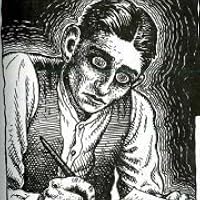
Emile quite literally lives in a glass cage, where he works, content because of his isolation, as a printer's proofreader. With his protruding eyes, his expressionless face, he knows he is unattractive to women. He chooses a wife as unattractive as himself, who is submissive because of her ugliness. They live humdrum lives, side by side, but there is little intimacy between them, and no true understanding.
Little by little, the reader is gripped with apprehension. Emile's passivity masks an ominous undercurrent, a subcutaneous rage that has built up since childhood. He is one of those people we read about when it is too late--when they have trapped their unsuspecting victims in a locked room, out of sight and earshot.
Georges Joseph Christian Simenon (1903 – 1989) was a Belgian writer. A prolific author who published nearly 500 novels and numerous short works, Simenon is best known as the creator of the fictional detective Jules Maigret. Although he never resided in Belgium after 1922, he remained a Belgian citizen throughout his life.
Simenon was one of the most prolific writers of the twentieth century, capable of writing 60 to 80 pages per day. His oeuvre includes nearly 200 novels, over 150 novellas, several autobiographical works, numerous articles, and scores of pulp novels written under more than two dozen pseudonyms. Altogether, about 550 million copies of his works have been printed.
He is best known, however, for his 75 novels and 28 short stories featuring Commissaire Maigret. The first novel in the series, Pietr-le-Letton, appeared in 1931; the last one, Maigret et M. Charles, was published in 1972. The Maigret novels were translated into all major languages and several of them were turned into films and radio plays. Two television series (1960-63 and 1992-93) have been made in Great Britain.
During his "American" period, Simenon reached the height of his creative powers, and several novels of those years were inspired by the context in which they were written (Trois chambres à Manhattan (1946), Maigret à New York (1947), Maigret se fâche (1947)).
Simenon also wrote a large number of "psychological novels", such as La neige était sale (1948) or Le fils (1957), as well as several autobiographical works, in particular Je me souviens (1945), Pedigree (1948), Mémoires intimes (1981).
In 1966, Simenon was given the MWA's highest honor, the Grand Master Award.
In 2005 he was nominated for the title of De Grootste Belg (The Greatest Belgian). In the Flemish version he ended 77th place. In the Walloon version he ended 10th place.
"At last he found himself back in his corner, his cage which protected him against everything that existed outside. After so many years he hardly knew the names of the men who worked in the pressroom, right under his eyes." - Georges Simenon, The Glass Cage
Georges Simenon made it a practice to carefully observe individuals on the street, pick out an interesting face and imagine that person dealing with an unexpected happening that would strip off all comfortable social clothing and serve as impetus to push him or her (usually a him) to the edge. Simeon would then use that very same man or women as his central character in a novel.
And in a Simenon novel, the unexpected incident nearly always takes place at the very beginning in Chapter One. For example, The Strangers in the House has Hector Loursat, a man who was a brilliant attorney in his younger days, forced to arouse himself from his eighteen-year hermit-like existence by a murder committed in his own house. With The Man Who Watched Trains Go By, shipping clerk Kees Popinga is shaken out of his bourgeois slumber by the collapse of his employer’s business. Again, in both cases, the decisive event occurs in Chapter One and the novel is, in effect, the protagonist dealing with the catastrophe.
The Glass Cage is the exact opposite: Emile Virieu’s life transforming episode takes place on the last page of the last chapter. In this way, Simenon's novel is a laser-like examination of Emile's life prior to rather than after the calamity.
And what a life. Emile is the second child of a couple residing in a small French town where his father is a baker and confectioner. Geraldine is his older sister. Even as a baby, Emile’s mother thinks something might be wrong because Emile does not cry nor does he laugh, he simply sits mute observing the world through large, expressionless eyes.
So it goes on throughout Emile’s boyhood and even into adulthood: no smiles or frowns, no friends or chatter or playing outside - Emile continues to remain still and spends many hours reading books. I picture Emile looking a bit like actor Peter Lorre only uglier. Life as forever flat – no highs, no lows; no joy, no sorrow, the barely audible hum of moving through the world in neutral with the emotions turned off.
Although Emile always has his nose in a book, we are never informed what type of book; there are no titles or authors given, instead Georges Simenon leaves it to the reader’s imagination. My own inference is our Mr. Placid reads dictionaries and encyclopedias along with some geography and travel books, certainly no novels or poetry since the third-person narrator informs us more than once Emile is not interested in people.
Incidentally, third person is a most effective way to tell this story - a reader can hover above Emile and view his entire life as if contained in a cube of glass, very much in keeping with Emile’s working year after year in a solitary glass cubical as a proofreader for a minor Paris publisher.
From what I’ve written so far, does Emile Virieu give you the creeps?
He certainly gives many men and women the creeps as he takes he walks on the streets of Paris with those big. expressionless eyes. Emile can sense people cast sidelong glances at him, judging him as strange – and he doesn’t like it.
Emile goes and gets himself married at age twenty-five to a woman three years his senior, an ugly women by the name of Jeanne. This is Jeanne’s second marriage; her first husband died of an infection. Emile moves into Jeanne’s furnished Paris apartment, has sex with Jeanne the first few weeks and then never again (they have always slept in separate beds and besides which, Emile can’t have children).
The couple settle into a dreary, colorless pattern and so it remained for twenty years. Jeanne fixes Emile two boiled eggs for breakfast, the same meal he has always eaten even as a boy; they never quarrel, they watch television together and end each evening with a “Good night, Emile." "Good night, Jeanne.” and that’s it.
Emile doesn’t like to take vacations as he would much prefer to spend his days in his glass cubical doing his proofreading. Then he decides at age forty-four a trip to Italy wouldn’t be a bad idea. Jeanne agrees. Off they go, however their experience is less than ideal – they go to the beach but Emile feels completely out of place with his flabby, pasty white skin and on top of this, neither of them can swim.
They visit the museums and walk the streets of the famous cities but all this does is bring Emile’s sense of alienation into sharper focus: "They were his fellow human beings, but he could see no resemblance to himself in them. What is more, he regarded them as his enemies. He resented their being there; he hated them for being themselves, for behaving differently from himself, for smiling and laughing, for taking in the sunlight, the surroundings, the sights and sounds through every pore of their skin."
Emile and Jeanne return to Paris and Emile encounters more problems and issues that upset his routine, beginning with his brother-in-law Fernand wanting to divorce his sister Geraldine. Upset on top of upset, personal, family and then, if this isn’t enough, new neighbors across the hall.
How much can a man like Emile take? One of the starkest, most unsettling existential tales you will ever encounter. What gives Simenon’s The Glass Cage a particular sting is how similar Emile Virieu’s lackluster routine is to a vast number of men and women working and living in our modern society.
Bust of Georges Simenon in his home city of Liege, Belgium
The Glass Cage was first published in 1971. This is my first time reading the book, and maybe my second or third novel from the celebrated Georges Simenon, who was both prolific and critically acclaimed as an author. Most of his books are mysteries, following the famed detective Maigret, and when Glenn Russell recommended this book as one of his four or five favorites, I expected it to be a Maigret murder mystery. I was wrong, as this is a novel of murder, but not a mystery novel, one that explores how it is a seemingly ordinary person might, after decades of never having done so, commit murder.
The Glass Cage is the story of Émile Virieu, a proofreader of regular habits. When I realized this was not a detective story, but knew (from the book jacket) that it involved a murder, I began to associate Emile as a kind of middle-aged Meursault, the nihilist from Camus’s The Stranger. Emile has from childhood been an outsider, mocked for having “glass eyes,” which is to say he seems to have n0 emotions. He neither hates nor loves anyone, though he eventually marries Jeanne because he prefers not to be alone, though they talk little, for twenty-five years. He has migraines that no medicine seems to ease.
Emile says something mildly to himself as he imagines the (slim) possibility of Jeanne’s ever leaving: “I’d kill her,” which of course sets up an expectation, though Jeanne only cares for him.and is perfectly docile. Four surprising events happen in this year: Emile suggests they travel to Italy for their holiday (though he neither has a great or terrible time there), and Emile later suggests that Jeanne get a dog. Three quarters of the way into the book, which is narrated in third person, from the perspective of Emile, not much happens except to establish the mundanity of their lives, and his “nowhere man” persona. He is apathetic, possibly nihilistic, but he’s never been violent. He is only extreme in his passivity. Theres a strong existentialist vibe to this book, perfect for 1971 Europe.
The third event occurs to Emile’s brother-in-law, who had long had numerous affairs, and who comes drunk to Emile’s house professing his undying love for his latest girlfriend (and not Emile’s sister). Later (spoiler alert?) the guy kills himself at the door of his girlfriend’s apartment. He acts, Emile observes, in a kind of passion Emile has never felt.
The fourth event is that a young couple moves in across the hallway, and for perhaps the first time in his life he notices the 20-year-old woman, Lina, who notices his noticing and somewhat flirts with him. Is she teasing him? He’s just a big oaf, and clearly asexual (we know this because he has had very little sex in his life, including with his long term wife), except he makes a point to leave for work in the morning when she goes out to shop. For reasons he can’t name, he becomes increasingly agitated. He knows he is not in love with the young woman, but she functions as a kind of irritant to his life.
Then a fifth thing happens, seemingly small, but it is consistent with what happens to Emile’s brother-in-law, in a way. Emile’s sister wants Emile to talk her twenty-year-old son out of impulsively leaving for America, but Emile supports him making the move. Has Emile ever made such a move? Well, he left his parents to head to Paris, but never since.
So, yeah, there’s a murder, an impulsive act, and it takes place in the last page of the book, and I won’t tell you what happens. Simenon writes like a warm knife slicing through butter. So smooth! Seemingly effortless. Georges Joseph Christian Simenon was a Belgian writer who published an astounding 500 novels and other short works. When he planned the Maigret books he said he wanted to write books that could be read in a couple hours, in one sitting, and this is entirely possible. This book, Maigret-less, is also a short read. I'd recommend you check this guy out, one of the greatest writers of all time, by critical and popular reputation.
Oh, the title? It’s really a reference to the only place he feels comfortable, at work, doing his job every day, in a glassed-in cubicle:
"At last he found himself back in his corner, his cage which protected him against everything that existed outside. After so many years he hardly knew the names of the men who worked in the pressroom, right under his eyes."
I don’t like how women are treated by this guy, finally, something that only emerges in the closing pages, though it is true he does not love or respect any man, either. Most people find Emile and Jeanne unattractive, and they use the word “ugly” to describe her, which is an ugly word to use for someone so nice and doting. Emile begins to acknowledge this criticism of her and this word, too, unfortunately. There’s some complicated tension in the book about male-female relationships, from the brother-in-law’s affairs to Emile’s relationships with Jeanne and Lina. But I liked the book quite a bit, thanks Glenn Russell. It’s a bit haunting, subtle, staying with me in its quiet way. I admire the writing that explores how the extraordinary might come about in “ordinary” lives.
This book was a quick read and pleasant enough to read but if I did not read the inside cover of the book jacket I would not know that supposedly at the end of the book the protagonist Emile would have create a psychopathic act. I don’t get the title of the book either, The Glass Cage. He worked at a publishing house in a square glass office (hence the title of the book) but it’s not like other employees at the workplace ogled him and made fun of him, and he didn’t mind working there (ergo why was it called a cage?). He supposedly was not attractive and neither was his wife; there was no deep relationship between them but they certainly got along. I am not sure he derived much enjoyment in his life – that is clear from the book when he was growing up (although his parents seemed to be nice) and then in later life – he was in his mid-40s for a good part of the book. He had a sister whose husband had a mistress -the husband ended up committing suicide. Emile had migraine headaches. He a couple of times in the book had feelings of hating other people.
I’m sorry but things just did not add up in this novel for me to believe he would have created a psychopathic act. Because really most of his thoughts and all of his actions up to the psychopathic act was not that of a psychopath. Sometimes when reading I know something bad is going to happen because the author leads one down the primrose path and drops hints along the way and it builds up and builds up and like…. “oh, damn, something bad is going to happen”… Here I knew something bad was going to happen only because the inside of the dustjacket told me so and I was at the final page!
The Glass Cage was first published as La Cage de Verre in 1971, and translated into English by Antonia White. It is the sad story of Émile Virieu, a man cut off from all others, seemingly indifferent to all emotion, and to what others think. He literally has no reaction to others, and this, added to his peculiar appearance, causes people to treat him with reserve and even suspicion. Émile works as a proof reader, isolated in the glass cage of the title which is suspended over a printing works. It is the only place he feels at home, never speaking to any of the printers, indulging his love of grammar by correcting proofs, happily protected from intrusion by the world. Émile is married, to a wife he is indifferent to, an unattractive woman he married for the conveniences of companionship. He has suffered from migraines since childhood, which has further isolated him. He preferred then to read than play with others. Even the suicide of his brother in law, whose life unravels when he falls for a younger woman who rejects him, and his wife will not divorce him, fails to unsettle him. Or perhaps it does. Increasingly, Émile’s thoughts turn to disease and death. He notices an attractive woman who is a new neighbour, who, surprisingly, flirts with him, and she becomes the focal point of all his lifelong resentments. This is a novel in which nothing happens until almost the last paragraph, and the suspense grows stronger and stronger until the end. It is part of Simenon’s skill as a writer that the reader slowly, imperceptibly, becomes Émile, suffers his resentments, makes his reflections on life, and finally, almost inevitably, lashes out in a futile yet destructive gesture. This is what Simenon does so well, getting under the skin of an ‘ordinary’ man and revealing the madness within, along with a melancholy sadness that human nature should be that way.
I think I'm finally getting a little tired of Simenon. Blah blah all people are terrible blah blah women are the worst blah blah murder. I'm still probably going to get another one the next time I'm at the library, though.
This book reads almost like Anita Brookner. These two main characters are as thick as cement and as mobile as glass. This novel is fantastic! I don't dare give it a 5 because who wants to read about cement?
I really like this author. The book is about an ugly, hopeless man who slowly starts to realize there may be a chance for joy in his life. Then one last insult causes him to unravel. My favorite line is " Are not all human beings enemies of the solitary man?"
It's a good thing Simenon is not as verbose as Stephen King or John Saul. The reader would have been mauled beyond all recognition if this book was any longer.
I don’t know why they published this one except that Simenon was popular and had a good run with his Inspector Maigret books. He published 400 novels plus a lot of stories as well. If you’re going to write that many books, it’s inevitable that some will be more successful than others. Back around 53 years ago, I read a couple Simenon mysteries and recently thought I might try a couple more. But, with this one, I think I drew a blank. It’s in the same Simenon style—more atmosphere, less mystery—but in “The Glass Cage” he describes the lives of an obviously psychiatrically-challenged man and his silent, wooden wife. A dog comes to bring a bit of life to Jeanne, but Emile spurns human contact almost completely. His sister’s marriage breaks up, her philandering husband commits suicide after his amour laughs off marriage. Almost as an after-thought, Emile, who had been shunned as a bit weird by everyone since childhood, gets fascinated by a young neighbor, but not sexually. He kills her. That’s the end. Emile worked at a publishers’ in a room like a glass cage. Obviously it’s a metaphor of his isolation from normal human life and relationships. But, Monsieur Simenon, what about a plot?
No, sorry, this one was not for me. Read some other one of the 400!
A thrilling little curiousity. On the one hand, it's a schlockier read than a lot of Simenon's books, which is interesting to consider given that it's not juvenalia, having been written relatively late on in Simenon's career. We are made to understand countless times that the protagonist is seemingly without emotion, a bloodless logician. Any decision he makes, whether it be to marry or to fulfill a promise to his sister is made with a sharp regard for only efficiency and sensibility. Simenon then throws into the mix a few distractions to let us know that everything will ultimately unravel, or I guess to stay more appropriate to the title, shatter. Even this, our "hero" considers only a foregone conclusion, even as a little humanity seeps in: "His throat had gone dry. What was happening htis morning did not surprise him. Lina's words were only the climax of something that had begun long ago in the distant past." This one was fun in the way that it hurtles toward the inevitable.
Émile n’aime pas les gens et les fuit autant que possible. Il a épousé une veuve, pas trop belle et pas trop envahissante qu’il évite – autant que possible – de toucher. Au boulot, idem. Correcteur dans une imprimerie, il s’enferme dans sa cage de verre pour travailler seul.
Mais la vie va se charger de lui jeter bien des encombrants sur son chemin. À commencer par sa sœur et son beau-frère volage en pleine crise, puis, sa jeune voisine, insouciante et… fort envahissante.
Une plongée un peu glauque et pourtant fascinante dans les méandres émotionnelles fort perturbées d’un misanthrope apathique
First Georges Simenon novel I've read (I randomly picked it up off a shelf). As someone who read this with 0 expectations, I'd give this a solid 4/5 stars! This is a very easy read and not a super climatic one as well, but it is intriguing. For most of the book, I wondered "how will this end? What will come out of this?" I stayed curious throughout the entirety of this novel, and I enjoyed not being able to guess the ending! I will definitely be reading more from him, as he has published over 400 books. Wow!
I read this a long time ago, only remembered that it was a psychological study rather than a murder mystery. It is a study of a sociopath. Simenon is a good author to practice French with--a clear style and lots of idiomatic conversation.
Two ordinary people, leading ordinary lives. They do not love each other, yet they are companionable. They are married. Emile is outwardly content but inside he is seething. The story ends as it must.
‘He was the solitary man, and they were aware of it. His look, his whole bearing bore no resemblance to theirs. He lived in a world of his own; in his eyes, these people he encountered were only shadows.’
Deze prachtige 'roman dur' van Simenon kocht ik in Brussel, toen bleek dat ik te weinig boeken had meegenomen op vakantie. Deze hardcover was een koopje voor 7 euro. Het verhaal gaat over Émile Virieu, een autistische man, die het leven aankan zolang het voorspelbaar verloopt en het contact met zijn medemensen (zoals collega's, die hij vooral beschouwt vanuit zijn 'glazen kooi') tot een minimum beperkt is. Als een nieuwe jonge buurvrouw hem uitdaagt, raakt hij uit balans, met fatale gevolgen.
Je devine comment Simenon a écrit autant: il n'avait aucun sens critique, aucun sens de l'intrigue - bref, il écrivait n'importe quoi. Non seulement il ne se passe rien dans cette nouvelle, mais on peut y voir des restes réchauffés de Camus et de Dostoievsky.
Je viens de lire trois Simenon, tous trois des navets, et je puis dire que sa bonne réputation m'est incompréhensible. Cette nouvelle ne méritait pas d'être publiée.
Does anyone read Simenon anymore? I think I read every volume, and provided guaranteed quick, satisfying reads for years. The Glass Cage is a psychological thriller, not a crime mystery.
The Glass cage is one of Simenon's many romans durs, or "hard-novels." While many of Simenon's Maigret novels are best known, it was in his romans durs that he expended his greatest efforts and accomplished his greatest artistic successes.
The Glass Cage is a first-person narrative placed inside the mind of Emile Vireu, an introverted social outcast who is slowly pushed into a mania of his own making.
As with many of Simenon's novels, there is a psychological undercurrent which shapes his protagonists life and distorts his epistemological understanding; this is shared with Simenon's characteristic to-the-point prose and misogynistic hints.
The Glass Cage is a fairly short read at about 150 pages, but an all-consuming read that is best digested in a few long sittings.