I received an ARC of “A Natural History of Magical Beasts: From the Notebook of Dr. Dimitros Pagonis” from NetGalley and Quarto Publishing Group in exchange for an honest review.
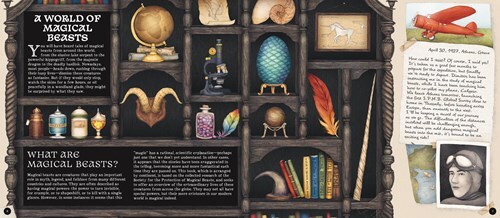
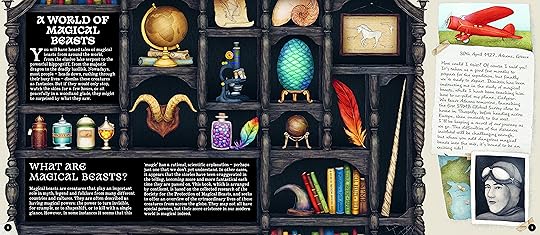
Written by Emily Hawkins, this book would not have had as much impact if Jessica Roux hadn’t illustrated it. Few genres, like PB’s, rely heavily on illustration. And while this book was created for a much older audience, the illustrations are a vital key to the book’s success.
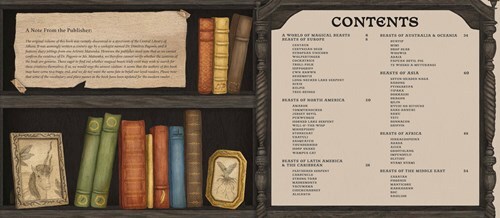
Hawkins, however, equally ensured that this book would be a success by focusing on diversity. The author arranged this book into 7 chapters: Europe, North America, Latin America and the Caribbean, Australia and Oceania, Asia, Africa, and the Middle East.
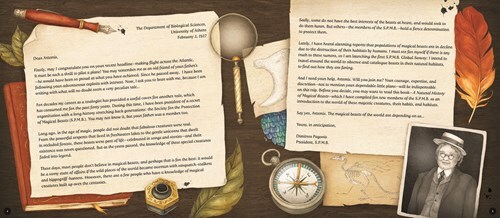
The book begins with a zoologist named Dr. Pagonis, who is the current President for the Society for the Protection of Magical Beasts. In about 1927, Pagonis contacts a young girl named Artemis Matsouka who lives in Greece. Artemis’ father was once a member of the society, and Pagonis asks Artemis to accompany him on a survey to locate declining beasts. He gives Artemis a book (the one that readers have in their hands) and together they begin traveling the world. Through it all, Artemis takes notes which are found throughout the book.
The book features mammals in all 7 regions. However, instead of just focusing on the mythical animals of each country’s predominant cultures, Hawkins introduces readers to a wide variety of often lesser known indigenous groups. For example, she discusses creatures of the Māori (New Zealand) and Wemba Wemba (Australia); mythical animals of the Zulu, Xhosa, and Fon (Africa); tales from Jordan, Syria, and Iran; and creatures that appear in tribal stories of the Lenape, Wampanoag, and Anishinaabe, among other North American tribes.
What I really love about this book is that in addition to showing readers what some of the mythical indigenous creatures are, she also looks at the current mythology of the dominant cultures in countries around the world. For example, the Drop Bear of Australia and the American New Jersey Devil.
For each of the creatures, Hawkins included the habitat, regions, features, size, diet, and behavior. I was surprised that Hawkins chose to classify the Quetzalcoatl as a dragon! In fact, this actually helped the author, who took great pains to show a variety of different creatures around the world, all belonging to the same “family.” For example, she showed how a number of different dragons at-round the world were related, and even did the same thing for unicorns (after the Alicante, the unicorn-like Qilin from China is my favorite!).
The story ends when both Pagonis and Artemis disappear from a hotel in Jordan. Later, Artemis’ book and papers are “discovered” after they end up in the Central Library of Athens.
Overall, this is a richly illustrated book on mythological creatures. Although the list of included creature’s isn’t comprehensive by any means, this would be a lovely gift for either young children, pre-teens, young adults, and even older people who are mythology enthusiasts. This would also be an excellent introduction to young people who are in other cultures, as the author included numerous indigenous tales.