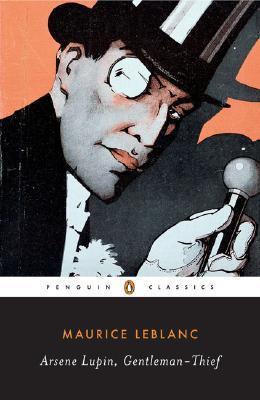
Librarian note: Not to be confused with the first collection of 9 Arsène Lupin stories, titled Arsène Lupin - Gentleman Burglar, sometimes as The Extraordinary Adventures of Arsène Lupin - Gentleman Burglar, this is a collection of 13 stories from across all the books by Maurice LeBlanc
The suave adventures of a gentleman rogue—a French Thomas Crown Created by Maurice LeBlanc during the early twentieth century, Arsene Lupin is a witty confidence man and burglar, the Sherlock Holmes of crime. The poor and innocent have nothing to fear from him; often they profit from his spontaneous generosity. The rich and powerful, and the detective who tries to spoil his fun, however, must beware. They are the target of Arsene’s mischief and tomfoolery. A masterful thief, his plans frequently evolve into elaborate capers, a precursor to such cinematic creations as Ocean’s Eleven and The Sting. Sparkling with amusing banter, these stories—the best of the Lupin series—are outrageous, melodramatic, and literate.
13 stories: The Arrest of Arsène Lupin Arsène Lupin in Prison The Escape of Arsène Lupin The Mysterious Railway Passenger The Queen's Necklace Sherlock Holmes Arrives Too Late Flashes of Sunlight The Wedding-ring The Red Silk Scarf Edith Swan-neck On the Top of the Tower Thérèse and Germaine At the Sign of Mercury
Maurice Leblanc (1864 - 1941) was a French novelist, best known as the creator of gentleman thief (later detective) Arsène Lupin.
Leblanc began as a journalist, until he was asked to write a short story filler, and created, more gallant and dashing than English counterpart Sherlock Holmes.
*****A new series featuring Arsene Lupin has just been released on Netflix.*****
”It was, indeed, the famous necklace, the legendary necklace that Bohmer and Bassenge, court jewelers, had made for Madame Du Barry; the veritable necklace that the Cardinal de Rohan-Soubise intended to give to Marie-Antoinette, Queen of France; and the same that the adventuress Jeanne de Valois, Countess de la Motte, had pulled to pieces one evening in February, 1785, with the aid of her husband and their accomplice, Rétaux de Villette.”
A necklace worthy of the very best thief.
The Queen’s Necklace is famous for being worth so much money, but also because of the scandal that surrounded it. It all begins with Marie-Antoinette becoming disenchanted with the lavish, licentious lifestyle of the Cardinal de Rohan-Soubise. She finally banned him from her company. The Cardinal was desperate to get back into her good graces and contacted Bohmer and Bassenge about this astoundingly expensive diamond necklace that they had been unsuccessful in tempting any of the Royal families to buy. Now there seems to be some confusion between the Queen, their mutual “friend” Madame Du Barry, and the Cardinal. The Queen didn’t want the necklace. Madame Du Barry seems to have told the Cardinal she did. The Cardinal made the arrangements on behalf of the Queen, but gave the necklace to Du Barry to deliver.
The necklace never arrived to the Queen.
When B and B does not receive their scheduled payments for the necklace, and the Queen insists that she never intended to purchase the necklace things got interesting in a hurry. The Cardinal was arrested in the Hall of Mirrors, very publicly, in front of the court.
Can’t you hear the gasps and the insect chatter of whispers?
Madame Du Barry and her accomplices were arrested. The Cardinal was found to be a dupe in the whole affair and was acquitted. Madame Du Barry on the other hand was found guilty and sentenced to be branded with the letter V for voleuse (thief).
I always thought V was for Vendetta.
Anyway in true French fashion, because they hated the Queen, the peasants interpreted this trial as a condemnation of the royals and assumed the Queen was involved in the whole affair.
Now at the time of our story the necklace is in the hands of an aristocratic family, fallen on hard times. The diamonds have been sold long ago, replaced by fake stones. The setting though is still worth a small fortune and it is the most prized possession of the family. It will prove to be the very first successful theft by the soon to be famous...Arsène Lupin.
That is not his real name, but then he has chosen a profession where using one’s own name is not advisable.
Maurice LeBlanc
Maurice LeBlanc was asked by the newspaper he was working for to come up with a French version of the very popular Sherlock Holmes. The stories of this debonair French thief were wildly successful. So successful that at several points LeBlanc, as tired of his creation as Arthur Conan Doyle was of his, attempted to create new characters, but the public’s demand for Lupin was too insistent and soon he would have Lupin merge into the stories of his other lead characters.
Marius Jacob, inspiration for Arsène Lupin
LeBlanc based Arsène Lupin on the real life gentleman thief Marius Jacob. He formed a band called the workers of the night. Now Jacob was not your typical criminal. He had rules. He did not rob people in a useful profession such as architects, doctors, artists, etc., but he did consider bosses, judges, soldiers, and the clergy to be social parasites and worthy of robbery. He was very clever in how he committed his robberies leaving very little trace and a puzzle of how he actually accomplished the crime.
”Where force fails, cunning prevails.”
This is a series of short stories and are not in any chronological order. The reader is able to see Arsène Lupin at various stages of his career from a clever child to a young man trying to establish a reputation to a mature man who by merely mentioning his name can inspire terror and despair among those with bibelots they wish to continue to possess. Of course he will also inform you if you have been duped by an unscrupulous dealer.
"Arsène Lupin, gentleman- burglar, will return when the furniture is genuine."
The plots of the stories are clever and compelling. I would often intend to only read one story before moving on to other reading, but would find myself usually reading three or four before I could pull myself away. I was often fooled by the solutions and would actually find myself smiling at being so cunningly deceived. I found Lupin’s arrogance and posturing and daring amusing. He isn’t annoying at all. He is a man against the world and winning.
LeBlanc can’t resist having a story involving Sherlock Holmes. He very cleverly has Lupin and Holmes involved in the same mystery, but not competing against each other. There is no winner or loser, but at the same time it was fascinating to see LeBlanc’s view of Holmes. It was a very reverential piece of writing that I think must have pleased Doyle immensely.
In 2004 there was a film made starring Romain Duris, Eva Green and Kristin Scott Thomas that I intend to see very soon.
Highly recommended to those that appreciate clever thieves and are fans of Sherlock Holmes. I bought twelve novels as a digital bundle because the price was ridiculously cheap and I’m so glad I did because periodically I will need a fix of the gentleman-thief Arsène Lupin.
This book was such a fun read. I'm not a particular fan of short story collections of detective fiction, but this collection beat me. There are nine short stories in this collection, and while I was differently attracted to them, all had one thing in common. And that is humour. This collection was altogether too hilarious.
Arsene Lupin, the Gentleman-Thief, is one of those notoriously attractive characters. :) His cleverness in his cunning is quite impressive. But none of these have the same charm as his audacity! This is the first time in my reading life that I was fascinated by a criminal. :)
The stories were not brilliant in that the mystery was not much of a mystery. But, they were all appealing in various degrees. I found Madam Imbert's Safe particularly brilliant in which even Arsen Lupin was outwitted.
I truly enjoyed this collection, which is my first exposure to Maurice LeBlanc's Arsene Lupin series. LeBlanc may not be brilliant in his creation like Arthur Conan Doyle, but he has certainly invented a Sherlock Holmes of crimes.
This is a collection of short stories featuring Arsene Lupin, Gentleman Thief. The Arrest of Arsene Lupin: A trans-Atlantic cruise ship gets a message saying that Arsene Lupin is on board, with a recent forearm wound and going by the name R-. The message gets cut off and hysteria grips the ship. Everyone whose name begins with R is suspected of being Lupin.
The writing is good and there are only slight hints that it's been translated from French. The story was well done and I'm a little ashamed that I didn't see the reveal coming.
Arsene Lupin in Prison: Baron Cahorn gets a letter from Arsene Lupin saying that either he should box up some of his prize paintings for Lupin or Lupin will collect them himself in one week's time. But Lupin's in prison, isn't he?
Lupin in Prison was even better than the first story. Lupin's way of robbing Cahorn from within prison walls is both innovative and plausible. The relationship between Lupin and his nemesis, Detective Ganamard, looks to be the best part of future stories.
The Escape of Arsene Lupin: Lupin, still in the clink, continuously tells people he won't be attending his trial. The authorities intercept a message from an accomplice of his and try to catch him in a trap. Little do they know, Lupin has more than one trick up his sleeve.
As of this story, I am officially a Lupin fan. He's the anti-Holmes, a criminal genius who's still a likeable character. Speaking of Holmes...
Sherlock Holmes arrives too late Lupin's casing a castle under a false identity. He has to be quick with his burglary, however. Sherlock Holmes is on his way...
Usually, crossovers don't live up to expectations. I'd say this one is different. Both Lupin and Holmes are given their due and neither is made to look markedly inferior to the other. The mutual respect between the two is well done.
These are just a sampling of the Lupin adventures contained within. I recommend them to mystery fans, especially those who like their protagonists brash and witty. Arsene Lupin is clearly influenced by Sherlock Holmes but has things in common with P.G. Wodehouse's Psmith character, as well as superheroes like Batman. He plans for every eventuality. Where Holmes uses his intelligence for good, Lupin uses it for personal gain, governed by a somewhat noble code of ethics.
2012 Note: I'm reading The Quantum Thief by Hannu Rajaniemi. It's partly an sf homage to Lupin and brought back fond memories of reading this.
I really enjoyed the adventures in this first volume of Arsène Lupin. Lupin is a master of disguises and schemes and uses these in his audacious crimes. His crimes are generally focused on the wealthy class, and often times it turns out that the people he robs are not the best of people, so you end up rooting for his crime sprees.
I have lived so much. This is a French-language classic. I have listened to it on Audible, and it was so fascinating that the narrator had a French accent. The narration was of good quality. How did I found this book? The Lupin Netflix series inspired me to search for the original text. Both a very hilarious and adventurous.
When reading the manga, the Arsene Lupin I came to know as a child once more came to life before my eyes. Goodness, Lupin is so snaky, so arrogant and so full of himself! But on the other hand you can't help cheering him on and adore him nonetheless.
Well, it really isn't the first time the Japanese had done this...but I like this new manga version with my whole heart!
Edited@26/09/2016:
After this re-reading, I lowed the rating to 3.7 stars.
The first few stories are still breathtaking: who can forget how Lupin makes his grand debut in The Arrest of Arsène Lupin? Or how he successfully robs a baron out of his fortune in Arsène Lupin in Prison? Or his mission-impossible-style escape in The Escape of Arsène Lupin?
Lupin's sassy attitude and the dialogues are still splendid. However, much to my surprise the murder mystery part of the stories isn't all that great; still I rather like the supporting character Inspector Ganimard and the short stories The Queen's Necklace (who can forget this impossible crime!) and Sherlock Holmes Arrives Too Late.
Brillante y divertido. Las historias de detectives y ladrones me gustan bastante, cuando están tan bien contadas y con una prosa tan elegante. La construcción del personaje es una maravilla.
The original gentleman burglar stories--first published in 1907 in French. I read the French version of book 1--the first in a long series by Maurice Leblanc. There are several short stories in each volume. It's a lot like Sherlock Holmes in that you're always trying to figure out how he did it, but the difference is that you are rooting for the bad guy.
I liked the story in which Arsene sends a note to a wealthy man and gives him a list of all the items in his house that he plans to steal, and how it would be so much easier if the owner would just box everything up for him--but not the painting over the mantle, since it is a fake...
150327: i do not remember when i last read Sherlock Holmes- only that this was much more fun for me, that however inspired by Conan Doyle, this gentleman thief is charming, comic, playful, and romantic and generous. he is not an intellectual puzzle-solver but first a criminal, later a detective helper, who maintains his curious ethics throughout his adventures, short-stories probably better read on occasion rather than in one concentrated dose... he is of the times and i think surrealists also liked him...
Masterful, ingenious crimes by gentleman-thief Arsene Lupin with at the end a tribute to the great english 'Brains' Sherlock Holmes; with a little twist:-)
"The unexpected always happens when Arsene Lupin is concerned in the affair."
Arsene Lupin is a thief. The French autthorities do not know how he looks like or even if Lupin is indeed his real name. He manages to elude them time and time again for he is a master of disguise. Yet what distinguishes Lupin from other thieves is his peculiar set of ethics: he does not appear to act out of malice and helps bring in criminals, in his particular fashion of course. He is thus known as a gentleman-thief.
I came to know of this book series in the same manner as so many, through the recently added Netflix series (which I am quite liking). Arsene Lupin is a complex fellow. His inventive genius and intellingence along with his uncanny ability to disguise himself (he is a "'man of a thousand disguises: chauffer, detective, Russian physician, Spanish bull-fighter, robust youth, or decrepit old man.") make him a nightmare for the police to track. But there is another facet to Arsene Lupin, he can also be charming, generous and uses his set of skills to bring down other criminals. I have to say that I really enjoyed this book. It was not only entertaining and fun but also well put together. These short stories linked and flowed quite nicely, the mysteries were remarkable and the characters intriguing. In a way, this is a whodunit in reverse. The way in which the prose is written made me root for Lupin desspite the fact that he was on the other side of the law.
Maurice Leblanc created Arsene Lupin in 1905. Gentleman-thief is the first of these series of novels and short stories that feature Lupin. In a few installments, Lupin comes against Sherlock Holmes. Due to objections from Arthur Conan Doyle, Leblanc had to change the spelling from Sherlock Holmes to "Herlock Sholmes" but of course the character is one and the same. I am glad to have come across this series and willl definitely continue reading on.
This book is a merging of two things I don't enjoy - short stories and mysteries that read like a puzzle you'd find in the back of Highlights magazine. However, I read it because it's a classic - Lupin is the French version of Sherlock Holmes. It turns out he is like a poor man's version of Holmes. Wow, Leblanc really stole his concept from Doyle, so much so that in one story he even includes Sherlock Holmes as Lupin's foil.
Reading this collection of short stories was such a slog. It took me forever to finish because I couldn't bear to read more than one story in a sitting. I never got a feel for the character. Leblanc stole the Scarlet Pimpernel idea of having the character be a ridiculously unbelievable master of disguise. Lupin can somehow 'change the shape of his face' among other over-the-top methods of disguise. Lupin's solutions to crimes was rarely explained in full. He was also super creepy towards women but I think Leblanc meant for the behavior to come across as charming.
All in all a weak substitution for Sherlock Holmes. I'm glad I read this collection of stories in order to form a view about this classic French mystery figure. And my view is negative. Lupin has not aged well. I think if I read this when I was 11, I would have loved it. But I didn't, and I don't.
52 Books Reading Challenge 2021/a book published by Penguin
I am quite happy to have found these books about Arsene Lupin. Got to know it through the Netflix series. I love detective stories like Sherlock Holmes or Miss Marple and Hercules Poirot. These stories are quite similar just with the difference that we don't follow the detective but the criminal. Though he is a thief, he is quite a nobel man, only taking from the rich and interested in tricky cases. In this book there are several stories that each are about one case but there are some strings that pull through the whole book. It was a fun read.
This is the first book in the series about Arsene Lupin the thief and gentleman. This is a similar idea to Raffles by EW Hornung.
The nine short stories cover Lupin's arrest, his time in prison, then his escape plus six further escapades involving jewellery, the return of incriminating letters and stolen items, and the unmasking of swindlers. A gentleman thief helps those in need and takes some items only to return them as the planning of a robbery is sometimes more thrilling than the robbery itself.
So, I'd never have picked this up if it hadn't been for one little thing: Hannu Rajaniemi's Quantum Thief. I was missing a thief in my life.
Fortunately, I enjoyed the taste of this French dish and especially enjoyed the aspects of the novel that were from Lupin's pov. From a pure story view, it was all standard pulp that reflected the late victorian era ending with a mild rivalry with Mr. Sherlock Holmes, himself.
I couldn't care less that there were copyright issues. Cameos are the pinnacle of flattery, no?
Of course, that wasn't even the brightest part of the tale. The anti-hero was rather heroic and selfless, all told, but never with his own money. Don't expect a modern Robin Hood, though. He definitely fights against his noble urges, and frankly, I'm glad that he does. I want to see this man succeed. And stay away from certain women. Both would be best, I think.
Enjoyable and fast reads. I might try hunting down the rest of the long series one of these days.
I am re-reading this at the moment. This is the first time Penguin issued this particular edition. Arsene Lupin is a major French literature character - where he basically steals from the Rich ... and keeps the dough. Sort of a nicer version of Fantomas.
I have a serious collection of the works - through out the years there are many many editions and stories - but very few in English. But I got editons from the 20's, etc. I first discovered Arsene Lupin in Japan. Over the years he became a popular Manga/anime figure - in these stories he's the grandsom of the original Lupin.
Nevertheless lets not go that route, and stay with the original. I like these books because they are basically amoral.
Arsene Lupin is such a charming character. His wit will make your mouth hang open. He offers you no choice but to love him. Enjoyed this book. Looking forward to seeing Arsene Lupin again
You don't even have to think twice since there's no point in denying that I've taken up this piece of writing due to Netflix's new series Lupin, featuring French actor and comedian Omar Sy, which has launched off 2021 with a bang. Arsène Lupin, a gentleman thief and master of disguise, is a huge smash in this amusing contemporary recreation of a legendary character in French mystery literature. This 19th-century novel features Arsène Lupin, who is essentially the French equivalent of Sherlock Holmes, whom he encounters in the book's last chapter. Holmes detects a mind that is in line with his own. Although Holmes does not catch the thief (because he is truly too late, as the chapter's title implies - Sherlock Holmes Arrives Too Late), he believes their paths will meet again. That is, I believe, exactly what happens in the sequel, but owing to copyright difficulties, it will never happen again. The book is episodic, with only a single plot thread running through each chapter. This is the fact because each chapter was first published as a short tale in the French magazine Je Sais Tout. This was a good novel, and I'll probably search for more in the series, though the Netflix series Lupin seemed more engaging and enthralling. He's a character that's impossible not to appreciate, since who doesn't enjoy a story about a sophisticated criminal?
First when I started reading this book, I was quite skeptical. The reason is that a thief is praised for his cunning and intelligent crimes. And also because author compares Arsene Lupin with Sherlock Holmes (one of my favorite characters), but in totally opposite way. Even the end: how Arsene Lupin steals Sherlock Holmes watches, and then returns them to him… But to be honest, I did enjoyed this short stories! Although he is kind of negative character (a thief), but he is a gentleman. He is like Robbin Hood, steeling only from rich people (although not giving money to poor). One of the stories, about his childhood.. How he started his career of a thief was very touching. He only wanted to protect his mom! Later, each story is sometimes funny, and definitely very clever. So I think, it worth reading it!
He's a clever thief but always a gentleman, can he outwit even the famous detective Sherlock Holmes?
Chapter I: The arrest of Arsene Lupin Chapter II: Arsene Lupin in prison Chapter III: The escape of Arsene Lupin Chapter IV: The mysterious traveler Chapter V: The Queen's necklace Chapter VI: The seven of hearts Chapter VII: Madame Imbert's safe Chapter VIII: The black pearl Chapter IX: Sherlock Holmes arrives too late
I couldn’t finish it. At all. The short stories are mostly way too unbelievable, and not all events are thoroughly explained which freaks me out. Probably I would have enjoyed it more when each short story was a book of its own. This shortness and so many absurd things happening, nah, not for me.
i really wanted to watch the show adaptation… also i rushed thru it so i could start this other book but honestly it was a lot of fun? lupin is just silly
Mon ami d'enfance - The Best of Lupin Review of the Penguin Books paperback (2007) translations selected from various French language originals (1906, 1911, 1922)
I remember first reading some of Maurice Leblanc's Lupin stories in my younger days when I literally picked up and read anything with Sherlock Holmes in the title. My first Lupins were therefore in Cosmopolitan Crimes : Foreign Rivals of Sherlock Holmes (1972). After that, it was slim pickings in the library or the bookstores in my neighbourhood. This was well before the years of inter-branch library transfers & holds or internet availability of course. I remembered Lupin regardless, primarily for the audacity and the magnitude of his heists and escapades. But also for his banter which even stretched so far as to regularly label his police nemesis Inspector Ganimard as mon ami d'enfance (friend of my youth) while Lupin again and always manages to make his escape.
So with the recent Lupin revival instigated by the new French Netflix series, I looked around for what was currently available in English translation. The anthology Arsène Lupin, Gentleman-Thief was the easiest to obtain. It is incorrectly labelled in Goodreads as Arsène Lupin #1, as it is not actually a full translation of the French original #1 Lupin - nouvelle édition de "Arsène Lupin, gentleman cambrioleur" à l'occasion de la série Netflix (Gentleman Burglar) (1906/2021) (the latter is the latest 2021 French edition released as a TV-tie-in).
Gentleman Thief has 6 stories from Gentleman Burglar (1906), 4 stories from The Confessions of Arsène Lupin (1911) and 3 stories from The Eight Strokes of the Clock. All told, I think there are 11 original books of Lupin novels and short story collections. Hopefully if the TV-series is popular enough in English (I don't really like the dubbed version, but each to their own taste) we'll see some English reprints as well in the future.
Gentleman Thief can somewhat be read as a novel as there are continuing threads in the plotlines from story to story and the overall "best of" selection takes the character arc from his early sneak thief days to his final manifestation as a "gentleman detective" living under an assumed name.
In any case, I was happy to renew my Lupin acquaintance and hope to find more of the stories in translation.
Trivia and Link I read Arsène Lupin, Gentleman-Thief due to the recent French Netflix reboot series Lupin, dans l’ombre d’Arsène (Lupin, In the Shadow of Arsène) (2021) which features a present day protagonist who is inspired by the fictional Lupin and with some of the story lines borrowed from the Leblanc tales, primarily The Queen's Necklace which is available in both Gentleman Thief and the original Gentleman Burglar..
Like many early mysteries, this was a succession of short stories featuring French master-thief Arsène Lupin, who gets away with everything short of murder but has a conscience and can be generous too. The final story included Sherlock Holmes as a character who is called to France to catch the famous thief.
Lupin clearly owes a lot to Raffles, but the stories are different and enjoyably grounded in their era. I particularly enjoyed the one where Lupin was installed as a secretary in the house of a couple who were said to keep a fortune in bonds in their safe.
Arsène Lupin is a gentleman burglar: educated, sophisticated, and as thoughtful about committing crimes as Sherlock Holmes was in solving them. He stole but also returned items under a number of circumstances: out of love, as part of a game, and as an honorable act.
Lupin was patient, meticulously planning his thefts (six months in one instance), and also picky in what he stole, entering Baron Schormann's home, for example, only to leave empty-handed. He left his card, where he indicated that he would return only "when the furniture is genuine” (p. 6).
Should Schormann advertise that his furniture is now genuine??? Would it be a badge of honor to have your pieces stolen?
The Extraordinary Adventures of Arsène Lupin, Gentleman-Burglar is a series of nine stories describing a series of thefts, not all successful. In some cases, but not always, Maurice Leblanc described how the theft took place (always meticulously planned, always without leaving a clue). He also posted stories in local newspapers – a little public relations campaign never hurt anyone!
“The Queen’s Necklace, the famous historical jewelry stolen from the family of Dreux-Soubise, has been recovered by Arsène Lupin, who hastened to restore it to its rightful owner. We cannot too highly commend such a delicate and chivalrous act.” (p. 104)
I read The Extraordinary Adventures of Arsène Lupin while also reading a book of essays and another of short stories – after watching the first episode in the French series on Netflix. These stories were fun – think Oceans Eleven: (complicated and well-planned thefts, although things did occasionally go wrong) – and could be great fun read aloud at bedtime.
Nonetheless, even though the copy I downloaded from Kindle Unlimited included five books in the series, I'm only reading one now. The stories don't flow as easily from one to another as I like. Although the stories all center around Arsène Lupin, they aren't clearly in order and occasionally have different narrators, which was somewhat jarring.