In Gentlemen Prefer Blondes, Anita Loos adopts the persona of blonde-about-town Lorelei Lee to satirize multiple aspects of contemporary 1920s society. Written as Lorelei’s diary, full of grammatical errors, misspellings, colloquialisms, double entendres, and linguistic faux faux pas, the book propels readers along the stream of Lorelei’s consciousness as she flits with her friend and foil Dorothy from one “gentleman” to another, from New York, to London, to Paris, to “the Central of Europe,” and back.
Although Lorelei is a small-town girl from Arkansas, who made her debut, according to Dorothy, “at the Elks annual street fair and carnival at the age of 15,” she’s got brains enough to have mastered the art of being blonde. Back in Little Rock, she was accused of murdering a “gentleman” named Jennings, but the jury acquitted her after three minutes when she testified that she was so shocked to learn that the gentleman in question was associating with girls who weren’t “nice,” that she became hysterical and her mind went blank—“and when I came out of it, it seems that I had a revolver in my hand and it seems that the revolver had shot Mr. Jennings.”
The judge was so impressed with her that he suggested she take the name Lorelei (we aren’t told what her given name was, although Loos says the character was based on a girl named Mabel Minnow)—“which is the name of a girl who became famous for sitting on a rock in Germany”—and go to Hollywood. She took his advice, but while in Hollywood she met Gus Eisman, who is “known all over Chicago as the Button King.” Mr. Eisman has set her up in New York, but only to improve her mind. “And he is the gentleman who is interested in educating me, so of course he is always coming down to New York to see how my brains have improved since the last time. … So of course when a gentleman is interested in educating a girl, he likes to stay and talk about the topics of the day until quite late, so I am quite fatigued the next day and I do not really get up until it is time to dress for dinner at the Colony.”
Lorelei meets other gentlemen in New York too, such as Gerry, who “seems to like me more for my soul.” But Gerry is not a realistic candidate for marriage. “So it seems that Gerry has had quite a lot of trouble himself and he can not even get married on account of his wife. He and she have never been in love with each other but she was a suffragette and asked him to marry her, so what could he do?”
Lorelei loves shopping, shows, dinners at the Ritz, jewels, and champagne: “I mean champagne always makes me feel philosophical because it makes me realize that when a girl’s life is as full of fate as mine seems to be, there is nothing else to do about it.”
At Mr. Eisman’s suggestion, Lorelei and Dorothy take their act on the road, or more accurately, on a ship to Europe. They are delighted when they arrive at the Ritz in London because it is full of Americans: “I always think that the most delightful thing about traveling is to always be running into Americans and to always feel at home.” One American they run into is the famous (real-life) actress Fanny Ward, who was in her mid-50s when the novel was published. “So now Fanny lives in London and is famous for being one of the cutest girls in London. I mean Fanny is almost historical, because when a girl is cute for 50 years it really begins to get historical.”
Wherever she goes, Lorelei manages to charm whatever gentleman she sets her sights on. But in Paris, she decides that she prefers American men. “So I really think that American gentlemen are the best after all, because kissing your hand may make you feel very good but a diamond and safire bracelet lasts forever.”
Meanwhile, Lorelei often worries about Dorothy making the wrong impression, because, unlike Lorelei, Dorothy is “unrefined.” But she does rely on Dorothy to help carry out the schemes she thinks up to snare (or un-snare) a gentleman. Dorothy appreciates Lorelei’s intellect: “So when I got through telling Dorothy what I thought up, Dorothy looked at me and looked at me and she really said she thought my brains were a miracle. I mean she said my brains reminded her of a radio because you listen to it for days and days and you get discouradged and just when you are getting ready to smash it, something comes out that is a masterpiece.”
Traveling on the train in “the Central of Europe,” Lorelei meets Henry Spoffard, a wealthy and famous American who “works all of the time for the good of the others” as a censor of plays and movies. Henry is a strict “Prespyterian,” which surprises Lorelei “because when most gentlemen are 35 years of age their minds nearly always seem to be on something else.” She thinks “it would be quite unusual for a girl like I to have a friendship with a gentleman like Mr. Spoffard.”
Will Henry be the one, the gentleman who wins Lorelei’s heart? She’s torn. When she and Dorothy plan a party, she doesn’t want Henry to know about it, “because all Henry has to do to spoil a party is to arrive at it.” But on the other hand, he is very wealthy. And Dorothy suggests that Lorelei should take a chance and marry Henry “because she had an idea that if Henry married me he would commit suicide about two weeks later.”
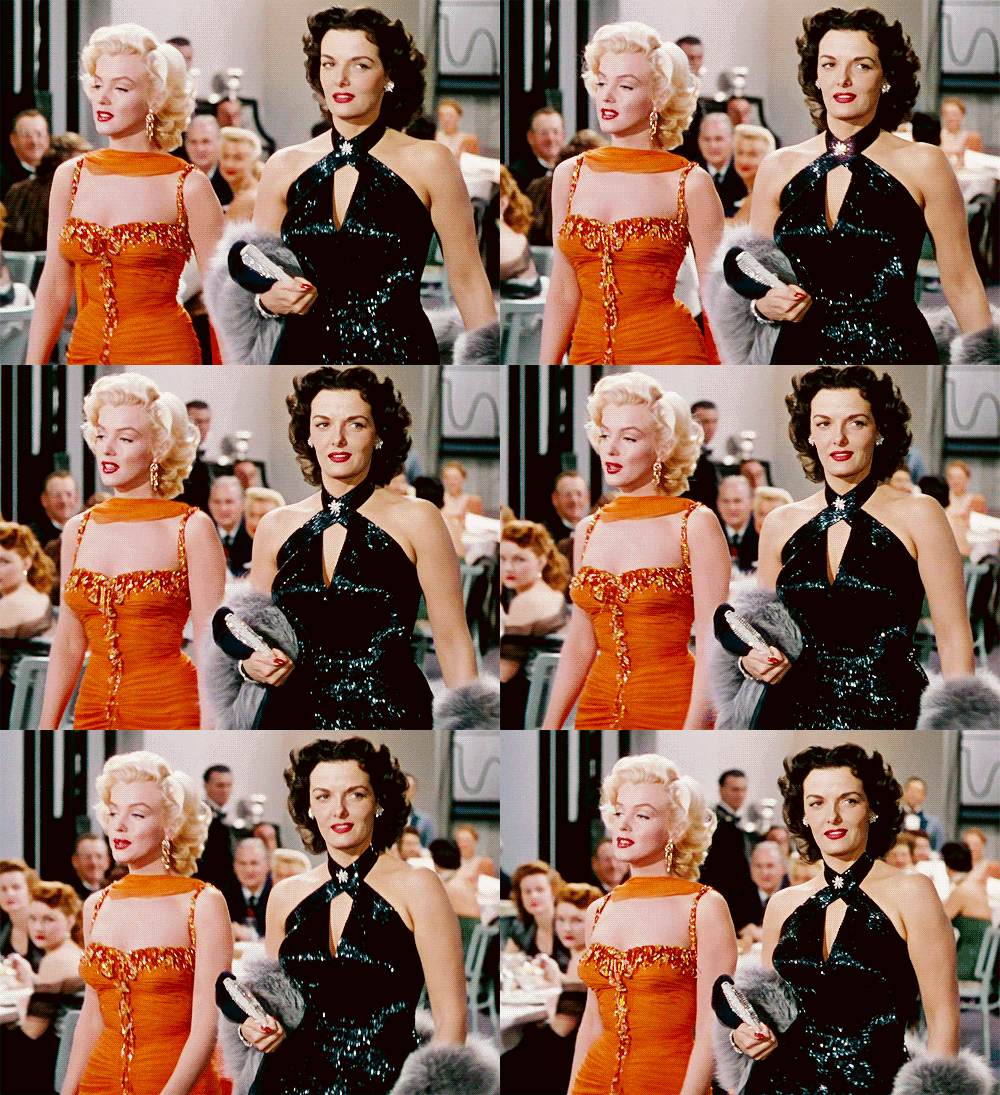
Gentlemen Prefer Blondes was published by the renowned publishing house Boni & Liveright in 1925, the same year they published works by Theodore Dreiser, Ernest Hemingway, William Faulkner, T.S. Eliot, and Ezra Pound. The book was a hit when it was published, and it has been made into several stage versions and adapted for the big screen by Howard Hawks in a 1953 release starring Marilyn Monroe and Jane Russell. I’ve never seen the movie, but it’s on my watchlist, especially after reading the book.
Does the book itself hold up almost a hundred years after it was published? I’d say yes, overall. Some of it is dated, but Lorelei is such an archetype that even modern readers can relate to her. And Loos’s clever linguistic gyrations mostly remain fresh and entertaining. I’m a fan.