Jump to ratings and reviews
Rate this book

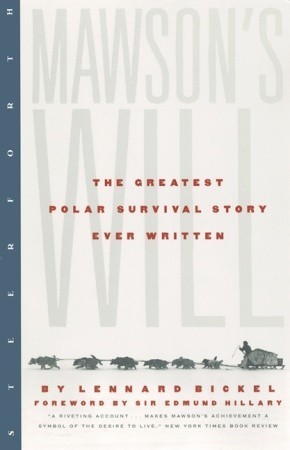
Mawson's Will: The Greatest Polar Survival Story Ever Written

Rate this book
The dramatic story of explorer Douglas Mawson and "the most outstanding solo journey ever recorded in Antarctic history" (Sir Edmund Hillary, mountaineer and explorer)
 
For weeks in Antarctica, Douglas Mawson faced some of the most daunting conditions ever known to blistering wind, snow, and cold; the loss of his companion, dogs, supplies, and even the skin on his hands and feet. But despite constant thirst, starvation, disease, and snow blindness—he survived.

Sir Douglas Mawson is remembered as the young Australian who would not go to the South Pole with Robert Scott in 1911. Instead, he chose to lead his own expedition on the less glamorous mission of charting nearly 1,500 miles of Antarctic coastline and claiming its resources for the British Crown. His party of three set out through the mountains across glaciers in 60-mile-per-hour winds. Six weeks and 320 miles out, one man fell into a crevasse—along with the tent, most of the equipment, the dogs' food, and all except a week's supply of the men's provisions.

Mawson's Will is the unforgettable story of one man's ingenious practicality, unbreakable spirit, and how he continued his meticulous scientific observations even in the face of death. When the expedition was over, Mawson had added more territory to the Antarctic map than anyone else of his time. Thanks to Bickel's moving account, Mawson can be remembered for the vision and dedication that make him one of the world's great explorers.

272 pages, Paperback

First published January 1, 1977

88 people are currently reading
4775 people want to read

About the author

Lennard Bickel

27 books7 followers

Ratings & Reviews

What do you think?
Rate this book

Friends & Following

Create a free account to discover what your friends think of this book!

Community Reviews

5 stars
858 (49%)
4 stars
573 (32%)
3 stars
235 (13%)
2 stars
51 (2%)
1 star
23 (1%)
Displaying 1 - 30 of 145 reviews
Profile Image for Natasha Johnson.
7 reviews4 followers
February 5, 2013
This book has a lot if sentimental value to me. I remember my mom reading this book to me when I was a child living in Alaska and showing me the mechanics of ice bridges by laying a graham cracker across two books. It kindled my spirit of adventure and discovery!
Profile Image for Ed Smiley.
243 reviews43 followers
May 17, 2012
The "Greatest" in the subtitle seems to be no exaggeration. I give a summary in the spoiler section of what Mawson survived, in case you think I'm kidding. But I think it's best you skip it, and just get the book.

It is an amazing story, and it is one of the best in the genre. I am more or less OK with the fact that the author has detailed what Mawson "thought" and "saw", as Mawson kept fairly meticulous records (except towards the end, in a state of extreme exhaustion), and carefully measured distances. The descriptions of the antarctic are sublime and terrifying. I would have liked to have a few maps with which to track the journey. But these are quibbles.

Many don't know the story, as it happened at the same time as the race to the South Pole, and the reports of Scott's death. Mawson had stubbornly refused the offer of joining the Scott expedition. He was a geologist, and realized that he could make a greater contribution by fanning scientific parties across the continent, with such tasks as locating the magnetic pole, rather than joining in a competition he did not have the resources to win, or be subject to the command of another. One result was that almost all that was known about the Antarctic in the early days was due to his expedition.


Mawson went 600 miles into absolutely unknown territory with two companions with dogs, food and adequate supplies.
However:

He returned, alone, barely alive, on foot and with nothing.
Profile Image for Jeannie.
94 reviews30 followers
November 1, 2011
This is absolutely one of the best books I have ever read. I found it in the library by accident several years ago and read it for a home school unit study. Within a few pages my world was all about following this incredible man and his companions through their travels and trials. Home school lessons revolved around Antarctica and Douglas Mawson. This incredible and true story left me breathless and amazed. I remember talking about Mawson to anyone who would listen. If I could meet an historical hero, Mawson just might be my top choice. All these years later I still feel the excitement and passion I felt while reading this book. I would recommend it to anyone who is looking for a great and inspiring adventure story. I'm going to put it on my read-again-in-2012 list.
Profile Image for Courtney.
570 reviews48 followers
Read
December 13, 2021
I cried when they had to eat the dogs. No I'm not joking.

Read for my wilderness survival class.
Profile Image for Cav.
907 reviews205 followers
May 14, 2021
Wow, what a story...

"This was nightmare country, a land of wayward, whirlwind columns of sucked-up snow, with gigantic frozen cauldrons in the ice from which winds sweeping down the length of the glacier spewed drift high into the air, as though it was steam from a geyser. Here there were domes of ice and open and snow-choked crevasses; here were frozen sinkholes sixty feet deep, and steep undulations rolling into one another as the stupendous weight of the inland ice cap pressured this frozen river to the sea..."

A fan of real-life sagas and historical explorations; I put this one on my list as soon as I came across it. Fortunately, Mawson's Will did not disappoint. An amazingly gritty and hardcore story, the book is one of the better sagas I have read.

Author Lennard Bickel was an eminent Australian writer and commentator on scientific affairs. Among his other books are The Southern Universe, Facing Starvation; Norman Borlaug and the Fight Against Hunger, This Accursed Land, The Deadly Element: The Story Of Uranium, and Shackleton's Forgotten Argonauts. He died in 2002.

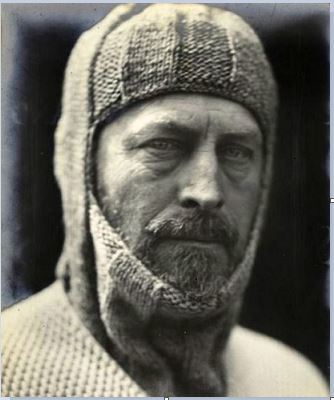
The writing here details the incredible Antarctic voyage of Sir Douglas Mawson (5 May 1882 – 14 October 1958). Mawson was an Australian geologist, Antarctic explorer, and academic. Along with Roald Amundsen, Robert Falcon Scott, and Sir Ernest Shackleton, he was a key expedition leader during the Heroic Age of Antarctic Exploration.

Douglas Mawson:
frrrr

Mawson and his crew sailed in the vessel Aurora—a "thirty-five year- old Dundee-built veteran of the Newfoundland sealing fleet", and made their way south to the frozen continent. They then set up a cabin and waited through the long winter before setting off on spring exploratory expeditions.
“We must build our home—and we must build it quickly and well, or we are dead men. We are far from any trades hall, and there will be no union nonsense here. Working hours, with breaks for meals and bad weather, will be from seven in the morning till eleven at night. After that you can sleep...”

Dr. Xavier Guillaume Mertz and Belgrave Ninnis joined Mawson on what would become the Far Eastern Party, which aimed to explore the area far to the east of their main base in Adélie Land, pushing about 500 miles (800 km) towards Victoria Land:
"...If all went well, the parties would explore about fifteen hundred miles of unknown coast and its immediate hinterland—a greater area of exploration in Antarctica than attained by any previous expedition."

Mawson at Aladdin's Cave during the outward journey:
swertm8

Bickel writes with a captivating and engaging style here, telling this incredible story in a manner that almost resembled a Hollywood thriller. The book also had very good formatting; the main characters are introduced, and the story proceeds in a chronological fashion, making the plot easy to follow. Good, effective communication.

An inhospitable, barren, and frozen land; you can't help but wonder why anyone would ever volunteer for such a perilous journey... Bickel writes of temperatures of -60 degrees, days-long blizzards, snow-blindness, frostbite and gangrene, and hundred-foot deep snow-covered crevasses that would swallow up sleds, dogs, and man alike.
Indeed, after reading what became of this journey, you are left scratching your head, wondering what the hell these men were thinking here.

The 3-man journey would become horrific, gruesome, and ultimately ill-fated. The crew encountered unbelievably rough conditions fraught with danger. A summary is listed below, covered with a spoiler to avoid giving anything away.

The struggles and hard choices of these early intrepid explorers are told well here by Bickel; making the story here very visceral and real. Bickel writes of the killing of the weakest dog, to feed the ill-fated men and the other dogs:
"In midmorning, when the dogs were barking wildly, Mawson thrust through the tent funnel, aching and dispirited, to find Haldane and Johnson—at full stretch of their tethers—gnawing the wood of the old sledge; a leather strap that had been within their reach had been eaten half away. Three of the other dogs were straining and leaping for a share. Poor George lay apathetic, too weak to rise on his legs. He would have to be the first to die to feed men and dogs.
Mertz could not face it. Mawson took the .22 rifle from its place on the sledge and led George behind the tent—then, saddened, shot him through the brain. The sharp crack of the rifle stilled the five tethered dogs into startled silence—for a moment. When Mawson dragged the body for butchering on the old sledge, they were already slavering in expectation.
Mawson cut away the fullest leg muscles and then excised the liver, surprised to find it had not diminished in size due to the malnutrition. With Mertz now sawing, they cut up half the carcass and fed it, with the offal and the head, to five frantic animals. Their fangs ripped sinew from the skeleton and tore tail, offal, pelt into pieces that could be gulped; then five pairs of ravaging jaws cracked and crushed bone, and tongues licked away the marrow. In minutes, nothing of George was left in the snow.
They had much to do before they would eat their share. Mertz cut a strut from the old sledge and, with the knife, patiently shaped two wooden spoons. Then he repaired the vital spade; its broken handle was spliced with other strips of wood and bound with lampwick. Mawson shaped two disused tins into food and drinking pannikins and then sewed up tears in the tent cover..."


The above quote drives home the stark reality of this ill-fated journey. Much of Bickel's writing here will likely shock many readers. The story told in Mason's Will is pretty raw and harsh. This book is not for the faint of heart...
Nonetheless, it was still a great telling of an incredible story. The writing here was very good.
5 stars.
Profile Image for Owen Neumayer.
59 reviews
January 12, 2023
Amazing book. Tells you a lot about the limits men put on themselves and how some men can break through their mental limits. This book also made me contemplate isolation in a different way than ever before. Masson was alone on a continent and still knew he had a life to get back to in Australia. He also did all this and sacrificed so much for the purpose of science. This book makes me want to read more survival stories similar to Mawson’s.
Profile Image for Tamhack.
328 reviews9 followers
May 23, 2015
I have read many books of the explorations of the Antarctica and Arctic but had not heard of this. I think it was downplayed because of the stories of Amundsen, Scott, and Shackleton. This story is equally as gripping and amazing. How do people survive such hardships? How after going through such hardships do they keep going back? What is the draw? For example Frank Wild went back 5 times despite extreme hardships.

What did Mawson achieve? Because his exploration was not goal of arriving at the South Pole, and was during the same time as the tragic death of Scott, it was downplayed. "Mawson led his Australsian Antarctic Expedition into the unknown country west of Cape Adare. It was an expedition that carried out a notable amount of scientific research, which earned it a place among the great scientific expeditions of its day. ...it is the greatest story of lone survival in Polar expedition."

I was intrigued and amazed by the author's descriptions of the Antarctic landscape.
The story was a page turner and made me hold my breathe...

...Mawson's exploration was larger and better funded than Scott's. Mawson's exploration would add more territory to the maps of the worlds sixth continent than any other man of his time.

"The Antarctic is alien land. Desolate and barren, hostile to life, it is a lost continent at the bottom of our world, now smothered under the greatest ice shield known.
This solid ice cape is an immensity. Three miles thick in places, with a mean overall thickness of a mile and a quarter, it blankets a region bigger than Europe and the United States combined-almost six million square miles of the earth's surface in southern summer. In winter, when the sea freezes over, the area inundated with ice can be doubled."
"Far inland, the ice plains rise more than 12,000 feet above sea level, and only the frost-rimed peaks of the mightiest mountains can pierce this frigid shield. Cloaking, submerging the great ranges, the ice makes the Antarctic the highest overall continent on earth and exerts an influence and an impact of the world's weather to an extent not yet fully understood.
This colossal canopy is of enormous weight and has prodigious power. Some 7.5 million cubic miles of ice puts the pressure of 24,000 million million tons on the buried continent and crushes the mountains, plains, and valleys back into the earth's mantle. The contour of the planet is thus dramatically flattened at the South Pole. Fortunately for mankind, the outward thrust of this gigantic mass is slow."

Antarctic landscape is devoid of color--in one part of the book, the men were so thankful for the colored bags that had been made for them.

"..a cold of rare intensity freezes the air into a crystallized white gray mist, a shroud over the frosted peaks and plains..."
"It is cold that kills. It is the coldest cold on earth. It makes the air so heavy that it falls across the frozen plains with increasing speed, hardening the ice to brittle rigidity so that the glaciers-...rend and fracture as they twist their way to the sea and riven into deep fissures, jagged winding cracks, called crevasses, reaching to bedrock. The frozen rivers break their back and burst with enormous explosions, like a bombardment by massed artillery- when it can be heard above the roar and boom of gales."

It has the biggest glacier on earth--the Lambert Glacier.

And the winds...
"Cold makes the Antarctic alien, but winds make it more deadly. The worst and most dangerous are katabatic winds, flying rivers of air, cold and heavy, falling down the frozen slopes from the polar plateaus and, with gravity, increasing in speed to batter and assault those parts of the coast where they find outlet. They reach gust of above two hundred miles an hour and can consistently blow for days and not drop their force below eighty miles for many hours on end. Such winds lift gravel and hurl rocks and heavy objects out to sea; they blow men from their feet and encase their eyes, nostrils, and mouths in ice formed from their own breath. They are the worst winds in the world, a greater menace than cold. Born in rare high solitudes, they pick up snowflakes, ice crystals, and frozen pellets, compacted like hail, all of which blown in the wind become abrasive material that can polish rough metal to brilliant sheen and scour the wood from between the grains when they are left exposed for a winter. And cold and wind can reach the sheltered parts of a man's body and cause deadly frostbite, adding to peril."

How could one lone man survive this... It is a story worth reading.
Profile Image for Derek White.
6 reviews2 followers
March 12, 2014
Somehow this book didn't have the passion or the sense of adventure that other books in this genre have. Sure, it's an amazing story of survival and accomplishment, but it largely left me flat--probably because there are more interesting survival stories and there are books that are better written on these subjects.

And somehow when the publisher (or author?) decides to call it the "The Greatest Survival Story Ever Written", the emphasis is on the writing rather than Mawson's accomplishment. And I would have to emphatically disagree with that statement. There are many other books in this genre that are better written.
Profile Image for Jason.
555 reviews31 followers
November 11, 2012
I've read several stories of early explorers, including Shackleton's memoirs. This story stands on its own two feet up there with the best of them. I've come to believe that not just anyone could survive extreme conditions like this, even if you have the knowledge to do so. It takes a degree of perspicacity and faith in oneself to transcend physical hardships like those presented in this book. And, as you'll see from reading the author's prologue, there was a bit of luck involved as well.

Bickel obviously did his research in preparation for writing this. Excellent recounting of details, engaging character sketches, and awe-inspiring overall. Highly recommended.
Profile Image for Lindsay Bolender.
570 reviews12 followers
July 5, 2019
Advertised as a man who, despite having to survive in Antarctica after a loss of resources, continued to diligently map a large section of the coastline for the first time - this was actually a story of how he took several large risks and made several mistakes and then survived that. That wouldn’t be so bad, if the book didn’t focus entirely on what he ate (His dogs) and the ice. I would have liked more about the miraculous mapping, but the only trace of that as a concept is what’s stated in the book’s description. The redeeming quality of this book (Why I gave two stars instead of one) is that it is a true and somewhat interesting story, and had shared history with other books I have read.
12 reviews
December 28, 2012
Instead of reading this second hand account of this polar survival story, I suggest that you read Douglas Mawson's first hand account of this same polar survival story "The Home Of The Blizzard: A True Story Of Antarctic Survival". A much better read with more detail. This book by Lennard Bickel does add new information as to why Mawson and his companion became so sick when trying to return to the base camp.
Profile Image for D.
18 reviews
December 7, 2014
Poorly written, this book jumps from one expedition to another. Explorers are introduced and then dropped off the page. The reader is pulled from meetings into flashbacks of explorations. It was unclear what expedition we are on. I would not recommend this very jumpy, jerky, hard to follow account of Mawson, Shackleton, Scott and everyone else who ever set foot in the Antarctic.
173 reviews2 followers
October 26, 2024
I just didn’t love this book. It wasn’t meant for me.

I felt like Mawson was put on a pedestal, which yes he survived a lot and was innovative in how he survived. But he also was out there to find places to mine to make Australia rich, and chose not to turn back when things were looking like the timing to reach their arbitrary mileage might be tight.

I think my main problem though was that I could NOT get over the treatment of the dogs. I know it was a different time, and a different culture, but those dogs had no choice for going on the expedition. They described them as thinking of them as “their children” since they raised them as pups. But the dogs were forced to freeze outside and starve when blizzards came through while the humans were in the tent. Even before things started going wrong, the plan was to shoot half the dogs and feed them to the other dogs on the trip back. When one of the dogs almost slipped into a crevasse, Mawson said, “We almost lost a third of our rations, Xavier.” And when one of the dogs died of exhaustion (and I say one because many died of exhaustion), Mawson’s thoughts were, “Poor dumb brutes, this is how they all go—pulling, pulling for man—unto death.”

And man that just makes my blood boil. When Mawson was starving, he shot or hacked the dogs to death to eat them and felt oh so sad. But when his human partner died in the tent from eating dog livers, did he eat the already pre-dead human? No. He buried him.

The way the book was written it was like Mawson always made the right decision, or was always the victim, and was a superhero of sorts. I don’t think that’s true at all and I would’ve liked the book more if all his flaws hadn’t been swept under the rug.
This entire review has been hidden because of spoilers.
Profile Image for Lara.
4,213 reviews346 followers
March 23, 2019
This is the fourth book I've read about Douglas Mawson's Australasian Antarctic Expedition (including Mawson's own account, as well as his diaries) and there were definitely some things in this one I hadn't known about before, but...something about Bickel's telling of it made me wonder if parts might have been slightly exaggerated for dramatic effect.

The story is definitely dramatic enough even without any exaggeration or extrapolation, and even though I already knew what happened to , I cried like a baby over . I was on my way to a meeting for work while listening to it too, and it was bad! Which is the plus side of reading the story in Mawson's own words in The Home Of The Blizzard: A True Story Of Antarctic Survival--it's super confusing trying to figure out who was where at what times, but at least there is some distance between the reader and the events. His diary is a little more intimate, but these explorers generally operated on the assumption that their diaries would be public, so there usually tends to be a sense of self-censorship and restraint in their accounts.

In any case, in my opinion Mawson is 100% on par with Scott and Shackleton and it's weird that he's so much less well-known, especially when a) he survived and b) BY HIMSELF!!!

I still don't quite feel like I've found the best book about Mawson yet, but I'll keep looking.
219 reviews2 followers
March 25, 2023
Mawson's Will is the dramatic story of what Sir Edmund Hillary calls "the most outstanding solo journey ever recorded in Antarctic history." For weeks in Antarctica, Douglas Mawson faced some of the most daunting conditions ever known to man: blistering wind, snow, and cold; loss of his companion, his dogs and supplies, the skin on his hands and the soles of his feet; thirst, starvation, disease, snowblindness - and he survived.
Sir Douglas Mawson is remembered as the young Australian who would not go to the South Pole with Robert Scott in 1911, choosing instead to lead his own expedition on the less glamorous mission of charting nearly 1,500 miles of Antarctic coastline and claiming its resources for the British Crown. His party of three set out through the mountains across glaciers in 60-mile-per-hour winds. Six weeks and 320 miles out, one man fell into a crevasse, along with the tent, most of the equipment, all of the dogs' food, and all except a week's supply of the men's provisions.
Mawson's Will is the unforgettable story of one man's ingenious practicality and unbreakable spirit and how he continued his meticulous scientific observations even in the face of death. When the expedition was over, Mawson had added more territory to the Antarctic map than anyone else of his time. Thanks to Bickel's moving account, Mawson can be remembered for the vision and dedication that make him one of the world's great explorers.
Profile Image for Justin.
218 reviews1 follower
April 21, 2020
5/5: It was a busy few years in Antarctica during the years 1911-1913. While Amundsen skied to the southern pole with his dogs, while Scott lay freezing and starving to death 15 miles from a food depot, a smaller trip was mounted to explore Adelie land and find the magnetic pole, west of the Ross ice sheet. This was led by the Australian Douglas Mawson, whose expedition split into smaller 3-person groups to chart out the geography and geology of unexplored Antarctic regions. While it would be interesting to have a book that more completely describes what these different parties accomplished (and how), this account follows Mawson’s sledge to the east of their camp across enormous glaciers with two trip-mates and 18 dogs. (Spoiler - but not really): at the point farthest from their base, one of the men fall through the a crevasse with the strongest dogs and a sledge containing much of their equipment. There are no survivors of the fall, now way to retrieve their equipment, and it is up to Mawson, his friend Mertz, and the remaining dogs to make it back alive. Of course the dogs have now been relegated as both sledge-pullers and resources. A truly incredible account that leaves you wishing the author had provided a larger perspective on this strange, often forgotten, side-trip along the Antarctic coast, overshadowed by other exploits to the pole.
Profile Image for Jen.
660 reviews6 followers
August 12, 2023
A harrowing tale of survival. The blatant attempt to increase the US sales by talking about the beauty of America, despite the fact that nobody in the book or writing the book is American and no other landmass or country is complemented at all, took off a star for me.
Mawson was undoubtedly a "hero" of Antarctic discovery and survival and mostly a principled man. His attempts to study Antarctica and to claim discovery for the crown were huge. His desperation to get the story of what happened to his comrades was definitely a part of his will to survive though I suspect that he would have found another reason if needed. I couldn't have made the choices he did over the dogs because I prefer dogs to people including myself. However, his decision not to leave Mertz, despite the fact it lowered his chances of survival, were the best of humanity. How he kept going after just missing his rescue attempt I don't know and his will to survive after missing the ship and passing on what had happened to Mertz and Ninnis, whilst still being so very ill, is superhuman.
A truly complex human being who could be so cold but also so warm and caring. I guess all the old explorers had some of that coldness or they would not have been able to do what they did.
Profile Image for Marie Carmean.
447 reviews7 followers
April 22, 2023
Fantastic book! I have read previously books about Scott and Shakleton, and Mawson is a much less known Antarctic explorer. His story is compelling. His group explored a part of Antarctica that no one ever had before and covered more miles. One faction of the group got closer to the magnetic South Pole than anyone ever had. But the trial Mawson's small faction (himself and two others) went through exceeds so many other's. After his two companions die, Mawson has to make it back to their base camp alone. Fighting vitamin A toxicity from eating the livers of their sled dogs, fighting extremely low food rations, terrible blizzards and a terrain that is horribly unforgiving, he slowly makes his way back. The toxicity is causing severe pain, peeling skin leaving raw areas in his entire body, and severe depression. The poison in his body far exceeds levels that cause death (and indeed took the life of Mertz) but he "soldiers on." It is a story of amazing fortitude and heroism. I was fascinated. Such a beautifully written book too...Bickel does a wonderful job painting the pictures of the frozen north. I wish everyone would read this inspiring book!
52 reviews
March 23, 2023
This is the first exploration book I have read, and I thoroughly enjoyed reading it.
How Mawson survived, only he will ever know. And when you think of society now, where the snowflakes (excuse the pun) rule and life is put on a plate for most, it is difficult to appreciate just how this example should serve as a reminder of how life can be. A lot of the book focussed on the physiological aspect of the survival as opposed to the alien world the men were exploring. And so this book takes on a greater social and emotional and psychological theme; how could anyone survive mentally and the physically the harshest of environments and loneliest of times?
The detail is excellent and harrowing, and the fact that their dogs were used as a food source shows how dangerous and at the end of their capabilities they ended at.
A remarkable group of men and dogs, and an example that should put into perspective our own minor challenges that we face while in our warm homes, with food available when we want.
168 reviews1 follower
August 28, 2024
I read many books on the subject of polar exploration over 20 years ago and somehow must have missed this one. It’s well worth the read despite being a little bit one dimensional. Not that the author could have done much about that - there’s only so much you can write about wind, cold, snow and ice.
For this reason, I found the outbound journey more interesting and stimulating than the inbound.

It’s interesting that many men lost their lives because of a failure to consult and listen to Fridtjof Nansen. He warned Scott against using ponies and told him he needed to use dogs and eat them. Nansen had also warned against the consumption of husky liver.

As I said, well worth the read, I’m glad I’ve added it to my collection. It fails to surpass however, Cherry-Garrard’s tome The Worst Journey In The World.
Profile Image for Steve Bera.
272 reviews4 followers
June 2, 2020
Great book. This expedition takes place in Antarctica while Ahmudsen and Scott are racing to the south pole. Leader Mawson was invited on the Scott expedition, where everyone died, but chose to map unexplored areas of the continent and claim that land for England. The book is a little slow until his trip with 3 sleds begins. Then, one falls into a crevasse, and a second one is scrapped when the leaders assistant dies of vitamin A toxicity from eating their dog livers for survival. Then, the leader is the only survivor for three weeks as he struggles to get back to base camp and meet the ship in time for sailing back to Australia. A grand and historic adventure rated as one of the best books of the decade. Once I read half the book I could not put it down.
Profile Image for Bob.
597 reviews13 followers
August 29, 2020
This was a great book, I was engrossed in it. The atmosphere and the emotions are well-portrayed. The book does a good job of explaining the background and what they were attempting, although i would've preferred some more explanation about the scientific aspects of the mission. As a survival story, it's amazing. I felt like it cut off abruptly, I want to know how long it took Mawson to recover, what happened to the station they established, what did he do with the rest of his life? The chapters where he is out on the ice (with his companions and, spoiler alert, without them) are definitely the best part of the book, very gripping.
Profile Image for Laurence.
1,158 reviews42 followers
May 14, 2021
Brutal blizzards and great white emptiness, three men plod from relative comfort of the Antarctic hut on an overland expedition. Already met by disasters, including loss of supplies, when attempting to navigate ice bridges covered in snow, one of the crew is lost into a deep crevass, his companions helpless to attempt a rescue. More devastating scenes follow as dogs die of starvation leading to the unlikely cause of the second man's death, vitamin A poisoning from eating husky livers.

As a walker myself I recognise the relief of sighting an end to a long journey, I can only attempt to imagine what it would be like to know that you have successfully survived such an ordeal.
Profile Image for Katie.
836 reviews4 followers
February 9, 2022
I've read a lot of Polar adventure stories, but this one was grim! Lots of descriptions of failing bodies and dog stew.
It was interesting how many expeditions went to Antarctica at the same time, and there are plenty of familiar faces mentioned in this story. This book is well written and full of beautiful descriptions of the landscape, and the people involved all come through as individual characters that we care more about as the story progresses.
The story is a reminder of how quickly your luck can turn in an inhospitable place. It's inspiring and terrible, with violence, friendship, and endurance. An excellent book, and a great one for any fan of Polar exploration.
Profile Image for Hope.
674 reviews1 follower
July 9, 2017
Book Challenge Category: A Book Set More Than 5000 Miles From Your Location

You can't get much farther from sunny Florida than the Antarctic! This book, reminiscent of Jack London's "To Build A Fire" (although with admittedly a happier ending), describes the harrowing survival tale of Mawson's expedition. Historically accurate and engaging for the reader, this is an excellent read-- and also why I like sunny weather! Moral of the story- do not eat the liver of an animal in a survival situation.
Profile Image for Gary Detrick.
285 reviews4 followers
March 22, 2019
At a loss for words. It's amazing that Mawson's story ever survived for our reading interest. That he survived at all to live into his 70's is unbelieveable. Man's will to endure extreme circumstances under such conditions dumbfounds me. Most people would succumb to inevitable. Many have in this extreme environment. It does not change my hope to visit the Antartica someday, although I do not see me pursuing any adventures to the South Pole!
A must read for those whom are fascinated with Artic and Antartic history.
11 reviews
April 29, 2022
A truly amazing and magnificent book. The story is one of the most horrific I've ever heard and beautiful at the same time. The author is a great writer and story teller. Mawson has to be one of the toughest men to ever live. Fascinating! Love this book. Again, the writing was great. One thing, I read the kindle addition and the spelling and punctuation was really messed up. Sometimes it was difficult to understand because of the grammatical errors. I'm sure this is a product of transferring the file to the Kindle addition and not the author's error.
Displaying 1 - 30 of 145 reviews

Can't find what you're looking for?

Get help and learn more about the design.