Christianity depends on the belief that the Jesus of history is identical with the Christ of Faith and that God in the person of Jesus intervened finally and decisively in human history.
“Whether one is a Christian or not depends on whether one believes the Jesus of history is identical with the Christ of faith.” (pg 7)
The issue presented here in Introducing Christianity isn’t about whether or not Jesus existed, (hint—there are independent accounts that suggest he did). The issue is really about whether or not the life story of Christ was embellished, altered and/or enhanced to suit a particular social, political, or denominational narrative.
Much has been written about the life, death, and alleged resurrection of Jesus Christ. The studies penned by evangelical theologians overwhelmingly trend towards the biblical; in other words they hold the company line, depicting the life of Christ as it is written in the New Testament gospels. Others (see The Quest of the Historical Jesus, Albert Schweitzer, 1906) take a decidedly different view.
In spite of what some reviewers have written about this book, the authors are not “skeptical and dismissive” on the life of Christ and the subsequent evolution of Christianity from an unorthodox cult to a worldwide religion. Anthony O’Hear and Judy Groves, at least one of which is a believer, are simply approaching their subject matter with a critical eye. For example, when the gospels emphasize that Christ’s tomb was empty, the authors point out that an empty tomb is no proof of a resurrection. Seems fairly obvious to this reader, but go ask a religious fundamentalist and you’ll get a 45 minute dissertation on why O’Hear and Groves are full of sh*t.
“THERE is not one Moral Virtue that Jesus Inculcated but Plato and Cicero did Inculcate before him; what then did Christ Inculcate? Forgiveness of Sins. This alone is the Gospel, and this is the Life and Immortality brought to light by Jesus . . .” William Blake, The Everlasting Gospel, 1818
I was hoping to find in this book symmetries of the narratives that will help me understand better art works, particularly from the renaissance. This wasn’t the case, nor the goal of this book.
Most everything about this book is wrong. Little to no useful information. Paul is made out to be a spineless people pleaser. Christ is misrepresented constantly. Would not recommend to anyone.
“[In Jesus] there is the idea that our own weakness or suffering can be redemptive. There is the idea that God’s best representation is a suffering man. These ideas suggest that the universal principle underlying the world as a whole can and does have a particular concrete manifestation.”
This book endeavors to briefly contextualize and summarize the core events, philosophies and writings that have made Jesus’ life as powerful a creative force as it has been for millennia.
Like other books in the Graphic Guide series, it does a great job introducing the subject with just enough relevant context and plenty of reference to other great works of writing. Love this series, will be reading more.
As I've mentioned in a previous review, this series of books is written in a 'Horrible Histories' style with large illustrations dominating the main area of the page and small chunks of select information dotted about the page in easy to read sentence. Although I found this slightly more useful than 'Buddhism for Beginners', I still felt that the style did little for the subject material, the chuncks usually only making up one or two sentences only able to convey the most basic of information. This would be understandable if the illustrations were in anyway interesting or useful, but their sole reason seemed to be to take up the spare page space to create this choppy, easy access style. This book is only really suitable for people with relatively little knowledge at all about Christianity.
This book goes into the history of Christianity and Jesus in particular. But my main complaint about the entire thing is it was written like a college paper but condensed. Lots of “big” words that could easily confuse some people, it may be condensed but it isn’t an easy read. If they were going to write a condensed version they might as well have gone through and made it easier to read as well.
Overall, it’s ok at best. I personally am Agnostic but grew up heavily religious, from what I can remember, I didn’t see anything that stuck out as being blatantly wrong.
The artistry was ok at best as well, very rudimentary artistry.
Overall, I doubt I would refer anybody who wanted to know more about Christianity or Jesus to this book.
It has DRM, so I have to subtract 1 point for that.
This book offers concise answers to some of the key questions that circle about the life of Jesus and the religion spawned by his existence. It tells the reader what is known about the life of Jesus, providing insight into what life events are well supported and which are only described in accounts written long after the fact (e.g. the gospels.) It describes which factions believed Jesus was a god and which didn’t. It describes opposing views of what Jesus was (i.e. if he wasn’t just a run-of-the-mill human being, was he wearing a human suit or was he some sort of divine hologram.) A lot of the book is more about Christianity than Jesus, proper, exploring how the religion came into existence, how it changed, why it schismed, and how it was influenced by other domains of human activity (e.g. governance and philosophy.)
As the subtitle suggest, the book uses graphics throughout – primarily drawings and monochrome artworks depicting Jesus, events from his life, and other characters in his story (e.g. apostles, disciples, and such.) Besides graphics, the only ancillary matter is a “Further Reading” section that discusses Bible versions and scholarly works on Christianity and the life of Jesus.
I found this book to be concise, interesting, and informative. If you’re looking for an outline of Jesus’s life that offers insight into the evolution of Christianity from a non-theological point of view (i.e. having no dog in the fight of whether Jesus was a god) you may want to give this guide a look.
The illustrations are amazing, the writing is simple, but the contents are a bit misguiding. I acknowledge that this is NOT a Christian book and so it is not fair for me to make a bias conclusion. For sure, this book is interesting, but I would not refer to anyone who wanted to know more about Jesus or Christianity to this book. There are some books about Jesus by non-Christians (in fact, by those who are a little more critical) that are better such as Reza Aslan or Bart Ehrman. I think the author is very ambitious by trying to cover so many heavy topics like philosophy, theology, and teleology over a couple of pages. Too many interpretations, too little of what the main sources really say about the most influential Man on earth. I understand that this book is meant to be an introduction or overview, but I think it can be more useful if the author (actually, the publisher) can focus on some key points about the historical Jesus especially in the New Testament.
I have nothing much to say 😅 I’m not sure either I’m disappointed or glad that I’ve finished it – knowing that at least I’ve learned how others think of Jesus ✌🤓😉 To read my other BOOK REVIEWS, click here: https://legasitv.blogspot.com/search/...
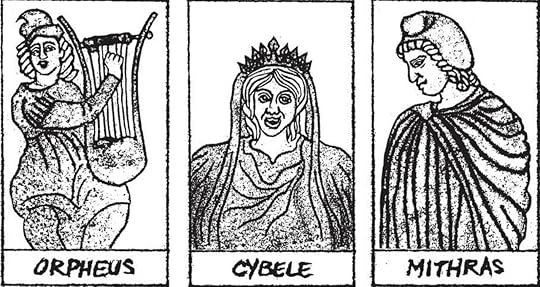
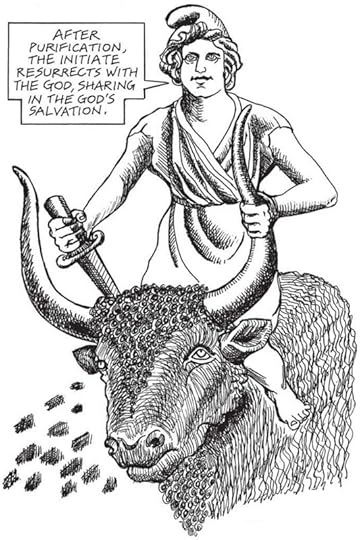
A quick outline mainly focusing on the historical Jesus and the early church, with just a little bit towards the end about the reformation and counter-reformation, modern Christian movements, and Christian mysticism and metaphysics (which is what I was really after). I thought the book could have been a little better balanced in that respect. The crusades and the East-West schism don't get a mention either. On the other hand, there is a bit about the relevance of Greek philosophy and Roman pagan cults to the young religion, which I didn't expect. The author can't help writing in an academic voice, right off the bat, which I thought seemed a bit out of step with the style of the series. You need to digest a few long and murky sentences, but then we're talking about snippets of text on pages mainly taken up with images. The book did give me a fresh perspective on the topic though, and taught me some interesting things that I'd never heard before despite having been raised a Roman Catholic. The main insight I took away was the importance of the figure of Jesus himself to the religion, over and above what he taught. Christianity's approach to the great beyond was to bring it down to Earth, literally!
Este es el segundo libro que leo de la serie de Introducing, y la verdad estoy muy contenta con el formato.
Escogí este tomo, porque la religión es un tema que me llama mucho la atención, no porque sea religiosa (no lo soy para nada lol) pero simplemente me parece interesante el origen de las religiones y la manera en la que hoy en día tienen tanto poder sobre la sociedad, incluso sobre las personas que no son religiosas.
Ya había escuchado un poco hablar sobre el Jesús de la biblia vs el Jesús histórico, y me parece un tema super interesante, y esperaba que este libro se enfocara en eso y en los orígenes de la religión cristiana. Y el libro, si bien no fue exactamente lo que estaba esperando, la verdad lo disfruté mucho y lo encontré super interesante y relativamente fácil de entender. Definitivamente una buena introducción al tema que te ayuda a entender el contexto histórico y social de la época, y si bien no es la explicación del inicio del cristianismo que estaba esperando, es más bien la explicación del papel de Jesús como base del cristianismo, y me pareció fascinante.
En fin... sin duda voy a seguir leyendo más tomos de la serie a ver qué otro tema interesante se me cruza.
This entire review has been hidden because of spoilers.
This book angered me. I have read several books in the "Introducing...A Graphic Guide" series and most of those delivered a brief but decent introduction to many topics. However, this book fell quite short. It used such terms as "messiah," "savior," saved," "original sin," and other terms without much explanation as to what they mean. It claims to be an introduction but it clearly assumes its audience has been indoctrinated into Christianity as a supernatural view. It covered so much of this goobledy-gook with the usual bloated and overly dramatic terminology that Christians use with very little insight into what it might mean to someone who hasn't been brainwashed by it. If non-Christians want to learn something about Jesus. Look elsewhere.
Anthony conveniently ignored the foreshadowing of The Messiah and His purpose in the writings of OT prophets. I was floored when he neglected to mention Mary and Martha by name as the followers—the disciples of Jesus who were the “some women” who first witnessed the empty tomb. His poor and lazy explanation of the Gospel writers’ accounts of Jesus’ ministry were incredibly disrespectful. I was very disappointed with this read.
I understand the direction that the author took here, but I think I was expecting a bit more from early sources other than the four accepted Gospels and Paul’s letters. There wasn’t even mention of other gospels and only very passing mention of references to Jesus’s existence by contemporary writers.
A decent introduction on the teachings of Christ and Christianity. It’s a good overview of certain tenets Christianity. And gives a thoughtful explanation of who Christ is.
Pensei que sería algo a explicar de uma forma bem simples o que em geral já sabemos mas afinal surpreende pela complexidade inerente de abordar os assuntos mais teológicos e filosóficos de quem foi Jesus, homem e figura superior.
I've read quite a number of titles in this series but I have to say this has been the one I didn't enjoy. I think it needs a good rethink and rewrite. The theme wanders without direction, the language is over complicated at times and the message is unclear.
This was something different, as a graphic text, it was a very quick read, although some of what was mentioned I had to take with a huge pinch of salt.
At times this was a difficult read and at other points, very enlightening. It was not a book that could hold my attention and I truly had hoped it would be.
Nice and easy read talks about Jesus and the political and social condition during his time. Also make further references to books and authors for the curios reader to further trace and follow.
The format of this book has limitations. Illustrations take up too much space. There isn't much space for text. It is useful as an introduction to the many debates about Jesus.
Anthony attempts to follow the story of Jesus and how his life evolved throughout history and points to one’s choice as to who he was and what he means to you personally.