Students, teachers, and interested readers will find in this resource a vivid and intimate account of life in the Elizabethan age. The first book on Elizabethan England to rise out of the living history movement, it combines a unique hands-on approach with the best of current research. Organized for easy reference, it is enlivened with how-to sections―recipes, clothing patterns, songs and games, all gathered from original sources. This hands-on approach recreates the daily life of ordinary people, not just the aristocracy, and systematically covers the most basic facts of life in a readily accessible format. Clearly illustrated with 94 drawings, patterns, and diagrams, it provides a treasure trove of information for classroom and library use and for those interested in recreating Elizabethan life. The work is organized into sections on the structure of Elizabethan society, the course of life (birth, childhood, education, marriage, old age, and death), the cycles of time (daily, weekly, and yearly schedules, including a calendar of the Elizabethan year), the living environment (houses, villages, towns, and travel), clothing (including instruction for making complete Elizabethan male and female outfits), food (featuring a selection of recipes), and entertainment (songs with sheet music and instruction for authentic games and dances). A chronology of Tudor England, a glossary, appendices with information and ideas on organizing Elizabethan feasts and fairs, and lists of suggested readings, videos, and recordings complete the work. This is an indispensable resource for classrooms and school and public libraries because it gives readers a true understanding of what it would be like to live in 16th-century England.
I’m addicted now to the books on details of daily life in different historic periods. It brings history to life and sets my imagination running wild — mostly to realize that my spoiled self would be very unlikely to survive in tougher times of Long Ago. As for Elizabethan times, I read and loved The Time Traveller's Guide to Elizabethan England by Ian Mortimer and How To Be a Tudor: A Dawn-to-Dusk Guide to Tudor Life by Ruth Goodman (not to mention the TV series “Tudor Monastery Farm” featuring Ruth Goodman - so much fun!).
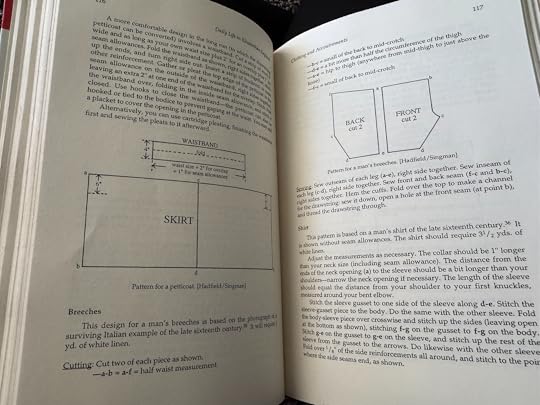
But what those other books didn’t have, and I unexpectedly discovered here, were the recipes to Elizabethan experience — the sewing patterns for clothes of the time period, actual recipes for the food of the times, songs complete with sheet music and dance steps for Elizabethan dances should you really get into the spirit of the times, and instructions for games should you want more entertainment. (Now, I must admit I mostly skimmed those because as fun as reading about Elizabethan times is, I’m not actually interested in the slightest in recreating those times).
We go through the social structures in England at that time — social classes from nobility to peasants, those in service and in apprenticeships and the limited social mobility, the idea of Elizabethan household, government and law enforcement, the role of religion. The increase in the numbers of those living in poverty and the Poor Laws. We go through the course of life — from childhood with diseases and schooling, to marriage, to aging and sickness. It goes through the common holidays of the time, month by month. There is an interesting chapter on houses and common furnishings, structures of different villages and towns, and ways to travel. And of course, the garments (and the patterns for them).
I wish my old history textbooks were more like this “Daily Life In …” series. Learning would have been so much more fun!
I haven’t loved it like I have loved Mortimer’s and Goodman’s books, but it was still a long airplane flight well-spent in good Elizabethan company.
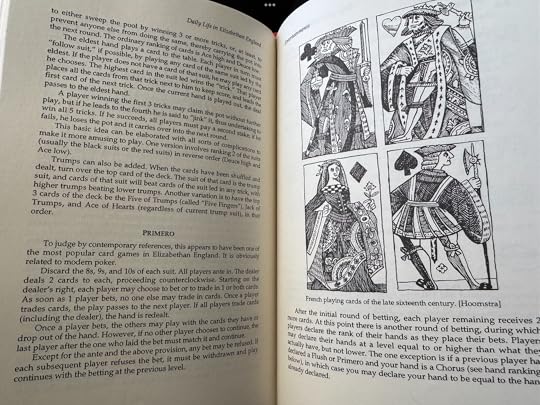
This is the second book I have read in this series and it certainly won’t be the last. Part of the “living history” movement, this volume seeks to really immerse the lay reader in and provide them with the basic tools for reimagining what it would have been like to live in Elizabethan times. As Singman writes in the introduction, “If history only touches the historians, it is truly a lifeless form of knowledge.” Hear. Hear. Daily Life in Elizabethan England seeks to correct the notion that history might be lifeless by first creating a context for understanding the times (which were fraught with religious tensions, espionage, plots and amazing discoveries) and then describing the daily life of people from different classes and professions – from the highest to the lowest and back and forth. Focusing on such things as religion and religious practices, literacy, education, clothes (patterns for various garments are included), music (there are lyrics and some basic sheet music), entertainment (there are various card and board games as well as others described at the end in detail), including jousting, bear and cock-baiting and other sports, relationships, family, trades, Singman beautifully sets the Elizabethan scene. Allowing us to imagine wandering crowded streets, entering a crofter’s or gentleman’s house, travelling across the country or abroad, he endows with the rudimentary knowledge to make our way. Warning us of diseases like the plague (which struck England many times throughout this period), the “sweating sickness” and other ailments, and to be wary of pickpockets, cut-purses and highwaymen, he also urges us to enjoy the delights of the theatre because of course, this was the era of Shakespeare, Marlowe, Johnson and many other wonderful creative souls. Reminiscent of Ian Mortimer’s The Time Traveller’s Guide series, this one functions as a compliment rather than replicating the information and I found it provided information Mortimer’s didn’t and vice-a-versa. Written in an easily accessible and always fascinating style, this is a must-read for teachers or students of history, a fabulous reference for writers and a great read for those curious about a resplendent, violent, rapidly changing, and extraordinarily inventive milieu.
Excellent look at life in England during Elizabeth's reign. Not as detailed as How to be a Tudor, but some people might prefer that. And I still learned a lot from it. Written in a simple, readable style. Recommend.
Stars: 7.5 out of 10 Age: Anybody. This is very readable. Would I read more? Yep. This is a series, and I will definitely look into the others in the series.
Excellent overview of England during the reign of Elizabeth the First. Very well researched and interesting, if a little pricey. Definitely would recommend to anyone interested in this period of history.
so turns out I was already an expert in Elizabethan society, because this book taught me nothing new. I did like the tone, which was light and not textbooky. The recipes and game rules were a nice addition, but overall just kind of boring.
I'm sorry I finished it! It's very interesting, and helpful in knowing how people lived then. There's a fair amount of stuff I didn't know! It was so good, I wanted to keep reading, and reading,…..
This wasn't the most thrilling book to read, but the information is very comprehensive and written in a very basic, easy-to-understand language (as in, school - aged children could learn from it).
This was a helpful book in understanding what life was like for the common people during this period of English history. However, I also read How To Be a Tudor by Ruth Goodman, and I found it to be better in nearly every way. The only reason I'd recommend you get this book over Goodman's is if you are interested in reenacting this era, the author had a lot more practical advice, from clothing patterns to how to organize living history events.