

What do you think?
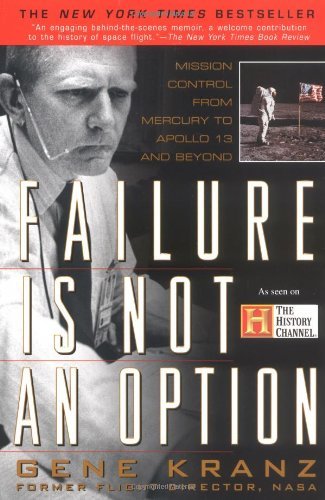
Failure is Not an Option: Mission Control From Mercury to Apollo 13 and Beyond
This memoir of a veteran NASA flight director tells riveting stories from the early days of the Mercury program through Apollo 11 (the moon landing) and Apollo 13, for both of which Kranz was flight director.
Gene Kranz was present at the creation of America’s manned space program and was a key player in it for three decades. As a flight director in NASA’s Mission Control, Kranz witnessed firsthand the making of history. He participated in the space program from the early days of the Mercury program to the last Apollo mission, and beyond. He endured the disastrous first years when rockets blew up and the United States seemed to fall further behind the Soviet Union in the space race. He helped to launch Alan Shepard and John Glenn, then assumed the flight director’s role in the Gemini program, which he guided to fruition. With his teammates, he accepted the challenge to carry out President John F. Kennedy’s commitment to land a man on the Moon before the end of the 1960s.
Kranz recounts these thrilling historic events and offers new information about the famous flights. What appeared as nearly flawless missions to the Moon were, in fact, a series of hair-raising near misses. When the space technology failed, as it sometimes did, the controllers’ only recourse was to rely on their skills and those of their teammates. He reveals behind-the-scenes details to demonstrate the leadership, discipline, trust, and teamwork that made the space program a success.
A fascinating firsthand account by a veteran mission controller of one of America’s greatest achievements, Failure is Not an Option reflects on what has happened to the space program and offers his own bold suggestions about what we ought to be doing in space now.
Gene Kranz was present at the creation of America’s manned space program and was a key player in it for three decades. As a flight director in NASA’s Mission Control, Kranz witnessed firsthand the making of history. He participated in the space program from the early days of the Mercury program to the last Apollo mission, and beyond. He endured the disastrous first years when rockets blew up and the United States seemed to fall further behind the Soviet Union in the space race. He helped to launch Alan Shepard and John Glenn, then assumed the flight director’s role in the Gemini program, which he guided to fruition. With his teammates, he accepted the challenge to carry out President John F. Kennedy’s commitment to land a man on the Moon before the end of the 1960s.
Kranz recounts these thrilling historic events and offers new information about the famous flights. What appeared as nearly flawless missions to the Moon were, in fact, a series of hair-raising near misses. When the space technology failed, as it sometimes did, the controllers’ only recourse was to rely on their skills and those of their teammates. He reveals behind-the-scenes details to demonstrate the leadership, discipline, trust, and teamwork that made the space program a success.
A fascinating firsthand account by a veteran mission controller of one of America’s greatest achievements, Failure is Not an Option reflects on what has happened to the space program and offers his own bold suggestions about what we ought to be doing in space now.
416 pages, Paperback
First published January 7, 2000
About the author
Gene Kranz
7 books42 followersEugene Francis "Gene" Kranz is a retired NASA flight director and manager. Kranz served as a flight director during the Gemini and Apollo programs, and is best known for his role in saving the crew of Apollo 13. He is also famous for his trademark flattop hairstyle, and the wearing of vests (waistcoats) of different styles and materials during missions for which he acted as flight director. Kranz has received the Presidential Medal of Freedom.
Ratings & Reviews
Friends & Following
Create a free account to discover what your friends think of this book!
Community Reviews
Displaying 1 - 30 of 914 reviews

April 4, 2008
I'm the daughter of a space guy... Dad worked on the Lunar Rover and various Apollo mission components as part of Boeing in Seattle. As a child of the 60's, we were rousted out of bed many an early morning to watch a "shot go up"... and every time it was a thrill. Apollo 13 was something we took personally in our house... I remember my mom and I were attending a PTA meeting and all of a sudden my Dad showed up (VERY unusual!) and announced that "the mission was in trouble". Every one of the parents there had a connection to Boeing, and the meeting was adjourned and everyone went home to watch the story unfold on television. Gene Kranz was one of the reasons the crew made it back and reading this book will give you a lot more information (but it's not TOO techy) than the news casts of the day - it really was perilous and many, many brave people helped them get home.

September 1, 2008
Ultimately this book was just OK...I was very interested in reading about the early NASA programs from the perspective of someone on the ground instead of one of the astronauts, and it definitely delivered in that regard.
Kranz details his whole career at NASA from its start to its peak and through its decline. I mostly wanted to read this book to hear about the Apollo 11 and Apollo 13 missions, but the sections on those were actually somewhat short. Instead, Kranz included almost too much detail on the earlier Mercury and Gemini programs.
The biggest weakness of this book is that there is generally a lack of storytelling...it's hard to follow a specific theme or challenge throughout the pages, so it just seems like a disjointed set of chapters that are good in their own right, but don't form any cohesive story that make you want to keep turning the pages.
Kranz details his whole career at NASA from its start to its peak and through its decline. I mostly wanted to read this book to hear about the Apollo 11 and Apollo 13 missions, but the sections on those were actually somewhat short. Instead, Kranz included almost too much detail on the earlier Mercury and Gemini programs.
The biggest weakness of this book is that there is generally a lack of storytelling...it's hard to follow a specific theme or challenge throughout the pages, so it just seems like a disjointed set of chapters that are good in their own right, but don't form any cohesive story that make you want to keep turning the pages.

July 20, 2022
If you believe that John Aaron is a steely-eyed missile man, this is a book for you. If you are not already a space/NASA nerd, you may find the material overly technical.
The book is a memoir of Gene Kranz’s career in NASA’s Mission Control. He tells about how he got hired by NASA and then gives a fairly brief account of all the missions, Mercury to Gemini to Apollo. I’ve read several similar books, but those were from astronaut’s point of view. It was a little different to see it all from ground control. Mr. Kranz was likely made most famous because of his handling of Apollo 13.

I learned some new things: some astronauts took shifts in Mission Control; Apollo 12 was hit by lightning during liftoff, twice (not sure if I ever knew that); every mission had its hair-raising moments and often it was only by divine help that they came through safely.
I also want to give a shout-out to Mrs. Kranz: What an amazing woman! She supported her husband through this job that had long and irregular hours. She got excited about the missions with him. She even made him vests to commemorate each mission (which even got a mention in the movie “Apollo 13”). Meanwhile she raised six children. THAT is what a strong woman looks like.
This memoir was written in 2000. Mr. and Mrs. Kranz are still around and busy today. I really enjoyed this book. It conveys a sense of wonder and patriotism that has been dwindling over time. I would love to meet Mr. Kranz.
Language: Mild
Sexual Content: None
Violence: No violence but some accidental injuries.
Harm to Animals:
Harm to Children:
Other (Triggers):
The book is a memoir of Gene Kranz’s career in NASA’s Mission Control. He tells about how he got hired by NASA and then gives a fairly brief account of all the missions, Mercury to Gemini to Apollo. I’ve read several similar books, but those were from astronaut’s point of view. It was a little different to see it all from ground control. Mr. Kranz was likely made most famous because of his handling of Apollo 13.
I learned some new things: some astronauts took shifts in Mission Control; Apollo 12 was hit by lightning during liftoff, twice (not sure if I ever knew that); every mission had its hair-raising moments and often it was only by divine help that they came through safely.
I also want to give a shout-out to Mrs. Kranz: What an amazing woman! She supported her husband through this job that had long and irregular hours. She got excited about the missions with him. She even made him vests to commemorate each mission (which even got a mention in the movie “Apollo 13”). Meanwhile she raised six children. THAT is what a strong woman looks like.
This memoir was written in 2000. Mr. and Mrs. Kranz are still around and busy today. I really enjoyed this book. It conveys a sense of wonder and patriotism that has been dwindling over time. I would love to meet Mr. Kranz.
Language: Mild
Sexual Content: None
Violence: No violence but some accidental injuries.
Harm to Animals:
Harm to Children:
Other (Triggers):

October 18, 2024
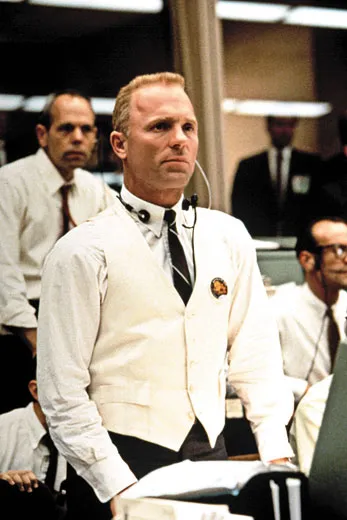
If you know who Gene Kranz is, it's likely because you either saw Ed Harris in Apollo 13 and thought "Who in the heck is that suave motherfucker in the white satin vest?" or because you're a space nerd. Or it might be both—there is no judgement from where I sit.
Well Gene Kranz was that suave motherfucker in the white satin (homemade!) vest, and he was Flight Director for the White Team for multiple Gemini and Apollo missions—not just Apollo 13, but also 11 and 7, 9, 15, 16, 17. He was a key contributor to setting operational precedent for Mission Control, ensuring the clear lines of communication, process for making mission critical decisions, and ensuring that NASA's ground operations hummed along without issue.
And yep, for every mission his wife Marta made him a fancy-ass vest and he wore that shit with pride because Kranz loved his wife.
1. Overall, this was an interesting autobiographical revisiting of Kranz's time with NASA during their push to the moon. His position as Flight Director is an interesting counter-point to the recollections of the astronauts themselves, and he routinely and regularly praises the contributions and valor of the men in the "trench" of mission control, those who were parsing data and routinely making go-no go decisions based solely on math and instinct.
And it's a little shocking, sometimes, the number of those faults and errors and issues they faced. Like, we know about Apollo 13—Tom Hanks told us all about it—but there were situations with nearly every single mission that came down to Mission Control examining the facts, determining root cause, and making a snap decision on how to move past it without putting the mission or the men in space at risk.
Which is just: bonkers. That was their daily! They did that! I bet they went through Tums like they went through cigarettes.
2. That said, I will acknowledge that this book suffers a bit from Kranz's matter-of-fact retelling only because his innate humility makes some of the brassier beats fall a little flat. He's also a little repetitive with his major themes, and that sometimes bleeds into the narrative of mission events, making them murkier than they needed to be. A more robust editing hand might have helped with some of this, but it's a minor complaint marring only the flow of the book vs. its underlying recollection of being there for some major shit.
3. Also have to acknowledge that Kranz doesn't shy away from some of the boys' club approaches taken by NASA employees in the 60s: he describes how he wrapped his flight director manuals in images of swimsuit models, and acknowledges that the celebrations following Apollo 17 would likely include topless go-go dancing clubs.
But for all that, Kranz comes through as someone who did the best that he could to serve his country and the shot to the moon idealized by a young president; he loves his family and his wife immensely, and built strong friendships with the men he worked with. He dedicated himself to his work at NASA and to Mission Control.
Well Gene Kranz was that suave motherfucker in the white satin (homemade!) vest, and he was Flight Director for the White Team for multiple Gemini and Apollo missions—not just Apollo 13, but also 11 and 7, 9, 15, 16, 17. He was a key contributor to setting operational precedent for Mission Control, ensuring the clear lines of communication, process for making mission critical decisions, and ensuring that NASA's ground operations hummed along without issue.
And yep, for every mission his wife Marta made him a fancy-ass vest and he wore that shit with pride because Kranz loved his wife.
1. Overall, this was an interesting autobiographical revisiting of Kranz's time with NASA during their push to the moon. His position as Flight Director is an interesting counter-point to the recollections of the astronauts themselves, and he routinely and regularly praises the contributions and valor of the men in the "trench" of mission control, those who were parsing data and routinely making go-no go decisions based solely on math and instinct.
And it's a little shocking, sometimes, the number of those faults and errors and issues they faced. Like, we know about Apollo 13—Tom Hanks told us all about it—but there were situations with nearly every single mission that came down to Mission Control examining the facts, determining root cause, and making a snap decision on how to move past it without putting the mission or the men in space at risk.
Which is just: bonkers. That was their daily! They did that! I bet they went through Tums like they went through cigarettes.
2. That said, I will acknowledge that this book suffers a bit from Kranz's matter-of-fact retelling only because his innate humility makes some of the brassier beats fall a little flat. He's also a little repetitive with his major themes, and that sometimes bleeds into the narrative of mission events, making them murkier than they needed to be. A more robust editing hand might have helped with some of this, but it's a minor complaint marring only the flow of the book vs. its underlying recollection of being there for some major shit.
3. Also have to acknowledge that Kranz doesn't shy away from some of the boys' club approaches taken by NASA employees in the 60s: he describes how he wrapped his flight director manuals in images of swimsuit models, and acknowledges that the celebrations following Apollo 17 would likely include topless go-go dancing clubs.
But for all that, Kranz comes through as someone who did the best that he could to serve his country and the shot to the moon idealized by a young president; he loves his family and his wife immensely, and built strong friendships with the men he worked with. He dedicated himself to his work at NASA and to Mission Control.

November 22, 2021
A personal account of the US space program, starting with the early years of the Redstone rocket launches through the end of the Apollo program in December 1972. Kranz's responsibilities were in the development of flight control, quite literally from the ground up. This involves the development of procedures, pre- and post-flight checks, and in summary relates the development of a complex and fine-tuned organization that was responsible for the successful completion of multiple ambitious projects.
Kranz writes directly. This is an autobiography, not a work of theory. There are personal anecdotes. I had at first expected a history of the early years of NASA, and I had wanted of course to read about all the Apollo missions. but an additional benefit was seeing how NASA worked - a preoccupation with not just finding but understanding potential points of failure; valuing different tranches of expertise to solve complex problems; a sensitivity to changing conditions; and bringing on not only people with expertise but the ability to bounce back after setbacks, which are inevitability for tasks so complex. This kind of organizational framework had to be built from scratch, out of a massive volume of applicants and with Congress being at times generous or skinflints with funding.
The book concludes with a lamentation of further work in space that is not yet finished, and a cri de coeur for future generations to finish what his had started.
Kranz writes directly. This is an autobiography, not a work of theory. There are personal anecdotes. I had at first expected a history of the early years of NASA, and I had wanted of course to read about all the Apollo missions. but an additional benefit was seeing how NASA worked - a preoccupation with not just finding but understanding potential points of failure; valuing different tranches of expertise to solve complex problems; a sensitivity to changing conditions; and bringing on not only people with expertise but the ability to bounce back after setbacks, which are inevitability for tasks so complex. This kind of organizational framework had to be built from scratch, out of a massive volume of applicants and with Congress being at times generous or skinflints with funding.
The book concludes with a lamentation of further work in space that is not yet finished, and a cri de coeur for future generations to finish what his had started.

July 23, 2013
I actually put off finishing this because I didn't want it to be over. I'm not really sure how to review it, except to say that if you're a space geek, this is pretty much exactly how you would expect Gene Kranz to write -- you can hear him narrating it in your head. I especially love how much he praised the people you don't see on the documentaries, the secretaries and math nerds and computer geeks (including the women programmers who basically wrote the entire space program). We rarely get to see the MC side of things, and this book makes you appreciate them even more. Definitely going on the To-Buy list.

November 13, 2017
Just for aficionados of space flight history. Invaluable to the historical record. Engaging. Not a particularly personal memoir, yet by the end I felt I knew Kranz quite well. Absolutely this will be a re-read.

July 13, 2019
Last year when my great granddaughter was born, I started writing letters to her every month. I do not live near her, and this would be my way of sharing family stories and whatever else I might think of as time moves on. This month marks the 50th anniversary of the first moon landing. I wanted to be sure to share my memories of that day and also of the early space program in general. I was in high school when Alan Shepard became the first American in space. The more I thought about what I wanted to tell her, I realized I wanted to go back and fill in a lot of what I do *not* remember.
I remembered all the highlights of this time period, but the book filled in so many details. What Kranz does so well is to put the reader at the console along with the flight controller. Flight controllers need to know about every aspect of the flight from liftoff to touchdown. Simulation was preparation. They sat in a mock up of the capsule so that they could envision every light and switch the astronauts saw. They knew timeframes in which maneuvers could happen. It was their call whether a mission could be continued or aborted.
Even though I knew the outcomes, Kranz well conveyed the tension for him and others. Things could and did go wrong, not just on Apollo 13, but on all of the flights. I found it fascinating to learn how they went about preparing for the flights and then working through problems. Technical references could not be left out and there were a lot of acronyms. I did my best to follow the narrative, and there is a glossary at the back in case I didn't remember what some initials meant.
Kranz lets us see the human side of things, too. The early Mercury capsule was small.
I remembered all the highlights of this time period, but the book filled in so many details. What Kranz does so well is to put the reader at the console along with the flight controller. Flight controllers need to know about every aspect of the flight from liftoff to touchdown. Simulation was preparation. They sat in a mock up of the capsule so that they could envision every light and switch the astronauts saw. They knew timeframes in which maneuvers could happen. It was their call whether a mission could be continued or aborted.
Even though I knew the outcomes, Kranz well conveyed the tension for him and others. Things could and did go wrong, not just on Apollo 13, but on all of the flights. I found it fascinating to learn how they went about preparing for the flights and then working through problems. Technical references could not be left out and there were a lot of acronyms. I did my best to follow the narrative, and there is a glossary at the back in case I didn't remember what some initials meant.
Kranz lets us see the human side of things, too. The early Mercury capsule was small.
The interior of the space capsule that Alan Shepard would soon climb into was so small that a human being could barely fit. The back of his couch was within inches of the heat shield. The instrument panel was less than two feet from his face and the parachutes only five feet forward. John Glenn had hung a sign on the panel: "No Handball Playing in This area."I marked (and failed to mark) several passages that I found meaningful.
Apollo 11 would be the flight for the ages, but Apollo 8 was a very big leap that drew on one's spiritual and moral resolve. For us it would become the second greatest Christmas story ever told. Think about the imagery of a rocket soaring through limitless space, so close to heaven the passengers could reach out and touch the face of God.Having been originally published in 2000, it isn't a recent addition to books about America's early space program. I'm very glad of the opportunity to read this. It is very readable. Although it just barely crosses the threshold, I'm happy to give it 5-stars.

June 7, 2015
I've read a number of books on the space race - the time period of Mecury, Gemini and Apollo. I've had a life long interest since I was a child growing up in that era. I give this book four stars because it a story that needs to be told. Gene Kranz is pretty exhaustive in his details but I admit it was way too "operationally" focused for me. I like the human element and this was all about how it was done -- the nuts and bolts. It took me months to get through this book because of the level of operational detail. But I think it is an important part of the whole story, so that's why I stuck with it. Addendum: I forgot to mention how utterly brilliant everyone was who worked there at the time. Many fresh out of college. The challenges they faced were enormous. In nearly every mission something went wrong they had to fix--of extreme crises proportions. And like the "cool, steely-eyed missile men" they were, they did it. What NASA accomplished was phenomenal.

November 28, 2025
Well, the title and the story behind it really drew me in. However, at times, I found it a bit dry and off the topic of the space program. Don’t get me wrong, it is a great look back in the history of the program with some very memorable moments and Gene Kranz tells his story here with directness, and emotion. For fans of the Mercury, Gemini, and Apollo programs, the book does an outstanding job describing some pretty technical stuff in a way that is understandable and pulls the reader in. Enjoy space fans!

February 16, 2023
Failure Is Not An Option by Gene Kranz
This is a memoir by Gene Kranz who was an assistant flight director for the Mercury and Gemini programs and then led many famed Apollo missions as the flight director. This memoir is not very personal but rather focused on the space program. I have no idea if he had children. And I only know his wife knitted special mission control vests. In the 1960s WASPY men dominated the Space program. The U.S. would successfully land 12 men on the moon in the Apollo program. No other nation has successfully landed men on the moon.
There are many solid books on the Space Race and even those brave pre Space Race test pilots of the 1950s. I have always been a dreamer and have been interested in technology and history since a young age. I am especially drawn to the history of my parent's generation. This book checks those boxes.
My father-in-law was there in Cape Canaveral for the Apollo 11 launch in 1969. I have told him many times about how jealous I am. He was a young Aerospace engineering student. While he never got to work for NASA, I have been extremely fortunate to have visited some cool Space program sites with my children, his grandchildren.
At the National Air and Space Museum in Washington D.C. there is a Lunar Rover complete with its tinfoil shield. Complete wow factor. It all seems so Rube-Goldberg, I can't believe they drove that across the moon.
At Cape Canaveral it is the impressive Launch Pad and structures that wooed us. My kids were more impressed by the feral pigs running around the cape. But my favorite NASA landmark of all is the Johnson Space Center in Houston. Beyond the mission control room on the 3rd floor which is straight out of the 1960s, there on the museum grounds rests a Saturn-V rocket. It is in its own massive building lying on its side measuring out at more than a football field in length. Having been to so many landmarks around the world, the Saturn V is one of the most impressive sights. It is the largest object to have ever flown from Earth's surface. It consumed 20 tons of fuel per second at takeoff. Not the greenest technology to be sure but impressive.
Back to the book, Kranz highlights the problems that plagued the Mercury, Gemini and Apollo missions (roughly thirty missions). That is the really unique aspect to this memoir. His memory is the connective tissue between the missions.
Instrumentation problems and false warnings were far away the most common problems in each of the Apollo missions beyond the launchpad disaster of Apollo 1. There is no Apollo mission that could have been successful without the non-stop troubleshooting experts on the ground and at the Mission Command Center. Interestingly, there were only two events on each manned Moon mission that did not have any redundancy built in: the lunar module ascent and the re-insertion into Earth's orbit and for which the engineers on the ground could help with. There were no Apollo accidents in either of these two situations.
Here are some more specific notes on many of the individual missions.
1. In May 1961, Alan Shepard became the first American in space (sub-orbital flight) with the Mercury-Redstone-3 mission. His flight reached an altitude of 116 miles above the Earth. The flight up took only two minutes, followed by five minutes of weightlessness and then some minutes for re-entry and splash-down. Eleven minutes after splashdown Shepard was safely aboard the aircraft carrier the Lake Champlain.
2. In November 1961, the Mercury Atlas-5 mission successfully saw Enos the chimpanzee orbit the Earth in a prequel to John Glenn's orbit of Earth in Mercury Atlas-6 in February 1962. The value of mission control was seen with the Atlas-5 mission and the decision was made to build a mission control center in Houston. One year later it was already employing 1,800 employees. Of course it would go on to be a fixture in the space program.
3. In February 1962, Glenn's three orbit mission did not go without problems. There was first an intermittent attitude adjustment problem and then a sensor problem indicating a detachment issue with the heat shield. This latter problem was ignored because nothing could have been done if the sensor was correct anyway. No problems were found on re-entry though.
4. John Glenn then became a national hero as a result of the mission. After three campaigns he became a U.S. Senator from Ohio. In 1998 he flew on the Space Shuttle at age 77 and lived to be 95 years old.
5. Scott Carpenter was pegged for the Mercury 7 mission in May. It was largely a repeat of Glenn's mission also with three orbits. There was a serious control systems issue that required so many refirings to line up with re-entry such that Carpenter came within seconds of running out and fuel and tumbling through space.
6. Gemini Titan-3 in March 1965 was the first manned Gemini mission. Gemini was to learn and perfect the docking, space walks and technology. The orbit mission with Grissom and Young went flawlessly. Gemini-4 in April 1965 would include 4 days of flight time.
8. By the time of the last Gemini mission in November 1966, the Gemini-12, the space program had achieved all their objectives in advance of the Apollo program. There were a few close calls and some aborted launches but the long flights, the EVA work and docking experiences would prove vital for the Apollo missions not just for feasibility but also the real-time troubleshooting. The next missions were all Apollo missions.
9. On January 27 1967 while Apollo 1 was on the launchpad at Cape Canaveral, the three Astronauts tragically burned up. Grissom, White and Chafee were all dead. This tragedy also created a significant delay in the program. The other Apollo missions, despite some close calls, all achieved their limited objectives.
10. Apollo 8 was led by Jim Lovell was the first manned spacecraft to go into lunar orbit. The flight was virtually flawless and was an enormous victory for the space program. Lovell is better remembered for Apollo 13.
11. Apollo 11 was the first manned mission to land on the moon. The book dedicates several chapters on this momentous occasion. It is far and away the best part of the book. I never knew that the Eagle Lunar Module only had a few seconds of fuel left when it landed on the surface and was such a hairy situation. The landing took so long because the LM had overshot the targeted landing zone and ended up landing in a crater. This gross error had more to do with orbiting errors than due to any fault on the part of the Astronauts.
12. There wasn't as much coverage on Apollo 13 as I would have preferred. But there is already been so much written about this mission that I am okay with that.
13. The final four Apollo missions (14-17) were largely lunar geology expeditions to gather space rocks and elements from around the moon. All of these missions (other than the last Apollo 17) had some close calls and near abort decisions and landed in some mountainous regions of the moon.
4.5 stars. This memoir would have been 5 stars if the writing were just a little better. However this is the most insightful book on the engineering behind the U.S. space program only possible because of the unique positions that Kranz held.
This is a memoir by Gene Kranz who was an assistant flight director for the Mercury and Gemini programs and then led many famed Apollo missions as the flight director. This memoir is not very personal but rather focused on the space program. I have no idea if he had children. And I only know his wife knitted special mission control vests. In the 1960s WASPY men dominated the Space program. The U.S. would successfully land 12 men on the moon in the Apollo program. No other nation has successfully landed men on the moon.
There are many solid books on the Space Race and even those brave pre Space Race test pilots of the 1950s. I have always been a dreamer and have been interested in technology and history since a young age. I am especially drawn to the history of my parent's generation. This book checks those boxes.
My father-in-law was there in Cape Canaveral for the Apollo 11 launch in 1969. I have told him many times about how jealous I am. He was a young Aerospace engineering student. While he never got to work for NASA, I have been extremely fortunate to have visited some cool Space program sites with my children, his grandchildren.
At the National Air and Space Museum in Washington D.C. there is a Lunar Rover complete with its tinfoil shield. Complete wow factor. It all seems so Rube-Goldberg, I can't believe they drove that across the moon.
At Cape Canaveral it is the impressive Launch Pad and structures that wooed us. My kids were more impressed by the feral pigs running around the cape. But my favorite NASA landmark of all is the Johnson Space Center in Houston. Beyond the mission control room on the 3rd floor which is straight out of the 1960s, there on the museum grounds rests a Saturn-V rocket. It is in its own massive building lying on its side measuring out at more than a football field in length. Having been to so many landmarks around the world, the Saturn V is one of the most impressive sights. It is the largest object to have ever flown from Earth's surface. It consumed 20 tons of fuel per second at takeoff. Not the greenest technology to be sure but impressive.
Back to the book, Kranz highlights the problems that plagued the Mercury, Gemini and Apollo missions (roughly thirty missions). That is the really unique aspect to this memoir. His memory is the connective tissue between the missions.
Instrumentation problems and false warnings were far away the most common problems in each of the Apollo missions beyond the launchpad disaster of Apollo 1. There is no Apollo mission that could have been successful without the non-stop troubleshooting experts on the ground and at the Mission Command Center. Interestingly, there were only two events on each manned Moon mission that did not have any redundancy built in: the lunar module ascent and the re-insertion into Earth's orbit and for which the engineers on the ground could help with. There were no Apollo accidents in either of these two situations.
Here are some more specific notes on many of the individual missions.
1. In May 1961, Alan Shepard became the first American in space (sub-orbital flight) with the Mercury-Redstone-3 mission. His flight reached an altitude of 116 miles above the Earth. The flight up took only two minutes, followed by five minutes of weightlessness and then some minutes for re-entry and splash-down. Eleven minutes after splashdown Shepard was safely aboard the aircraft carrier the Lake Champlain.
2. In November 1961, the Mercury Atlas-5 mission successfully saw Enos the chimpanzee orbit the Earth in a prequel to John Glenn's orbit of Earth in Mercury Atlas-6 in February 1962. The value of mission control was seen with the Atlas-5 mission and the decision was made to build a mission control center in Houston. One year later it was already employing 1,800 employees. Of course it would go on to be a fixture in the space program.
3. In February 1962, Glenn's three orbit mission did not go without problems. There was first an intermittent attitude adjustment problem and then a sensor problem indicating a detachment issue with the heat shield. This latter problem was ignored because nothing could have been done if the sensor was correct anyway. No problems were found on re-entry though.
4. John Glenn then became a national hero as a result of the mission. After three campaigns he became a U.S. Senator from Ohio. In 1998 he flew on the Space Shuttle at age 77 and lived to be 95 years old.
5. Scott Carpenter was pegged for the Mercury 7 mission in May. It was largely a repeat of Glenn's mission also with three orbits. There was a serious control systems issue that required so many refirings to line up with re-entry such that Carpenter came within seconds of running out and fuel and tumbling through space.
6. Gemini Titan-3 in March 1965 was the first manned Gemini mission. Gemini was to learn and perfect the docking, space walks and technology. The orbit mission with Grissom and Young went flawlessly. Gemini-4 in April 1965 would include 4 days of flight time.
8. By the time of the last Gemini mission in November 1966, the Gemini-12, the space program had achieved all their objectives in advance of the Apollo program. There were a few close calls and some aborted launches but the long flights, the EVA work and docking experiences would prove vital for the Apollo missions not just for feasibility but also the real-time troubleshooting. The next missions were all Apollo missions.
9. On January 27 1967 while Apollo 1 was on the launchpad at Cape Canaveral, the three Astronauts tragically burned up. Grissom, White and Chafee were all dead. This tragedy also created a significant delay in the program. The other Apollo missions, despite some close calls, all achieved their limited objectives.
10. Apollo 8 was led by Jim Lovell was the first manned spacecraft to go into lunar orbit. The flight was virtually flawless and was an enormous victory for the space program. Lovell is better remembered for Apollo 13.
11. Apollo 11 was the first manned mission to land on the moon. The book dedicates several chapters on this momentous occasion. It is far and away the best part of the book. I never knew that the Eagle Lunar Module only had a few seconds of fuel left when it landed on the surface and was such a hairy situation. The landing took so long because the LM had overshot the targeted landing zone and ended up landing in a crater. This gross error had more to do with orbiting errors than due to any fault on the part of the Astronauts.
12. There wasn't as much coverage on Apollo 13 as I would have preferred. But there is already been so much written about this mission that I am okay with that.
13. The final four Apollo missions (14-17) were largely lunar geology expeditions to gather space rocks and elements from around the moon. All of these missions (other than the last Apollo 17) had some close calls and near abort decisions and landed in some mountainous regions of the moon.
4.5 stars. This memoir would have been 5 stars if the writing were just a little better. However this is the most insightful book on the engineering behind the U.S. space program only possible because of the unique positions that Kranz held.

January 4, 2020
I'd been looking for a read about Neil Armstrong for the 50th Anniversary of the Moon Landing and instead made the thrilling discovery that Mr. Kranz wrote a book! I just knew I'd like him after seeing him interviewed on Smithsonian channel, etc. (For reference, Ed Harris played him in the movie Apollo 13.) What took me by surprise is that this fighter/test pilot-engineer-NASA flight director is one helluva writer! He knows just how to describe what things felt like and with just the right balance of detail. This book flowed, I ate up every word. What a ride!

September 14, 2010
I picked this as my first "fun book" to read on my Kindle. It was a good read. Kranz was a flight director during the Apollo mission, and is best known to most people as the character played by Ed Harris in "Apollo 13." This book is a good addition to the popular literature on the space program, focusing on the heroic and inspirational efforts of the men and some women who worked as a team to put men on the moon.
This notion of teamwork and really hard work under stress and risk is the most impressive part of this book. Kranz is unfailingly gracious about everyone he worked with, and is quite kind to people with whom he sometimes had disagreements. It's impressive to see this sort of evenhandedness in a memoir, although some might like their memoirs more "dishy." Indeed, he is nice to a fault--it would be interesting to learn more about conflicts between smart, strong-minded people about important matters. But this is less Kranz's goal than is the idea that a team can come together and build something as prodigious as a system for putting people on the moon, and getting them home.
For space geeks who revel in the technical aspects of the space program, this book may not be fully satisfying, as interesting material is not fully explained or covered, while some technical terms are assumed to be known by the reader. And as space history or policy, this isn't at the same level as some of the more expansive works on the subject. But, again, this isn't Kranz's goal. This is an interesting and fun read.
This notion of teamwork and really hard work under stress and risk is the most impressive part of this book. Kranz is unfailingly gracious about everyone he worked with, and is quite kind to people with whom he sometimes had disagreements. It's impressive to see this sort of evenhandedness in a memoir, although some might like their memoirs more "dishy." Indeed, he is nice to a fault--it would be interesting to learn more about conflicts between smart, strong-minded people about important matters. But this is less Kranz's goal than is the idea that a team can come together and build something as prodigious as a system for putting people on the moon, and getting them home.
For space geeks who revel in the technical aspects of the space program, this book may not be fully satisfying, as interesting material is not fully explained or covered, while some technical terms are assumed to be known by the reader. And as space history or policy, this isn't at the same level as some of the more expansive works on the subject. But, again, this isn't Kranz's goal. This is an interesting and fun read.

December 20, 2018
Failure is Not an Option by Gene Kranz the statement of being Tough & Competent, tough that you are always accountable for what you do or fail to do. Competent, that you never take anything for granted, you must never be found short in your knowledge or skills. This was written on a board and was instigated from the aftermath of 3 astronauts deaths in a fire on the ground, very profound and motivating something worth remembering. Littered with technical details but told in an easy to follow enjoyable way. Solid telling of the many relationships between very motivated individual’s working in a high intensity and stressful environment all were young and intrusted with crucial tasks, then let loose by bosses who just simply got out of their way. I liked the way they reacted and handled the many situations and how the many types of personalities some pretty weird others humorous and more were very geeky and technical minded, but they all worked together for a common goal, story is from Mercury through Gemini and then the last Apollo missions, felt the pain on the funding cutbacks and wasted opportunity to keep going imagine what could have been, bases on the moon, manned missions to Mars fantastic science non fiction something really to inspire generations of space geeks. Really loved this story and it’s Imho definitely a blast, pun intended.

January 12, 2023
I tried reading this a couple of years ago and got too caught up in the technical jargon, so on second attempt, I listened to it as an audiobook-- definitely would recommend especially for those not well versed in space flight language. Other than that difficulty (which, I think, is ultimately a fault of my own and not the book), this memoir is one of the best historical accounts of Mission Control during Kranz's time there that I've come across. He's incredibly thorough, funny, and insightful regarding the development and execution of each mission, and provides glimpses into his own personality and the humanity of his colleagues. I especially appreciated his focus on the Mercury and Gemini missions-- having that foundation at the beginning really emphasized the importance of Mercury & Gemini for the successful completion of the Apollo missions.
(I also think he gave just the right amount of attention to Apollo 11 and 13 in this-- these two tend to get overemphasized, in my opinion).
Overall, good stuff. Gene Kranz continues to be my favorite NASA flight director.
(I also think he gave just the right amount of attention to Apollo 11 and 13 in this-- these two tend to get overemphasized, in my opinion).
Overall, good stuff. Gene Kranz continues to be my favorite NASA flight director.

January 27, 2018
This was an incredibly detailed read. I was fascinated by the focus, determination, and skill shown by the teams of flight controllers through the missions from Mercury to Apollo. This book wasn't really a narrative to me in the traditional sense, but rather a personal description of events throughout his career with Mission Control. An excellent, albeit quite dense, read if you're interested in the early US space program from Mission Control's point of view.

November 7, 2015
I was first introduced to the idea of Gene Kranz when I first saw the film Apollo 13, and then again shortly after I saw the excellent HBO miniseries, From the Earth to the Moon. I found his steely-eyed, take-no-bull, calm and collected attitude, portrayed by Ed Harris in Apollo 13 and Dan Butler in the HBO series, to be an integral part of the NASA equation.
So when this book, Failure is Not an Option, came up as a daily deal from Audible, I jumped on it. I couldn’t have made a better decision. This book is a personal memoir of Kranz, following his career at Nasa through the Mercury, Gemini and Apollo programs. The beginning of the book is a bit awkward, as it starts out immediately with the Mercury program, then provides an entire section on his own background, qualifications and training, then resumes with Gemini. It is a bit jarring at the point where you read it, but once you’re past it, you don’t think of it again.
The thing I like the best about this book is how it is not just effusive praise of the astronauts. This by no means diminishes their contribution, but Kranz seems to go out of his way to hammer into your head that everything was a team effort, and there were more people than you could possibly imagine who, working together, raced against the Russians to put a man on the moon. At one point, he says, “Chances are, you’ve never heard of Hal Beck.” This is just one of the many times he goes out of his way to describe the individuals who contributed to his team, praising their worth, their contribution and their ability.
Kranz seems selfless to a fault. He says, “I think everyone, once in his life should be given a ticker-tape parade.” I have a feeling the statuary of his controllers are polished with a little extra shine, but you can tell that he is the type of man who wants to make sure that everyone gets recognized. He jokes about how Alan Shepard says, “More people remember that I’m the guy who hit a golf ball on the moon, than that I was the first American in space.” Shift that back a few levels, and try to name any of the Flight Directors other than Kranz, or CAPCOMs that were not former astronauts, and you can see how he wants to make sure people don’t get forgotten.
And that’s the beauty of the book. It’s not about the astronauts; it’s about the people at Mission Control. The full name of the book is “Failure is not an Option: Mission Control From Mercury to Apollo 13 and Beyond,” and it is absolutely a recounting of the people who make up Mission Control - not the engineers who built the spacecraft, and not the astronauts who flew it - but the people who solved the problems mid-flight and kept everything together. When talking about how his flight director colors were retired, he says the retirement proclamation is “written by one’s peers, the only people who matter in our business.”
And problems there were, in spades. Apollo 13 stands out as one of the most celebrated successes pulled from the ashes of failure, but there were many other problems as well. All three Apollo 1 astronauts died before ever leaving the ground. Apollo 11 missed its landing zone by a large margin. Apollo 12 was struck by lightning before it ever left Earth’s atmosphere. It seems every mission had something that went wrong, and the Mission Control people worked the problems and fixed them with incredible efficiency.
This book is THEIR story. And it’s a fascinating one.
The book was written in 1999, and as such mentions the Challenger disaster, but was well before the Columbia disaster. It also is well before the privatization of space exploration, and the wonderful things being done by SpaceX. I would love to hear what he says about SpaceX, especially as the Afterword laments the current (1999) state of NASA and the country’s commitment to space exploration.
Audiobook note: The audiobook was very nicely narrated by Danny Campbell, who does a nice job of making it sound like he knows and believes the technical jargon sprinkled copiously throughout the book. The only negative is his rather poor British accent, which is thankfully kept to a minimum.
So when this book, Failure is Not an Option, came up as a daily deal from Audible, I jumped on it. I couldn’t have made a better decision. This book is a personal memoir of Kranz, following his career at Nasa through the Mercury, Gemini and Apollo programs. The beginning of the book is a bit awkward, as it starts out immediately with the Mercury program, then provides an entire section on his own background, qualifications and training, then resumes with Gemini. It is a bit jarring at the point where you read it, but once you’re past it, you don’t think of it again.
The thing I like the best about this book is how it is not just effusive praise of the astronauts. This by no means diminishes their contribution, but Kranz seems to go out of his way to hammer into your head that everything was a team effort, and there were more people than you could possibly imagine who, working together, raced against the Russians to put a man on the moon. At one point, he says, “Chances are, you’ve never heard of Hal Beck.” This is just one of the many times he goes out of his way to describe the individuals who contributed to his team, praising their worth, their contribution and their ability.
Kranz seems selfless to a fault. He says, “I think everyone, once in his life should be given a ticker-tape parade.” I have a feeling the statuary of his controllers are polished with a little extra shine, but you can tell that he is the type of man who wants to make sure that everyone gets recognized. He jokes about how Alan Shepard says, “More people remember that I’m the guy who hit a golf ball on the moon, than that I was the first American in space.” Shift that back a few levels, and try to name any of the Flight Directors other than Kranz, or CAPCOMs that were not former astronauts, and you can see how he wants to make sure people don’t get forgotten.
And that’s the beauty of the book. It’s not about the astronauts; it’s about the people at Mission Control. The full name of the book is “Failure is not an Option: Mission Control From Mercury to Apollo 13 and Beyond,” and it is absolutely a recounting of the people who make up Mission Control - not the engineers who built the spacecraft, and not the astronauts who flew it - but the people who solved the problems mid-flight and kept everything together. When talking about how his flight director colors were retired, he says the retirement proclamation is “written by one’s peers, the only people who matter in our business.”
And problems there were, in spades. Apollo 13 stands out as one of the most celebrated successes pulled from the ashes of failure, but there were many other problems as well. All three Apollo 1 astronauts died before ever leaving the ground. Apollo 11 missed its landing zone by a large margin. Apollo 12 was struck by lightning before it ever left Earth’s atmosphere. It seems every mission had something that went wrong, and the Mission Control people worked the problems and fixed them with incredible efficiency.
This book is THEIR story. And it’s a fascinating one.
The book was written in 1999, and as such mentions the Challenger disaster, but was well before the Columbia disaster. It also is well before the privatization of space exploration, and the wonderful things being done by SpaceX. I would love to hear what he says about SpaceX, especially as the Afterword laments the current (1999) state of NASA and the country’s commitment to space exploration.
Audiobook note: The audiobook was very nicely narrated by Danny Campbell, who does a nice job of making it sound like he knows and believes the technical jargon sprinkled copiously throughout the book. The only negative is his rather poor British accent, which is thankfully kept to a minimum.

July 16, 2023
This book has been sitting on my shelf for years; I'm glad I finally picked it up.
.
While parts were technical and confusing and sailed right over my head, Gene Kranz is an American treasure and loved his time in Mission Control.
.
I really enjoyed learning more about the Mercury and Gemini missions; Apollo gets all the glory, but wouldn't have happened without Mercury and Gemini.
.
If you love space history, this book is a must read.
.
"It isn't equipment that wins the battles; it is the quality and the determination of the people fighting for a cause in which they believe."
.
"Apollo 11 would be the flight for the ages, but Apollo 8 was a very big leap that drew on one's spiritual and moral resolve. For us it would become the second greatest Christmas story ever told. Think about the imagery of a rocket soaring through limitless space, so close to heaven that passengers could reach out and touch the face of God."
.
In this final mission, the crew and controllers all had time to sense the history in our work. As the final hours approached, I found myself mentally reviewing the early years of space, trying to fathom why we succeeded when by all rights we should have failed."
.
While parts were technical and confusing and sailed right over my head, Gene Kranz is an American treasure and loved his time in Mission Control.
.
I really enjoyed learning more about the Mercury and Gemini missions; Apollo gets all the glory, but wouldn't have happened without Mercury and Gemini.
.
If you love space history, this book is a must read.
.
"It isn't equipment that wins the battles; it is the quality and the determination of the people fighting for a cause in which they believe."
.
"Apollo 11 would be the flight for the ages, but Apollo 8 was a very big leap that drew on one's spiritual and moral resolve. For us it would become the second greatest Christmas story ever told. Think about the imagery of a rocket soaring through limitless space, so close to heaven that passengers could reach out and touch the face of God."
.
In this final mission, the crew and controllers all had time to sense the history in our work. As the final hours approached, I found myself mentally reviewing the early years of space, trying to fathom why we succeeded when by all rights we should have failed."

November 9, 2016
This is "inside baseball" for NASA fans. It is like a diary full of details that aren't really tied together into a coherent theme. The title is "Failure is not an option" but the author describes the space program failing spectacularly an awful lot "from Mercury to Apollo 13" so there's a big picture missing that I would have hoped for.
May 18, 2024
Some very interesting stories in here but it drags on a bit and a Mission Control memoir is just not going to be as exciting as an astronaut memoir. Still worth reading though. Gene Kranz was in Mission Control from the very beginning and Flight Director for Apollo 11, Apollo 13, and many more. This had to be an incredibly stressful and exciting job, and they were pretty much making it up as they went along.
During the descent to the lunar surface on Apollo 11 two alarms went off, 1201 and 1202. You can hear them in the Apollo 11 First Steps documentary. Gene tells how in the last simulation they did before the mission, the simulation team gave them these exact alarms which have to do with computer overload. In the simulation, they called an abort when they shouldn’t have and would have unnecessarily thrown away the mission. Crazy that the last simulation they did ended up happening in real life! In the real mission of course they diagnosed correctly and proceeded with the landing.
Also during the Apollo 11 landing, they used way more fuel than they had ever expected; the fuel levels were below where they could read them and they only had about 30 more seconds left when they landed. Cutting it close!
Bill Bookworm’s running NASA books ranking:
1. Carrying the Fire (first person, put you in his shoes, authentic writing style, there for the first moon landing)
2. The Right Stuff (unexpectedly hilarious)
3. Apollo 13 (epic story, but you could tell it’s ghost written compared to Carrying the Fire)
4. The Six (great stories worth telling, but we stay in earth’s orbit)
5. Endurance (no knock on Scott at all, great book, but less interesting content to work with)
6. Failure is Not an Option (good book, just at the bottom of a great list)
During the descent to the lunar surface on Apollo 11 two alarms went off, 1201 and 1202. You can hear them in the Apollo 11 First Steps documentary. Gene tells how in the last simulation they did before the mission, the simulation team gave them these exact alarms which have to do with computer overload. In the simulation, they called an abort when they shouldn’t have and would have unnecessarily thrown away the mission. Crazy that the last simulation they did ended up happening in real life! In the real mission of course they diagnosed correctly and proceeded with the landing.
Also during the Apollo 11 landing, they used way more fuel than they had ever expected; the fuel levels were below where they could read them and they only had about 30 more seconds left when they landed. Cutting it close!
Bill Bookworm’s running NASA books ranking:
1. Carrying the Fire (first person, put you in his shoes, authentic writing style, there for the first moon landing)
2. The Right Stuff (unexpectedly hilarious)
3. Apollo 13 (epic story, but you could tell it’s ghost written compared to Carrying the Fire)
4. The Six (great stories worth telling, but we stay in earth’s orbit)
5. Endurance (no knock on Scott at all, great book, but less interesting content to work with)
6. Failure is Not an Option (good book, just at the bottom of a great list)

March 7, 2025
Pretty comprehensive story from a flight control person’s perspective of the early times of US space missions: orbital flights after Sputnik to Gemini mission and finally Apollo mission to the moon. Towards the end, Krantz issued a call for the government to re-embrace space. That part I’m not so sure. As I finished this book, SpaceX just launched another Starship mission with a successful capture of the returned booster on the tower — a pretty incredible sight. Let Elon and co. continue.

April 24, 2020
I had high expectations for this book and was listening to the audio version but unfortunately it just got to be too boring. It just didn’t have the same drama for me as other space books did.

September 6, 2012
I am a major fan of America's space program, especially the years we went to the moon. I've watched the TM shows and the movies and now I've listened to Gene Kranz's book. Comparing, I find the book is more complete. I enjoyed hearing about missions that didn't get a show, like the unmanned flights.
Astronauts get the ticker tape parades and mission control teams prepared future missions. It was an interesting perspective from the flight control console. Kranz outlined how the first American in space was such a short mission, only one team was needed in mission control. Each mission doubled in length, until more teams were needed. Handling of shifts and teams who covered major events in a mission were interesting items.
The epilogue was bittersweet as he exhorted Americans to return the space program to the gung-ho, explore the universe attitude we had, when we went to the moon. I agree, to a point, but I know it can't happen the same way, these days. We aren't the underdogs in space. We don't have a young, charismatic president setting a laudable goal and then being martyred, as Kennedy was. Even all those factors brought into today's political environment, and the economic situation may not be enough to put the space program high enough on the national priority list to get another big goal accomplished, the way it was, back in 1969.
Astronauts get the ticker tape parades and mission control teams prepared future missions. It was an interesting perspective from the flight control console. Kranz outlined how the first American in space was such a short mission, only one team was needed in mission control. Each mission doubled in length, until more teams were needed. Handling of shifts and teams who covered major events in a mission were interesting items.
The epilogue was bittersweet as he exhorted Americans to return the space program to the gung-ho, explore the universe attitude we had, when we went to the moon. I agree, to a point, but I know it can't happen the same way, these days. We aren't the underdogs in space. We don't have a young, charismatic president setting a laudable goal and then being martyred, as Kennedy was. Even all those factors brought into today's political environment, and the economic situation may not be enough to put the space program high enough on the national priority list to get another big goal accomplished, the way it was, back in 1969.

November 29, 2020
It should be easy to get swept up in this story of the exhilarating start to the space program. But for me, it was a little difficult to completely get invested, as Kranz’s writing was incredibly technical when it came to the inner workings of the different space crafts. Though on a surface level I could grasp the moments when a mission was in peril or when things were going smoothly, I felt left out of a close knit boy’s club.
Though for the most part, this was a pretty bland read for me, there were some really poignant images that this former flight director could conjure up. A lone flight controller walking through the empty MCC hallway before coordinating the moon landing. The last astronauts to walk on the moon laying a commemorative plaque to mark the end of an era. When the technical jargon is stripped away, the simplistic style of Kranz’s writing really shines.
I didn’t really get into this book, but it wasn’t a terrible read, if that makes sense. Maybe it deserves a re-read in the future. Maybe not. This was such a middle of the road read for me, I formed no strong opinions about it one way or another.
Though for the most part, this was a pretty bland read for me, there were some really poignant images that this former flight director could conjure up. A lone flight controller walking through the empty MCC hallway before coordinating the moon landing. The last astronauts to walk on the moon laying a commemorative plaque to mark the end of an era. When the technical jargon is stripped away, the simplistic style of Kranz’s writing really shines.
I didn’t really get into this book, but it wasn’t a terrible read, if that makes sense. Maybe it deserves a re-read in the future. Maybe not. This was such a middle of the road read for me, I formed no strong opinions about it one way or another.

June 17, 2014
Impossible to give a 'proper' rating for this book. If I was to be utterly brutal and honest I would rate it 3 stars. A decent, if slightly pedestrian account of Mission Control. Kranz gives us all the numbers and facts but it lacks the 'humanity' of a more intimate account.
But. I sat up and watched that grainy black and white film as Neil Armstrong climbed down the ladder to take his first step. I listened to the reports of Apollo 13 as they were relayed (in school- the only time we were ever allowed a radio in class and only because I was so insistent)
I watched it all and dreamed.
How could I not give this five stars. It is part of my past, my hopes and aspirations. A book that reminds me of an era when we all looked to the stars and knew it was going to be great.
But. I sat up and watched that grainy black and white film as Neil Armstrong climbed down the ladder to take his first step. I listened to the reports of Apollo 13 as they were relayed (in school- the only time we were ever allowed a radio in class and only because I was so insistent)
I watched it all and dreamed.
How could I not give this five stars. It is part of my past, my hopes and aspirations. A book that reminds me of an era when we all looked to the stars and knew it was going to be great.

September 29, 2021
As Gene Kranz recounts his story he mentions that he thought his life was over the day stopped flying fighter jets shortly after the Korean War. He had no idea what he was going to do next.
He joined NASA and was instrumental in helping get the unmanned Mercury missions into space and was later promoted to Flight Director for the manned Gemini missions and later moon-bound Apollo missions, including the moon landing phase of Apollo 11.
For me and I suspect many others he's most well known for being the lead Flight Director during the Apollo 13 disaster, and I still picture him as Ed Harris because of the film.
Kranz is a no-nonsense, practical guy but he also comes across as very likable as he details his life. I found this a really informative book in getting a view on what life was like for people working at NASA during that golden age. He covers off almost every mission in some detail, even the ones he wasn't directly involved in.
I believe he's still passionate about space exploration as his final chapter laments the winding down of the space program after the Shuttle Challenger disaster and looks back fondly at the risks his people took in getting to the moon and back in such a turbulent era.
There are sections that are quite dry with details and I found I had to concentrate to understand exactly what he was talking about, but those sections are infrequent and the overall narrative is quite engaging.
The audiobook is narrated by Danny Campbell who definitely sounds like a grizzled old NASA Flight Director, and he helped get through a couple of those dry sections.
Definitely a great book for anyone interested in the history of NASA.
He joined NASA and was instrumental in helping get the unmanned Mercury missions into space and was later promoted to Flight Director for the manned Gemini missions and later moon-bound Apollo missions, including the moon landing phase of Apollo 11.
For me and I suspect many others he's most well known for being the lead Flight Director during the Apollo 13 disaster, and I still picture him as Ed Harris because of the film.
Kranz is a no-nonsense, practical guy but he also comes across as very likable as he details his life. I found this a really informative book in getting a view on what life was like for people working at NASA during that golden age. He covers off almost every mission in some detail, even the ones he wasn't directly involved in.
I believe he's still passionate about space exploration as his final chapter laments the winding down of the space program after the Shuttle Challenger disaster and looks back fondly at the risks his people took in getting to the moon and back in such a turbulent era.
There are sections that are quite dry with details and I found I had to concentrate to understand exactly what he was talking about, but those sections are infrequent and the overall narrative is quite engaging.
The audiobook is narrated by Danny Campbell who definitely sounds like a grizzled old NASA Flight Director, and he helped get through a couple of those dry sections.
Definitely a great book for anyone interested in the history of NASA.

August 20, 2020
I gave this five stars because I’m a space junky, and I salivate over anything that has to do with the American Space program. For those not so interested, this is still a four star read.
Kranz effectively helped create America's space exploratory program from scratch. When he arrived at NASA in 1963, he had no guidance. There was no memo awaiting his arrival on his desk to walk him through what to do. In short, as a budding "Flight Director" (The guy in ultimately in charge of the mission) he had to create a program of endless countdown “Go Nogo” checklists and procedures out of nothing with no one else to count on but himself.
With that said, that he and his team of brainy 20-somethings managed to steer our country’s highly complex (Mercury, Gemini and Apollo) space exploratory efforts thorough the missions they did (while doing much of the necessary trajectory math by HAND!) in the 1960's with minimal human casualties is nothing short of miraculous.
In such an exciting time in this country's history, Kranz was smack in the middle coordinating it all, (while the astronauts got the glory.) He is, perhaps, one of the most spell binding American heroes out there that the general population will never know about.
Highly, highly recommend...
Kranz effectively helped create America's space exploratory program from scratch. When he arrived at NASA in 1963, he had no guidance. There was no memo awaiting his arrival on his desk to walk him through what to do. In short, as a budding "Flight Director" (The guy in ultimately in charge of the mission) he had to create a program of endless countdown “Go Nogo” checklists and procedures out of nothing with no one else to count on but himself.
With that said, that he and his team of brainy 20-somethings managed to steer our country’s highly complex (Mercury, Gemini and Apollo) space exploratory efforts thorough the missions they did (while doing much of the necessary trajectory math by HAND!) in the 1960's with minimal human casualties is nothing short of miraculous.
In such an exciting time in this country's history, Kranz was smack in the middle coordinating it all, (while the astronauts got the glory.) He is, perhaps, one of the most spell binding American heroes out there that the general population will never know about.
Highly, highly recommend...

February 22, 2022
Space, spaceflight and NASA has always been fascinating to me, and this book provided a look at a large chunk of a 30+ year career at NASA while being on the ground for some of the most exhilarating and also some of the most harrowing moments of the early space program. I struggled to put this down, and while the authors unending patriotism did get a little tiresome, that did not detract from my enjoyment.

August 21, 2024
Every time I’m reminded of what these guys did, it blows my mind. The sheer audacity to figure out from scratch, how to send people into space, orbit the Earth, land on the moon and come back, using 1950s and 60s technology is one of the craziest things I can think of. Having it explained by a super likeable guy who was involved from the very beginning feels like a real privilege.
I can’t recommend this book enough.
I can’t recommend this book enough.
February 21, 2021
I wanted to like this, but it just didn’t work for me. It wasn’t really holding my attention, but I pushed through knowing that Apollo 11 and 13 are stories almost too good to be true. Unfortunately, most of my favorite parts of these stories are left out; my guess is that these were done on a different shift or by a different team (engineering?). Overall, the vast majority of the time is spent discussing abort/no abort discussions and going over plans; I can’t honestly recommend unless you’re the type that loves plans and documentation, or you’re looking for some inside details.
Displaying 1 - 30 of 914 reviews