In ORPHEUS DESCENDING, a handsome, stoic musician, Val Xavier, descends on a repressive Southern town. He finds work in a dry-goods store owned by the tyrannical but terminally ill Jabe Torrance; the store’s daily operations are overseen by Jabe’s wife, Lady. Tragedy in Lady’s past drove her to Jabe, and her life since the marriage has been one of desperate loneliness. Val, with his exotic seductiveness and undeniable talent, might offer Lady an escape route to a happier future—if the town doesn’t destroy them both first. (Dramatists Play Service)
"... because of the power and the brilliance and the humor of his writing, it emerges as a consistently moving and captivating experience ... the author has done a masterful job of getting inside his characters." —NY Journal-American.
Thomas Lanier Williams III, better known by the nickname Tennessee Williams, was a major American playwright of the twentieth century who received many of the top theatrical awards for his work. He moved to New Orleans in 1939 and changed his name to "Tennessee," the state of his father's birth.
Raised in St. Louis, Missouri, after years of obscurity, at age 33 he became famous with the success of The Glass Menagerie (1944) in New York City. This play closely reflected his own unhappy family background. It was the first of a string of successes, including A Streetcar Named Desire (1947), Cat on a Hot Tin Roof (1955), Sweet Bird of Youth (1959), and The Night of the Iguana (1961). With his later work, he attempted a new style that did not appeal to audiences. His drama A Streetcar Named Desire is often numbered on short lists of the finest American plays of the 20th century, alongside Eugene O'Neill's Long Day's Journey into Night and Arthur Miller's Death of a Salesman.
Much of Williams' most acclaimed work has been adapted for the cinema. He also wrote short stories, poetry, essays and a volume of memoirs. In 1979, four years before his death, Williams was inducted into the American Theater Hall of Fame.
Orpheus Descending is a bold and powerful interpretation of the Greek myth. Williams retells the legend of Orpheus, shaping it in his own unique way, creating a story that is poignant with sorrow and just as capable of causing catharsis as those legendary Greek tragedies. As to why Orpheus Descending wasn't an immediate success, I must admit I'm a bit perplexed. Perhaps it was simply ahead its time with the strength of its imagism and the immense pain of its loneliness. Sexuality (either repressed or stressed) is always an important theme with Tennessee and this play is no exception. Whether that had to do anything with initial reception, I’m quite clueless but it might have had an impact of more conservative viewers. The character of Myra, with her open promiscuous ways, is a figure that might have raised a few eyebrows- and it still might. Recently I have learned that Williams wrote the character of Myra having the famous Hollywood actress Tallulah Bankhead in mind. Doesn’t Myra sound just like her? With her panic fear of loneliness?
There is a lot of tenderness in this novel. Val, the musician (our Orpheus) strand out in a variety of ways, but mostly because he is capable of sincerity and tenderness. He comes to this small dry shop searching escape from his ‘night life’, not running so much from live in the city, but from night life of the city, explaining that night and day city people live in different cities and don’t really know one another. Little does Val know that he has come to a sinister place, an underworld of a sorts, where a beautiful lady is trapped. Val’s tired of his life, of being lonely women’s paid comfort. Val claims that his guitar can ‘wash him clean of anything’, but he years are catching up with him, that’s why he must have left the (night) city. What is he looking for? Perhaps what we’re all looking for. Genuine kindness and tenderness, sometimes known under the name of love.
On one level, the story seems pretty straight-forward and simple. The plot itself is, quite possibly, nothing exceptional or unheard of. Lady gives a job to Val, who immediately attracts negative attention from the closed, racist and xenophobic community. Not surprisingly, Lady, a woman who was forced into marriage to a man she doesn’t love falls for Val, a young handsome guitar player. Not that I’ve read quite the same story before, but there must be similar ones. The irony is that Val is, in fact, innocent of just about anything he gets accused of. He just tries to comfort most women he talks with- we can see him as an embodiment of art itself. He brings solace to other people’s life and as a musician’s he understands other artists- for example the sheriff’s wife- the naïve painter. As you might guess, the sheriff won’t take too kindly to their talks.
Another woman Val is on friendly terms is Myra. She is a wealthy girl who is tormented by a terrible loneliness. She wears fantastical make up (modelling some dancer), drinks and drives around a lot, shocking everyone she comes across. At start she flirts with Val, but what happens between them ends up being something very akin to friendship. In one of their conversations, Val teases Myra, saying that being so slim and petite, she probably can’t even take the weight of the man, and Myra responds quite seriously that the act of love making is absolutely painful for her, but that she endures it, because a person will endure everything for the sake of chasing the loneliness away. Now, doesn’t that sound like Tallulah Bankhead who famously said to her doctor (after being discharged from hospital weighing only 70lbs (32 kg) due to vaginal disease complications): “Don’t think this taught me a lesson!”. I do wonder why Tallulah turned out that Myra role, she supposedly said that the play was impossible. Tennessee is brilliant when it comes to connecting themes of passion, love, sexuality and loneliness. Perhaps it is not his candid portrayal of human sexuality and desire that met with mixed reviews, perhaps it was his critique of the society.
For society is, without doubt, criticized in this novel. Perhaps it is even implied that society always senses ‘an artist’ as something intruding, ‘an alien’ of sorts, ‘a foreigner’ coming into familiar domestic and social structures and destroying them all. Society, does, as an entity, hate art instinctively. It may value artists, but only after a while, when they’re dead and lost to the underground.
What is exceptional about this play is the story itself, but the way the story is told. The beauty of this play is in its characters, whose human fragility is almost celebrated. The myth of Orpheus is retold and art founds a wonderful and befitting personification in the character of Val. The play is certainly tragic but very touching and profound in its tragedy. Its poetry will sound familiar to those appreciative of Williams’ talent. That kind of lyrical prose was something I expected. After all, the lyrical dialogues /monologues and the strong imaginary are among things this writer is celebrated for. What I did not expect from this play was the strength of its message, the way its characters and story merged into one. I won’t talk about the plot because I don’t wait to spoil anything, but let’s just say there were some twists and turns. In one way, this play can be read as a commentary on art itself, in another it can be read as a story. It is a play that is not only worth one’s time, but one’s heart as well. Read it and put some heart into it!
Wild things leave skins behind them, they leave clean skins and teeth and white bones behind them, and these are tokens passed from one to another, so that the fugitive kind can always follow their kind...
In the midst of reading all of Tennessee (actually, Thomas Lanier) Williams' plays, I am permeated with his characteristic atmosphere of desperation, decay, madness and melodrama, so thick that it condenses on me and drips, drips, drips from my extremities. Why do I continue, and with such relish? One reason is that Williams is one of our (the USA's) most poetic playwrights. In fact, he wrote poetry for much of his life, and he and his firmest advocate - James Laughlin, the founder of the New Directions publishing house, where almost all of Williams' texts (plays, poetry, short stories, two novels, essays, memoirs) first appeared - formed their lifelong bond after an enthused evening discussing their favorite poets. This poetic sensibility lends luster and additional depth to his plays.
Another is that despite all the variety in situation, tone and technique, the recurring types - the reality-denying mother, the absent and/or violent, dictatorial father, the impecunious family absent any real prospects to ameliorate the situation (indeed, every attempt to improve goes disastrously wrong and accelerates the family's slide into the abyss), the family member threatened by madness, the impecunious young man torn between his duty to his family and his desire to make something of himself - spring directly from his own life, and this fevered, obsessive wrestling with his own traumas lends an authenticity to the melodrama that completely changes its nature; or perhaps I should say that below the garish melodramatic exterior one glimpses real anguish. Certainly, Williams causes me to reconsider the tenuous dividing line between melodrama and theatricality.
The melodramatic surface lent itself well to the film versions of a good number of Williams' plays, and I fear that most people know Williams' work through these films alone (that was certainly true of me for most of my life). I can tell you that this immersion in his plays has significantly changed my view of Williams the dramatist.
Yet another reason for my interest and pleasure in Williams' plays is his dialogue, which freely and deftly transitions from some of the most natural I have heard in the theater to moments of poetic flight that don't strike one as artificial gestures, but rather as gratefully received enhancements. The telling deftness of the many passages (some quite extended) wherein the characters' speeches overlap and collide is a marvel to me, though they must be real challenges for the directors and actors to realize.
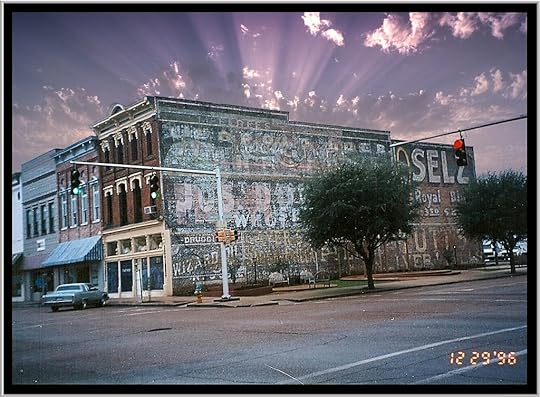
Columbus, Mississippi - Williams' birthplace
But it is high time that I focus on a single play: Orpheus Descending. Though it was first produced on Broadway in 1957, it is a completely re-written variant of Battle of Angels - Williams' first professionally produced play (it flopped in Boston). Williams wrote in a preface to the published play: Why have I stuck so stubbornly to this play? For seventeen years, in fact? Well, nothing is more precious to anybody than the emotional record of his youth, and you will find the trail of my sleeve-worn heart in this completed play that I now call Orpheus Descending. On its surface it was and still is the tale of a wild-spirited boy who wanders into a conventional community of the South and creates the commotion of a fox in a chicken coop.
On the surface indeed, for during the five re-writes Battle of Angels underwent to become Orpheus Descending,(*) Williams decided to re-cast the myth of Orpheus and Eurydice in this emotional record of his youth, changing the dictionary-toting poet of the earlier play to the guitar-toting musician of the later. But in my view the connections with the Greek myth are rather slight, adding relatively little to the core of the piece: a portrayal of the hell of small Southern town life in the 1930's,(**) with its racism, classism and enervating conformity enforced by malevolent gossip and, when "necessary", deadly violence. It is into this hell that the orphic Val enters and disturbs the stultifying conformity he encounters with passion, charisma and a breath of freedom, then discovers Lady - Williams' Eurydice - and tries to release her from Hades' grasp. The town's violent response may even top the tragedy of the ancient myth.
I've read some critics complain that Williams' personages are not fully fleshed-out characters. Orpheus Descending is indeed chock-a-block full of secondary characters who are types - real types - but types nonetheless, and each played a useful/necessary role in the piece.(***) It is a mystery to me that some critics label Williams as a "naturalist" or as a "realist". His plays are "true" but hardly "real"; Williams was a highly theatrical dramatist enamoured of symbols, morals, language and emotions and possessed of a great compassion and acceptance of persons of all types,(4*) believing himself to be of the "fugitive kind", and not merely because he was homosexual. He, like Val, felt he was caught in a corrupt, mendacious world, that he necessarily bathed in corruption, but that he was not corrupt, that his compassion and art kept him pure. Far from being a Naturalist or Realist, Williams was a Romantic, and to be a Romantic in the 20th century was to be of the fugitive kind.
(*) The latter title emerged during a re-write in 1953.
(**) Throughout his career Williams either explicitly or implicitly set his pieces in the 1930's, a period where he himself was struggling to find himself as a man and an artist, moving from one dead end, usually menial, job to another, but writing, writing, writing.
(***) Pace those critics who felt the play should focus more closely on the Val/Lady relationship. This piece is more of a novel than a short story. Or to put it another way: quite some time ago it was recognized that there are valid alternatives to Aristotle's unities of action, time, etc.
(4*) He rejected only cruelty, at least after he overcame the puritanical attitude that often accompanies feeling guilty about one's sexuality.
Sve drame Tenesija Vilijamsa, pa i ova, jedinstven su spoj lirizma, melodrame i nasilja jednog košmarnog paganskog i čulnog sveta u kome pojedinac visi okačen o tanku nit varljivog spasa sažetog u krilatici „depended on the kindness of strangers“. Pokretački događaj, opet tipičan za veliki broj Vilijamsovih komada, pa i uopšteno za južnjačku gotiku – dolazak misterioznog stranca u zatvoren svet američkog juga – ostvaruje se u vidu dolaska melanholičnog i zgodnog bivšeg žigala među stanovnike zabačenog mestašca. On sa sobom nosi gitaru, ima pseću temperaturu tela, pomalo je mitološki Orfej, više hristolika figura, delom biblijska pošast, donekle protuva koja želi da promeni svoj život – tu je da kazni, oprosti, strada za drugog, ali pre svega da probudi prikrivene nagone. U svojoj koncepciji približava se simbolu, dok psihološku dubinu imaju ženski likovi sa kojima dolazi u kontakt. I tako, dok želja kulja kao nezaustavljiva voda ispod trulog praga zatvorenih drvenih vrata represije, dramski likovi šapuću o pticama bez nogu koje nikada ne hodaju po zemlji već spavaju nošena vetrom. Divan i čulan dok se čita, iako gledano čisto dramaturski, ima svojih mana.
Tennessee Williams (1911 -- 1983) currently [2004] is getting a great deal of attention in Washington, D.C. The Kennedy Center is presenting three of his major dramas performed by marquis stars. The Washington Opera is presenting an operatic version of "A Streetcar Named Desire" with music by Andre Previn. But another Washington theatre, the Arena Stage, is taking a more adventurous approach. It is reviving Williams's little-known work "Orpheus Descending". It was my good fortune to see this production. It lead me to read the play and to think about it, about Tennessee Williams, and about passionate and romantic theater.
Orpheus Descending was first presented on Broadway in 1957 where it enjoyed a brief run and only modest success. The play is a rewrite of an early Williams effort, "Battle of Angels" which was written in 1940 and poorly received. Williams was attached to Orpheus and to the effort it cost him. When the play appeared in 1957, he wrote that "[o]n the surface it was and still is the tale of a wild-spirited boy who wanders into a conventional community of the South and creates the commotion of a fox in a chicken coop. But beneath that now familiar surface it is a play about unanswered questions that haunt the hearts of people and the difference between continuing to ask them, ... and the acceptance of prescribed answers that are not answers at all."
The play is a retelling of the Orpheus legend and deals, in the most elemental fashion, with the power of passion, art, and imagination to redeem life and return it to meaning. The story is set in a dry goods store in a small southern town marked, in the play, by conformity, sexual frustration, narrowness,and racism. Into the scene steps Val, a young man with a guitar,a snakeskin jacket, a past and undeniable animal and erotic energy and appeal. He gets a job in the dry goods store run by a middle-aged woman named Lady whose elderly husband is dying. Lady has a past and passions of her own and she is attracted to Val and to life as an antidote to her loveless marriage. The play describes the awakening of passion, love, and life -- and its tragic consequences for Val and Lady.
The play deals with passion, its repression and its attempted recovery. For Williams, I think it is about trying to live bravely and honestly in a fallen world. The play is replete with lush, poetic dialogue and imagery. On the stage, the production seems in the opening sections somewhat lacking in dramatic movement, but it picks up power as the characters are developed and the play moves to its climax. Val as Orpheus, represents the force of energy and eros which buried as they are in compromise and in humdrum everydayness have the tragic power to make life anew.
I felt lucky to have the opportunity to see this play. It shows, I think, how much remains to be explored in the world of art when we look just a bit below the surface. Those not in a position to see the play themselves will still have the joy of discovery in reading this obscure work by a great romantic American dramatist and poet.
After a while, these plays start to feel like mix and match. Variations on the same characters pass through,but their names change, and sometimes their orbits change a bit as well. I liked this one well enough, and I would like to see it performed someday. Basically, that is my biggest regret after reading any of his play. I am always left with the idea that it would be so much better on stage, especially with the minor characters. On paper, I find them to be a bit flat, but I know that a good actor and director can really find the life in them, and that the flatness is mostly the result of my laziness.
I didn't much like either of the two main metaphors. First, there is the idea of a leg less bird who must keep a flight it's entire life. The characters seem drawn to this image, which they see as a metaphor for freedom? But where is the freedom in it? It sounds like a terrible prison to me. Did Williams not see this, or did he see it, and make his characters too stupid to see it? Either way, it struck me as being both a mistake, and heavy handed. The other idea I didn't like so much is that we are all prisoners condemned to solitary confinement in our own skins. Yeah, I suppose it has a kind of profundity to it, but it is also just so much bullshit.
The townspeople in this play are truly horrifying. It seems that their main aim in life is to ostracize anyone who differs. And this is where a performance would help me so much. On paper, I see the. As simply shallow and evil. And maybe that is all there is. But I suspect that a good production could bring out more, and that would make the play both richer and more troubling.
I really enjoyed this Williams play. There's a lot going on but it's all very focused and tightly woven together. The plot and the character developments of both Lady and Val are well balanced out. One can see that Williams was in total control here, and I like that the stage directions weren't overly intrusive, just well-elaborated at the start of a scene. I also found it refreshing that each Act had multiple shorter Scenes, rather than his typical long scenes; it helped the pacing a great deal. And unlike some of his other plays, including the good ones, even the secondary character were really interesting and could've been easily developed further were it necessary. Wish I could see this live.
There was a Japanese movie long ago called “I Want to Be a Shell”. When I think of the mean, violent, racist characters of this play, I feel like that too. Human beings have redeeming features, but sometimes it’s hard to remember that, especially in the days of Trump. There’s a husband who led the KKK murder of his wife’s father and burned down his property to boot. Then there are the racist folks ripped from the pages of every petit bourgeois handbook---gossipy, hypocritical, backbiting, jealous, and full of hatred for anyone different. The sheriff who kills runaway prisoners with dogs. Yes, Tennessee Williams does it again, ripping apart his native Dixie with an over-the-top drama full of sex and violence. It might not be the most circumspect analysis of the American South that you’ve ever read! To say the least. And does it apply only to the South? But, it certainly asks the question to every reader (playgoer)---why are we like this? Val, the music-loving wanderer (an Orpheus-like figure) who appeals to women tired of macho domination meets an end which you can predict from the first page. Val is almost a Buddha figure in that he has rejected material wants and carnal desire, he wants only to live peacefully. He is a free spirit, so in such a narrow society (where the various stores are named “Red”, “White” and “Blue” ), he must be crushed. All those who are trying to find peace in the world, who are looking for a home, who need love, but without ownership are condemned to disappointment. The play, at least on one level, is about need. People need love, yes, but they also need to own others, they need to feel superior by putting down others or even by hurting others. Then there is a need for revenge, for success. Perhaps above all is a need to come to terms with life and with one’s past, but this is a need not understood by many. To paraphrase what Val says, “There are three kinds of people in the world; those that are bought, those that buy, and those that remain unbranded.” Each of us may think where we fall. Amen.
نصری که نمایشنامه های ویلیامز رو شاخص میکنه نشان دادن ذات غریزی انسان هاست ... به نظر میرسه که هسته اغلب نمایش های او اعتقادی که به تغییر ناپذیری خصوصیات ذاتی و عقده های روحی وارد بر انسان هاست . در نزول اورفیوس هم شخصیت هایی رو به تصویر میکشه که فقط برای گرفتن انتقام و حذف انسان های دیگه زندگی میکنن و اگر این ویژگس در بشر وجود نداشت او از همان لحظه افرینش دچار پوچی میشد . نام نمایشنامه هم اشاره ای هست به سقوط یکی انسان خدا های اساطیر یونان که به نقش وال نمایشنامه ویلیامز شباهت زیادی داره .
Despite a number of obvious flaws and a place of relative obscurity in Williams' body of work, I consider Orpheus Descending to be my favorite of his plays that I've read so far. It has all the hallmarks of his more well-known stuff: a faded southern belle, a cruel and rigid southern society, dreamlike environs, and doomed lust. But here I think everything is just about cranked up to eleven, and I'm sure a proper production could pass well beyond twelve. The title is a reference to the Greek myth of Orpheus, a musician who goes to the underworld to reclaim his lost love. No need to place your bets on how it turned out.
Our tragic central character is Lady Torrance, daughter of Italian immigrants and prisoner in a cage of her own design. Lady is a great example of an exceptional female lead; while not in a position of power, her strong will and layered love life make her the driving force of the show. She married a man who had a hand in the death of her father, which isn't a spoiler because it's one of the first things the chorus gossips about. Now, her passion is dying, her husband is dying, she's been stuck with his rotted general store, and she's surrounded by a community that doesn't respect her all that much.
Her foil comes in the form of Val, a traveling busker who's newly 30, full of poetic lines, and possessed of enough ambition for the both of them. He himself is not all that interesting or complex, despite a colorful analogy he makes about a bird of paradise that's supposed to encompass the entire play. No, what makes Val special is the effect that he has on nearly every woman he meets. He inflames them, excites them, becomes a kind of muse to emotional truth that small southern towns don't take kindly to 'round here (at least where the other men are concerned). The best conversations are reserved for him and Lady, but his role as a catalyst of both creation and destruction for all the women is fascinating—and it's made better by the fact that this baffles him to no end.
I think this one falls on shaky territory because of the blunt and unforgiving violence. Williams was never shy about the horrible things that happened to people who got in too deep with their emotions, as Streetcar and Cat readily demonstrate. But I have yet to experience violence as abrupt and cruel as the kind exacted in Orpheus, and this is in printed words alone. It's the kind of violence that's difficult to imply, but no easier to portray. And not only that, but several threats made throughout the play are treated almost comically, making the end result even harder to swallow. This I think could leave audiences less contemplative than crudely shaken. Though again, that's Williams' prerogative 9 times out of 10.
For a theatre experience that's as poetic as it is anti-sentimental, there's nothing quite like this one. Don't take the kids.
Not Williams' best but quite strong nonetheless. All that's typical to Williams - women, men and athmosphere - are there although the theme is occasionally a bit hard to get a grasp of. At least the theme isn't as prominent and clear as it is in The Streetcar Named Desire or The Glass Menagerie.
Orpheus Descending was one of the very first plays I saw in a theatre, which might make it more memorable than it actually is. Subsequent reading didn't felt the same. But still, I'm a devoted fan of Williams.
A bittersweet sadness haunts the pages of this play. Gentle tragedy, melancholy and sorrow that for me defines the works of Tennessee Williams is doing its thing again in this play.
There is a sensitive Italian women capable of great love and passion reminiscent of protagonist in The Rose Tattoo, there is the Orpheus who (like his original in the Greek mythology) is seductive but lacking in strength and there is the Lady- reminiscent of Blanche- a women searching for love in the wrong places. However, Lady unlike Blanche finds at least a friend in modern Orpheus and I found that somehow very comforting. There isn't a lot of comfort to be found in this play, though. It is tragic in every sense of the word. It exposes human weaknesses and their tragedy.
Some think that this is one of his lesser play. Honestly, I don't see why. For me, it in a way ties all of his plays together. Maybe it is not my favourite play by him, but it is not inferior to other play. I don't know, the quality of his writing always seem to be at the same level, a pretty high level, and I don't think it has ever oscillated as with some writers. I actually cannot say which of his plays I consider to be the best.
Now that I've finished reading this, I feel massively bereft that I was not able to see this rarely produced play during its run in LA this January with Gale Harold in the cast. (Sobs piteously)
Orpheus descending is the beautiful story of love and hate in a small town. Secrets and passion. Its simple and beutiful, my favorite of Williams' plays. This is something that everyone can relate to and it deserves to be read.
What a wonderful hot mess of a play--like the bastard child of Williams and O'Neil. This play is filled with some of Williams's most gorgeous speeches but at any moment seems about to collapse into hysterical camp.
i’m sorry i’ve really been trying to not add measly little school readings but this one gave me such grief that i wanted to at least give myself some good takeaway from having read it. like what did i just read.
It's as if Williams is saying: If you are sensitive and lucky, you might find someone else sensitive to understand you, but no matter, the world will destroy you anyway. (7)
I wanted death after that, but death don't come when you want it, it comes when you don't want it! (82)
But violence ain't quick always. Sometimes it's slow. Some tornadoes are slow. Corruption - rots men's hearts and - rot is slow... (89)
I think people tend to be most equipped to criticize the works of others, to reduce another's life works to single items they either like or dislike, and sometimes not even explain why. Why do writers write anyway? I like to think that Tennessee Williams wrote to entertain an audience; he was always trying to create dialogue that diverse people could enjoy equally and learn from. Of course, he may never have continued writing if he was not eventually recognized monetarily for his talent as a writer, but he struggled for many years when he didn't have to, working on stories that would be at the mercy of the public eye. To reduce his work to something liked or not would be unfair considering his own efforts to relate to us in a meaningful way. I believe with this play and within almost any hard work, there must be some value or a collection of values to take away from something I've invested my time in as an audience member. Even if it was the way he wrote that single line, or the particular flaw he describes in one character that I found pleasing, I am convinced that these bits of value lie within all art and especially writing. Stating whether or not I like a complete work is as good a contribution as saying nothing at all. Tennessee Williams is a brilliant writer, and as few have suggested below, continues to demonstrate his talent in many parts of this play.
Not sure the story is quite as thrilling as his other works but I am drawn to Lady. To be honest, it's probably a superficial allure--I am probably drawn to her for the interesting thing she says because in the back of my mind, I am always on the look out for compelling monologues. I believe this deserves a close re-read. Williams (in my opinion) went a little heavy on the direction in writing this, in that he is more controlling in how he wants the action played out than some of his earlier work. From the eyes of a reader (and not as an actor or a director actively working on this piece) the directions get cumbersome and thus distracting.
Anyway... just a little technical complaint. Lady and Val are super interesting though. Mostly just because they have a juicy, sexy relationship. Maybe because I find the beginning part of a relationship, whether it is a friendship or something more, most fascinating. How people reveal bits of themselves to others: what they do reveal, what they choose to omit, etc. How people receive bits of other people and how it builds one's perception of another. When two people are really focused on absorbing all they can about another person, you can see the electricity crackle in the air. Most exciting.
A revised version of Battle of Angels. Reading these plays in order has been fascinating, as it shows how an author defines concepts and characters over years of experience. Williams had already written three masterpieces by the time this came out, so his grasp of character improved on the characters in this play. Also, after spending time abroad and becoming enamored with Italy, he added the immigrant aspect into this play. Overall it's a stronger play than Battle of Angels, with Williams keeping what was good in the original and toning down some of the more outrageous character behavior.
I just finished playing the role of Val Xavier. A truly amazing experience that will live in me forever. I learned much more than was written in those pages. Thank you Tennessee Williams.
A beautiful amalgamation of myth, theology, music, and the tragedy of an artist's experience. Although there are certainly issues with this play (Carol is a carbon copy of Alma from Summer & Smoke, and the end is a bit rushed) I think the years of work and rewrites that Williams did to this play paid off admirably.
Orpheus keeps coming back for me hmmm sounds about right. This is a great follow to the house of mirth about the danger and allure of GOSSIP. I love reading stage directions once you get into it it’s so awesome how many things you see in front of and behind your eyes and in your mind’s eye and in the back of your head and on the eyes on the back of your head at once
Probably one of my favorite ending monologues for plays ever from Carol. Tennessee Williams always has done an excellent job of painting the scenes and emotions to really make you feel like you’re watching the play versus reading.