

What do you think?

The Oxford Book of Modern Fairy Tales
Most people think of fairy tales as having been created anonymously and almost magically long ago, and later discovered and recorded by scholars such as the Brothers Grimm. In fact original fairy tales are still being written. Over the last century and a half many well-known authors have used the characters and settings and themes of traditional tales such as 'Cinderella', 'Hansel and Gretel', and 'Beauty and the Beast' to produce new and characteristic works of wonder and enchantment. The Oxford Book of Modern Fairy Tales brings together forty of the best of these stories by British and American writers from John Ruskin and Nathaniel Hawthorne to I. B. Singer and Angela Carter.
These tales are full of princes and princesses, witches and dragons and talking animals, magic objects, evil spells, and unexpected endings. Some of their authors, like John Ruskin and Oscar Wilde, use the form to point a social or spiritual moral; others such as Jeanne Desy and Richard Kennedy, turn the traditional stories inside out to extraordinary effect. James Thurber, Bernard Malamud, and Donald Barthelme, among many others, bring the characters and plots of the traditional fairy tale into the contemporary world to make satiric comments on modern life. The literary skill, wit, and sophistication of these stories appeal to an adult audience, even though some of them were originally written for children. They include light-hearted comic fairy stories like Charles Dickens's 'The Magic Fishbone' and L. F. Baum's 'The Queen of Quok', thoughtful and often moving tales like Lord Dunsany's 'The Kith of the Elf Folk' and Philip K. Dick's 'The King of the Elves', and profoundly disturbing ones like Lucy Lane Clifford's 'The New Mother', and Ursula Le Guin's 'The Wife's Story'. Together they prove that the fairy tale is not only one of the most popular and enduring forms, but a significant and continually developing part of literature
Contents
Uncle David's nonsensical story about giants and fairies (1839) by Catherine Sinclair
Feathertop (1846) by Nathaniel Hawthorne
The king of the Golden River (1850) by John Ruskin
The story of Fairyfoot (1856) by Frances Browne
The light princess (1864) by George MacDonald
The magic fishbone (1868) by Charles Dickens
A toy princess (1877) by Mary De Morgan
The new mother (1882) by Lucy Lane Clifford
Good luck is better than gold (1882) by Juliana Horatia Ewing
The apple of contentment (1886) by Howard Pyle
The griffin and the minor canon (1887) by Frank Stockton
The selfish giant (1888) by Oscar Wilde
The rooted lover (1894) by Laurence Housman
The song of the morrow (1894) by Robert Louis Stevenson
The reluctant dragon (1898) by Kenneth Grahame
The book of beasts (1900) by E. Nesbit
The Queen of Quok (1901) by L. Frank Baum
The magic shop (1903) by H.G. Wells
The Kith of the Elf-folk (1910) by Edward Plunkett
The story of Blixie Bimber and the power of the gold Buckskin Whincher (1922) by Carl Sandburg
The lovely Myfanwy (1925) by Walter De La Mare
The troll (1935) by T.H. White
Gertrude's child (1940) by Richard Hughes
The unicorn in the garden (1940) by James Thurber
Bluebeard's daughter (1940) by Sylvia Townsend Warner
The chaser (1941) by John Collier
The King of the Elves (1953) by Philip K. Dick
In the family (1957) by Naomi Mitchison
The jewbird (1963) by Bernard Malamud
Menaseh's dream (1968) by Isaac Bashevis Singer
The glass mountain (1970) by Donald Barthelme
Prince Amilec (1972) by Tanith Lee
Petronella (1973) by Jay Williams
The man who had seen the rope trick (1976) by Joan Aiken
The courtship of Mr Lyon (1979) by Angela Carter
The princess who stood on her own two feet (1982) by Jeanne Desy
The wife's story (1982) by Ursula K. Le Guin
The river maid (1982) by Jane Yolen
The porcelain man (1987) by Richard Kennedy
Old Man Potchikoo (1989) by Louise Erdrich
455 pages, Hardcover
First published July 1, 1993
About the author
Alison Lurie
81 books211 followersAlison Stewart Lurie was an American novelist and academic. She won the Pulitzer Prize for Fiction for her 1984 novel Foreign Affairs. Although better known as a novelist, she wrote many non-fiction books and articles, particularly on children's literature and the semiotics of dress.
Ratings & Reviews
Friends & Following
Create a free account to discover what your friends think of this book!
Community Reviews
Displaying 1 - 30 of 34 reviews

December 16, 2022
Discussion April 2023 in the Once Upon a Time group here on GR.
https://www.goodreads.com/topic/show/...
---
Amazing. YA and adult - parents should read first then share selections with younger children. Also a good resource for scholars. Two of the later selections, by Barthelme and by Erdrich, I didn't think fit well and I wish I'd skipped. The appendix of biographical notes is going to keep me in 'to-read' books for a long time.
A neat quote from Hawthorne's tale: "... the scarecrow reminds me of some of the lukewarm and abortive characters, composed of heterogeneous materials, used for the thousandth time, and never worth using, with which... writers (and myself, no doubt, among the rest), have so overpeopled the world of fiction."
And Pyle shares a zinger: "... nobody in the world can have more than contentment..."
Fairy tales, folklore, fables - all are still relevant, even valuable.
------
Reread May 2016, bewitched all over again. T.H. White mentions a dish, served in northern Sweden/ Lapland, that I want to try: "a thick sour-cream soup that was taken cold with pepper and sugar."
Mary de Morgan is an author I'm adding to my wishlist, but meanwhile some of her works are archived & available on OpenLibrary.org.
https://www.goodreads.com/topic/show/...
---
Amazing. YA and adult - parents should read first then share selections with younger children. Also a good resource for scholars. Two of the later selections, by Barthelme and by Erdrich, I didn't think fit well and I wish I'd skipped. The appendix of biographical notes is going to keep me in 'to-read' books for a long time.
A neat quote from Hawthorne's tale: "... the scarecrow reminds me of some of the lukewarm and abortive characters, composed of heterogeneous materials, used for the thousandth time, and never worth using, with which... writers (and myself, no doubt, among the rest), have so overpeopled the world of fiction."
And Pyle shares a zinger: "... nobody in the world can have more than contentment..."
Fairy tales, folklore, fables - all are still relevant, even valuable.
------
Reread May 2016, bewitched all over again. T.H. White mentions a dish, served in northern Sweden/ Lapland, that I want to try: "a thick sour-cream soup that was taken cold with pepper and sugar."
Mary de Morgan is an author I'm adding to my wishlist, but meanwhile some of her works are archived & available on OpenLibrary.org.

February 4, 2022
So, what is a “modern fairy tale”? Well, your first assumption might be “recently written”, but since the first of the stories in this book – which are presented in chronological order – was from 1839…that’s clearly not what the editors of this 1993 collection meant! We might then guess that by “modern” they meant “an original story written by a single known author within the last 200 years” rather than a codification of a pre-existing folk tale. However, if that’s the case, why nothing from Hans Christian Andersen, whose claim to fame is creating new fairytales and whose career overlaps this book?
It might be best to say collection is mostly “Fairy tales written in the 19th and 20th centuries by people who normally wrote other things” – those other things including literary fiction, long-form fantasy, science fiction, etc. Thus, we have a star-studded list of authors including Nathanial Hawthorne, Charles Dickens, Oscar Wilde, Robert Louis Stevenson, L. Frank Baum, H.G. Wells, Lord Dunsany, T.H. White, James Thurber, Philip K. Dick, Tanith Lee, and Ursula Le Guin, among others. There are a few authors who (according to the handy list of biographies at the back) are mainly known for fairy tales but are much less famous than Andersen, such as Jane Yolen.
Sadly, but not surprisingly, I must admit that I didn’t know any of the female authors from before 1970, which just goes to show that even in children’s literature there is a distinct gender bias in who gets remembered and reprinted! That’s a real shame, especially considering that some sound like they ought to have books written about THEM, including Frances Browne, who was the blind daughter of an Irish postmaster with 11 other children, and grew up to support herself and her sister as a poet and book author, combining ideas from Irish folk tradition with modern wit and (sometimes) satire. Her story in this collection, ‘Fairyfoot’, is about a boy who is discriminated against for having what we’d call normal-sized feet because his kingdom just happens to value large ones, despite the fact that having small feet makes him good at certain things (like jumping) that others can’t do; a good illustration of the arbitrariness of beauty standards and the stupidity of judging people for physical traits they can’t help (or – extending further than the story does – perhaps something like neurotype, where a given variant has advantages for some things and disadvantages for others).
My favorites:
- Feathertop (Nathaniel Hawthorne) A witch brings a scarecrow to life in a commentary on vapid people who are seen as witty while saying nothing (especially if they seem to be rich).
- A Toy Princess (Mary De Morgan) Quite a good counterpart to ‘Feathertop’, now that I think about it, and what feels like a 19th century “Stepford Wives” take of a sort.
- The Griffin and the Minor Canon (Frank Stockton) Kind of funny, kind of sad…and someone writing it today would definitely turn it into a gay monster romance considering
- The Reluctant Dragon (Kenneth Grahame) A young lad educated on a sensible mix of fantasy and natural history befriends a retiring dragon who likes to write poetry…but what will happen when Saint George comes to town?
- The Kith of the Elf-Folk (Lord Dunsany) Kind of like ‘The Little Mermaid’, but with a happier ending. One of the Wild Things in a great marsh longs for a soul, so its companions make it one…but humans, it turns out, are really good at starving a soul of the love and beauty it feeds on!
- The Chaser (John Collier) A dark short story illustrating the pitfalls of love potions and the unending devotion we might THINK we want… (Note, it is ‘chaser’ here as in the drink)
- Prince Amilec (Tanith Lee) A story for anyone who ever thought that princes and princesses who set impossible tasks sound rather awful, and sound much better!
- The Princess Who Stood On Her Own Two Feet (Jeanne Desy) Not a bad allegory for how one can get roped into giving up important parts of yourself for “love”…and the importance of saying no.
- The Wife’s Story (Ursula Le Guin) A werewolf tale with a twist.
- The River Maid (Jane Yolen) Don’t get me wrong…I hate what happens to the titular character in this story. But the guy gets what’s coming to him to the degree that all “I’m gonna steal this swan/seal woman’s skin so she has to stay with me” stories need!
It might be best to say collection is mostly “Fairy tales written in the 19th and 20th centuries by people who normally wrote other things” – those other things including literary fiction, long-form fantasy, science fiction, etc. Thus, we have a star-studded list of authors including Nathanial Hawthorne, Charles Dickens, Oscar Wilde, Robert Louis Stevenson, L. Frank Baum, H.G. Wells, Lord Dunsany, T.H. White, James Thurber, Philip K. Dick, Tanith Lee, and Ursula Le Guin, among others. There are a few authors who (according to the handy list of biographies at the back) are mainly known for fairy tales but are much less famous than Andersen, such as Jane Yolen.
Sadly, but not surprisingly, I must admit that I didn’t know any of the female authors from before 1970, which just goes to show that even in children’s literature there is a distinct gender bias in who gets remembered and reprinted! That’s a real shame, especially considering that some sound like they ought to have books written about THEM, including Frances Browne, who was the blind daughter of an Irish postmaster with 11 other children, and grew up to support herself and her sister as a poet and book author, combining ideas from Irish folk tradition with modern wit and (sometimes) satire. Her story in this collection, ‘Fairyfoot’, is about a boy who is discriminated against for having what we’d call normal-sized feet because his kingdom just happens to value large ones, despite the fact that having small feet makes him good at certain things (like jumping) that others can’t do; a good illustration of the arbitrariness of beauty standards and the stupidity of judging people for physical traits they can’t help (or – extending further than the story does – perhaps something like neurotype, where a given variant has advantages for some things and disadvantages for others).
My favorites:
- Feathertop (Nathaniel Hawthorne) A witch brings a scarecrow to life in a commentary on vapid people who are seen as witty while saying nothing (especially if they seem to be rich).
- A Toy Princess (Mary De Morgan) Quite a good counterpart to ‘Feathertop’, now that I think about it, and what feels like a 19th century “Stepford Wives” take of a sort.
- The Griffin and the Minor Canon (Frank Stockton) Kind of funny, kind of sad…and someone writing it today would definitely turn it into a gay monster romance considering
- The Reluctant Dragon (Kenneth Grahame) A young lad educated on a sensible mix of fantasy and natural history befriends a retiring dragon who likes to write poetry…but what will happen when Saint George comes to town?
- The Kith of the Elf-Folk (Lord Dunsany) Kind of like ‘The Little Mermaid’, but with a happier ending. One of the Wild Things in a great marsh longs for a soul, so its companions make it one…but humans, it turns out, are really good at starving a soul of the love and beauty it feeds on!
- The Chaser (John Collier) A dark short story illustrating the pitfalls of love potions and the unending devotion we might THINK we want… (Note, it is ‘chaser’ here as in the drink)
- Prince Amilec (Tanith Lee) A story for anyone who ever thought that princes and princesses who set impossible tasks sound rather awful, and sound much better!
- The Princess Who Stood On Her Own Two Feet (Jeanne Desy) Not a bad allegory for how one can get roped into giving up important parts of yourself for “love”…and the importance of saying no.
- The Wife’s Story (Ursula Le Guin) A werewolf tale with a twist.
- The River Maid (Jane Yolen) Don’t get me wrong…I hate what happens to the titular character in this story. But the guy gets what’s coming to him to the degree that all “I’m gonna steal this swan/seal woman’s skin so she has to stay with me” stories need!

Did Not Finish
February 4, 2025DNF. No rating. I decided life is too short. I browsed and read maybe 3 or 4 stories, but I didn't read every story in this.
This collection includes authors like Nathaniel Hawthorne, George MacDonald, Charles Dickens, Oscar Wilde, R. L. Stevenson, Kenneth Grahame, E. Nesbit, L. F. Baum, H. G. Wells, Carl Sandburg, T. H. White, Philip K. Dick, and Ursula Le Guin.
I enjoyed these stories in particular:
--The Light Princess: By George MacDonald - Illustrated
--The Reluctant Dragon
This collection includes authors like Nathaniel Hawthorne, George MacDonald, Charles Dickens, Oscar Wilde, R. L. Stevenson, Kenneth Grahame, E. Nesbit, L. F. Baum, H. G. Wells, Carl Sandburg, T. H. White, Philip K. Dick, and Ursula Le Guin.
I enjoyed these stories in particular:
--The Light Princess: By George MacDonald - Illustrated
--The Reluctant Dragon

May 31, 2012
This has been my sleep companion for some time - takes longer if you only manage a paragraph a night, but its a good one. I'd never read the Reluctant Dragon (sad, I know...). The stories are in 'chronological' order, so in a sense its a history of fairy tales. The oldest is from 1839, and was much sillier than I'd expected. No idea why - it had not occurred to me that people were silly in 1839, I guess. Clearly, something lacking in our approach to history.
Some were familiar and comfortable, like fairy tales should be, especially at bedtime - Selfish Giant, The Light Princess, King of the Golden River. Some of the authors were familiar - Kenneth Grahame, T.H. White, Tanith Lee...actually, more than I expected. I enjoyed the alternative perspectives of Bluebeard's Daughter - the Lang version is rather scary and bloody, and this provided a MUCH different perspective on Bluebeard's private life. At this very moment, I enjoyed Petronella and The Princess Who Stood on Her Own Two Feet most. Very fond of the Courtship of Mr Lyon and King of the Elves, though. Of course, that will change the next go-around.
Some were familiar and comfortable, like fairy tales should be, especially at bedtime - Selfish Giant, The Light Princess, King of the Golden River. Some of the authors were familiar - Kenneth Grahame, T.H. White, Tanith Lee...actually, more than I expected. I enjoyed the alternative perspectives of Bluebeard's Daughter - the Lang version is rather scary and bloody, and this provided a MUCH different perspective on Bluebeard's private life. At this very moment, I enjoyed Petronella and The Princess Who Stood on Her Own Two Feet most. Very fond of the Courtship of Mr Lyon and King of the Elves, though. Of course, that will change the next go-around.

June 21, 2025
wonderful. I love fairytale

January 19, 2020
No, the eyes don't deceive; that is a five star! And for an anthology no less. Be warned: the book doesn't include modern fairy tales, but rather fairy tales/homages to the genre penned by modern and post-modern writers. This book has been on my TBR for an embarrassingly long time (honestly, I think it was the first, if not one of the first, I added when I got on Goodreads three years ago). But it was out of stock, too rich for my blood, you know the drill. The reason for the five stars is the quality/various topics were discussed in much the same manor from story to story without growing stale. The subjects ran the gambit from bewitched scarecrows brought to life seeking love, enchanted objects, princes, princesses, misunderstood monsters, dragons who long to put on the Ritz, even a little satire and horror gems sneak in. As always, here are the ones that had me thoroughly enchanted:
*"Feathertop"-Nathaniel Hawthorne
*"The Story of Fairyfoot"- Frances Browne
*"A Toy Princess"-Mary de Morgan
*"The Apple of Contentment"-Howard Pyle
*"The Griffin and the Minor Cannon"-Frank Stockton
*"The Song of the Morrow"-Robert Louis Stevenson
*"The Rooted Lover"-Laurence Housman
*"The Reluctant Dragon"-Kenneth Grahame
*"The Story of Bilxie Bimber and the Power of the Gold Buckskin Whincher"-Carl Sandburg
*"The Unicorn in the Garden"-James Thurber
*"Bluebeard's Daughter"-Sylvia Townsend Warner
*"The Chaser"-John Collier
*"Prince Amilec"-Tanith Lee
*"Petronella"-Jay Williams
*"The Princess Who Stood on Her Own Two Feet"-Jeanne Desy
*"The Wife's Story"-Ursula Guin
*"The River Maid"-Jane Yolen
*"The Porcelain Man"-Richard Kennedy
Quite the list, I know. But when I love a story, I want anyone who stumbles across my review to see it.
*"Feathertop"-Nathaniel Hawthorne
*"The Story of Fairyfoot"- Frances Browne
*"A Toy Princess"-Mary de Morgan
*"The Apple of Contentment"-Howard Pyle
*"The Griffin and the Minor Cannon"-Frank Stockton
*"The Song of the Morrow"-Robert Louis Stevenson
*"The Rooted Lover"-Laurence Housman
*"The Reluctant Dragon"-Kenneth Grahame
*"The Story of Bilxie Bimber and the Power of the Gold Buckskin Whincher"-Carl Sandburg
*"The Unicorn in the Garden"-James Thurber
*"Bluebeard's Daughter"-Sylvia Townsend Warner
*"The Chaser"-John Collier
*"Prince Amilec"-Tanith Lee
*"Petronella"-Jay Williams
*"The Princess Who Stood on Her Own Two Feet"-Jeanne Desy
*"The Wife's Story"-Ursula Guin
*"The River Maid"-Jane Yolen
*"The Porcelain Man"-Richard Kennedy
Quite the list, I know. But when I love a story, I want anyone who stumbles across my review to see it.
May 31, 2015
Interestingly, I liked a lot more of the stories in this anthology in this re-read than I did the first time(but I should note that I still don't like "The Glass Mountain" or "Old Man Potchikoo" at all). I appreciate how much variety there is among the stories, from cute to terrifying, and from pure fantasy to satire. These were the ones most worth reading for me:
-Feathertop
-The King of the Golden River
-The Light Princess
-The Magic Fishbone
-A Toy Princess
-The New Mother
-The Griffin and the Minor Canon
-The Selfish Giant
-The Book of Beasts
-The Queen of Quok
-The Magic Shop
-The King of the Elves
-Prince Amilec
-Petronella
-The Porcelain Man
Original review:
This book has fairy tales of all kinds, written from 1839 to 1989. There are various authors, some of the most famous being Charles Dickens, Carl Sandburg, Jane Yolen, T.H. White, Kenneth Grahame, Oscar Wilde, and E. Nesbit. The stories in this book are often very creative twists on traditional fairy tales, though some are more interesting than others. One of the stories, "The Glass Mountain", made very little sense and was simply confusing, while the last story, "Old Man Potchikoo", was just plain gross. But there were enough profound and delightful stories to make up for these two sub-par ones. My personal favorites were "The Magic Fishbone", "The Griffin and the Minor Canon", "Petronella", "Prince Amilec", "King of the Elves", and "Gertrude's Child". I also liked "The New Mother", but it had a really creepy ending that made me regret reading it late at night.
Still, I really enjoyed this unusual story collection, and would definitely reread some of the stories.
-Feathertop
-The King of the Golden River
-The Light Princess
-The Magic Fishbone
-A Toy Princess
-The New Mother
-The Griffin and the Minor Canon
-The Selfish Giant
-The Book of Beasts
-The Queen of Quok
-The Magic Shop
-The King of the Elves
-Prince Amilec
-Petronella
-The Porcelain Man
Original review:
This book has fairy tales of all kinds, written from 1839 to 1989. There are various authors, some of the most famous being Charles Dickens, Carl Sandburg, Jane Yolen, T.H. White, Kenneth Grahame, Oscar Wilde, and E. Nesbit. The stories in this book are often very creative twists on traditional fairy tales, though some are more interesting than others. One of the stories, "The Glass Mountain", made very little sense and was simply confusing, while the last story, "Old Man Potchikoo", was just plain gross. But there were enough profound and delightful stories to make up for these two sub-par ones. My personal favorites were "The Magic Fishbone", "The Griffin and the Minor Canon", "Petronella", "Prince Amilec", "King of the Elves", and "Gertrude's Child". I also liked "The New Mother", but it had a really creepy ending that made me regret reading it late at night.
Still, I really enjoyed this unusual story collection, and would definitely reread some of the stories.
April 9, 2012
Fairy tales (that often don’t have a single fairy in them) old and new dot the pages of this book. If anyone has read the modern graphic novels in the “Fables” series, they will recognize the character of Feathertop from this story, a patchwork scarecrow made of sticks, ragged finery and a withered pumpkin. This story was created by Nathaniel Hawthorne, he of “The Scarlet Letter” fame, and tells the moral of how the world is filled with stuffed men with no more sense than a pumpkinhead and how society will worship these false idols.
There is something for everybody in this book, for it is not filled merely with tales for children but with fanciful, grim, thought-provoking, eye-popping or humorous stories for young and old. Morals on greed, selfishness, thoughtlessness, idleness are also here, coming off as preachy sermons rather than tales meant to amuse. Not all stories may be to the reader’s liking. But there is something of good or interest to be taken from them all.
There is something for everybody in this book, for it is not filled merely with tales for children but with fanciful, grim, thought-provoking, eye-popping or humorous stories for young and old. Morals on greed, selfishness, thoughtlessness, idleness are also here, coming off as preachy sermons rather than tales meant to amuse. Not all stories may be to the reader’s liking. But there is something of good or interest to be taken from them all.

January 30, 2013
A wonderful collection of stories, all worth reading and a number truly extraordinary. The New Mother by Lucy Lane Clifford may be the creepiest story I've ever read, the Kith of the Elf Folk by Lord Dunsany is as wild and unpredictable and haunting as its protagonist. The older, Victorian and Edwardian stories are the stranger ones though, the modern ones being more riffs on familiar themes, but those old stories carry the scent of the unexpected and, indeed, of faerie itself.
November 10, 2012
When I hear the word fairy tale, I envision something like this :
And in the end:

Maybe because I grew up reading stories like Cinderella and Jack and the Beanstalk, I think fairy tales should have a happy ending and a MEANING, however simple it may be.
Likewise, the words "Modern Fairy Tales" snagged me. Ooh! Some modern stories! Lets cuddle up on my bed and read! Best book ever! NOT. First of all, the word "modern" is a huge lie. The words were so old-fashioned I couldn't understand what the story was going on about sometimes. Also, these weren't FAIRY TALES, they were screwed up stories that couldn't get published because of their awfulness. So somebody took all those really lame stories so people like me could do this:
[image error]
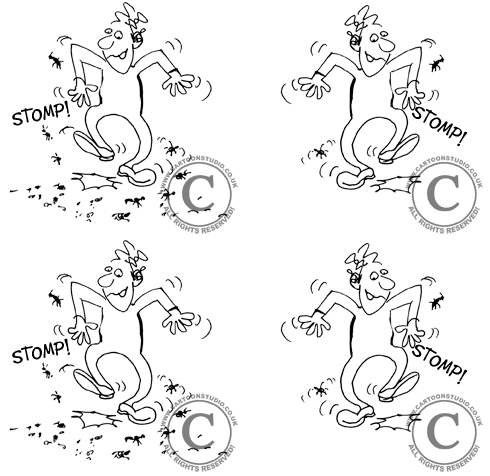
Just imagining stomping this book to pieces puts me in SUCH a good mood! But I'm not, because it's a library book. Let me go blow off my steam...
And in the end:
Maybe because I grew up reading stories like Cinderella and Jack and the Beanstalk, I think fairy tales should have a happy ending and a MEANING, however simple it may be.
Likewise, the words "Modern Fairy Tales" snagged me. Ooh! Some modern stories! Lets cuddle up on my bed and read! Best book ever! NOT. First of all, the word "modern" is a huge lie. The words were so old-fashioned I couldn't understand what the story was going on about sometimes. Also, these weren't FAIRY TALES, they were screwed up stories that couldn't get published because of their awfulness. So somebody took all those really lame stories so people like me could do this:
[image error]
Just imagining stomping this book to pieces puts me in SUCH a good mood! But I'm not, because it's a library book. Let me go blow off my steam...

November 5, 2008
"The Oxford Book of Modern Fairy Tales" is exactly what it says it is - a book of modern fairy tales.
And, what is a modern fairy tale, you ask?
It's pretty much the same as a traditional fairy tale. There's one or two with a dragon, one with a nymph, a few with fairies, a lot with princes and princesses, etc.
But a modern fairy tale has a modern twist to it. "The Princess Who Stood on Her Own Two Feet" is a fantastic feminist story about a princess who changes everything about herself so a prince will love her (she stops standing so he can enjoy being taller than her and stops talking because he doesn't like it when she talks), realizes that the prince is kind of a jackass, dumps him, and ends up happily married anyway. Ursula LeGuin's "The Wife's Story" is super awesome and I can't tell you anything about it without giving the whole thing away.
The modern fairy tales, like the traditional fairy tales, teach a lesson.
And the modern fairy tales, many of them, are better than the traditional fairy tales.
And, what is a modern fairy tale, you ask?
It's pretty much the same as a traditional fairy tale. There's one or two with a dragon, one with a nymph, a few with fairies, a lot with princes and princesses, etc.
But a modern fairy tale has a modern twist to it. "The Princess Who Stood on Her Own Two Feet" is a fantastic feminist story about a princess who changes everything about herself so a prince will love her (she stops standing so he can enjoy being taller than her and stops talking because he doesn't like it when she talks), realizes that the prince is kind of a jackass, dumps him, and ends up happily married anyway. Ursula LeGuin's "The Wife's Story" is super awesome and I can't tell you anything about it without giving the whole thing away.
The modern fairy tales, like the traditional fairy tales, teach a lesson.
And the modern fairy tales, many of them, are better than the traditional fairy tales.

May 3, 2009
I absolutely love the authors' sophisticated, contemplative style of writing and the selection of stories with the most unusual flavor of plotlines, while still retaining that wonderful, magical fairytale feeling.

December 15, 2007
Read it and creep

June 4, 2008
Buy it!! Griffins, faeries, goblins, reluctant dragons and a princess who's lost her gravity. Genius!

June 27, 2008
I'm still reading this but I love it so much and keep dipping into it and re-reading stories.
It includes my favourite fairy tale ever, "The Princess Who Stood On Her Own Two Feet" by Jeanne Desy.
It includes my favourite fairy tale ever, "The Princess Who Stood On Her Own Two Feet" by Jeanne Desy.

August 14, 2011
When we were younger my mom used to read us stories from this book every time we went to Block Island.

November 20, 2013
I wish I could rate each of the stories separately, as some I loved, and some I wasn't so keen on (as always with collections like this).

February 10, 2020
A quality book with quality stories from 1839 to 1995. I think favorite was The Apple of Contentment (1886). My least favorite was probably The Light Princess (1864), mainly because it copped out of a sacrifice. The options were sacrifice the prince and fill the lake or save the prince and let the lake dry out. You can't both save the prince and fill the lake. It's a minor issue really. Overall, amazing book with great stories.

April 14, 2025
A fun collection of Fairy tales though it hardly counts as Modern 30 years after it was published. I enjoyed the whole collection and much like any collection of fairy tales my reactions swung between enjoying how each story embraced or subverted the comfortable tropes associated with the genera and shaking my head at what passed as morality tales in bygone days. Many of these would still be fun to read to kids at bedtime, but definitely give any selections a review first.
November 13, 2022
Spectacular collection that includes modern fairy tales written from 1839 to 1989. It includes classics in their own right like The Reluctant Dragon, The Kith of the Elf-Folk, and Old Man Potchikoo. Just as importantly, it shares delightful stories from relative unknowns like Jeanne Desy's The Princess Who Stood On Her Own Two Feet.

September 20, 2021
A good collections of stories, all worth reading
December 2, 2022
Kxkx
This entire review has been hidden because of spoilers.

Did Not Finish
February 4, 2023DNF. Got this years ago in Ann Arbor and never could get into it. Tried many times.
April 18, 2023
A great collection of stories
December 14, 2016
Worth it just for the horror of 'The New Mother'.
September 20, 2024
Oh, back when fear tactics ruled a child's psyche and tales were not Disney iterations. The book includes many well-crafted short tales which range from unsettling to disturbing at times. There are few uncomplicated endings and many sacrifices in exchange for services which make the reader think realistically, not just dream of unbridled graciousness. Entertaining, especially to read out loud.
January 4, 2010
{old notes}
Kenneth Grahame's The Reluctant Dragon:
(200)
T.H. White The Troll
(282)
Kenneth Grahame's The Reluctant Dragon:
(200)
Banquets are always pleasant things, consisting mostly, as they do, of eating and drinking; but the specially nice thing about a banquet is that it comes when something's over, and there's nothing more to worry about, and tomorrow seems a long way off.
T.H. White The Troll
(282)
Life is such unutterable hell, solely because it is sometimes beautiful. If we could only be miserable all the time, if there could be no such thing as love or beauty or faith or hope, if i could be absolutely certain that my love would never be returned: how much more simple life would be. One could plod through the Siberian Salt mines of existence without being bothered about happiness. Unfortunately, the happiness is there. There is always the change (about eight hundred and fifty to one) that another heart will come to mine. I can't help hoping and keeping faith, and loving beauty. Quite frequently I am not so miserable as it would be wise to be. And there, for my poor father sitting on his boulder above the snow, was stark happiness beating at the gates.

September 24, 2014
Historically, this is a very interesting collection to read as the values and artistry in each author's work reflected the literary and cultural leanings of the era in which it was written as well as the author's individual style. All of them are well crafted.
This is a collection gathered for adults. Some of the stories were written with a young audience in mind but many were simply written as artistry for adults, so this collection will be of more interest to someone interested in the history of the development of short fairy tales since the mid 1800s than it will be to a young reader who enjoys a good fairy tale. As an adult reader there are some tales that I think would be fun to share with a child and some that I think would clearly just leave the child puzzled.
It is a collection that I enjoyed reading and found historically intriguing but it was not compelling enough that I will save it to reread again, though I may someday look up H.G. Wells' "The Magic Shop" again to share with someone who loves a young boy with an imagination.
This is a collection gathered for adults. Some of the stories were written with a young audience in mind but many were simply written as artistry for adults, so this collection will be of more interest to someone interested in the history of the development of short fairy tales since the mid 1800s than it will be to a young reader who enjoys a good fairy tale. As an adult reader there are some tales that I think would be fun to share with a child and some that I think would clearly just leave the child puzzled.
It is a collection that I enjoyed reading and found historically intriguing but it was not compelling enough that I will save it to reread again, though I may someday look up H.G. Wells' "The Magic Shop" again to share with someone who loves a young boy with an imagination.

November 2, 2012
OK, I admit it. I never stopped reading Fairy Tales. Never will, either, as long as books like this one come out. A first-rate collection
of some new, some old favorites. All the Victorian gems are there - Dickens' Magic Fishbone,The Light Princess by George MacDonald, some great dragon stories like Stockton's The Griffin and the Minor Canon, and E. Nesbit as well, but there were delightful surprises like Sylvia Townsend Warner's Bluebeard's Daughter. A gem of a book!
of some new, some old favorites. All the Victorian gems are there - Dickens' Magic Fishbone,The Light Princess by George MacDonald, some great dragon stories like Stockton's The Griffin and the Minor Canon, and E. Nesbit as well, but there were delightful surprises like Sylvia Townsend Warner's Bluebeard's Daughter. A gem of a book!

March 12, 2009
Some of the stories were amazing and some of them were rather strange. They're perfect for 5 minute breaks.
Displaying 1 - 30 of 34 reviews