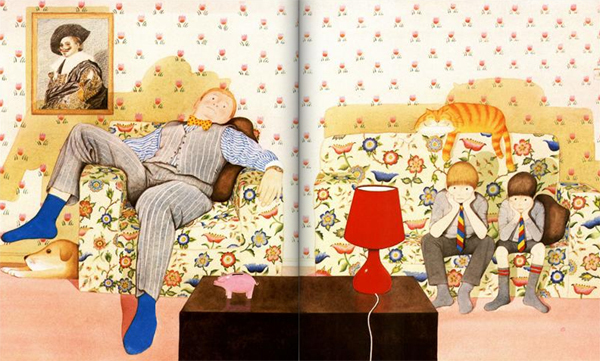
Illus. in full color. "Mr. Piggott and his sons are a male chauvinist lot who, outside of yelling for their dinner, don't exercise themselves much around the house. When Mrs. Piggott finally tires of the endless chores that sandwich her workday, she leaves the menfolk on their own, with a note saying, 'You are pigs.' With the cooking and housework untended, they soon turn genuinely porcine, a transformation Browne foreshadows with pig faces on the wallpaper, vases, fireplace, phone. As in most of Browne's art, there is more than a touch of irony and visual humor here. Fun to read aloud."--Bulletin, Center for Children's Books.
Anthony Browne, a Hans Christian Andersen Medalist, is the author-illustrator of many acclaimed books for children, including Silly Billy and Little Beauty. He lives in Kent, England.
Anthony Browne: named the UK’s Children’s Laureate in June, 2009.
I love this book – and so did the kids in the many classes I have read it to. Usually, we would read it twice – straightaway – because it isn’t only the printed word, but the illustrations that add depth and texture to this richly layered picture book.
No getting around it: the males in the Piggott family are chauvinistic pigs. Dad and the two boys consider it their right to make demands upon the only female in the household, their mom. Mr. Piggott has a “very important job” and Simon and Patrick attend a “very important school” dressed in their British school uniforms. Meanwhile, almost-faceless Mom makes their breakfast, does all the chores; then goes to her own outside job.
Every evening when they come home, the boys say, “Hurry up with the meal, Mom,” and Dad, busy reading the paper, adds, “Hurry up with the meal, old girl.” So Mom prepares dinner, does more chores, and makes lunches for the following day while the boys lounge on the chesterfield, in front of the TV.
One night, the boys arrive home to a silent house, “Where’s Mom?” Mr. Piggott demands. Mom is nowhere to be found, but she has left a note on the mantelpiece: You are pigs.
With his great use of foreshadowing, Anthony Browne has included so many details that even pre-school children will search for all the signs of pigs they can find.
The “boys” literally turn into pigs as they try to take care of themselves. (Oh, the artwork is exquisite – and even the language changes):
“When is Mom coming home?” the boys squealed after another horrible meal. “How should I know?” Mr. Piggott grunted. They all became more and more grumpy.
Another double page spread, with text and more pigs, and then: One night there was nothing in the house for them to cook. “We’ll just have to root around and find some scraps,” snorted Mr. Piggott.
And just then Mrs. Piggott walked in.
Her three piggy-boys, on their knees pleading for her to come back, see her for the first time as more than just “background”. And of course, given their hard lesson, they begin to pitch in.
By the end of the book Mom has a huge smile on her face as she too, pitches in, in a way she never has before.
Anthony Browne, author and illustrator of Piggybook, has produced a book about gender roles that is both insightful and meaningful, and sends a message to both males and females. And it may have been written over two decades ago, but the message is still relevant today.
I couldn't help but laugh while reading this book as I pictured my mother trying to discourage me from dating as a teenager by claiming that "all men are pigs!" Clearly Mrs. Piggot is also a scorned woman as you can see by the cover of this story in which she is symbolically carrying her family the way she carries the load of responsibilities at home. As usual, Browne has incorporated many symbols into his work to enhance whatever social issue he is aiming to highlight. In this story his use of pig imagery is a clear play on men as "chauvinist pigs" expecting the woman to cook, clean and dote on the men in their lives. However, considering that Piggybook is a children's picture book, I was kind of shocked that Mrs. Piggot actually leaves, but I also couldn't help cheer her on. As a woman and child of divorce, I appreciate Browne keeping it "real" and not sugarcoating family relationships the way most children's books do. I was really surprised at how Browne, a male author, portrayed the strength of the female figure in the home rather than the male. In fact, when mom leaves, the boys are helpless, filthy and not at all self-sufficient. Classic children's books portray men as the strong family figure, the provider and the protector and the woman as the needy, doting house wives. It was nice to see women appreciated for once. Browne must have had a great mother!
Piggybook is about a family of four, a Dad, two sons and Mum who appears to be exhausted of her seemingly unappreciated role in the family causing her to leave them to fend for themselves. Ultimately, she agrees to return home, after seeing them living in squalor, and they seem to share the domestic chores. As Joosen (2015, p.151) states Piggybook was written in the mid-1980’s “when second-wave feminism had exerted considerable influence on children’s literature,” which could mean Browne was trying to challenge the gender-roles in society. Although Bradford (1998) proposes that if the book is read ironically it could be viewed as contesting equality in domestic roles.
It is narrated in the past tense with speech from the males but never the Mum, who is spoken for by the narrator and once through her own note, which could reflect how she has no voice in the family. More so, the use of the past tense could make the reader want to know what is happening to the characters in the present.
A variety of aspects within Piggybook link to other works by Browne, such as the intertextual links, particularly of famous artwork. Within Piggybook Browne includes the famous portrait 'Laughing Cavalier' (1624) and 'Mr and Mrs Andrews' (1750). On one hand, this could be to appeal to, and engage with, the adult reader, as Browne (no date) has stated that he believes that "picture books are for everybody at any age". However, he has also stated that he hopes the paintings are not "seen as winking over the child's shoulder" as he believes these tell another aspect of the story and add to the context (1994, p.185). These intertextual links could be taught to children, as Purdon (2000) reports doing, with the children taking the intertextuality as a puzzle to solve. This could suggest Browne credits children's ability to understand and make references to other texts.
Browne's use of colour, positioning and lines throughout Piggybook can aid the reader in making inferences, particularly about the Mum, who first appears on page 4. Although here she has not been given a face, which could be so that the reader inputs their own emotions or to represent her lack of identity. The use of a diminishing return across the two pages when describing her pre-work domestic routine, combined with the repetition of "all", could be to reflect the number of chores she has to do before she can be at the same point as the male characters- being at work/school. These images contrast to those of the males, as she is much lower in saturation and the hue is an ochre colour making the images look sepia. This could represent her quieter and duller life in comparison to her brightly coloured family, such as the bold primary colours on the boys' ties on the previous page. More so, the style the Mum is drawn in shifts to include cross-hatching which could make the reader feel the Mum's troubled emotions and nervous energy.
Common features of Browne's work are hidden images and merging of animals and humans, both can be seen here in the form of pigs. These are scattered throughout, hidden in plant pots and buttons, for example. The purpose of this could be to foreshadow the second half where the males turn into pigs. There is also a potential reference to this on the first endpaper where there are two flying pigs, who could be an allusion to the phrase 'when pigs can fly' that is used to refer to something that will never happen, which in this context could mean Mr Piggot taking on domestic duties.
At the end of the book, we see Mrs Piggot happily fixing the car- a stereotypically unlikely role for women, which could imply that the family have become less gender-stereotyped. However, Browne's portrayal of the family on the last double page could suggest otherwise. On the left, the three males stand holding food with their faces drawn almost like a caricature with black dots for eyes, thin line for a smile, and prominent circular rosy cheeks. This contrasts greatly to the right where there is a vignette of Mrs Piggot drawn more realistically with detailed eyes, depth to her lips, and clear strands of hair. This could have been done to imply that the males' behaviour was a facade and they were faking to make the Mum stay.
As a concept, I like the idea of using literature to challenge gender roles in society. Piggybook could be used to teach the negative implications of them to both adults and children, make people realise their own actions or perhaps send a less progressive view of faking your behaviour to settle a situation. I would be interested to read Piggybook with children and adults from varying cultures to learn what understandings they bring to the text, as Meek (1988, p.6) states “reading does not happen in a vacuum” therefore their own contexts and experiences could affect their interpretations.
A great statement from Browne about the reliance and pressure placed upon some mothers in the family home. I loved how the illustrations mirror the behaviour and attitudes of the characters, with their entire home being overcome by images of pigs. This is often quite subtle, and could be used to help children with reflecting more deeply about how the actions that characters links to characterization.
Piggybook begins with the introduction of a seemingly perfect family. A dashing husband with two polished young boys standing in front of their picturesque home; only mentioning that his wife was inside the house. “Hurry up with the breakfast” and “Hurry up with the meal, old girl”, the story takes us through the daily routine of the over worked Mrs. Piggot trying to meet the needs of her demanding boys. Until one day she disappears, leaving only a note. The boys soon realize the impossible demands they have placed on their mother, begging for her to return to a changed home. This story uses a home-away-home setting, I felt, to add a dramatic emphasis to the character development. Both, the father, Mr. Piggot, and his two sons are examples of dynamic characters. These boys begin the story very selfish and unwilling to put forth an effort in their daily routine. After having their “caretaker” disappear, the home-away-home setting, they realize what part they must play day to day. After this you can see the boys taking their part in chores and housework, no longer expecting their mother to do all the work herself.
In the opening of the book that shows Mr. Piggot reading the note left on the fireplace mantel there are two images with distinct characteristics, a large image to the left that corresponds with the image below the text to the right. In the image on the left you see a mantelpiece boarded with pig embellishments. You see pigs in the fireplace detailing, the blue pig tiles, and pig faces on the fireplace floor frame. There is a painting hanging above the mantel that pictures a pig-like man with his dog, you can also clearly see the cut out figure of a woman. The wallpaper, a vase, and even an eraser on one of the pencils on the mantel all resemble a pig.
This image adds a huge emphasis to the impact of the image to the right. Placed under the text there is a famed image of a pig hand holding a note that reads, “You are pigs”. The note is being held by a pig hand, dressed in a suit, in front of the pig wallpaper background. Until this point Mr. Piggot and his two sons have only been pictured as humans. However, this father and his boys will remain as pigs while they try to take on all the duties and responsibilities they placed on their mother. I felt one strong essence of representational and interpersonal structure in the opening where the pig boys were pleading for their mother to come back. In the image on the left the pigs are low in the image and close to the bottom of the boarder. Where, the mother stands tall, having a large portion of her head breaking the boarder. This shows her importance over the pigs. This builds on the image on the right that shows the pig father and boys from the perspective of the mother. The pigs are holding direct eye contact with the readers, giving you their feelings of sincerity.
I enjoyed reading this book very much. There where several details in the illustrations that I did not notice at first. As I looked deeper into the pages I felt the message of the story was really brought forward by the illustrations. I thought this was a very creative way to send a more powerful message.
Most of us, growing up, were very dependent of our mothers; and most of the time, we never paid attention to all the effort that went into her hard work. This is the case with the men of the Piggott family in Anthony Browne’s book, Piggybook. The Piggott family consists of four members- Mr. Piggott, Simon and Patrick Piggott and Mrs. Piggott. This is the order they are introduced in the book and all but Mrs. Piggott are introduced together. The three men of the family demand a lot, and without any consideration of the mother. Their demands get worse as the story progresses and Mrs. Piggott decides to let them feel how life is without a caring mother. The way the book is structured is very interesting. The story is told through the omniscient limited point of view; it’s apparent since the characters thoughts aren’t known, but the use of the pronouns “they” and “their” are throughout the story. Also, the story is not centralized around a child character. This being a children’s book, one would expect that the main character is a child, of some sort. In this case, and in my opinion, it’s the mother. Some may disagree and say that the “protagonists” are the father and the sons, since they’re in the book for a longer duration of the story, but they’re more of the antagonist; they treat the mother very coldly and with macho behavior. The conflict in the story is Person v Society because it’s the mother against the society within her home; she is basically treated like a rag doll and she decides to make a change to solve this problem within this society. The illustrations in are great. For the first half of the book, the illustrations stayed in parallel/ symmetrical interaction with the text. After the first half, the illustrations sort of take a turn, still describing the text but with a twist- enhancing interaction with the text. Even in the beginning of the story, there were small symbols that foreshadowed future events (Don’t want to spoil anything but look for a certain pink animal throughout the illustrations). The colors in the illustrations also affect the mood. In scenes where the men are relaxing, the colors are vibrant and lively; but when the mom is shown doing all the work, there's a brown filter on the illustration, making it monotone. This story, although no the conventional kid’s book, was a fun read and can help teach your children a lesson in gratitude and appreciations for others hard work. Heck, an adult can read this by themselves and have a blast. My mom loved it so I’m giving it five stars.
Wow! Where to start with this book? I thoroughly enjoyed reading this book! Unfortunately, the story reminded me a lot of my childhood. My mom did everything for all of us, although she never left! I can see that Browne was trying to show what society thinks of women as wives and mothers.
The illustrations were my favorite part of the book, by far! Just by "noticing" things on the cover, I saw that the woman was the only one who wasn't smiling and she looked like she was carrying the family. As I opened the book, I noticed that there was a pig with wings on the title and dedication pages. I immediately thought that what was going to happen in the story would be far fetched or impossible based on the saying "when pigs fly".
The gorilla in the newspaper and the painting reminds me of Voices in the Park.
In one page when the father is asking where the dinner is, his shadow is in the shape of a pig and then when the mother leaves, there is a shadowy figure of a wolf outside of a window. That makes me think of The Three Little Pigs story.
My favorite part about the illustrations is that the amount of pigs appearing in the background increases as the males in the story act more and more like pigs.
Finally, I liked the message at the end of the story. The mother comes back to the family and is finally firm with them about not just doing the household chores and being a servant to the family. She proves that she can move past society's view of a wife and mother and do anything, like fix a car!
This book is about the Piggott family – Mr. Piggott, Mrs. Piggott, and their sons Simon and Patrick. Poor Mrs. Piggott is lumbered with having to do all of the housework and clearing up after the rest of her family before going to work, every single day, until one day she decides to take a stand! This is an absolutely fantastic and very cleverly illustrated picture book, which would be enjoyed and appreciated by children in KS1 or lower KS2 – I actually worked with a class of year 3 children on this book last year in their literacy lessons, and they loved it for it’s humour and it’s illustrations, although they were also able to understand and reflect upon the less light-hearted themes contained within the story as well. This book reminds us not to take people for granted, and it also addresses and questions traditional gender stereotypes – by the end of the story all of the male members of the family are doing their fair share of the housework and Mrs. Piggott is happy because she is able to mend the car. This is therefore a fantastic story for children to read in that it not only highlights the importance of everyone doing their fair share, but reminds us not to stereotype certain roles as being jobs that are just suitable for women or for men.
Piggybook by Anthony Browne is a book about a family of two boys, a father and a mother. The father and the two boys in the family treat poor Mrs. Piggott (the mother) like a maid and she is burdened with having to do all of the housework before going to work every day. One day the mother decides she has had enough when she doesn't come home and leaves a note calling them pigs. The men in the house are left to take care of themselves and eventually, turn into pigs (literally). The mother returns and the men learn their lesson. They appreciate the mother more and even help her around the house.
This book could be suitable for children in both KS1 and KS2 as it portrays valuable lessons such as the importance of not taking your mother or any family for granted. It highlights the importance of team work within in the family circle where everybody should contribute in whatever way they can to help other family members and get things done around the home.
Another clever use of text and pictures by Anthony Browne. This book tells the story of what happens when you take people for granted, in this case the men and sons turn into pigs after the wife becomes fed up of always clearing up for them. She feels as though she has no importance in her life and role. Throughout the book there are lots of little nods to pigs (in doorknobs, furniture, clothing, shadows etc.) that suggest what might happen, to the reader.
Un libro que leí de pequeña en la biblioteca una de esas tardes en las que iba con amigos a hacer deberes y... hacíamos de todo menos los deberes. xD Esta vez lo he vuelto a leer en la biblioteca, pero no como usuaria, sino como empleada. ¡Y en la sección prohibida! Desde luego, todos los libros que estoy redescubriendo tienen ahora un sabor especial, mezcla de pasado, presente y sueño. Este, en concreto, me ha parecido una denuncia clara y, espero, efectiva. Sin embargo, me sigue dando pena que esta historia esté tan vigente ahora como hace 15 años. Ojalá estos libros pronto no sean necesarios.
Mr. Piggott Lives in a nice house with his wife and two sons Patrick and Simon “Hurry up with the meal” they demand; every day Mrs. Piggott tends to the daily house chores, cooks breakfast, lunch, dinner and goes to work. Meanwhile, after getting home from “his very important job” and “their very important school” her husband and sons sit lazily on the couch and watch T.V. They never help Mrs. Piggott or show her any appreciation. One day Mrs. Piggott finally gets fed up with their chauvinistic behavior and disappears, leaving a very interesting note behind. As they attempt to fend for themselves they soon discover how pig like they truly are.
This was a wonderful book, perhaps one of Anthony Browne’s best work. It has a deep powerful message and amazing symbolism as well as creative humor. This book teaches children that women should be appreciated as mothers and wives and to realize that women are very capable of doing a variety of things, even those considered to be for men only such as fixing a car. The illustrations reinforce this idea perfectly, at the beginning of the book you cannot see Mrs. Piggott’s face it is obscured and the drawings focus on the task that she is performing which is what is important to the boys whose faces are visible and mouths always open to show them obnoxiously demanding something of poor Mrs. Piggott. This changes at the end when she returns and her family starts to help her with the cooking and cleaning, the last two pages of the book show her face in detail smiling and at the end, fixing a car. Being mindful of gender roles and stereotypes created by society is a very important task for any person and even though this book was published in 1986 it is still very relevant today. Browne’s use of symbolism is very humorous he uses pigs as the animal the males turn into after their caretaker leaves because they become so messy, start eating scraps, also this is metaphor children are familiar with. One of my favorite things about this book is the skillful use of foreshadowing, throughout the story there is images of pigs within the colorful illustrations which change to an eerie dark tone when it shows Mrs. Piggott doing all the house work. The cover and title of the book also foreshadow the main theme of the story. The cover illustration shows Mrs. Piggott carrying her sons and husband on her back which is a metaphor for the terrible way they treat her. Also the clever title Piggybook, which is purposely one word to make it sound like the word piggyback, it is not only symbolic but it also sparks the reader’s interest. I really liked his creative word use another example of this is after they turn into pigs he uses different words to describe their dialogue such as squealed and grunted this further emphasizes that they are now literally pigs. I truly enjoyed this book, it is a fun creative story children will learn from and never forget.
Piggybook is about a family consisting of a mother, father and two boys. The mother made breakfast, cleaned, took care of the house and went to work while her children and husband yelled at her as if she were their slave. Finally, the mother leaves them a note reading 'You are pigs.". She does not return for days. When she does come back home, the boys and husband change their ways and start doing chores around the house. The major topic I brought from this book was sexism. The mother was expected to keep quiet while she cleaned, took care of her family in the home and had a job. This is portrayed in many texts as a 'normal' family life. However, Anthony Browne carefully illustrates pictures to make the reader analyze what the male characters in this story really are. I thought it was very creative and a perfect spin on the 'traditional' family usually shown in picture books.
Piggybook has many hidden meanings. Let's begin with the front cover. It is in a double frame showing the mother (assuming) holding her husband and two boys on her back. The husband and boys all have smiles on their faces looking directly at the reader while the mother is looking down with sad face. There is an obvious shadow on the ground which I perceived as a sad part to this family that the mother who carries the weight of her family on her back is not happy. She is also wearing a skirt with heels. This to me made me feel as if she felt she was expected to dress in this way. The boys both have bright red jackets which is where my eyes were directed as soon as I picked up this text. The boys heads also pass through the boarders making me feel as though they don't follow the rules or care about structure. PIGGYBOOK is in bold black letters, with a more modern font.
With each page, you must look closely at the text and illustrations. The male characters are portrayed as pigs more throughout each page. Their shadows, clocks, the moon, salt and pepper shakers, and more resemble pigs. You never see the mothers face until the last two pages where she is the one fixing the car while the boys and husband are 'finally' in the house cleaning and making HER dinner. Male versus female roles are very important in this story and it shows in both the illustrations and text. The sense of you don't know what you've got until it's gone is also a moral to this story.
Anthony Browne plays with traditional gender roles and stereotypical pig symbols throughout this story, starting with the cover. The framed image on the cover shows a woman, who we assume is the mother, carrying her husband and two sons on her back. The three men are all smiling, while the mother looks disgruntled. This image alone symbolizes the traditional gender roles that woman take in a family, where they are the backbone of the family because they are the care givers. The pig symbol is first introduced on the dedication page, where there are two pigs that are flying, playing the cliché when pigs fly. As a reader, this symbolizes to me that the following story may be unreal due to these symbols. As the story begins, the topic of traditional gender roles is brought up again when the male characters are introduced with details, while their mother is introduced with “Inside the house was his wife.” The boys are very bossy and demanding of the mother, and they do not show much appreciation for the work she does for them. As we get to know the characters better, pigs start to emerge in the images, depicting the stereotype of pigs being ungrateful and greedy. As the story progresses, the mother gets fed up with her families lack of appreciation, and she takes off leaving a note stating, “You are Pigs.” Since the boys have been treated like kings their entire life, they do not know what to do without her. Their bodies physically transform into pigs and their home becomes a pigsty. The more the characters actions resemble those of pigs, the more pig symbols the images contain, where pigs are the face of the moon, the clock, the wall paper and the shapes of the trees outside, reminding the reader that the actions of the traditional male role that is depicted resembles that of a greedy, sloppy pig. When the mother returns, she is depicted as a shadow that looks like a savior. The following opening of the book gives Mrs. Piggott all the power when we see her husband and sons graveling at her feet to return. As the gender roles reverse, and the boys help with the housework and Mrs. Piggott helps fix the car, the pig symbols disappear from the images and all the family members are very happy.
Piggybook made me a little angry but for some reason I really enjoyed it. The illustration on the front cover shows a very sad woman with three smiling boys on her back. Upon reading the story, I found that the reason the woman looks upset is because her husband and her two sons were treating her terribly. She made their food, cleaned their cloths, cleaned the house, and worked. After being abused by her family, Mrs. Piggott leaves her family with a note the says three simple words "You are pigs" written on the paper. Then the three boys turned into real pigs and have to fend for themselves. They don't know how to do anything for themselves and become dirty and have no food. Mrs. Piggott comes home and the Piggott boys change their ways and all is right with the world.
I enjoyed the images in this book because you really feel the frustration and anger that Mrs. Piggott feels toward her family. After the Piggott boys turn into pigs there is a pig in almost every illustration. The tulips on the wallpaper, the heads of the salt and pepper grinders, the moon, the heads of the faucet, the phone (and the bush is a wolf in the same image), and a painting all turn into pigs. Mrs. pig got comes home and looks like a savior coming home to put their lives back together.
As a woman, I found that I was super angry at the Piggott boys and their lack of appreciation for their mother and wife. At the beginning of the story Mr. Piggott and his sons have all of the power and Mrs. Piggott is their slave but the tables turn when Mrs. Piggott leaves and come back. After her return, she is given the power and is no longer a slave to her husband and sons. By the end of the book I am no longer angry with them and find that the playing field has been leveled.
As a teacher, I don't think that I would read this book to my students as I don't feel that they would understand some of the themes. Overall however, I find that this book is well written and has great illustrations that pull you into the book. If you want to read an interesting picturebook I highly recommend this book.
The mischievous tone and wry humour of "Piggybook" begin with its front cover. In a play on the word "piggyback," a man and two young boys ride upon the back of an overburdened woman (who we assume is their wife and mother). The man and boys are grinning while the mother's face is impassive and stoic.
Turning the page, we see the man and boys (Mr. Piggot, Simon, and Patrick) standing in front of their house grinning stupidly while their mother is absent from the image entirely. We learn, somewhat ominously, that "inside the house was his wife."
From there, we see a succession of images that reveal the status of each member of the household. Mrs. Piggot cooks, cleans up, makes beds, does laundry, irons, and cooks some more. Mr. Piggot and his sons eat, demand, and watch TV. Some visual foreshadowing occurs when the subtle images of pigs begin to appear in the illustrations. For example, when Mr. Piggot calls to his wife "Hurry up with the meal, old girl" the shadow he casts on the wall is that of a pig.
The final straw occurs when Mrs. Piggot leaves one day, leaving behind only a note that says "You are pigs." At this point Mr. Piggot and his sons turn into literal pigs, to match their heretofore pig-like behavior. Pig imagery appears everywhere - on the face of a clock, on the wallpaper, on the knobs of faucets, and so on. Without their mother, their "piggish" (i.e. sexist) ways cause their household to descend into filth and chaos, until they are literally crawling on the ground on all fours, looking for scraps of food to eat.
Finally, mother returns. In an image with almost biblical connotations, she towers above her husband and sons as a messianic figure while they grovel at her feet and beg her to come back.
"Piggybook" is a smart, sophisticated satire of gender roles, male privilege, and sexism. The males in the story only become human beings again after they begin to take on more "feminine" household chores like cooking and cleaning. Meanwhile the mother, finally happy and drawn in detail at the end of the book, "fixed the car."
Piggybook by Anthony Browne is about the Piggot family. Ms. Piggot does everything in the house; she makes food, cleans the house, does laundry, and works, too. One day, Ms. Piggot decided to take off. Mr. Piggot and his two sons, Simon and Patrick finally realize how much Ms. Piggot has done and wish she back. The cover is bordered and framed. In the frame, there is a woman who carries a man and two boys on her back and she looks unhappy. Later on in the book the readers will discover that the woman is Ms. Piggot. At the beginning of the book, Ms. Piggot always appears alone in squared, bordered illustrations, in a fainted yellow color tone. The readers cannot see her face at all. She is silent and has no expression. On the other hand, Mr. Piggot, Simon and Patrick always appear together in bright colors, demanding Ms. Piggot for food. And there are hints in the illustrations of what is going to happen. There are pigs hidden in newspaper, shadow, and doorknobs and so on. Also, the illustrations use a lot of pink colors when Mr. Piggot, Simon and Patrick show up. When Ms. Piggot left with a note that says “You are pigs.” on it, as expected, not only more patterns of pigs appear in the illustrations, but also Mr. Piggot, Simon and Patrick turn into pigs, too. This transformation does not limit in illustration but also shows in the text. For example, “the boys squealed after another horrible meal.” Mr. Piggot and the boys are making sounds of a pig, too. When Ms. Piggot returns, she appears with authority by looking down at the three little pigs while Mr. Piggot and the boys beg her to come back. The text, “please”, is also capitalized to enhance the emotions. In the end, there is a portrait of Ms. Piggot. And for the first time, she is refered to as “mom”, which makes her finally feel like a member of the family. However, I was confused to see that she fixed the car in the last page, it doesn’t seem relevant to the rest of the story to me.
Piggybook by Anthony Browne follows the lives of the Piggott family. Mr. and Mrs. Piggot have two sons, Simon and Patrick, all of whom live in “a nice house with a nice garden, and a nice car in the nice garage.” However, what the Piggot boys, including Mr. Piggott, don’t realize is the extent to which Mrs. Piggott works to keep the house and their lives nice. She is the one who cooks and cleans and does laundry without any gratitude or appreciation. One day, it’s just too much. She leaves a note telling the Piggots that “[they] are pigs” and doesn’t come home for an unspecified amount of time. In the time she is gone, the Piggotts are reduced to living in a pigsty and rummaging for scraps of good around the house. When Mrs. Piggott does return, the boys realize how much they were taking her for granted, and learned to show their appreciation and gratitude for what she does around the house.
The cover illustration is quite telling to the themes in the book. It portrays all the Piggott boys riding Piggyback on Mrs. Piggott, relying on her to support her weight. The boys are all smiling, because when they aren’t smiling, they are shouting demands at Mrs. Piggott. Throughout the illustrations in the story, there are small images of pigs that are worked in to help foreshadow the Piggotts’ transformation into filthy pigs. When Mrs. Piggott is shown cooking and cleaning and working, her head is always down, and we don’t see her eyes. This is an indication of her perceived inferiority from Mr. Piggott. Eventually, everything in the house is transformed into images of pigs as the boys are reduced to scrounging for table scraps on their hands and knees. When Mrs. Piggott does return, she is now the one in power. She is above the pigs, looking down on them. We now see her eyes, and the smile is now on her face.
This picture book by Anthony Browne shocks audiences by presenting the stereotypes of a mother, a dad and their two sons. It hits back home because I have a husband and two sons. It was impossible not to feel like the Mrs. Piggott of the story because I do al the things that the book shows. However, since I went back to work, I do not cook, clean the house or do the laundry any more. My husband is taking care of all of that, the boys included. I liked that Mrs. Piggott revered against the state of servitude she had in her own house. A simple statement "You are pigs" can be so powerful in changing people's minds.
After I read the book the first time several weeks ago, my husband said "I don't like it" and there were no explanations about it and no questions asked. My sons did not pay much attention to it. It is important to mentioned, I read the story to them in the kitchen. However, I read the story to my two sons for second time last night before going to bed. This time they had a blast finding pigs in the illustrations. First, my youngest son said he was scared of one of the paintings. He thought he was going to be scared when the boys and the father would start turning into pigs, but soon he forgot about being scared and continue listening to the story and finding pigs.
It was interesting that after I finished reading the story, I asked my boys What do you thing? They answered they like the book and that the boys and the dad were bad because they did not helped the mom. After I kissed them, said good night and put them in bed. They both came and hugged me and said, I love you mom! The purpose of the book was accomplished! Now, feel like the new Mrs. Piggott the one that fixes the car.
Anthony Browne has again made a picturebook that questions the status quo, challenges societies stereotypes and makes readers question gender roles that still plague our contemporary lives. What I love about Browne's books is that he pushes the genre of childrens literature into uncharted waters, never underestimating the young readers he writes his books for. Piggybook is the story of a young family who discover that they have been taking advantage of the sole female in the house, by expecting her to clean up after them as they head off to their "very important job" and "very important school". Although the mother/wife of this family also works outside of the home she is responsible for all of the household chores. Along with Browne's characteristic visual imagery, the males in the family transform into pigs halfway through the story, this picturebook has the potential to transform the way students view gender roles in their own lives. What a wonderful way to expose students to the topic of feminist theories and open up their discussions on the current expectations of males and females in our society.
A scathing, but sometimes subtle, children's book about sexism & the casual every-day chauvinism that can happen in a home. I didn't catch everything the first time I read through the book & was glad I flipped through it a second time.
It starts by showing who is clearly the most "important" people in the family: Mr. Piggot & his two sons. "Inside the house was his wife."
Throughout the book, the men & boys are in bright colors and are central to the illustrations whereas Mrs. Piggott's face is never clearly shown, her panels are subdued and colored in yellow tones. Mr. Piggott goes to his "very important job" and the boys to their "very important school" while Mrs. Piggott quietly takes care of everything around the home, as well as going to a job, too. But one day, the Piggott boys come home to an empty house and find a simple note: "You are pigs." Mrs. Piggott has left and the piggish behaviors of the males are finally revealed to themselves. When Mrs. Piggott finally returns, everyone chips in to help around the house.
Piggybook is the story of a family who is taking advantage of their mother. The kids and husband are bossy and think nothing of making mom do all the work. One day the mom has had enough and without her there their eyes are opened to how messy they are and how they have taken advantage of her. The kids and the dad realize they were acting like pigs and they decide to change that.
This book was an interesting one to read. I like that it used light hearted humor to share the perspective and role of a mother. So often children do not appreciate all their parents do to make their lives a good one. I appreciate any book which tries to open a person’s mind to experiences other than their own. Hopefully the readers of this book will leave a little more thoughtful and appreciative of their mother, or those who take care of them. In a classroom, this would be a good one to read and brainstorm ways which each student can contribute to their household more. This might be a great book to pull out around Mother’s Day.
Too true to life for many women, I'm afraid, who are still the only ones considered for the job of housework in a totally capable family of lazies. Mom does all the housework as the hubby and sons wait to be fed and cared for. "Hurry up with the meal, old girl"--indeed! Not surprisingly, she leaves, with a note: "You are pigs." And oh, how they turned around their behavior! If only it were that simple in situations like that! I know of women who are working away from the home and doing all of the housework as well, and I only wish a simple, three-worded note could solve their problems as efficiently. Not only that, but, for the men's sake, there are only males in the role of pigs in this story, and I know some rather messy girls as well! (I needed to defend the other gender just a little bit--they'll have to do the rest themselves!)
Every family needs to read this book. Every. Night. Until they die. After reading it with me last night for the first time, Nash looked at me quizzically, his head turned sideways with one magnificently bushy eyebrow raised in the Spock style, as if to say - Hey, you're trying to teach me something here, aren't you mom. Knock it off.
Un clásico ya de la literatura infantil que consigue sorprender, divertir y, al mismo tiempo, repensar los roles de las personas en una familia. Basta decir que lo hemos disfrutado mucho, platicado mucho y reído mucho.
When I was reading this book I noticed that the pictures in this book looked like they were created and colored with colored pencils or crayon. The design within the pictures looked like everything was shot up-close with something in the background. when you turned the pages it looked like the pictures extended on to both pages rather than there being 1 picture on one page and another on a different page. I thought that was really creative. The pictures also seemed really detailed compared to the other books. For example on one of the pages the character was reading a news paper and you could tell it was it was a news paper because it was colored very realistically. The rest of the pictures looked like they were shaded in with pencils. Other then the details the books was interesting but the drawings were more interesting.
Que hermosa manera, hace ya casi 40 años, de mostrarnos cómo las mujeres tienen doble jornada laboral. En un libro para “niñas y niños”, el gran Anthony Bronwe nos muestra cómo una familia cualquiera, en un país cualquiera, de una clase burguesa; achaca a la madre-mujer la tareas domésticas sin atenderse de ellas, sólo como exigencia. Mas en un vuelco, la familia entenderá que las labores domésticas son una tarea más de las múltiples del diario vivir: ¿habremos aprendido con el paso del tiempo?
Gran regalo para las infancias, y una lectura que nunca envejecerá … o esperemos, que en algún momento, si lo haga.