Jump to ratings and reviews
Rate this book

New Grub Street

Rate this book
New Grub Street (1891), George Gissing's most highly regarded novel, is the story of men and women forced to make their living by writing. Their daily lives and broken dreams, made and marred by the rigors of urban life and the demands of the fledgling mass communications industry, are presented with vivid realism and unsentimental sympathy. Its telling juxtaposition of the writing careers of the clever and malicious Jaspar Milvain and the honest and struggling Edward Reardon quickly made New Grub Street into a classic work of late Victorian fiction.

540 pages, Paperback

First published January 1, 1891

259 people are currently reading
10999 people want to read

About the author

George Gissing

373 books204 followers
People best know British writer George Robert Gissing for his novels, such as New Grub Street (1891), about poverty and hardship.

This English novelist who published twenty-three novels between 1880 and 1903. From his early naturalistic works, he developed into one of the most accomplished realists of the late-Victorian era.

Born to lower-middle-class parents, Gissing went to win a scholarship to Owens College, the present-day University of Manchester. A brilliant student, he excelled at university, winning many coveted prizes, including the Shakespeare prize in 1875. Between 1891 and 1897 (his so-called middle period) he produced his best works, which include New Grub Street, Born in Exile , The Odd Women , In the Year of Jubilee , and The Whirlpool . The middle years of the decade saw his reputation reach new heights: some critics count him alongside George Meredith and Thomas Hardy, the best novelists of his day. He also enjoyed new friendships with fellow writers such as Henry James, and H.G. Wells, and came into contact with many other up-and-coming writers such as Joseph Conrad and Stephen Crane.

Ratings & Reviews

What do you think?
Rate this book

Friends & Following

Create a free account to discover what your friends think of this book!

Community Reviews

5 stars
1,970 (30%)
4 stars
2,200 (33%)
3 stars
1,516 (23%)
2 stars
528 (8%)
1 star
258 (3%)
Displaying 1 - 30 of 445 reviews
Profile Image for Glenn Russell.
1,511 reviews13.3k followers
October 1, 2024


"Literature nowadays is a trade. Putting aside men of genius, who may succeed by mere cosmic force, your successful man of letters is your skillful tradesman. He thinks first and foremost of the markets; when one kind of goods begins to go off slackly, he is ready with something new and appetizing. He knows perfectly all the possible sources of income."

The above quote is from this unforgettable 500-page British classic set in 1880s London about the men and women working as part of the literary hub of New Grub Street. Indeed, we encounter some of the most articulate, refined, educated people in society; however, since these genteel men and women of letters lack the benefit of either family fortune or private wealth, they must continually use their pens to stave off grueling poverty and starvation as they attempt to stake their claim in the world of books and publishing.

Not an easy task even when their writing is going well, a fact author George Gissing (1857-1903) knew firsthand since circumstances hurled him into much the same plight; matter of fact, his earliest published novel, Workers in the Dawn, hit bookstores in 1880, when Gissing was a mere twenty-three years old, a semi-autobiographical three-volume novel recounting the unhappy life of a struggling, half-starved London artist married to a prostitute. Incidentally, when the author read the first book review of Workers he became so outraged he described literary critics as “unprincipled vagabonds.” Ooooo, George! If you were alive today, I hope you wouldn’t lump me in among those nasty, lit crit Brits.

Anyway, New Grub Street is also a “triple-decker,” that is, a novel in three volumes, which was standard fare at the time - almost predictably, the reason for this format was money: rather than purchasing novels, the reading public typically used circulating libraries and these circulating libraries could make a separate charge for each volume checked out. One of the main characters, Jasper Milvain, bemoans how such a demanding structure is “a triple-headed monster, sucking the blood of English novelists.” And Milvain isn’t even a novelist; rather, as we come to know in much more detail, his literary focus is entirely practical and utilitarian – acknowledging his turn of mind and skill level, he writes columns for literary periodicals.

As counterpoise to all these literary folk, there is old John Yule, a wealthy retired merchant who would very much like to see literary production abolished since, by his reckoning, the writing and especially the reading of books makes men weak, flabby creatures with ruined eyes and dyspeptic stomachs, men who should spend their leisure hours not reading but out in open-air exercise. But, alas, John is fighting a losing battle since in 1880s England reading has caught on like wildfire – books, journals, magazines and newspapers are all the rage.

One of the novel’s overarching themes is the hierarchy of social class. A prime example is John’s brother Alfred Yule, a literary man and journalist, who disgraced his family by taking a humble servant woman for his wife. Then when Mrs. Yule gave birth to daughter Marian, Alfred forbade his wife to speak to her daughter since he was horrified at the prospect that Marian might be infected with his wife’s faulty grammar and hackneyed diction. No, no, no – as soon as humanly possible, Marian was separated from her mother and sent off to a day school. Then, some years later, after hearing her mother’s grammatical errors, young Marian innocently asked her father, “Why doesn’t mother speak as properly as we do?”

Along somewhat the same lines, in conversation with his hyper class-conscious wife Amy, young novelist Edwin Reardon stresses the biggest difference in all the world: that the man with money thinks: “How should I use my life?” and the man without money thinks: “How shall I keep myself alive?” Reardon goes on to ruminate that if he should fail to make a great name for himself as a novelist, how such a fate would be a grievous disappointment to Amy.

However, when we first encounter the novelist around age thirty, the promise of fame is very much alive as he did write and have published two marginally successful novels prior to his marriage. But shortly thereafter, as we read further on, a crisis is at hand: sensitive, high-principled, Edwin Reardon encounters the ever-looming nightmare for a poor novelist attempting to make money in order to support a family by the publication of his work: writer’s block. In many respects, the drama of Edwin Reardon’s personal and artistic integrity is at the heart of the heart of Gissing’s compelling tale.

Another writer with integrity is Reardon’s friend Harold Biffen, a habitually half-starved scarecrow of a man who has a vision for a realistic novel, a novel depicting life as it truly is, specifically the grimy nitty-gritty of an everyday drudge, in his case, a grocer living hardscrabble in the poorest section of the city. This literary skeleton-man despises romantic novels with their heroes performing predictable heroic acts, so it is something of an irony that Biffen performs the most singularly heroic act in the entire novel.

Listening to Harold Biffen’s philosophy on realism and the realistic novel, I hear echoes of this very three volume George Gissing, a novel realistic in the extreme, reminding me much more of the Paris destitute depicted in Émile Zola’s The Gin Palace than any Charles Dickens misty-eyed yarn with a happy ending.

At one point, a demoralized, forlorn Edwin Reardon shares with Harold Biffen the highpoints of his life, a time prior to his marriage when he was traveling. As he relates: “The best moments of life are those when we contemplate beauty in the purely artistic spirit – objectively. I have had such moments in Greece and Italy; times when I was a free spirit, utterly remote from the temptations and harassings of sexual emotion. What we call love is mere turmoil. Who wouldn’t release himself from it forever, if the possibility offered?”

The novelist’s statement accords with Edmund Burke’s philosophy of the sublime - the magnificent experience of beauty and overwhelming majesty out in nature, so distinct from the toil of even a creative expression such as novel writing, an endeavor forever bound to the pressures of schedule and the anxiety of possible rejection. Also, Edwin’s words speak to English society as a whole in the nineteenth century, where the vast majority of men, women and even children were condemned to a life of unrelenting toil, forever bound to the wheel of Ixian, slaving from dawn to dusk as if they were nothing more than beasts of burden.

Yet again another aspect of nineteenth century British society takes center stage with the unfolding events in the life of Marion Yule. How free is Marion and how eligible is she as a lover and future wife? The answers to these questions are closely tied to how much money, if any, she will receive in her inheritance from her rich uncle, John Yule, along with to what degree she will be obliged to care for her ailing father. With Marion, Gissing provides us with a clear perspective on how a woman’s life and possible tragic fate is so dependent on outside forces, especially the letter of the law.

Toward the end of the novel, we listen in on a discussion of the future face of publishing with Jasper Milvain and others as the forward-looking Mr. Whelpdale proposes a change in the name of a paper: “In the first place I should slightly alter the name; only slightly, but that little alteration would in itself have an enormous effect. Instead of Chat, I should call it Chit-Chat. . . . Chat doesn’t attract any one, but Chit-Chat would sell like hot cakes, as they say in America.”

With this brief exchange George Gissing conveys how well-worn, conventional notions of culture are rapidly transforming, how success in literature is becoming Americanized along with everything else, how what people read will be driven by catchphrases and slick marketing. Utilitarian, optimistic, pragmatic, materialist Jasper Milvain is all for it. The more I reflect on Gissing’s novel, the more I discern distinctly how the entire current day mass-media is the new literary New Grub Street.

Profile Image for Jeffrey Keeten.
Author 5 books252k followers
July 17, 2017
“That is one of the bitter curses of poverty; it leaves no right to be generous.”

George Gissing was a young man on his way. He had impressive scores at the Oxford Local Examinations, and all was going well until he fell in lust with a young orphaned prostitute named Marianne Helen Harrison or Nell. He gave her money to keep her from plying her trade and when he ran out of money he stole from his fellow students. He was caught, expelled, and convicted serving a month of hard labor at Belle Vue Gaol. What a promising start for a young novelist. I'd probably have twenty books written and published if I'd been so foolish to get hooked up with a woman of questionable morals and went to jail because of it. When Gissing got out he married Nell and their relationship became the basis for his first novel.

Gissing was very bitter about having to make a living teaching and tutoring to support his writing.

"According to his pupil Austin Harrison, from 1882 Gissing made a decent living by teaching, and tales of his fight with poverty, including some of his own remembrances, were untrue. The issue of his supposed poverty may be explained by Gissing's attitude to teaching, which he felt robbed him of valuable writing time which he limited as much as possible and by poor management of his finances."

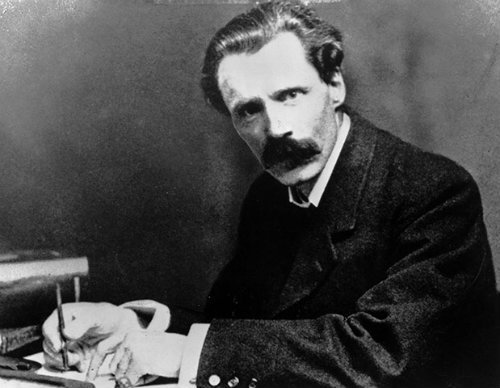
GeorgeGissing1890s
George Gissing

I see from other reviews that people were making comparisons of Gissing with Dickens, but to me the book was more modern than a Dickens more like reading Henry James. I knew as I read the book that the chance for a happy ending was beyond impossible. I would have been disappointed if Gissing had decided to manufacture a happy ever after conclusion. It would have rang untrue, like a bell with a crack, and certainly would have made unsound all the wonderful work he does in this book to show the devastating mental effects of uncertain income and the fickle chance of fate.

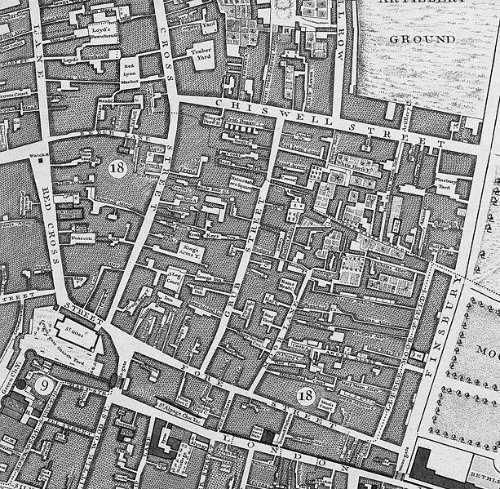
GrubStreet
Grub Street, London

The setting of the novel is Grub Street. It was a street close to London's impoverished Moorfields district that ran from Fore Street east of St Giles-without-Cripplegate north to Chiswell Street. Famous for its concentration of impoverished 'hack writers', aspiring poets, and low-end publishers and booksellers, Grub Street existed on the margins of London's journalistic and literary scene. It was pierced along its length with narrow entrances to alleys and courts, many of which retained the names of early signboards. Its bohemian society was set among the impoverished neighbourhood's low-rent flophouses, brothels, and coffeehouses. Now as long as a young writer could keep a couple of coppers in his pocket imagine the quick, all inclusive education of the world he could obtain spending a few months on Grub Street.

This book is about writing and the battle with poverty in 1880s London. There are really two main characters Edwin Reardon and Jasper Milvain. Edwin writes serious novels and views any sensational writing, to make money, as something he is incapable of. He has a wife and child and as the novel progresses we see him slide farther and farther into the grip of poverty. Jasper Milvain sees writing as a means to an end. His reputation is only of concern to him as that it provides him more opportunities to make more money. He is always scheming and trying to position himself to achieve a better position. He really is the exact opposite of Reardon. I didn't despise Milvain, although I never liked him and certainly would never feel comfortable trusting him. I was equally as frustrated with Reardon's inability to make changes that would have at least insured that he could keep his wife loyal to him and his life above the poverty line. Interesting enough Gissing did make the decision to do what was necessary to stay out of poverty, so one wonders if he wished he'd taken a perceived artistically more honorable route of sticking with just writing and enduring the poverty.

Reardon is afraid of poverty and yet ends up feeling more secure falling back into it than he does fighting to stay above it. "The difference," he went on, "between the man with money and the man without is simply this: the one thinks, 'How shall I use my life?' and the other, 'How shall I keep myself alive?' A physiologist ought to be able to discover some curious distinction between the brain of a person who has never given a thought to the means of subsistence, and that of one who has never know a day free from such cares. There must be some special cerebral development representing the mental anguish kept up by poverty."

Milvain is always working the angles. He is clever and wants everyone to like him, but is always looking for a way to elevate himself in the esteem of others sometimes at the cost of his friends. "Jasper, whose misrepresentation was willful, though not maliciously so, also fell into silence; he did not believe that his conversations with Amy Reardon had seriously affected the course of events, but he knew that he had often said things to her in private which would scarcely have fallen from his lips if her husband had been present---little deprecatory phrases, wrong rather in tone than in terms, which came of his irresistible desire to assume superiority whenever it was possible. He, too, was weak, but with quite another kind of weakness than Reardon's. His was the weakness of vanity, which sometimes leads a man to commit treacheries of which he would believe himself incapable. Self-accused, he took refuge in the pretense of misconception, which again was a betrayal of littleness."

There is a side theme working in the novel about the emancipation of women. A new law allows women to inherit, and over the course of the novel we see the importance of that law at work. Women are suddenly in a position to make different decisions and do not have to spend the rest of their life under the thumb of a father, brother or son if they are lucky enough to be bequeathed money and means of their own. after Gissing's second marriage ended with his wife committed to an insane asylum he became good friends with Clara Collet. Miss Collet seems to have been in love with Gissing, but there is no evidence of the feelings being reciprocated. Clara was an outspoken advocate of advancing the pay of women and I feel she influenced those sections of the novel regarding the emancipation of women.

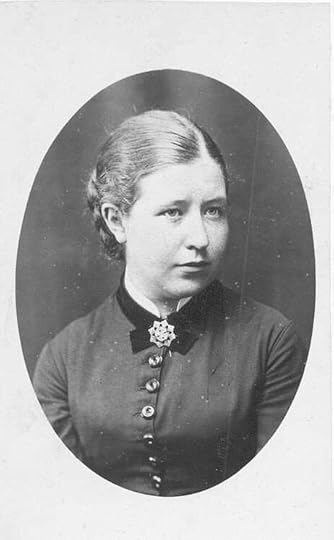
Photobucket
Clara Collet, a woman who made a difference.

The characters in this novel with a change of clothes, an iPhone, and a brush up on modern language are the same people populating our lives today. People, regardless of the time period, exhibit the same foibles and strengths. They have the same desires, the same troubles, and the same insecurities. There are no lazy people in this book. Everyone is striving the best they can to be successful, but pride plays a big hand during the course of this book and opportunities are lost and irrevocable things are said. Deception, misinterpretation and debilitating anxiety are the worms that wiggle through the plot of this novel. It will have such an influence on you, as the reader, that you will find yourself squirming with thoughts of your own personal defects and failings.
Profile Image for Fionnuala.
886 reviews
Read
May 7, 2025
Did you ever hear of the phenomenon of 'the three-volume novel'?
It wasn't a trilogy as we know the concept today but a single novel published in three parts. It became very popular in 19th century England around the time that 'subscription libraries' were common, and there's a link between the two. You see, the owners of subscription libraries charged the users a yearly rate. There was a cheap rate, which allowed subscribers to borrow one book at a time, and a more expensive rate which allowed them to borrow up to three books at a time. If all the popular novels of the day were in three volumes, and you were paying the cheap rate, you can imagine the frustration of having to wait to read the next chapter of the novel you'd become engrossed in until it was available. You'd soon change your subscription! So the three-volume novel suited the subscription library owners very well. It also suited the publishers because they made enough money out of selling the first volume to the subscription libraries to help with the costs of printing the second, etc.

How did it suit the writers of three-volume novels though? Not so well, if we are to go by George Gissing's story of one such writer in London in the 1880s. When a publisher agreed to buy the first volume of a novel main character Edwin Reardon was working on, they gave him a low price because he hadn't yet finished the final volume. But that wasn't the worst aspect for the poor writer. In order to make his novel fill three volumes—a total of maybe eight or nine hundred pages—he had to stretch out what might have made a good quality single-volume novel by adding all sorts of filling, including melodrama and stock-phrasing. If he couldn't or wouldn't do that, he was doomed. Edwin couldn't do it. Would you blame him?


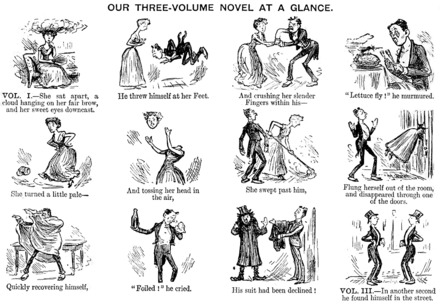
I was curious about the phenomenon of the three-volume novel so I did a bit of wiki research and that's how I found that cartoon from Punch.
I found some great quotes about the three-volume novel too, including this one from Oscar Wilde: 'Anybody can write a three-volume novel, it merely requires a complete ignorance of both life and literature!'
And here's another Wilde quip from 'The Importance of Being Earnest': [The attaché-case] contained the manuscript of a three-volume novel of more than usually revolting sentimentality'.

In Three Men in a Boat, written in the 1880s around the same time as Gissing's book, Jerome K Jerome's narrator says: 'the heroine of the three-volume novel always dines [at Maidenhead] when she goes out on the spree with somebody else's husband'.

The three-volume novel is even mentioned in Jane Austin's Pride and Prejudice back in 1813 (itself a three-volume novel originally): Darcy took up a book; Miss Bingley did the same...At length, quite exhausted by the attempt to be amused with her own book, which she had only chosen because it was the second volume of his, she gave a great yawn and said, "How pleasant it is to spend an evening in this way! I declare after all there is no enjoyment like reading! How much sooner one tires of anything than of a book! When I have a house of my own, I shall be miserable if I have not an excellent library."

………….....................................................

Ok, enough with the filling, I hear you say.
George Gissing's New Grub Street isn't just about the struggles of Edwin Reardon to write a three-volume novel. Grub Street itself was an eighteenth century London street where poor writers, and small publishers and booksellers, plied their trades. It was renamed Milton Street in the nineteenth century, but Gissing, by recalling it in his title, is setting out his stall, as it were. Inside the covers of his own very long book (which was originally published as a three-volume novel), there are many subplots and many characters. Some of those characters are novelists like Edwin Reardon, incapable of writing what the publishers demand; some are writers for periodicals; and some are journalists for newspapers. They are mostly poor and mostly struggling but none of them write in the Punch cartoon style illustrated above, it has to be said.

Because while Gissing's story is a little long-winded in places, especially in the first third, I wouldn't dream of accusing him of filling it out with melodrama or stock-phrasing—indeed some of his descriptions of poor writers and journalists are exceedingly good. Take Mr Quarmby who wore a coat "between brown and blue, hanging in capacious shapelessness, a waistcoat half-open for lack of buttons and with one of the pockets coming unsewn, a pair of bronze-hued trousers which had all run to knee..." You can see him clearly, can't you? And maybe you can hear him too, because, when he was excited, Mr Quarmby "talked in thick, rather pompous tones, with a pant at the end of a sentence".
Yes, the writing is colourful and the plots and characters Gissing develops reveal a great understanding of both life and literature.

…………..................................................

Why did I choose to read this very long nineteenth-century novel, you might wonder?
Well, this is a perfect case of 'one book leading to another'. I'd read a lot of books by Gerald Murnane a couple of months ago and he mentioned George Gissing more than once when recalling his favourite writers. So I went looking for one of Gissing's book. The one I found was called The Odd Women, but after finishing that very interesting novel, I wasn't completely satisfied that I understood why Murnane valued Gissing so much—although I had the beginnings of an idea. So I decided to read another one, and now that I've finished New Grub Street, I have a better understanding of the attraction of Gissing's books for Murnane. Murnane was a struggling writer himself for a long time and he refused to write in the conventional way publishers might have preferred. But that may be only part of the explanation for his love of Gissing. As I see it, Gissing writes very fine independent-minded women characters, and unusual women characters in literature are one of the things Murnane seems to value highly in his own reading: the 'odd' women who step outside the norm of their times; the 'odd' women who love reading and writing.
Yes, on reflection, I think that may well be it.
Profile Image for Katie Lumsden.
Author 3 books3,767 followers
October 19, 2016
Gissing is fast becoming on of my favourite Victorian writers. His writing is so strong, his description of people and his observations so well thought out and poignant. This is a story that deals will struggling writers within 1880s London, and is superbly and heart-breakingly written. Brilliant.
Profile Image for Paul Bryant.
2,409 reviews12.6k followers
October 4, 2018
Sometimes you see those guys on the street with one long dotted line tattoed round their neck and an inscription CUT HERE. This is one of their favourite novels.
Profile Image for MJ Nicholls.
2,274 reviews4,845 followers
May 9, 2013
Gissing’s seminal novel is perched peculiarly on the precipice of modernism and the hard crank of technogeddon is hewn into every toilsome syllable. Jasper and Edward are the foolish scribes living by their pens (imagine such an absurd notion!), kicking against the hot fuzz of hackdom and bitchery in their blazing borough. Edward, the inspiration for cuddly failed writer Ed Reardon in the heretically off-point Radio 4 comedy, is the “artist” (the quality of his novels is never particularly clear) crushed by the need to succeed and a disappointed wife whose delusional cheerleadering forces him into paid drudgery. If you have ever sacrificed anything at the expense of putting squiggles on a screen, this book may cause you to crunch up the little bundle of paper you spent three years organising and salve your soul with cut-price supermarket lager and self-hypnotise to a happier, less pig-ugly place where the imagination is valued and rewarded with kegs of champagne and hours of financial freedom.
Profile Image for Ярослава.
971 reviews925 followers
Read
April 10, 2025
Умовно кажучи, це як "Yellowface", тільки у вікторіанському Лондоні і з мужиками-мудаками замість дівок-мудачинь у головних ролях, ну й без теми культурної апропріації. Поза тим антураж той самий - мудаки у книговиданні, руйнівна сила нереалізованих амбіцій і поганий вплив бідності на характер молодого автора, наскрізний моральний первень, як у літературі з недільної школи. Буквально всі персонажі абсолютно всраті, я такого мерзького паноптикуму сто років не бачила - один герой радіє, що хворіє його дитина, бо може ж помре нарешті і не буде проблем, адже це з появою дитини дружина почала його зайобувать, щоб він гроші заробляв, а не тільки викохував свою самооцінку талантіща, й геть перестала розуміти, що йому б рік відпочити - і тоді він огого шедеврів понаписує. Інший герой вирішує одружитися з дівчиною тільки тому, що вона отримала спадок, і він на її гроші зможе робити літературну кар'єру, а коли зі спадком не вигорає, не розриваючи тих заручин, починає шукати інших багатих спадкоємиць; і т.д., і т.і. Не огидних персонажів майже немає. Усе виписано гротескними барвами і дуже в лоб. Тобто ані на тематичному рівні не приємно, ані на стилістичному.

Зате якщо ви переймалися, що з появою цих ваших соцмереж у людей пофіговило концентрацію уваги й вони вже неспроможні утримувати концентрацію уваги і читати щось серйозне, то не хвилюйтеся, ці побоювання передують появі соцмереж на понад сто років:
No article in the paper is to measure more than two inches in length, and every inch must be broken into at least two paragraphs. ... I would have the paper address itself to the quarter-educated; that is to say, the great new generation that is being turned out by the Board schools, the young men and women who can just read, but are incapable of sustained attention. People of this kind want something to occupy them in trains and on ‘buses and trams. As a rule they care for no newspapers except the Sunday ones; what they want is the lightest and frothiest of chit-chatty information—bits of stories, bits of description, bits of scandal, bits of jokes, bits of statistics, bits of foolery. Am I not right? Everything must be very short, two inches at the utmost; their attention can’t sustain itself beyond two inches.
Profile Image for robin friedman.
1,945 reviews415 followers
January 18, 2025
Revisiting New Grub Street

I have been a reader of the late Victorian novelist George Gissing (1857 -- 1903) for most of my life and have read or reread much of his writing and reviewed it online. Gissing remains too little known and I focused in my reading and online reviewing on some of his less familiar works which tend to go in and out of print. Unlike most of his books, Gissing's novel "New Grub Street" (1891) has achieved recognition and readership. The book has remained in print, is frequently read and taught, and has garnered perceptive and appreciative reviews from online readers. After a long absence I wanted to revisit New Grub Street through Gissing's book.

Grub Street was the center of literary activity and publishing in London. Set in the late 18880's London, Gissing's book offers a sad, pessimistic depiction of literary life in an age of commercialization. The book depicts the heavy competition among writers for publication, recognition, and financial reward and the attendant difficulty of finding and maintaining a sense of individual integrity.

Virtually all of the novel's large group of characters are involved in the literary life. The book focuses on struggling young writers usually described as Bohemian. It also enters into the world of scholarly writing, into book editing and publishing, and, a subject important to serious online reviewers, book reviewing. The book explores how with the rise of at least partial literacy in a large population and the perceived attractions of the literary life, writing frequently involved harshness and drudgery and led to poverty. Early in the novel, Gissing describes those who survive by writing and who sit for hours in the British Museum as living in the "valley of the shadow of books." Writing and poverty are at the center of this novel together with the effect of writing on the search for love, intimacy, and sexuality.

The primary character, Edward Reardon, is a young novelist whose early writings achieved a degree of success. Reardon has married the lovely, accomplished Amy Yule who wants a materially comfortable life which she believes her husband can provide through his writings. Reardon, however, is in the midst of writer's block and cannot produce anything up to his own standards. His efforts in the area of popular writing prove unsuccessful as he and Amy quarrel, drift into poverty, and ultimately separate.

Reardon's story is juxtaposed to that of his contemporary and acquaintance, Jasper Milvain who likewise is trying to rise from a modest background. Although lacking novelistic talent, Milvain is a young man on the make through networking, writing essays and reviews, and trying to cater to the public taste. Milvain also seeks a financially advantageous marriage and has few scruples about how he obtains it.

A third writer, Alfred Yule, is an aging scholar with large, thwarted ambitions who spends his days in the British Museum and who ekes out a modest living writing articles assisted by his daughter Marian. With the pressures of sexuality and the need for love, Yule married early in life, taking a wife from a poor, uneducated family. The marriage proves unhappy to all concerned.

Besides these three characters and their love interests, the book develops some fascinating secondary characters. The most memorable of these is Biffen who lives in abject poverty and who is writing a long, "realist" novel called "Mr. Bailey, Grocer" focusing on the every day, undramatic life of those whom Biffen calls the "ignobly decent". Biffen proves a true friend to Reardon. A character named Whelpdale is a failed novelist and a mostly failed suitor, but he develops an eye for low literary taste and for the reading needs of those who ride buses and subways. He becomes the successful publisher of a gossipy tabloid.

Many readers find "New Grub Street" glum indeed. Most fundamentally, the book questions the value of having so many people with substantial gifts and educations struggling to succeed in the overcrowded field of writing when they might make more modest rewarding choices for themselves which would offer the chance of love and sexual fulfillment. Then too, Gissing criticizes shallow, commercial writing aimed largely at turning a profit. Although Gissing portrays the weaknesses of characters such as Reardon and Biffen, he believes writing must aim at value and meaning separate from the marketplace. His icons are the writers of Greece and Rome. This is a difficult belief to maintain because of the education and agnosticism of the characters in this book and the denial of any values beyond those of immanence.

"New Grub Street" is written in the third person in a narrative voice that tells the reader virtually everything about its characters. Critics have often found that Gissing talks too much about his characters rather than showing them in action. This criticism is overdone, I believe, but the author still has a heavy editorial voice which sometimes reaches out in apostrophes to the reader. The book also includes a great deal of dialogue. In places in the novel, Gissing satirizes his own writing style. Although heavy in places, the writing in "New Grub Street" effectively matches its story. It is in shades of gray and of London fog. Each of the primary characters, male and female, are well and individually developed, showing both their strengths and their inevitable human failings.

At one point in the book, Biffen is accompanying Reardon as Reardon responds to an urgent call from his estranged wife. Biffen points out to his friend the folly and obstinacy of his way of life and the need to compromise. He says:

"[W]e both of us have too little practicality. The art of living is the art of compromise. We have no right to foster sensibilities, and conduct ourselves as if the world allowed of ideal relations; it leads to misery for others as well as ourselves. Genial coarseness is what it behoves men like you and me to cultivate."

Gissing put a great deal of himself into "New Grub Street" as he describes the dilemmas he faced as a writer. Reardon is an autobiographical figure but there is much of Gissing as well in Biffen, Whelpdale and in Jasper Milvain. Readers new to Gissing will not need to worry about these autobiographical references. The book also describes well the London of the late 19th Century and the nature in particular, of literary London.

I was glad to revisit New Grub Street and an author I have loved for a long time. "New Grub Street" remains the book of Gissing that will be of most interest to the reader seeking to know his work.

Robin Friedman
Profile Image for Nigeyb.
1,475 reviews405 followers
July 9, 2020
George Orwell said that George Gissing was "perhaps the best novelist England has produced". Orwell identified New Grub Street (1891), along with The Odd Women and Demos: A Story of English Socialism as Gissing's "real masterpieces". Orwell, as an impoverished writer, would doubtless have identified with New Grub Street which discusses the connection between literature and commerce in late-Victorian London.

New Grub Street was not a physical place, but an allusion to the original, 18th century Grub Street which was once a real street in the Cripplegate (now the Barbican) area of London, and in New Grub Street it is a metaphor for a life of literary penury.

The main protagonists are a pair of writers: Edwin Reardon, a novelist reluctant to compromise on his art, and Jasper Milvain, a hard working hack journalist who perceives his writing as an end to accumulating money. Milvain is open about his desire for wealth and status, whilst Reardon endlessly frets about the quality of his work and recoils against Milvain's ideas to more readily sell his written output. The plot examines how these two approaches impact on the friends and families of the two writers.

Anyone hoping for a happy ending should look elsewhere, and the story was clearly borne of personal experience. Given Gissing’s downbeat opinion of London's publishing industry, it is no surprise that it is the unscrupulous characters who ultimately prosper. I thought it was a great plot and credibly captured a society in transition. I look forward to reading more of George Gissing's work.

4/5

Profile Image for Cynthia Dunn.
194 reviews194 followers
December 21, 2020
I thought this would be dry, so I left it on the shelf for a number of years. It took my husband reading it and telling me how much I would like it, to finally attempt it. Boy, was I wrong. Thoroughly engaging and written in an almost modern style, I didn't want it to end. One of my favorite books this year even though it wasn't the cheeriest. Sort of like how this year has been.
Profile Image for Tristram Shandy.
875 reviews264 followers
January 31, 2020
Literature as a Wheel on Which People’s Souls Are Broken – Both Writers‘ and Readers‘

I did not manage to read beyond the first six chapters of New Grub Street, a novel which is generally acclaimed as one of Gissing’s finest works, and, not ever having read any Gissing before, I have to say that if I take this praise at face value, I’d rather give that author a wide berth from now on since there a pleasanter ways of wasting one’s time.

New Grub Street is about the literary market in late Victorian England, and how writing became more and more of a trade instead of a calling. At the centre of the story, there are two opposing characters, who are not really characters but – judging from the way they talk of themselves – stand-ins for attitudes: One of them is Jasper Milvain, a young aspiring journalist, cynical, self-complacent, enterprising and callous, who is determined to become rich by writing exactly the sort of stuff that people demand to read, appealing both to the vulgar and to those who preen themselves on their intellect and fine taste. Milvain will say a thing like this:

“‘[…] Never in my life shall I do anything of solid literary value; I shall always despise the people I write for. But my path will be that of success. […]‘“


Or something like this:

“‘[…] Literature nowadays is a trade. Putting aside men of genius, who may succeed by mere cosmic force, your successful man of letters is your skilful tradesman. He thinks first and foremost of the markets; when one kind of goods begins to go off slackly, he is ready with something new and appetising. […]‘“


And he does say things like these constantly, chapter for chapter for chapter, amen. Milvain wants his two sisters to write edifying tracts because he senses there is a market for this kind of books, and he thinks that his sisters can earn more from this kind of occupation than from giving lessons. To round off what little there is of a character, he also frankly avows that he will only marry for money. Who would have guessed otherwise?

His friend, and yet his counterpart, is to be seen in Edwin Reardon, a serious, conscientious writer who waits for the kiss of the Muses or the neighing of Pegasus, and who simply cannot make his mind engage in writing with a view to his audience’s expectations, in writing for necessity but who wants to produce genuine literature. He will say things like this:

“‘[…] No, that is the unpardonable sin! To make a trade of an art! […]‘“


Or, at his most whining, something like this – to Milvain, of course:

“‘Because you are the kind of man who is roused by necessity. I am overcome by it. My nature is feeble and luxurious. I never in my life encountered and overcame a practical difficulty.‘“


If you like the characters in the books you read parading across the stage and declaim in such a grossly programmatic manner, which makes it clear that they are not real individuals but illustrations of thoughts and outlooks, and if you have already read John Bunyan, then you might like this book. It gives you a lot of this repetitive, formulaic claptrap. To make matters worse, the narrative voice is not any better but likes to indulge in the technique of telling rather than showing, spelling it all out for you unless he uses the characters‘ dialogue as a vehicle of these careful spelling exercises. Gissing’s style, which is totally void of humour, wit and beauty – like the lives of his characters – reminds me of another mogul of verbosity’s, i.e. of Theodore Dreiser, who made his readers suffer infinitely more than his characters in that he did not subject the latter to the overblown humdrum of his uninspired prose. And yet, notwithstanding this example of how not to do it, I might even say that if ever prose was merely prose, it must be Gissing’s. As I have never read anything else by this author, it might be the case that in New Grub Street, which is, after all, a book to denounce the decline in literary quality due to the emergence of a mass market, Gissing might have chosen this particular style to illustrate the blandness and triteness of books that are written with the sole intent of making money. If this be the case, then Gissing is a master of mimickry, and the style of New Grub Street is an achievement that can only be topped by the achievement lying in the patience, forbearance, not to say self-loathing, of any person willing to go through it all as a reader.
Profile Image for Chrissie.
2,811 reviews1,421 followers
December 24, 2020
Two stars means the book is OK, not bad.

So I have now read this long, long book and I am having a hard time coming up with interesting things to tell you about it. THAT in itself is quite revealing!

Set in London in the 1880s, it is about diverse characters of literary and journalist circles—authors and their critics. It is about writing for the love of the art versus writing for what sells and what is profitable. I know where I stand in relation to this question, so I found little food for thought. The book emphasizes the destructive forces of poverty. Poverty is shown to destroy loving relationships. One can consider if perhaps in Victorian times social class and wealth were more binding and restrictive than they are today.

There is one character whose sole aim is to be successful; his goal is financial gain above all else. And if he is to marry, it will be for financial gain too. He works hard to achieve his goals. He is self-confident, unabashedly sure of himself and jovial. He knows what he is going for and is not ashamed to declare openly what he is seeking. In contrast to this fellow, we are given a novelist who has talent, but is less self-assured and sets high standards for his work. His goal is to write literature that he is himself proud of, regardless of its popularity or its sale ability or profitability. By focusing on two opposite personality types, the author ignores those who compromise, those who take the middle road, those who do not go to such extremes, which in my view is how most people actually behave. I guess these people though, do not make such good stories

Around the men circle the women. It is assumed they are to marry, a few stretch their creative abilities writing light fiction for those of their own sex. One woman sticks to her principles and dares to be different.

The characters are thus varied and pretty well developed. Personally, I liked Harold Biffen, rather than the two central characters Edwin Reardon and Jasper Milvain. I cannot say though that I grew terribly close to any of them.

The story is on the depressing side, lacks humor, and definitely goes on too long.

The prose is fine but nothing extraordinary, nothing unique. There are moments of melodrama, but nowhere near as much as in Dickens.

Nigel Patterson narrates the audiobook. It is easy to follow but there is nothing exceptional about the narration either. I have given the narration three stars.

Sorry this review is so boring, but the book is kind of boring. There just is not that much you can say about it.

*Eve's Ransom 4 stars
*The Private Papers of Henry Ryecroft 3 stars
*The Odd Women 3 stars
*New Grub Street 2 stars
Profile Image for Kathleen.
Author 1 book264 followers
December 29, 2024
“No, that is the unpardonable sin! To make a trade of an art!”

London’s Grub Street has a fascinating history, a place for poor and non-conformist folks and the publication of tabloid journalism and periodicals going back as far as the 1600’s. The actual street was renamed in 1830, but the term “Grub Street” continued to refer to the business of print publication.

This world of poverty and literature and striving is the perfect setting for a Gissing novel. He places us in the 1880’s, in “new” Grub Street, hinting at changes in the literary world.

Here Jasper Milvain schemed to make his fortune. Edwin Reardon struggled to recapture his talent while also trying to keep his pretty wife happy. Marian Yule suppressed her own talent to assist her disgruntled father. All tried to scrape together a living by their pens, while times and tastes were changing.

“… he’s behind his age; he sells a manuscript as if he lived in Sam Johnson’s Grub Street. But our Grub Street of to-day is quite a different place; it is supplied with telegraphic communication, it knows what literary fare is in demand in every part of the world, its inhabitants are men of business, however seedy.”

Jasper and Edwin are a study of contrasts. They’re in the same game, but Jasper’s goal is to be rich, and Edwin’s to create lasting literature. It’s more than that, though. Jasper needs to be rich to feel safe. Edwin possibly needs to be poor in order to create.

Edwin’s wife pushes her husband to be ambitious like their friend Jasper. “Give yourself a week to invent a sensational plot, and then a fortnight for the writing. Have it ready for the new season at the end of October … Just make it a matter of business, as Mr. Milvain says, and see if you can’t earn some money.”

As someone who tries to write fiction, I’ve heard this argument before, and it makes my blood boil! And as so many want-to-be writers will relate to, the weight of responsibility Edwin felt hampered his ability to create.

I really enjoy the way Gissing portrayed women. Jasper and Edwin are the main characters, but there are many in supporting roles, including some fully-formed and fascinating women that run the spectrum from powerful to abused, and for varied and intriguing reasons.

Towards the end, one of the characters has a plan to create a paper made up of very short articles, “two inches at most,” for “the great new generation that is being turned out by the Board schools, the young men and women who can just read, but are incapable of sustained attention.” Hmm. Is this the origin of our current crisis? I don’t know, but I loved the response from one of the strong female characters: “Surely these poor, silly people oughtn’t to be encouraged in their weakness.” Though it sometimes seems we’ve lost the war, the debate continues.

Was Gissing using this novel to get his gripes across, begrudging the success of those he complains have lesser ideals? Perhaps, but who cares when he tells such a good story. I loved his The Nether World, but this one even more, perhaps because of the literary subject matter. Yes, he’s dark--very dark and Hardy-like tragic. But he isn’t afraid to tackle the difficult issues, to show the world from unpopular viewpoints, and to give us morals and ethics wrapped in a page-turning tale.
Profile Image for Sara.
Author 1 book935 followers
November 23, 2025
When my friend Kathleen tells me I will enjoy a book, she is seldom wrong, so I struck out The Odd Women, the Gissing I have been shuffling about every year, and penciled in his novel, New Grub Street instead. I was certainly not mislead with this one. I found it captivating.

Gissing takes on a world he obviously knows and understands, and follows the careers of two writers in the late Victorian era. We first meet Jasper Milvain, a rather pompous young man, who means to make money and etch out a spot in society through his writing, in the home of his mother and sisters. He is not unlikable, and he is brutally honest about his views on the profession he is pursuing, but I felt a kind of discomfort with him. He theory seems to be that it does not matter what one writes, as long as one becomes well-known and achieves the right degree of reputation. He is what some would call a practical man, I find him quite a cynic.

Our second author is his friend, Edwin Reardon. Reardon has written a couple of books that were well-received, but he has no influential friends and is what I can only describe as a “man of art.” He is pressured on all sides to “perform” and write for the masses, but the writing means more to him than the money. He cares that what he writes should have substance and be worthwhile. The more he is pressured, the less he is able to meet expectations.

The world has no pity on a man who can’t do or produce something it thinks worth money. You may be a divine poet, and if some good fellow doesn’t take pity on you you will starve by the roadside.

The women who link their lives with these two men are just as interesting and just as complicated. I greatly admired the one and absolutely despised the other. Even the lesser characters, like their fellow writer, Biffen, are fully fleshed and wholly unpredictable, and one of my favorite characters was Milvain’s sister, Dora, who is not a central character but in my mind is central to the story.

Gissing addresses some very important issues in this novel, many of which plague us today in our world of mega-wealth. How is it that we admire people based sometimes strictly on their monetary value or their unearned position in society? What do we owe to our parents and siblings? Should we destroy our own dreams to their benefit? Are we our brother's keeper? What do we owe to our husbands and wives? Are we to be ruled by them? Is it wrong to put a comfortable life ahead of a commitment to a person you have sworn to love? What is a person to do if they are striving as hard as they can but cannot keep their head above water or even find an air bubble? How is it people can ignore or just forget someone who sinks below their standard of living? And what of love? Does it exist? Can it ever weather the worst storms?

Man has a right to nothing in this world that he cannot pay for. Did you imagine that love was an exception? Foolish idealist! Love is one of the first things to be frightened away by poverty.

The ending of this book surprised me and yet, in retrospect, it felt inevitable that this is where things were going. I was immersed in this world Gissing created right up to the last word. I am going to bring that other Gissing novel right to the fore-front for next year. I’m sorry it took me so long to make good on my intention to read him…he belongs on my dance card.
Profile Image for Peter.
736 reviews113 followers
September 23, 2025
The novel 'New Grub Street' was first published in 1891 but some elements still resonates today. It opens with aspiring writer Jasper Milvain lamenting to his family that his friend and fellow author Edwin Reardon has made the terrible error of marrying for love. Reardon’s wife, Amy, is from a comfortable background, but Reardon will be incapable of making enough from his writing to support her because he is incapable of exploiting the burgeoning periodicals market. The growth of the periodicals market here is almost comparable with the rise of the ebook a few years ago as a way for authors to make money — or more often fail to.

Milvain likes to see himself as ambitious and aware of the challenges of the market but he soon falls in love with a cousin of Reardon’s wife, Marian Yule. Marian is intelligent and represents the woman he would marry if money was not a factor but sadly neither have any. Her father is a respected but unsuccessful writer for periodicals and Marian works alongside him as researcher but while he gets all the credit. When Marian is in line for an inheritance, Milvain decides that he can marry the woman he loves, secure in the knowledge that they will have enough to live on. But when the inheritance fails to materialise he backtracks but rather than him break the engagement off he manipulates her so that she is the one who actually breaks off.

Meanwhile Rearden's financial worries only deepen. There is some beautifully subtle dialogue between Rearden and Amy as they struggle with these conflicting demands. For Amy art is not just about money but about status, identity, her place in society. Reardon decides to abandon writing and secures a place as a clerk but Amy is horrified and returns to live with her family rather than live in obscurity with him. When Amy inherits a substantial sum of money and after the convenient death of Reardon, Milvain and Amy marry, both have a similarly jaundiced worldview.

'New Grub Street' takes on some pretty broad social issues, class, money, the price of art and women's' place in a male dominated society. The characterisation is astute and beautifully crafted whilst London with it's fog is vividly evoked. I was particularly interested in the depiction of the young women who feature– Marian Yule, Amy Reardon, and Milvain’s sisters, Maud and Dora, all are thoughtful and articulate, and the woman's place in society is gradually changing, they have some financial rights of their own. However, my biggest disappointment was with Milvain himself. I found him rather insipid and would have preferred him to have been an out and out rotter rather than simply pragmatic, hence my rating.

On the whole 'New Grub Street' offers both a fascinating slice of social history and a realisation that, while the technology might have changed, the rivalries of the myriad authors are not so different. Despite the public being generally much better educated today, most writers still rely on endorsements by their peers to get their books noticed by the buying public and to actually make a living out of writing.
Profile Image for Issicratea.
229 reviews475 followers
May 18, 2014
I find myself wavering about this novel. Half of me thinks it’s only medium good—standard, intelligent, late-Victorian/Edwardian fiction, without Stevenson’s quicksilver eye and prose, or even Arnold Bennett’s dogged lyricism. The other half thinks it’s actually rather powerful in the relentlessness of its vision, and almost brutal, in an interesting way —in particular, with what it does with its not-quite heroine Marian Yule.

New Grub Street opens on a note of literal gallows humor, when we see the young Jasper Milvain winding up his sisters by expressing his liking for reading about executions (“There’s a certain satisfaction in reflecting that it is not oneself.”) Jasper has plenty of opportunities to enjoy this charitable sensation as he pursues his arduous path to literary success. His rise is accompanied on all sides by the spectacle of less “adapted” writers (Darwin is definitely a subtext) descending into poverty, sickness, and despair.

This makes the novel sound depressing, and it should be, with this subject matter. In fact, it’s actually quite an enjoyable read. If I can say this without sounding too disparaging, it has something of a soap opera feel about it, with a fairly broad cast of flattish characters choreographed into satisfying moral and emotional geometries. The setting is very interesting and vividly realized: the half-gentlemanly, half-cutthroat world of journalism and literary publishing in 1880s London, with some details curiously reminiscent of today. The appealing minor character Whelpdale finally makes his career with a vanity school for would-be authors—“novel-writing taught in ten lessons”—and a periodical made up of articles measuring no more than two inches in length, with every inch broken into at least two paragraphs, for readers “incapable of sustained attention.”

Some of the historical detail in the book I found fascinating. There’s a weird account of a morning in a smog-filled interior (“The thick black fog penetrated every corner of the house. It could be smelt and tasted … ”). And I loved it when three characters had dinner in an “à la mode beef shop” —perhaps the 1880s equivalent of St John? Sometimes the pleasure in these details is made up of dramatic irony. In this genre, I particularly enjoyed the reference to “one of the most shocking alleys in the worst part of Islington.”


Profile Image for Erin.
3,889 reviews466 followers
June 23, 2020
 Men won't succeed in literature that they may get into society, but will get into society that they may succeed in literature.

Originally published in 1891, through his fictional characters, George Gissing examines the hard life of the 19th-century professional author. Gissing's two main characters are polar opposites- you have the shy literary novelist, Edwin Reardon who has had very little commercial success, and Jasper Milvain, a young journalist who treats his writing as a means to an end. Throughout the novel, Reardon has a difficult time having his wife accept their poverty, while Milvain looks to rise to wealth. The latter even encourages his sisters to take up the pen and "write pretty little romances." Even if Jasper Milvain does appear to be our literary villain, I couldn't help but smile at a lot of his behavior.

Many of the themes explored are just as relevant today as they were in the 19th century. There are various critics, disappointed writers, and the ups and downs of the publishing market. New Grub Street shows Gissing's cynical side to the reader and who better than a Victorian English author to show us readers what that life looked like. Through my browsing online, I came to discover that Gissing himself wrote the novel to pay off his creditors. If you are thinking that this is a rather bleak book, you would be right. However, if you are looking for cynicism, with snippets of hilarity and a good hero(Reardon) and an entertaining villain( Milvain), than  New Grub Street is just the ticket.


If it's not quite your thing but you are still interested in Gissing, may I suggest The Odd Women by George Gissing The Odd Women, a delightful novel of the author's I read in university and enjoyed very much.


Goodreads review published 23/06/20
Profile Image for William Sandles.
18 reviews19 followers
April 22, 2013
As far as tragic novels go, Gissing doesn't have the narrative power of a Joseph Conrad, or even a Thomas Hardy at his best; nor does he have the singular gift of psychological subtlety of a Henry James; or the ambition of Mary Ann Evans aka (bka?) George Eliot; not even close. These writers can be downright operatic in their works. Gissing's style is a wonderful and curious hybrid of knife fight and Victorian drawing room comedy. No, there is no violence to speak of; not in the physical sense. The violence comes from the "benign neglect" of a culture that doesn't give a damn about serious art or artists, but will peddle the most mundane works for the "quarter educated" masses for a cheap quick dollar, or rather pound, since the scene of the crime is London in the 1890's. Gissing's hand is savage, and spot on, not just about his age, but of apparently about our own. Think our age invented empty fame, or hype men, or "hustlers?" Not so. A great read, I have to put it on my "cynic's syllabus" of works that eviscerate a medium: on lit, it joins (or rather pre-dates) Wallace Thurman's Infants of the Spring, on Broadway the film All About Eve, on film the film Sunset Boulevard, on Hollywood in general The Player, on television the film Network. I read about the book years ago, in a piece in the New York Times on books that aspiring writers should never read, (Gissing would appreciate the clever lure; one could almost see one of the hacks he writes of using the same device to help sell copy; Gissing would also entirely understand our click conscious culture, where fortunes are made and lost on the amount of eyeball traffic a site gets.)Read it. Think about it. Tell somebody about it after you're done.

Profile Image for Steffi.
1,121 reviews270 followers
May 22, 2020
Gut lesbare Geschichte über den Literaturmarkt Ende des 19. Jahrhunderts in England, auf dem triviale Massenware sehr erfolgreich war, während zahllose Literaten auf diesem Markt erfolglos waren oder sich ihm verweigerten und an ihrem Stil festhielten. Letztere verarmten und in diesem Roman scheitert eine Ehe daran, dass die Ehefrau Armut und Erfolglosigkeit des Mannes nicht ertragen kann. Auf der anderen Seite gibt es die skrupellosen Opportunisten, die jeden Stil, jede Marktlücke bedienen, um erfolgreich zu sein und – hier als Gegenfigur zu dem scheiternden Literaten – jede Heirat nur mit Blick auf materielle Absicherung und sozialen Aufstieg ins Auge fassen. Am Ende hatte ich aber den Eindruck, dass der Literaturmarkt nur ein Beispiel für verschiedene gesellschaftliche Bereiche darstellt und die eigentlichen Themen des Romans eben blinder Ehrgeiz, Rücksichtslosigkeit und Opportunismus sind. Das fand ich, da ich einen Roman dezidiert über das literarische Leben erwartete, etwas enttäuschend; auch findet sich wenig über das zeitgenössische London in dem Buch wieder.
Profile Image for F.R..
Author 37 books221 followers
January 22, 2015
This is my second reading of ‘New Grub Street’ and I think I’m even more impressed this time around. Gissing follows three writers in the late Victorian age: struggling artist Edwin Reardon, embittered critic Alfred Yule and literary opportunist Jasper Milvain. Each of them is trying to make their way as a man of letters in London and through them the book deals with literature in a commercial age.

If you’re a writer yourself you’ll see replicated some of the pain and frustration is takes to actually write a book. (Although, to be honest, if this novel had been written a hundred years later it probably would have concerned academics). As well as the three main protagonists, there are many other characters engaged in ‘writing’ and in their diligence and disappointments can be seen the lessons Gissing himself learnt as a struggling scribe. (The most touching portrait is that of Harold Biffen.) Interestingly, the book also has a lot to say about writing as art as opposed to writing for financial reward – a debate which would become louder in the 20th century.

The ending is necessarily cold and no doubt reflects the reality of the world as Gissing saw it. There are searing descriptions of poverty throughout, but there is little bitterness in the tone of the book. Even when death and failure descend, the author prefers to elegise rather than settle scores. Indeed the man with the grudge is portrayed as ridiculous. The older set of writers know that they’ve entered into is a gamble and may win success or fail, while the younger generation has already realised that different rules now apply.

I remember the last time I read it finding the first two chapters hard work, but then it was compulsive beyond that. This time around I’d describe it as a work of genius from start to finish.

A masterpiece I would heartily recommend to everybody.
Profile Image for Pam.
121 reviews40 followers
January 18, 2008
I bought this book a couple years ago, when I was on a 19th-century naturalism binge. As near as I can tell, the book is about writing for money, as opposed to writing as art. One character is totally opposed to reading and education in general. He thinks it's unnatural, and that we should all be out exercising and working, building our bodies rather than our minds.

The book is on some classic lists, and I even saw it on a list of best horror novels. I'm thinking someone expanded the definition of horror. But it's early yet -- maybe there will be a Therese Raquin type of psychological torture later.

Edit: Finished the book. I didn't find any horror, unless not realizing your dreams and ambitions is horror. Maybe it is. There aren't a lot of people to like in this book, but it's worth reading for the insight into 19th century publishing and the lives of impoverished writers.

We've all read Austen and Dickens, but Gissing shows us a different class of 19th century people -- intelligent, ambitious, literate, but outside of society because of their poverty and lack of success.
Profile Image for Sera.
1,314 reviews105 followers
December 9, 2015
New Grub Street is my second Gissing book, and he's now become solidified as my favorite Victorian author hand's down.

The book involves three primary groups of characters who are engaged in some form of literary or journalistic occupation: the Reardons, the Yules and the Milvians. There are some important characters ancillary to these families, but the primary story involves the three families and how their occupational pursuits impact their personal lives. Gissing provides interesting commentary on the current state of literary society, while also examining its evolution into other genres and non-standard writing practices. In addition, Gissing provides insight into the role of the literary critic and his impact on the success on the writings (and earnings) of others.

The ability (or inability) to earn a living in these occupations is really the core of the story. Gissing takes the common Victorian themes of poverty and eagerness of upward advancement and presents them in a fresh way. Whereas Dickens seems to find a positive spirit or inherent morality in his impoverished characters, Gissing shows poverty as it really is by focusing on how financial concerns consume a poor person's thoughts above all else, how it can destroy families, and how some people who need money use others to improve their financial condition, whether it be through marriage or otherwise. Most interesting is when Gissing puts money into the hands of a few of his female characters, which automatically puts them in an improved position of power, making it clear that financial means is gender neutral and of significant benefit to any person who is able to obtain it.

All in all, a great read. If you haven't read Gissing yet, do yourself a favor and check him out. His ability to explain the inner workings of the human mind and one's feelings far surpasses that of most writers.
Profile Image for Pamela.
Author 10 books153 followers
December 13, 2008
I suspected I was going to love this book because I so loved another Gissing novel, The Odd Women (see my review). I did. New Grub Street was published in 1891 but couldn't feel more contemporary in its wry, sly, cynical take on writers and the writing life. As in The Odd Women, Gissing is preoccupied with the ways in which material want deforms lives and ideals. There are no villains here, but the talented and high-minded tend to fail, while the savvy and commercial-minded tend to succeed. Gissing is too good a psychologist to make all this simplistic or moralistic... he just makes it ring true enough to hurt. His portrait of the disintegrating marriage between a literary novelist and his practical-minded wife is excruciating, and puts me in mind of another terrific novel that's getting so much attention right now, Revolutionary Road.
Profile Image for Christine.
7,223 reviews569 followers
March 22, 2015
It's a great book, which is strange because so many of the characters are unlikeable. Then again, maybe that is why it is a great book because all the characters are human.

Gissing paints a very good picture of the times, and several characters, in particular Jasper, feel as if they could just work off of the page. There are only a total of two flat characters and that is all. There is something compelling about the tone and style as well. I wish my teachers in college had assigned this book. It's great.
Profile Image for Ángela D..
228 reviews4 followers
January 16, 2025
2ª Reseña: Este libro me sigue impresionando, es excesivamente realista y pone en la mesa muchos temas qeu se pueden extrapolar hoy en día, la lucha de clases, habilidad vs suerte en cuestión de trabajo, que vale mas el talento o la astucia para poder hallar un camino de éxito, el feminismo, independencia femenino, la importancia del dinero, la pobreza, la falta de atención en las nuevas sociedades, la inadaptabilidad de las antiguas generaciones; este libro es sin duda una critica excelsa al mundo del libro y a todos sus "clientes". Es sin duda uno de mis libros favoritos, este hombre callo en el olvido como uno de sus personajes, pero como el mismo comenta en el libro, si eres capaz de hacer una buena obra aunque caiga en el olvido, el tiempo la rescatará. No puedo más que recomendaros esta obra y a este autor.

1ª Reseña: Sinceramente... Me ha dolido este libro, me duele mucho que la vida sea tan injusta, me duele la representación del autor porque es extremadamente veraz, incluso diría que se puede extrapolar hasta la actualidad. Los personajes son exquisitos, son tan grises que más de una vez me he encontrado buscando sus nombres en internet porque no me fiaba de que fueran ficticios.

Profile Image for Despoina Despoina.
108 reviews36 followers
September 14, 2023
Οι ήρωες αυτού του βιβλίου είναι όλοι τους κονδυλοφόροι - γράφουν.
Καταρχάς βέβαια διαβάζουν, αγαπούν πολύ το διάβασμα, αγοράζουν βιβλία και περιοδικά, θέλουν να είναι ενήμεροι για τις νέες εκδόσεις και τις κριτικές τους.
Κι όπως σχεδόν κάθε άνθρωπος που διαβάζει πολύ και αγαπάει τα βιβλία, έχουν την ικανότητα, άλλος λίγο κι άλλος πολύ, να γράψουν. Έχουν και την επιθυμία επίσης, άλλος λιγότερο κι άλλος περισσότερο, να γράψουν.
Κι εδώ είναι που ξεκινάει το θέμα του βιβλίου.
Για να γράψεις, λέει, δεν αρκεί μόνο η ικανότητα και η επιθυμία. Θέλει να αποφασίσεις και για τον δρόμο που θα επιλέξεις: θα γράφεις όπως θέλεις, όπως σου βγαίνει ή όπως ζητάει η αγορά; Θα γράφεις όποτε έχεις έμπνευση ή όποτε χρειάζεσαι λεφτά; Θα γράφεις ότι θέλεις να γράψεις ή ότι σου ζητάνε;

Οι ήρωες.
Ο ένας ελίσσεται, γράφει με τέτοιο τρόπο ώστε να χτίσει δημόσιες σχέσεις, να κερδίσει χρήματα, να μπορέσει να ζήσει καλά. Άλλος γράφει με τον τρόπο που θεωρεί ο ίδιος ότι πρέπει να γράψει, ικανοποιημένος κι ας διαισθάνεται εκ των προτέρων ότι το έργο του δεν θα γίνει αποδεκτό, κι ας ρισκάρει το να πεθάνει από την πείνα.
Κι άλλος προσπαθεί να γράψει αυτό που ζητάει η αγορά, όμως με τόσο κόπο (και γι' αυτό ακριβώς χωρίς καλό αποτέλεσμα) που σχεδόν οδηγείται στην τρέλα.
Άλλος για τη φήμη, άλλος για τα λεφτά, άλλος για τον έρωτα, άλλος για να συντηρήσει την οικογένειά, όλοι πασχίζουν με τα μολύβια και τα χαρτιά.

Δεν μπορώ να χαρακτηρίσω τους Κονδυλοφόρους αριστούργημα γιατί δεν έχει εκείνες τις στιγμές τις μαγικές που νιώθεις ότι κάτι θείο έκανε ο συγγραφέας και σε σήκωσε από το έδαφος. Θα πω όμως την κοινοτοπία ότι είναι ένα βιβλίο που πρέπει να διαβάσει κάθε άνθρωπος που αγαπάει τα βιβλία, το διάβασμα και το γράψιμο.

Βρήκα λίγο από τον εαυτό μου κι από τους φίλους μου μέσα του, την αγάπη για τα βιβλία ως αντικείμενα, την ικανότητα να δοκιμάζουμε τον εαυτό μας στο γράψιμο-παιδιόθεν, την επιθυμία να είμαστε κονδυλοφόροι, κυρίως, πέρα από κάθε τι άλλο που κάνουμε.

Εντυπωσιάστηκα που βρήκα τόσες ομοιότητες ανάμεσα στο 1891 που εκδόθηκε το βιβλίο και στο σήμερα. Μάλλον δεν θα έπρεπε να εκπλαγώ τόσο: η ανθρώπινη ψυχή και οι ανάγκες δεν αλλάζουν με τους αιώνες.

Ποτέ δεν θα πάψει να με εκπλήσσει το γεγονός ότι ο κόσμος του βιβλίου περιλαμβάνει μέσα του τόσα συμφέροντα και δημόσιες σχέσεις. Για κάποιο λόγο (για τον προφανή) θεωρούσα ότι εξ ορισμού έπρεπε να είναι διαφορετικός. Κι όμως.

* Όταν μια φορά έβγαλα την κάρτα μου να πληρώσω σε ένα βιβλιοπωλείο και ρώτησα γατί δεν μου ζήτησαν ταυτότητα, έλαβα την απάντηση Μα ποιος θα έκλεβε μια πιστωτική κάρτα για να πάει να αγοράσει βιβλία; Ε, αυτό.
Profile Image for Kiran Bhat.
Author 15 books215 followers
December 12, 2024
George Gissing is one of the most curious novelists to assess from the early 20th century. Gissing was considered a great influence on Virginia Woolf and many of the modernist writers who came a little after him. At the same time his own work did not receive the same surge in popularity as some of his contemporaries. As writers like Woolf went from nobodies to huge literary stars after their passing, Gissing went from someone who was heavily talked about, to someone few except some key hyper-read literatis will know now.

Because of Gissing's influence on a lot of writers that heavily influence my own writing, I felt like giving New Grub Street a go. I'm glad I did. Gissing has a great style that is fast pace and easy to follow. He also makes characters which come alive through simple appearing yet deceivingly complex dialogue. He's good at making you feel like the characters you are reading are talking in front of you, and yet what they reveal about themselves about shares a lot of who they are. I always think of Hemingway as the master of this style, but I see a lot of this in Gissing as well (though with a lot more flourish in his way of writing).

However though Gissing has a lot of good habits and talents, I don't feel like they were well deployed in New Grub Street. I appreciated the plot of a writer trying to find his voice, and I found a lot of his assessments on the attempt to publish and be known for one's work quite relatable. At the same time I don't feel like the characters went anywhere. There wasn't a gravitas to the situations Gissing poses, and I don't feel like much was exposed.

I liked New Grub Street. It's absolutely a great read and deserves more attention from our world's current batch of living readers. At the same time I think it lacks the epic sweep and greater sense of purpose that marks truly great literature. I think it's basically gotten the literary assessment it deserves. Much like Sherwood Anderson or Theodore Dreiser, it is great to read Gissing for his riveting plots and characters, but mostly as a footnote for the writers that would come the generation after...
Profile Image for Janelle.
1,619 reviews344 followers
December 7, 2025
This book was slow to get going for me but once it did I really enjoyed it. It explores the world of writing, novels, for publications, and the different types of writers. Edwin Reardon wants to write something of substance, of literary value; Jasper Milvain will do anything that will make him money or improve his stature (including marrying someone with money). There were characters I despised and strong female characters, and some of the writing is quite beautiful. Class, ambition, women’s rights (there was a discussion on divorce at one point), poverty and much more explored. A great read.
Profile Image for Rachel Lu.
161 reviews19 followers
June 2, 2021
Gissing’s novel on literary market trends in 19th-century novel remarkably anticipates contemporary media like Twitter that profit off of the short-attention spans of the average consumer. One of his characters comes up with an idea to revitalize a weekly literary paper, Chat, by transforming it into Chit-Chat, a paper with no article in it longer than two inches in length. He says:

“Let me explain my principle. I would have the paper address itself to the quarter-educated; that is to say, the great new generation that is being turned out by the Board schools, the young men and women who can just read, but are incapable of sustained attention. People of this kind want something to occupy them in trains and on ‘buses and trams. As a rule they care for no newspapers except the Sunday ones; what they want is the lightest and frothiest of chit-chatty information—bits of stories, bits of description, bits of scandal, bits of jokes, bits of statistics, bits of foolery. Am I not right? Everything must be very short, two inches at the utmost; their attention can’t sustain itself beyond two inches. Even chat is too solid for them: they want chit-chat” (447).

Art and literature become machines to produce large amounts of money for the artist who becomes machinelike. In reading this novel, one becomes all too aware of how little has changed for art functioning in a capitalist economy. Gissing may as well be writing about 21st century America.

Ironic, humorous, self-aware (characters critique the triple decker novel, New Grub Street itself is three volumes), New Grub Street is a wonderful read, if a bit too long, and a sharp critique on the commodification of literature, family and the individual.
Profile Image for Ryan.
1,181 reviews61 followers
September 6, 2023
Sometimes a reputation is lethal: the book feels so thoroughly strip-mined by critics that actually reading it feels irrelevant .

So with this book. Gissing's dialogue rarely sounds like living speech or slyly advances a plot: it's there to info-dump on the reader for page after page without mercy. The characters have attitudes rather than personalities; the stock of events is thin and repetitious.

What sets it apart are the insights, all of which George Orwell was quick to spot. Gissing knew all about the anguish of people for whom the strain of denying poverty guaranteed they would never leave it.

Gissing's characters live in garrets, yet are forever mentally trying and convicting the 'savages' they have for neighbours. They hate the leisured gentry but despise self-made men with a passion. However brutish the effects of poverty, they resist any hint of change or attempts to better their lot (which is meddling and would only make things worse anyway). This very English tangle of attitudes towards class and wealth is thoroughly realistic, and remains sadly true even today.
Displaying 1 - 30 of 445 reviews

Can't find what you're looking for?

Get help and learn more about the design.