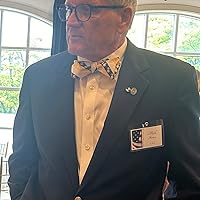
George B. Clark was an amateur military historian. He was the proprietor of The Brass Hat, an antiquarian bookstore in New Hampshire specializing in military and Marine Corps history.
Clark joined the U.S. Marines during World War II, just after graduating high school. He also served in the U.S. Army during the Korean War.
For many years, Clark administered grants, contracts, and patents for Brown University and the University of Massachusetts Medical School in Worcester. After retiring, he wrote 22 books, mainly on US Marine history.
Mr. Clark not only records the History from primary source material and books written by those he wrote about within this masterpiece – he provides the historical account in form and fashion of the true story sense. There wasn’t a page in this book I didn’t enjoy. Mr. Clark also had in my opinion a bit of snarky humor that is peppered periodically throughout the pages; I found myself chuckling at times and although the active voice of Mr. Clark I never knew, I could in fact sense and feel this third dimensional communication through the words of inflection, almost as though they were rain drops on my face in the fields, hills, and woods of France. These accentuated points that oft times within the book are injected at key points during the battle history, in this manner he shows his ability above and beyond the source material and in doing so brings this overall story to life. Passages that contain statements such as: that on page. 285: “Although the 4th Brigade later generally referred to St. Mihiel as a “piece of cake,” no one ever needs a second helping of that kind of desert.” Mr. Clark provides a steady balance and was under no illusions in this highly-detailed book. Early in the book he writes of Marines that took issues in their personal memoires of Officers and Non-Commissioned Officers who wrote critically and rather pessimistically of all they met; the balance provided in such references is acknowledged by the many heroic acts of Marine and Naval Officers, Non-Commissioned Officers, and Enlisted personnel generally. He gives credit as well to the U.S. Army Divisions and pays honorable tribute to the French Forces who were at the time of the arrival of the 4th Brigade – exhausted after years of war.
Blanc Mont comes to mind near the conclusion of the “Great War” as to how exhausted the French Forces were when questions of those forces continuously were aroused within field reports going back to the Post Command locations. Though my main interest in this book was to balance the Battle of Bois de Belleau with that of the accounting as presented in the book "Through the Wheat" Through the Wheat: The U.S. Marines in World War I the battles that came after Belleau Wood makes me question certain actions taken both during this first major front the Marines were exposed to within the open and later actions in which protective caution then circles back in following battles but is thrown to the wind toward the end. As I continued to read and then reached the Battle of Blanc Mont the full accounting of various reports arriving back to Post Command were consistent from various points of the battle front on the noticeable lack of French Forces to the flanks which caused gaps and additional work for the Marines and Army ranks present at the time. It should be noted that although in modern times the term “PC” became “CP” and Post Command therefore transitioned to “Command Post” before the Second World War. This is one form of keeping the historical accounting correct to the time and honoring the efforts of those involved. Whether intentional or not Mr. Clark does not make much reference to Maréchal Philippe Pétain in the final closing phases of the war and in fact Petain is referenced a mere few times within the book overall. Regardless, this does not take away from the official battle accounts of the many men who served, were injured or killed, or the objectives that had to be met at the time. One thing is clear in this readers’ mind – the fog of war lays everywhere within the battle fronts and Mr. Clark was highly critical of a President who went to war and Soldiers and Marines who were at the time ill prepared. President Roosevelt, had, in 1941 the foresight previously of what that stage of time to come to and in fact had one excellent officer in General George C. Marshall to do what could have been done prior to the American involvement of the Second World War – the First World War was however a different matter entirely and quite frankly, this book covers the U.S. Marine involvement rather well. Mr. Clark obviously enjoyed “asking tough questions” – as I write this I ponder to myself how many up the brass ranks he may have perturbed along the way.
Mr. Clark saves his opinion for certain sections near the end, there is an “Editorial Comment” provided following the Meuse River Campaign in which I personally believed could have been expanded upon and an “Opinion” section in the “Conclusion” chapter. For sometimes critical considerations and decisions made during this final phase period of the First World War he briefly takes mention of the slaughter the Canadian Expeditionary Forces experienced as well as others (I would be remiss here at this point if I did not mention the good lads of Australia and New Zealand – the Anzac Bridge in Australia represents the hard-emotional feeling of loss to this day of the slaughter.) This was the “Lost Generation” over all for all nations involved. A thing to note is that following the Franco-Prussian War the development of armaments outpaced the tactical planning and abilities of General Officers from all nations at the outbreak of this war. Tactics would eventually catch up during the war but not before the trenches would force a stalemate. In this, the involvement of the American Expeditionary Forces was necessary for the time – the Wilson Administration was severely lacking in quiet preparation and the desire to end this war became the mantra to force the conclusion after their supportive arrival in France.
Mr. Clark was well to point out the human elements of existence and this includes nothing less than the manner to which he writes of the wars conclusion. On page 376 we see yet as we do throughout all of combat, war, military history of all eras of how a “grunt is a grunt” regardless of nation or whether the soldier was on the winning or losing side of the war. Following the cessation of hostilities, the German soldier emerged wanting to exchange cigarettes, cigars, brandy sharing with the Marines and Soldiers they had been fighting only days (if not hours) before. Fraternization rules have proven never to have worked – we see this in Europe following the Second World War, General MacArthur was the one in fact in Japan who never allowed the rule to even exist following the surrender of the Japanese Forces. Here, however for this time frame one can easily imagine with the words of Mr. Clark the soldiers on both sides coming to the open, white handkerchiefs on bayonets atop rifle in one hand, Brandy in the other – possibly a cigar in the mouth of the German Soldier with a smile or grin on his face. Mr. Clark embodies this in a curt manner rather well and to the point. To the much larger view of this – a “grunt is a grunt” and will always be as they have always been going back to ancient Greek and Roman times.
Maps - the maps within this book are nothing short of outstanding and will stand the test of time for their detail in not being over burdened but true to the topical formations and movements of battle lines. Very easy to follow for any person who knows how to read battle maps and basic enough for any person not familiar with maps to follow with the story line.
Art work on the cover – is an official painting of the 2nd Battalion of 5th Marine Regiment of the 2nd Division crossing the Meuse River on 10 and 11 November 1918 respectively. Major George W. Hamilton was the Commanding Officer of the Battalion of the time and Captain Charley Dunbeck was the leader who followed the orders that were properly reported to Major Hamilton. (See the book by Mr. Mark Mortensen as well "George W. Hamilton USMC: America’s Greatest World War I Hero" for a full accounting. George W. Hamilton, USMC: America's Greatest World War I Hero) This painting is held by the U.S. Naval Historical Center. The cover captures well the anguish that was felt on the battle fields.
Lastly, and of special note here – Author and Historian Mr. Mark Mortensen informed me of the passing of Mr. Clark (which occurred) on or about 23 December 2016. I learned of this loss as I was reading the pages of the chapter on the Battle of Blanc Mont. True Historians such as Mr. Clark bring a lasting value to the societies to which they are citizens of and to the greater need of mankind generally. It is apparent that Mr. Clark worked for “truth” as opposed to “fame” – his fortune and his legacy are written with this and his other works for time immortal. This book is the first book I have read by Mr. Clark, I feel honored and humbled at the same time to possibly be the first reviewer of one of his works following his passing. I truly wish I had had the opportunity to meet this extraordinary Veteran, Author, American – may he Rest in Peace and may his family and friends continue to celebrate his life and admire the honesty of work and truth that will be brought to future generations and current persons like myself who are in continuous education of History.
I call “Devil Dog’s” the Goren's Bridge book of the WWI USMC 4th Brigade. It’s not easy reading, but for those looking for specific details from top to bottom and sideways it’s all here. The facts are solid. Clark's portrayal of a few senior officers in the Corps appears a bit harsh, but he hits home the point that the fighting “Devil Dogs”, known today as the “Old Breed” led the way rendering success and accomplishments in each and every encounter. When the U.S. entered WWI the Marines were considered to be the little brother of the Navy and garnered little respect from the Army. Following Armistice the Marines were recognized as America’s elite fighting force.
George Clark continues to put out books, but this is his masterpiece.
Informative but could have used a bit more editing. Interesting to learn how the Marines managed to get troops sent over to Europe with some political machinations when the Army would have rather kept them out of the fight. It was a good thing for the US we sent them though. They focused on marksmanship as a part of their training which made a big difference in battles where some of the Army troops had little actual experience shooting their guns.
The battles the Marines engaged in are meticulously relayed to the reader with many stories of heroics briefly told. The story of the Marines as a whole is center stage though and individual heroics are side notes. A history rather than an engaging story.
In World War I the US Marine Corps provided a Brigade of Marines that was integrated into the US Army Second Infantry Division. It was the Fourth Brigade in the Division. This book is the most comprehensive report of the Brigade's action in the war. George B. Clark did extensive research including terrain walks of the areas over which the Brigade fought. He addresses the war essentially from division level down to the Marine in the trenches. His references include official documents and letters from individual marines. He integrates the story of the Brigade with the descriptions of the fighting and war conditions from individual Marines. What I learned from this book is that the Marines provided numerous field grade (Majors - Colonel) officers to supplement Army shortages throughout Pershing's Forces. Colonel Hiram "Hiking Hiram" Bearss USMC was sent to the 26th Infantry Division to command the 102nd Infantry. A number of other Marine officers served in Division and Army Staff positions. A Fifth Brigade of Marines was sent to France but Pershing used it to provide security for the Army behind the front lines. The Fifth Marine Brigade was commanded by Brigadier General Smedley Butler. Another bit of information I learned was that the Army provided a number of Lieutenants as platoon leaders in the Marine Brigade. Additionally Major General John A. LeJeune USMC commanded the 2nd Infantry Division during much of the fighting. The description of the fighting is detailed and maps are provided to help orient the reader. I wish there had been more detailed maps. The author provides a Conclusion and he is not soft on the leadership of the Division, Brigade and sometimes down to the Battalion. He even criticizes General LeJeune for his handling of the Mon Blanc Campaign. Reading the Appendices, Appendix C states, "The Marine Brigade suffered approximately 150 percent casualties during the period from spring 1918 until November 1918." The totals are staggering, 1,342 Killed in Action, 8,292 Wounded. This is an outstanding read for those interested in World War I and especially for Marines. It is one of the Leatherneck Classics of the Naval Institute Press.
A very fine history of the Marines in WWI. I was a little disappointed that there was no mention of the award of the Medal of Honor to 6th Marines surgeon Lt.Cmdr.Joel T. Boone. As a retired Vice Admiral that fine gentleman made a phone call to the Navy's recruiting office in Washington D.C. in 1969 recommending my enlistment as a Hospitalman Recruit. In addition to the MOH, Admiral Boone also received a Distinguished Service Cross, six Silver Stars, and a Bronze Star in WWI making him the most highly decorated medical officer in the history of the U.S. armed services.
A valiant effort to untangle the knotted history of the Marine Brigade's record in 1917-1918. Clark works hard to follow battles at the small unit level -- down to individual companies -- a difficult task in battles like Belleau Wood because poor US maps meant that each company had its own unique and incorrect understanding of the geography.
This isn't the first book on WW I to read, and I suspect that those who haven't served will be baffled at times, but it is still an accomplishment by the author.
A compelling story is in the back of the book. There was a dawning of a great idea in the minds of Marine Corps leaders at the headquarters level during WWI: induct women marines to handle clerical work in Washington, DC so Marines could be released for combat. Once the Marine Corps announced openings for women, a huge avalanche of applications descended. Selection criteria was rigorous with the majority turned away. One woman who was initially turned away, went home and died her hair then turned up again the next day for another try. By chance, a selection officer spotted her in the line and somehow recognized her from the day before but also noted her "altered" appearance. When asked why she had done this, she replied, "I really wanted to be selected." And she was: on the spot. She became a Marine because the officer liked her spirit and drive. Semper Fidelis.
Difficult to get into, only because of great detail spent on concrete facts, listing of names of officers along the way, etc. Its as if it were written for an old timer who was either there or someone indocrinated/served in the armed forces, perhaps WWII. Its like reading the Old Testament in that there are many pointless facts in there that have lost meaning with the years passed since and change in culture. HOWEVER, with patience and skimming over the Deuteronomy-like passages, the book gave me some insight into the genesis of the marines, and their role in the world war. If anything, reading this style of book is one of those "broaden your horizon's" type books. Supress the yawning.
Historical perspective of the United States Marines in France during World War I as part of the American expeditionary force. Interesting to any Marine or Marine buff.