

What do you think?

The Last Stand: Custer, Sitting Bull, and the Battle of the Little Bighorn
An engrossing, thoughtfully researched, and tautly written account of a critical chapter in American history." -"Los Angeles Times" With a fantastic body of work that includes "In the Heart of the Sea" and Pulitzer Prize finalist "Mayflower," Nathaniel Philbrick has emerged as a historian with a unique ability to bring history to life. "The Last Stand" is Philbrick's monumental reappraisal of the epochal clash at the Little Bighorn in 1876 that gave birth to the legend of Custer's Last Stand. Bringing a wealth of new information to his subject, as well as his characteristic literary flair, Philbrick details the collision between two American icons- George Armstrong Custer and Sitting Bull-that both parties wished to avoid, and brilliantly explains how the battle that ensued has been shaped and reshaped by national myth.
447 pages, Paperback
First published May 4, 2010
About the author
Nathaniel Philbrick
57 books3,824 followersPhilbrick was Brown’s first Intercollegiate All-American sailor in 1978; that year he won the Sunfish North Americans in Barrington, RI; today he and his wife Melissa sail their Beetle Cat Clio and their Tiffany Jane 34 Marie-J in the waters surrounding Nantucket Island.
After grad school, Philbrick worked for four years at Sailing World magazine; was a freelancer for a number of years, during which time he wrote/edited several sailing books, including Yaahting: A Parody (1984), for which he was the editor-in-chief; during this time he was also the primary caregiver for his two children. After moving to Nantucket in 1986, he became interested in the history of the island and wrote Away Off Shore: Nantucket Island and Its People. He was offered the opportunity to start the Egan Maritime Institute in 1995, and in 2000 he published In the Heart of the Sea, followed by Sea of Glory, in 2003, and Mayflower. He is presently at work on a book about the Battle of Little Big Horn.
Mayflower was a finalist for both the 2007 Pulitzer Prize in History and the Los Angeles Times Book Award and was winner of the Massachusetts Book Award for nonfiction. In the Heart of the Sea won the National Book Award for nonfiction; Revenge of the Whale won a Boston Globe-Horn Book Award; Sea of Glory won the Theodore and Franklin D. Roosevelt Naval History Prize and the Albion-Monroe Award from the National Maritime Historical Society. Philbrick has also received the Byrne Waterman Award from the Kendall Whaling Museum, the Samuel Eliot Morison Award for distinguished service from the USS Constitution Museum, the Nathaniel Bowditch Award from the American Merchant Marine Museum, the William Bradford Award from the Pilgrim Society, the Boston History Award from the Bostonian Society, and the New England Book Award from the New England Independent Booksellers Association.
from his website
After grad school, Philbrick worked for four years at Sailing World magazine; was a freelancer for a number of years, during which time he wrote/edited several sailing books, including Yaahting: A Parody (1984), for which he was the editor-in-chief; during this time he was also the primary caregiver for his two children. After moving to Nantucket in 1986, he became interested in the history of the island and wrote Away Off Shore: Nantucket Island and Its People. He was offered the opportunity to start the Egan Maritime Institute in 1995, and in 2000 he published In the Heart of the Sea, followed by Sea of Glory, in 2003, and Mayflower. He is presently at work on a book about the Battle of Little Big Horn.
Mayflower was a finalist for both the 2007 Pulitzer Prize in History and the Los Angeles Times Book Award and was winner of the Massachusetts Book Award for nonfiction. In the Heart of the Sea won the National Book Award for nonfiction; Revenge of the Whale won a Boston Globe-Horn Book Award; Sea of Glory won the Theodore and Franklin D. Roosevelt Naval History Prize and the Albion-Monroe Award from the National Maritime Historical Society. Philbrick has also received the Byrne Waterman Award from the Kendall Whaling Museum, the Samuel Eliot Morison Award for distinguished service from the USS Constitution Museum, the Nathaniel Bowditch Award from the American Merchant Marine Museum, the William Bradford Award from the Pilgrim Society, the Boston History Award from the Bostonian Society, and the New England Book Award from the New England Independent Booksellers Association.
from his website
Ratings & Reviews
Friends & Following
Create a free account to discover what your friends think of this book!
Community Reviews
Displaying 1 - 30 of 1,116 reviews

March 30, 2013
”You ask me if I will not be glad when the last battle is fought, so far as the country is concerned I, of course, must wish for peace, and will be glad when the war is ended, but if I answer for myself alone, I must say that I shall regret to see the war end.”
George Armstrong Custer

George Armstrong Custer at West Point
George Armstrong Custer was last in the graduating class of 1861 at West Point. They were graduated a year early due to the pressing need of the Union for officers, any officers, even the man at the bottom of the class was needed immediately. His class rank is deceptive. Custer was not dumb. He just was in trouble all the time for too many demerits. When he would run out of the number of demerits that he was allowed he would buckle down and pull himself back from the brink of being expelled.
Custer was tailor made for the Civil War.
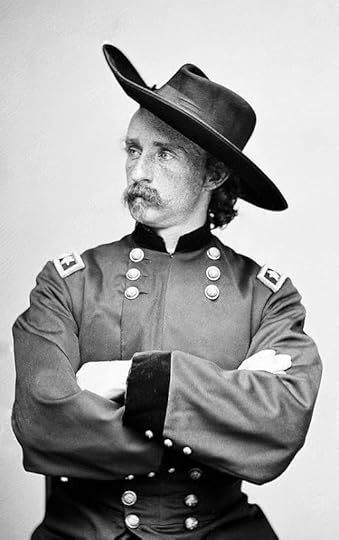
Or should I say he always knew a good tailor
He rose quickly through the ranks and reach the temporary rank of Major General (after the war he was reverted to the rank of captain). He was brave without question even his detractors could not say different. He was at times perceived as foolhardy, but was saved time and time again by the notorious Custer luck. He was a dramatic leader, loved by his men, who led from the front and as a result had several horses shot from under him during the war. His most famous cavalry charge was at the Battle of Gettysburg. Robert E. Lee had dispatched Jeb Stuart’s cavalry to hit the Union forces from behind. Custer led his 1st Michigan Cavalry into the teeth of that charge and broke the back of the assault preserving victory for the Union in what became the pivotal battle of the war. Custer's brigade lost 257 men at Gettysburg, the highest loss of any Union cavalry brigade. ”I challenge the annals of warfare to produce a more brilliant or successful charge of cavalry”, Custer wrote in his report.
Modesty was not a trait found among Custer’s characteristics.
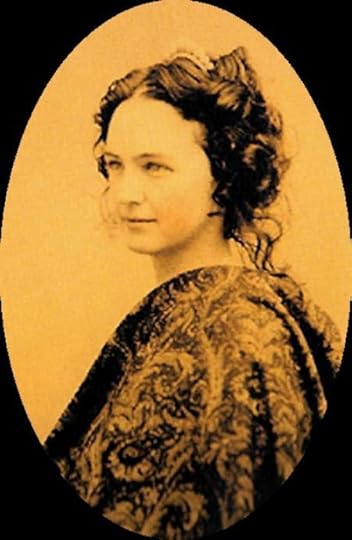
"At one point, Custer abandoned his regiment and dashed to Libbie, covering more than 150 miles on horseback in just sixty hours. From Libbie's standpoint, it was all wonderfully romantic and resulted in what she later remembered as a 'long perfect day,'but it almost ruined Custer's career. He was court-martialed and sentenced to a year's unpaid leave."
After the war General Philip Sheridan awarded the table on which Grant and Lee signed the surrender at Appomattox to Custer’s wife Libby. Included with the gift was a note: ”Permit me to say, Madam, that there is scarcely an individual in our service who has contributed more to bring this desirable result than your gallant husband.” This really struck me because when you think about all the powerful players involved with the ending of the war for Custer to be presented with such an important gift is frankly mind boggling. Layered beneath the braggadocio nature of George Armstrong Custer was merit that was recognized by his superiors.
You can’t really be neutral about Custer. He forces you to either like him or hate him. I’ve read several biographies over the years of Custer starting with the The Story of General Custer when I was a kid. My parents bought me a handful of these Grosset and Dunlap biographies which also included Davy Crockett, Daniel Boone, Geronimo, Crazy Horse, and Sitting Bull. I read them to pieces. I then discovered the public library also had more of them and I read all that they had as well. Out of all these great people I was most enamoured with GAC.

I’ve had an uneasy relationship with him. He is flawed. He did not take his cues from General Washington who hid his ambitions under a cloak of humbleness. Custer was raw with his desire to not only be successful, but to be adored. He created as many enemies as friends and one of those enemies just happened to be Captain Frederick Benteen. At the Battle of Washita an engagement against the Cheyenne in 1868 a friend of Benteen’s, Major Joel Elliott was left behind and was killed. Benteen felt that Custer had an opportunity to save Elliott and the resentment he felt over this incident was a scab he couldn’t quit picking.
President Ulysses S. Grant didn’t really care for Custer. He thought he was brash (true) and undisciplined (very true) and when the campaign against the Indians resumed in 1876 he wanted to make sure there was a steady hand guiding events out west. He put General Alfred Terry in command of what became known as the Centennial Campaign. General Terry may have also been under the glamour of Custer’s persona.
”General Terry, like Sheridan before him, had told Custer to do whatever he thought best once he came in contact with the Indians.”

General Alfred Terry
Terry had orders to engage the enemy and who better to send down the throat of an enemy than George Armstrong Custer.
”As Terry would have wanted it given the ultimate outcome of the battle, Custer has become the focal point, the one we obsess about when it comes to both the Black Hills Expedition and the Little Bighorn. But, in many ways, it was Terry who was moving the chess pieces. Even though his legal opinion launched the Black Hills gold rush and his battle plan resulted in one of the most notorious military disasters in U.S. history, Terry has slunk back into the shadows of history, letting Custer take center stage in a cumulative tragedy for which Terry was, perhaps more than any other single person, responsible.”
Okay I agree with Philbrick that Terry had his fair share of responsibility for the disaster at the Little Bighorn, but to put the finger on him as most responsible is hard to justify in my mind. I guess if you believe as Harry Truman so famously said: “The Buck Stops Here” then you could make a case that Terry was ultimately responsible. He wasn’t at the Battle of the Little Bighorn and he had complete faith in Custer’s ability to fight Indians. Custer had a few bobbles here and there, but overall he had proved himself a capable field commander.
To me there are several points in the series of events at the Little Bighorn where things could have went differently. Custer splitting his command was a critical miscalculation, but it was based on actual solid strategic thinking. He felt he could flush the Indians forward and keep them from escaping a pitch battle. The much maligned Major Marcus Reno had a golden opportunity to change the course of events when his group of 142 men charged toward the Indian encampment. Most of the warriors were elsewhere and it would have been a critical pendulum swinging moment in the conflict if he could have captured the women and children. He halted the charge about 600 yards from the encampment and formed a skirmish line giving the Indian fighters time to assemble. Major Reno, by many accounts, was drunk and intent on getting even more so if the bottle of whiskey seen in his hand during the battle was any indication. They were driven back losing a large portion of his command and during the ensuing pell-mell retreat Reno did not provide the necessary leadership that his men needed so desperately. Just as things are getting dire suddenly the Indians flow away from them like water. Reno’s command did not know this but they were heading to help finish off Custer’s command.
Frederick Benteen with his 100 men receives a written message from Custer sent via courier.
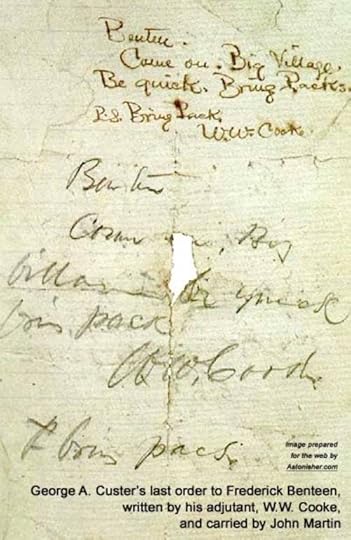
”Benteen, come on, big village, be quick. Bring packs." Benteen did not go; in fact, he dawdled even took time to water his horses. He then led his men down to join up with Reno which was a very good thing for Reno’s men because Benteen was an able commander and quickly shaped things up for the coming siege. He didn’t give a thought to joining up with Custer as requested. He resented Custer and I believe this may have been a bit of rebellion on his part. He certainly had put up with a lot of ostracization from the Custer sycophants. He had not been quiet about his feelings about Custer even sending those thoughts in writing to a newspaper. I also believe that he was somewhat under the spell of the Custer mystic. It would have been hard for him to believe that Custer, the brilliant dashing Custer, was in any real trouble. Could he have saved Custer? I’m not sure. He would have increased the chances and if Custer was hit fairly early in the battle, as some have speculated, he would have been a steadying influence on the troops and maybe would have come out a hero instead of a scapegoat.
208 men died with Custer that day. They were battling a force of Indians estimated to be about 3,500. Certainly more than what Custer could have even believed possible. His brothers Tom and Boston, his nephew, and his brother-in-law all perished with him. His intention to capture the women and children and end the battle quickly was daring and was almost accomplished.
”Hindsight makes Custer look like an egomaniacal fool. But as Sitting Bull, Runs the Enemy, and many other Lakota and Cheyenne realized that day, he came frighteningly close to winning the most spectacular victory of his career.”
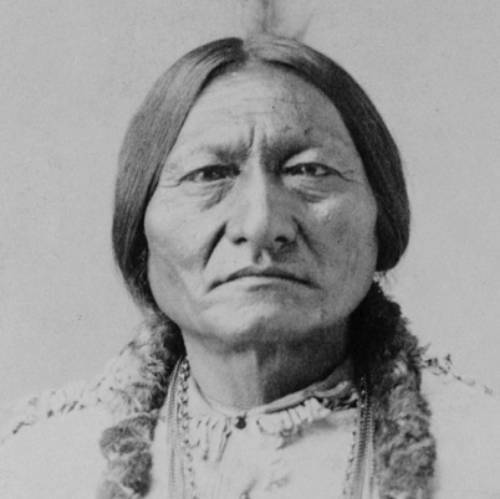
Sitting Bull
I love the way Nathaniel Philbrick organized this book. He gives us some background on Custer and then takes us through the politics, the personalities of the principle players Indian and soldier, and their movements during the battle. Most of what happened with Custer’s command comes down to speculation as there was only “one survivor” and that was horsed named Comanche. (He didn’t talk.)
I personally feel it was just a lost battle and as happens with losses a few things go wrong that contributed to defeat. Reno and Benteen both made decisions that may have ultimately cost Custer and his command their lives. Custer was too brash, maybe trusting too much in that Custer luck and the ability of his men. If he had captured the village he might have ended up President of the United States. Whether you believe him to be foolhardy or courageous, he accomplished something in death that he always wanted while living...to be immortalized. Philbrick doesn’t contribute anything new, but this book was so damn pleasurable to read.
If you wish to see more of my most recent book and movie reviews, visit http://www.jeffreykeeten.com
I also have a Facebook blogger page at: https://www.facebook.com/JeffreyKeeten
George Armstrong Custer

George Armstrong Custer at West Point
George Armstrong Custer was last in the graduating class of 1861 at West Point. They were graduated a year early due to the pressing need of the Union for officers, any officers, even the man at the bottom of the class was needed immediately. His class rank is deceptive. Custer was not dumb. He just was in trouble all the time for too many demerits. When he would run out of the number of demerits that he was allowed he would buckle down and pull himself back from the brink of being expelled.
Custer was tailor made for the Civil War.

Or should I say he always knew a good tailor
He rose quickly through the ranks and reach the temporary rank of Major General (after the war he was reverted to the rank of captain). He was brave without question even his detractors could not say different. He was at times perceived as foolhardy, but was saved time and time again by the notorious Custer luck. He was a dramatic leader, loved by his men, who led from the front and as a result had several horses shot from under him during the war. His most famous cavalry charge was at the Battle of Gettysburg. Robert E. Lee had dispatched Jeb Stuart’s cavalry to hit the Union forces from behind. Custer led his 1st Michigan Cavalry into the teeth of that charge and broke the back of the assault preserving victory for the Union in what became the pivotal battle of the war. Custer's brigade lost 257 men at Gettysburg, the highest loss of any Union cavalry brigade. ”I challenge the annals of warfare to produce a more brilliant or successful charge of cavalry”, Custer wrote in his report.
Modesty was not a trait found among Custer’s characteristics.

"At one point, Custer abandoned his regiment and dashed to Libbie, covering more than 150 miles on horseback in just sixty hours. From Libbie's standpoint, it was all wonderfully romantic and resulted in what she later remembered as a 'long perfect day,'but it almost ruined Custer's career. He was court-martialed and sentenced to a year's unpaid leave."
After the war General Philip Sheridan awarded the table on which Grant and Lee signed the surrender at Appomattox to Custer’s wife Libby. Included with the gift was a note: ”Permit me to say, Madam, that there is scarcely an individual in our service who has contributed more to bring this desirable result than your gallant husband.” This really struck me because when you think about all the powerful players involved with the ending of the war for Custer to be presented with such an important gift is frankly mind boggling. Layered beneath the braggadocio nature of George Armstrong Custer was merit that was recognized by his superiors.
You can’t really be neutral about Custer. He forces you to either like him or hate him. I’ve read several biographies over the years of Custer starting with the The Story of General Custer when I was a kid. My parents bought me a handful of these Grosset and Dunlap biographies which also included Davy Crockett, Daniel Boone, Geronimo, Crazy Horse, and Sitting Bull. I read them to pieces. I then discovered the public library also had more of them and I read all that they had as well. Out of all these great people I was most enamoured with GAC.

I’ve had an uneasy relationship with him. He is flawed. He did not take his cues from General Washington who hid his ambitions under a cloak of humbleness. Custer was raw with his desire to not only be successful, but to be adored. He created as many enemies as friends and one of those enemies just happened to be Captain Frederick Benteen. At the Battle of Washita an engagement against the Cheyenne in 1868 a friend of Benteen’s, Major Joel Elliott was left behind and was killed. Benteen felt that Custer had an opportunity to save Elliott and the resentment he felt over this incident was a scab he couldn’t quit picking.
President Ulysses S. Grant didn’t really care for Custer. He thought he was brash (true) and undisciplined (very true) and when the campaign against the Indians resumed in 1876 he wanted to make sure there was a steady hand guiding events out west. He put General Alfred Terry in command of what became known as the Centennial Campaign. General Terry may have also been under the glamour of Custer’s persona.
”General Terry, like Sheridan before him, had told Custer to do whatever he thought best once he came in contact with the Indians.”

General Alfred Terry
Terry had orders to engage the enemy and who better to send down the throat of an enemy than George Armstrong Custer.
”As Terry would have wanted it given the ultimate outcome of the battle, Custer has become the focal point, the one we obsess about when it comes to both the Black Hills Expedition and the Little Bighorn. But, in many ways, it was Terry who was moving the chess pieces. Even though his legal opinion launched the Black Hills gold rush and his battle plan resulted in one of the most notorious military disasters in U.S. history, Terry has slunk back into the shadows of history, letting Custer take center stage in a cumulative tragedy for which Terry was, perhaps more than any other single person, responsible.”
Okay I agree with Philbrick that Terry had his fair share of responsibility for the disaster at the Little Bighorn, but to put the finger on him as most responsible is hard to justify in my mind. I guess if you believe as Harry Truman so famously said: “The Buck Stops Here” then you could make a case that Terry was ultimately responsible. He wasn’t at the Battle of the Little Bighorn and he had complete faith in Custer’s ability to fight Indians. Custer had a few bobbles here and there, but overall he had proved himself a capable field commander.
To me there are several points in the series of events at the Little Bighorn where things could have went differently. Custer splitting his command was a critical miscalculation, but it was based on actual solid strategic thinking. He felt he could flush the Indians forward and keep them from escaping a pitch battle. The much maligned Major Marcus Reno had a golden opportunity to change the course of events when his group of 142 men charged toward the Indian encampment. Most of the warriors were elsewhere and it would have been a critical pendulum swinging moment in the conflict if he could have captured the women and children. He halted the charge about 600 yards from the encampment and formed a skirmish line giving the Indian fighters time to assemble. Major Reno, by many accounts, was drunk and intent on getting even more so if the bottle of whiskey seen in his hand during the battle was any indication. They were driven back losing a large portion of his command and during the ensuing pell-mell retreat Reno did not provide the necessary leadership that his men needed so desperately. Just as things are getting dire suddenly the Indians flow away from them like water. Reno’s command did not know this but they were heading to help finish off Custer’s command.
Frederick Benteen with his 100 men receives a written message from Custer sent via courier.

”Benteen, come on, big village, be quick. Bring packs." Benteen did not go; in fact, he dawdled even took time to water his horses. He then led his men down to join up with Reno which was a very good thing for Reno’s men because Benteen was an able commander and quickly shaped things up for the coming siege. He didn’t give a thought to joining up with Custer as requested. He resented Custer and I believe this may have been a bit of rebellion on his part. He certainly had put up with a lot of ostracization from the Custer sycophants. He had not been quiet about his feelings about Custer even sending those thoughts in writing to a newspaper. I also believe that he was somewhat under the spell of the Custer mystic. It would have been hard for him to believe that Custer, the brilliant dashing Custer, was in any real trouble. Could he have saved Custer? I’m not sure. He would have increased the chances and if Custer was hit fairly early in the battle, as some have speculated, he would have been a steadying influence on the troops and maybe would have come out a hero instead of a scapegoat.
208 men died with Custer that day. They were battling a force of Indians estimated to be about 3,500. Certainly more than what Custer could have even believed possible. His brothers Tom and Boston, his nephew, and his brother-in-law all perished with him. His intention to capture the women and children and end the battle quickly was daring and was almost accomplished.
”Hindsight makes Custer look like an egomaniacal fool. But as Sitting Bull, Runs the Enemy, and many other Lakota and Cheyenne realized that day, he came frighteningly close to winning the most spectacular victory of his career.”

Sitting Bull
I love the way Nathaniel Philbrick organized this book. He gives us some background on Custer and then takes us through the politics, the personalities of the principle players Indian and soldier, and their movements during the battle. Most of what happened with Custer’s command comes down to speculation as there was only “one survivor” and that was horsed named Comanche. (He didn’t talk.)
I personally feel it was just a lost battle and as happens with losses a few things go wrong that contributed to defeat. Reno and Benteen both made decisions that may have ultimately cost Custer and his command their lives. Custer was too brash, maybe trusting too much in that Custer luck and the ability of his men. If he had captured the village he might have ended up President of the United States. Whether you believe him to be foolhardy or courageous, he accomplished something in death that he always wanted while living...to be immortalized. Philbrick doesn’t contribute anything new, but this book was so damn pleasurable to read.
If you wish to see more of my most recent book and movie reviews, visit http://www.jeffreykeeten.com
I also have a Facebook blogger page at: https://www.facebook.com/JeffreyKeeten

May 8, 2010
"Back on Last Stand Hill, the relentless rifle and bow-and-arrow fire had winnowed the washichus to only a handful. By this point, [Lt. Col. George A.] Custer may already have suffered his first of two gunshot wounds - a bullet just below the heart. The blast would have knocked him to the ground but not necessarily killed him. Alive but mortally wounded, America's most famous Indian fighter could no longer fight...That evening on Last Stand Hill, as he lay on the ground with a gunshot wound to the chest, it may have been his brother Tom who came to his aid. Two days later the brothers were found within fifteen feet of each other, and the possibility exists that rather than see his wounded brother tortured to death, Tom shot Custer through the head. Whatever the case may be, Custer's second bullet wound was through the left temple..."
- Nathaniel Philbrick, The Last Stand: Custer, Sitting Bull, and the Battle of the Little Bighorn
I was going to give this book one star. Two at the most. But my wife stopped me, and insisted on five. To keep her happy, I split the difference.
There are roughly two types of Little Big Horn book. The first is the type directed towards the Obsessed. These are the readers who pour over every detail, however minute, in a vain effort to fully understand an event that really won't impact their lives in the least. They are a lot like Trekkies, or Star Wars fanboys, except they, if possible, might like girls even less. For these readers, there are a number of everyday-guys-turned-amateur historians (e.g., Gray, Michno) who have written incredibly detailed, well-researched, and in-depth analyses. Unfortunately, these guys aren't authors, and it shows.
The second group of Little Big Horn book is directed at the general reader. It is easily digestable, simple to follow (Custer = yellow hair), and generally treats the reader like Forrest Gump. Because this second type of book is written by a professional (e.g., Ambrose, Donovan, and now, Philbrick), there is very little incentive to leave the beaten path and - gasp! - speculate as to what happened at the famous battle. Instead, it follows the same pattern as every book before, and never teaches you anything new.
I thought this book was going to be a well-written example of the first type; instead, it was a well-written example of the second, and that's not good enough.
See, there are a lot of Custer books. If you're going to add a new one to this crowded bookshelf, you really need to bring something to the table, otherwise, you might as well name your tome Here's My Custer Book Now Where's My Check? This is especially true when you are Nathaniel Philbrick and semi-famous (and the author of some pretty darn good histories). This is doubly-especially true when James Donovan just released A Terrible Glory last year (although it is a popular history, for the general reader, it is up-to-date with the latest scholarship.)
A lot of my rancor comes from the title. You called it The Last Stand, so I mistakenly believed it was, you know, about the last stand.
Instead, the book reads like a warmed over, half-assed version of Evan S. Connell's classic, Son of the Morning Star. For those of you unfamiliar with Connell's work, I would compare it to a dendritic tree, where each idea branches off into another idea, and then another. Somehow, in the end, all the tangents come together, as threads in a loom, to create something that you feel, subconsciously, as much as you discern, consciously. I mean, I didn't learn anything, but I'll be darned if I could put the book down once I started. It is a structual marvel. Some reviewers claimed it was "novelistic"; I'd say it's a lot like the television show Lost, with flashbacks, flashforwards, flash-sideways, and many, many gunshot wounds.
Philbrick self-consiously apes this framework for much of the book. Unlike Connell, he has a more straightforward, chronological throughline; but like Connell, he uses his narrative throughline as a laundry-line on which to hang biographies, past battles, and discussions about topics as varied as riding bits, visions, and adultery within the 7th Cavalry.
Utilizing this approach, Philbrick takes us along with the 7th Cavalry as it embarks on its final campaign in the Summer of '76. Though Philbrick isn't Connell, he is Philbrick, and I'm not going to pretend I didn't enjoy his telling of well-known events. As previously demonstrated (In the Heart of the Sea is particularly impressive), he has a great eye for telling detail, and you can sit back and enjoy the raconteur at work. For instance, I really liked this thumbnail portrait of Captain Frederick Benteen, the acidic, vendetta-carrying, tough-as-nails leader of Company H:
For a reader new to the world of Custer, this is good stuff. But if you already know the story, it's just a lot of filler. You don't find out what happens to Custer and his men until page 257 (out of 312).
All the stuff leading up to the battle has been covered before. Well covered. By James Donovan. Last year. At times, the only thing that separates Donovan from Philbrick is that Philbrick is a little kinder to Major Reno (who was drunk during the battle) and a little harsher on Benteen (whom Philbrick comes close to accusing of abandoning Custer to his fate out of spite). In order to get the book published, I'm sure that Philbrick had to argue he had something "new" to add. This "new" piece of evidence is the wild story of Private Thompson, who lagged behind Custer's battalion as it rode to its doom, and eventually joined up with Reno and Benteen. However, as Philbrick notes in the text, this really isn't new material; in fact, it's been commented on many times before. Thus, once again, the dust jacket has lied to me. (Someday, dust jacket, I will even the score).
The frustrating thing about Philbrick is that he's really smart, done a ton of research, and really knows how to synthesize the work of others. Throughout the book, there are glimmers of his "theory" of the battle. For instance, he makes some really interesting observations about the similiarities between the battle of the Washita and the battle of the Little Big Horn. Building off of Sklenar's To Hell With Honor, Philbrick posits that Custer believed there were a series of smaller camps, rather than one big one, and that Custer sought to capture one of these camps and use the hostages as bargaining chips (as Custer had done to extricate himself from the Washita in 1868). He also believes that Custer maintained an offensive posture for over an hour, waiting for a link-up with Benteen. This is interesting stuff, and it would've been wonderful to have it delivered by a polished author. However, because Philbrick is writing for a general audience, and because he prefers literary flourishes to logical rigor, the theory sort of vanishes like smoke dissipated by the wind.
As already noted, Custer's battle is dealt with in a cursory manner, when compared to the many chapters devoted to the Reno-Benteen fight. The reason, of course, is that Philbrick, aiming for a wide audience, refuses to do much speculating. Really, though, isn't it time we agreed that we know a lot more about Custer's Last Stand than we've ever let on? I mean, you have archaelogical evidence (thanks to Fox and Scott), you have forensic evidence (thanks to Hardorff's compilations), you have tons of direct, eyewitness testimony (thanks to Hardorff and Michno), and you have good insight into Custer's military mind (thanks to Wirt). With all that evidence, you could put together a pretty good blow-by-blow account of Custer's fight on battle ridge.
Why am I belittling this point? Maybe I'm just bitter, like Benteen. Maybe I'm drunk and beligerent, like Reno. Or maybe it's because I'm sick of buying books about the Little Big Horn that don't have the guts to talk about the one part of the Little Big Horn that anyone cares about: Custer and his men. (For the record, I won't stop buying these books, no matter how many disappointments).
Back to my wife and the stars. On a long-distance road trip, she was reading The Last Stand aloud to me as I drove (I am too cheap to buy audiobooks; instead, I got a wife). Eventually, car sickness forced her to stop, but she mentioned how she almost wanted to keep reading, just to see how it ended (I promised not to ruin the surprise).
I told her I didn't like the book, because it felt derivative. She told me I was being elitist, and that people like her would find the book invaluable. I pulled over and made her get out. She later tracked me down and slashed my tires. In short, I grudgingly came to see her point.
This book wasn't written for me. It was written for those who don't know Custer, and who want a good overview of the story culled from the best sources (and who coincidentally failed to read James Donovan's worthwile effort). Still, I maintain that the title should've been different. Maybe: Another Custer Book, Just Like All the Rest, Except a Little Better. Or perhaps: The Twilight Saga: Custer's Last Stand (This would help boost sales).
Strangely, even with all the Custer literature out there, I believe there's a great book still waiting to be written. I'm just disappointed it didn't belong to Philbrick.
[Addendum, or A Second Thought, Eight Years Later: Recently, I experienced The Last Stand for the second time, and liked it a lot more. Quite a bit more, in fact. To the point where I came really close to changing the number of stars, a habit I do not want to get into. (Since I will be endlessly tweaking). Reflecting upon this after the passage of a good chunk of time, I recognize that it is probably the best popular history on the Battle of the Little Bighorn. It is more straightforward than Son of the Morning Star (which is the better book, overall), and probably better written than Donovan's A Terrible Glory (despite the belaboring points I made in my original review, which for posterity's sake, I will not change).
When I first read this, it was long enough ago that audio books were not mainstream, and if I wanted to hear a book aloud on a long car ride, I needed my wife to narrate. Despite our original disagreement over The Last Stand's merits, and my continued insistence on taking her to distant battlefields (you should hear her story of the time we took our six-month old to the Battle of Cowpens - the baby had a diaper blowout while I was walking the battlefield loop. Funny stuff, which I am sure will be mentioned in the divorce), my wife and I recently came full circle, when we listened to this on Audible. We were not alone this time. Instead, there were three kids in the backseat, fighting over two iPads. Despite the distractions, I came to appreciate what Philbrick brings to the table.
My wife, on the other hand, fell quickly asleep.]
- Nathaniel Philbrick, The Last Stand: Custer, Sitting Bull, and the Battle of the Little Bighorn
I was going to give this book one star. Two at the most. But my wife stopped me, and insisted on five. To keep her happy, I split the difference.
There are roughly two types of Little Big Horn book. The first is the type directed towards the Obsessed. These are the readers who pour over every detail, however minute, in a vain effort to fully understand an event that really won't impact their lives in the least. They are a lot like Trekkies, or Star Wars fanboys, except they, if possible, might like girls even less. For these readers, there are a number of everyday-guys-turned-amateur historians (e.g., Gray, Michno) who have written incredibly detailed, well-researched, and in-depth analyses. Unfortunately, these guys aren't authors, and it shows.
The second group of Little Big Horn book is directed at the general reader. It is easily digestable, simple to follow (Custer = yellow hair), and generally treats the reader like Forrest Gump. Because this second type of book is written by a professional (e.g., Ambrose, Donovan, and now, Philbrick), there is very little incentive to leave the beaten path and - gasp! - speculate as to what happened at the famous battle. Instead, it follows the same pattern as every book before, and never teaches you anything new.
I thought this book was going to be a well-written example of the first type; instead, it was a well-written example of the second, and that's not good enough.
See, there are a lot of Custer books. If you're going to add a new one to this crowded bookshelf, you really need to bring something to the table, otherwise, you might as well name your tome Here's My Custer Book Now Where's My Check? This is especially true when you are Nathaniel Philbrick and semi-famous (and the author of some pretty darn good histories). This is doubly-especially true when James Donovan just released A Terrible Glory last year (although it is a popular history, for the general reader, it is up-to-date with the latest scholarship.)
A lot of my rancor comes from the title. You called it The Last Stand, so I mistakenly believed it was, you know, about the last stand.
Instead, the book reads like a warmed over, half-assed version of Evan S. Connell's classic, Son of the Morning Star. For those of you unfamiliar with Connell's work, I would compare it to a dendritic tree, where each idea branches off into another idea, and then another. Somehow, in the end, all the tangents come together, as threads in a loom, to create something that you feel, subconsciously, as much as you discern, consciously. I mean, I didn't learn anything, but I'll be darned if I could put the book down once I started. It is a structual marvel. Some reviewers claimed it was "novelistic"; I'd say it's a lot like the television show Lost, with flashbacks, flashforwards, flash-sideways, and many, many gunshot wounds.
Philbrick self-consiously apes this framework for much of the book. Unlike Connell, he has a more straightforward, chronological throughline; but like Connell, he uses his narrative throughline as a laundry-line on which to hang biographies, past battles, and discussions about topics as varied as riding bits, visions, and adultery within the 7th Cavalry.
Utilizing this approach, Philbrick takes us along with the 7th Cavalry as it embarks on its final campaign in the Summer of '76. Though Philbrick isn't Connell, he is Philbrick, and I'm not going to pretend I didn't enjoy his telling of well-known events. As previously demonstrated (In the Heart of the Sea is particularly impressive), he has a great eye for telling detail, and you can sit back and enjoy the raconteur at work. For instance, I really liked this thumbnail portrait of Captain Frederick Benteen, the acidic, vendetta-carrying, tough-as-nails leader of Company H:
During the early years of the Civil War, Benteen's two commanding officers feuded incessantly; the scuffle that killed one of them and sent the other to prison seems to have been a kind of object lesson for Benteen, who, as several officers in the Seventh could attest, instinctively reached for his pistol whenever he felt his honor had been slighted. Benteen loved his wife, Frabbie, intensely and passionately (he sometimes decorated his letters to her with anatomically precise drawings of his erect penis), but they were a couple who had known more than their share of hardships...and over the course of the last decade, he and Frabbie had lost four out of five children to illness.
For a reader new to the world of Custer, this is good stuff. But if you already know the story, it's just a lot of filler. You don't find out what happens to Custer and his men until page 257 (out of 312).
All the stuff leading up to the battle has been covered before. Well covered. By James Donovan. Last year. At times, the only thing that separates Donovan from Philbrick is that Philbrick is a little kinder to Major Reno (who was drunk during the battle) and a little harsher on Benteen (whom Philbrick comes close to accusing of abandoning Custer to his fate out of spite). In order to get the book published, I'm sure that Philbrick had to argue he had something "new" to add. This "new" piece of evidence is the wild story of Private Thompson, who lagged behind Custer's battalion as it rode to its doom, and eventually joined up with Reno and Benteen. However, as Philbrick notes in the text, this really isn't new material; in fact, it's been commented on many times before. Thus, once again, the dust jacket has lied to me. (Someday, dust jacket, I will even the score).
The frustrating thing about Philbrick is that he's really smart, done a ton of research, and really knows how to synthesize the work of others. Throughout the book, there are glimmers of his "theory" of the battle. For instance, he makes some really interesting observations about the similiarities between the battle of the Washita and the battle of the Little Big Horn. Building off of Sklenar's To Hell With Honor, Philbrick posits that Custer believed there were a series of smaller camps, rather than one big one, and that Custer sought to capture one of these camps and use the hostages as bargaining chips (as Custer had done to extricate himself from the Washita in 1868). He also believes that Custer maintained an offensive posture for over an hour, waiting for a link-up with Benteen. This is interesting stuff, and it would've been wonderful to have it delivered by a polished author. However, because Philbrick is writing for a general audience, and because he prefers literary flourishes to logical rigor, the theory sort of vanishes like smoke dissipated by the wind.
As already noted, Custer's battle is dealt with in a cursory manner, when compared to the many chapters devoted to the Reno-Benteen fight. The reason, of course, is that Philbrick, aiming for a wide audience, refuses to do much speculating. Really, though, isn't it time we agreed that we know a lot more about Custer's Last Stand than we've ever let on? I mean, you have archaelogical evidence (thanks to Fox and Scott), you have forensic evidence (thanks to Hardorff's compilations), you have tons of direct, eyewitness testimony (thanks to Hardorff and Michno), and you have good insight into Custer's military mind (thanks to Wirt). With all that evidence, you could put together a pretty good blow-by-blow account of Custer's fight on battle ridge.
Why am I belittling this point? Maybe I'm just bitter, like Benteen. Maybe I'm drunk and beligerent, like Reno. Or maybe it's because I'm sick of buying books about the Little Big Horn that don't have the guts to talk about the one part of the Little Big Horn that anyone cares about: Custer and his men. (For the record, I won't stop buying these books, no matter how many disappointments).
Back to my wife and the stars. On a long-distance road trip, she was reading The Last Stand aloud to me as I drove (I am too cheap to buy audiobooks; instead, I got a wife). Eventually, car sickness forced her to stop, but she mentioned how she almost wanted to keep reading, just to see how it ended (I promised not to ruin the surprise).
I told her I didn't like the book, because it felt derivative. She told me I was being elitist, and that people like her would find the book invaluable. I pulled over and made her get out. She later tracked me down and slashed my tires. In short, I grudgingly came to see her point.
This book wasn't written for me. It was written for those who don't know Custer, and who want a good overview of the story culled from the best sources (and who coincidentally failed to read James Donovan's worthwile effort). Still, I maintain that the title should've been different. Maybe: Another Custer Book, Just Like All the Rest, Except a Little Better. Or perhaps: The Twilight Saga: Custer's Last Stand (This would help boost sales).
Strangely, even with all the Custer literature out there, I believe there's a great book still waiting to be written. I'm just disappointed it didn't belong to Philbrick.
[Addendum, or A Second Thought, Eight Years Later: Recently, I experienced The Last Stand for the second time, and liked it a lot more. Quite a bit more, in fact. To the point where I came really close to changing the number of stars, a habit I do not want to get into. (Since I will be endlessly tweaking). Reflecting upon this after the passage of a good chunk of time, I recognize that it is probably the best popular history on the Battle of the Little Bighorn. It is more straightforward than Son of the Morning Star (which is the better book, overall), and probably better written than Donovan's A Terrible Glory (despite the belaboring points I made in my original review, which for posterity's sake, I will not change).
When I first read this, it was long enough ago that audio books were not mainstream, and if I wanted to hear a book aloud on a long car ride, I needed my wife to narrate. Despite our original disagreement over The Last Stand's merits, and my continued insistence on taking her to distant battlefields (you should hear her story of the time we took our six-month old to the Battle of Cowpens - the baby had a diaper blowout while I was walking the battlefield loop. Funny stuff, which I am sure will be mentioned in the divorce), my wife and I recently came full circle, when we listened to this on Audible. We were not alone this time. Instead, there were three kids in the backseat, fighting over two iPads. Despite the distractions, I came to appreciate what Philbrick brings to the table.
My wife, on the other hand, fell quickly asleep.]

June 8, 2014
I was drawn to The Last Stand: Custer, Sitting Bull and the Battle of the Little Bighorn not so much by its subject matter, but by its author, Nathaniel Philbrick. For one thing, I was intrigued why a writer who heretofore had written about the sea and coastal areas, and had done so in admirable fashion, would venture into the hinterland and write about two of the icons of the American West and one of the most famous battles in American history. I wasn’t sure that it would be possible to learn anything new since there have been dozens of books written about the subject he had chosen.
Philbrick indicates that his first real introduction to Custer was in the film “Little Big Man,” released in 1970, and that it sparked his interest in the man. I would say that his introduction was a poor one. Although I like Thomas Berger’s novel upon which the film is based, I never liked the film. It seems to me that the filmmakers could never make up their minds if they were making a satire, a comedy, or a dramatic film. And Richard Mulligan’s portrayal of Custer as a psychotic and hysterical coward is over the top and way off the mark.
My own introduction to Custer, on film anyway, was an old black-and-white film made by Warner Brothers and released in 1942, that I first saw on late night TV. It was “They Died With Their Boots On” and starred Errol Flynn as Custer. It was a whitewash job as far off the mark as the 1970 film, but in the opposite direction. But then what could you expect from Hollywood? If it could make a Robin Hood out of Jesse James in 1939, making a hero out of Custer was easy.
Neither of these Custer films was an accurate portrayal. The truth was located somewhere in the middle. And that is what we get from Philbrick. I think he was right to spread the blame for the debacle on the Little Bighorn among Custer and his second-in-command, Major Marcus Reno, and his senior captain, Frederick Benteen. I did find it interesting that he did not let the overall commander of the campaign off the hook either. That would be General Alfred Terry, who was, I was interested to learn, the only non-West Point general in the post-war army. Most accounts have not had much to say about General Terry’s role in the disaster and when they do they generally find no fault in his leadership.
If you are a student of the battle and its principals or if you have visited the battlefield as I have on three occasions (the most recent being last summer) then you probably are not going to learn a lot of new information. If, on the other hand, you haven’t immersed yourself in the subject but are interested and would like to learn more about the most disastrous military defeat in U.S. history, this book would be as good a place to start as any.
I would also recommend Son of the Morning Star by Evan Connell, which was written about twenty-five years ago. Connell was a novelist and though the book is nonfiction, it reads like a good novel. And I have on my “to read” list and on my bookshelf yet another fairly recent Custer book that received good reviews, A Terrible Glory by James Donovan.
Philbrick indicates that his first real introduction to Custer was in the film “Little Big Man,” released in 1970, and that it sparked his interest in the man. I would say that his introduction was a poor one. Although I like Thomas Berger’s novel upon which the film is based, I never liked the film. It seems to me that the filmmakers could never make up their minds if they were making a satire, a comedy, or a dramatic film. And Richard Mulligan’s portrayal of Custer as a psychotic and hysterical coward is over the top and way off the mark.
My own introduction to Custer, on film anyway, was an old black-and-white film made by Warner Brothers and released in 1942, that I first saw on late night TV. It was “They Died With Their Boots On” and starred Errol Flynn as Custer. It was a whitewash job as far off the mark as the 1970 film, but in the opposite direction. But then what could you expect from Hollywood? If it could make a Robin Hood out of Jesse James in 1939, making a hero out of Custer was easy.
Neither of these Custer films was an accurate portrayal. The truth was located somewhere in the middle. And that is what we get from Philbrick. I think he was right to spread the blame for the debacle on the Little Bighorn among Custer and his second-in-command, Major Marcus Reno, and his senior captain, Frederick Benteen. I did find it interesting that he did not let the overall commander of the campaign off the hook either. That would be General Alfred Terry, who was, I was interested to learn, the only non-West Point general in the post-war army. Most accounts have not had much to say about General Terry’s role in the disaster and when they do they generally find no fault in his leadership.
If you are a student of the battle and its principals or if you have visited the battlefield as I have on three occasions (the most recent being last summer) then you probably are not going to learn a lot of new information. If, on the other hand, you haven’t immersed yourself in the subject but are interested and would like to learn more about the most disastrous military defeat in U.S. history, this book would be as good a place to start as any.
I would also recommend Son of the Morning Star by Evan Connell, which was written about twenty-five years ago. Connell was a novelist and though the book is nonfiction, it reads like a good novel. And I have on my “to read” list and on my bookshelf yet another fairly recent Custer book that received good reviews, A Terrible Glory by James Donovan.

July 16, 2011
Did you hear the one about the military moron, the drunkard and the backstabbing subordinate?
The Battle of the Little Bighorn was such an unnecessary debacle that it might as well be a joke. But it's no joke. It's tragedy.
In the lead role of this tragedy is this boy...

He finished last at Westpoint and went on to become this ego maniac...

George Armstrong Custer made his career by daring and foolishly brave acts during the American Civil War, such as at the Battle of Gettysburg where his aggressive leadership at the head of a calvary charge turned the tide of the battle, while also obtaining the distinction/infamy of having lost the most men.
Custer the impulsive, irrational and cock-sure killer of plains indian women and children could also be conciliatory. He had his own kind of respect for the western tribes and at times attempted diplomatic resolutions to avoid conflict.
Nathaniel Philbrick, one the most popularly read modern historians, tries to get into the psychology of not only Custer, but all of the principle players in the Little Bighorn tragedy. He's done his research. He's sourced from the most credible accounts available. All of it seems to add up to plausibility, and yet Philbrick himself admits that almost nothing can be certain. After all, the few who survived the battle had their own agendas to consider and reputations to cultivate or at least repair. Therefore, eye-witness accounts vary. Were Custer's subordinates acting out of self-interest and would the battle have gone differently had that been otherwise? Philbrick continually questions who's to blame and who's telling the truth. Little Bighorn was a mass of confusion. It is unlikely the truth will ever be fully reveal. However, Philbrick's The Last Stand is an honest attempt to piece together as many factual fragments as possible to get closest to the most probable picture of truth.
The Battle of the Little Bighorn was such an unnecessary debacle that it might as well be a joke. But it's no joke. It's tragedy.
In the lead role of this tragedy is this boy...
He finished last at Westpoint and went on to become this ego maniac...
George Armstrong Custer made his career by daring and foolishly brave acts during the American Civil War, such as at the Battle of Gettysburg where his aggressive leadership at the head of a calvary charge turned the tide of the battle, while also obtaining the distinction/infamy of having lost the most men.
Custer the impulsive, irrational and cock-sure killer of plains indian women and children could also be conciliatory. He had his own kind of respect for the western tribes and at times attempted diplomatic resolutions to avoid conflict.
Nathaniel Philbrick, one the most popularly read modern historians, tries to get into the psychology of not only Custer, but all of the principle players in the Little Bighorn tragedy. He's done his research. He's sourced from the most credible accounts available. All of it seems to add up to plausibility, and yet Philbrick himself admits that almost nothing can be certain. After all, the few who survived the battle had their own agendas to consider and reputations to cultivate or at least repair. Therefore, eye-witness accounts vary. Were Custer's subordinates acting out of self-interest and would the battle have gone differently had that been otherwise? Philbrick continually questions who's to blame and who's telling the truth. Little Bighorn was a mass of confusion. It is unlikely the truth will ever be fully reveal. However, Philbrick's The Last Stand is an honest attempt to piece together as many factual fragments as possible to get closest to the most probable picture of truth.

April 14, 2021
I have read many books about the Battle of the Little Bighorn, and I have visited the battlefield so it's obvious that I find it to be a fascinating subject. This is one of the better books that I have read. The story starts with the three prongs of cavalry who are sent out to insure that the Indians will return to their reservations. One prong is defeated at the Battle of the Rosebud while the Montana column is very slow moving, leaving the Dakota column basically in charge of the job although they do expect the other two to show up.
General Terry is in command of the Dakota column, but as everyone knows the volatile George Armstrong Custer is in charge of the 7th Cavalry. It is the relationship of Terry and Custer that is in the forefront of this book. The author seems to believe that Terry set up Custer to take the blame if something went wrong, or Terry could take his share of the praise if Custer was victorious since he was in command.
The other two subordinates, Reno and Benteen, come in for a close look since their actions on June 25 played an important role in the tragedy.
I really enjoyed this book despite the fact that I knew most of it. Hubris and ego colored many of the decisions made. Over 200 soldiers died because one man needed to show his prowess as a warrior. Not that Custer was all to blame. The failings of Reno and Benteen added to the numbers, especially because of Benteen's negligence during the siege and Reno's failure in his initial attack. There was plenty of blame to go around.
But in the long run, the Indians suffered the most as this victory achieved liitle for them. By 1890 their way of life had been lost for the most part. Tragedy was the byword as the Indians only wanted to keep their way of life, but there was no way for that to happen.. Time itself was against them.
General Terry is in command of the Dakota column, but as everyone knows the volatile George Armstrong Custer is in charge of the 7th Cavalry. It is the relationship of Terry and Custer that is in the forefront of this book. The author seems to believe that Terry set up Custer to take the blame if something went wrong, or Terry could take his share of the praise if Custer was victorious since he was in command.
The other two subordinates, Reno and Benteen, come in for a close look since their actions on June 25 played an important role in the tragedy.
I really enjoyed this book despite the fact that I knew most of it. Hubris and ego colored many of the decisions made. Over 200 soldiers died because one man needed to show his prowess as a warrior. Not that Custer was all to blame. The failings of Reno and Benteen added to the numbers, especially because of Benteen's negligence during the siege and Reno's failure in his initial attack. There was plenty of blame to go around.
But in the long run, the Indians suffered the most as this victory achieved liitle for them. By 1890 their way of life had been lost for the most part. Tragedy was the byword as the Indians only wanted to keep their way of life, but there was no way for that to happen.. Time itself was against them.
November 8, 2025
3.5 stars. I have read many books about the Little Bighorn battle. I have also visited the battlefield to see where it all happened. Obviously, a major portion of the battle is speculation because of its nature since not even the Indians who fought there can agree on the timeline actions, especially at the Last Stand area. The only thing that is for sure is that the 5 companies which accompanied Custer died to a man. (Although I saw a 'documentary' that one man made it out. Now that would be one for the history books.)
The other two officer who are key figures in this story are almost as interesting in their own way. Major Marcus Reno who led his men on a charge that was supposed to penetrate the huge Indian village that was focus of the attack. The attack went awry and Reno (under the influence of alcohol supposedly) ordered a retreat to take up safer positions on a cliff.
To me the most questionable officer was Captain Frederick Benteen of Company H who had a chip on his shoulder the size of Gibralter. He had been with Custer at the Washita in 1868, and still hated him for supposedly abandoning some of his men. He was a good fighter, but a vindictive man.
Whatever happened that day in June, it is a fascinating how ego can lead men into making fatal mistakes. It is a lesson that those in power need to take seriously.
The other two officer who are key figures in this story are almost as interesting in their own way. Major Marcus Reno who led his men on a charge that was supposed to penetrate the huge Indian village that was focus of the attack. The attack went awry and Reno (under the influence of alcohol supposedly) ordered a retreat to take up safer positions on a cliff.
To me the most questionable officer was Captain Frederick Benteen of Company H who had a chip on his shoulder the size of Gibralter. He had been with Custer at the Washita in 1868, and still hated him for supposedly abandoning some of his men. He was a good fighter, but a vindictive man.
Whatever happened that day in June, it is a fascinating how ego can lead men into making fatal mistakes. It is a lesson that those in power need to take seriously.

November 2, 2011
Nathaniel Philbrick has become one of my favorite authors. I've still yet to read his perhaps most famous book In the Heart of the Sea, but I have read, and thoroughly enjoyed, his Sea of Glory and Mayflower; and now I have finished his latest: The Last Stand.
Each of these books was intriguing and interesting from the first page to the last. The Last Stand of course is the story of George Armstrong Custer and the last days of the free Lakota people. My sentiments are always with the Lakota. Their life on the plains seems so appealing to me, and I feel it is such a shame that such a precious culture and way of life had to be so ruthlessly destroyed -- that we and the native inhabitants of this land today no longer have the option of living that culture.
I very much enjoyed and appreciated this book. For me, the maps were wonderful. I always try to visualize the terrain and the troop movements when I read histories like this, and without good maps it is nearly impossible to do so. The author's ability to present each of the major players in this drama as a real person with both good and bad qualities was exceptional.
Each of these books was intriguing and interesting from the first page to the last. The Last Stand of course is the story of George Armstrong Custer and the last days of the free Lakota people. My sentiments are always with the Lakota. Their life on the plains seems so appealing to me, and I feel it is such a shame that such a precious culture and way of life had to be so ruthlessly destroyed -- that we and the native inhabitants of this land today no longer have the option of living that culture.
I very much enjoyed and appreciated this book. For me, the maps were wonderful. I always try to visualize the terrain and the troop movements when I read histories like this, and without good maps it is nearly impossible to do so. The author's ability to present each of the major players in this drama as a real person with both good and bad qualities was exceptional.

July 6, 2014
Another excellent history written by Nathaniel Philbrick. Focusing on two men-George A. Custer and Sitting Bull- he details the events that led to their final confrontation on June 25, 1876, on the Little Bighorn River in Montana. It is really the story of two Last Stands. It was the end of Custer, but it was also the end of the freedom of the Northern Plains Indians. When a nation celebrating the centennial of its independence heard the terrible news of the death of Custer with his men, there arose a demand to completely defeat the last free Indians. Philbrick does a great job covering the battle itself, but also tells what happened to individuals affected by the battle, such as Sitting Bull, and Libby Custer, the widow of General Custer, who spent the rest of her life promoting Custer as figure of legend.

June 9, 2026
The Last Stand: Custer, Sitting Bull, and the Battle of the Little Bighorn is an incredible and interesting book. George Armstrong Custer led his cavalry regiment against a huge company of Sioux and Cheyenne near the the Little Big Horn river in central Montana. Custer and his soldiers didn't know it, but they didn't stand a chance of defeating them. Some people think Custer was brave attacking Sitting Bull, but most people think Custer was so full of arrogance that he thought he could defeat them. But, again, Custer's arrogance is what actually defeated him.

July 20, 2018
White man came across the sea
He brought us pain and misery
He killed our tribes killed our creed
He took our game for his own need
We fought him hard we fought him well
Out on the plains we gave him hell
But many came too much for Cree
Oh will we ever be set free?
Riding through dust clouds and barren wastes
Galloping hard on the plains
Chasing the redskins back to their holes
Fighting them at their own game
Murder for freedom the stab in the back
Women and children are cowards attack
Run to the hills, run for your lives
Run to the hills, run for your lives
Soldier blue in the barren wastes
Hunting and killing their game
Raping the women and wasting the men
The only good Indians are tame
Selling them whiskey and taking their gold
Enslaving the young and destroying the old
Run to the hills, run for your lives
3.5*'s
The is the first time I've read an in depth account of Custer and what happened at Little Bighorn. Usually you develop some sort of empathy for characters even those severely flawed when reading about them. Nixon is a great example. The man was a criminal but when you read about his paranoia you at least on some level feel for the man.
It's really hard to feel anything but disdain for Custer when you read about his dessacrating Indian burial grounds and stealing artifacts from the dead, running into Indian camps and taking women, children and the elderly as prisoners to get the Indians to surrender, abusing those prisoners and this was to the point that he and his brothers had a running "joke" that "the great thing about Indian women is they rape easy."
I'll grant him his bravery but other than that there's nothing heroic about the man. He was rash, a braggart, a rapist, he killed for sport.........amazing, or not, that he's survived as a "national hero" for this long.
Benteen, Terry, Sheridan and many of the others didn't cover themselves in glory either. Sitting Bull and all of the Indians came to bad ends. Really there are no winners in this epically sad tale.
He brought us pain and misery
He killed our tribes killed our creed
He took our game for his own need
We fought him hard we fought him well
Out on the plains we gave him hell
But many came too much for Cree
Oh will we ever be set free?
Riding through dust clouds and barren wastes
Galloping hard on the plains
Chasing the redskins back to their holes
Fighting them at their own game
Murder for freedom the stab in the back
Women and children are cowards attack
Run to the hills, run for your lives
Run to the hills, run for your lives
Soldier blue in the barren wastes
Hunting and killing their game
Raping the women and wasting the men
The only good Indians are tame
Selling them whiskey and taking their gold
Enslaving the young and destroying the old
Run to the hills, run for your lives
3.5*'s
The is the first time I've read an in depth account of Custer and what happened at Little Bighorn. Usually you develop some sort of empathy for characters even those severely flawed when reading about them. Nixon is a great example. The man was a criminal but when you read about his paranoia you at least on some level feel for the man.
It's really hard to feel anything but disdain for Custer when you read about his dessacrating Indian burial grounds and stealing artifacts from the dead, running into Indian camps and taking women, children and the elderly as prisoners to get the Indians to surrender, abusing those prisoners and this was to the point that he and his brothers had a running "joke" that "the great thing about Indian women is they rape easy."
I'll grant him his bravery but other than that there's nothing heroic about the man. He was rash, a braggart, a rapist, he killed for sport.........amazing, or not, that he's survived as a "national hero" for this long.
Benteen, Terry, Sheridan and many of the others didn't cover themselves in glory either. Sitting Bull and all of the Indians came to bad ends. Really there are no winners in this epically sad tale.
May 20, 2011
This is the first book I have read on the Little Big Horn battle and for me it was a very interesting and well presented account.
My knowledge of the battle was basic, and I knew something of the main characters - Custer and Sitting Bull - but little about others such as Reno, Benteen, White Bull, Red hawk and the Scouts etc.
I also knew of the 7th US Cavalry, as they always appeared (or so it seemed to me) in Hollywood films about the West - and perhaps as I came across a squadron of the unit during my own military career and remembered conversations with them about our units' respective histories.
So I came to Nathaniel Philbrick's book looking for an account of the events leading to the battle and the people who were involved. For me it did precisley that in an easy to read, yet not shallow piece of well written story telling that means I now want to read more.
From this book I now know something about the US Government's plans and the background to those, and why the US Army, and therefore Custer, was doing what it was doing. The information on the Indians - the many tribes and orders within - was easy to understand and helped me to really get a sense of how they lived their lives as well as the anguish and fear these people must of had.
The real gem in this book I felt though was the events leading up to Custer's final stand. Brought out by clear and regularly placed maps the developing maelstrom, the conduct of Reno and Benteen and the Indians' tactics was page turning helped by the use of accounts from survivors and participants. I also found the work of the steamboat Far West under the captaincy of Grant Marsh to be a real important aspect to the story and one I shall look to explore further.
Perhaps this isn't the best account - as suggested by people here who clearly have studied the battle and the characters in great depth - but for a single volume it was very good indeed.
My knowledge of the battle was basic, and I knew something of the main characters - Custer and Sitting Bull - but little about others such as Reno, Benteen, White Bull, Red hawk and the Scouts etc.
I also knew of the 7th US Cavalry, as they always appeared (or so it seemed to me) in Hollywood films about the West - and perhaps as I came across a squadron of the unit during my own military career and remembered conversations with them about our units' respective histories.
So I came to Nathaniel Philbrick's book looking for an account of the events leading to the battle and the people who were involved. For me it did precisley that in an easy to read, yet not shallow piece of well written story telling that means I now want to read more.
From this book I now know something about the US Government's plans and the background to those, and why the US Army, and therefore Custer, was doing what it was doing. The information on the Indians - the many tribes and orders within - was easy to understand and helped me to really get a sense of how they lived their lives as well as the anguish and fear these people must of had.
The real gem in this book I felt though was the events leading up to Custer's final stand. Brought out by clear and regularly placed maps the developing maelstrom, the conduct of Reno and Benteen and the Indians' tactics was page turning helped by the use of accounts from survivors and participants. I also found the work of the steamboat Far West under the captaincy of Grant Marsh to be a real important aspect to the story and one I shall look to explore further.
Perhaps this isn't the best account - as suggested by people here who clearly have studied the battle and the characters in great depth - but for a single volume it was very good indeed.

April 25, 2023
Just about everyone in the US knows something about Custer’s Last Stand. If you are of a more historical bent, or have been exposed to the many Western movies and TV shows, you’d know the names Reno, Benteen and Keogh. Most even know his full name - General George Armstrong Custer, does anyone know President Lincoln’s middle name ?
Having read his ‘Mayflower’ I knew author Philbrick’s ‘historical novel’ style would be a good, no, great read, for this epic event, both legendary and mythical, of the American west and I was not disappointed. He admits right up front, despite from immediately after the battle, the many investigations, interviews, and various documentation, we don’t know everything, in fact there are parts of the battle where no one survived from either side, but he’s going to take a good shot at telling you - how did it happen.
He has fun delving into the various personalities and the many conflicts between them whether it’s Sitting Bull and his eager to fight young warriors or Custer’s ever-present wife, Libbie. And thank goodness he jumps right into the time period about 1870, as it is not a biography of Custer or any of the major players. Another curiosity is that Major Benteen credited baseball with making one of his companies a superior fighting unit. Have to love insights like that, after all this is 1876.
Philbrick does have the affliction of what apparently even the better 21st century historians seem to suffer from, that is providing some politically correct ‘comeuppance’ opinions now and then on events.
I was amazed at the many mysteries that still surround the battle, the biggest is Custer’s pause hidden behind the hill; and the teasing information from a trooper who managed to roam around the battlefield catching glimpses of Reno’s struggles and also Custer’s, supplying many clues, but to what conclusions? Then there’s the officer that sped away from the last stand on a powerful horse ?
I do wonder if there had been a survivor or two from the Custer’s troop, would it still be as fascinating?
Another mystery to muse upon was that after the battle, Custer was found by troopers with a smile on his face, was he thinking we would still be reading about him to this day ?
Having read his ‘Mayflower’ I knew author Philbrick’s ‘historical novel’ style would be a good, no, great read, for this epic event, both legendary and mythical, of the American west and I was not disappointed. He admits right up front, despite from immediately after the battle, the many investigations, interviews, and various documentation, we don’t know everything, in fact there are parts of the battle where no one survived from either side, but he’s going to take a good shot at telling you - how did it happen.
He has fun delving into the various personalities and the many conflicts between them whether it’s Sitting Bull and his eager to fight young warriors or Custer’s ever-present wife, Libbie. And thank goodness he jumps right into the time period about 1870, as it is not a biography of Custer or any of the major players. Another curiosity is that Major Benteen credited baseball with making one of his companies a superior fighting unit. Have to love insights like that, after all this is 1876.
Philbrick does have the affliction of what apparently even the better 21st century historians seem to suffer from, that is providing some politically correct ‘comeuppance’ opinions now and then on events.
I was amazed at the many mysteries that still surround the battle, the biggest is Custer’s pause hidden behind the hill; and the teasing information from a trooper who managed to roam around the battlefield catching glimpses of Reno’s struggles and also Custer’s, supplying many clues, but to what conclusions? Then there’s the officer that sped away from the last stand on a powerful horse ?
I do wonder if there had been a survivor or two from the Custer’s troop, would it still be as fascinating?
Another mystery to muse upon was that after the battle, Custer was found by troopers with a smile on his face, was he thinking we would still be reading about him to this day ?

September 30, 2012
After sifting through a staggering quantity of contradictory interviews, testimony, historical opinion, and even bald speculation, Philbrick succeeds in creating a new narrative of the ill-fated Custer and the Battle of the Little Bighorn. It is a narrative that bypasses ideology and blame, to refocus on the unbroken connection between historical events and their consequences. It is also a narrative that captures the very human actions that are lost in the approach of a formal inquiry which assumes a fictive and mechanical rationality not unlike the decision-making model posited by an earlier generation of economists.
The tribes of the Great Plains were part of a larger, century-long westward displacement due to white settlement. Inter-tribal warfare was a cultural focal point, with emphasis on individual bravery, swift raids conducted on horseback, and traditional enmities, as between the Sioux and the Crow. The apparent coalition evidenced in June of 1876 was a product of ecology more than politics. The southern herds had been decimated by the building of the railroad and the predations of buffalo hunters. Tribes had been forced from the Black Hills when gold was discovered. Failure to supply the reservations with food caused many bands to leave rather than starve. It was only natural to seek out the encampment of Sitting Bull where these refugees were welcomed and fed. Added to that was Custer's eagerness to corner the massed Indians before they could again disperse – an inevitability due to the constant need for fresh pastures for the horses, and the pursuit of game. What should a society do when confronted with imminent collapse, Philbrick inquires: “The future is never more important than to a people on the verge of a cataclysm...fear of the future can imbue even the most trivial event with overwhelming significance.” Thus, Sitting Bull's visions had a powerful resonance that enhanced his importance as a leader.
Custer's impulsiveness, flamboyance, and daring have often been blamed for his faulty decisions leading up to the events of June 25. Philbrick examines the question of character more carefully. On the one hand, it was part of his charisma. Common soldiers were inspired by him. His independence from authority and quick-thinking were critical in securing victory for the Union in the Battle of Gettysburg. Even after his death, the 7th Cavalry was said to still reflect the imprint of his “dash.” The same characteristics, however, instilled strong dislikes. Philbrick recounts a dynamic of animosity between Custer and his senior officers. Resentfulness, doubt, the suspicion that Custer's decisions were self-serving rather than prudent, and a reluctance to be targeted by Custer's mercurial emotions all fused in a passive aggressive Capt. Benteen, an alcoholically impaired Capt. Reno, back-biting among the senior officers, and a poorly conceived strategy that ignored the warnings of his own Indian scouts. Nor was Custer's superior, General Terry blameless. With a lawyer's ambiguity, he first instructed Custer to follow a cautious plan, but then added that Custer should use his own judgment if they located the Indians earlier than anticipated. His earlier appointment of Major Reno over Custer to lead a key scouting patrol did little to enhance a spirit of cooperation. Emotion-driven decisions bring this story to life.
It also causes us to reflect: What is the source of personal charisma? Wise decision-making, deep reflection, effective management skills – perhaps all are trumped by the perception of good luck. Do we flock to those whom luck favors, hoping some of that radiance will shower down on us the followers? Custer had charm, but he was also very lucky. At the Little Bighorn, his luck finally ran out.
Philbrick approaches his material to assess the flawed accounts of the events. We should not be surprised to learn that eye-witness accounts can be unreliable. The mind fashions narratives that support opinions of ourselves and others. As these narratives are repeated, we are increasingly persuaded of their accuracy. It is from this vantage point that Philbrick examines what has been said about Custer and the events surrounding the battle – with the wisdom of hindsight. A stray remark could easily have been merely a joke, or a theatrical gesture. Certainly the survivors of that day had reason to cast themselves in the best possible light.
What makes this a book to be enjoyed by the widest possible audience is its superlative writing. He sets up the completely unexpected observation: “Custer did not drink; he didn't have to. His emotional effusions unhinged his judgment in ways that went far beyond alcohol's ability to interfere with clear thinking” (p.17). The most polished comedian could not have done a better job of delivery.
At another point, the uninspired and uncharismatic Major Reno is sent out on a prescribed path by Terry. “Marcus Reno was edging toward a momentous, potentially insubordinate decision. Instead of simply finding, as he later put it, 'where the Indians are not,' why not try to find where they are? Contrary to nearly everyone's expectations – especially General Terry's – Reno decided to do the obvious: find the Indians' trail and follow it” (p.78).
Philbrick's description of a 1200 man outdoor encampment crowded into a protective quadrilateral formation along with horses & mules instills a visceral assault on our senses. Details such as the “grasshoppering” of a steamboat up the river, and the problems of the Springfield single-shot carbine immerse the reader in another time and place. His depiction of characters and their intertwined histories is so vivid that despite the scores of names and roles, the reader retains an individual sense of each of them.
Reading this book did not change my overall opinion of Custer. It did, however, ignite a sense of connection with events I had previously considered to be musty history.
NOTE: I read the hard-cover edition published by Viking and highly recommend it. This is a beautifully made book. Ample maps are distributed throughout the text. Two sections of photographs are printed on heavy, quality stock. In addition to the extensive notes and bibliography, the book is indexed. The cover art shows a vast and cloud-darkened sky. The silhouettes of a company of cavalry rides two abreast across the crest of a hill. We sense they are disappearing into history, not through perspective, but through the composition. The band is grouped with flags unfurled at the head, and trails off to single stragglers at the rear. The whole is framed by a huge low-lying gray ceiling of clouds.
The tribes of the Great Plains were part of a larger, century-long westward displacement due to white settlement. Inter-tribal warfare was a cultural focal point, with emphasis on individual bravery, swift raids conducted on horseback, and traditional enmities, as between the Sioux and the Crow. The apparent coalition evidenced in June of 1876 was a product of ecology more than politics. The southern herds had been decimated by the building of the railroad and the predations of buffalo hunters. Tribes had been forced from the Black Hills when gold was discovered. Failure to supply the reservations with food caused many bands to leave rather than starve. It was only natural to seek out the encampment of Sitting Bull where these refugees were welcomed and fed. Added to that was Custer's eagerness to corner the massed Indians before they could again disperse – an inevitability due to the constant need for fresh pastures for the horses, and the pursuit of game. What should a society do when confronted with imminent collapse, Philbrick inquires: “The future is never more important than to a people on the verge of a cataclysm...fear of the future can imbue even the most trivial event with overwhelming significance.” Thus, Sitting Bull's visions had a powerful resonance that enhanced his importance as a leader.
Custer's impulsiveness, flamboyance, and daring have often been blamed for his faulty decisions leading up to the events of June 25. Philbrick examines the question of character more carefully. On the one hand, it was part of his charisma. Common soldiers were inspired by him. His independence from authority and quick-thinking were critical in securing victory for the Union in the Battle of Gettysburg. Even after his death, the 7th Cavalry was said to still reflect the imprint of his “dash.” The same characteristics, however, instilled strong dislikes. Philbrick recounts a dynamic of animosity between Custer and his senior officers. Resentfulness, doubt, the suspicion that Custer's decisions were self-serving rather than prudent, and a reluctance to be targeted by Custer's mercurial emotions all fused in a passive aggressive Capt. Benteen, an alcoholically impaired Capt. Reno, back-biting among the senior officers, and a poorly conceived strategy that ignored the warnings of his own Indian scouts. Nor was Custer's superior, General Terry blameless. With a lawyer's ambiguity, he first instructed Custer to follow a cautious plan, but then added that Custer should use his own judgment if they located the Indians earlier than anticipated. His earlier appointment of Major Reno over Custer to lead a key scouting patrol did little to enhance a spirit of cooperation. Emotion-driven decisions bring this story to life.
It also causes us to reflect: What is the source of personal charisma? Wise decision-making, deep reflection, effective management skills – perhaps all are trumped by the perception of good luck. Do we flock to those whom luck favors, hoping some of that radiance will shower down on us the followers? Custer had charm, but he was also very lucky. At the Little Bighorn, his luck finally ran out.
Philbrick approaches his material to assess the flawed accounts of the events. We should not be surprised to learn that eye-witness accounts can be unreliable. The mind fashions narratives that support opinions of ourselves and others. As these narratives are repeated, we are increasingly persuaded of their accuracy. It is from this vantage point that Philbrick examines what has been said about Custer and the events surrounding the battle – with the wisdom of hindsight. A stray remark could easily have been merely a joke, or a theatrical gesture. Certainly the survivors of that day had reason to cast themselves in the best possible light.
What makes this a book to be enjoyed by the widest possible audience is its superlative writing. He sets up the completely unexpected observation: “Custer did not drink; he didn't have to. His emotional effusions unhinged his judgment in ways that went far beyond alcohol's ability to interfere with clear thinking” (p.17). The most polished comedian could not have done a better job of delivery.
At another point, the uninspired and uncharismatic Major Reno is sent out on a prescribed path by Terry. “Marcus Reno was edging toward a momentous, potentially insubordinate decision. Instead of simply finding, as he later put it, 'where the Indians are not,' why not try to find where they are? Contrary to nearly everyone's expectations – especially General Terry's – Reno decided to do the obvious: find the Indians' trail and follow it” (p.78).
Philbrick's description of a 1200 man outdoor encampment crowded into a protective quadrilateral formation along with horses & mules instills a visceral assault on our senses. Details such as the “grasshoppering” of a steamboat up the river, and the problems of the Springfield single-shot carbine immerse the reader in another time and place. His depiction of characters and their intertwined histories is so vivid that despite the scores of names and roles, the reader retains an individual sense of each of them.
Reading this book did not change my overall opinion of Custer. It did, however, ignite a sense of connection with events I had previously considered to be musty history.
NOTE: I read the hard-cover edition published by Viking and highly recommend it. This is a beautifully made book. Ample maps are distributed throughout the text. Two sections of photographs are printed on heavy, quality stock. In addition to the extensive notes and bibliography, the book is indexed. The cover art shows a vast and cloud-darkened sky. The silhouettes of a company of cavalry rides two abreast across the crest of a hill. We sense they are disappearing into history, not through perspective, but through the composition. The band is grouped with flags unfurled at the head, and trails off to single stragglers at the rear. The whole is framed by a huge low-lying gray ceiling of clouds.

January 25, 2026
This book describes the 1876 Battle of the Little Bighorn, where US troops under George Armstrong Custer met the Lakota and Cheyenne led by Sitting Bull. It took place in Montana Territory, where Custer and 214 men died in what became known as Custer's Last Stand. The narrative includes minibiographies of the main players. It alternates between cavalry movements and the Indian village perspective. It is book ended with riverboat pilot Grant Marsh's provisioning of the cavalry and his return carrying wounded soldiers after the battle.
Philbrick analyzes conflicting eyewitness accounts and later testimonies to attempt to find the facts of what happened. His main point is that the battle marked “the beginning of the end” for both sides. Though the tribes prevailed over Custer, not long afterward, they were forced onto reservations. I have read other accounts of this battle, but I feel this book paints the picture in a most realistic, logical, and detailed manner, so I found it worthwhile.
Philbrick analyzes conflicting eyewitness accounts and later testimonies to attempt to find the facts of what happened. His main point is that the battle marked “the beginning of the end” for both sides. Though the tribes prevailed over Custer, not long afterward, they were forced onto reservations. I have read other accounts of this battle, but I feel this book paints the picture in a most realistic, logical, and detailed manner, so I found it worthwhile.
February 2, 2011
Like a lot of people, I have a low grade obsession with the Battle of Little Big Horn aka Custer’s Last Stand, and I’ve read several of the general reader accounts and even a few of the more scholarly things on the archaeology of the battlefield site. When I heard about Philbrick’s book, I was somewhat suspicious because it is being touted as the first time somebody tried to write a book incorporating the Indians’ point of view. Not true at all. Even back in the benighted 19th century people realized that when it came to the Last Stand, the only accounts available were going to be from the Indians. Virtually everything ever written about the Last Stand relies heavily on Indian accounts. So boo to the public relations arm at Viking. But this misleading PR is not the book’s fault. In fact I liked it a lot. Although I am not sure it covers much by way of new ground beyond some recent archaeological evidence, it is really put together well. Here are a few of my thoughts on it:
Philbrick is a clean writer. By which he avoids the Simon Winchester (or Stephen Ambrose, for that matter) school of history writing wherein the author makes himself constantly obtrusive with humorous asides and blatantly weepy emotionalism. Philbrick tells the story and stays the hell out of the way.
I liked the way he organized the thing. I was tempted to be annoyed with the Battle of Washita (1868 I think) showing up as a kind of flashback about a third of the way into the book. But this actually turned out to be a good way to compare and contrast Custer’s tactics. Also, the Indian vs. Cavalry accounts are nicely balanced against each other.
For the first time in a while I got a book of history where the photo sections are printed on glossy paper! The trend has been recently to print the illustrations on the same standard paper the text is printed on, which means loss of clarity and difficulty in flipping back to the pictures while reading. Huzzah to Viking for not cheapening the thing. If you want people to keep buying books, quit making them lousier.
Great maps. I am a military map dunce and have a hard time following stuff on them. The maps in this book are coherent, imbedded in the text where they are needed (so the reader doesn’t have to hunt them down) and are easy to figure out. My only complaint is that they are rather small.
Better than any other account I’ve read, the personalities of Custer, Marcus Reno and Frederick Benteen (the leaders of the three separate columns the 7th Cavalry was divided into just before the attack) emerge. Reno, the poltroon of the group, is given a fair shake except for the question of how drunk he was – Philbrick makes it sound like a fact that he was trashed, whereas this is a very controversial point among the Last Stand devotees. He was functioning too well (and on horseback!) to have been as besotted as Philbrick says he was, in my amateur opinion. Philbrick has a good time with Benteen, who was a fascinating and complicated character, vindictive and courageous to an almost looney extent but also intermittently brilliant. Other characters in the Army also came clear for me, in particular the remarkably devious General Alfred Terry, Custer’s commander, who issued lawyerly ass-covering commands that could be seen as setting Custer up for a fall (if not a Last Stand).
For the hoopla about this book’s Indian angle, the principal Lakotas are rendered a tad less vividly than the Cavalry, with the exception of Sitting Bull. Crazy Horse doesn’t get a lot of airtime. Gall is barely mentioned. And the puzzling (to us 21st century Americans) interrelationship between the whites and the “friendlies” is not addressed much at all (I mean the fact of all those loyal Arikara 7th Cav scouts).
This book is not what I’d call “definitive” by any means, this is still a worthy introduction to Little Big Horn and our weirdo, often tragic history of The West.
Philbrick is a clean writer. By which he avoids the Simon Winchester (or Stephen Ambrose, for that matter) school of history writing wherein the author makes himself constantly obtrusive with humorous asides and blatantly weepy emotionalism. Philbrick tells the story and stays the hell out of the way.
I liked the way he organized the thing. I was tempted to be annoyed with the Battle of Washita (1868 I think) showing up as a kind of flashback about a third of the way into the book. But this actually turned out to be a good way to compare and contrast Custer’s tactics. Also, the Indian vs. Cavalry accounts are nicely balanced against each other.
For the first time in a while I got a book of history where the photo sections are printed on glossy paper! The trend has been recently to print the illustrations on the same standard paper the text is printed on, which means loss of clarity and difficulty in flipping back to the pictures while reading. Huzzah to Viking for not cheapening the thing. If you want people to keep buying books, quit making them lousier.
Great maps. I am a military map dunce and have a hard time following stuff on them. The maps in this book are coherent, imbedded in the text where they are needed (so the reader doesn’t have to hunt them down) and are easy to figure out. My only complaint is that they are rather small.
Better than any other account I’ve read, the personalities of Custer, Marcus Reno and Frederick Benteen (the leaders of the three separate columns the 7th Cavalry was divided into just before the attack) emerge. Reno, the poltroon of the group, is given a fair shake except for the question of how drunk he was – Philbrick makes it sound like a fact that he was trashed, whereas this is a very controversial point among the Last Stand devotees. He was functioning too well (and on horseback!) to have been as besotted as Philbrick says he was, in my amateur opinion. Philbrick has a good time with Benteen, who was a fascinating and complicated character, vindictive and courageous to an almost looney extent but also intermittently brilliant. Other characters in the Army also came clear for me, in particular the remarkably devious General Alfred Terry, Custer’s commander, who issued lawyerly ass-covering commands that could be seen as setting Custer up for a fall (if not a Last Stand).
For the hoopla about this book’s Indian angle, the principal Lakotas are rendered a tad less vividly than the Cavalry, with the exception of Sitting Bull. Crazy Horse doesn’t get a lot of airtime. Gall is barely mentioned. And the puzzling (to us 21st century Americans) interrelationship between the whites and the “friendlies” is not addressed much at all (I mean the fact of all those loyal Arikara 7th Cav scouts).
This book is not what I’d call “definitive” by any means, this is still a worthy introduction to Little Big Horn and our weirdo, often tragic history of The West.

July 30, 2012
Satisfying, very readable account of the Battle of Little Bighorn, which was the last major violent resistance of Native Americans against the unbeatable forces of Manifest Destiny. The Lakotas and Cheyenne of the northern plains of the Dakotas, politically led by Sitting Bull and militarily by Crazy Horse, won a major battle, essentially precipitated by efforts of the U.S. government to wrest the Black Hills away due to gold. But this short term success sped up the punitive efforts leading to the forcing them on to reservations within a short period. In clear, even handed prose, Phibrick renders the tale as a compelling narrative story, covering the main characters on both sides of the conflict in the context of much relevant biographical and historical context. Although much of his intense scholarship hidden from view in the appendix, he is clear where uncertainty in events remain unresolved, including Custer's final choices and actions that preceded the disastrous loss of his column of 210 men. The contradictions in his character are not resolved, on the one hand an effective cavalry officer in the Civil War and in prior skirmishes with Indians, a loving husband, and often a promoter of peace with the Sioux, while on the other hand showing plenty of evidence of being self-serving, egotistical, rash, adulterous, and dupicitous. Philbrick also brings to life the complexities of Sitting Bull, who sought to avoid a violent battle even after the unprovoked attack was initiated, and Custer's key subordinates Major Reno and Captain Benteen, who showed much incompetence, yet succeeded in holding about 2,000 warriors at bay with their combined 400 survivors of forces Custer foolishly split off from his regiment. Why "Custer's Last Stand" is such an iconic event in the history of the West is well clarified in this book. His long-standing heroic image and villification from the Vietnam era forward as the epitome of American imperialism are important precedents to this valuable, more even-handed assessment.

July 22, 2022
This is the first book I have read about Custer’s last battle. Having seen the movie “Little Big Man” I had an idea how things went.
The book did provide a good description of who Custer was as a person. An extremely ambitious person who had political plans in mind such as running for President against Ulysses Grant. Grant did his best to keep Custer out of the spotlight as he did not like him.
He was devoted to his wife, who traveled with him much of time out on trail or not too far away. He once left his military post to horseback ride like 200 miles to see her. He ended up being court marshaled and lost his rank for a year.
The book primarily focuses on the battle of Custer’s attack of the huge Indian village led by Sitting Bull. A battle known to most people like me as Custers Last Stand.
I did learn a lot about the battle. It seemed a little strange that much of the description was not focused on Custer’s led forces. Custer did seem to have a plan, capture the women and children of the village, that may have brought him victory against a much larger Indian force.
I did enjoy this one. It was not overly drawn out at around 500 pages which is good with my limited attention span.
The book did provide a good description of who Custer was as a person. An extremely ambitious person who had political plans in mind such as running for President against Ulysses Grant. Grant did his best to keep Custer out of the spotlight as he did not like him.
He was devoted to his wife, who traveled with him much of time out on trail or not too far away. He once left his military post to horseback ride like 200 miles to see her. He ended up being court marshaled and lost his rank for a year.
The book primarily focuses on the battle of Custer’s attack of the huge Indian village led by Sitting Bull. A battle known to most people like me as Custers Last Stand.
I did learn a lot about the battle. It seemed a little strange that much of the description was not focused on Custer’s led forces. Custer did seem to have a plan, capture the women and children of the village, that may have brought him victory against a much larger Indian force.
I did enjoy this one. It was not overly drawn out at around 500 pages which is good with my limited attention span.

August 25, 2019
Nathaniel Philbrick has written an excellent account of an iconic event in American history. The book is extremely informative, objective and reads like an exciting novel. I highly recommend it to anyone who want to know the real story of ”Custer's Last Stand."

March 27, 2023
Well written and researched but the horrific atrocities inflicted by both sides were hard to read at times. Bury My Heart At Wounded Knee is a book that's been on my TBR list for a long time; but I believe it will be a longer wait after reading this. Wounded Knee is mentioned several times towards the end of this book, as there were soldiers and warriors that fought there as well as Little Bighorn.

January 8, 2019
This is a book I really wanted to love, but there is too much here not to like, and I am beginning to not like Nathaniel Philbrick. Although he can write exceptionally well - and The Last Stand is no exception - his interpretation of historical events and the people who made them is frequently revisionist. In The Last Stand, Philbrick aims to set the record straight on Custer and the Battle of the Little Big Horn, but falls well short, offering more confusion than clarity.
If this were it's only shortcoming, it would easily have rated a fourth star. However, The Last Stand also suffers from an abundance of unnecessary details. Some of it is interesting, in the way that all the scenery in a "Where's Waldo" scene is interesting, but like all that scenery, it only serves to distract and detract from the story. This is a book where yielding to the urge to skim over a few places will likely improve your reading. The chance that you will miss something of significance is very, very slight.
Having finished, I am finished with The Last Stand. Not because it is awful, but because there is nothing in it to draw me back to it. By all means, read it if you must, but there are, in my opinion, better ways to spend your time and better books to read.
If this were it's only shortcoming, it would easily have rated a fourth star. However, The Last Stand also suffers from an abundance of unnecessary details. Some of it is interesting, in the way that all the scenery in a "Where's Waldo" scene is interesting, but like all that scenery, it only serves to distract and detract from the story. This is a book where yielding to the urge to skim over a few places will likely improve your reading. The chance that you will miss something of significance is very, very slight.
Having finished, I am finished with The Last Stand. Not because it is awful, but because there is nothing in it to draw me back to it. By all means, read it if you must, but there are, in my opinion, better ways to spend your time and better books to read.

May 3, 2013
Philbrick lays it out plainly. The Battle of the Little Big Horn is always a little confusing to grasp. This is the best description and explanation I've encountered. Custer did lose the battle because he split his command into 3 unnecessary wings. But why? He was competing for glory with his subordinate officers. He wanted to take squaws as hostages, some for his own liking. He wanted to get all the credit for defeating Sitting Bull. Sitting Bull was the opposite of Custer and that's how Philbrick analyzes their characters. Philbrick depicts Sitting Bull as superior on many counts. I got to know both the general and the Indian chief more intimately as well as Reno, Benteen and the soldiers and Indian scouts they commanded in battle.

June 22, 2015
Loved it!
I found it a totally absorbing read - all the way through.
I really do take my hat off to people who write this type of historical fiction - all the work that goes into the presenting of the detail.
I realise it's all probably out there somewhere in some other novel but it still has to be brought together (in the correct order) into this one.
To me the way it was written made it a very easy and enjoyable read - and it held my interest from the first to the last page.
Really can't say better than that!
I wouldn't think twice about suggesting 'The Last Stand' to anyone with an interest in the subject - or to someone who wants a good western read.
Ummm....based on this book I think I'll have to find some more work by Nathaniel Philbrick.
I found it a totally absorbing read - all the way through.
I really do take my hat off to people who write this type of historical fiction - all the work that goes into the presenting of the detail.
I realise it's all probably out there somewhere in some other novel but it still has to be brought together (in the correct order) into this one.
To me the way it was written made it a very easy and enjoyable read - and it held my interest from the first to the last page.
Really can't say better than that!
I wouldn't think twice about suggesting 'The Last Stand' to anyone with an interest in the subject - or to someone who wants a good western read.
Ummm....based on this book I think I'll have to find some more work by Nathaniel Philbrick.

December 2, 2012
One of the best accounts of the Custer Battle. I particularly enjoyed Philbrick's focus on the events leading up to the Battle of the Little Bighorn -- the campaign, the reconnaissance operations, the various Indians moving to and from the encampment and the role of the Riverboat/Steamer, "The Far West" -- the causes of so many inevitable frictions that affect battles but we have a tendency to gloss over. I also enjoyed the fact that he spent some time on lesser known, but inarguable, aspects of the battle -- the stragglers, the casualties and the horses -- so critical to the Cavalry's ability to engage the Indians on anything close to their own terms. And he provided a solid break when he described the events that happened after the last spotting of Custer and his battalion as they rode to their fate -- recognizing that he is truly speculating and acknowledging that the Indian accounts are both confusing and contradictory. To those of us who've dealt with men who have been under fire in AARs -- especially those from another culture -- this should be no surprise. I've become fairly familiar with the battle over the past few years, reading most of the recent scholarship, both archaeological and native American oral accounts, which he integrates into his narrative. His weight toward these aspects bring him in the camp of many contemporary authors as he spends a great deal of effort in debunking the "Erol Flynn" version of history and the "Marlborough Man" portrayal (Fredrick Remington) of the US Cavalryman. Maybe this is necessary for the public at large but I found it tedious and it led me to question some other aspects of his work. All professional militaries become a haven for immigrants (don't we herald that?), those who are one step ahead of the law (Wellington's 'scum of the earth'), etc...during peacetime. For example, he spends a great deal of time recounting the Cavalry's indiscipline: desecration of Indian gravesites, the rape of Indian women, etc.... without reminding us all that these were features of the Plains Indian life -- ie. that they regularly did this to each other. He also spends way too much time, in my opinion, recounting premonitions, visions and the like -- and while these were an important part of the Indian culture as well as the inevitable lot of a Soldier, the quality of a person's testimony seems to be based on how accurate their supposed 'premonitions' were before the battle -- although how many people haven't thought they were going to be killed at some time or another when going into battle? However, the book is exceptionally well supplied with maps -- one of my pet peeves of contemporary military history is absence of geography -- which to me makes it worth the read.

August 5, 2015
I have read this book before and listened to it as an Audible book this time around. To start, this book is narrated by George Guidall and for my money, he's one of the best in the business. Nathaniel Philbrick is a well known historian whose books are uniformly excellent. This one is no exception. Custer's Last Stand is one of those historical events whose mythological luster never seems to fade. To this day people are fascinated with Custer and the events at the Little Big Horn. This book is a straightforward historical novel only directly describing events where there is source material and, where necessary, trying to make the best judgment where there is no evidence. There is no bias towards one side of the conflict or the other. While you learn a great deal you are still left with questions that plague history to this day. Why did Reno and Benteen not go to Custer' aid? Why did Custer split his command in the face of a known enemy with overwhelming numerical superiority? These things may never be known but the story is told spectacularly here and whether you are a longtime "fan" of this piece of history, or if you have never read anything about Custer's Last Stand, this is a fantastic place to follow your journey.

May 7, 2018
This was my first book to read about the Battle of Little Big Horn; I dont have the knowledge to compare to it any other related books. I found it to be a very engaging read. For instance, I was intrigued to learn more about how perceptions and portrayals of G.A. Custer and Sitting Bull have changed over the years.
For a number of years the expression "Last Stand" has been used in application to Custer at Little Big Horn, but as Philbrick eloquently notes, it was the last stand for the Native American warrior.
For a number of years the expression "Last Stand" has been used in application to Custer at Little Big Horn, but as Philbrick eloquently notes, it was the last stand for the Native American warrior.

February 2, 2016
4 stars.
I don't feel like writing a review for this one, so there. Happy Wednesday.
:P
I don't feel like writing a review for this one, so there. Happy Wednesday.
:P

May 12, 2010
Why do we need another book on the Little Big Horn? I've read Connell's and Donovan's books on the subject and enjoyed them. Nevertheless, I was curious to see how Philbrick would immerse himself in a non-nautical theme, although you could argue this environment is just a sea of grass.
Philbrick does a superb job. The soldiers and Indians come alive in this narrative and you want to keep turning every page. He tries to be even handed and impartial but it's hard not to make judgments. He singles out Terry particularly as a conniving person full of duplicitous orders. Terry was a lawyer and comfortable commanding a desk. He basically set up Custer for success or failure. According to Philbrick Terry's personality was such that he could even get the imperturbable skipper of the Far West, Grant Marsh, into a funk of self doubt. Philbrick highlights the contributions of Marsh to the expedition. Marsh is truly a man that I need to read more about. I never realized either the unique capabilities of the Far West in hauling itself over sandbars. Philbrick points this out; how the ship was equipped with winches, etc and would look like a bug hopping down the river. Marsh was the lynchpin to the Army's logistical operations in theater. We also read more about Benteen, who never served a commander who was worthy of him and his love for the game of baseball. We see Reno as the vacillating drunk who would only exert his leadership when shamed by junior officers. Some real lessons in leadership here.
Philbrick tells the Indian side of the story too. Sitting Bull actually was ready to talk rather than fight. Philbrick makes the point that Custer had a chance to win and almost pulled it off too.
And the maps!! Can't say enough about the great maps in this book. Lots of them and they are located appropriately. Great pictures in color of the battlefield as well as black and whites of the soldiers and Indians.
Glad I purchased this book.
Philbrick does a superb job. The soldiers and Indians come alive in this narrative and you want to keep turning every page. He tries to be even handed and impartial but it's hard not to make judgments. He singles out Terry particularly as a conniving person full of duplicitous orders. Terry was a lawyer and comfortable commanding a desk. He basically set up Custer for success or failure. According to Philbrick Terry's personality was such that he could even get the imperturbable skipper of the Far West, Grant Marsh, into a funk of self doubt. Philbrick highlights the contributions of Marsh to the expedition. Marsh is truly a man that I need to read more about. I never realized either the unique capabilities of the Far West in hauling itself over sandbars. Philbrick points this out; how the ship was equipped with winches, etc and would look like a bug hopping down the river. Marsh was the lynchpin to the Army's logistical operations in theater. We also read more about Benteen, who never served a commander who was worthy of him and his love for the game of baseball. We see Reno as the vacillating drunk who would only exert his leadership when shamed by junior officers. Some real lessons in leadership here.
Philbrick tells the Indian side of the story too. Sitting Bull actually was ready to talk rather than fight. Philbrick makes the point that Custer had a chance to win and almost pulled it off too.
And the maps!! Can't say enough about the great maps in this book. Lots of them and they are located appropriately. Great pictures in color of the battlefield as well as black and whites of the soldiers and Indians.
Glad I purchased this book.

July 3, 2026
A good read rich with detail of all those involved. Philbrick on occasion goes down a brief rabbit trail. During the peak of describing the battle he inserts a page or two on how one of Custer's officer loved baseball. Just seemed an odd placement.

May 15, 2017
This is an audiobook that I listened to - unabridged. Philbrick always does a great job and this is no exception. Overall, this is an excellent ancillary read to the BOTM May selection. One story which stood out for me was at the beginning when Custer saw a buffalo which was not only huge - but even more magnificent. Custer's first inclination (even though the animal had no interest in him nor attacked him) was to ride like a demon after it and to try to kill it for sport. Accidentally, instead of shooting the buffalo, Custer shot his own horse and was left defenseless without "his ride" back to camp while in Indian country. The buffalo, on the other hand, just looked at him in disbelief and thought that Custer was strange indeed and just ambled off. Custer had to walk back to the camp - a sizable distance away while his horse was dead.
The questions that I had dealt with what kind of a man was Custer to just want to "kill" this magnificent creature - he could not bring it back for food or anything else - only possible reason he could have was that it was just for sport and he only wanted to kill the buffalo.
Did Custer have a lust for battle and pursuit? Was he reckless? These and many other questions regarding Custer's last battle are explored.
And many more questions arise regarding the treatment of the Indians and the US soldiers' campaign against them and why. The chapter in American History regarding the Native Americans is as sad, if not sadder, than the African American one.
The questions that I had dealt with what kind of a man was Custer to just want to "kill" this magnificent creature - he could not bring it back for food or anything else - only possible reason he could have was that it was just for sport and he only wanted to kill the buffalo.
Did Custer have a lust for battle and pursuit? Was he reckless? These and many other questions regarding Custer's last battle are explored.
And many more questions arise regarding the treatment of the Indians and the US soldiers' campaign against them and why. The chapter in American History regarding the Native Americans is as sad, if not sadder, than the African American one.

July 10, 2021
Is anything better than a well written history book?
Displaying 1 - 30 of 1,116 reviews