Jump to ratings and reviews
Rate this book

Flashman Papers #3

Flash for Freedom

Rate this book
This is an alternative cover edition for ISBN 9780006511274

A career in politics beckons for Flashman, until it's scuppered by a crooked game of cards. Forced to flee London, Flashy journeys to America where he encounters an assortment of characters, including a New Orleans madam and a young Mr Lincoln...

343 pages, Paperback

First published January 1, 1971

166 people are currently reading
1186 people want to read

About the author

George MacDonald Fraser

115 books688 followers
George MacDonald Fraser is best known for his Flashman series of historical novels, purportedly written by Harry Flashman, a fictional coward and bully originally created by Thomas Hughes in Tom Brown's School Days. The novels are presented as "packets" of memoirs written by the nonagenarian Flashman, who looks back on his days as a hero of the British Army during the 19th century. The series begins with Flashman, and is notable for the accuracy of the historical settings and praise from critics. P.G. Wodehouse said of Flashman, “If ever there was a time when I felt that ‘watcher-of-the-skies-when-a-new-planet’ stuff, it was when I read the first Flashman.”

Ratings & Reviews

What do you think?
Rate this book

Friends & Following

Create a free account to discover what your friends think of this book!

Community Reviews

5 stars
2,264 (41%)
4 stars
2,182 (40%)
3 stars
898 (16%)
2 stars
86 (1%)
1 star
22 (<1%)
Displaying 1 - 30 of 244 reviews
Profile Image for Daren.
1,560 reviews4,568 followers
January 12, 2023
So with Episode #3 of the Flashman Papers, Fraser take us out of chronological order for the first time, although it follow on from the end of #2 Royal Flash. Royal Flash wraps up in 1848; Flash for Freedom takes place in 1848 & 1849.

The brief version - Flashman is pushed into politics by his father-in-law, but at the first hurdle he is found wanting - caught cheating at cards (not guilty this time, but an old acquaintance from the past got his revenge at last), and bundled out of the country. Onto a merchant ship and away, but, of course, it isn't just a merchant ship, she is a blackbirder, running slaves from Dahomey (Benin) to Honduras for the 'American Market', and while Flash doesn't have an objection to slavery per se, even he balks from time to time at the treatment of the men and women.
Not that Flashman is subject to the morals of normal men... he manages to find his way on the ship, and shows he is still all about looking after himself.

A run in with the US Navy after they unload most of the slaves at Honduras lands Flashman and the crew in the USA, but he has a scheme, and ends up on the side of the law, but not for long. The Underground Railroad engage his services to accompany a man up to Canada, but even then circumstances conspire against Flashy, and he must make an escape again. From here, the story is far from over.

As a side note here - as we come to expect with Fraser and his immaculate accuracy in these books, the descriptions are very real. There is a lot of hard reading in this book, which would have been the case in 1971 when it was published. The treatment of the Africans on the Balliol College was bad, but as described in conversations in the book, one of the better slave ships - where the captain realised the better treated the cargo were, the more survived the journey. Similarly the attitude of people and treatment of slaves in the slave-states of the USA at the time - unpleasant to read (at best). As I mention above, while Flashman is still looking after Flashman, and he takes what advantages he can.

As usual, Fraser is able to seamlessly weave real life events into the story around Flashman. Abraham Lincoln features heavily here, as do the details of the slave trade, the Underground Railroad, the slave hunters and the complex laws, changing from state to state. Frances Isabella Locke Duberly (as Fanny Locke, before she married) features at the start, in the card game that sinks Flashman; King Gezo of Dahomey with his Amazon warrior women are real historical characters; and Flashy also suggests he provided the inspiration for Uncle Tom's Cabin.

After Royal Flash, it was good to have Flashman back (partially) in control of his own story, after being led through that book.

4 stars

----------

Previous reviews from this series:
Flashman
Royal Flash
Profile Image for Tristan.
112 reviews253 followers
March 11, 2017
After the slight dip that was the second entry of the series, Royal Flash, Flash for Freedom marks a triumphant return to form for the character. Harry “bushy whiskers” Flashman is firmly and confidently back in the saddle. And what a glorious show with plenty of rollicking, non-PC fun Fraser has on offer here, while providing a historically accurate framework for Flashy to mess around in like – how fitting - a pig in mud.

Here we have our brutish, venal, lecherous cad as his globetrotting old self, first crewing on a slave ship due for Africa led by the crazed captain John Charity as punishment for having been – for once, falsely - accused of cheating at a game of cards. Of course, this enterprise doesn’t fare smoothly and our sociopathic “hero” soon finds himself deluged by a rapid succession of misfortunes, embarrassments and outright disasters, eventually ending up in the land of the then not so free, the USA. One side note, without spoiling anything: all you Abraham Lincoln enthusiasts, pick this one up. You won’t regret it.

Flash for Freedom may not be as outrageous as the original (which for its sheer devil-may-care indulgence in all manners of sordidness even now is still fresh in my mind), but it’s up there. As a piece of historical fiction oddly reminiscent of old boy adventure books, yet with a definite MATURE audience in mind (one can’t stress this enough), The Flash series remains awfully tough to beat. The editorial annotations which accompany - and often correct - details of the stories Flashman divulges in his memoir are just icing on the cake for a history buff like me. Never can get enough of them.

For newcomers I’d wholeheartedly recommend making this one your point of entry. It has all the key elements of what makes a great Flashman novel, while still keeping the more.. let's say abrasive aspects in check. Chronology is of minor importance to this series (it has been intentionally written that way by Fraser), so you should be fine.

If you want to get a couple of the novels in one volume, I’d be a real prick neglecting to encourage tracking down the absolutely spiffing Everyman’s Library edition, which contains the original, this one, and the fifth entry, Flashman in the Great Game. A damned fine deal, I daresay.

Our old Flashy truly shows himself to be a hard addiction to kick.
Profile Image for Evan Leach.
466 reviews163 followers
September 5, 2013
Perhaps, dear reader, you finished The Adventures of Huckelberry Finn and said “that was pretty good, but what really would have put this book over the top is if they replaced Huck with a borderline sociopath (sporting a full set of whiskers):

img: Flashman

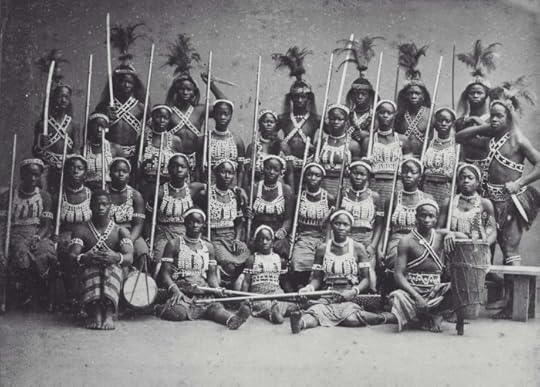
Well, George MacDonald Fraser has answered your prayers with the third entry in the Flashman series. This book covers a lot of territory, with the protagonist zipping all over three continents over the course of just over 350 pages, but the bulk of the story centers around Flashman’s (unwilling) participation in the American slave trade. Flashy gets in trouble with the law back home, in his usual sordid fashion, and ends up being shipped out on a slave ship. The first part of the book deals with how the slavers acquire their human “cargo.” The slave ship, captained by the insane John Charity (accompanied by his equally delusional wife), sets sail for Dahomey, an African nation led by a tyrant named Ghezo. One of my favorite things about the Flashman books is that they insert some fascinating, solid history in between the adventure and the laughs, and this is a prime example. The slaver nation of Dahomey (along with Ghezo) was very real, as was their elite fighting force of Amazons, called “Our Mothers” by the Damoney tribesmen:

img: Dahomey Amazons

I thought this part of the story was really interesting, as I knew very little about this particular chunk of history (in the U.S., we learn a great deal about slavery within our borders, but the nuts and bolts of how the demand was supplied are covered in much less detail). Chaos ensues, as you might expect, and eventually Flashman is off to the good ol’ USA for the first time in his illustrious career. There he manages to get himself into all sorts of bizarre situations involving a brothel, a meeting with Abraham Lincoln, a trip up the Mississippi working for the Underground Railroad (like a demented Huck Finn), a brief career as a plantation manager, and even a wild incident that he claims was the inspiration for Uncle Tom's Cabin.

If you’ve read any of the previous installations in this series, you know political correctness is pretty much out the window (which I’d argue fits with the period, but FYI). This book is no exception. But I thought this was an absolutely ripping good adventure story from start to finish, sprinkled with Fraser’s usual comic genius. The plot moves Flashman all over the place pretty quickly, and the story can feel a little schizophrenic at times which had me toying with the idea of knocking off half a star. But at the end of the day, this was a page turner I simply couldn’t put down. The first Flashman book probably remains my personal favorite, but this was a close second. 5 stars, highly recommended!
Profile Image for Ensiform.
1,509 reviews148 followers
June 11, 2017
Accused (falsely, amazingly enough) of cheating in a friendly game of cards, Flashy injures the accuser in a rage. His reputation damaged, Flash joins a ship’s crew until the scandal cools down – only to realize to his horror (his own neck being on the line, of course) that it’s a slave ship. Here begin Flashy’s adventures on the high seas and America, where at various times he is dragooned and bluffs his way into nearly every role concerning the slave trade: buyer, trader, seller, driver on a plantation, underground railroad smuggler, anti-slavery double agent, almost even a slave himself at one point.

It’s all tremendous stuff, full of the usual (on Fraser’s part) erudition and wit and (on Flashy’s part) lechery, as well as, of course, the historical tweaking: Flashman meets a young Disraeli, a young Lincoln, and even serves as the inspiration for Harriet Beecher Stowe’s famous book. Superb historical parody, historical fiction, and pure entertainment all in one. Oh, a final thought: Flashy’s definitely gotten a lot braver since the first book. Scared or not, it takes guts to pull a gun on a killer, or even keep one’s wits enough to play-act in the face of danger. That’s most likely a good thing, of course; as a reader, one can take only so much helpless, quivering terror from the narrator.

[Read twice]
Profile Image for Adrian Deans.
Author 8 books49 followers
October 14, 2020
I've read all the Flashman books, several times, and regard the series as an absolute masterpiece. Mind you, the confessions of the arch-cad and womanising scoundrel can be challenging, and this episode would have been particularly confronting for some, even when published back in 1971.

If you regard the book as a study in the evils and attitudes attending slavery back in the 1840s, it's a work of genius, but if you bring modern C21 sensibilities to the novel, you will be shocked and maybe disgusted. Especially at Flashman's own sneering attitude to the individuals (slaves and others) he encounters.

I would suggest that this book could not possibly be published in 2020, which is entirely understandable given modern views, and yet is also a problem. Historical fiction ought not flinch from portraying people as they truly were in their own time. If that means reading a character who despises black people and never tires of using the N word, so be it. But that's the way people were in the Southern States in the 1840s - do we truly want to read sanitised versions of history based on the presentist mores of modern day ethicists? Not me.

It was an uncomfortable book but a book which teaches a lot of history. It's also funny and very, very gripping.
Profile Image for Hudson.
181 reviews46 followers
July 23, 2015
Who is Flashman? He is:

a boor
a coward
a liar
a cheat
a womanizer
a woman abuser
a bully

You get the idea..... but Flashy has a habit of stepping in shit and somehow coming up like a rose.

This book has him fleeing scandal in Europe aboard a slave ship bound for Africa and then America. As you can imagine, a series of misadventure ensues and has him doing Flashman type things on plantations and steamboats circa the 1840's.

These books are extremely politically incorrect to say the least, they probably wouldn't be published now. The word "n***** is used liberally throughout the book (as it was in prior books to describe natives over in India.) Flashman is more of a bigot than a racist though, he despises everyone below his social standing. And the French too, he hates the "frogs".

Fraser is laugh out loud funny and I love how he incorporates real people in to his fiction. (For example, Abraham Lincoln in this book.)

Recommended for fans of historical fiction with a sense of humor.
Profile Image for Nancy.
415 reviews91 followers
December 13, 2020
I don't care that Flashman is a bounder, a cad and a coward; indeed I love him for those unabashed qualities. I read him for the wit and the absurdity, but this book was about the slave trade and there is very little to amuse. Fraser doesn't try and to his credit I think this is a successful exposition of the situation and an examination of the attitudes that made slavery palatable to some - very effective, in fact. But while this was as inventive as the earlier books, I missed the fun.
Profile Image for Olethros.
2,724 reviews532 followers
July 1, 2014
-Repaso humorístico de realidades históricas incómodas pero ciertas.-

Género. Novela (y a su malévola manera, casi, sólo casi, Novela Histórica).

Lo que nos cuenta. La carrera política de nuestro truhán favorito termina antes de empezar cuando le hacen pasar por tramposo durante una partida de cartas totalmente casual e intrascendente pero en la que juegan personas importantes y en la que reacciona a la acusación de forma casi homicida. Harry es embarcado inmediatamente para que abandone Inglaterra pero se enrola sin saberlo en un barco destinado a actividades esclavistas, que en ese momento de mediados del siglo XIX no gozan de cobertura legal como antes. Más que probablemente el cuarto en la línea de tiempo de la vida de nuestro embaucador favorito pero quinto libro de la serie de HarryFlashman.

¿Quiere saber más de este libro, sin spoilers? Visite:

http://librosdeolethros.blogspot.com/...
Profile Image for WJEP.
321 reviews21 followers
October 29, 2021
In this volume, dastardly Harry Flashman fornicates his way across the Atlantic and up the Mississippi.
"I doubt if there’s a man living who can move faster with his pants round his ankles than I can"
Flashman's misdoings are governed by The Yellow Rule:
"I’ll never do harm to anyone if there’s a chance he may harm me in return."
This book is fun and educational. I learned much about the the slave trade in the 1840s and the principles of immoral philosophy.
Profile Image for V..
Author 22 books181 followers
October 21, 2012
Fraser really revels in his un-PC approach to the telling of these stories but this one is particularly hard on a sensitive 21st century soul like myself.

While he has created a reasonable context for Flashman, both a realistic portrayal of the times and a particularly selfish hero, just seeing nigger, coon and relentless references to black people looking like monkeys used so freely and without judgement is hard to take at times, especially the callous way slaves are dealt with at sea. And yet it feels very well researched and I have no doubt as to its authenticity.

I would say that the blacks get short shrift in terms of screen time, barely having any lines, and pretty much all being female so Flashy can have his way with them. He never even seems to encounter a black man anywhere in two continents.

Fraser does make you look at what happened face-on without softening things up, but his relish as he does it is a little overly lip-smacking at times.

Lincoln is really well portrayed, and his manner of speaking very effective on the page, but not too many other memorable characters in this one. He is clearly a writer of ability, but seems to 'borrow' most of his plots and settings, this one feels like a lot of Conrad was used as a primer for the African stuff, and various American novels for the New Orleans and underground railroad stuff.
Profile Image for Tom Meyer.
130 reviews9 followers
February 4, 2010
If you combined Edmund Blackadder's ethics, James Bond's way with the ladies, and Forest Gump's ability to be present at history's great moments -- and dressed him up in a handsome 19th century uniform with dashing facial hair -- you'd have Flashman.

This is by far my favorite of the series thus far. As much fun as Flashy's lechery and treachery are, the scene-stealer in this one is Abraham Lincoln. It's an insightful and not terribly flattering portrayal of the great man that -- were it not for Fraser's ability to regularly pull literary rabbits out of hats like this -- seems too well done for a book this much fun.
Profile Image for Michał Hołda .
436 reviews40 followers
November 18, 2016
Historical fiction of Englishman, soldier, traveler, talented linguist& charming scoundrel who visits africa in journey back home. Though as texas slave dealer he have to find his way back through pre- Civil War ameircan states first. After plot of politicts in England. He finds himself friend of slaves and Abraham Lincoln too, who helps him in court. Unjust,treacherous,cowardice and with greate luck, Harry Flashman expeienced in first afgan War(read first book)always gets back to his wealth and famyly in England.
Profile Image for Rob Thompson.
732 reviews43 followers
June 11, 2022
Flash for Freedom! is a 1971 novel by George MacDonald Fraser. It is the third of the Flashman novels.

As usual with these books, this one covers a lot of diverse historical ground: The 1848 Chartist demonstration, Disraeli, the African slave trade, King Ghezo and his amazon warriors, the underground railroad and Abraham Lincoln himself. Much of the in the United States itself.

After a scandal involving cheating and assault, England becomes too hot for young Flashman and his father-in-law sends him off. Flashman suddenly realizes that he’s on a slave ship captained by a lunatic bound for Africa to take on a cargo of slaves, and he’s horrified. Not so much about slavery but that running slaves is proscribed in 1848 and he’s fearful of the ship being seized by an in­ter­dict­ing navy. They transport a cargo to the Americas but offload it before being captured by the U.S. Navy. Flashman manages to pose as a Royal Navy spy, then escapes before having to give testimony. He flees up the Missis­sip­pi in a variety of guises; re­luc­tant­ly escorting escaped slaves; subsequently becoming a slavedriv­er himself for a while before the slaveowner has Flashman sold into slavery; escaping across a frozen river to be saved from slave­catch­ers by Con­gress­man Abraham Lincoln; before ending up in a New Orleans courtroom.

What I found most interesting about this book was that it got into the international politics of slave trading. It was allowable to own slaves in America, but slave trading itself had been outlawed and was punishable by death. Consequently, when Flashman finds out he's on a slave trading vessel, he's horrified not for moral reasons, but because he's worried about being caught and hanged.

Reader be warned: there is extensive use of the "n" word. But if you can set that to one side, this is a extremely entertaining book.
Profile Image for Ben.
216 reviews8 followers
January 28, 2018
I'm not doing a PhD in postcolonial literature, thank God, but if I was I'd be tempted to put a chapter on The Flashman Papers in my dissertation. And in that chapter, I might argue that they are some of the most withering critiques of colonial attitudes and policies written by a white author in fiction. They appear, on the surface, to be pure escapism, but if you keep your wits about you, you'll find there's much more at work.

These books are often called "un-PC"—fair enough. But I'd make the case that they are far from glorifying or romanticizing the attitudes of the time; instead they have a sneaky way of making you feel guilty by association, of recognizing uncomfortable parallels with the modern world.

This volume particularly hits home for we Americans, as it deals with the slave trade. It's a ripping adventure, like the others, but not quite as easy to enjoy because it rises to a new level of inhumanity, a level that even Flashman can't ignore. The notoriously self-concerned hero is actually taken aback by the institution's barbarity on a few occasions, meaning that any person with a functioning conscience would be positively in pieces.

One of Harry Flashman's few positive qualities is a sharp eye for a hypocrite, and we see the two-faced dealings of British lords who abhor far-off slavery but own local factories where children are worked to death, and the paternalistic American abolitionists who think of themselves as benevolent angels rescuing "simple creatures" from bondage. We're also treated to a portrait of young Abraham Lincoln, one of the few characters in the series perceptive enough to instantly see Flashman for the "rascal" he is.

For some reason, experiencing the violence and hypocrisy of empire through the buoyant, amoral, brutally honest voice of old Flashy is more shocking than if the same events were soberly narrated by a character with modern, liberal sensibilities. Even so, this book can never quite shake off a certain gloom—where the previous two volumes saw Flashman gleefully double-crossing friends and taking credit for others' bravery, this one can't muster quite the same enthusiasm for the job. The world it travels in is too awful, and it's a world Fraser could easily have avoided tackling if he wanted to. I take that as the surest sign he meant us to see as much horror in these stories as we see adventure and romance.
Profile Image for Bill.
1,985 reviews108 followers
June 30, 2021
This is the 3rd book in the Flashman adventure series. I found this book very disturbing. The premise is that Flashman gets involved in a bit of gambling scandal (for once not his fault) and his father-in-law decides to get him out of the country and puts him on a sailing ship. It turns out the ship is a slavery and Flashman finds himself off the coast of Africa taking on a load of slaves and then heading to America. As he tries to return to England, he will be involved with the Underground Railroad, meet Lincoln and find his life at risk many times. That is the basic story.

The Good - hard to find anything edifying in this story. However, considering the current climate in the US, the denial of systemic racism by the right, the mistreatment of Negroes by the police, Republican governors passing anti-voting laws and denying Critical Race teaching in schools, it's probably not a bad book to be read as it describes the slave trade and treatment of slaves in the harshest possible terms. Even though it's fiction, there are interesting factoids provided at the end of the story. His description of the period is excellent (accurate? well, I can't actually verify it as I'm not quite that old), you can see it in your mind very clearly. The appearance of Abe Lincoln made me feel better, one of the positives in the book.

The Bad - Flashman can't be described as an anti-hero is an unabashed coward who will do anything to ensure his survival. He's a racist, an sexual misogynist. The portrait of the slave trade is dark, scary and very disturbing. The language gave me shudders and left me feeling cold. Flashman's attitude to the slaves and women he encounters is negative and he treats them as objects to be used.

As an adventure, Flashman gets into constant life-threatening situations and somehow manages to get out of them, even if it means stabbing his partners in the back. I will continue with this series, hoping the next one isn't quite so dark. (3 stars)
391 reviews18 followers
August 17, 2025
Otro libro más sobre el canallesco,cobarde e impresentable Flashman, que si embargo el escritor te lo describe de una manera que casi te cae simpático. En este libro trata sobre la esclavitud, tanto en un barco esclavista con africanos en las bodegas, como en los Estados Unidos con la guerra sorda entre los partidarios y contrarios a la esclavitud. Por supuesto Flashman va completamente a su egoismo personal, pero como siempre, la cosa se complica tanto que él sale como un héroe de la emancipación. Lo que no me ha gustado es que al final no se puede encarcelar a los "malos"
Profile Image for Jamie Collins.
1,555 reviews307 followers
March 9, 2008
In this installment Flashman works as a crewmember on a slave ship traveling from Europe to Africa and then on to New Orleans, where he ends up working for the underground railroad assisting runaway slaves to escape to the north. Of course, his participation in both these occupations is involuntary and since they both involve personal danger he isn't well pleased with either of them.

This book was very good, perhaps my favorite so far, but it did have me cringing in places. I avoided reading it in public for fear someone would look over my shoulder and be horrified at what was written on the page. It's useless to say that old Flashy is racist and misogynistic; that doesn't even begin to cover it. Maybe you could just say he's a particularly unenlightened 19th century character.

By the third book you'd think it would have been pounded into my skull that Flashman is Not a Nice Person. Usually in fiction the lovable scoundrel eventually does something altruistic, but Flashman is consistently horrible. I'm not surprised when he fails to be moved by the suffering around him, unless it inconveniences him, but I keep expecting him to get sentimental about one of the women he becomes involved with. It still startles me that while he occasionally admits to fond feelings, he never even hesitates to betray or abandon one of them to save his own skin.

My favorite quote from this book (that I'm willing to repeat): "I'm an experienced sailor, which is to say I've heaved my guts over the rail into all the Seven Seas."
Profile Image for Liedzeit Liedzeit.
Author 1 book105 followers
July 15, 2019
Even better than the first. Flashman is accused of cheating in a card game and there is some fighting. He is forced to leave the country and his father in law manages to get him on board of a ship. Which happens to be a slaver. Now, Flash has nothing against the idea of having slaves but he dislikes the position. They are getting new slaves in Africa, meeting and fighting Amazons. When finally arriving in the new World they get into trouble. Slaving is still legal but not the trade. Luckily he takes over the identity of an Anti-slaver who was on board to collect evidence and who has deceased. For some reason thinking Flash was one of the good guys. Flash does not want to appear in court and flees. He finds himself forced to rescue a slave on the run, something he dislikes, and he really despises the guy. Later on, he is involved with a black girl on the run, something he likes much better. He meets Lincoln when he was still a young senator and tells him that you can fool some people all the time. Etc. The meeting is extremely funny. Lincoln will later appear again and come to the rescue.
Excellent stuff.
This entire review has been hidden because of spoilers.
Profile Image for Lauren.
65 reviews1 follower
February 16, 2017
My father BEGGED his then young daughter (me) to read these books (I guess to have someone to discuss and laugh about them with) and having read one I was hooked. Flashman and I have travelled the world together and he was an excellent and bawdy companion. I was so taken with these books that I even wrote the author when he was still alive AND he wrote me back (now...if I can just find the blasted letter I've treasured for years). I love history which was why it was easy for my father to get me to read them but its Flashman's wicked humor (and any PC version was happily left to other writers) that really committed me to these books. I in turn wanted so badly to hear the stories of Flashman during the Civil War but unfortunately GMF was only able to get one done before he left this world. I will always wonder about my missed opportunities of hearing Flashman with the likes of Sherman, Grant, and so many more. (Well, at least in this book we got Lincoln and Custer in Redskins). Maybe he's still writing in heaven.
Profile Image for Marko.
Author 13 books18 followers
June 20, 2014
The third Flashman novel is relatively dark in comparison to the two that came before it. The novel's plot revolves around Flashman trying to avoid getting in personal danger, spiced with false identities and surprise twists and turns along the way - basic Flashman, you could say. The darkness is largely due to the subject matter: slavery and slave trade. Flashman is tricked into becoming part of a slave trade ship's crew and while he does not mind the promise of good pay, he is afraid of being caught and the repercussions of having taken part in illegal activities. Along the way, we see the dark side of slavery (is there any other?) in its many forms.

Flash for Freedom is a fine yarn of historical fiction about the scoundrel that is Flashman - it is not as light in mood as the first two parts, but still very enjoyable with great writing and wit.
Profile Image for Laura.
7,126 reviews605 followers
June 13, 2015
From BBC Radio 4 Extra:
It's 1848 and the philandering cad Sir Harry Flashman becomes embroiled in slavery.

Now a reluctant secret agent, Sir Harry Flashman finds himself fleeing for his life.

Stars Joss Ackland and Rhys Meredith.
Profile Image for Malum.
2,834 reviews169 followers
August 31, 2022
Professional scumbag Flashman gets caught up in all sides of the slave trade. As funny as Flashman is, insane Captain Spring steals the show whenever he is on the page.
Profile Image for Illiterate.
2,757 reviews55 followers
August 15, 2022
Why do we like Flashman? His honesty contrasts with the insincere performances that often pass as moral.
19 reviews2 followers
August 1, 2018
"FLASH FOR FREEDOM!" (1971) Book Review

In my review of "FLASHMAN IN THE GREAT GAME" (1975) , I had stated that there are at least six novels from George MacDonald Fraser’s series about the adult adventures of Harry Flashman, the cowardly bully from "Tom Brown’s School Days", that I consider among the best that the author has written. One of these six novels happens to be "FLASH FOR FREEDOM!".

Published in 1971, the novel featured Harry Flashman’s experiences with the Atlantic trade of African slaves and the American slave system in the antebellum South. The novel took that great English symbol of cowardice, lechery and bigotry from the coast of Dahomey in West Africa, to the Caribbean, Washington D.C., New Orleans, the Mississippi River Valley, the Ohio River Valley and finally back to New Orleans.

"FLASH FOR FREEDOM!" began with Flashman’s arrival from the European continent, where a series of revolutions had appeared during the early spring of 1848 (see ”ROYAL FLASH”). Fearful of a class uprising that seemed to be brewing within a British radical group called the Chartists , Flashy’s father-in-law, John Morrison, arranged for Flashman to meet political figures like Benjamin Disraeli and Lord George Bentinck at a country house party in order to seek help in jump starting his own political career. But an encounter with an old nemesis from ”FLASHMAN” (1969) framed Flashman with card cheating . . . and the surprisingly innocent Flashy assaulted him. Morrison has Flashman shipped out of the country to ride out the scandal . . . on a slave ship bound for the western coast of Africa. Through deceit and genuine good luck, Flashman managed to survive his traumatic adventures.

I was not kidding, when I stated that I considered ”FLASH FOR FREEDOM” to be one of the best from the FLASHMAN series. Through Flashman’s jaundiced eyes, Fraser revealed a richly detailed account of the African slave trade during the mid 19th century. In fact, Fraser’s account of the trade is one of the most detailed I have ever read in any fictional story – from the Balliol College crew’s preparation of the slave deck, to the crew’s expedition to Dahomey and King Gezo’s court; from the Middle Passage across the Atlantic Ocean to the slave marts of Honduras and Cuba; and finally the Balliol College’s encounter with a U.S. Navy frigate in the Gulf of Mexico. I have to admit that Fraser’s writing was supreme in the novel’s first half.

Once Flashman reached the United States, the story became unevenly paced. From the moment Captain Fairbrother sent Flashman to Washington D.C. to the moment when the Englishman boarded the Sultana Queen with George Randolph and black Underground Railroad agents posing as slaves, the story raced at a fast pace. Perhaps too fast for my tastes. The narrative managed to slow down to a leisurely pace in order to describe Flashman’s trip up the Mississippi River aboard the Sultana Queen, where he compared the crass "noveau riche" planters of the Mississippi Delta to the older planter societies of Virginia, Maryland and the Carolinas. But upon his arrival at Greystokes, the Mandevilles’ plantation; the story’s pace quickened again. There, Flashman became an overseer and engaged in an affair with the mistress, Annette Mandeville. And for the second time, it slowed down when his boss, Peter Mandeville caught Flashman in bed with the missus. This meant that Fraser never bothered to give readers a detailed account of life on a Mississippi cotton plantation. Instead, he focused upon Flashman’s affair with Annette.

A similar problem occurred when the fugitive Flashman found himself at a Memphis slave mart with a fellow fugitive named Cassiopeia, who offered herself at a sale in an effort to fund their steamboat journey up the Mississippi River. Through Flashman’s eyes, Fraser focused on the entertaining and colorful auctioneer, the auction’s location and the male attendants’ reaction to Cassy’s attempts to raise her price (via a strip tease, apparently). Not once did Fraser give the readers a glimpse – however brief – into the other slaves’ reaction to being sold like stock on parade. Granted, Flashman is not the type who would care about their feelings. But being an observant man, surely he would have noticed the reaction of those slaves who were sold before Cassy? Like I had said, I had found this particular aspect of the sequence slightly disappointing.

I also found myself surprised by Fraser’s description of the Underground Railroad. For a writer who usually went through a great deal to incorporate historical accuracy into his novels as much as possible, he certainly failed to do so in regard to the abolitionist organization. The Underground Railroad had never been as organized as Fraser described it in the novel. Most of the agents (black and white) lived above the Mason-Dixon line. And they simply assisted those slaves that managed to reach the Free States with food, clothing and temporary shelter. The Underground Railroad was never dominated by white agents that escorted runaways out of the South. Granted, personalities like Harriet Tubman, John Fairfield and John Brown may have engaged in such activities, but they were rare in numbers and usually operated in the Border or Upper South. Regardless of whether they were successful or not, the runaway slaves bore most or all of the responsibilities for their bids for freedom.

And I never understood how Captain John Charity Spring, master of the slave ship S.S. Balliol College, managed to avoid being convicted of slave smuggling in the end. Granted, the slaves he had picked up in Honduras and Cuba were all American-born . . . save for one. There was also the Dahomey slave, Lady Caroline Lamb. Captain Fairbrother of the U.S. Navy had certainly met her. I never understood how the Federal judge managed to overlook her presence aboard the Balliol College. Flashman claimed that she had not been shackled. And because of this particular testimony, she was not deemed a non-American slave aboard Spring’s ship. Frankly, I found this a bit too thin . . . but what can one say?

One last problem I had with ”FLASH FOR FREEDOM” centered around Fraser’s portrayals of non-white characters. Mind you, he had provided strong portrayals of West African characters in the novel’s first half. However, King Gezo was a historical figure, Lady Caroline Lamb was a passive bed mate for Flashy, and not one of the Dahomey Amazons had a name – not even the leader who had taken a fancy to Flashman. With the exception of two, the African-Americans featured in the novel’s second half ended up being mere background characters. Even worse, the only two major slave characters of African descent were light-skinned. George Randolph was one-quarter black and Cassy was one-eighth black. Both were light enough to pass for white, bar a few physical characteristics that hinted their African ancestry. And once again, I stumbled across another disappointment. Granted, Fraser probably needed Cassy light enough to pass for white during her and Flashman’s flight up the Mississippi River Valley. But why Fraser thought it was necessary to portray Randolph as light-skinned? What exactly was the author trying to hint? That only light-skinned African-Americans were intelligent and strong-willed enough to be interesting characters?

But despite my misgivings about ”FLASH FOR FREEDOM”, I still consider it to be one of Fraser’s better works. First of all, I thought it took a great deal of guts on his part to write a serio-comic story that featured African slavery or race in the 19th century American South as its main theme. The only other works of art that I can recall that dared to even touch upon the subject seemed to be an episode of ”BEWITCHED” called (5.02) "Samantha Goes South For A Spell" in which Samantha Stevens ends up trapped in 1868 New Orleans, the 1971 movie ”SKIN GAME” and its 1974 remake, ”SIDEKICKS”. And despite the novel’s grim subject matter, Fraser provided some very funny moments:

*Flashman’s attempt to seduce Fanny Locke (soon to be Duberly) at the political house party at Cleeve House

*A cabin boy’s offer to sexually service Flashman

*One of the Dahomey Amazons’ interest in Flashman

*Abraham Lincoln sniffs out Flashman as a scoundrel

*Captain Spring’s trial in New Orleans

*Flashman’s reaction to John Morrison’s death


But there are two humorous scenes that truly stood out for me. One involved Flashman’s description of Captain Spring and his wife:

”At any rate, he lost no opportunity of airing his Latinity to Comber and me, usually at tea in his cabin, with the placid Mrs. Spring sitting by, nodding. Sullivan was right, of course; they were both mad. You had only to see them at the divine service which Spring insisted on holding on Sundays, with the whole ship’s company drawn up, and Mrs. Spring pumping away at her German accordion while we sang ‘Hark! the wild billow’, and afterwards Spring would blast up prayers to the Almighty demanding his blessing on our voyage, and guidance in the tasks which our hands should find to do, world without end, amen. I don’t know what Wilberforce would have made of that, or my old friend John Brown, but the ship’s company took it straight-faced – mind you, they knew better than to do anything else.”

Another scene that stood out was when Cassy, the light-skinned slave with whom he had fled the Mississippi River Valley aboard a steamboat, says good-bye to Flashman in Ohio before departing for Canada:

”’There,’ says Mrs. Payne. ‘I think you may kiss your deliverer’s hand, child.’

I wouldn’t have been surprised if Cassy had burst out laughing, or in a fit of raage, but she did something that horrified Mrs. Payne more than either could have done. She bent down and gave me a long, fierce kiss on the mouth, while her chaperone squawked and squeaked, and eventually bustled her away.

‘Such liberties!’ cries she. ‘These simple creatures! My child, this will never-‘

‘Good-bye,’ says Cassy, and that was the last I ever saw of her – or of the two thousand dollars we had had between us.”


”FLASH FOR FREEDOM” had its share of virtues. But what really stood out in the novel was its collection of some of the most interesting fictional characters created by Fraser. Yes, the novel had its share of historical figures like Benjamin Disraeli, King Gezo and Abraham Lincoln. In one passage, Fraser continued to tear down the prevailing view of the future 16th president as some modest, gentle giant who found himself caught up in national politics. Fraser’s portrayal of Lincoln revealed a tough and intimidating man who managed to scare off a pursuing slave catcher named Buck Robinson. Fraser's Lincoln also proved to be a shrewd and manipulative personality, who immediately recognized Flashman as a scoundrel, and whom he managed to blackmail Flashman into returning to New Orleans for John Charity Spring’s slave smuggling trial.

But the fictional characters proved to be the novel’s finest assets. Fraser introduced his readers to characters like the imbecilic and pathetic Looney; the Dahomey Amazon that took in interest in Flashy; the intense and enthusiastic Underground Railroad agent Mr. Crixus; the conceited and self-involved fugitive slave George Randolph; the ever suspicious slave trader Peter Omohundro; the pathetic Mr. Mandeville and his cold and controlling wife Annette, and the brutish slave catcher Buck Robinson. But two characters stood above the rest. They were the beautiful, yet ruthless and determined fugitive slave, Casseopeia (Cassy); and the psychotic captain of the S.S. Balliol College, Captain John Charity Spring. In fact, I would say they were among the best of Fraser’s creations.

I might as well add that the novel was not perfect. Its description of the Underground Railroad was historically incorrect. Most of the African-American characters were poorly conceived, with the exception of two that happened to be light-skinned. And the novel’s second half seemed to be marred by uneven pacing. Fortunately, the virtues outweighed the flaws. Fraser did an excellent job of creating semi-humorous story from the grim topic of slavery. The story had its share of drama and action. It provided a detailed account of the Atlantic slave trade during the mid 19th century. And the novel also featured some of the most fascinating fictional characters in the entire FLASHMAN series. In the end, I believe it is one of the best novels written by George MacDonald Fraser.
Profile Image for Mike Futcher.
Author 2 books40 followers
May 11, 2021
To think that everything that happens in Flash for Freedom!, the third of the Flashman novels, arises out of a game of pontoon (with Benjamin Disraeli, no less) is testament to the writing abilities of author George MacDonald Fraser. The plotting is spectacular, and it is a wonder that ol' Flashy even gets into these messes, let alone gets out of them. He always seems like he's done for, but once again the jammy sod gets through his adventures essentially none the worse for wear, and usually having sampled the finest of the local women.

In some ways, Flash for Freedom! compares unfavourably to its two predecessors. For one, it has less laughs. To be sure, Flash is as shameless as ever (particularly with Cassy on page 275) but he spends much of the book in thrall to one force or another, whether under the watchful eye of a terrifying slave-ship captain, an American naval officer, Abraham Lincoln (yes, that's right), or various other players. Being the coward he is, he often errs on the side of caution and tries not to put his head above the parapet any more than he has to. This means he doesn't have the freedom to abuse his gift for lechery as much as he could in Flashman (where he romps through India and Afghanistan) and Royal Flash (where he was impersonating a prince, with all the power that commands). He also operates under a series of pseudonyms for the most part, so doesn't have to worry much about the damage his actions might do to the reputation of grand old Harry Flashman, patriot and war hero. The most amusing thing about the first Flashman book was how, no matter how shameless and cowardly he was, he always emerged to be (wrongly) thought of as a hero and upstanding gentleman. But by the end of Flash for Freedom!, no one involved is any the wiser as to who Flash really is. So yes, the laughs are rarer in this book, and this is in part because of Fraser's plotting. Whilst the plotting is ingenious, it does mean most of the time is spent getting Flashy into various scrapes and then out of them, rather than making the reader laugh.

But whilst it is not quite as uproariously funny as its predecessors, it is in some ways better. However, whether you are likely to think so depends solely on the reasons you have for reading the Flashman books. If you read them solely for laughs, Flash for Freedom! probably shouldn't be near the top of your list (though, as I have intimated, it does have its moments). But the Flashman series has always been more than just a comedic romp. The books are also cracking adventures, well-researched historical fiction and possessing of fully-realised characters. In these three regards, Flash for Freedom! represents the series well. The adventure is a strong one, taking him from England to the slave coast of Africa and then across the sea to the Caribbean then on to the USA, where he flits about the southern states. Both the fictional characters (Cassy was a treat) and the real-life historical figures (Abe Lincoln is awesome) are well-rendered.

But the greatest strength of Flash for Freedom! is its historical authenticity. Fraser has done his homework on the slave trade of the 1800s and there were things in this book which I hadn't known previously, even though I am a former history student. Slavery was more than just the common image of black people picking cotton in a field, or even about the horrors and indignities they suffered on the slave-ships and the plantations. Fraser does evoke this horror and humiliation of the human spirit (particularly through Cassy), but he also addresses the unseen side of the slave trade. He notes the corruption by which British and American businessmen and politicians would profit from this illegal trade (Flashy's father-in-law is a respectable businessman with one of his fingers in this particular rotten pie) and also the cancerous effect it had on the society as a whole (the trial at the end of the book becomes a farce as witnesses are intimidated, the judge is bought and the truth is shamelessly fudged). As one character remarks to Flashman on page 303: "Oh, it's a fine, dirty business... the slime and corruption doesn't end on the slave deck, I can tell you." Fraser also confronts the fact - an uncomfortable fact, for some people - that the slave trade could not have existed and could not have thrived without the complicity of black tribes in Africa (see page 71) and raises, on the same page, a surprisingly socialist point about working conditions among whites in British industry at the time. This is real history: uncomfortable truths abound.

Some readers may find it hard to reconcile the above sentiments with the fact that Flashman indulges in all the depravities. He uses the 'n-word' with abandon and rapes some of the female slaves (at one point he lets it be known that slavers wanted their female slaves to be pregnant by a white man as 'mulatto' children fetched a higher price. Jesus Christ.) But he is a product of his time and of his circumstances; that does not make it right, and you may feel even guiltier about some of the funnier parts of the novel than you usually are, but if you're looking to the Flashman books for morality, then you're really in the wrong place. In my opinion, the casual, matter-of-fact approach by many of the characters (including Flashman) to the brutalities of slavery is more important than any sanitised politically-correct hand-wringing, as it shows just how easily people can be sucked into depravities and rationalise them if it is seen to be 'normal', as it was at the time.

It also educates readers - and I'd wager, without judgement, that there are many avid readers of the Flashman series who'd never dream of picking up a history book - on the realities and complexities of the slave trade. And, make no mistake, the slave trade is still going on today. It might not be the same as in the mid-1800s, but tens of millions are still forced into slavery in the 21st century, and today's anti-slavery crusaders are much less prominent than the likes of Abraham Lincoln. That might seem a rather serious note on which to end a review of what is essentially an adventure-comedy romp, but the Flashman series has always been much more than that, and Flash for Freedom! illustrates it perfectly.
Profile Image for Kelly.
490 reviews
July 28, 2017
In the third novel in the Flashman Papers series, Harry Flashman again battles for self-preservation as he journeys on a slaving ship to Africa and then arrives in the United States where he finds himself working on first one then the other side of the slavery/abolition debate. Politically incorrect, yet ever so roguishly entertaining.
Profile Image for Sam.
1 review1 follower
May 11, 2023
Flashman at his finest.
Profile Image for Stephen Alexander.
Author 4 books7 followers
August 21, 2020
Even better than the last two. How does he keep surviving...?

Great story... Felt that the pace either lacked or went too fast in places. But, the American west setting made up for all of that. Flashman keeps getting better and better...Read it in 4 days.
Displaying 1 - 30 of 244 reviews

Can't find what you're looking for?

Get help and learn more about the design.