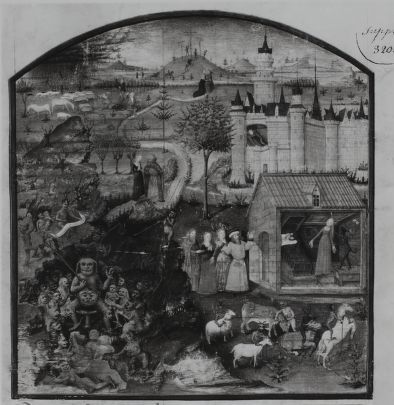
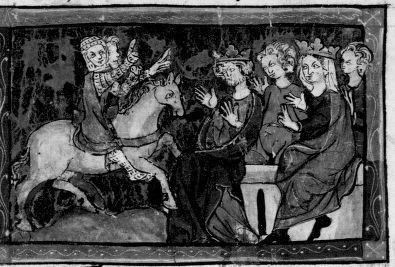
Né d'une femme abusée par le diable, Merlin est aussi fou que sage. Ayant le privilège de connaître le passé et l'avenir, l'auguste prophète du Graal et de la grandeur arthurienne conseille et protège les rois qu'il a pris sous sa protection. Mais sa nature sauvage le pousse parfois à fuir la société des hommes pour gagner les solitudes forestières du Northumberland, ses talents de sorcier lui permettent de prévoir et de parer tous les mauvais coups et il sait à l'occasion se montrer facétieUX3 sournois, et vaniteux. Saint et démon tour à tour, l'enchanteur est au cœur de ce roman du XIIIe siècle qui raconte l'histoire fantastique du royaume de Logres depuis la naissance du prophète jusqu'à l'avènement d'Arthur.
Robert de Boron (also spelled in the manuscripts "Bouron", "Beron") was a French poet of the late 12th and early 13th centuries who is most notable as the author of the poems Joseph d'Arimathe and Merlin. Though little is known about him outside of the poems he allegedly wrote, his works and their subsequent prose redactions impacted later incarnations of the Arthurian legend and its prose cycles, particularly due to his Christian backstory for the Holy Grail, originally an element of Chretien de Troyes's famously-unfinished Perceval.
The literature of the Middle Ages isn’t the one I prefer, and I’m not at all an expert in this genre. I took this book, for a challenge for the Historical Fictionistas group. There’s a big preface in this text in French, which I haven’t read. I prefer to make my own idea first. Then, sometimes, I read the prefaces if I think I need additional information. So, I dived into Merlin, head first, which I don’t even do at the swimming pool: I'm too scared! Well ... by reading the book, I was scared!
The first chapters tell why Merlin was conceived, so what happened before his conception, then his birth and the first years of his life. I was immersed in this medieval world, which always terrified me, when the door of the house opened suddenly: my son came back for the weekend. I jumped, I thought I had a heart attack! This is to tell you how poignant, emotional, is the beginning of this book. It must be said that the devil insinuates itself everywhere in the man ... and in the woman, especially in one of her whom it fertilizes, which will give birth to Merlin.
The life of women is the submission to men imposed by the law of men of the Middle Ages: a young free woman who sleeps with a free man is put to death. A woman seduced by her priest (which didn’t seem to be an isolated fact, given the number of times that Robert de Boron mentions it!), this woman, therefore, is also put to death. And the men? Oh, no, they aren’t killed for sleeping, poor of them, it's not their fault they’re seduced by these brainless female creatures always inclined to open their hearts to the devil!
So, let’s return to Merlin. He’s the son of the devil and of a girl who was a virgin until the devil visited her against her will... By the behaviour conduct of Merlin’s mother, the devil cannot completely own the soul of this child, who will lean all his life on the good side. Roughly speaking, I only knew about Merlin his long white beard and his cape with a pointed hat. I discovered in this story a young, mischievous Merlin, who sometimes laughs like a devil, and who doesn’t use the straightest (rightest?) ways to achieve his goals! In short, apart from his fantastic (magical?) nature, I found Merlin more human than a human.
There’s a lot going on in this story, really a lot of events! If you like intrigues, dragons, knights, battles, wonders and mysteries, you’ll be served. All these events are told in a very, very simple way: no adjectives, no feelings described, very few vocabularies. On the other hand, more than half of the text are dialogues, and there, Robert de Boron is very strong. And some monologues or essays on the divine, the diabolical, the human nature are very finely studied.
And ... if you read it until the end, you'll be surprised with what can happen to a great character like Merlin when he falls stupidly in love! Last victory is for a woman, fair enough! 😊 Some passages on the wars between kings, dukes or barons, castle assaults, men's honor that can only be repaired in revenge and blood bored me. Just a matter of personal taste. But in the end, I rate this Merlin by Robert de Boron five stars, because it’s good to be remembered from time to time that anger and revenge are the doors we open to the devil towards our heart.
I was simultaneously perusing The Mabinogion and came across a beautiful passage I had underlined on a previous read, as Caledfwlch (Excalibur in Welsh) is described vividly in The Dream of Rhonabwy:
"Then they heard Cadwr Earl of Cornwall being summoned, and saw him rise with Arthur's sword in his hand, with a design of two chimeras on the golden hilt; when the sword was unsheathed what was seen from the mouths of the two chimeras was like two flames of fire, so dreadful that it was not easy for anyone to look."
I read this book longer ago than I care to remember, and liked it, but I need to re-read it before giving it a detailed review as such.
It was, I think, my first serious exposure to un-modernized or regularized, Middle English prose, from about 1450, with all its varying spellings and slightly unfamiliar grammar, or at least the first I could make sense of without constant reference to editorial glosses. (Unlike an incomplete verse translation by Henry Lovelich, also c. 1450, or the other, shorter, verse translation, into Kentish dialect, "Arthour and Merlin," from the second half of the thirteenth century.)
However, I originally posted a rather long "review" to clear up some confusion on the Goodreads page, because the book description was then in French. The situation has now been corrected, but anyone expecting to get a French text edition from this description was going to be surprised, probably not pleasantly. The description was, word for word, that of a French edition of the the prose redaction of Robert de Boron's verse "Merlin" (itself c. 1200), found on Amazon France -- see https://www.amazon.fr/Merlin-Roman-du... Goodreads has now corrected this language problem (thank you!) -- although the new write-up, apparently based on that of the publisher of another, more modern edition, is a little bit confused itself. I've kept the information I provided, in modified form, and may actually get around to saying something about the literary qualities of the story in a future edit.
I have no idea whether or not that edition of "Merlin" is the French original of this Middle English rendering, that is, the "Vulgate Merlin" (see below for that title), or is another, related work -- there were several medieval expansions or retellings of the Robert de Boron verse account in prose, often with additional material. (In fact we only have about 500 lines of the actual de Boron poem -- it survives complete, more or less interpolated, only in prose.) I suspect, from the length given by Amazon, that it represents only the portion plausibly derived from the lost de Boron poem, and not one of the Old French continuations.
So the English book in question is a fifteenth-century prose translation of a thirteenth-century prose version of the Old French "Merlin" a verse romance attributed to one Robert de Boron (c. 1200). It contains considerable additional material not by de Boron at all. (Sorry if this all sounds confusing -- I'm trying to be concise about a situation which really is confusing.)
The considerable additional material, that added to the original Robert de Boron story (by an unknown hand, or hands), fills the bulk of the book, and readers may bog down after de Boron's relatively terse narrative is finished. These expansions were intended to connect it to the great "Lancelot-Grail," or "Vulgate" (commonly accepted), series of French prose romances, written about 1215-1235, that is, shortly after de Boron's time. It fills in the earlier history of Merlin and Uther Pendragon, and Arthur's wars to establish his authority, and the very early life of Lancelot. In this form, the French text serves as a sort of "prequel" to the main story.
"Merlin, or The Early History of King Arthur: A Prose Romance" is in fact an e-book of a multi-volume nineteenth-century edition for the Early English Texts Society (still publishing), stripped of the glossary, collation with the manuscript, and editorial introductions and appendices. (This latter material is available through archive.org -- the Internet Archive -- but, annoyingly, not the text itself.)
As noted above, there is a modern edition of the Middle English, which can be found on-line at http://d.lib.rochester.edu/teams/publ... -- but I find it a pain to read in their section-by section arrangement, and I find that it works best on my desktop monitor (mileage may vary, of course). There it is free, and the scholarship is certainly more up-to-date.
Finally, this "Merlin" is not the French "Merlin" text on which Malory drew for the early years of Arthur's reign in "Le Morte D'Arthur," but is a sort of relative, and makes an interesting companion to Thomas Malory's more famous version. It includes a lot of material about (obviously) Merlin, and the rise of Uther Pendragon (Arthur's father), which Malory passed over in silence in order to go directly to Arthur's conception and birth. His base text for Books I-IV (in Caxton's edition) is now known as the "Suite du Merlin," and it too is a thirteenth-century adaptation and continuation of de Boron's obviously influential account.
Voilà par où commencer les romans de chevalerie de la table ronde! Merlin est une excellente introduction puisqu'il renvoie aux origines des personnages de la série. Fils d'un diable ayant abusée une femme dont la famille subit les persécutions du malin, il sauve dés sa plus tendre enfance sa mère condamnée par un usage barbare à la mort, du fait que le père soit inconnu. Cette prouesse le rend fameux pour sa sagesse, et il va mettre à profit son origine surnaturelle et sa connaissance de l'avenir pour influer sur le destin des royaumes de Bretagne, mettant ainsi en place la fameuse table ronde. On trouvera donc moins de prouesses dans les faits d'armes que dans les discours et les impostures que Merlin fait subir aux pauvres humains qui essaient vainement de le surpasser en finesse. D'autres histoires plus courtes viennent compléter celle ci, avec toujours Merlin comme héros, où par exemple la fée Viviane enferme le magicien après que ce dernier soit tombé amoureux d'elle et qu'il lui ait imprudemment enseigné son savoir.
Le moyen-âge est tellement problématique. Si on met ça de côté, Merlin m'a donné envie de lire les premiers romans français qui ont nourrit la légende arthurienne : je suis prête dès que possible pour un marathon! J'ai appris beaucoup de choses avec Robert de Boron et je suis même assez surprise. Je ne connaissais absolument pas le personnage de Merlin.
Merlin is an enchanter and wise man in Arthurian legend and romances of the Middle Ages, linked with personages in ancient Celtic mythology (especially with Myrddin in Welsh tradition). He appeared in Arthurian legend as an enigmatic figure, fluctuations and inconsistencies in his character being often dictated by the requirements of a particular narrative or by varying attitudes of suspicious regard toward magic and witchcraft. Thus, treatments of Merlin reflect different stages in the development of Arthurian romance itself.
Geoffrey of Monmouth, in Historia regum Britanniae (1135–38), adapted a story, told by the Welsh antiquary Nennius (flourished c. 800), of a boy, Ambrosius, who had given advice to the legendary British king Vortigern. In Geoffrey’s account Merlin-Ambrosius figured as adviser to Uther Pendragon (King Arthur’s father) and afterward to Arthur himself. In a later work, Vita Merlini, Geoffrey further developed the story of Merlin by adapting a northern legend about a wild man of the woods, gifted with powers of divination.
A translation of Geoffrey of Monmouth’s Historia regum Britanniae, appearance in France, Wace’s Roman de Brut (1155), which introduced Arthurian legend to continental Europe.
Robert de Borron’s verse romance Merlin added a Christian dimension to the character, making him the prophet of the Holy Grail, whose legend had by then been linked with Arthurian legend.