What do you think?
Rate this book


Silent Night, by renowned military historian Stanley Weintraub, magically restores the 1914 Christmas Truce to history. It had been lost in the tide of horror that filled the battlefields of Europe for months and years afterward. Yet in December 1914 the Great War was still young, and the men who suddenly threw down their arms and came together across the front lines to sing carols, exchange gifts and letters, eat and drink and even play friendly games of soccer naively hoped that the war would be short-lived, and that they were fraternizing with future friends.
It began when German soldiers lit candles on small Christmas trees, and British, French, Belgian and German troops serenaded each other on Christmas Eve. Soon they were gathering and burying the dead, in an age-old custom of truces. But as the power of Christmas grew among them, they broke bread, exchanged addresses and letters and expressed deep admiration for one another. When angry superiors ordered them to recommence the shooting, many men aimed harmlessly high overhead.
Sometimes the greatest beauty emerges from deep tragedy. Surely the forgotten Christmas Truce was one of history's most beautiful moments, made all the more beautiful in light of the carnage that followed it. Stanley Weintraub's moving re-creation demonstrates that peace can be more fragile than war, but also that ordinary men can bond with one another despite all efforts of politicians and generals to the contrary.
Paperback
First published January 1, 2001
Last night I had the strangest dream
I ever dreamed before
I dreamed the world had all agreed
To put an end to war
I dreamed I saw a mighty room
The room was filled with men
And the paper they were signing said
They'd never fight again
And when the papers all were signed
And a million copies made
They all joined hands and bowed their heads
And grateful prayers were prayed
And the people in the streets below
Were dancing round and round
And guns and swords and uniforms
Were scattered on the ground
Last night I had the strangest dream
I ever dreamed before
I dreamed the world had all agreed
To put an end to war
Ed McCurdy, 1950

Christmas Day, Flanders, 1914
Where have all the flowers gone?
Long time passing
Where have all the flowers gone?
Long time ago-Pete Seger, 1955
Where have all the soldiers gone?
Long time passing
Where have all the soldiers gone?
Once upon a time there was a tavern
Where we used to raise a glass or two
Remember how we laughed away the hours
And dreamed of all the great things we would do
Those were the days my friend
We thought they'd never end
We'd sing and dance forever and a day
We'd live the life we choose
We'd fight and never lose
For we were young and sure to have our way.
La la la la...
I thought I would do great things. I would become a history professor. I had scholarships to the University of Alabama. If I didn't get drafted and sent to Vietnam.
We didn't think much about it. It hadn't touched us much. Jennifer's brother was shot down, flying a Phantom F-4. We didn't know why she went screaming down the halls when the principal called her out of class till later.
That business about the tavern. I had sneaked some Strawberry Hill out in the country. Didn't smoke. Had a 1963 Olds Rocket 88 with a big back seat. Never got past second base. But it was sweet. Someday. Maybe, if I didn't get shipped home in a box. We did have student deferments.What if they gave a war and nobody came?
Why then the war would come to you!-Bertolt Brecht, 1930
The Christmas Truce, 1914Peace is harder to wage than war.-Stanley Weintraub, A Stillness Heard Round the World, 1985
Stanley Weintraub, Historian, Biographer
Although Weintraub is a historian down to his toes, he has written a moving account of the Christmas Truce of 1914. Weintraub leaves the reader reeling with a series of evolving and ever more powerful emotions as he unveils this riveting history. The truce comes alive through the words of those who were there. The truce lives in the letters and diaries of Englishmen, Scots, Germans.
This is a tale of sadness and hope. The men who recount these strange days in the midst of war are able to recognize the humanity in one another that exists no matter one's language, origin, or government. It is all the more amazing because it occurred almost sua sponte, as the result of the actions of the men in the trenches, of their own volition, something that sent shudders up the ranks of authority to the centers of their governments.
Christmas Eve, 1914
The Garwhal Rifles, a Regiment of Indian troops, noticed a line of lights appearing atop the German trenches across from them. They were the candles on Christmas trees. Earlier one of their number had written home, "It is more than horror, it is the end of the world." Though they did not have Christmas trees, the Indians thought the lights reminiscent of their Diwali, the "Festival of Lights." Strange, but there was a peacefulness about it all. In their Diwali, it was a time of forgiveness, new beginnings, and a time for the exchanging of gifts. For a short time, they would see all this happen.
"Thus, Christmas, the celebration of Love, managed to bring mortal enemies together as friends for a time...I told them we didn't want to shoot on the Second Day of Christmas, either."--from the diary of Kurt Zemisch, 134th Saxons
"I wouldn't have missed that unique and weird Christmas Day for anything. ... I spotted a German officer, some sort of lieutenant I should think, and being a bit of a collector, I intimated to him that I had taken a fancy to some of his buttons. ... I brought out my wire clippers and, with a few deft snips, removed a couple of his buttons and put them in my pocket. I then gave him two of mine in exchange. ... The last I saw was one of my machine gunners, who was a bit of an amateur hairdresser in civil life, cutting the unnaturally long hair of a docile Boche, who was patiently kneeling on the ground whilst the automatic clippers crept up the back of his neck."
Signs appeared above the trenches on both sides of the lines. "Merry Christmas." Carols were sung. Troops poured out of the trenches and met in No Man's Land. They shook hands. Exchanged souvenirs, gifts, newspapers. The rain that had turned everything to mire had stopped. It turned cold and clear. There was a hard freeze. War took a holiday.
Christmas Day, 1914
It continued the next day. Christmas day. In different ways. Some units helped one another bury their dead. In other areas, men continued to mingle freely, exchanging gifts. There were seemingly incredible small world moments, an Englishman recognizing his former German barber who had been called home to serve the Fatherland. Regimental histories recorded soccer matches occurring in No Man's Land.
Footers, English and German, play the game
Boxing Day, The Second Day of Christmas, 1914
The truce remained in full force, though the upper echelons were beginning to rumble.
"Dear Mother, I am writing from the trenches. It is 11 o'clock in the morning. Beside me is a coke fire, opposite me a 'dug-out' (wet) with straw in it. The ground is sloppy in the actual trench, but frozen elsewhere. In my mouth is a pipe presented by the Princess Mary. In the pipe is tobacco. Of course, you say. But wait. In the pipe is German tobacco. Haha, you say, from a prisoner or found in a captured trench. Oh dear, no! From a German soldier. Yes a live German soldier from his own trench. Yesterday the British & Germans met & shook hands in the Ground between the trenches, & exchanged souvenirs, & shook hands. Yes, all day Xmas day, & as I write. Marvellous, isn't it?"-Private Henry Williamson, Age 19, London Rifle Brigade
German soldiers of the 134th Saxon Regiment and British soldiers of the Royal Warwickshire Regiment meet in no man's land, December 26, Boxing Day, 1914
Letters, uncensored at the time, were sent home. The letters were forwarded to newspapers where they were reprinted. The Christmas truce became public news.
Might the "Truce" be the beginning of the end of the war? It might have been. But, as we know, it was not. Strict orders were passed down from the highest command of all powers that any form of fraternization would be strictly disciplined. Any soldier found in possession of material belonging to another power was subject to punishment.
Not all soldiers and officers at the front during the Christmas truce of 1914 approved of it. No one should be surprised that the young Adolph Hitler did not. Hitler, a Corporal, had been awarded the Iron Cross, Second Class by Kaiser Wilhelm personally. In Mein Kampf, Hitler described the occasion as the happiest day in his life. Regarding the "Truce," Hitler said, "Such a thing should not happen in wartime. Have you no German sense of honor left at all?"
By New Year's, 1915, the Christmas truce was effectively over. It would continue until November 11, 1918. The death toll of combatants was four-thousand-six-hundred per day.
August 31, 1970Well, come on generals, let's move fast;
Your big chance has come at last.
Now you can go out and get those reds
'Cause the only good commie is the one that's dead
And you know that peace can only be won
When we've blown 'em all to kingdom come-Country Joe McDonald, 1965
I turned eighteen on August 31, after I graduated from high school. My grandfather told me we had somewhere to go that morning. "Where," I asked. We were having coffee at the kitchen table. He shook his pack of Camel unfiltereds in my direction. His signal he had something to say. I took the cigarette that popped out the end of the pack, pecked an end of it on the placemat to pack the tobacco down and lit it with my Zippo.
"Well, Son, first we're gonna get you a haircut."
"I've been working. All summer. Like you wanted."
"Yes, you have. Stuck it out. All the men say you worked hard."
"So, what's up?" I knew what was up.
"You get your draft card today. Not going down there like a hippie."
It was the only fight we ever had. I got my hair cut. Got my draft card. Was always opposed to the war. My hair grew back and over my collar. I joined the Student Mobilization Committee. There's a yellowing photograph of me on the cover of the college paper on the steps of the old Student Union during a protest. I'm with Vietnam Veterans Against the War. A curious mix, some thought. But I was never against the soldiers.
As to the Class of Seventy, in due time, the war began to touch it. The lonely ones. The outcasts. The guys on the top row at the pep rallies. The ones on the smoking court. The fellows that didn't give a flip about their grades that took the vocational courses because they never planned to go to college. No deferments for them. First to go. Their names are on the wall in D.C. and on the monument downtown in front of the Courthouse.
Me? I was a fortunate son. Even though I was no Senator's son. I did not become a history professor, but a lawyer. I remain a student of history.
When will we ever learn? Probably never. But we can hope.
Why not Five Stars?
It's a beautiful read. One that will haunt the reader, linger in the memory long after the final page is turned. BUT...Weintraub engages in a lengthy chapter, "What if?" This chapter dulls the impact of the narrative that precedes it. It is an exercise in alternative history. What if a peace had been reached as a result of the Christmas Truce? While such exercises can fuel many a speculative conversation, we can hypothesize from now till death do us part. Would a Germany reaching a peace that left it in substantially all of the territory it occupied have prevented the Third Reich? We'll simply never know. The acts of those who were participants in the Christmas Truce should not be diminished by an anticlimactic exercise in speculation.
So....4.5 Stars. Highly recommended.
EXTRA!
For a Magnificent Film about the Christmas Truce, I highly recommend "Joyeux Noel" which my wife and I watch each year.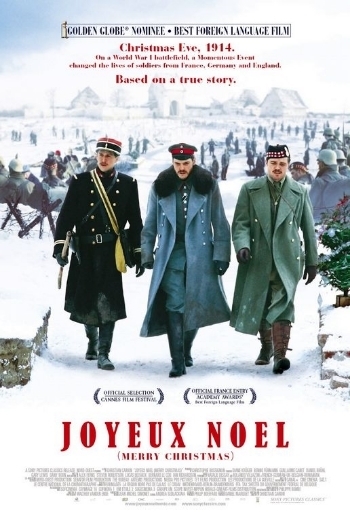
Soundtrack
A Collection of Protest Songs
Last Night I Had the Strangest Dream
I Ain't Marching Anymore
Where Have All the Flowers Gone
Blowing in the Wind
Seven O'Clock News Silent Night
You're the Voice