

What do you think?

Paradise Reclaimed
An idealistic Icelandic farmer journeys to Mormon Utah and back in search of paradise in this captivating novel by Nobel Prize—winner Halldor Laxness.
The quixotic hero of this long-lost classic is Steinar of Hlidar, a generous but very poor man who lives peacefully on a tiny farm in nineteenth-century Iceland with his wife and two adoring young children. But when he impulsively offers his children's beloved pure-white pony to the visiting King of Denmark, he sets in motion a chain of disastrous events that leaves his family in ruins and himself at the other end of the earth, optimistically building a home for them among the devout polygamists in the Promised Land of Utah. By the time the broken family is reunited, Laxness has spun his trademark blend of compassion and comically brutal satire into a moving and spellbinding enchantment, composed equally of elements of fable and folkore and of the most humble and delicate truths.
The quixotic hero of this long-lost classic is Steinar of Hlidar, a generous but very poor man who lives peacefully on a tiny farm in nineteenth-century Iceland with his wife and two adoring young children. But when he impulsively offers his children's beloved pure-white pony to the visiting King of Denmark, he sets in motion a chain of disastrous events that leaves his family in ruins and himself at the other end of the earth, optimistically building a home for them among the devout polygamists in the Promised Land of Utah. By the time the broken family is reunited, Laxness has spun his trademark blend of compassion and comically brutal satire into a moving and spellbinding enchantment, composed equally of elements of fable and folkore and of the most humble and delicate truths.
304 pages, Paperback
First published January 1, 1960
About the author
Halldór Laxness
164 books875 followersBorn Halldór Guðjónsson, he adopted the surname Laxness in honour of Laxnes in Mosfellssveit where he grew up, his family having moved from Reyjavík in 1905. He published his first novel at the age of only 17, the beginning of a long literary career of more than 60 books, including novels, short stories, poetry, and plays. Confirmed a Catholic in 1923, he later moved away from religion and for a long time was sympathetic to Communist politics, which is evident in his novels World Light and Independent People. In 1955 he was awarded the Nobel Prize for Literature.
Ratings & Reviews
Friends & Following
Create a free account to discover what your friends think of this book!
Community Reviews
Displaying 1 - 30 of 91 reviews

Read
June 15, 2011"Am I muddy at all?" asked the Mormon.
Steinar coiled the rope up carefully like the tidy man he was, and laid it on the tethering-block. Then he brushed the Mormon down a little.
"There is little I can say," said Steinar. "Criticizing others will not make me any bigger." (p.48)
This is a very simply told and deceptively slight story. Once upon a time there lived in Iceland a man called Steinar, he gave an uncommonly fine horse to the King of Denmark and then travelled to that distant land to visit it bearing with him a puzzle box as a gift for the monarch. In one way we are not so far from the world of the sagas, certainly this is how Steinar and his wife see things. At the same time this is set in the world of steam ships and sewing machines. The modern world can intrude into that of the sagas.
Along his way Steinar gets caught up with a Mormon missionary and goes to Utah, but in his absence from the family farm there is a woman's tale of abandonment, abuse, injustice, getting caught up with a Mormon missionary, death and rebuilding life in Utah.
Let two things be noted. This is a slyly humorous book, if the woes of Independent People frightened you away from reading Laxness then try this, the efforts of a court to get a girl to explain who the father of her illegitimate child is when the only example of human reproduction that she has ever been taught about is that of the Virgin Mary has to be read to be believed. Second, the mastery of an apparently casual writing style - there are some beautiful transitions when long journeys or periods of time are passed over in the space between a full stop and the next capital letter. The text is parred down, but feels entirely natural. I'm not sure which to wonder the more at, the skill or the confidence of Laxness.
Deceptively slight I said, because Paradise Lost comes before Paradise Reclaimed. The puzzle box with its secret compartments becomes a central motiv. Who is our Adam and what are his qualities if he is a man of stone and not from dust or earth (although then again we have the bricks, and what are bricks but pressed clay) and who our tempter, and how is paradise reclaimed? The drive of the story therefore is ethical, but also social. Gold is the source of all evil. Gold is what the asset striping Agent and the financially speculating Sheriff have access to and dispose of freely at a high cost. Modern finance displaces and destroys the family as well as the proper work of man yet opens up adventure. Is Mormonism in the story a return to primitive virtue or another delusion? Was, as the Lutheran claims, Adam "a dirty shit" (p192), or can naivety be an adequate defence, or is that judgement itself nonsensical - undercut by his adulterous life in the land of the Mormons?
Both Independent People and Paradise Reclaimed are merry-go-round stories. The principle characters returned to their starting point after having been spun round through misery and elation, triumph and disaster. The man's story and the woman's story split and become two opposite points on a circle. As one's lot improves the other's get worse - a see-saw adventure. Each story is a commentary on the other and perhaps points to the sexual inequities in society, or the playground of life as we may think of it.
The end note of independent People is defiance in the face of the powers that be, here it is Homo Faber, not as a distancing from the world and a means of control over nature as in Max Frisch's novel, but as a mode of existence that is co-operative, an immensely powerful drive in the face of an existence that could otherwise be merely tragic.
Steinar coiled the rope up carefully like the tidy man he was, and laid it on the tethering-block. Then he brushed the Mormon down a little.
"There is little I can say," said Steinar. "Criticizing others will not make me any bigger." (p.48)
This is a very simply told and deceptively slight story. Once upon a time there lived in Iceland a man called Steinar, he gave an uncommonly fine horse to the King of Denmark and then travelled to that distant land to visit it bearing with him a puzzle box as a gift for the monarch. In one way we are not so far from the world of the sagas, certainly this is how Steinar and his wife see things. At the same time this is set in the world of steam ships and sewing machines. The modern world can intrude into that of the sagas.
Along his way Steinar gets caught up with a Mormon missionary and goes to Utah, but in his absence from the family farm there is a woman's tale of abandonment, abuse, injustice, getting caught up with a Mormon missionary, death and rebuilding life in Utah.
Let two things be noted. This is a slyly humorous book, if the woes of Independent People frightened you away from reading Laxness then try this, the efforts of a court to get a girl to explain who the father of her illegitimate child is when the only example of human reproduction that she has ever been taught about is that of the Virgin Mary has to be read to be believed. Second, the mastery of an apparently casual writing style - there are some beautiful transitions when long journeys or periods of time are passed over in the space between a full stop and the next capital letter. The text is parred down, but feels entirely natural. I'm not sure which to wonder the more at, the skill or the confidence of Laxness.
Deceptively slight I said, because Paradise Lost comes before Paradise Reclaimed. The puzzle box with its secret compartments becomes a central motiv. Who is our Adam and what are his qualities if he is a man of stone and not from dust or earth (although then again we have the bricks, and what are bricks but pressed clay) and who our tempter, and how is paradise reclaimed? The drive of the story therefore is ethical, but also social. Gold is the source of all evil. Gold is what the asset striping Agent and the financially speculating Sheriff have access to and dispose of freely at a high cost. Modern finance displaces and destroys the family as well as the proper work of man yet opens up adventure. Is Mormonism in the story a return to primitive virtue or another delusion? Was, as the Lutheran claims, Adam "a dirty shit" (p192), or can naivety be an adequate defence, or is that judgement itself nonsensical - undercut by his adulterous life in the land of the Mormons?
Both Independent People and Paradise Reclaimed are merry-go-round stories. The principle characters returned to their starting point after having been spun round through misery and elation, triumph and disaster. The man's story and the woman's story split and become two opposite points on a circle. As one's lot improves the other's get worse - a see-saw adventure. Each story is a commentary on the other and perhaps points to the sexual inequities in society, or the playground of life as we may think of it.
The end note of independent People is defiance in the face of the powers that be, here it is Homo Faber, not as a distancing from the world and a means of control over nature as in Max Frisch's novel, but as a mode of existence that is co-operative, an immensely powerful drive in the face of an existence that could otherwise be merely tragic.

November 16, 2017
Fabulous

Halldór Laxness by Einar Hákonarson, 1984
I have never read anything by Halldór Laxness before, so I have no idea if this relatively late novel is typical of him—but it is, in a word, fabulous. I chose it at random, because I am trying to work through all the Nobel Laureates. I then put off reading it for years, thinking it a duty rather than pleasure. How wrong I was! I get no further in than page 5, and here Laxness is (in the luminous translation by Magnus Magnusson), describing the birth of a white pony:
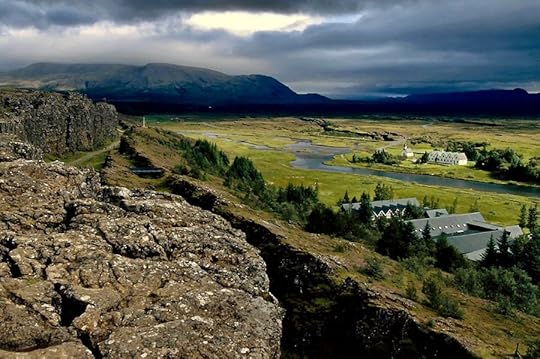
Thingvellir, Iceland
But Steinar does not come straight back home. In Copenhagen, he meets a Mormon bishop,* who convinces him to go to Utah to see Paradise reclaimed on earth, and provides the money for him to do so. The two had met twice before, actually, for the bishop had returned to his native Iceland on a Mormon mission, and Steinar twice rescued him from being beaten up or worse. It appears that there is quite a large settlement of Icelandic Mormons in Spanish Fork, Utah; Laxness visited it twice, and based much of the novel on the kindness he had received there. It was a special privilege to see the old Mormon ways through the perpetually wide-open eyes of Steinar, or Stone P. Stoneford, as he is called in America.
This was before polygamy had been renounced by the main body of the Church, and it gave me a more sympathetic understanding of the practice—not as a matter of acquisition or lust, but as a kind of charity towards women whom society would otherwise have pushed aside. It speaks to a spirit that Steinar holds in his very breath, and that underlies the humanitarian socialism of the author himself. Accepting his Nobel Prize, he spoke of his grandmother and "…the moral principles she instilled in me: never to harm a living creature; throughout my life, to place the poor, the humble, the meek of this world above all others; never to forget those who were slighted or neglected or who had suffered injustice, because it was they who, above all others, deserved our love and respect." In Utah, Steinar supports himself as a bricklayer and carpenter, making a place for himself in the community through sheer competence and kindness.

Spanish Fork, Utah
Those who pursue the path of goodness may be kind to the people in front of their eyes, but they can also be blind to the fortunes of those they leave behind. Steinar leaves his wife and two young children at Hlíðar, awaiting his return then losing hope. This is the most eventful section of the book, especially in terms of the young daughter, who has no idea of relations between women and men. But even here, the fabulous tone continues, softening the edges of what would, in reality, have been a desperately painful few years. Eventually, though, Steinar sends for his family to join him. On the ship, his daughter meets a young man, and discovers she has a natural rhythm for dancing, an activity that was banned in Iceland. Laxness weaves his fabulist magic once more, describing the process of falling in love with someone who does not speak a word of your language:
======
*The bishop has a name, Þjóðrekur. I won't even try to give a phonetic equivalent. Both the "thorn" (Þ) and "eth" (ð) characters are th sounds, one unvoiced as in "with" and the other voiced as in "breathe." Although I once studied Old Icelandic as part of my degree and should be familiar with this stuff, I found it a distinct difficulty with this otherwise delightful translation that proper names were not transliterated—especially when they are as daunting as this!
Halldór Laxness by Einar Hákonarson, 1984
I have never read anything by Halldór Laxness before, so I have no idea if this relatively late novel is typical of him—but it is, in a word, fabulous. I chose it at random, because I am trying to work through all the Nobel Laureates. I then put off reading it for years, thinking it a duty rather than pleasure. How wrong I was! I get no further in than page 5, and here Laxness is (in the luminous translation by Magnus Magnusson), describing the birth of a white pony:
The birth took place in a snowstorm nine days before summer; not a flower in sight, not even a dock-leaf crouching by a wall, certainly no sign of the golden plover yet—the fulmar had scarcely started to hurl itself high in the air to see if the mountains were still there; and suddenly a new creature had been brought into the world almost before the spring itself was born. The little foal ran so lightly at the old mare's side that he could hardly be said to touch the ground with his toes; and yet these tiny hooves were not turned backwards, and this seemed to indicate that he was not a water-kelpie after all—at least not on both sides.Fabulous indeed—literally so, for the novel has its roots in a rural Iceland of simple country ways and folk tales. The protagonist, Steinar of Hlíðar (pronounced, I think, Hleethar), is a ordinary farmer, scraping a living on this mountainside farm to support his wife and two children. Uncomplicated and a little credulous, but without a mean bone in his body, he is also an utterly good person, one of the select few in literature. Although richer and more powerful neighbors wish to buy his white pony, he refuses their offers and instead rides to Thingvellir (ancient site of the National Parliament) to present the horse to the Danish King, who has come to celebrate the thousandth anniversary of the settlement of the country, which places the action in 1874. Though taken aback, the King accepts the gift, and later invites Steinar to visit the pony in Copenhagen, where it has become a favorite of the royal children.
Thingvellir, Iceland
But Steinar does not come straight back home. In Copenhagen, he meets a Mormon bishop,* who convinces him to go to Utah to see Paradise reclaimed on earth, and provides the money for him to do so. The two had met twice before, actually, for the bishop had returned to his native Iceland on a Mormon mission, and Steinar twice rescued him from being beaten up or worse. It appears that there is quite a large settlement of Icelandic Mormons in Spanish Fork, Utah; Laxness visited it twice, and based much of the novel on the kindness he had received there. It was a special privilege to see the old Mormon ways through the perpetually wide-open eyes of Steinar, or Stone P. Stoneford, as he is called in America.
This was before polygamy had been renounced by the main body of the Church, and it gave me a more sympathetic understanding of the practice—not as a matter of acquisition or lust, but as a kind of charity towards women whom society would otherwise have pushed aside. It speaks to a spirit that Steinar holds in his very breath, and that underlies the humanitarian socialism of the author himself. Accepting his Nobel Prize, he spoke of his grandmother and "…the moral principles she instilled in me: never to harm a living creature; throughout my life, to place the poor, the humble, the meek of this world above all others; never to forget those who were slighted or neglected or who had suffered injustice, because it was they who, above all others, deserved our love and respect." In Utah, Steinar supports himself as a bricklayer and carpenter, making a place for himself in the community through sheer competence and kindness.
Spanish Fork, Utah
Those who pursue the path of goodness may be kind to the people in front of their eyes, but they can also be blind to the fortunes of those they leave behind. Steinar leaves his wife and two young children at Hlíðar, awaiting his return then losing hope. This is the most eventful section of the book, especially in terms of the young daughter, who has no idea of relations between women and men. But even here, the fabulous tone continues, softening the edges of what would, in reality, have been a desperately painful few years. Eventually, though, Steinar sends for his family to join him. On the ship, his daughter meets a young man, and discovers she has a natural rhythm for dancing, an activity that was banned in Iceland. Laxness weaves his fabulist magic once more, describing the process of falling in love with someone who does not speak a word of your language:
That is why sages believe that language is one of mankind's blunders, and consider that the chirping of birds, with appropriate gestures of the wings, says far more than any poem, however carefully worded; they even go so far as to think that one fish is wiser than twelve tomes of philosophy. The happy assurance that two young people can read in one another's eyes becomes incomprehensible in verbal explanation; silent confession can turn into a denial if the magic spell is broken by words.The author's gentle irony is delightful, but Laxness uses it with a purpose. For the world is more worldly than idealists imagine. What good is paradise in Utah if its price is ruin in Iceland? In the final chapters of the novel, both Steinar and the reader must face some moral calculations. The farmer turned bricklayer does not weigh them out theologically, of course; he does not have the mind for that. But he addresses them in the practical way he has always done, by putting one stone on top of another, building a wall. It is a beautiful, beautiful ending to a radiant book.
======
*The bishop has a name, Þjóðrekur. I won't even try to give a phonetic equivalent. Both the "thorn" (Þ) and "eth" (ð) characters are th sounds, one unvoiced as in "with" and the other voiced as in "breathe." Although I once studied Old Icelandic as part of my degree and should be familiar with this stuff, I found it a distinct difficulty with this otherwise delightful translation that proper names were not transliterated—especially when they are as daunting as this!

June 29, 2017
The Westman (Vestmannaaeyjar) islands are home to hardy Icelandic fishermen and farmers. In winter access to the mainland is often impossible. A favourite hobby is hunting for puffin eggs. So it is not surprising that in the second half of the 1800s some 400 citizens were attracted to Mormonism and migrated to Spanish Fork Utah.
From this unusual link, Laxness tells another tale of Icelandic folk. The all-too-naive Steinar of Steinahliðar who's trust in others is unsurpassable, his even more naive daughter and the evil Björn of Leirur.
Steinar leaves his farm goes first to Denmark then to Utah where his industry is welcomed by the Mormon community. Meanwhile, Björn of Leirur rules his little piece of Iceland, seduces women, reduces the already poor farmers to even greater poverty, takes over their farms and is driven by greed. He rapes Steinar's daughter, impregnates her and then tries to buy her a husband. Steinar returns to his home forced to rebuild his farm.
Laxness's gift is in able to describe the nuances of people. In this book his focus in on those who are truly evil and those who are the gullible. He also tells of the evil of greed and what happens to people who over extend themselves and lose their ill gotten fortune. Unfortunately when their fall from grace also affects others than there is an even greater sadder impact; a la the financial collapse of recent times.
This is an extremely clever story.
From this unusual link, Laxness tells another tale of Icelandic folk. The all-too-naive Steinar of Steinahliðar who's trust in others is unsurpassable, his even more naive daughter and the evil Björn of Leirur.
Steinar leaves his farm goes first to Denmark then to Utah where his industry is welcomed by the Mormon community. Meanwhile, Björn of Leirur rules his little piece of Iceland, seduces women, reduces the already poor farmers to even greater poverty, takes over their farms and is driven by greed. He rapes Steinar's daughter, impregnates her and then tries to buy her a husband. Steinar returns to his home forced to rebuild his farm.
Laxness's gift is in able to describe the nuances of people. In this book his focus in on those who are truly evil and those who are the gullible. He also tells of the evil of greed and what happens to people who over extend themselves and lose their ill gotten fortune. Unfortunately when their fall from grace also affects others than there is an even greater sadder impact; a la the financial collapse of recent times.
This is an extremely clever story.

March 18, 2024
3.5 stars. An odd, intriguing, fable like novel about Steiner of Hlidar, a generous, poor man who lives on a small farm in nineteenth century Iceland with his wife,daughter and son.
Steiner is a hard worker who lives without the need to improve his material wealth. He very capably maintains his sheep farm. He refuses money for his pure white pony, instead, gifting the pony to the King of Denmark. He makes a unique casket with several compartments that requires knowledge of a poem to open the casket. He again travels to Denmark to see the King and gift the King the casket. A Mormon priest from Utah persuades Steiner to visit Mormon Utah. Meanwhile his young daughter sleeps with Bjorn of Leirur, a wealthy womaniser who appropriates property. The daughter is so naïve that she is unaware that she is pregnant.
An interesting, satisfying reading experience, however I was a little perplexed at times as to why the characters behaved the way they did. For example, I am not sure why Steiner felt the need to abandon his family in Iceland and visit Mormon Utah. At the start of the novel, Steiner seemed to be content with his life.
I prefer the author’s excellent ‘Independent People’ novel.
This book was first published in Icelandic in 1960.
Steiner is a hard worker who lives without the need to improve his material wealth. He very capably maintains his sheep farm. He refuses money for his pure white pony, instead, gifting the pony to the King of Denmark. He makes a unique casket with several compartments that requires knowledge of a poem to open the casket. He again travels to Denmark to see the King and gift the King the casket. A Mormon priest from Utah persuades Steiner to visit Mormon Utah. Meanwhile his young daughter sleeps with Bjorn of Leirur, a wealthy womaniser who appropriates property. The daughter is so naïve that she is unaware that she is pregnant.
An interesting, satisfying reading experience, however I was a little perplexed at times as to why the characters behaved the way they did. For example, I am not sure why Steiner felt the need to abandon his family in Iceland and visit Mormon Utah. At the start of the novel, Steiner seemed to be content with his life.
I prefer the author’s excellent ‘Independent People’ novel.
This book was first published in Icelandic in 1960.

March 17, 2021
Soldið lík Sjálfstæði fólki, nema betri? get ekki myndað mér almennilega skoðun á þessarri bók því ég hlustaði bara á hana á spotify, næ ekki að einbeita mér vel þannig.

September 21, 2011
Once again, Halldor Laxness shows such a warm sympathy for the human condition. The story of the simple,industrious, innately pure Steinar, unfolds with gentle irony yet sincere respect. The reader often experiences an almost stereoscopic vision that elicits contrasting responses.
Fundamentally, it chronicles Steinar's altruistic quest for a better life for himself and his family, first seeking some sort of vague benificence from the Danish king, and subsequently, making the pilgrimage to the promised land, the new Zion of the Mormons. The story is suffused with humour, yet with an underside of misery and tragedy.
The tale is replete with contrasts and juxtapositions, not least in the way we respond to the main character. He is a generous man, pure of heart, who never has a bad word for anyone, and yet he abandons his family to the predations of the wealthy and powerful. It is difficult to believe that he would have had such little understanding of his wife and children's likely fate without his protection. As it happens, they become wards of the parish, the farm falls into ruin and the daughter is impregnated by a lecherous old man. His daughter's unworldy innocence almost requires suspension of disbelief. With all the family members, we wonder is it innocence or naivity? faith or gullibility?
We also juxtapose Steinar's own words "...when the world ceases to be miraculous in the eyes of our children, then there is very little left," with his own action in giving away the horse that was his daughter's own miracle. We can also contrast his beautiful sentiments with his later admiration of the material world that is Zion, in which God rewards those with the correct opinions with earthly prosperity.
Like in all Laxness's writing, it is the shadows that make us appreciate the light. For despite all our frustrations with some of Steinar's actions, we end up with a certain loving respect of this often misguided but essentially noble soul.
Fundamentally, it chronicles Steinar's altruistic quest for a better life for himself and his family, first seeking some sort of vague benificence from the Danish king, and subsequently, making the pilgrimage to the promised land, the new Zion of the Mormons. The story is suffused with humour, yet with an underside of misery and tragedy.
The tale is replete with contrasts and juxtapositions, not least in the way we respond to the main character. He is a generous man, pure of heart, who never has a bad word for anyone, and yet he abandons his family to the predations of the wealthy and powerful. It is difficult to believe that he would have had such little understanding of his wife and children's likely fate without his protection. As it happens, they become wards of the parish, the farm falls into ruin and the daughter is impregnated by a lecherous old man. His daughter's unworldy innocence almost requires suspension of disbelief. With all the family members, we wonder is it innocence or naivity? faith or gullibility?
We also juxtapose Steinar's own words "...when the world ceases to be miraculous in the eyes of our children, then there is very little left," with his own action in giving away the horse that was his daughter's own miracle. We can also contrast his beautiful sentiments with his later admiration of the material world that is Zion, in which God rewards those with the correct opinions with earthly prosperity.
Like in all Laxness's writing, it is the shadows that make us appreciate the light. For despite all our frustrations with some of Steinar's actions, we end up with a certain loving respect of this often misguided but essentially noble soul.

June 21, 2011
I have to admit that it was the title that made me read this book. "Paradise Reclaimed" suggested that it would be no ordinary kind of an adventure and it did! The story is absolutely beautiful and do not expect a regular kind of the novel. The book also provides an interesting insight into the history of Icelandic immigration and mormonism in the nineteenth century. The author does a magnificent job of transporting you into the right epoch and his prose is singing and enchanting. That said, I found some places in the book as being somewhat tiresome. I also had a feeling that my reading would have been enhanced by getting to know more of the inner world of the main character, Steinar of Hlidar, as it was often frustrating to understand his choices. "But why???" wanted I to ask him all the time. An interesting but challenging character! I also enjoyed the half-cynical half-sentimental tone of the narrator. No doubt, I will read more of Laxness.
July 21, 2024
Ich weiß nicht, was ich davon halten soll. Ich hab die ganze Zeit danach gesucht, was genau dieses Buch eigentlich will und ich weiß es noch immer nicht.

April 7, 2024
Publicada en 1967, Paraíso reclamado del islandés ganador del premio Nobel de literatura de 1955 Halldór Laxness, conjuga una suerte de fábula con elementos propios de una saga familiar y novela histórica para entregar una historia que deambula en la frontera de la ignorancia, la buena fe y la estupidez a partes iguales.
Steinar, granjero islandés del siglo XIX, junto a su apacible familia asentada en la granja heredada por sus antecesores, vive una existencia en paz y acompasada a las estaciones y costumbres de la isla europea. Un hombre guiado por sus antepasados, que desenvuelve su vida según las necesidades vitales que lo reclaman para existir, se ve envuelto, posterior al contacto que mantiene con el rey de Dinamarca, en una serie de aventuras que transforman su vida, como así también la vida de los miembros de su familia, grupo que queda al descubierto de pillos y trúhanes, luego del viaje que emprende Steinar al continente y a EUUU respectivamente.
Determinados por la buena fe y la ignorancia, los personajes de Paraíso reclamado serán protagonistas de tragedias y aprovechamientos que permiten al lector juzgar las acciones que secundan las ideas que representan. Las costumbres populares, la religión, el poder del dinero, entre otras, son los móviles que cruzan las vidas de Steinar y su familia.
Una sorpresa ha sido leer a Laxness, debido a los temas que trata y a la contextualización histórica que toma como eje central, conformada esta por las características consuetudinarias de Islandia del siglo XIX, como así también la proliferación de la religión mormona en EEUU y por consecuencia en Europa. En relación a este libro, si bien fue una lectura sin mayores sobresaltos, si objeto la conformación de algunos diálogos entre los personajes, leyéndose estos, en ocasiones, proco prolijos y carentes de expresividad.
Steinar, granjero islandés del siglo XIX, junto a su apacible familia asentada en la granja heredada por sus antecesores, vive una existencia en paz y acompasada a las estaciones y costumbres de la isla europea. Un hombre guiado por sus antepasados, que desenvuelve su vida según las necesidades vitales que lo reclaman para existir, se ve envuelto, posterior al contacto que mantiene con el rey de Dinamarca, en una serie de aventuras que transforman su vida, como así también la vida de los miembros de su familia, grupo que queda al descubierto de pillos y trúhanes, luego del viaje que emprende Steinar al continente y a EUUU respectivamente.
Determinados por la buena fe y la ignorancia, los personajes de Paraíso reclamado serán protagonistas de tragedias y aprovechamientos que permiten al lector juzgar las acciones que secundan las ideas que representan. Las costumbres populares, la religión, el poder del dinero, entre otras, son los móviles que cruzan las vidas de Steinar y su familia.
Una sorpresa ha sido leer a Laxness, debido a los temas que trata y a la contextualización histórica que toma como eje central, conformada esta por las características consuetudinarias de Islandia del siglo XIX, como así también la proliferación de la religión mormona en EEUU y por consecuencia en Europa. En relación a este libro, si bien fue una lectura sin mayores sobresaltos, si objeto la conformación de algunos diálogos entre los personajes, leyéndose estos, en ocasiones, proco prolijos y carentes de expresividad.

March 10, 2022
Classico islandese del 1960, scritto dal premio Nobel del 1955.
Una sorta di parabola religiosa raccontata in chiave ironica (in questo mi ha fatto pensare molto a Saramago, anche se con uno stile ben diverso e trame meno ardite) che parla dell’Islanda degli anni 70-80 dell’Ottocento.
Piacevole e divertente, si basa su figure storiche realmente esistite che qui vengono romanzate e rese maggiormente ‘libresche’ chiamate non solo a rappresentare l’uomo ma anche l’idea.
Il protagonista rappresenta i vecchi valori, l’attaccamento alla terra, al lavoro fisico e alla semplicità. Lui e la famiglia mostrano come la modernità incombente influenzi e riesca a raggiungere anche coloro che non desiderano aprirle le porte.
La storia è particolare, i personaggi altrettanto.
Lo stile è semplice ma con guizzi linguistici che determinano la firma dell’autore (in lingua deve essere ancora più evidente). Belli i giochi di parole e i momenti in cui il narratore si esplicita, rimarcando la sua personalità e il suo intento.
Non c’è morale ma la di può trovare: come nei migliori libri non si avverte la volontà di mandare un messaggio univoco ma semplicemente di far riflettere e, nel contempo, di fare cultura.
Consigliato a tutti, inizialmente può creare delle difficoltà ma non cedete e vedrete che dopo poche pagine ritrò sarà più chiaro (e anche divertente!).
Una sorta di parabola religiosa raccontata in chiave ironica (in questo mi ha fatto pensare molto a Saramago, anche se con uno stile ben diverso e trame meno ardite) che parla dell’Islanda degli anni 70-80 dell’Ottocento.
Piacevole e divertente, si basa su figure storiche realmente esistite che qui vengono romanzate e rese maggiormente ‘libresche’ chiamate non solo a rappresentare l’uomo ma anche l’idea.
Il protagonista rappresenta i vecchi valori, l’attaccamento alla terra, al lavoro fisico e alla semplicità. Lui e la famiglia mostrano come la modernità incombente influenzi e riesca a raggiungere anche coloro che non desiderano aprirle le porte.
La storia è particolare, i personaggi altrettanto.
Lo stile è semplice ma con guizzi linguistici che determinano la firma dell’autore (in lingua deve essere ancora più evidente). Belli i giochi di parole e i momenti in cui il narratore si esplicita, rimarcando la sua personalità e il suo intento.
Non c’è morale ma la di può trovare: come nei migliori libri non si avverte la volontà di mandare un messaggio univoco ma semplicemente di far riflettere e, nel contempo, di fare cultura.
Consigliato a tutti, inizialmente può creare delle difficoltà ma non cedete e vedrete che dopo poche pagine ritrò sarà più chiaro (e anche divertente!).

March 12, 2017
I've been a huge fan of Halldór Laxness since I first read Independent People. I am now working my way through all his translated works, after which, I hope my Icelandic will improve enough to read his other stories. Paradise Reclaimed is just as wonderful as my previous reads. Laxness has a wonderful wry sense of humour that contrasts perfectly with the emotional depth in his stories. His tales always possess a keen sense of place, and his characters are always memorable and beautifully portrayed. I so often smile when I read his words, even though the situations should probably make me want to weep. Laxness is, without a doubt, one of the greatest authors of the twentieth century.

March 10, 2009
What a funny little book! The recovered manuscript of Iceland's Nobel Prize winning Halldor Laxness in which he somehow manages to be both satrical and emotionally astute with a story as alien to the land of the fjords as "the back of the moon"--Mormonism. This book is a complete prize.

March 7, 2022
Gran bel libro, ne ho parlato qui:
https://www.instagram.com/p/CbdPUHPIGQ3/
https://www.instagram.com/p/CbdPUHPIGQ3/

September 25, 2007
With the mountainous legacy of Icelandic sagas looming over him, Nobel-prize winning Icelandic author Halldor Laxness' writing is positioned in a very fertile artistic space. His prose is modern, aware of itself, and is heavily influenced by the complications and ambiguities of modern life. Particularly impressive are his powers of description. Laxness is able to place the reader in mid-19th century Iceland, geographically as well as psychologically, without spending any time away from the characters. Making reference to heroes of various sagas (graciously footnoted) instantly conjures a certain set of characteristics and storylines-- immensely useful to someone like Laxness, who is ready to subvert them.
The key difference from the sagas of Iceland is the story's moral complexity and ultimate ambiguousness. Laxness explains the characters in terms of their more simple characteristics, which suffice to get a feeling of them. Steinar, the main character, is introduced as an able handyman who keeps his farm in immaculate condition despite the boulders that continually roll off the mountain onto his property. He rejects gold or any other form of earthly accumulation of wealth, and in the very beginning, the family is blessed with a beautiful white pony who possesses a supernatural aura. All this traditional-seeming story development is quickly subverted by the entrance onto the scene of a Mormon missionary, who convinces Steinar to move to the quickly developing Territory of Utah. Accordingly, over half of the book takes place in America, in the rapidly growing Mormon community around Salt Lake City. And this is right at the height of the period of military confrontations between the polygamous Mormons, set on creating their own Kingdom of God right in the desert of Utah, and the American government.
The turn the story takes from its unassuming opening is unexpected and refreshing, and the story reveals itself to be quite complex. Laxness sheds a lot of light on the experiences of the 19th century emigrate: how tough, life-changing decisions can be made with irrationality and spontaneity, just like 21st century ones. Overall, this book is rich with insights and masterfully written.
The key difference from the sagas of Iceland is the story's moral complexity and ultimate ambiguousness. Laxness explains the characters in terms of their more simple characteristics, which suffice to get a feeling of them. Steinar, the main character, is introduced as an able handyman who keeps his farm in immaculate condition despite the boulders that continually roll off the mountain onto his property. He rejects gold or any other form of earthly accumulation of wealth, and in the very beginning, the family is blessed with a beautiful white pony who possesses a supernatural aura. All this traditional-seeming story development is quickly subverted by the entrance onto the scene of a Mormon missionary, who convinces Steinar to move to the quickly developing Territory of Utah. Accordingly, over half of the book takes place in America, in the rapidly growing Mormon community around Salt Lake City. And this is right at the height of the period of military confrontations between the polygamous Mormons, set on creating their own Kingdom of God right in the desert of Utah, and the American government.
The turn the story takes from its unassuming opening is unexpected and refreshing, and the story reveals itself to be quite complex. Laxness sheds a lot of light on the experiences of the 19th century emigrate: how tough, life-changing decisions can be made with irrationality and spontaneity, just like 21st century ones. Overall, this book is rich with insights and masterfully written.

November 23, 2015
I was unaware of the Iceland/Utah connection but on a recent trip to Iceland I learned that over 200 people from the Westmann Islands converted to Mormonism in the 19 th century and many left for Utah ending up around the community of Spanish Fork. So I was very interested when someone told me about this book by Iceland's Nobel laureate. The story captures very well Iceland and Mormonism at a certain period in time with humor, social commentary and two fine protagonists in the characters of the Icelandic farmer and the Bishop who converts him. I knew little about Laxness' works and this entry in Wikipedia offers a good profile and quotes
https://en.m.wikipedia.org/wiki/Halld...
Since I have not read other Lasxness books, I would give this 3 1/2 stars.
https://en.m.wikipedia.org/wiki/Halld...
Since I have not read other Lasxness books, I would give this 3 1/2 stars.

August 29, 2009
This book is not as good as Iceland's Bell, my favorite Laxness, but still worth reading. It's about an Icelandic farmer who gives his daughter's poney to the king of Denmark and then is sent by his indignant wife to retrieve it. Along the way he converts to Mormonism and voyages to Utah where he sends for his family to join him. A wonderful series of comedic misadventures delivered with a light touch and rendered in a rhythmic cadence that, stylistically, manages to be unassuming and yet rigorously wrought.

January 20, 2015
Otro libro que comencé con muy buenas perspectivas, pero que fue decayendo a medida que avanzaba en su lectura y la historia se iba perdiendo entre la religiosidad y la moralidad de unos personajes con vidas sencillas y llanas hasta la simpleza.
La duda que me queda es si el autor retrata la realidad de un mundo por él conocido, si el relato está influido por sus propias creencias (se confirmó como católico), o si es una crítica a ese mundo debido a sus experiencias posteriores (al simpatizar más tarde con el comunismo).
La duda que me queda es si el autor retrata la realidad de un mundo por él conocido, si el relato está influido por sus propias creencias (se confirmó como católico), o si es una crítica a ese mundo debido a sus experiencias posteriores (al simpatizar más tarde con el comunismo).

January 28, 2020
Halldor Laxness honra las vidas humildes que se suceden en su país natal contándolas como si fueran esas viejas historias que se cuentan alrededor de una fogata, sin ninguna epicidad ni extremo dramático para hacerlas creíbles. No obstante ésta es una novela irregular: que se emborrona cuando se sumerje en los aspectos teológicos y que brilla (como lo hace completamente en su otra novela El concierto de los peces) con fría honestidad cuando la narración pisa el terreno más llano y mejor conocido del país al que Dinamarca permitió ser para explicarnos cuán impío es el ser humano.

October 31, 2010
After nursing this for almost two years - I read about a page a week on Sundays waiting for church to start - I took it with me on vacation and finished the last 200 or so pages in a day.
Very good and some good discussion points for a book group. It reminded me a little of a threshed out Alchemist; travel the world to only fing your Paradise right there at home.
It is also fun if you are a little familiar with both Iceland and Mormons, as I just happen to be.
Very good and some good discussion points for a book group. It reminded me a little of a threshed out Alchemist; travel the world to only fing your Paradise right there at home.
It is also fun if you are a little familiar with both Iceland and Mormons, as I just happen to be.

May 8, 2017
Independent People was amazing and I really liked The Fish Can Sing, both books made Laxness one of my favourite authors. But this one... I don't know if I missed something important, but it seemed meaningless to me. It has a really good beginning, although the main character seems too familiar, and slowly decays to the ending which is really bad. I feel like it was a project that progressively lost the author's interest.

February 1, 2010
I had always wanted to read this highly regarded Icelandic author and this book was well written and slyly funny. Also learned about the community of Icelanders who settled in Utah and converted to Mormonism.

December 14, 2010
The book is a wonderful story, however, I gave it 4 stars because the translation is not as good as Independent People or Iceland's Bell. You can tell, at times, that it is verbatim translation from Icelandic.
March 3, 2011
Written by Nobel prize winning Iceland author Halldor Laxness. The main character of the book leaves his family in rural Iceland for fundamentalist Mormon life in Utah. A satire true to Iceland and critical of religion.

June 5, 2007
Iceland + Mormons should equal something amazing, but I was disappointed. The story is steady and understated, exactly the kind of story I don't like that much.

March 4, 2010
Interesting book about Icelandic Mormon converts who immigrated to Spanish Fork, Utah.

April 20, 2010
It was interesting. It is a good understanding of Scandinavian immigrants and and interesting insight into the early Mormon doctrine. But it wasn't my favorite thing I have ever read.

November 4, 2011
Beautifully written and engaging story. I thoroughly enjoyed reading this one!

December 31, 2024
"Things Fall Apart" but in Iceland.

March 10, 2024
I really enjoyed Paradise Reclaimed. It was written after Laxness won the Nobel Prize, and you can tell. I haven’t read any of his other works, so I’m not sure if it’s his best, but it certainly feels like the work of a mature writer. The narrator’s tone and the overall style remain consistent throughout. It’s a very patient book, with characters like Björn and the Mormon bishop introduced early on, reappearing and impacting the plot in their own time.
This "patience" makes the passage of time and its weight palpable. Throughout the book, we clearly see Björn’s life from adulthood to old age through small episodes. Life goes on for everyone. This slow, methodical rhythm also creates a sense of coherence in the world and the story. Elements are introduced—such as the puritanical life imposed on the Icelandic population—that reappear many pages later, revealing their importance.
In terms of style, Laxness is very authentic and faithful to the setting, the era, and the characters. Many of them remain unnamed but are described in a way that is consistent with the uneducated voice we would associate with Icelandic farmers at that time, like "Goldminer" or "Blue-Hands." One case I particularly liked was the mother on the ship, described as suffering from feebleness in the head and weakness in the heart instead of using modern medical terms. Another example is Steina and Goldminer understanding each other because they both speak the language of the fish. These types of expressions give this book a unique voice.
This "patience" makes the passage of time and its weight palpable. Throughout the book, we clearly see Björn’s life from adulthood to old age through small episodes. Life goes on for everyone. This slow, methodical rhythm also creates a sense of coherence in the world and the story. Elements are introduced—such as the puritanical life imposed on the Icelandic population—that reappear many pages later, revealing their importance.
In terms of style, Laxness is very authentic and faithful to the setting, the era, and the characters. Many of them remain unnamed but are described in a way that is consistent with the uneducated voice we would associate with Icelandic farmers at that time, like "Goldminer" or "Blue-Hands." One case I particularly liked was the mother on the ship, described as suffering from feebleness in the head and weakness in the heart instead of using modern medical terms. Another example is Steina and Goldminer understanding each other because they both speak the language of the fish. These types of expressions give this book a unique voice.
August 5, 2024
I discovered Paradise Reclaimed while on vacation in Iceland.
Kirsten Piil’s water and repeated exposure to “correct thinking” from a visiting Mormon Bishop lead the main character, Steiner, on a journey to Utah. Meanwhile, his wife and children back in Iceland cope with an unscrupulous rich acquaintance whose lack of ethics brings about the family’s eventual demise when they are outside the protection of their Steinar.
The Icelanders are consistently presented as naive, and the Bishop is depicted as “the best Bishop to ever visit Iceland.” Steiner’s quest for Utopia teaches him that polygamy is “holy” and a means to protect the reputation of women. Steiner therefore takes two additional wives to save them from ostracism after his own wife dies (his daughter neglects his first wife for his own base desires at sea).
It was such a strange book, but I couldn’t put it down.
Kirsten Piil’s water and repeated exposure to “correct thinking” from a visiting Mormon Bishop lead the main character, Steiner, on a journey to Utah. Meanwhile, his wife and children back in Iceland cope with an unscrupulous rich acquaintance whose lack of ethics brings about the family’s eventual demise when they are outside the protection of their Steinar.
The Icelanders are consistently presented as naive, and the Bishop is depicted as “the best Bishop to ever visit Iceland.” Steiner’s quest for Utopia teaches him that polygamy is “holy” and a means to protect the reputation of women. Steiner therefore takes two additional wives to save them from ostracism after his own wife dies (his daughter neglects his first wife for his own base desires at sea).
It was such a strange book, but I couldn’t put it down.
Displaying 1 - 30 of 91 reviews