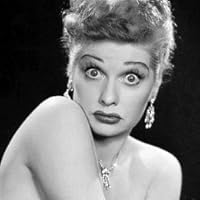
As with, most recently, Paul Newman and Alan Rickman, Lucille Ball's foray into memoir was discovered after death. It emerged from a few old file boxes held by a former attorney - this project she'd mounted in the 1960s with the help of one Betty Hoffman at the suggestion of Lucy's close friend, Dr. Norman Vincent Peale. Interviews were taped and transcribed in what appears to have been a difficult process for Ms. Ball, coming as she had from a puritan background similar to that of her contemporary, Katharine Hepburn. Like Hepburn, there is a characteristic reticence here to journey behind closed doors. In trade of deep emotional revelation we have, as we did with Ms. Hepburn, a turn to the pragmatic rendering of a hard life lived bravely and that Yankee march forward, stalwartly forward, into tomorrow.
Young Lucille Ball, as a talent, was quite the anomaly for the business end of the entertainment community. What to do with her? She was attractive enough to be a model and obtained some initial work in Ziegfeld-like productions that asked for an ethereal moment of femininity...and very little more. The rogue ability she had to overcome self-consciousness revealed a comic bent that set audiences on their heels. But vaudeville, where such gifts might be most profitably employed, had slipped into the past, and as much as she wanted to remain in the East, on Broadway, the plays simply didn't have the roles to launch her in their capacity.
Hollywood, with the end-stage remnants of its studio system, offered opportunities at least to be seen, to be engaged, to be paid. Still, her anomaly status remained, and it took a number of cultivated relationships and cultivated circumstances to open up a path. I found very much of a suffragette's struggle here, though she does not frame it in that way. She had to break beyond those restrictions the culture had erected around women, and where women should be seen, and what they should be seen doing. You simply cannot dispute the fact that Lucille Ball introduced more authenticity into the equation of the female of the species, and not only raised the height of that glass ceiling but also elbowed apart those narrow walls that kept certain stultifying ideas of femininity intact. She was, should anyone need to be reminded, the first female studio head in Hollywood history.
This is a good book, and fittingly presented. Respectful, remarkably direct, and honest to its very bones. Worth a read to those whose interests run in this direction.