

What do you think?

Camille Pissarro: The Audacity of Impressionism
Camille Pissarro, der "Vater des Impressionismus", war auch Begründer einer einflussreichen Künstlerfamilie.
Mit Sympathie und Kunstverstand erzählt die preisgekrönte Biografin Anka Muhlstein das Leben eines Mannes, der das Sehen für sich, seine Zeit und uns neu erfunden hat.
Mit Sympathie und Kunstverstand erzählt die preisgekrönte Biografin Anka Muhlstein das Leben eines Mannes, der das Sehen für sich, seine Zeit und uns neu erfunden hat.
320 pages, Hardcover
Published November 28, 2023
About the author
Anka Muhlstein
35 books27 followersAnka Muhlstein was born in Paris in 1935. She has published biographies of Queen Victoria, James de Rothschild, Cavelier de La Salle, and Astolphe de Custine, a study on Catherine de Médicis, Marie de Médicis, and Anne of Austria, and a double biography, Elizabeth I and Mary Stuart. She is currently writing a volume on Proust as a reader. She has won two prizes from the Académie Française, and the Goncourt Prize for Biography. She and her husband, Louis Begley, have written a book on Venice, Venice for Lovers. They live in New York.
Ratings & Reviews
Friends & Following
Create a free account to discover what your friends think of this book!
Community Reviews
Displaying 1 - 30 of 32 reviews

October 6, 2024
Impresionistai ir post-impresionistai yra sena mano meilė. Tad, kaišioju savo spragas. Man rods, lietuviškai nėra išleista monografijų apie jį. Gal vertėtų išverst šią.
Gak kiek sausoka, bet pakankamai informatyvi knyga. Patiko, kad autorė skyrė dėmesio ne tik dailininkui, bet ir tuometinei jo aplinkai - kolegoms ir kultūriniams (vaizduojamo meno) įvykiams.
Man Camille Pissarro artimiausi ir mieliausi Paryžiaus gatvių "portretai".
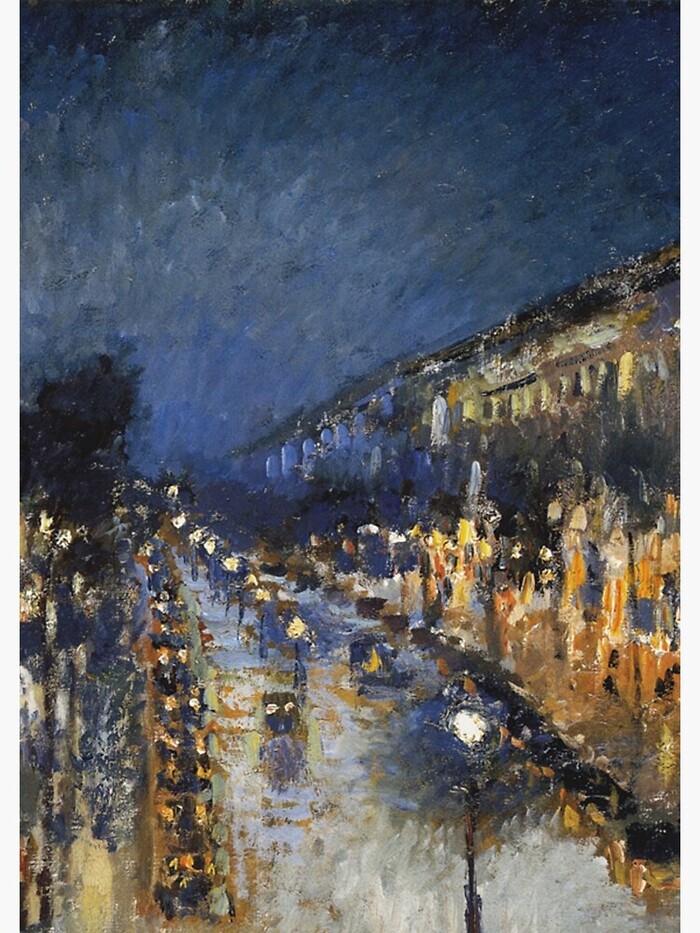
The Boulevard Montmartre At Night
Gak kiek sausoka, bet pakankamai informatyvi knyga. Patiko, kad autorė skyrė dėmesio ne tik dailininkui, bet ir tuometinei jo aplinkai - kolegoms ir kultūriniams (vaizduojamo meno) įvykiams.
Man Camille Pissarro artimiausi ir mieliausi Paryžiaus gatvių "portretai".
The Boulevard Montmartre At Night
January 7, 2024
I didn't know much about Pissaro before reading this book. I guess I thought of him as a second tier impressionist painter, but now I'm much more appreciative of his work and life. And watching the Art Exhibition on film movie about him was a great bonus as it brought many of his paintings to life for me. Pissaro had a very interesting life and was known in some circles as the "father of impressionism." He had many friendships with many of the other impressionist painters and was universally loved for his character and kindness. It took a while for his paintings to sell, but he did finally achieve success in his lifetime. He was also a very loving and attentive father and many of his children and grandchildren became artists as he encouraged their talents.

March 31, 2025
This was enjoyable and well written but it was more about Pissarro's personal life and less about his work or ideas. I would have preferred the opposite.

March 3, 2024
This well written biography shows us the many sides of Pissarro、the artist, the friend of impressionists, husband, father, and alien living in France. The book is neither too long nor too condensed and offers a rich portrait of a man and his times.

March 30, 2025
Possibly 3.5 rounded to 4/5.
Kept me company while on the plane rides to and from Philly to Orlando, much appreciated. Didn’t put me to sleep as other biographies have in the past so we love it for that. Wish there were more illustrations and examples of his paintings, perhaps representative of each era, to round out the narrative — especially given I didn’t have internet to look them up and reference it all. That being said, this book leans more towards painting the bigger picture (ahaha) of his life outside of painting, especially his commitment to family and relationships with his art dealers and patrons + the camaraderie of the whole impressionism squad / coterie. Gained a newfound appreciation for how mellow and fatherly he is compared to other painters of his time (I mean, raising sooo many children to be artists? what an accomplishment and feat to be proud of)
Who should I read next 👀👀👀
Kept me company while on the plane rides to and from Philly to Orlando, much appreciated. Didn’t put me to sleep as other biographies have in the past so we love it for that. Wish there were more illustrations and examples of his paintings, perhaps representative of each era, to round out the narrative — especially given I didn’t have internet to look them up and reference it all. That being said, this book leans more towards painting the bigger picture (ahaha) of his life outside of painting, especially his commitment to family and relationships with his art dealers and patrons + the camaraderie of the whole impressionism squad / coterie. Gained a newfound appreciation for how mellow and fatherly he is compared to other painters of his time (I mean, raising sooo many children to be artists? what an accomplishment and feat to be proud of)
Who should I read next 👀👀👀

February 7, 2024
I never knew much about the painter Camille Pissarro before reading this marvelous book by Anka Muhlstein. I have gained a new appreciation for Pissarro’s paintings. Pissarro, I discovered, was a hardworking, loyal, benevolent family man, a prolific artist, as well as a founding and steadfast member of the Impressionist movement. I admire him immensely, not only because of these qualities, but more so when I compare Pissarro to his fellow male artists of his era. Most (I’m talking mainly of European artists here) were either serial womanizers, had severe substance abuse issues, and/or were known for their violent, erratic, and/or vitriolic personalities. Pissarro stands alone as even-tempered, constant, and dedicated. One exception might be Matisse, but Matisse put his art first—case in point—he chose to live in his later years, with his younger assistant over his wife (given her ultimatum).
Muhlstein does a fine job pulling together her research and presenting Pissarro’s life, starting from his birth (on the island of Saint Thomas, then a colony of Denmark) through to his adulthood. He lived the majority of it in Europe—Paris mostly, the epicenter of the art world at the time. Pissarro was, as mentioned, an Impressionist and one of the few within the group who exhibited at every one of the eight Impressionists’ shows. He was loyal, not only to his artist friends but also to his art dealer, Durand-Ruel (even when Durand-Ruel was falling on hard times).
Muhlstein describes the art world in Paris in Pissarro’s time, providing a good discussion about the French Salon and its importance. She discusses the Salon’s resistance to novel painting techniques, ones like Impressionism, which violated the well-established norms of painting. At the time, it was paintings of historical and biblical scenes that were valued, not half-finished paint daubs of vague subjects, as the Salon judges (and public) viewed the Impressionist works.
Another element of Pissarro’s life that pegs him as one of my favorites is his unwavering commitment to his family. First to his wife. He married Julie Vellay when he was in his early twenties, the family cook at the time, which was something his bourgeoisie mother never forgave him (or her) for. Pissarro remained faithful and loyal to her until his death. They had seven children together (one passed away) and of the six, all became artists. Julie did not approve, yet Pissarro encouraged and supported his children to develop their skills and find a career in the arts. Two of his sons became engravers, and one of who founded a book publishing shop. Muhlstein references many of the letters that Pissarro sent to his children, full of encouraging and instructive advice. Given that Pissarro painted over 1500 paintings, his devotion and commitment to his family are remarkable.
The book includes several high-quality images of Pissarro and some of his paintings, enhancing the reading experience. Camille Pissarro: The Audacity of Impressionism is marvelous.
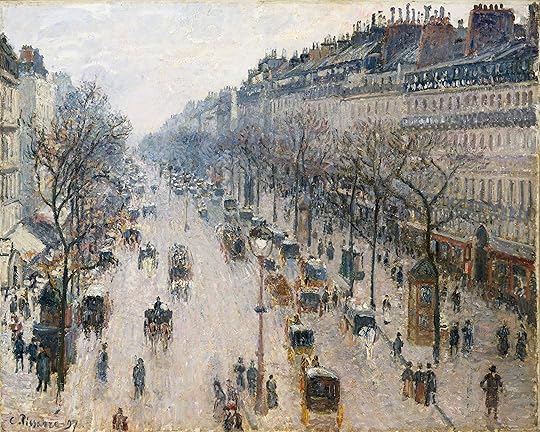
Pictured below is one of my favorite works by Pissarro, "The Boulevard Montmartre on a Winter Morning", 1897
Muhlstein does a fine job pulling together her research and presenting Pissarro’s life, starting from his birth (on the island of Saint Thomas, then a colony of Denmark) through to his adulthood. He lived the majority of it in Europe—Paris mostly, the epicenter of the art world at the time. Pissarro was, as mentioned, an Impressionist and one of the few within the group who exhibited at every one of the eight Impressionists’ shows. He was loyal, not only to his artist friends but also to his art dealer, Durand-Ruel (even when Durand-Ruel was falling on hard times).
Muhlstein describes the art world in Paris in Pissarro’s time, providing a good discussion about the French Salon and its importance. She discusses the Salon’s resistance to novel painting techniques, ones like Impressionism, which violated the well-established norms of painting. At the time, it was paintings of historical and biblical scenes that were valued, not half-finished paint daubs of vague subjects, as the Salon judges (and public) viewed the Impressionist works.
Another element of Pissarro’s life that pegs him as one of my favorites is his unwavering commitment to his family. First to his wife. He married Julie Vellay when he was in his early twenties, the family cook at the time, which was something his bourgeoisie mother never forgave him (or her) for. Pissarro remained faithful and loyal to her until his death. They had seven children together (one passed away) and of the six, all became artists. Julie did not approve, yet Pissarro encouraged and supported his children to develop their skills and find a career in the arts. Two of his sons became engravers, and one of who founded a book publishing shop. Muhlstein references many of the letters that Pissarro sent to his children, full of encouraging and instructive advice. Given that Pissarro painted over 1500 paintings, his devotion and commitment to his family are remarkable.
The book includes several high-quality images of Pissarro and some of his paintings, enhancing the reading experience. Camille Pissarro: The Audacity of Impressionism is marvelous.
Pictured below is one of my favorite works by Pissarro, "The Boulevard Montmartre on a Winter Morning", 1897
January 19, 2024
It was Adam Gopnik’s review of this new biography of Camille Pissarro in the New Yorker that persuaded me to read this book. Pissarro, sometimes dubbed the “Father of Impressionism,” is a painter generally well represented in museums showing impressionist paintings. For example, the National Gallery in Washington DC has 12 Pissarro paintings on display. At the same time, Pissarro’s paintings don’t seem to meet the “test of the crowded room” (Gopnik’s term). Guided museum tours and visitors tend to congregate in front of (the usually nearby) paintings by Monet, Manet, Renoir, Cézanne, and Degas (not to speak of Van Gogh). Against this backdrop, I found the book to be very good at two tasks. First, providing an account of why Pissarro holds a central place in the impressionist narrative; and, second, explaining why Pissarro is today not regarded as one of the grandees of the impressionist movement. On the first task, the book documents Pissarro’s major influence on many of the key impressionists and post-impressionists, especially Cézanne. At the same time, Pissarro is portrayed as the quintessential nice family guy among a circle of men (Berthe Morisot and Mary Cassatt being exceptions) that come across as neither nice nor family-oriented. On the second task, the book convincingly argues that Pissarro’s paintings require much effort and concentration to appreciate, something that is especially out of tune with today’s selfie-based and rapidly-moving museum visitation culture.
The book’s print makes reading it a pleasure; the book also contains a useful collection of Pissarro’s key paintings (in color) as well as photos of Pissarro and his family and fellow painters (in black and white).
The book’s print makes reading it a pleasure; the book also contains a useful collection of Pissarro’s key paintings (in color) as well as photos of Pissarro and his family and fellow painters (in black and white).

July 9, 2025
I don't know a lot about art history but am always open to learning more; I'm not sure what struck me about this biography of Pissarro, but I picked it up from a display table in my home county's library and really enjoyed it. The latter chapters about the technique of pointilism - where one"thereby [leaves] the fusion to occur in the viewer's eye," as the author so ably puts it - and how this led his fellow early impressionists to dissociate themselves from him were really interesting and illuminating. Pissarro came across as a more forward-thinking, progressive artist and made the younger painters of his era, like Degas and Renoir, seem more static and traditional in their objections to the neo-impressionists of the next generation. I was also impressed by his dedication to his large family and his occasionally difficult relationship with his patron and dealer, Paul Durand-Ruel, who believed in his worth but could never convince him that he just couldn't get the prices he wanted for his paintings (particularly in the early years when the impressionists were scorned by the art world). I loved the author's statement near the end that "Painting and bringing up his children constituted the two poles of his existence" (277). I came away from this feeling that I'd learned a lot, not just about Pissarro, a gentle and relentlessly positive man, but about his contemporaries and painting in general as well.

March 6, 2024
This is a marvelous account of the life of the impressionist Camille Pissarro. Born in the Caribbean in 1830 of Jewish parents, he did not arrive in France until he was 25. He became close friends with Monet, Cézanne, and Degas and to some extent, Gauguin as well.
Clearly an independent thinker, Pissarro became an atheist (much to his mother’s chagrin), an anarchist, and a bit of a bohemian. While he struggled most of his life with earning enough money to support his lovely wife and their many children; he never tired of offering advice and support to his fellow impressionists, his friends, and relatives. Ever curious, he adopted the Pointillists’ style later in life after being influenced by the work of Seurat.
He organized the first of the salons where the ‘refused’ impressionists exhibited their work, and was always regarded highly despite the rising fame of his peers. Indeed, he participated in each of the eight official Impressionist exhibitions between 1874 and 1886. In addition, Pissarro was influential in including women such as Suzanne Valadon, and Mary Cassatt in their impressionist circles.
Always a family man, Pissarro strongly supported his childrens’ art ambitions. Indeed, four generations of ‘Pissarros’ have become artists through the years. Looking forward to viewing Pissaro's paintings in museums with new eyes!
Clearly an independent thinker, Pissarro became an atheist (much to his mother’s chagrin), an anarchist, and a bit of a bohemian. While he struggled most of his life with earning enough money to support his lovely wife and their many children; he never tired of offering advice and support to his fellow impressionists, his friends, and relatives. Ever curious, he adopted the Pointillists’ style later in life after being influenced by the work of Seurat.
He organized the first of the salons where the ‘refused’ impressionists exhibited their work, and was always regarded highly despite the rising fame of his peers. Indeed, he participated in each of the eight official Impressionist exhibitions between 1874 and 1886. In addition, Pissarro was influential in including women such as Suzanne Valadon, and Mary Cassatt in their impressionist circles.
Always a family man, Pissarro strongly supported his childrens’ art ambitions. Indeed, four generations of ‘Pissarros’ have become artists through the years. Looking forward to viewing Pissaro's paintings in museums with new eyes!
February 17, 2024
This was a great biography full of information not just abut Pissarro but about the Impressionist movement and their struggle for recognition. Pisarro was a friend to them all, Monet, Sisley, Cezanne, Renoir, Bazille, Degas. Cassat and the book reveals how much these painters interacted, shared ideas about painting and supported each other, Pissarro first of all as a guide and advisor to others at the beginning, and later even financially as Monet lent Pissarro money to buy a house. Part of the work besides painting was insuring their work was sold and the up and down long relationship between Pissarro and his dealer Durand Ruell makes one realize how stressful the financial situation was for these painters. Also covered was the historical period 1830-1903 with its dramatic changes and how these influenced the work of the painters. Highlighted in the book, thanks to the many letters he wrote, is Pissarro's relationship with his children and what a loving and supportive father he was. All in all an engrossing and beautifully written biography of a wonderful man, the father of Impressionism.

January 24, 2026
If you're interested in Pissarro, my impression (see what I did there?) is that biography is the most comprehensive and useful on his life and work. I LOVE that Muhlstein didn't spend a ton of time on Pissarro's parents or his life as a child. She gave just enough to know the relevant material. Well written, but not a very engaging style. Pretty dry stuff. Easy to follow. Not much narrative momentum.
My biggest take away from the book is just how close the impressionists were. So many mentioned in their circle: Monet, Manet, Cezanne, Renoir, Degas, Morisot, Cassatt, Gaugin, etc. I also didn't realize how much Turner and Delacroix influenced them.
After a while, it started to seem like a Robert Altman film with so many characters weaving in and out of Pissarro's life, while having full-on stories of their own.
If you're curious about Pissarro, I recommend this one. If you're interested in the impressionists as a group, there's got to be something better than this one. Glad I read it though.
My biggest take away from the book is just how close the impressionists were. So many mentioned in their circle: Monet, Manet, Cezanne, Renoir, Degas, Morisot, Cassatt, Gaugin, etc. I also didn't realize how much Turner and Delacroix influenced them.
After a while, it started to seem like a Robert Altman film with so many characters weaving in and out of Pissarro's life, while having full-on stories of their own.
If you're curious about Pissarro, I recommend this one. If you're interested in the impressionists as a group, there's got to be something better than this one. Glad I read it though.
August 24, 2025
Anka Muhlstein's biography of Pissarro (1830-1903) was well-written, well-researched and brought to life for me a hardworking and prolific artist, a benevolent family man, a loyal friend and a founding and steadfast member of the Impressionist movement. The book highlights his loyal friendships and mentoring of other artists such as Monet, Renoir, Sisley, Cezanne, Morisot, Cassatt and many other important Impressionist artists. Muhlstein's book provided a picture of Pissaro's inspirations for his art as well as the development of the Impressionist movement and the interactions among the artists.
While he was born in the Virgin Islands (then a Danish colony) to Jewish parents, he lived most of his life in and around Paris, inspired by the light and colors that he brought forth in his paintings.
I'm always struck by reminders of the struggle for these artists to promote their art and make a living when the art is now so revered and valuable!
While he was born in the Virgin Islands (then a Danish colony) to Jewish parents, he lived most of his life in and around Paris, inspired by the light and colors that he brought forth in his paintings.
I'm always struck by reminders of the struggle for these artists to promote their art and make a living when the art is now so revered and valuable!
May 26, 2025
Well researched book. Sometimes hard to follow because there are SO many people (and particularly artists) mentioned in this book. But that’s unavoidable with the Impressionists. I didn’t realize what an interactive group they were, and I loved learning that Monet was Pissarro’s friend, even watching out for his wife and kids after his death. I also loved his devotion to his kids and grandkids. Here’s a quote/advice…”He gave her [Cocotte, his daughter] plenty of advice, particularly emphasizing that she must always make studies from nature ‘even if it’s less accurate, its better, tracing is bad practice, it is not honest.’”

January 9, 2026
Camille Pissarro: The Audacity of Impressionism reveals the artist as a man of authenticity and personal warmth, with a great capacity for friendship and the humility to learn from younger artists even when his own fame was well established. In addition to Pissarro's life, Muhlstein offers insightful glimpses into the lives of Pissarro's many now-famous friends, including Monet, Renoir, Degas, Cezanne, Cassatt and Van Gogh. Pissarro's difficulties as an artist and family man are revealed while the subplot (the early struggles and final triumph of the artistic movement that would become known as Impressionism) progresses. Very accessible and enjoyable read.

May 8, 2024
My first Muhlstein book. Also couldn't finish it because almost any other reading would prove move valuable. Feels like another example of well-researched in secondary sources, but not particularly additive to insights. It's better than Balzac's Omelette and Proust's Library, but only because the book shines a light on Pissarro's didactic contributions to Impressionism. Also always nice to read about an artist who isn't a complete dick. But I suspect I could have found the same in more authoritative biographies or art histories.

February 20, 2024
The book traces the life of Camille Pissarro from its beginnings in the Caribbean to his place in the center of the Impressionist movement where most fellow artist considered him father of the movement. This is told against the background of the turbulent political times and dreadful antisemitism. He struggled most of his life for success while being a wonderful father and supporter of his children and their careers in the arts. I love his art
April 13, 2024
well-written bio
Muhlstein offers a sympathetic portrait of a painter who today is outshined by other contemporaries like Monet, a great friend, Renoir, Morisot and Degas. She shows the importance of “Papa” Pissarro to the impressionist movement. She discusses his perception of being an outsider in French society having been born in St. Thomas and being Jewish during the Dreyfus affair. I wish there had been more illustrations of his paintings.
Muhlstein offers a sympathetic portrait of a painter who today is outshined by other contemporaries like Monet, a great friend, Renoir, Morisot and Degas. She shows the importance of “Papa” Pissarro to the impressionist movement. She discusses his perception of being an outsider in French society having been born in St. Thomas and being Jewish during the Dreyfus affair. I wish there had been more illustrations of his paintings.

July 11, 2025
A clean, thorough and concise biography that doesn’t go much outside the lines, feeling very much aligned with Pissaro’s approach. At the same time, it feels like you could explore a bit more how & why Pissaro might just be the father of modern art, and an anarchist. But maybe it was all just his life, but I mean, with all those kids (8), he must have been a remarkable man of passions, despite the control his words evidence.

November 15, 2024
I think an artist or art lover would appreciate this book. I do not have this background and I enjoyed reading it but it was a bit difficult to keep my attention on it due to unfamiliar terms and some French names/words. The last part of the book was most enjoyable for me as Pissarro's street scenes are my favorite.
January 19, 2026
This was very pleasant to read. Lots of insights, both into Pissarro but also the other giants of early impresionism. I found the reaction to Pissarro's efforts at pointilism to be most interesting.
August 30, 2026
I liked this book. It took a minute to get into, being unfamiliar with French names, places, and references - but I appreciate how the chapters were themed by topic and not necessarily chronological. I felt the book really captured and honored the nickname "father Pissarro" very well.
January 21, 2024
Still worth reading
February 16, 2024
Audiobook.

Read
November 3, 2024Nice!

November 25, 2024
Fascinating look at the grand old man of Impressionism and his relationship with Monet, Durand Ruel, Berthe Morisot and others.

February 16, 2025
A fun and informative read. Led to me searching the internet for the many paintings mentioned in this book. Really enjoyed learning about Pissarro the person.
March 23, 2026
Fascinating account of this kind family man who spent much of his life in poverty. His devotion to his are and to his family is a thing of beauty.
September 12, 2026
Eh…. It was fine. It was a really good book on the impressionist painters as a group, but I felt like most of the times the information was rather surface

September 17, 2026
Excellent biography
Displaying 1 - 30 of 32 reviews