Jump to ratings and reviews
Rate this book

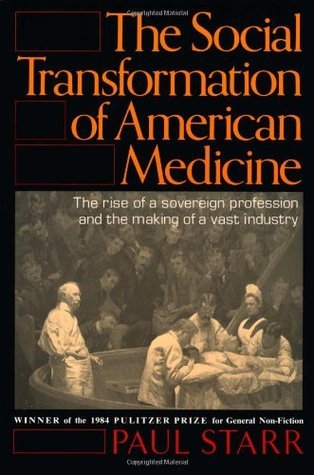
The Social Transformation of American Medicine: The Rise of a Sovereign Profession and the Making of a Vast Industry

Rate this book
Sociology, History, Medicine

514 pages, Paperback

First published January 1, 1982

390 people are currently reading
5882 people want to read

About the author

Paul Starr

63 books22 followers

Ratings & Reviews

What do you think?
Rate this book

Friends & Following

Create a free account to discover what your friends think of this book!

Community Reviews

5 stars
598 (42%)
4 stars
533 (37%)
3 stars
219 (15%)
2 stars
48 (3%)
1 star
15 (1%)
Displaying 1 - 30 of 146 reviews
Profile Image for Christy Hammer.
113 reviews302 followers
January 7, 2017
Reading Paul Starr's summary here in a Sociology of Medicine undergraduate class in the early 80s I realized how we thoroughly screwed up American healthcare starting towards the turn of the 20th century when the rapidly scientising and professionalizing field of medicine ran smack dab in the middle of the height of monopoly capitalism searching for the next big profit. Healthcare, what we can surely all understand as a human concern, a human, public concern, became a business concern. All that's happened over the 30 or so I've tried to keep abreast of "sociology of medicine" issues, while our cost of healthcare in the US went from 13% to 18% of our GNP.

Given that neither Obama nor Clinton could even start to decouple business from healthcare, I assume Trump isn't going to perform any magic. Even with the benefits of the Affordable Care Act, Obama was unable or unwilling to break the chokehold of either the insurance racket or Big Pharma, which is the only way to make a healthcare system truly "affordable" as well as equitable in the US.
Profile Image for Frank Stein.
1,092 reviews169 followers
September 9, 2010
I was suspicious that this might be a historically-based political screed, since Paul Starr has been active in liberal political health care circles for years, and he was one of the major "economists" to sign on to a petition for Obama's health care bill (he's actually a sociologist but hell, they were taking anybody they could get). Beyond his political credentials, I was worried that Starr would impose a stale sociological narrative about "social control" on what was actually a typical industrial economic evolution, where dollar efficiency mattered more than "cultural authority." Yet by the end of the book I have to admit that Starr more than proves his case for a social analysis, and he masterfully shows how physicians in America have garnered more social and political power than physicians in any other society on earth. Overall and to my surprise, I learned more from this book than from any other I've read in recent memory. Its sweep across the entire history of American medicine is fantastic, detailed, and constantly surprising.

The first half of the book deals with doctors ability to control the private medical market for their own ends. It is a fascinating case study of how a private group can monopolize and restrict a market by using its own power and influence. For instance, after AMA membership became a requisite for cheaper malpractice insurance in the late 1800s, the national organization used its muscle to ban patent medicines from almost all national newspapers (which had almost single-handedly financed those newspapers' rise) and demand that all prescribed medicines ban advertising to the public and not print their uses on their label, so only doctors could understand and administer them. This of course increased doctor's fees for both prescriptions and visits. The AMA's control over which medicines were recommended as "legitimate" also allowed it to fund itself almost entirely from doctor-directed ads in the JAMA, where medicines vied for favor. The AMA then funnelled some of these ads and funds to state doctor associations, increasing its control over these groups and allowing the national organization to more fruitfully hold the threat of banishment over those local doctors who joined pre-paid group or fraternal insurance plans (all private mind you, but supposedly demeaning to every doctor's authority).

The second half of the book deals with how doctors and the AMA dealt with the growing power of government and resisted its blandishments throughout the 20th century. It is full of interesting facts often neglected in the quickie health care histories provided in newspaper articles. For instance, World War II didn't cause the rise of health insurance, the Wagner Act of 1935 that guaranteed collective bargaining did, and the War didn't make health insurance tax deductible, a little known 1954 decision by the IRS did. Even Obama cites Teddy Roosevelt's early call for national health insurance in 1912, but few today remember, or want to remember, that both Nixon and Ford briefly called for national health insurance as an idea whose "time has come." The 1973 HMO bill cited by demagogues like Michael Moore as the end of good health care, actually inhibited HMO growth by loading it with expensive perks demanded by Congress (in a similar vein, see the 2009 PPACA).

Looking back I realize that I covered almost the entire book in underlines, and upon review I took pages and pages of notes on the even more salient stuff. This is simply the best book on health care out there, and everybody should read it.
Profile Image for Sebastian.
163 reviews34 followers
September 21, 2022
The Social Transformation of American Medicine is a history of the medical profession. It's outstanding: thorough without being needlessly dense, and while the author is opinionated, Starr is careful to not make those opinions the focus of his writing. I am not sure I've underlined and starred so many things in a book in recent memory.

If you've ever wondered about some aspect of hospital payment, are curious about the history of Kaiser Permanente, or find yourself asking why we didn't end up with national health insurance like Europe, this book has answers.

----------

In the Jacksonian, autarkic 19th century, American physicians were mistrusted by the public and markedly low status. Between 1800 and 1850, while 26% of Ivy League graduates entered the clergy and 25% entered law, about 8% entered medicine [82]. Doctor salaries hovered around 1.5x-1.75x average unskilled wages, in 1860 earning perhaps $600 in annual income against a national average of $363 [85]. Attempts at supply-restraining licensure were generally rebuffed: "a people accustomed to governing themselves and boasting of their intelligence are impatient of restraint," remarked one NY state senator repealing licensure in 1844, "they want no protection but freedom of inquiry and freedom of action" [58]. Early America was different.

In the late 19th century, the rise of large corporations threatened to pour salt on a wounded medical profession. Many industrial firms hired doctors for workplace injury and emergency care. "The members of the profession," wrote one Ohio doctor in 1902, "are constantly humiliated by wealthy corporations, state, county, and city officials" [110].

The American Medical Association (AMA) went on the offensive. The once-ridiculed society assiduously grew membership from 8,000 members in 1900 to 70,000 in 1910 [110]. The 1904 Flexner Report created a plan to reform medical education and improve physicians' standing; medical schools that did not comply lost their ability to recieve any licensure from states -- where the AMA simultaneously revived licensure laws lost 50 years prior [117-9]. In a stroke of mastery, the AMA's 1906 pamphlet "The Great American Fraud" leveled a withering critique on the pharmaceutical industry (which was, legitimately, quite prone to fraud at the time) and started building its manual of New and Nonofficial Remedies, which would in turn give AMA physicians authority over evaluating medicines and eventually prescribing [131]. The AMA bullied newspapers that would advertise snake oil remedies [132] and over time the AMA's own journal would become the the main focus for pharmaceutical marketing dollars.

This period is especially interesting to me. The medical profession and AMA, while fighting doggedly for their own interests, won their authority not by force or deception but by legitimate mastery of legitimate complexity. As Starr writes, medicine was not merely a "monopolistic guild," but rather a class that has "won support from outside its membership" [144]. At the dawn of the progressive era, Americans began to defer to authority on their own volition.

Authority for the medical profession emerged at a fortuitous time: in the 1880s and 1890s, the rise of antiseptic surgical technique created a boom in demand for hospital-based services [157-8]. Physicians needed access to operating theaters to perform procedures but were not about to hand their newfound authority to the hospital administrators. They instead formed relationships where physicians would use hospitals and often enjoy admitting privileges but would bill patients separately for their services [163] and would generally not be employed by the hospital directly. By the 1920s, "hospitals remained incompletely integrated, both as organizations and as a system of organizations -- a case of blocked institutional development, a precapitalist institution radically changed in its function and moral identity but only partially transformed in its organizational structure" [179].

This "loose alliance" model of hospital leadership authority (between hospital admins, trustees / donors, physicians) roughly continues to this day and is the source of much institutional inertia and inefficiency. Vetocracies rarely produce any sort of optimization.

In the 1930s, attempts at consolidating physicians and hospitals into corporations were thwarted and the medical profession once again shrugged off a threat to sovereignty. "Doctors opposed corporate enterprise in medical practice not only because they wanted to preserve their autonomy, but also because they wanted to prevent the emergence of any intermediary or third party that might keep for itself the profits potentially available in the practice of medicine" [216]. The AMA categorically made capital formation in medical care challenging and did not permit physicians to be subject to the heirarchical controls of capitalist enterprise. Like the earlier war with hospitals, the war with corporations was won on the back of "physicians' authority with patients... their strategic position in the system represented a resource that give them power over institutions" [218]. Again, there is something very democratic about the source of medical authority: it was not taken but given. And that monopoly on patient trust is what physicians have monetized now since time immemorial.

The balance of the book focuses primarily on postwar reforms, where the medical profession navigates through a series of government subsidies that further empowered the profession (e.g. Hill-Burton grants for hospital construction; the formation of the NIH and research grants) and a series of financing reforms starting with the introduction of Medicare and Medicaid, through the Nixon-Carter-Reagon HMO era. The book ends in 1982, prescient of the man-made horrors to come but unsure of their form: "conflict itself is one of the legacies of the development of healthcare. American medicine will likely remain a symbol of national frustration as well as a national achievement" [493].

----------

American medicine is a story of contingencies. There really is no logic to it.

"Yeah there is," you might say, "it's a story of physicians protecting professional sovereignty!" Which is somewhat right but not entirely. Someone leading the AMA in the early 1900s clearly had a vision and a proverbial fire under his ass. That leader or cadre of AMA leaders gave physicians prescribing authority, prevented physician domination by hospitals, the state, and corporations, and instead won a century of sovereignty with the support of the American people. I would love to read more about this 1900-1910 period at the AMA: what they accomplished was brilliant and the story could have truly been very different in less capable hands.

Many classses have won cultural and social priviledges with government support. But I wonder if we shouldn't see those stories as centering around their charismatic influencer figures be they Eugene Debs or Susan B. Anthony or Martin Luther King Jr. Do these class movements exist without these great uniters?

Physicians have battled to a stalemate with hospitals, corporations, and insurance in the United States. No group seems capable of outgunning the other. And a 4-way Maginot line means that nobody really wins. In fact, everyone loses: we build systems of imperfect compromise that protects each group from annihilation at the hands of the other, but produces no optimization.
Profile Image for Jake.
243 reviews54 followers
September 5, 2020
This was a really good book explaining many of the basics of how the medical industry became what it is today. A must-read for anyone looking to be well versed in social, political, and economic lenses of the modern health care industry.
Profile Image for Matthew Loftus.
169 reviews30 followers
February 23, 2023
A tremendous (and tremendously long) book detailing the social power of American doctors and the hijinks that led to the current bizarre amalgamation we call a healthcare system. It has somehow sustained itself despite being "unsustainable" and "in crisis" for decades. It is shocking how many times America came this close to having a national health insurance system, only for the football to get yanked away at the last minute. (Even Nixon almost did it!) There is a lot of detail and the book is perhaps longer than it needed to be. (It was originally meant to be 2 books.) Still a fascinating read, and I wish he had written a "book 3" telling the post-1982 story in more detail.
Profile Image for Zachary Coburn.
6 reviews
February 26, 2025
A classic, Starr begins with the cultural formation of medicine in the United States by first examining the fractured independent practitioner model through consolidation/standardization and finally corporatization of medicine. His update covering the 1980’s through 2016 continues his thematic examination. No book can cover all topics but I think some extra attention to the implementation of EMTLA and subsequent safety net status of the Emergency Department would be helpful. A big miss was also not discussing end of life care issues—the majority of healthcare spending is spent in the last few decades of life and there is considerable variation in how it is handled in the U.S. versus other countries (he does begin to broach it when discussing dialysis care).

In sum, this is an approachable book providing a broad overview of American healthcare.
Profile Image for Jessica Jin.
171 reviews97 followers
December 28, 2023
Ok so our healthcare is as messed up as it is because doctors had to fight tooth and nail for legitimacy and money and the American Medical Association isn't for the people-- in fact they have a long history of putting provider interests before patients. And they pushed out lots of ancestral knowledge held by generations of women caretakers as they fought to "professionalize" to be taken seriously, push out quack men, and make more money. We also didn't learn enough in school about how labor movements and the health insurance system we have now came up together, because that shit is fascinating. But now I can also better see why this country is stuck in the mud. I'm sorry my mind drifted a lot in the sections about different payment and network models and I almost quit the book 60% of the way through because of this so unfortunately don't have many learnings to report back on there as I mindlessly plowed through that until things got interesting again. This is a bit dense so there are a couple other books I'd recommend as primers on healthcare in America before this if you're just getting started but I can see why a lot of people say it's important to read this one.
Profile Image for Peter Van Os.
66 reviews
June 10, 2025
The end of an era. Occasionally very illuminating, at other times I may as well have been staring at a brick in my lap.
Profile Image for Aurel Mihai.
162 reviews3 followers
July 20, 2019
The title of the book is not entirely accurate. While there has been a transformation of medicine since the foundation of the United States, the book is both more and less than what it claims to be. It is more because the transformation is many things besides a social transformation. It is in very, very large part a financial transformation, starting as just another trade and becoming a driving force of the economy. The book does talk about the economic impact of medicine, but mostly in a negative way, as related to its cost, and not in a positive way, as in the impact it has on an American economy that has nothing else left to offer so that its main national products are now the military, entertainment and medical services. More on this in a moment. I said the book is less than what it claims to be as well. There is certainly a running argument throughout the book about the sovereignty of the medical profession and the social change that physicians have undergone in general, but really most of the book is just a running timeline of events concerning medicine in America and as we cross into the last thirty years or so prior to the publication of the book this becomes much more pronounced until the editorial and crystal ball gazing chapter at the very end.

Trying to make sense of what has actually happened in and around medicine is no small feat so I certainly don't criticize this as the main thrust of the book, but then the title should be something like "A Brief History Of US Medicine". And as I mentioned, when the author chooses to editorialize he is quite selective in doing so. He writes about the battles between cost containment and the physicians and hospital administrators trying to eke every last penny out of the economy to enrich themselves, but there is very little mention about the army of hospital and clinical personnel and how their ranks have ballooned in size since the beginning of the twentieth century. He writes about repeated attempts by various administrations since roughly the 1950s to legislate medicine, but nothing at all about the implications of this. That doctors have come to spend more time maintaining compliance, filling out paperwork, and struggling to obtain reimbursement for their services than they spend with patients. There is virtually no discussion of liability in the book. Or medical billing. Corporate medicine sneaks in at the very end, this understandably because it hadn't much taken off when the book was written.

Granted, it's just one book. And for what it tries to take on it's a relatively short book. It might be too short to give a realistic picture of how American medicine came to be what it is, but the bird's eye view, I think, is still helpful. And I don't believe there are many alternatives to this particular telling of the history of American medicine. Unfortunately, that's one last criticism I'll point out and I've already hinted to it. This book was published in 1982. More than a quarter of a century has passed since then and a whole lot has happened. Almost to the point of making this book obsolete. Not only is the history far from complete and becoming less complete every day, but the lens through which it is viewed is further every day from what we are living with and, although many of the social and economical issues brought up in the book are issues that we still struggle with today, it becomes more difficult to share that lens through which the author sees history the further removed we are from his time.
Profile Image for Michael Burnam-Fink.
1,702 reviews304 followers
January 16, 2013
Starr's book is one of the landmarks in the history of medicine. Using a framing theory of professional authority and a desire for independence, he examines medicine in America from the late Colonial period up through 1980. This book is sometimes overwhelming, but rarely obscure, and useful for both scholars and interested laymen. Starr explains the major periods of American medicine (disorder and disrepute to about 1870, standardization and professionalization from 1870 to WW2, and specialization and conglomeration after WW2) and their broader social and political contexts in education, public health, hospitals, and how doctors are paid.

Obviously, this book doesn't cover the past 30 years, and Starr is interested more in the character of a defined era than the actual moments of transformation, which to be fair, may be too elusive to really observe in a historic sense. But for anyone interested in why American healthcare is so expensive and why it is so resistant to reform, this is a definitive history.
69 reviews6 followers
August 23, 2009
This outstanding history, published 1984, of the system, or lack of it, of health care delivery in the USA is exceptionally relevant now, 2009, during the health care debates. It's a long, detailed book, but it's objective and well-referenced. It's exceptionally useful in describing developments in the post-World War II era. Forces set in motion during that period continue to this day. Some details are fascinating, e.g., the author believed that the best opportunity for national health care came in 1974, in motions proposed by Ted Kennedy but likely to be credited to Nixon who was then enduring the revelations of Watergate. That scandal and the opprobrium then attached to Nixon probably can be blamed for the death of that attempt.
Profile Image for Terragyrl3.
408 reviews5 followers
March 18, 2023
A bit dry in style—and not helped by the reader of the audio version—this book is still amazing for the author’s breadth of knowledge. Starr traces the history of the US medical profession, indicating where we took important turns that led to our present-day situation. The analysis focuses much more on the business models of medical developments—like salaries and the battle for professional oversight—and less on the social implications.
7 reviews
April 25, 2015
Seminal work describing in detail the progressive political enfranchisement of the medical profession (and now the industry surrounding it). Necessary for anyone who wants to understand the current incentive framework foundation of American medicine, and the thought processes and the sociology of its practitioners.
Profile Image for Ben.
29 reviews6 followers
September 20, 2019
An expansive history of the medical system in America, with a particular lens through the concept of the physician's "professional sovereignty." Still incredibly relevant after more than 35 years of publication!
Profile Image for Janet.
268 reviews3 followers
June 25, 2020
amazing compilation of history of American medicine from social and economic perspective. But let's face it, the chapters covering the 1930's to the 1950's got a little dry.
Profile Image for Nina Clark.
203 reviews
October 8, 2025
This one of the better non-fiction books I’ve ever read. Paul Starr approached the topic of the formation of the American healthcare system through a fairly academic lens relying on sociology, history, and econ but in a super clear and digestible way. I learned many many things and will reference this text often! There are lots of questions I still have and things I wish he would have covered, but one can only write a book so long. STAM is one of the few instances where I don’t think the book would have been stronger if it was shorter as it wasn’t particularly repetitive and all sections were deeply engaging and felt relevant. I think one of its strengths over much policy non-fiction is it doesn’t overpromise and underdeliver on prescribing how to fix the challenges laid out in the text. Starr simply provides a well researched and clearly explained analysis of how and why we developed the system we have today. I would read an analysis of any profession/industry/system from Paul Starr and hope he writes a 3rd addition that picks up post-2016! I would recommend this book to anyone interested in how we got to the insanely complicated healthcare system we have today. Probably best if you have at least a tiny bit background knowledge of healthcare structures and basic econ terms or a willingness to do little bits of outside research (ex: he assumes you already know terms like deductible, premium, price elasticity etc)

Excited for book club!
78 reviews6 followers
November 15, 2020
I cannot recommend this book highly enough for anyone who wants to learn about the history of the medical industry. It's ambitious, thorough, well-researched, and concludes in a way that's still incredibly relevant, in spite of it being 40 years old.

My main takeaway: patients are pretty obviously left out in our current system, without much direct negotiating power, left to hope for indirect help from employers or the government. Government help has been mostly ad-hoc efforts to deal with particularly egregious problems after they've arisen, and those have often been hamstrung by industry lobbying. The history of lobbying was particularly disturbing. I came away a lot more sympathetic to healthcare reform, though I don't know enough to have any opinion on specifics.

Also, I found it fascinating how close we came at multiple times in the past to national healthcare systems.
5 reviews
January 14, 2025
A really great, relatively unbiased overview of the healthcare system in America and how it’s evolved into the monstrosity we have today. It was interesting (and a little demoralizing) to read this during a time when our healthcare system has been under a lot of scrutiny in the media. I was surprised to find myself feeling more anger toward cartel-like hospital conglomerates and pharmaceutical companies, physicians advocating for increasingly expensive yet only marginally more effective treatments, and our government for failing to be proactive about any of these problems than I was toward private insurance companies. Nevertheless, it’s impossible to ignore the fact that America wouldn’t have some of the best acute care in the world (for those who can afford it) if the medical profession hadn’t been given the autonomy it’s had over the years.
Profile Image for Stuart Woolf.
156 reviews17 followers
June 22, 2021
If you were to read one book about American healthcare, make it this one.

This book is a history of the medical profession in the United States. Each paragraph of its 500 pages is a product of meticulous research, and Paul Starr is, evidently, not a writer of throwaway sentences. It is also a work of sociology: the introduction is a treatise on professional authority, rife with theory. (I personally dug this and read the introduction multiple times.)

The aim of the book is to explain two unique characteristics of American healthcare. The first is the extraordinary market power and political clout of American physicians. The second is a fragmentary and woefully inefficient system of private practitioners, hospitals, ambulatory care, medical schools, ancillary services, and public and private insurers that provide (and often do not provide) healthcare to American patients. According to Starr, these phenomena are not separable, and he makes a strong case that the former is directly responsible for the latter.

But therein lies a paradox: this is a book about medicine, but yet, in many respects, the role of medicine in only incidental. Because this is really a book about social institutions and how they navigated the cultural waters of a turbulent time, i.e. when America transitioned from being a predominantly rural society to an industrial one.
132 reviews2 followers
December 4, 2025
quite a tedious read, and the last chapter should probably be skipped as a prediction of a future that never came, but the overview of how the medical market became organized by doctors is quite instructive. I wish I had more attention to give this book, it deserved it.
Profile Image for Josh Friedlander.
831 reviews136 followers
November 18, 2021
The two sections of this book (originally intended to be printed as separate volumes) cover different, but somewhat parallel periods in the history of American medicine. The first runs through the early history, from Cotton Mather's fight against anti-vaxxers to the enthusiastic egalitarianism of the Democratic Era, when popular movements advanced the cry of "every man his own physician" against the medical establishment. (I was aware of this phrase only through a dirty joke in Ulysses; it is apparently the title of a 1760 self-help book.) Despite attempts by doctors to import it, Americans instinctively rejected the English model - in which doctors formed an elite class who did not work with their hands, merely observing and advising; surgeons (members of the same guild as barbers) performed manual tasks, and only apothecaries would prescribe.
"We should at once explode the whole machinery of mystification and concealment - wigs, gold canes, and the gibberish of prescriptions - which serves but as a cloak to ignorance and legalized murder!" These are standard sentiments of the period. Perry Miller has written that a majority of the people in early American society "simply hated the law as an artificial imposition on their native intelligence" and believed it was "a gigantic conspiracy of the learned against their helpless integrity." Andrew Jackson said of the duties of public office that they "are so plain and simple that men of intelligence may readily qualify themselves for their performance," and this was almost exactly what people said of medicine.
To be fair, a healthy scepticism toward the medical practice of the Jacksonian Era was justified; medicine was then mostly a hodgepodge of classical ideas and intuition. In an influential address, one Harvard professor declared it "the unbiased opinion of most medical men of sound judgement and long experience" that "the amount of death and disaster in the world would be less, if all disease were left to itself". But the profession was on the cusp of changing. The problem was that the "French revolution" had introduced surgical training, auscultation ("as is often said, doctors previously observed patients; now they examined them" - remember Foucault's regard médical) and statistical rigour - but that very empirical analysis showed that outcomes for patients treated by doctors were not better than those left alone. The scientific revolution had begun by uncovering the inadequacies of the profession; its dividends in improved care were yet to arrive.

In the second half of the nineteenth century, American doctors waged war on various "sectarians", eclectic practitioners of alternative medical doctrines: naturopathy, osteopathy, Christian Science, chiropractic. The best known of these are homeopaths, who insisted on calling the other form of medicine allopathy "insisting that they, too, had an exclusive dogma, cure by opposites, the reverse of homeopathy". When William James appeared before the Massachusetts legislature to defend Christian Science, he wrote to a friend: "I well know how my colleagues at the Medical School…will view me and my efforts. But if Zola can face the whole French army [in the Dreyfus case], can’t I face their disapproval?" Starr notes that it was not the power wielded by the medical establishment which succeeded in routing the eclectics, in fact the opposite.
When homeopathic and Eclectic doctors were shunned and denounced by the regular profession, they thrived. But the more they gained in access to the privileges of regular physicians, the more their numbers declined. The turn of the century was both the point of acceptance and the moment of incipient disintegration.
Around this time the AMA was reorganised (1901) and began to lobby vigorously for the status, income and privileges of the medical profession. As medical advances steadily piled up, leaving the eclectics behind, new conflicts arose. First up on the agenda were medical schools and nostrums (proprietary medicines marketed directly to consumers, such as Lydia Pinkham’s Vegetable Compound; the AMA paid for the publication of The Great American Fraud). The Flexner report (its author, later the founder of the Institute for Advanced Study in Princeton, was raised an Orthodox Jew) eviscerated the field of medical education. In its wake, the number of medical schools was reduced by 80%, on the grounds that they did not meet the requisite standards, or simply that the country was producing too many doctors. This had a ruinous effect on medical schools for minorities (of seven medical schools for blacks, only two survived) and women, whose participation in the profession began a steep decline aided by common quotas keeping the number of female medical students to five percent, "on the grounds that they would not continue to practice after marriage". But the worst impact of the report was on rural areas.
Flexner denied in his report that the "poor boy" had any right to enter medicine "unless it is best for society that he should," and he made no allowance for the inability of low-income communities to pay for the services of highly trained physicians. From a medical school in Chattanooga, Tennessee, one doctor responded, "True, our entrance requirements are not the same as those of the University of Pennsylvania or Harvard; nor do we pretend to turn out the same sort of finished product. Yet we prepare worthy, ambitious men who have striven hard with small opportunities and risen above their surroundings to become family doctors to the farmers of the south, and to the smaller towns of the mining districts." The graduates of the larger schools, he added, could never be expected to settle in these communities. "Would you say that such people should be denied physicians? Can the wealthy who are in a minority say to the poor majority, you shall not have a doctor?" But that was, implicitly, what they did say. Flexner insisted in his report that a kind of "spontaneous dispersion" would spread the graduates of the top medical schools to the four winds. On this matter, he proved quite wrong. Doctors gravitated strongly to the wealthier areas of the country. A 1920 study by the biostatistician Raymond Pearl showed that the distribution of physicians by region in the United States was closely correlated with per capita income. Doctors, Pearl concluded, behaved the way all "sensible people" might be expected to. "They do business where business is good and avoid places where it is bad."
The second half of the book is mainly about the battle over insurance. It was famously Bismarck who introduced the first European social security net, including a Sickness Insurance Bill (a fact that was not missed by its opponents in the US. "What is Compulsory Social Health Insurance?” asked one pamphlet. "It is a dangerous device, invented in Germany, announced by the German Emperor from the throne the same year he started plotting and preparing to conquer the world".) The moment America came closest to public health insurance was the Wagner-Murray-Dingell Bill of 1945. Such programs were in the air: Beveridge's wartime report had come out in England and within a decade or two many European countries would follow the lead of the NHS. However the US would not: Truman, who strongly favoured such a system (and would later be the first enrollee in Medicare), did not have the power of a Lloyd George. Following strong lobbying by the AMA, most reformers reluctantly fell behind the compromise of employer-sponsored coverage. One group, though, did receive extensive medical care at this time - veterans (through the VA), who proved a strong enough interest group to overcome intense AMA lobbying. By the 1960s, Medicare and Medicaid also became law, again in spite of an intense lobbying campaign by the AMA. (Lest the reader get the idea that the AMA is a conservative association, it is worth pointing out that it is also ludicrously woke.)

Ubiquitous insurance, whether employer-or publicly funded, proved to be a boon to profits for doctors and hospitals. Accustomed to setting fees according to patients' ability to pay, providers were now able to raise costs since insured patients could afford more. (Like much in this review, this is a great oversimplification; the inflation in services costs without corresponding gains in productivity known as Baumol's cost disease has many and complex causes.) The 1970s saw a backlash against soaring costs - often led by conservatives - which acted in tandem with a nascent scepticism of the medical establishment on the left. The anti-psychiatry movement is the best known (as portrayed in the film Mad to Be Normal about R.D. Laing), but according to Starr there was a general emphasis on "community care", laywomen-run women's health clinics, and other non-medical forms of intervention, a surprising return to the "every man his own physician" of the previous century. (A good recent look at this subject is this piece from the past week.) The field of "health management" arose, attempting to rationalise costs: a common critique of the "fee-for-service" model was that it incentivised higher cost procedures: some services, like cataract surgery, are financial 'winners' because they pay much more than they cost to produce, while other services, like talking to a patient, are 'losers' because they pay less than they cost. Thus were born the HMOs, an attempt to align providers and payers to both reduce costs and improve outcomes. The concept of managed care was not new, but federal regulation requiring employers to offer an HMO option led to a Cambrian explosion of managed care plans (and it is at this point, entering the alphabet soup of PPOs and IPAs and POS that many people's eyes begin to glaze over.) Unsurprisingly, the AMA publicly and privately opposed this, but by 1971 it had begun to lose support, with membership dropping to below fifty percent of doctors. But attempts to reduce costs fell short of success. Despite some fluctuations, healthcare costs have basically continued to rise since then.Starr cites examples of new forms of care such as kidney dialysis centres, which can often be highly lucrative and offer conflicts of interest for doctors who run them and also see patients.

Although this book was published in 1982, my edition included an afterword by the author from 2017. (Starr teaches public policy at Princeton and advised Clinton's failed healthcare reform plan of 1994, bemoaned by Harry and Louise.) The author discusses the ACA and the corporatisation of medicine, both in hospitals and ambulatory care. In the interim market elements have been introduced into Medicare, via Medigap and Medicare Advantage. Although at one stage it seemed as if the market had succeeded in taming cost inflation, the trend did not last. In place of managed care, high-deductible plans have now become popular, which are best for the healthy and/or wealthy.

Starr concludes that healthcare reform has become increasingly difficult in America owing to the accrual of half-measures and compromises that have added complexity without solutions. The issue has become more partisan as well; the last major reform, the ACA in 2010, only passed because the Democratic Party briefly held a supermajority in the Senate, despite it forwarding essentially conservative ideas (the "individual mandate", for example, was first suggested by Newt Gingrich in the 1990s, and implemented by Mitt Romney in Massachusetts).

This book is written by a sociologist, and as such probably puts more emphasis on clashes between social groups than is necessary. Though not always riveting, it is a complex, thorough look at an important topic.
Profile Image for Luke Prohaska.
45 reviews
June 11, 2021
This book is a behemoth. It took me over a year to read and as someone who was fairly unfamiliar with the intricacies of the history of the American health care system, this had a good amount of necessary, yet confusing, political and social commentary—especially in the 20th century as the health care system started to take off and be more involved with the government. There were also a few parts that, although informative, were incredibly dull to me (i.e. the specifics of every type of health insurance that developed in the early 20th century and how they competed with each other and why they were successful/not successful. It's impossible to make insurance 100 years ago exciting). However, I learned a ton through this book, and Starr did a brilliant job of research (there's 50 pages of sources at the end of the book) and tying together cultural, sociological, societal, and political trends and showing how they influenced the health care system. In addition, all history is biased, but I think Starr did a magnificent job of presenting both sides of the arguments on policy relatively fairly and adequately, allowing the reader to make their own conclusions. Here were a few other takeaways and things I learned, in chronological order through the history of America.

-The combination of wildly inconsistent medical training, unregulated licensure, lack of empirical, longitudinal research to support clinical methods, and lack of research and production of effective medicine led to inconsistent and often poor health care outcomes. A Harvard doctor said in 1835 that it was "the unbiased opinion of most medical men of sound judgement and long experience" that "the amount of death and disaster in the world would be less, if all disease were left to itself." Woah. What a blow to the medical profession. In the WWI era, 10,000 workmen partook in a study and not one was in perfect health, with 90% requiring some sort of medical treatment.

-This, along with the prevailing culture at this time of the American dream, self-determinization, individualism, and the power of the common man, led many to believe that doctors were actually unnecessary and health care could be done successfully by everyone. There were many guides published in the 1800s on home health care and home remedies that didn't necessitate a physician.

-This meant that doctors had to fight for power and respect before the 20th century. The profession consolidated power through inflexibility regarding compromise and, with the dawn of private- and government-funded research and production, the health profession took off. Doctors, with their newfound authority and power, did not want to relinquish it after fighting for authority for so long. WWII only helped their cause, as unparalleled advances in medicine saved millions of lives. American doctors experienced unprecedented control, jurisdiction, and status until the 60s and 70s, when health care costs continued to rise while health care outcomes plateaued. Until this point, physicians had had the authority to stave off a lot of governmental intervention in health care due to their track record and desire for autonomy. Now, they began to lose public trust in health care, and the government intervened to create programs to limit costs and redistribute health care privileges.

-It is amazing how little the health care system has changed since the 70s and 80s. We still have high health care costs. We still have Medicare and Medicaid that help to provide for the poor and elderly but do it inefficiently and leave many behind. We still discuss the how much government intervention is positive and the prospects of a universal health care system. We had worse health care outcomes despite spending more than other Western countries. Many of the political questions regarding health care from the 70s remain entirely unresolved. Thus, even though this book was written in 1982, it is still highly relevant. Furthermore, to understand the U.S. health care system with a broad, unbiased lens is essential to avoiding past mistakes and creating new solutions.

Honestly, there's probably a lot more I could put down, but those are my big takeaways. This isn't as much of a review as it is an essay regarding the book because it's helpful for the sake of my memory to aggregate my thoughts into cohesive points for future reference.
93 reviews9 followers
Read
March 4, 2021
I would be lying if I said I had read this book in its entirety. I tried, very hard, for the first hundred endless pages. But I would like to think that participating in class as though I had read it all and being lectured on it for three weeks solid counts as reading it.

This is an interesting book, but it's just too long and detailed to fulfill its purpose effectively. 1/10 of it is is insightful, the rest of it is fluff and historical miscellany. Reading the introduction is certainly worth it, but as for the rest of it, I'd just find yourself an online summary, or maybe a chain-smoking, russian-speaking professor to tell you about it.
Profile Image for Melsene G.
1,057 reviews5 followers
February 17, 2019
This book took me a long time to finish. I started it 2 years ago and recently got back to it. It is a tome, and excellent history of the medical profession. It is worth taking the time to read if you're in healthcare. Many of the issues we're dealing with today are not new, just the names have changed. It's about money and control. The author does a solid job spelling out the history of medicine in the US.

Doctors were at the low end of the pole in the beginning. We sort of begin the journey in the mid to late 1700s. Religion had a hold on health, then it moved along copying the European model. The first med school in the US dates from 1765. Licensing and medical societies followed but it was a slow process. Education was next and it was a mixed bag. By 1850 there were 42 medical schools in the US. Lay medicine was popular. Women were healers until the late 1700s and then they were kept out of medical schools.

Cost was and is always an issue. Industrial development helped the doctors expand. Money was to be made in the cities and rural areas were neglected, similar to today. Mental hospitals increased. Bitter feuds and divisions existed within the field. Medical education was poor until the late 1800s. AMA took control and began consolidating its power and authority. There's a lot of history on how hospitals developed.

I can go on and on but I suggest you read the history for yourself. There's a great deal to absorb. This book was written in 1982 so it was big on HMOs which never made it, however, now we've got hospital and healthcare systems, ACOs, and similar issues. The names have changed, but the biggest problem in healthcare now is still the rising and outrageous costs, issues with government control (Medicare) vs private docs, the AMA and other lobbying groups. We're still talking about the poor and rural areas, and insurance issues. New ideas come and go and sadly, in my judgment, most seem to fail.

I'd love to see a follow-up book beginning with where the author left off and dealing with today's issues.
Profile Image for Tom.
371 reviews
February 12, 2018
As others have noted, this book is not a short read. I have many pages underlined and notes on the blank back pages. I will return to it as a reference in the future.

The book was originally published in 1982, but this edition has an addendum taking the issues up to 2016, so it is fairly current. It is about American medicine, but there are some parts that are similar to Canadian medicine, specifically the autonomy of the medical profession is similar, though it appears in recent years, American physicians are losing their autonomy to large medical corporations. In Canada, the erosion of autonomy is from government and seems to be proceeding at a slower pace.
Profile Image for Bill.
3 reviews3 followers
October 1, 2008
Pulitzer-winning history of exactly what the title says. It is an incredible piece of history that describes how the American medical profession rose to a position of social authority over the course of the twentieth century to become perhaps the most prestigious--and affluent--profession in modern America. A classic.
Profile Image for Austin Barselau.
240 reviews12 followers
May 10, 2021
Paul Starr's Pulitzer Prize-winning "The Social Transformation of American Medicine" provides the definitive history of both the development of the medical practitioner's exclusive sphere of professional authority and socioeconomic prestige and the rise of the broader health care industry in the United States. Divided into two sections, Starr's tour de force elucidates the historical arc of American health care system, and masterfully probes the wellsprings of how power and authority are defined, created, and threatened in a system with an infinite array of competing and conflicted interests.

Starr's work begins by describing physicians' sociological struggle for power and authority, and their conversion of such privileges into cultural, social, and economic dividends. In this process, physicians transformed themselves from loosely aligned independent practitioners into a coordinated profession with its own spheres of dominance and autonomy, bolstered by advocacy groups that represented and advanced their interests. The emergence of the American Medical Association (AMA) as a gatekeeper of the profession allowed physicians to maintain their collective autonomy against the twin threats of competition and control, which commonly originated from either alternative health care providers like hospitals, or the federal government and, later, health insurance. Starr describes the professions' numerous attempts to ward off perceived encroachments on its professional turf, including the emergence of hospitals as a threat to physicians' source of revenue, the rise of public providers such as local neighborhood medical care "dispensaries," and drug manufacturers' attempts to market medications directly to consumers. In each of these instances, the profession devised ways to preserve its professional autonomy and attendant privileges.

The second half of Starr's work traces the development of a complex health care ecosystem beginning in the twentieth century, and physicians' shifting roles in the system. The author describes the birth of health insurance from a campaign spearheaded by unions in the aftermath of collective bargaining laws and inspired from workmen's compensation and welfare programs to protect against sickness. Employers, while initially resistant to both the rising costs health insurance provision entailed and the characterization of such benefits as socialized medicine, gradually accommodated worker demands for health insurance coverage through a mix of indemnity and service prepayment health insurance plans like those offered by Blue Cross and Blue Shield. Health insurance in these inchoate stages, Starr describes, was regressive because it was conditional on employment, discriminated against people with adverse health conditions, and subsidized through its tax-exempt status. As costs began to rise in the 1970s, so-called "health maintenance organizations" (HMOs) were conceived of as a way to replace fee-for-service medicine with prepayment for comprehensive care. Thus began the shift from single-level-of-care organizations to managed care entities that integrated the continuum of care.

Lastly, Starr describes the emergence of managerial commercialism, corporate consolidation and concentration, and for-profit designation as fuel for the transformation of health centers as sources of care to centers of profit. Such worrying developments still plague our health care system today. With the retreat of managed care beginning in the 1980s due to its lackluster public reception, consumers faced higher costs as employers began to shift the burden of health care expenses to workers in the form of high deductible coverage and defined contribution plans. The author laments missed opportunities for public payors to develop a coordinated front against a thriving private health care industry, rather than accommodating its interests by using public subsidies for private care. "Instead of public financing for prepaid plans managed by subscribers' chosen representatives," he writes, we instead tolerated "corporate financing for private plans controlled by conglomerates whose interests will be determined by the rate of return on investments." Starr argues that such fragmentation of health insurance across both private and public payors, instead of unified control under a single public financier, impeded effective cost control against a sprawling private industry that represented one of the country's single biggest disappointments.

Don’t let the fact that this book was written in the early 1980s deter you; Starr's account of both the profession of the American health care practitioner and the rise of a byzantine health care system is the most thorough, descriptive, and deeply distressing portrait of how we managed to arrive at our current situation. Starr's framing of this lineage as preventable only adds to the concern that much of the excess in the system could have been preempted if the right mixture of fortitude and reason were leveraged to craft a system that was more orderly, unified, and bereft of the perverse incentives that undermine its institutional durability.
Profile Image for Cathy J.
7 reviews
December 18, 2025
A bit dry in the way it’s written but fundamental for understanding the history of healthcare in the US.
Profile Image for John.
492 reviews412 followers
September 7, 2020

Much of U.S. medical care, particularly the everyday business of preventing and treating routine medical illness is inferior in quality, wastefully dispensed, and inequitably financed. . . . Whether poor or not, most Americans are badly served by the obsolete, over-strained medical system that has grown up around them helter-skelter . . . the time has come for radical change. (Fortune Magazine, 1970; quoted on p. 381).


The more things change, the more they stay the same!

I have been wanting to read this book for years. My doctoral research was about literature and medicine (specifically: anatomy) in the 16th century and that caused me to read very broadly in the history of medicine. This book, though, starting in the mid-18th century, was outside my research horizon so I never read it. I wish I had, because the introduction which situates Starr's arguments around authority, controls, the nature of professions and the structure of institutions is very much in keeping with what I was thinking about in the Tudor era in England. Anyway . . . this will be mildly spoiler-y but I outline some bits to whet your appetite.

The text is organized into two "books," the first one covering the mid-18th century up to the 1920s. It's very interesting, and explains how physicians managed to get control of healthcare and became the essential adjudicator of structure, process, and money. The first book is pretty straight history: serious stuff. You'll find quite a bit about the emergence of medical schools, and competition between doctors and para-medical disciplines (e.g., homeopathy). Then the second book takes us from the Great Depression to the 1980s. Because this second book talks about, essentially, the dismantling of the sovereignty of the profession of doctoring, it's more polemical, and also has some moments of humor to alleviate the disturbing saga of healthcare shooting itself in the foot over and over again. Finally, there's a fantastic Epilogue that reflects on all of that and takes the story up to 2016.

The book is chock full of little sections that provide origin stories for things we take for granted: For instance, Blue Cross (p. 295), Blue Shield (p. 306), the rise of healthcare tied to employment (pp. 311ff), Kaiser and Group Health (p. 321), the NIH (p. 340: did you know that it emerged from the Marine Hospital Service of the 1880s?), etc. I'm not a doctor, so much of the story here was pretty surprising to me: I did not realize that hospitals make their services available to doctors, and see doctors as funnels for business: Thus there is endless competition between doctors and hospitals, each trying to get the buck. There are also endless quotations of statistical facts that provide points of comparison to the present: For instance, "The average private physician in 1930 saw about 50 patients per week; by 1950, he saw more than one hundred" (p. 359). Huh. As another example of something I've tended to just take for granted is the difference between Medicare Part A and Medicare Part B. I've known for a long time that Part A was about hospital insurance and Part B was outpatient insurance including medically necessary procedures and preventive services . . . But did you know that in 1965, A originated from the Democrats while B came from the Republicans? (p. 369). To find out why, you'll have to read the book.

Anyway, the super-broad summary of the second book is that we almost had universal healthcare under Nixon in 1974, but that probably didn't happen because of Watergate (p. 405). After the 1970s, there was a tremendous amount of consolidation in healthcare; much of this narrative follows Starr's sad witticism that "In health reform, a little known law of nature seems to require that every move toward regulation be followed by an opposite move toward litigation" (p. 407). Political deadlock was the dominant paradigm through the 80s, though there are hints of what was to come. For instance, Starr notes in passing (regarding the late 70s) that "To discourage insurers from only enrolling the affluent and the healthy, they would be paid according to the actuarial risk that their subscribers represented (more for the aged, the poor, and so on)" (p. 413) -- you can see modern risk adjustment coming. The 80s were about cost containment. The 90s were about Clinton's failure to re-org healthcare.

The Epilogue goes over the dominance of PPO programs, the advent of the ACA and its doubtful economic merits (though, to be sure, many more people are insured), and the emerging interest in quality and safety. The book ends by reflecting on the rhetoric of consumerism in healthcare.

I would strongly recommend this to anyone interested in American history, particularly if you're interested in institutions, professions, and politics; and certainly anyone currently working in healthcare who wonders how we got here.
Displaying 1 - 30 of 146 reviews

Can't find what you're looking for?

Get help and learn more about the design.