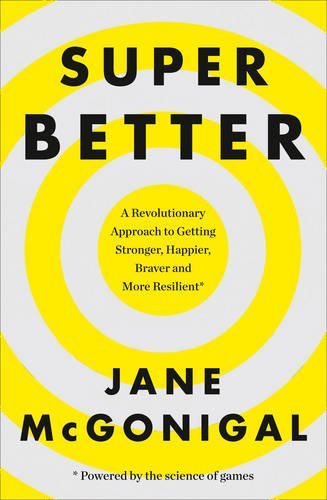
Jane McGonigal (born October 21, 1977) is an American game designer and author who advocates the use of mobile and digital technology to channel positive attitudes and collaboration in a real world context.
The concept is great, but I didn't really get into this book. Lots of quests, many of them banal.
Jane McGonigal did have some interesting facts about game playing. She described how playing Tetris for ten minutes within six hours of suffering a trauma reduces PTSD (Post-traumatic stress disorder), as hundreds of studies have proven. Playing the game does not erase the memory, but helps to stop involuntary memory, preventing flashbacks.
She describes how video games can help control cravings. You can control your thoughts and cravings by fully absorbing the visual processing center of the brain, and give pleasurable neuro-mechanical rewards. Also, falling in love can dampen cravings for food, alcohol, and drugs, as was discovered through fMRI's.
Hand-held video games can help reduce children's anxiety before surgery. Other distractions, such as music, comic books and cartoons don't work as well because of the lower level of cognitive absorption. Games and play are the "quintessential flow activity." McGonigal also mentions that mindfulness meditation has similar benefits to casual game play.
McGonigal is clearly an advocate of certain video games. Playing video games is good when they are viewed as a challenge, but bad when they are used as an escape mechanism. She describes how playing Farmville literally saved a marriage!
McGonigal also takes on the subject of violent video games. She writes that aggression associated with violent games is actually related to feelings of incompetence after losing. But this only occurs when playing alone or with strangers. When people play against others in the same physical space, it decreases aggression and hostility, and increases empathy.
So, while I enjoyed reading about McGonigal's philosophy of game-playing, I didn't really get hooked on using quests in everyday life. But this is a personal thing--perhaps others will get hooked more than me.
This book would be better named SuperHype primarily because McGonical has grossly exaggerated the science behind games.
The research on McGonical’s game SuperBetter best exemplifies this.
The dropout rate from the SuperBetter study was huge - about 90%. This is despite recruiting a group of highly motivated participants. So the bottom line is that even the most motivated people struggled to engage with SuperBetter.
The high dropout rate makes any claims to the benefits of SuperBetter highly questionable at best and realistically probably irrelevant. As the authors of the research say “……. should be interpreted cautiously in light of high attrition rates and the motivated, self-selected sample.”
I’d also point out the research was very poorly designed. As mentioned earlier – small biased sample (predominantly females interested in positive psychology), no placebo control (is it better than a sugar pill?), self report measures, and no reasonable follow-up (does it last longer than a month? – most of these interventions don’t).
The poor quality of the research and the high dropout rate probably explain why the research couldn’t be published in a first grade journal.
I have just focused on the gaming of science in the book. The New Yorker also carried an excellent review that expressed far more eloquently than I could many of the other issues with the book (google “A new movement seeks to turn life’s challenges into a game.”)
Finally the book is hardly revolutionary. For those who have read self help books, the information will look awfully familiar to you. This is a central theme of the other negative reviews of this book.
It really is the same old information dressed up in the hype of gamification. An article "it looks like the whole gamification thing is over" in fortune magazine best captures this. I guess this is why McGonical avoids using the term gamification.
Don't you find it intriguing that Superbetter has supposedly helped 400000 people, yet no one else seems to be able to make gamification work? And everyone of the 400000 people kept using SuperBetter, which is contrary to what the superbetter study found. How could this be?
As an aside, SuperBetter is based on positive psychology. And research suggests the impact that positive psychology has on depression is limited. See http://tinyurl.com/nzherb3. So sadly it would seem SuperBetter was going to fail before it even got started.
So would I recommend the book? If you are into science fiction or fairy tales, then you might find the book interesting. However if you after something that will improve your wellbeing, then probably not. Games might work for some people but for most they are just an interesting diversion from reality (sorry couldn't resist the bad pun on McGonicals previous book - reality is broken)
I have also avoided opening the “can of worms” that suggests that games might have an adverse impact on health and wellbeing.
And Ms McGonical - I am happy to correct any factual errors
I am one of the first people to admit that video games are a tremendous waste of time. They are used by a lot of people to avoid reality, but that is not what this book is about.
Super Better is a refreshing look at the science of gaming, and its main claim is that we can use gaming theory to enrich our lives and overcome our weaknesses by turning the entire thing into a game, rather than an ordeal.
I listened to this book as an audiobook, which was very frustrating because there is a lot of material in it that does not lend well to easy listening as you drive. There are concrete steps that lead you to design your own game to transform your own life, and I had to get a hard copy of the book to lock down the concepts.
Super Better challenges the reader to pick a quest, find a bad guy, enlist allies and go after nagging problems with a gameful, more positive attitude than they might normally use. I intend to try it out for the next month to see if it works, even though I am not a gamer by any stretch of the imagination. There is a Super Better website and app, and it has its own community of gamers.
Jane McGonigal uses her own experiences dealing with recovering from head trauma to show how she developed the game, and it seems to have worked well from her. She claims that people who have great traumas can experience growth from the experience. Even better, those who do not experience traumatic events can grow as well by experience growth inducing quests related to their life goals.
There is a lot of science backing up her claims, which is most impressive, and the stories of burn victims using games to combat pain or trauma victims playing Tetris to keep the memories from locking in and causing later issues was fascinating to me.
My main problem with computer and video games is the enormous time waste when immersed in an alternate world that has little to do with the real one. Superbetter warns against escapist gaming, and says that intentional gaming, used to improve real world performance is extremely powerful.
Not an easy read or listen, but a good book to shake up your thinking and make your life more fun and powerful while decreasing stress and depression. Four stars.
While this book is well written and has an interesting premise, it should not have been more than an article. Stretching it out to a full-length book makes it lose its edge and become a tedious chore to read.
This was a pretty amazing book and definitely changed the way I think about games. The first section is a very well researched rundown of all the ways gaming can help us, how it can build connections with others and motivate us to do better all the time. In the second section McGonigal lays out a plan for using gaming to help a person achieve just about any personal goal.
I felt like this could really work and could make a difference in my life and others. Unfortunately, I was not in a place where I could actually follow along and do the steps. And as I got further away from reading the book my drive decreased. I still hope to some day get back to it and use the system. Even without using the book properly I think it made some small but significant changes in the way I approach problems. I highly recommend this book but read it during a time when you will be able to really engage with it.
Having a super positive frame of mind to start with, I got through the first hour or so of this audio book and am deciding to set down. Yes, I've read many of the reviews and I can see why others find this framework help. It's just not for me.
So I first fell in nerd-love with Jane McGonigal when she performed a TED Talk and wrote her first book (Reality Is Broken). SuperBetter is even better and there's also a great TED Talk to introduce it. Or rather, if Reality Is Broken gave readers a well-researched argument for why gaming is an important part of our human nature, SuperBetter gives us the guide on how to actually make life more like a game and improve mental, emotional, physical, and social health. She stacks the first half talking about the game she has devised (SuperBetter) and the research it has been built and tested upon. For the second half, she breaks down how you can play the game on your own and with friends. There is even an app and website you can log your gaming efforts into. What I like so much about McGonigal's prose is that it is accessible and lively. She's encouraging throughout for people to make even the smallest bit of progress to their goals. Additionally, the ways to play the game she offers up are actually really smart ways of just improving one's life without having to start some dread and draconian regime. If you want to change your life and have fun doing it, check out this book!
I like the idea of SuperBetter a lot. I have been playing strategy and roleplaying games since I was a wee one, staying up way too late to get JUST ONE MORE TURN in on Civilization 2. I have tasted sweet victory upon getting that rare item I wanted in World of Warcraft. I have thought long and hard on ways to make doing 10 pushups worth 10 experience points so I would be "completing a quest" and "leveling up" because when it is obfuscated like that I am much more likely to do it.
But I have never found the answer to sticking to it or designing it how I want - and unfortunately this book did not lend itself to that answer either.
Based on the examples given here, it seems like SuperBetter could help if you are combating a very specific problem. It also seems to help if that specific problem is health based. So you want to recover from a sports injury? The assigned physical therapy is your daily quest, and your epic win is when you are again able to run a mile. Easy! That's measurable, you want to do it, and there is a distinct moment when you have won.
My goal is more like..."Be Better." And that just does not translate well - for me, at least - into the SuperBetter game.
It was very popular science-y. There was one part where she talked about autophagy which is a relatively new discovery. "Self-eating" is essentially the body's janitor system and universally recognized as being really, REALLY good for you. And she spun it to be a bad thing, literally the only person I have ever heard mention autophagy in a negative light. So if she can be so wrong about that, everything else in the book is also under suspicion. I stopped trusting her after that.
I read this book as an audiobook and although Jane McGonigal was a pretty good narrator, it was not a great audio experience. There would be quests like "Get up right now and hold your hands above your head for 10 seconds." Well okay but I'm driving right now? Or "Write down your 5 bad guys." I can't because I'm about 30 minutes away from the house on a walk? So I did not get the workbook exercises and my experience suffered because of that. I was hoping there would be a PDF download of the worksheets throughout the book - but no. So if I wanted to do a quest that required writing items down, I would need to go find that exact chapter and fast forward to the spot. That's not gonna work for me. So the audiobook was just okay.
Things I liked: A pragmatic and potentially fun approach to post-traumatic growth. Positive and strength-based psychology methods presented in lighthearted and approachable packaging. Basically, if you're into games at all, and facing some kind of challenge where you've felt stuck, I think the methods presented in this book are solid. I already use a lot of the methods with clients, and I can see lots useful applications for framing these methods using a gaming mindset.
I love the idea of turning our identities and ego personas into tangible heroes and bad guys, and framing/seeing/recording our progress as "power-ups" and "quests" and "epic-wins", I especially love the recruitment of allies, and the pragmatic and low pressure ideas for building community and improving relationships around mental health fun times.
I like that she has free app (haven't checked it out) for helping to implement the ideas in the book.
Didn't love: i think she has a tendency to over-simplify and over-state the research.
I don't know that it's *this* books fault, or any particular book, even, but I'm kinda generally annoyed with the self-help genre, and this has many of the faults of the genre. She does occasionally mention the role of luck/privilege (to paraphrase "If you're working two jobs and just barely covering the bills, this isn't going to be a cure all") but on the whole so much of what is ailing us is systemic inequality. and I'm tired of packing up the solution to systemic problems in a self-help bow. But that said, the ideas here are solid, practical and fun.
Wish the book delved into more of the psychology like it did at the start, but like most self-help books the science got overshadowed by the constant "this method works, it sooo good, just do itt".
Such a practical book. I love that. This one should be read hard copy though for best effect, I believe. But I still had a great time reading the audio version. I took so many notes and will just leave them here in random order because they're that good.
Post-traumatic growth is getting super better. But if we bounce back too quickly we miss the growth.
You can experience the benefits of post-traumatic growth without the trauma if you are willing to undertake an extreme Challenge in your life such as running a marathon writing a book, starting a business, quitting smoking, becoming a parent. Is it called post-ecstatic growth or gains without pains. We discussed this in my book group when we talked about Man's Search for Meaning.
7 ways of thinking that contribute to post-traumatic or post-ecstatic growth that you learn from gaming:
1. Adopt the challenge mind set. Be willing to engage in obstacles and look at stressful life events as a challenge not a threat. (In games this is called accepting the challenge to play.) 2. Seek out whatever makes you stronger and happier. (Powerups) 3. Strive for psychological flexibility. (Battle a bad guy) 4. Take committed action (a quest) 5. Cultivate connectedness (Making allies) 6. Find the heroic story (you are the hero) 7. Learn the skill of benefit finding (epic wins)
Super better turns can't into can. All the can'ts you tell yourself each day slowly murders your soul.
Whenever you sit down for a few minutes your body starts to shut down at the metabolic level.
Snapping your fingers 50 times increases mental strength and willpower.
Gratitude is the single most important relationship strengthening emotion.
She said that 99% of boys and 92% of girls play games regularly under 18. I don't know about that one.
All games teach you to be uncomfortable with failure because loss is always a possibility. Digital games increase that number. You fail 80% of the time and that adds up to building Grit and perseverance. And you learn effectively from your mistakes.
Having your palms up for 15 seconds opens your mind. This was a neat tecnica that works pretty well.
Video games can help with reducing pain like morphine. In fact it was stronger than morphine. It does it by diverting the mind's processing Power.
The first 6 hours after a traumatic event is where your brain is malleable and you can alter having PTSD such as playing Tetris (or bejeweled or Candy crush, and for you old fashioned people jig saw puzzles work well too). This is what I should have done a few months ago when Jerry showed me the worst video in the world and shook me to my very core. Tetris occupies the visual processing circuitry of the brain with something other than is usually preoccupied after a PTSD event involuntarily remembering the trauma over and over again. So in other words in order to interfere with the involuntary visual demands of a traumatic memory event you have to swing the spotlight to something that specifically demands a huge attention of visual attention. The Tetris technique doesn't erase those traumatic memories though, it simply stops the cognitive process or involuntary memory. It gives you control over the memory. You won't think about it when you don't want to. There again, playing Tetris for 3 minutes will cut a craving by 25%. A 25% reduction in a craving is enough to change behavior. Cravings have a very strong visual component. The more you can imagine your craving the more you'll give in. Hence Tetris distracting you reduces that craving. This is gold!!
Anxiety can be a queue or a call to action. That's why we shouldn't always be trying to suppress or block it like idiots do. Because it can be a helpful emotion. If you feel anxious about an exam then study for it so you'll be prepared. If the anxiety is not helping you identify concrete, positive steps you can take but rather is creating distress, play a game. If it's preventing you from doing something you truly want (like become a pilot) block it by playing a game for a few minutes. The reason why games are much better at this is because they provide a better quality of mind absorption called Flow. Flow is state or being completely cognitive absorbed in an activity. Flow is an extremely positive psychological state. Keep in mind that games are meant to compliment and not replace therapy.
Elon Musk plays and makes games. I think that has helped him with his success.
Experiencing success together makes people more likely to help each other in the future. That's why gaming with friends or even strangers is good.
Those family and friends who play online games together are more likely to see each other in person.
Instead of asking someone "how was your day?" Or "how's it going?" Ask them, "on a scale of 1-10 how was your day?" And then follow up with "how can I make it from a 3 to a 4 or a 7 to an 8?" This works great with family and strangers. I did this with my brother in law and instead of his annoying one word answers he actually wrote out a complete sentence.
Playing online games that are very competitive such as Call of Duty with strangers, increase testosterone in men and make them less empathetic with the strangers and thus can spill over in real life. But playing with people you know in the same room as you actually decrease hostility and aggression.
The violence that comes from video games is people feel incompetent after losing and feeling humiliated usually because of playing with strangers.
Self efficacy is the belief that you yourself can effect positive change in your own life. It's not the same thing as self esteem. It's having confidence in achieving goals. It's the crucial difference between having lots of motivation but failing to follow through and successfully converting motivation into consistent and effective action.
Making an avatar of yourself boosts self efficacy and helps you to do things your avatar does like exercise, eat healthy, etc. When people play the Sims and they make an avatar like themselves doing those good things they will do them in real life.
Making a prediction is one of the most reliable and efficient ways to prime the reward circuitry of the brain.
The reason why some people benefit from gaming and others don't is because of this simple question: why do you play games? To escape from your life or do you play games to enhance your life? There are two different kinds of immersion while playing games self oppressive immersion and self-expansive immersion. Any escaping activity as self suspressive.
The biggest lie we tell ourselves is that the fastest way to feel better is to avoid rather than engage.
First person video games help you lucid dream and have control of your dreams and do things such as flying.
Playing more than three hours a day or 21 hours a week of video games is too excessive and does take joy from The Real World.
It is because of games that Duolingo is so successful for me. And doing Google/Goodreads reviews. The Willpower book talked about games needing to be tapped into because they are very powerful agent for helping someone do something.
It's rare to feel hopeless or have anxiety during gameplay. You might feel stressed out but you're determined to win.
We need to view our obstacles as challenges more than threats when we do something as a challenge we think of the best that could happen when we see something as a threat to rethink what's the worst that could happen.
Wow one of the tips she gave is lucid dreaming and combating your fears. Dream sharing boosts trust and intimacy between two people.
When you consciously clench or flex your muscles it strengthens your mind.
Humming reduces inflammation in your nasal cavity.
Her post concussion life sounded like the worst. She couldn't do anything that stimulated the mind. Just sat there.
People who think of physical activity as exercise or something hard will be more likely to eat treats and dessert and other high calorie snacks afterwards. But if you think of it as something fun and pleasurable that is it's own reward and you don't have to go seeking for snacks and treats for a reward when you "exercise".
Quests need to be driven by your values. One quest a day should be completed. Quests are about making steady progress and epic win is a major breakthrough about yourself.
Your heart literally is stronger with social support.
Self distancing helps you see the bigger picture when seeking self discipline and helps you combats your weaknesses.. Don't say "do I want to drink this SODA?" Instead say "does Kimball want to drink this SODA?" Better yet say "does [insert your hero's name here] want to drink a SODA?"
We create ourselves through conforming to our own mythic story.
The ability to identify turning points in your life's narrative is a key predictor of post-ecstatic or post-traumatic growth.
That's a good idea when you have a dog to celebrate their birthdays (every 52 days) and do things the dog loves.
Regular exercise helps you be less vulnerable to physical pain as your body becomes conditioned and knows what's hard and what's not.
Areyougameful.com to take various optimsm tests and others.
To write a book I need to collect the habits and skills that are important for Success, those are power ups. The obstacles that might get in my way are the bad guys. And finally come up with one or two weeks of tiny goals or daily Quest that will help my players practice getting better or whatever my adventure is about. It's especially fun to combine forces and design an adventure with a group.
Put your hands over your heart for a small amount of time to boost your self love.
People who feel powerful feel time rich.
On Time: To make the day seem longer, do something for the first time. This is because the more predictable and familiar the experiences to you the less work your mind has to do to process it and your brain can take a shortcut. The less work your brain has to do the faster you can process it and the faster time flies. If your brain processes the event quickly it thinks it happened quickly. So that's why it's important to take things slowly so that way your mind can process it slowly and time will feel more abundant. That whole paragraph right there explain why time flies better than the whole book, Why Time Flies: A Mostly Scientific Investigation.
Full disclosure, this book lost me less than halfway through.
Apparently everything that can remotely improve mental health is considered "super better". There's no unique or clear method, measuring stick, or goals. There were so many things to do to be super better, It's as if McConigal did very a brief and sporadic glance through wikipedia articles, put all of the suggestions in a hat, and then wrote everything down as she drew it out. She would make a point and then repeat it twice, sometimes three times. Everything was written like she was a student who was ten pages and several ideas short on her term paper. Every piece of supporting drivel that was convenient to her ideas was passed as science, research, and data.
McGonigal spent the first quarter of the book trying to argue that 21 hours a week of candy crush is a good use of time. I don't think the attention-starved children of the millions of bored forty-year-old moms would agree. The more adamant McGonigal argued her case, the clearer it became as to 1) how little she actually did any research into the effects of these games, and 2) how little she knows about actual gaming culture to call people addicted to apps "gamers".
I was excited to read this because I thought it would be about gamifying my time and goals. I like to quantify my work days, my personal hobbies, and even my commute into how I can improve- but this book wasn't about that. Terrible execution.
But I loved the sprinkling of tips and the writing style that was convincing without ignoring the work's shortcomings or caveats.
I'm going to play this even though my response to this was "I understand what I'm supposed to imagine but idk how it applies to me." I guess I'll have to just try and figure it out as I go.
3 powers ups, 1 bad guy battle, and a quest daily. Seems simple.
tips: Palms up for 15 seconds to become more open Game stopped the cognitive resources (blood flow) to pain processing centers Game support translates to real social support Self-suppression and experiential avoidance can be compared by purposeful playing 21 hours a week is the tipping point of when games are productive. more than 3 hours a day takes too much time from outside game pursuits Anxiety and Excitement are the same physiological state - it's how the mind processes it. Tell yourself out loud you're excited (I've been saying this for years). Challenge mindset > threat mindset Boost your vagal tone! reflect on your social interactions Humming increases nitrous oxide in nose >> less headaches We focus on weaknesses over strengths. Name your strengths.
"I realized I didn't have to believe the voice in my head telling me to kill myself because it didn't represent my true thoughts or feelings....I didn't have to fix the suicidal thoughts. I just had to acknowledge them and wait for them to pass."
I was pleased to read this book for several reasons, at least in general, largely because the approach discussed in this book is one I tend to undertake. The author encourages readers to view their lives as a game, and to treat the various aspects of games like quests [1], power ups, allies, and enemies/obstacles as aspects of one's life as well. This is something I regularly do, and I have found that it tends to add some level of optimism to a life that is frequently on the melancholy to gloomy side, it must be admitted. The book is itself written in order to encourage better health outcomes by increasing resilience and a sense of responsibility and hope among people suffering with serious illnesses, and I can see this as a worthwhile aim in public health, although the author has to make it plain (at the beginning and throughout the book) that this is not being done to replace medical care but rather to supplement and encourage it. Likewise, this book is aimed at those who already have a positive view of games, as those who view games in a negative fashion will likely be highly resistant or skeptical to the book's gamification of life approach.
This book is about 400 pages long and is divided into three parts. The author begins with a discussion about what one needs to know before one plays the SuperBetter game as well as an introduction. After that the author has four chapters on why games make us superbetter (I), including the fact that we are stronger than we know (1), we are surrounded by potential allies (2), we can be the heroes of our story (3), and that we can make the leap from playing games to being gameful (4). After that the author explores various ways to be gameful (II) by encouraging the reader to challenge oneself (5), gain power-ups through beneficial behaviors (6), deal with various bad guys and obstacles (7), engage in quests for things that have to be done (8), encouraging one to gain allies (9), adopting a secret identity (10), seeking to gain epic wins (11), and keeping score of how one is succeeding in life (12). After that the author discusses some adventures (III), giving very long quest chains for games she calls love connection (i), ninja body transformation (ii), and time rich (iii), after which the book ends with some notes about the science of the book's approach, acknowledgements, notes, and an index.
Ultimately, gamification is something that people have mixed feelings about. There are some people who view games as a terrible waste of time and something that can actively threaten relationships. Yet if viewed wisely, games help us realize certain aspects of our lives are very much like games, and that if we are skilled in recognizing these features, we can gain a sense of freedom as a player in a game rather than feel as if the world is hostile to us. We do have powers, even if they are limited, and we do have allies, even if we also have enemies as well, and realizing that life is full of quests to accomplish that enrich our existence and make it easier to see the success we have in it. Admittedly, I am a highly biased reader of a book like this in that the way I enjoy games, not only video games but tabletop role playing games, and in gamifying life, all of which predisposes me to appreciate this book and its approach even if I find the book's attempt to curry scientific favor more than a bit entertaining. If you dislike games, though, and find it insulting that one would view life as a game, this book would probably not appeal to you as much as it does to me, though.
Wow, this is an amazing book. I listened to it from the library as an audio book. I’ve now ordered a hard copy for myself and plan to reread it. I’ve already had the opportunity to recommend the book to others who are struggling with depression and health concerns. A playful, empowering, and innovative way to look at mental and physical health.
I like the computer version/app SuperBetter better than the book. It really comes to life in the "doing." The book is very well-written. McGonigal takes the features and strategies of games, especially video games and applies them to life goals. The best part of this book was the section on allies. I also liked the real-life examples.
Sehr spannende Ansätze. Einige davon hab ich tatsächlich selber ausprobiert und würde sie auch wieder einsetzen. Herausforderungen auf spielerische Art meistern: Wirklich ein lehrreiches und interessantes Buch, da das Thema für mich komplett neu war.
This book and the science behind it is so interesting and I’m excited to start playing!! I love how customized it can be for anyone, anytime, anywhere.
I loved this book thoroughly. It was long and because there was a lot to take in, I had to take breaks, but I feel like the read was life changing and will stick with me.
I like applying gameful elements in the classroom. It’s no surprise that I would enjoy a book about applying gameful elements to live a Super Better life. I really enjoyed this read and I’m enjoying adding it to my life.
If you are a gamer and struggle with goal setting or maybe have ADHD and struggle with focus, this book has some practical ways to make your tasks fun.
On the one hand, I think the method described in this book has a lot of wisdom behind it. I think it's smart, potentially effective, and I am planning on trying it fairly thoroughly. I am actually feeling more optimistic about things that have dogged me for a long time. I'm also realizing that there are "gameful" things I have been doing my whole life to improve my life that dovetails with this book.
That said, there is a lot about the way this book is written that pushed me away and turned me off. Now this could be just because it's a self-help book written in an immensely self-promotional style. It felt hucksterish, bordering on cultish. It's just so over-the-top and cloying in its "this works, this is amazing, it's so so so SO great" approach. Again, this may just be the genre and what's expected. But it made the actual reading, even while I was decently inspired by the premise, challenging to get through.
Even the name, SuperBetter, just feels so toxic positivity culture and glib. (I hasten to add: I don't think the actual METHOD is either of these things.)
So... 5-star method in a 2.5-star package? 4 stars, I guess. I do recommend you read it if you are hoping to prioritize your mental health and you enjoy games of any kind. Just be prepared to cringe a fair bit.
(The English review is placed beneath Russian one)
Как я понимаю, главной или первой книгой автора стала книга по компьютерным играм «Реальность под вопросом. Почему игры делают нас лучше и как они могут изменить мир» (Reality is Broken: Why Games Make Us Better and How They Can Change the World). Возможно, автор решила добавить к своей основной теме (game designer), более распространённую и популярную среди читателей (т.е. на эту тему пишут все кому не лень) – популярную психологию. Я делаю такой вывод не потому, что автор не является практикующим психологом или не является академическим учёным и пр. Вовсе нет. И журналисты и в целом не профессионалы могут написать хорошую, качественную и интересную книгу. Я делаю такой вывод исходя из содержания этой книги. Нужно сразу признать, что вопрос, который выбрала автор – положительное влияние компьютерных игр – выглядит довольно революционным, т.к. на эту тему я ещё никогда ничего не читал, хоть всегда чувствовал, что компьютерные игры, при умеренном времяпровождении, способны приносить пользу. Так что книга в этом смысле, уникальна (на сегодняшний день). И да, мне понравилась теоретическая часть, но только теоретическая. Книга поделена на две части – теоретическую и практическую. И если у вас нет каких-либо проблем, которые можно было бы решить, то я думаю, первой части будет достаточно, т.к. вторая настолько специфична, что, как мне кажется, заинтересует она только некоторую часть людей. Лично я быстро потерял интерес, перейдя ко второй части книги. Исходя из этого, я сосредоточусь только на первой. Итак, как я уже сказал, главная идея книги состоит в том, что компьютерные игры способны быть полезными. Когда и при каких условиях? В основном, когда дело касается стресса, включая сильный стресс после какого-либо страшного события в жизни. Как пишет автор, компьютерные игры, единственные инструменты (если мы можем так сказать, инструменты терапии) способные отвлечь от тревожащих мыслей, от стресса вызванного боязнью полёта или предстоящим публичным выступлением. Именно компьютерные игры способны сначала поглотить внимание, унести вас от тревожащего вопроса, а потом помочь расслабится. Далее, это уже что-то типа «реальность как игра». Тут автор пишет, приводя пример детей, которые должны были принимать лекарство, строго следуя за графиком, т.е. любой пропуск вёл к очень серьёзным последствиям. И тут автор предлагает привнести в реальность элементы компьютерной игры. Я не совсем понял, существуют ли подобные игры в действительности или это некое фантазирование. В любом случаи, суть остаётся той же самой. Ну, и последнее что я запомнил, это то, и я сам это всегда использую, когда оказываюсь в подобной ситуации, что игры помогают существенно поднять настроение. С моей практической точки зрения, это так. Хорошие и интересные игры действительно способны и поднять настроение и отвлечься от чего-то негативного. В принципе, автор будет много писать о том, чем могут помочь игры и опять же, в принципе, список довольно существенный. Поэтому мы можем просто сказать, что компьютерные игры, при умеренном использовании и без попытки убежать от реальности (автор это будет подчёркивать особо), благополучно влияют как на здоровье, так и на социальные навыки. И вот социальным навыкам автор посвятит вторую часть первого раздела книги (всё того же теоретического). Тут будет и история про то, как игры спасли брак и как они помогли налаживанию отношений с детьми и как они влияют на социальные связи в целом. Всё это и всё о чём я писал выше, будет дополнено разнообразными экспериментами. А теперь главный недостаток книги. В книге отсутствует строгая теоретическая часть. Всё очень похоже на некий mix, сборник, но никак не на строгую, чёткую и полноценную теорию. И исходя из этого, прочитанное быстро забывается. Авто не предлагает нам новую большую тему, а просто рассказывает интересные истории из жизни людей и интересные эксперименты, без попытки построить что-то значимое как это делали такие психологи как Фрейд, Юнг, Маслоу и пр.
As I understand it, the main or the first book of the author was the book on computer games "Reality is Broken: Why Games Make Us Better and How They Can Change the World". Perhaps the author has decided to add to her main theme (game designer), a more common and popular theme among readers (i.e., this theme is written by everyone who is not lazy) - popular psychology or self-help. I make this conclusion not because the author is not a practicing psychologist or an academic scientist, etc. Not at all. Journalists and not professionals in general can write a good, high-quality and interesting book. I make this conclusion based on the text of this book. I must admit that the question that the author raises - the positive influence of computer games - looks quite revolutionary, because I have never read anything like it, although I always felt that computer games, in a moderate pastime, can be useful. So the book in this sense is unique. And yes, I liked the theoretical part, but only the theoretical one. The book is divided into two parts - theoretical and practical. And if you don't have any problems that could be solved, I think the first part will be enough, because the second one is so specific that I think it will interest only some part of people. Personally, I quickly lost interest, moving on to the second part of the book. On this basis, I will focus only on the first one. So, as I said, the main idea of the book is that computer games can be useful. When and under what conditions? Basically, when it comes to stress, including severe stress after a terrible event in life. As the author writes, computer games are the only tools (if we can say so, therapeutic tools) that can distract from disturbing thoughts, from the stress caused by fear of flying or the upcoming public performance. It is computer games can first absorb attention, take you away from the disturbing question, and then help relax. Next, it's something like "reality as a game". Here the author writes, citing the example of children who should have taken the medicine, strictly following the schedule, ie, any omission led to very serious consequences. And here the author proposes to bring into reality the elements of computer games. I did not quite understand whether such games really exist or whether they are some kind of fantasy. In any case, the essence remains the same. Well, the last thing I remember is that, and I always use it myself when I find myself in a similar situation, that the games help to raise the mood significantly. From my practical point of view, that's right. Good and interesting games can really make you feel good and distracted from something negative. The author will write a lot about how the games can help and the list will be quite substantial. Therefore, we can say that computer games, with moderate use and without trying to escape from reality (the author will emphasize it), successfully affect both health and social skills. But the author will devote the second part of the first section of the book to social skills (still the same theoretical). There will also be a story about how games saved the marriage and how they have helped to build relationships with children and how they affect social relations in general. All of this and all of the things I have written above will be complemented by a variety of experiments. And now the main drawback of the book. The book lacks a strict theoretical part. Everything is very much like a mix, a collection, but not a comprehensive, clear and complete theory. And on this basis, the readings are quickly forgotten. The author does not offer us a new big topic (the theory), but simply tells interesting stories from people's lives and interesting experiments, without trying to build something meaningful, as it was done by such psychologists as Freud, Carl Jung, Abraham H. Maslow, etc.
Did not finish. The due date came up and I'm still not done. I guess I'm just not a gamer at heart. I did load the app to see if this works for me (still just a couple of days in). Most of the information contained has me questioning things. I would see this as more targeted to a gaming audience.
The first section of this book was exactly what I wanted it to be: a great resource and breakdown on the latest research into games and their impact on health. Jane McGonigal is a performance phycologist that has spent decades designing video games and studying their impact. This is the best resource for this type of information and how video games can positively impact your life and your relationships. Some of the research on stress reduction or PTSD mitigation was truly surprising and hearing Jane tell her story about recovering from a massive brain injury was inspirational.
Later on this book shifts more fully into a self-help book designed to turn aspects of your life into things that more closely associate to the benefits we get from playing games. Essentially, what can we learn about games that we can translate into our daily lives? I mostly breezed through this part as I don't really enjoy self-help books but there was a lot of interesting ideas to chew on.