The Poem of a Life is the first critical biography of Louis Zukofsky, a fascinating and crucially important American modernist poet. It details the curve of his career, from the early Waste Land-parody “Poem beginning 'The'” (1926) to the dense and tantalizing beauties of his last poems, 80 Flowers(1978), paying special attention to the monumental, complex, and formally various epic poem “A”, on which Zukofsky labored for almost fifty years, and which he called “a poem of a life.” Zukofsky was a protégé of Ezra Pound's, an artistic collaborator and close friend of William Carlos Williams's, and the leader of a whole school of 1930s avant-garde poets, the Objectivists. Later in life he was close friends with such younger writers as Robert Creeley, Paul Metcalf, Robert Duncan, Jonathan Williams, and Guy Davenport. His work spans the divide from modernism to postmodernism, and his later writings have proved an inspiration to whole new generations of innovative poets. Zukofsky's poetry is oblique, condensed, and as fantastically detailed as the late writings of James Joyce, yet it bears at every point the marks of the poet's life and times.
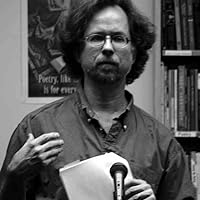
Born as military brat just down the street (he likes to imagine) from where Theodor Adorno was lecturing on the culture industry & modernist aesthetics. Bounced all over in his formative years -- Monterey CA, Syracuse NY, various bits of Germany, west Texas, western Kentucky -- then more or less settled down in middle Tennessee, but not before contracting a permanent sense of dislocation. Studied at Virginia Tech & Cornell University, with concomitant degrees. Now in south Florida, where he lives with his wife, a scholar of early modern & contemporary drama, & his two just unbelievably beautiful daughters.
Considers poetry his first calling (after several ephemeral chapbooks, Anarchy [2003] his first full-length collection), but has been deeply involved in scholarship on the poet Louis Zukofsky (1904-1978), whose biography he has written.
It isn't meant to dissuade but I felt a growing relief as I moved to finish this book. The author gave us as intended a life of a poet, the poem of a life. It is scholarly but haphazard. It keeps within the lines of hagiography while acknowledging the evidence against such. It is a life without much acclaim and yet the author appears as bitter about such as the poet most likely appeared. That is a different vein of scholarship: resentment in poetry. We could start with Doc Williams and how he felt eternally snubbed by Eliot and Bloomsbury. Pasternak was thin-skinned and John Clare just wanted to bring books into his house and not incur his wife's wrath while the the Keats of the world imagined Clare a grimy monkey penning sonnets. But alas, Zukofsky wasn't the Stoner of John Williams, nor was he steeped in a threadbare misery like Walter Benjamin. His adult life with wife and child is parallel to Nabokov except Zukofsky never had a Lolita. He was fashioned as the father of a movement Objectivism and he also had a intense period on the radical left. As he aged he began to view translation and quotation as the eternal voices and/or methods of the poetic spirit, though not in those fatuous terms.
I can probably say right now that I will not read this book in its entirety. It's not the fault of the book, which is clarity itself. I just never read biographies in their entirety anymore, and I don’t know why. Boredom, maybe, or maybe because they just make me want to read the actual productions of the subject, or maybe I just find it damn strange to spend my life reading about someone else’s life as told by yet someone else.
What I’ve read has been extremely helpful in my years long desultory reading of Zukofsky. He was a very heady poet, on the level of Pound or Joyce, so he’s difficult, but this critical-type biography throws some much needed light on his work – inspirations behind the poems, books and subjects that influenced him for a lifetime, personal intellectual preoccupations, how he structured his poems, etc. – that reveal his poetry as still difficult, but the type of difficult that is actually crystal clear. But of course even crystals can be impenetrable, however beautiful and translucent and incredibly alluring. So even with the assistance of this book Zukofsky is not for the oatmeal brained (not even steel cut).
As the title implies, the focus here is more on LZ's work than his life, though the intricate intertwining of both is developed with scrupulous attention and a brilliant reading of this most hermetic of poets, as Kenner called him.
Brilliant. I take my hat off to Mark Scroggins. He must surely be the most important Zukofsky scholar in the world today. This book, The Poem of a Life: A Biography of Louis Zukofsky, is part-biography part-literary criticism and to me, it was never boring, even though some may find Zukofsky's actual life rather insipid.
I emerged from this book with the hugest respect for Zukofsky and to paraphrase something Scroggins says near the beginning of the book, once the dust settles on the modernist poets, Louis Zukofsky may just emerge as the most important and brilliant poet of his time. During his own life, he certain felt that his work had been overlooked, lying in the bigger-than-life shadows of his contemporaries William Carlos Williams and Ezra Pound, who were both close friends.
When George Oppen, an early friend, and so-called member of the 'Objectivist' movement, comes back to writing poetry after an absence of about 15-20 years, to critical acclaim, and even obtaining a Pulitzer Prize, Zukofsky became incredibly bitter and jealous at seeing friends around him obtaining the recognition he deeply craved. However, if I had known Zukofsky, I would have argued to him at the time that that was possibly a good indication that he was a superior artist. For the truly gifted and deep artists often go ignored or are passed over, and sometimes not recognised until after their death. Melville's Moby Dick is a classic example - it wasn't until a Melvillean scholar brought it back to the public's attention that Melville could finally rest a little more in his grave and reap the posthumous acclaim that he so rightfully deserved.
Finally, towards the end of his life, around the mid-60s onwards, Zukofsky begins to receive some of the recognition that had been eluding him for most of his life. And this volume, along with another great book of critical analysis by Scroggins called The Poetry of Knowledge are going a long way to correct this wrong and help put Zukofsky's difficult work in an easier light to comprehend. I don't mind if a work is difficult as long as it's not difficult AND boring. To me, that's the difference between Zukofsky and some of Gertrude Stein's work (not all) - Zukofsky is NEVER boring but extremely intriguing.
As a previous reviewer pointed out, Zukofsky had a fairly straightforward life as a struggling poet working various jobs, such as writing electric manuals for companies and teaching (a profession much more congenial to his temperament and talents). However, last year, when I was teaching a course on LZ using his Selected Poems, I gave students the assignment of presenting on one Objectivist poet of their choosing and one presenter talked about something which shocked me a little - something which I now know is possibly just a false rumour spread to discredit Zukofsky. According to a certain Reisman, and Mary Oppen (George Oppen's wife) who heard this story probably from Reisman as well, Zukofsky had a brief affair with Lorine Niedecker (one of the few female poets in the Objectivist camp) and she got pregnant. According to Reisman, Zukofsky asked her to have an abortion. When I heard this story in my student's presentation, it completely changed my opinion of him. I don't mean on just moral grounds but also in terms of the poetry. So much of LZ's poetry refers to or is directly about his wife, Celia Zukofsky, and he dedicated much of his poetry, including his final obscure but fascinating work, 80 Flowers, to Celia himself. If this story were true, did Celia ever find out about it? And wouldn't that make Zukofsky a bit of a hypocrite then? etc. It set off many questions but Mark Scroggins partly put my mind at ease in the Afterword at the end of the biography - he basically debunks or delegitimises Reisman's claims and indicates that clearly he had an axe to grind with Celia Zukofsky and possibly with Louis as well. Unfortunately, it seems that some other scholars, including one of my own students (who presented on Niedecker) have swallowed this story hook, line and sinker without questioning its veracity. All things considered, there is insufficient evidence to say whether this happened or not. Niedecker's letters to Zukofsky have survived and have been published but the letters from Zukofsky to Niedecker are in the Harry Ransom Center for Humanities at the University of Texas, where Louis Zukofsky's archives and manuscripts, typescripts etc. are mostly held.
The 'Objectivist' camp is a very loose group of poets, who really had little in common, other than the fact that they were published together with Zukofsky under a famous issue of Poetry magazine. Harriet Monroe pushed Zukofsky to come up with a name of the group of poets, or even better - the name of a MOVEMENT. This was partly Ezra Pound's idea - a friend and figure who appears frequently throughout this biography. Therefore, Zukofsky comes up with the idea of 'objectivist poetry' in the sense that the goal, as he saw it, is to create a 'perfect' poem that would look like an object or exhibit in a museum. Others have interpreted the word 'objectivist' (also referred to as 'sincerity') in the sense of 'objective' vs. 'subjective' and after reading George Oppen's first but brief book of poems, Discrete Series, I did indeed get the feeling that all subjective emotion or feeling had been left out, insofar as possible. Ultimately, this was more Louis Zukofsky's idea than the others but since that issue was published, Oppen, Reznikoff, Rakosi, Zukofsky himself and a few others such as Basil Bunting (another close friend) and even Kenneth Rexroth have been loosely bundled under this category. It is just another means of conveniently 'pigenholing' poets into certain time frames and eras. In a more general sense, these poets were all part of a logical extension of modernism, or dare I say even 'postmodernism' in some respects.
Out of all of these poets, perhaps Louis Zukofsky was the most ambitious and revolutionary writer of them all - creating a masterpiece "A" based on the fugal form of Bach, and creating a whole new approach to translation - homophonic or aural translation, in which he tried to replicate or approximate the sounds of Catullus's Latin and the Hebrew texts of the Bible and even some Classical Greek poets into English. This approach to translation was and continues to be very controversial as meaning is unloyal to the original text at best, and at worst, incomprehensible at times. This is because Zukofsky had to resort to using antiquated language from Shakespeare and elsewhere in order to come up with the vocabulary which would be able to replicate the sounds of Latin, Greek and Yiddish etc. What is the advantage of this method? Well, to some degree, the person reading LZ's translations can 'hear' some of the sounds or MUSIC (a very important aspect of Zukofsky's work as a disciple of melopoeia which he reclassified as 'liquid state' poetry) of the original poems and therefore giving us access, to a certain degree, to the original poet's VOICE, without having to be able to read the original language. A truly fascinating but controversial idea.
All things considered, Louis Zukofsky was the poet of the modernist movement who took Pound's innovations one step further and tried to do new things with language and poetry. The 'music' of his poetry is what he will be remembered for, as well as some unforgettably beautiful visual lines (phanopoeia or 'solid state' language) that appear throughout his work, especially his grand opus "A."
If you are interested in reading about a modernist poet, someone who was 'streets ahead' of everyone else, to the detriment of his career and consequent obscurity, then check this guy out. Scroggins is not just a good writer who has done a superb job of researching Zukofsky's life for a biography, he also UNDERSTANDS his poetry at an incredibly deep level and by reading this book, will open up many of the doors to difficult passages in Zukofsky's work, letting you enter and enjoy all the wonderful rooms of his mind, that are there lurking in his work, in the ink, and in the pages.
I'd been waiting for and wanting this biography. Louis Zukofsky was one of the more interesting and influential poets of his time. I'd had a long fascination with his work and had been reading his long poem "A"--the poem of his life--for years with a muddied understanding. This is critical biography focusing on analysis of all his work and is extremely helpful. My reading has produced a blizzard of marginalia and underlinings. He was an ambitious poet dedicated to strict form. What this book reveals about the disciplines he imposed on himself and used to corral his poetry is an immense aid to understanding. Though this is biography and traces the arc of his life, it has little to say about the details of that life. There's little to report. There are no shocking revelations, no scandals, no sexual exploits, no academic controversies. He led a peaceful family life, spent his professional life teaching at a small Brooklyn college, and quietly wrote poetry which was largely unread except by his peers. His life can hardly be written about outside the context of his poetry. I'd not known how influential Zukofsky was to the generation of poets growing up in the 60s and 70s. And while I was aware of his closeness to the New Jersey poet William Carlos Williams, I was surprised to learn of his friendship with Ezra Pound and by how much he'd been influenced by him.
Mark Scroggins shaped his biography of Zukofsky's work in a way that transported me, the reader, into Zukofsky's world so that I was able to experience the progression of events as they occurred in relation to Zukofsky's work ,and in turn, I understood how they shaped his work. That a biography may actually embrace the relationship between form and content, which is essential to creative writing works, is very puzzling and feels quite innovative.
I very much appreciated Scroggins's clear understanding of Zukofsky's poetics, which I think, makes a good point in favor of constructed poems vs. the Romantic notion of "imagination": "Zukofsky came to a realization. . . that human culture as a whole was an echo chamber, a series of repetitions and variations on a limited number of inexhaustible themes. . . . . The poet. . . does not create in a Romantic sense (as Coleridge's imagination, a repetition of divine creation): he 'sows,' 'composes,' and above all 'hunts,' hoping to find the recurrences in culture out of which to 'compose' his own poem"(424).
Again, an essential book in the study of poetry and poetics.
Z is fascinating as well as an essential poet. Scroggins delivers the info clearly (the facts) while discussing Z's work usefully. very good bio and study.