A, A' raises a troubling question: How would you feel if your lover died--and was replaced by a clone? Could recreate your relationship with someone who was physically exactly the same but didn't share any memories of your life together? In 4/4 (Quantre-Quarts), Mori, a teenager, is flunking out of an ESP training program. But when he meets Trill, a beautiful Unicorn, his latent abilities begin to blossom!
Unfortunately, Mori can't control the psyhic powers Trill stimulates in him, and Trill can't cope with the feelings Mori has set free in her! In X + Y, Hagio uses science fiction to explore questions of gender and sexual identity. Time has passed, and once again, Mori finds himself inexorably attracted to a member of the Unicorn race--but this Unicorn is male..and so is Mori!
Moto Hagio (萩尾望都 Hagio Moto) is a manga artist born in Ōmuta, Fukuoka Prefecture, Japan, though she currently lives in Saitama Prefecture. She is considered a "founding mother" of modern shōjo manga, and a member of the Year 24 Group (24-Gumi). She helped pioneer modern shōjo manga, modern science fiction manga, and BL manga. In addition to being an "industry pioneer", her body of work "shows a maturity, depth and personal vision found only in the finest of creative artists". She has been described as "the most beloved shōjo manga artist of all time."
Moto Hagio made her professional debut in 1969 at the age of 20 with her short story Lulu to Mimi on Kodansha's magazine Nakayoshi. Later she produced a series of short stories for various magazines for Shogakukan. Two years after her debut, she published Juichigatsu no Gimunajiumu (The November Gymnasium), a short story which dealt openly with love between two boys at a boarding school. The story was part of a larger movement by female manga artists at the time which pioneered a genre of girls' comics about love between young men. In 1974, Hagio developed this story into the longer Toma no shinzo (The Heart of Thomas). She was awarded the Shogakukan Manga Award in 1976 for her science fiction classic Juichinin iru! (They Were Eleven) and her epic tale Poe no ichizoku (The Poe Family).
This set of interlocking science-fiction stories does a ton (perhaps too much, really). Tragedy and romance, interrogations of identity and memory and gender and self-determination. There are things that may make you angry.
This is a book I really wish I buddy-read with other people so we could discuss it, especially as the author is more in the mode of proposing ideas or questions and not answering them or telling the reader what they should think. Or at least so it seemed to me.
Although the space setting and inclusion of hard science (don't worry, you don't need to understand it) were unexpected, this was thematically in some ways typical of Moto Hagio: pretty art, confused characters, interesting ideas that are presented as stimulation to thought rather than answers, loss and sadness, uniformly awful parents.
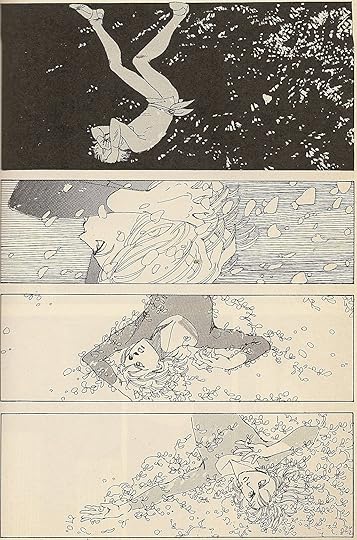
This image isn't from A (I couldn't find any right away) but there is a similar panel here of Tacto, or maybe it was Mori, falling through space to land on one of the moons of Saturn. (Her characters often fall slowly or are swept up.)
I'm not really one for sci-fi, but I thoroughly enjoyed these stories, the concepts, the characters, and the building and destruction of relationships. I like that the manga touched on some issues and topics that aren't usually focused on, such as intersexuality, ethical standards in experimentation, cloning, etc. There are some things about the book that made me uncomfortable, but for the most part I believe that was intentional on the part of the author. One thing that was upsetting to me [SPOILERS and TW for talk of potentially non-consensual medical intervention] was that noone really spoke out against the people pressuring Tacto to transition to become female. Even though Tacto says,"He has no preference," he also says before when he's first given the revelation that "he won't be injected with female hormones" and that "when he returns from Mars, he'll have [his ovaries] removed". Again, the issue with the whole being a subject of an experiment comes into play, as well as society's standards. The subjects seem to have few rights to their own bodies- especially when they are of the Unicorn species. The only one who seems to take a stand against the authorities is Mori, who tells Tacto,"This is your body we're talking about! Think for yourself for once!"
Aside from that, I liked how emotion was conveyed throughout the book and I enjoyed learning more about the unicorns (who I honestly interpreted as being coded as Autistic, but I'm not sure if that was the intent). I also like that the Unicorns were humanized, that despite various characters dismissing them as being completely emotionless, that other characters (and the audience) were able to see differently. I would have loved to have seen a second part to this, to learn more about the societies, the experiments, the people, and to explore the relationships more. (However, I kinda feel like the unresolved feeling you get is kinda good, because it does provoke you to think more and be creative.)
I did NOT realize going in that this would be intersex-themed. Also has several gay and/or bi characters.
Longer review to come IY"H, probably in my column on Tor.com bc it qualifies. (I had mixed feelings about it. Also cn for violent ableism, sexual violence)
____ Source of the book: Bought used with my own money
Only read the first volume, this series floated around in swap circles forever which means it was hard to get rid of nobody wanted it, so i'm surprised about the high rating.
This is an amazing work of art and literature. I had stumbled upon this comic by mistake and I am so glad I did. The idea of a "unicorn race" is beautiful and Hagio Moto (I got used to calling her this) created three spectacular stories with an amazing outer space world. I just cannot express my love for this comic and Hagio Moto. I REALLY wish I owned a hard copy myself. After reading this, I just had to check out other works by her and read Marginal and The Heart of Thomas (which are both really good as are all her works).
Pulled this off the shelf during quarantine. Something I’d bought half-price years ago but hadn’t gotten around to reading yet. Hard to rate but definitely something I’m going to keep. Human subjects experimentation and Moto Hagio, what’s not to like?
Read: September 6-16,2025 Parental advisory: Attempted SA A,A prime covers three stories that involve relationships between humans and genetically engineered humans called "Unicorns" whose relationships reflect the inhumane results of generically modified and engineered humans.
The first story: A story about a boy who loses his love during a mission outer space who is then replaced by her clone who has no memories of him. 2-An odd romance between a "unicorn" named Trill and a human boy named Mori who has a problem controlling his telekinesis ability. 3.An odd relationship between Mori and another "unicorn" by the name of Tocto. This story is labeled a boy's love story but it isn't exactly a BL because most of the relationships shown on screen are heterosexual and not not homosexual. Like a few of Moto Hagio's other stories this story plays with the idea of BL and gender. Mori isn't exactly gay because he started to love Tocto because his appearance is similar to his previous love named Trill who is a female. Tocto's father Professor Moonsault married his work partner - Marble who had taken an experimental pill that Moonsault created illegally to become female. Tocto's father started to lose interest with Tocto's "mother" after Marble returned to his original appearance after Tocto was born. Professor Moonsault started to have relations with women outside of his marriage because he couldn't handle being in a relationship with someone who appeared as a man. Tocto's previous relationship was with a woman named Merimé - a cousin of one of his friends. Due to Tocto being born to a man who has taken gender changing pills and being a "unicorn" he has female and male organs which might make him intersex(or neither like Froll from They were 11)? The only "love" scene is of Tocto and Mermé. I didn't like the romance in romance in this story because the unicorn clearly don't understand the concept of romance or sexual attraction and this was made especially clear with Mermé's relationship with Tocto and Mori's relationship with Trill and Tocto. Mermé even admitted to using Tocto for her own gain. Aside from Mori and the boy from the first story no one else questions the inhumane practice of engineering human genetics, cloning or experimentation. They all act as if experimenting in humans and animals is perfectly fine. There is a scene where Trill's "adopted father" admitted to trying to create a child with her eggs without her permission to create more "unicorn" At one point after multiple failed attempts at recreating her genes he decided to r*pe her to create a child. Fortunately she is able to escape this man but for whatever ridiculous reason only Mori supported Trill escaping imprisonment from this creep everyone else blamed Mori for helping Trill realize that her "father" was abusing her. The characters of A,A truly live in a twisted world. In the Viz Media graphic novel edition of "A,A" this story is described as "Hagio uses science fiction to explore questions of gender and sexual identity" which this story does not. Like with her story "They were 11!" Hagio simply plays with the idea and theme of gender and sexuality. She never explicitly stated that Mori and Tada struggled or questioned their attraction to Tocto and Frol because they are male and "neither" gender. In fact Mori only questions being attracted to Tocto he appears male twice. He was more concerned in being attracted to someone who reminded him of his previous love than being in love with another boy. Tada didn't want a relationship with Frol unless she decided to take hormones to become female. Hagio plays with the possibility of boy's love themes with her earlier chapters of The Poe Clan but from what I've read and heard she never made this story into a boy's love story. I don't count A Cruel God Reigns as a boy's love story. It was as if Hagio didn't want to commit to writing an actual gay relationship in her stories at this time because The Heart of Thomas story is (possibly) her only proper boy's love story that isn't involved with any strange age gap between characters or toying with the theme of homosexuality. A,A isn't a story for anyone searching for actual BL/MxM romance however it definitely a story for readers who enjoy reading the earlier shojo sci-fi series and how shojo manga changed over time. Moto Hagio's meticulously crafts the most beautiful panels I've seen in manga. Her experiment with panel layout,panel/character placement and the interplay of text, expressionistic background effects and poetic dialogue makes her works a unique reading experience. If you are looking for a story where she shows the best of her talents I recommend her stories The Heart of Thomas,The Poe Clan,A Cruel God Reigns,They were 11:Horizon of the East and Eternity of the West and a Drunken Dream and other stories and Otherworld Barbara.
I had to stop reading this book once it got to 4/4 as the manga-ka doesn't know basic biology. Basically all the "Unicorns" up tho this point have been female and in the 3rd story Takt starts becoming female as he looks like Trill, the Unicorn who "died of shock" jumping out a window. So, now "starts becoming female". To the author Takt goes from XY chromosomes to XX chromosomes and because of this, he starts developing ovaries and stuff and thus everyone is all "you need to start taking female hormones". ..........It doesn't WORK that way. Your bits are pretty much determined when the chemicals do their mixing and cell mitosis is doing it's thing. After you are born taking puberty blockers and "female/male" hormones will only change the chemical balance that will lead to minor alterations of the body. I doubt you'd start growing new gametes. Mind you Takt at this point is past puberty. (yes breasts are a minor body alteration) Going from XY to XX chromosomes (if that was even possible?) won't make you suddenly sprout new gametes. Since this is the future however you could do some SCIENCE to grow new gametes, however it's not mentioned that any SCIENCE has been done. Just the body switched up some chromosomes and bam, new gametes. This also ignores XXY, XYY, XXX and other combinations of chromosome make-ups. Also even if Takt did grow new gametes it doesn't suddenly make him female.
1. A, A' - the first short story is easily the best one imo. It contemplates an intriguing question of "If two people fall in love, could their clones fall in love as well?" It took me most of the story to get into it, but I thought that the ending was great and has raised my enjoyment from "meh" to "this is very good". Also, for a story from the 80s, it touches upon a theme of emotionally induced anorexia - ⭐⭐⭐⭐
The other 2 stories are part of a larger story.
2. 4/4 (Quarte-Quarts) - I did not get the point of this story. It's about deeply traumatized kids and adults who are doing terrible job (to the point of awful abuse in one case) of parenting. It's also has themes of experimentation on children and them having no way to consent on it or don't. But again, there were glimpses here and there, but I didn't see which point the author wanted to make - ⭐⭐⭐
3. X+Y - this is supposed to a story that discusses gender and sexual identity, but I just found it to be very confusing and, again, I didn't really see what point the author was trying to make with it - ⭐⭐⭐
Bright 5 stars for the first short story (manga), which is titled A, A'. It asks the fundamental questions of identity and love. Why do I love you, not others? What makes you you? And what is love anyway?
One of my all time favorite volumes of manga! Sci-fi with some very interesting plots that aren't like most other sci-fi I've read. I especially love Moto Hagio's explorations of gender.
"Unicorns" are genetically-altered humans. They were created in order to enhance logical abilities and remove emotions from the equation. The result was a new, frail species with a streak of red hair that struggle in their dealings with unaltered humans. With this concept as a backdrop, Hagio Moto's A, A' explores far-ranging concepts from cloning to hermaphroditism, all with her unique touch that turns science fiction into shoujo manga and vice versa.
The first of the three short stories in this collection, A, A' may also be the strongest. In it, a young Unicorn clone named Adelaide Lee is sent to the fifth planet of Proxima Centauri in order to replace the original Adelaide Lee as a research after she was killed in an avalanche. The focus of the story is how close a clone can be to the original without being the same person. Adelaide's fellow researchers struggle with this new "Addy" as she isn't as friendly as her predecessor. However, over time they remember how long it took for their Addy to come out of her shell and even the most resistant member, Regg begins to accept her. However, Adelaide Lee cannot be Addy, and Hagio carefully crafts a way to make this clear to give readers a bittersweet ending that leaves us pondering what makes us who we are--genes, memories, experiences, scars...?
The next story 4/4 focuses on the idea of an emotionless being and how unlikely as well as unstable such a person would be. This short also introduces us to Mori, an inconsistent telekinesis user who appears in the final story as well. The Unicorn of this story, Trill, is much less advanced than Adelaide Lee. She is unable to speak in full sentences and acts solely on impulses. Her adoptive father claims her to be without any emotion, but when she meets Mori they have a resonance together which unlocks her emotions as well as his telekinetic abilities. Unfortunately, emotions overwhelm Trill's enhanced logic aspects leading to tragedy. There are a few things that can be potentially taken from the story: tampering with human nature has unfortunate consequences, but also that emotions can be a blessing and a curse all at once, particularly when released at once. There also appears to be at least a small message questioning the ethics of experimentation. Trill is essentially an experimental animal and the things that are done to her are assumed to be fine because she has no feelings. However, the lack of feelings and the inability to express them in a way that can be understood are very separate things. In some ways this story perhaps is perhaps the most thought-provoking, but it doesn't quite have the same emotional impact as A, A'.
The final story, X + Y, is the longest and looks at sex, sexuality, and love. The Unicorn of the story, Tacto, has recently learned that while he was thought to be male, his DNA has mutated once again which means his female reproductive organs will begin developing soon. This is in part due to some actions on the part of his scientist father (although not intentionally), so it's not an issue that every Unicorn experiences. Tacto rejects this discovery as he's engaged to a vapid girl who wants to marry someone famous, something Tacto is likely to become due to his membership in a group of young Terrans who've developed an efficient method for terraforming Mars. While at an academic conference on Mars to detail their proposal, Tacto meets Mori with whom he develops a resonance as Mori did with Trill years earlier. While all of the tales in this collection have important romantic entanglements, this is the first where it feels like the romance begins to hide the other aspects of the story. And while the story is twice as long as the first two, the execution of the romance is probably the weakest. This is partly because with shorter stories it feels more vignette-like, so you can feel like things have happened behind the scenes to assist in the development of the relationship. However in X + Y we see more of the story, and the development is a bit awkward. Additionally, the deeper concepts of the story do not feel as fully fleshed out, particularly with regard to effects of hermaphroditism on the psyche.
Overall, the collection is perhaps one of Hagio Moto's weaker offerings, but still provides readers with thought-provoking science fiction with shoujo trappings and undertones. It's certainly still worth checking out not only for Hagio fans, but classic shoujo or sci-fi fans in general. There's plenty to enjoy, particularly in the eponymous first chapter.
Three stories set in the same universe, pondering the common themes of gender, identity and memory, the ethics of genetic engeneering and human cloning, and what it means to love someone. ➡ A, A' - ★★★☆☆ ➡ 4/4 - ★★☆☆☆ ➡ X+Y - ★★★☆☆
Not a fan of sci-fi but I greatly enjoyed Hagio's take on the genre. Thought provoking, funny, A,A is a volume I would read again. You cannot go wrong with a story that has a race of genetically modified humans called unicorns. If you don't think unicorns, in any form, are the shit, you are probably a little dead inside. ;( So maybe you should read this book! ;)
Clones and trannies, lovely artwork, interesting take on a possible future. This is an amazing comic for the rare folks who manage to find it (took me a year or two).
I about screamed when I found a used copy of this for a reasonable price. It's been out of print like 20 years. The art is beautiful and the stories are strange.