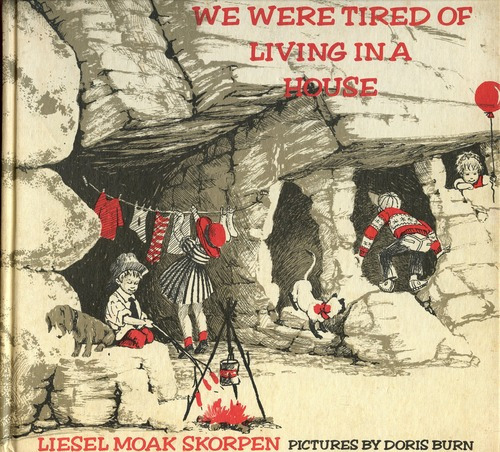
I don't think the person who wrote the blurb used here understood the book. It is not like Goldilocks. The kids are not having scary misadventures. They do not learn a lesson. It is perfectly obvious from the illustrations that the brothers and sister are out having a day of play in nature and their mother knows where they are. This is much more like Swallows and Amazons with younger kids than like Goldilocks. All very peaceful and cheerful.
What a delightful story! It captures the spirit of adventure, the love of outdoors, the bountiful imagination of children. Each home the children discover is delightful in its own way. I enjoyed the cumulative nature of the storytelling, too.
I wish my library had the original edition, with illustrations by Doris Burn. I will have to keep my eye out for an inexpensive used copy because I know I would love those illustrations. The few illustrations I've seen online are wonderful and so well suited to my idea of what this story represents.
There is nothing exactly "wrong" with the newer illustrations but they aren't really my cup of tea. They feel too modern, not detailed enough, too bold, something...
ONLY IF YOU HAVE THE 1960s version--the illustrations MAKE the book. If you want to read this one, seek out the old one, that's all black and white drawings though there's a little red on the front cover, so glad I own my old copy! But if you see the old one at a garage sale, snap it up! I spent hours looking at those drawings as do my children now.
Hip, hip, hooray for free play and imaginative play!!! I just loved this book. I was skeptical, despite two friends each assigning this book 4 stars, because the cover illustration didn’t appeal to me.
But, I enjoyed the illustrations, and the story is wonderful. It’s a fabulous book for read aloud, just terrific, and independent readers are also likely to enjoy reading it themselves. The cumulative story is amusing and sweet and silly and fun, and great for nature lovers and kids who like to have adventures, or dream or read about them.
Apparently, the edition I read is illustrated by an illustrator who didn’t create the original pictures for this book. I cannot find the edition with the original illustrations. While I’d like to read that original edition, I was very pleased to have read this one.
Love the poetic cumulative text. The illustrations by Cepeda are fun, but not as well suited, I'm sure, as the original ones by Doris Burn. Cepeda apparently changed the story, too, dropping two pets and a fourth sibling. And I wonder if the headless parents painting the real house are part of the original.... So, I've requested the original; please add your good wishes that it comes in for me! --- Apparently it didn't, but I did actually happen to notice that the library bought an anniversary edition. There are no headless parents in Doris Burn's vision. There is a lot of drama, action, body language, and facial expression. There is just a beautiful fantasy, universally appealing, with a satisfying ending. I am raising my rating to four stars for the edition illustrated by Burn and I wish I could find more by Burn and by Skorpen.
I found this 50 year old classic at my sister's house over Christmas. How is it possible I've lived my entire life without knowing who author Liesel Moak Skorpen and author/illustrator Doris Burns are?
I love the original version of this book--from the early seventies--which had much better illustrations. I would have given this 5 stars if it were the original version, but that seems to be out of print. You may be able to find it at the library still. The new text is probably still the same, and it is a wonderful story, but if you can find the original, do so! The illustrations in this newer version are lame. Ugly. A sad change.
Anyway, the great things about the story are...
1.That the kids stick together (though there is a sad moment at the beginning, in the old one at least, in which their parents just get fed up with how messy and rowdy they are and send them out of the room);
2. That they are apparently fearless about striking out and playing (and living!) in the wilderness, in various contexts;
3. That they are welcomed home lovingly, like Max in Where the Wild Things Are, though with much less psychological drama. No mention is made of anger or resentment or negative parental judgments or punishments...that sort of drama may be a subtext, but the story is told with the cheerful attitude of a kid who just feels like exploring. Nobody is power-hungry, wishing to dominate big monsters. Just, you know... it might be fun to live in a tree for a change!! Or in a cave!! Or at the beach!!
If I could give this book a split rating, it would be story-5/illustrations-1. I first owned this book through the Weekly Reader Children's Book Club, and the illustrator of that edition was Doris Burn (1969). If you can find this edition, read it!
In this newer release(1999), I find the colors to be lurid and completely overwhelming to the charm and simplicity of the story. The characters are flat, and they and the landscapes are one-dimensional, and the brush techniques make the children look as though they are dirty or scraped-up. The children have no range of expression, even when confronted by bears. I just really loathe these illustrations.
I reiterate that the story is charming, simple, with description blending with the repetitive language that children find so engaging. In all, this picture book is the embodiment of "the grass is always greener on the other side of the fence".
The older version has much better illustrations and is the one I remember from my childhood. The older illustrations are done by Doris Burn. My children love this book as well. I happened to find it at a used bookstore for fairly cheap but it is quite expensive for a used book online.
Not sure exactly how this came up in conversation but a colleague at the Library remembered this gem from his childhood. I requested it and was not disappointed. A group of children try out living in a tree, a sandcastle, and a cave. But something always happens to roust them and they go along bringing a new souvenir from each habitat, all of which they bring home in the end. Charming! My colleague says the original illustrations were better but in this case as in so many, ignorance is bliss, and I was perfectly satisfied with these bright and lively images.
First of all, I do not know what’s up with the artwork here. I guess it was rereleased with new illustrations? We’ve had this one for awhile— I found it for sale on a cart at the library and knew nothing about it, but the ink drawings (black and white with just a touch of red, reminded me a bit of Robert McCloskey) made it look like this would be a delightful, classic book. And it is. The blurb doesn’t do it justice, either. The kids take a romp through nature with their cat and dog, both losing and finding treasures along the way, before returning home.
What a fun premise for a story! And those illustrations are superb; they truly transport the reader (or listener) into the children's summery adventure. And it's quite dreamy enough to make any kid long for a similar adventure of their own.
I just wish that the first picture in the book hadn't have made the parents upset, the room look like the kids had been naughty and hence, most likely, running away.
Audience: Preschool / Grade School, but might have to ad-lib for younger groups Illustrations: A little like Denise Fleming Plot / Review: Why live at home when you can live in a tree or a cave or the beach! This is a great read-aloud that celebrates both adventure and coming home. Read Aloud: Yes
This is a wonderfully short and sweet children's book, but it has a message for all ages. It is the story of anyone growing up, and going out into the wide world. Although they have amazing experiences and collect wonderful keepsakes, they also learn the value of home.
Perhaps I'm reading too much into it, but this could also be read as the history of the Back to the Land movement of the 1960's, from youthful idealism for Nature to the realization that culture can't be created from a blank slate, that in some way we bring our culture with us, no matter how hard we try to get away from it.
Either way, the illustrations by Doris Burn in the original addition are exquisite: sharp-eyed naturalism fading to dreamy around the edges.
We Were Tired of Living in a House is a book about children who are tired of living in their house and decide to try out some new living arrangements. Of course, each of these arrangements, a tree, a pond, a cave, and the sea, have drawbacks which lead the children back home to their parents. The adventurous group of children discover many new things about the world and make friends with animals along the way. The story values adventure while enforcing the importance of a child's home which keeps them safe from nature's elements.
Honestly this book just made me think about colonialism. Its the tale of three white children who get tired of living in a house and take up residence in various landscapes in turn. It’s a well-paced story and is pleasant in the way it celebrates nature, but I don’t think I could not think about the worry of glorifying colonialism while reading this, so wouldn’t read it in a storytime tbh.
The artwork (in my old b/w copy) is beautiful, the story is whimsical, and the writing captivating. Everything you could want in a children's book.
The story is about children who spend their summer 'living' elsewhere: up a tree, on a raft, in a cave, at the beach. They're just building and creating and having fun. And it's what every child's summer memories should be.
This is a book that will appeal to children for years and years! A good read-aloud to youngsters with some repetition, simple descriptions, and fabulous illustrations to help you imagine playing in the great outdoors. A classic I should think.
Wanted to read this for a very long time and because Purple House Press reprinted it I finally got to! I love the illustrations and the fun story of kids tired of home who go in search of different places to call home. They realize in the end they actually do like the home they left :)
I read the Doris Burn version, and thought it was as adventurous and rebellious as her classic, "Andrew Henry's Meadow". I do wonder how long the kids were away, and why the parents seemed so laissez faire about it, but I suppose it was a different time.
Children decide they want to explore different places to live outside their home. Terrific for talking about imagination. Could be a fun book to introduce environments and habitats.