Jump to ratings and reviews
Rate this book

Rosales Saga #4-5

The Samsons: The Pretenders and Mass

Rate this book
With these two passionate, vividly realistic novels, The Pretenders and Mass,
F. Sionil José concludes his epochal Rosales Saga. The five volumes span much of the turbulent modern history of the Philippines, a beautiful and embattled nation once occupied by the Spanish, overrun by the Japanese, and dominated by the United States. The portraits painted in The Samsons, and in the previously published Modern Library paperback editions of Dusk and Don Vicente (containing Tree and My Brother, My Executioner), are vivid renderings of one family from the village of Rosales who contend with the forces of oppression and human nature.

Antonio Samson of The Pretenders is ambitious, educated, and torn by conflicting ideas of revolution. He marries well, which leads to his eventual downfall. In Mass, Pepe Samson, the bastard son of Antonio, is also ambitious, but in different ways. He comes to Manila mainly to satisfy his appetites, and after adventures erotic and economic, finds his life taking a surprising turn. Together, these novels form a portrait of a village and a nation, and conclude one of the masterpieces of Southeast Asian literature.

560 pages, Paperback

First published August 1, 2000

14 people are currently reading
191 people want to read

About the author

F. Sionil José

57 books394 followers
Francisco Sionil José was born in 1924 in Pangasinan province and attended the public school in his hometown. He attended the University of Santo Tomas after World War II and in 1949, started his career in writing. Since then, his fiction has been published internationally and translated into several languages including his native Ilokano. He has been involved with the international cultural organizations, notably International P.E.N., the world association of poets, playwrights, essayists and novelists whose Philippine Center he founded in 1958.

F. Sionil José, the Philippines' most widely translated author, is known best for his epic work, the Rosales saga - five novels encompassing a hundred years of Philippine history - a vivid documentary of Filipino life.

In 1980, Sionil José received the Ramon Magsaysay Award for Journalism, Literature and Creative Communication Arts.

In 2001, Sionil José was named National Artist for Literature.

In 2004, Sionil José received the Pablo Neruda Centennial Award.

Ratings & Reviews

What do you think?
Rate this book

Friends & Following

Create a free account to discover what your friends think of this book!

Community Reviews

5 stars
30 (40%)
4 stars
33 (44%)
3 stars
8 (10%)
2 stars
2 (2%)
1 star
2 (2%)
Displaying 1 - 4 of 4 reviews
Profile Image for K.D. Absolutely.
1,820 reviews
April 9, 2013
The story of the Samsons actually started in Book 1 of "The Rosales saga," Dusk (5 stars) when the main protagonist Eustacio "Istak" Salvador changed his family name to Samson. The reason for the decision to change their surname was to hide their identity because their family had to flee the authorities as his father Ba-ac accidentally killed the Spanish friar in his attempt not to lose the right to till the ancestral land that was grabbed by the church from him. At the end of Book 1, the whole family has perished except from some secondary characters including Istak's sons, Antonio Samson and Pedro Samson.

At the start of Book 3, The Pretenders (4 stars), Antonio is in jail because he is a rebel and killed many landowners. His son, Tony Samson is a history professor who has just gone to the US for his graduate studies at Harvard. Tony and his sister Betty Samson keep the information about their father a secret because they are ashamed of him. Tony has a lovechild, Pepe Samson with his cousin Emy Samson. Emy keeps Tony's true relationship to Pepe a secret, too because she is ashamed of the fact that they are first-cousins and yet they have a child. There are many other characters in this book who are "hiding" or pretending and that explains the title.

At the start of Book 4, Mass (4 stars), Pepe Samson leaves Cabuwagan, one of the sitios in the hometown of the Samsons, Rosales. Pepe has to leave to take up college in Manila. Here, the young provincial man meets all kinds of people and in the process, sees the harsh reality of living in the city, learns to accept the sins of his father and finds his true self. The setting of the last book is in mainly Manila but Jose still injected a lot of flashbacks to Pepe's life as a young boy Cabuwagan and in Rosales.

In fact, the whole saga or each of the five books seems to revolve around Rosales, Pangasinan. This is the hometown not only of the Samsons but also of the 90-y/o author of this book: F. Sionil Jose.Here is my picture taken with the author when we visited him in his bookstore on December 1, 2012:FSJ
I and the author, F. Sionil Jose
Not contented with the just seeing the author, we went to his hometown on March 23, 2013 with a group of friends. The reason for the field trip was to understand and appreciate the Rosales saga more by being in the setting. I have many American friends here in Goodreads who have gone to the house of Nathaniel Hawthorne, Truman Capote, Ernest Hemingway and others. So, I told my bookclub members why can't we do the same thing here in the Philippines? We rented an van and drove to Rosales for 4 hours:Rosales
I and my fellow bookclubbers in the hometown of the author, F. Sionil Jose
In that same building, called Presidencia, was the bust of F. Sionil Jose. Truly, the town is honored to have a son as famous and brilliant as the author. However, I felt so sad knowing that his books are not among the required reading in his hometown's schools. I tested this by asking people, young and old alike, around and no one answered me that he or she knew his books except the Mayor and his wife. bust
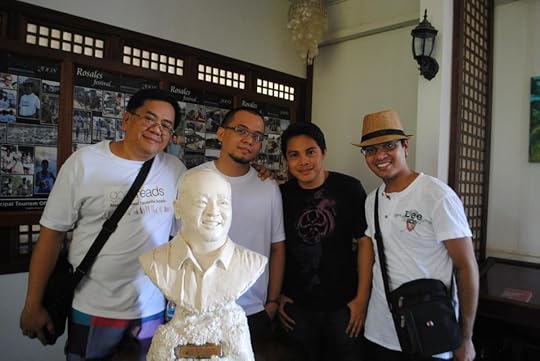
I and my fellow bookclubbers with the bust of the author, F. Sionil Jose
Overall, the experience was fun and made the reading the whole saga a real unforgettable experience.

Profile Image for Patrick.
563 reviews
August 25, 2012
Jose is an excellent prose writer with an interesting story to tell about the social ills of the Philippines.

THE PRETENDERS

The great thing about this, is this can be about the US because essentially it talks how an idealistic middle class person get caught up in progressive capitalist family who influence politicians by giving them campaign money. As long as the politicians support their business, they support the politicians no matter their ideology.

The book tells of Antonio Samson who comes from a humble indentured servant family who rises out from his humble beginnings through his scholarly achievements and is now an Associate Professor @ a UP-type institution. Tony searches for his autodidact grandfather in order to know his roots. Tony's Lolo was a homesteader/settler whose land was stolen from them by educated people who knew the law. I wonder why people who are rootless always want to look for their roots?

The book starts out with his father imprisonment for murdering a rich landlord for stealing the fruits of his labor because he did not know that he was squatting on the rich man's land. From his father's experience Antonio learned armed revolutionary resistance is a losing proposition. So, he dedicated himself to the prospect of learning and reforming the system from within. To this end, he was schooled in America and learned the middle class value of working for a livable wage. Although his college friends now sees him as an intellectual elite, he understands the role of intellectuals, landowners, and, capitalist in trying to change the nation from within while his friends favor the Huk revolutionary armed resistance.

While away, he met and became engaged to a landowner's daughter.
In being engaged with Carmen, Tony has forgotten his promise to his 1st love/sexual partner and cousin, Emy who subsequently became pregnant with Pepe. Unlike Carmen, Emy considered Tony's feelings in her decision not to abort the child; thus, she learned to live with the shame with being an unwed mother. Besides keeping the child, Emy also never told Tony about Pepe because he did not want him to miss his big chance to be a great man. For Emy and the rest of Rosales, Tony success represents the collective yearnings of an oppressed people. Emy represents American middle class values of integrity and honor. Unfortunately, Tony visit confirms that he has forgotten his idealistic roots so important to Emy in favor of capitalistic yearning.

Carmen is a philosophy major and was attracted to Tony's self-respect and he possessed an American rugged individualism. Even though Carmen can be a real snob in terms of her roots and her fathers money, at least she sought out a man who has character, skill, and brains instead of someone who simply has money. She knows what she wants and is outspoken about her views. Carmen natural impulsiveness combined with her father's tacit approval allowed them to elope. Carmen never felt loved by her father; thus she married Tony in order to have someone to herself. Carmen rushed the wedding because she is with child. At least Don Manuel is progressive enough to allow his daughter to decide whom they are going to marry. For her part, Carmen's unilateral decision to abort should be seen as a broken vow on her part and should seriously question the integrity of their marriage. Carmen and Tony are really a bad match for each other. Whereas Carmen is a collector of things and people, Tony is an idealist who is after a legacy; thus predictably they do not support each others goals.

Carmen's lack of responsibility for something worthwhile made her bored and thus prone to cheating. Tony interpreted his wife's cheating as due to his lost of self-respect by turning a blind-eye to his former idealistic self in order to fit in the capitalistic world of the Villa's. I love how Tony gains some measure of self-respect back by calling his wife a whore and leaving her. Tony faults himself for having original sin of greed of wanting more than he was capable of handling. In his fall, Tony begins to doubt God's presence and blames his fall on the circumstances of his environment. In a moment of weakness, he commits suicide.

When he described his engagement to his Manang, she reminded him of his duty to his family when he marries into wealth. Like a true American, he wants to make it on his own without the burden of wealthy connections but coming from Filipino family he also realizes his obligations. It is the most successful individual's duty to make sure everyone in the family succeeds. Besides the obvious duty to family vs rugged individualism, Tony's marriage to Carmen signals the marriage between two families unlike the American view of marriage which is between two individuals.

While meeting abroad and having an affair might be great in the US where class really does not matter, I wonder if their marriage is going to be a good one knowing the class consciousness of the Philippines? Carmen does not seem to support Tony wanting to be a cultural anthropologist professor. Internal academia politics finally pushed Tony out of academia. Fortunately for Tony, Don Manuel thinks like a capitalist who seeks opportunities and new blood thus is not tied tradition of marrying within one's status.

Tony represents the American middle class ethos brains/skill/ and hard work will get him where he wants to go. He even does not care that his wife had former lovers.

Unfortunately for Tony not only is he marrying Carmen but also her family and he has to go into the family business. Carmen does not even want to leave her parent's home. Tony is now the family's PR man. The first thing Don Manuel teaches Tony is Filipino businesses is based on familial loyalty. The next thing is that everyone has their price. If you give them their asking price, then they will beholden to you forever. So from professorial idealist, Tony looks at his inevitable future of being an executive with a stable family home life and mistresses with illegitimate children on the side. Don Manuel is trying to assuage Tony's guilt by saying that the steel mill as means for more employment for the common man @ cheaper prices for the consumer. Tony is unrealistically pissed off that the investors are all foreign and the value of American consumerism is infiltrating the US. But at the same time, Don Manuel is right in stating it is the demand for consumption that fuels progress.

Even though Tony is the Villa's PR man and does their market research for them, he feels useless. Tony is good at his job in the way he pitched Don Manuel's steel mill as a sign of progress for the Philippines, and thus is nationalistic. He would rather be an academic with the freedom to write and to teach whatever he would like to do. He wants to be his own man and create his own legacy. Since becoming a company man, Tony sees friendship as utilitarian instead of an emotional support system.

Tony is falling into a slippery slope of abandoning his ideals in order to become a capitalist. He is consorting with the Villa corporation unethical practice of displacing illiterate farmers from public lands. He is also in cahoots with a Chinese entrepreneur who is buying American products at wholesale prices and reselling it to the government at exorbitant prices. The reason it is believable within a US context is the subprime mess was due to predatory lending practices and American subsidizing of Medicare advantage plans that was more expensive than traditional Medicare.

Tony is taking the stance of a capitalist vs journalist friends that everyone has an equal opportunity in the Philippines. Now that he is a capitalist, Tony proves my theory that ones political affiliation and seeing the world is really based on ones experiences and how one's attitude toward those experiences. Although they generally agree to disagree, they all agree on one thing that equal opportunity for children's education is a must in order to realize the full potential of kids. Charlie is correct in stating that despite his many mistakes, life is for living. When Tony confronts Godo of his hypocrisy, Godo states that Tony has abandoned his roots because he is now rich. I think Godo is wrong for blaming him for his luckiness. I think this is where America is superior to the rest of the world in that its people are naturally optimistic and change can happen during elections whereas other parts of the world the only answer is through armed resistance toward the status quo.

Tony is really turning into a shadow of his former idealistic self by disregarding his father's wishes to be buried next to his mother instead of being dissected by medical student because he is too ashamed of what his capitalistic in-laws might think is new low that cannot be forgiven.

Although the Latin mistress cultures has the ability to destroy family life, if it is endemic in the culture that one lives in; is it possible not to partake in it? If one is given the keys to a life of luxury, is it possible not to take a bite of the forbidden fruit and not participate in the mistress culture?

The irony of trying to enforce American rugged individualism in an endemically corrupt system is it cannot be done. Unlike America, poverty in the Philippines usually means one is stuck in that station; thus it does not matter how hard one tries one will inevitably remain stuck. While UP professors pontificate to the reason for such corruption is due to Filipino undisciplined colonial mentality, the Dean perpetuates the system by doing favors for his underlings in exchange for their loyalty. The question is does a revolution help in changing a corrupt system or will it just change the face of a system?

Senator Reyes is a patriot who is trying to forge a national identity out of so many thousand of islands that it seems impossible to do. As a politician Senator Reyes has to walk a fine line between voting on principle and risk looking out of touch or voting for what constituents want and risk looking like a flip-flop. Filipino politics is so enmeshed with Filipino business that is hard for any sane person to distinguish the two. Businessmen fund politician in return for favorable tax and regulation favors. In return, Tony justify it by citing that industrial business creates jobs.

Tony illistratos like Dr Rizal as reformers who wanted equality but he praises Bonificio for his dedication to armed revolution with the goal of changing the entire system. Tony decides to be Reyes' speechwriter as a vanguard to the cultural revolution. Ironically, Reyes is part of the problem by voting for bills supporting corporate profits. At least, he sees himself as a supporter of new industries.

Underpinning the book is the whole notion of how even the most idealistic man, like an educated Tony Samson eventually succumbs to the endemic systemic corruption of Filipino life with all its crony capitalism, corrupt politics, and system of mistresses which produces poor illegitimate children.

The end shows Mrs. Samson as morning the loss of her husband and by extension her identity who rejected her elite upbringing as stifling. All Antonio wants is to live a life filled with integrity in order to make his wife proud of him. She blames herself for Tony's suicide for pushing him into a life that he did not want and her subsequent cheating on him. To atone for her perceived sins, she publishes Tony's works and commits herself into a mental institution. Tony's professorial instincts is to write about the Ilocanos desire for self-sacrifice in order to get what they want and the fact that educated classes stole from the illiterate classes.

The post-script has Lawrence, the idealistic American USAID worker finding out the reality that pervades the Philippines. Lawrence sees crony capitalism at its worst and he does not understand the upper class focus on materialistic things. He realizes that 3rd world countries are controlled by the rich and idealist like Tony can be corrupted by the rich and thus destroyed from within. The Dean things that Tony was to idealistic in his time table for change. It is interesting to see that Tony really did have an impact on Don Manuel developing a conscience forcing him to think twice before executing a bottom line strategy. Although Ben sights a common landowner refrain that tenant farmers do not know how to maximize farming production, Lawrence gets pissed off at him for suggesting the boys who came to help them in their time of need were really thieves.

Although everyone knows this is what happens in 3rd world countries, is America with the growing divide between rich and poor headed in that direction or can we make decent-paying jobs for uneducated people here too to keep the divide from ever widening?


MASS

I enjoy Jose's realistic description of the poverty in the Philippines.

Jose is apathetic because he is a bastard in a country where that means something. He does not see progress for his lot so he decides to tune out and concentrate on his base needs which are food, sex, and sleep. Pepe know the rich will always rule and thus is apathetic toward any movements. He states that the mestizo land owners are replace people who look like him but take advantage of the poor none the less. He is apathetic because he sees a classless society as fairytale dream. Pepe realizes that the powerful do favors for the powerless not because they want to help them but so the powerful can control them. Pepe is succumbing to the hopeless poverty that his is born in.

Again Jose writing can extend to American society as Pepe to me can be any inner city kid who gives up on life before he has lived it specifically Black inner city society who are raised without fathers and thus become rootless. Like his forefathers, Jose has a restless soul who is looking for change but unlike his father he wants to forget his past and concentrate in surviving in Tondo. He does not want to get to know his father because he felt abandoned by him. Pepe is interesting because despite his criminal activities, he has ethics of gratitude toward people who are good to him. For example, he stays in school b/c his mother and aunty worked hard for him, he befriends Toto because he feeds Pepe and pushes him to reach his potential, and he does not screw Milli because Kuya Nick gave him an opportunity to earn money.

Pepe's wants to concentrate in "living fully" which for him means experiencing different foods, reading multiple books, and life in general. He wants to be successful life with excitement and affluence without working for it. Although he hate school, he is a self-professed autodidact like his great-grandfather and loves that he is popular in school. He is particularly drawn to literature as a means for escaping his hopeless surroundings. He joins the Brotherhood, runs for class president, and becomes a literary editor as a means to get things not because he believes in what he is doing.

Unlike his father and Toto who are both idealist and want nothing more than to help others, Pepe is a skilled opportunist who engages in drug pushing and live porn shows for the upper classes as a way to make money. Again, there is a pervasive pessimism in Jose's writing that corruption in the Philippines is inescapable that anyone can be corrupted with the right price according to Kuya Nick. In his trial week as a drug pusher for rich kids, Pepe justifies his actions by saying that he is simply filling a demand by the rich who did not earn the money in the first place. Old rich families enable their relatives in their drug habits in order to continue looking respectable. He eventually realized being a drug pusher is dangerous business when a deranged desperate addict held him hostage before he escaped.

Unlike the realistic Pepe, Toto is an optimist who wants to be a doctor. Toto the idealist is using Pepe the natural politician to further Toto's idealism of a revolution by edging Pepe to be voted into the National Directorate of the Brotherhood while Pepe does it in order to get the perks of the job. While Pepe is not sold on the revolution because he believes that Filipino's are ingraites who have a tradition of betraying causes for money, Toto's believes that the young have the power to change things. In the end, Toto dies at a mass rally due to police brutality. According to the Huk leader, revolutions start with the basics which are food, shelter, clean water, safety, education, and decent pay for a decent work.

Fr Jess professes liberation theology. Is there merit to liberation theology in places where the establishment is keeping themselves rich at the expense of everyone else? On the poor's part, Jess blames them for being apathetic and not organizing against the rich. Fr Jess was a member of a scion old rich family that disowned him for professing liberation theology and living in Tondo. He is trying to teach his flock that the church of God is within each one of us and it is not buildings but people that make its pillars.

Pepe is a Deist who sees God as a vengeful God of the old testament and sees Jesus Christ as nothing more than a subversive who died because he was challenging the Jewish and Roman authorities. He believes that God does not interfere in human affairs because he sees the wicked prosper and the virtuous suffer. Also, I think the book touches on why priests are looked up to in the Philippines as to why they should be emulated because they live better lives than the vast majority of their congregation.

Pepe has an affair with the help, Lucy and is attached to her because she is his first. It turns out that Pepe's Uncle Bert is paying Lucy for sexual favors. In response to this betrayal, Pepe agrees to do a Toro show for the upper class. After being sick to his stomach that he is succumbing to his animalistic side and becoming more and more like Kuya Nick, the corruption of Lucy by uncle Bert, a reminder of his father's suicide on the train tracks, and the fact that he wants to leave the influence of his family, he decides to leave Antipolo for Tondo.

For Pepe, Tondo represented hell incarnate where policemen are de facto landlord/extortionists and there is lack of sewage system so it smells. In Tondo, religion and relationships are important as a vanguard against disease, unemployment, hunger, and crime. He rightly states that unless one has experienced it for himself, a person can never understand what it is like to live a life of poverty. People keep going to Manila because the dangers of a the city is a lot better than the monotonous hell of the provinces.

Pepe is a natural at reading people and getting what he wants from them. For example, he wants the Brotherhood to do some civic works and thus he strokes Roger's ego in order for him to get his Tayo-tayo gang to make a basketball court for the community.

Apparently, Filipino middle and upper class women did not seek the companionship of military personnel for fear of being labeled a prostitute. Pepe's new love interest, Lily, works at a massage parlor that gives "happy endings" in order to support her family. It is sad how the massa Filipina have to either become a sex worker or work abroad in order to support their families. Lily is at a precipice that she might do more than jack a guy off. Pepe still likes Lily and eventually visits the massage parlor where she works. Although he is grateful to Lily for showing him that his penis still works after being tortured, he feels bad that he is the one who pushed her off the divide into possible prostitution.

This entire review has been hidden because of spoilers.
Profile Image for Fernandina Fernández Antonio.
9 reviews
December 25, 2024
A must-read for the Filipino youth. Memorable lines include:

1. "Writers and academics who think they have a role in revolution are flattering themselves; what they really want to do is be part of it, lead it, without having to raise the sword. Only those with the sword can participate in revolution, for revolution means destruction, not contemplation."

2. "I organize on the basis of friendships, on being Ilocano. Most of the students are not really interested in demonstrations, except that they mean no classes. Do you know what their interests really are? To pass, to be able to get a degree, and after that, a job. Politics is a luxury of the rich."

3. "Yes. Everyone needs to be politicized, not just the masses. But we are talking about organizing and winning a broader base. This comes first if we are to have the sea. And we can build this sea around us first by talking the people's language - not the language of conference rooms and seminars. And this language is warm, earthy."
Displaying 1 - 4 of 4 reviews

Can't find what you're looking for?

Get help and learn more about the design.