Jump to ratings and reviews
Rate this book

Personal Knowledge Graphs: Connected thinking to boost productivity, creativity and discovery

Rate this book
Is your thinking connected?Do you write, read, research and think for work or leisure? Then you’ll have years of notes, ideas, articles and images. But all those thoughts are decaying. They are stuck in dusty notebooks, forgotten files on old backups and buried emails.

What if…all the thinking you had ever done was live, fresh and connected?adding new knowledge popped up connections to writing and reading you had forgotten?you could travel through your thoughts like surfing the web?That is connected thinking. That is a Personal Knowledge Graph.In Personal Knowledge Graphs, experts and researchers explore the latest uses of PKGs. We mine the bumps to productivity, creativity and serendipity that come from a PKG practice. And delve into new developments and novel ways of thinking about and using PKGs to go beyond just linking topics and text.

Want to expand your mind and go deeper with PKGs?

Personal Knowledge Connecting Thinking to Boost Productivity, Creativity and Insight will link you to the cutting edge of tools for thought.Praise for Personal Knowledge Connected thinking to boost productivity, creativity and discoveryAs a productivity coach, I use PKGs primarily for making knowledge actionable—which has implications for the intake, development, and output of knowledge. The essays Velitchkov and Anadiotis have assembled in Personal Knowledge Graphs cover a wide variety of important PKG topics. Some essays are more philosophical, some are more pragmatic, but all of them deepened my understanding of how I can get the most out of the PKG tools I use.

— R.J. Nestor, Productivity in Tools for Thought expert

------------------

Knowledge Graphs are now widely accepted in industry and government as an effective way to combine, store and query large volumes of heterogeneous data. This book is the first to open the door to a new application of knowledge individual citizens that want to have control over their own data, with applications ranging from personal archiving all the way up to a personal digital assistant. The book is a collection of accessible contributions that open the door to this new vision on personal knowledge management.

— Prof. Frank van Harmelen

------------------As the data that individuals need to manage is becoming increasingly complex, there has been a rise in the development of tools and practices to assist in this process. This new generation of tools, although not necessarily based on open and enterprise graph approaches, seem to be converging with them on some level.

These tools allow individuals to manage their data as personal knowledge graphs, experienced interactively with edges that can be traversed linking content, in a manner akin to explorations with a “thinking partner”.

This timely book thoroughly reviews current research around personal knowledge graphs, with the aim to empower individual users, promoting productivity, data literacy, sovereignty, and interoperability, as well as highlighting future directions.

— Prof J. Mark Bishop

397 pages, Kindle Edition

Published June 15, 2023

19 people are currently reading
36 people want to read

About the author

Ivo Velitchkov

2 books7 followers

Ratings & Reviews

What do you think?
Rate this book

Friends & Following

Create a free account to discover what your friends think of this book!

Community Reviews

5 stars
5 (41%)
4 stars
2 (16%)
3 stars
3 (25%)
2 stars
0 (0%)
1 star
2 (16%)
Displaying 1 - 3 of 3 reviews
Profile Image for Malik Alimoekhamedov.
9 reviews
February 19, 2024

My official review of this book is here.


Like consuming any creative work, reading is both a blessing and a curse. On the one hand, there’s the thrill of discovering something new; on the other hand, there’s a profound disappointment when, after reading a few similar books, you feel like every new oeuvre no longer adds any additional value because it just rephrases everything you’ve already read—the above leads to biased rating attributions on Goodreads. You love the first book you came across, and you hate the last one from the same category.

Since Ivo Velitchkov’s and George Anadiotis’s collection of PKG-related essays, written by a group of experienced PKG (Personal Knowledge Graph) specialists, is my first read from that category, I’m certainly biased. Nevertheless, I read it with a pen and a notebook by my side and felt I had to highlight the entire book from start to finish.

Perhaps one of the primary reasons this book strikes a chord with me is that, as an engineer working with knowledge graphs and graph databases, I also evolved in a startup environment and built knowledge management tools for scientists. Most of my personal knowledge is structured as an interconnected graph, too.
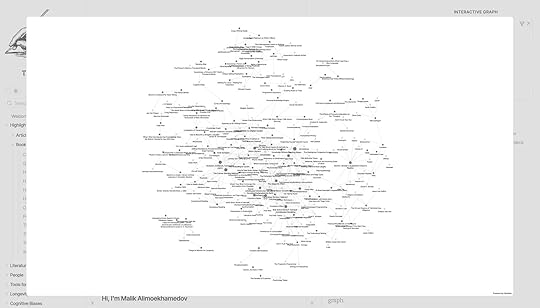
A publishable part of my PKG is on https://malikalimoekhamedov.com/garden.A publishable part of my PKG is on https://malikalimoekhamedov.com/garden.

All of the subjects listed above are part of the book. You’ll find information on incredibly nerdy deep-level implementation details, including source code and schema definition conventions, metaphysical musings on PKGs and their importance for an average note-taker, and even how much some PKM startups have raised in their latest fundraising rounds.

In my opinion, the abovementioned makes this book a hit or a miss. I’m exactly the right target audience. All of these topics are highly relevant to my work and daily life. But how big is this niche? I know my audience, and I know that recommending this book here is a risky bet. Some of you will love it, but many might find it borderline gibberish.
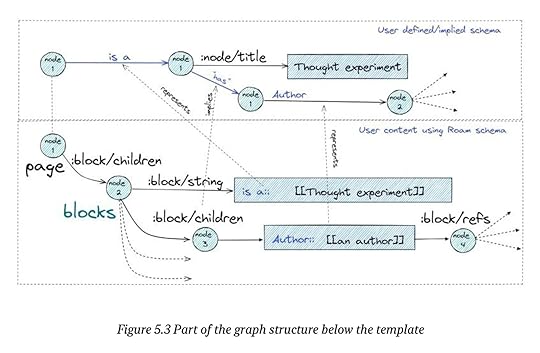
An example of a PKM software implementation concept demonstrates how technical the book can sometimes get. You might or might not like it. I do.An example of a PKM software implementation concept demonstrates how technical the book can sometimes get. You might or might not like it. I do.

An example of a PKM software implementation concept demonstrates how technical the book can sometimes get. You might or might not like it. I do.

Therefore, if you still decide to try it, read it like you’d read Antoine de Saint-Exupéry’s “The Little Prince”. Depending on your experience with PKM tools and tech-savyness, your first read could be introductory and superficial. Still, subsequent reads at later stages of life reveal a book within a book.

Don’t worry if you don’t understand certain things yet. If you’re not a developer, skip the source code. Modulate the reading speed. If you're not building a knowledge management business, skip less relevant bits, such as startup fundraising rounds. Slow down when you stumble upon details that solve your current PKM pains. Set the book aside, keep engineering your knowledge and grooming your setup. Let it percolate for a while. Then, open the book again. The second iteration will demystify things that looked like cyphers the first time. Rinse and repeat. This phenomenon is almost guaranteed to occur if you’re diligent with your PKM practice, and it’s the most significant indicator of knowledge engineering maturity.

Though, as mentioned in the beginning, it was tough to be selective with highlights, I managed to control my impulses. Here are a few (non-technical) examples of what’s inside:

Personal knowledge graphs have another special feature. They are generators of surprise. They can deliver serendipity on demand.
The mind is extended with objects from the environment, such as pen and paper, a navigation map, or a PKG.

I intend to write about these so-called Complementary Cognitive Artefacts in future issues.
In a library, the answer to a query is the end of the journey; in a graph, it’s the beginning.
Created by knowledge engineers, ImageSnippets is a web-based linked data annotation and metadata management system. With images as the central subjects of the graph, it also functions as an image-graph based digital asset management system. The system allows nontechnical users to store descriptions of images as structured and semi-structured machine-readable data in Resource Description Framework (RDF). RDF is a standard data model for storing metadata on the web.

…and so much more.

You can review all my highlights and annotations on the dedicated note in my digital garden.
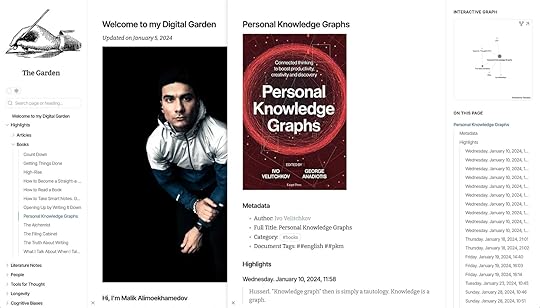

The highlights and annotations of “Personal Knowledge Graphs” are part of my digital garden.

This newsletter issue is an opportunity to touch the tip of my hat to Gregor B. Rosenauer, Ivo Velitchkov, George Anadiotis, Dr. Ashleigh Faith, Fabrice Gallet, Martynas Jusevičius, Maribel Acosta, Omes Baltes, Eduardo Ivanec (Flancian), Margaret Warren, and all those whose work was mentioned throughout the book or was foundational for co-authors’ projects. They are the giants on whose shoulders the PKM community builds.

Profile Image for Curtismchale.
193 reviews20 followers
December 29, 2023
lots of theory little practical advice

There is a whole chapter on BeOS and Haiku two operating systems you’re never going to run but the authors spend pages telling you about how they work without giving any useful advice on how you could implement anything similar on a modern operating system.
Profile Image for Vineet Naik.
6 reviews
October 13, 2023
I came across this book as a recommendation from Amazon, probably because I was doing some online research for improving and streamlining my own note-taking workflow at that time. The book contains a great deal of useful information about knowledge management and makes compelling arguments for personal knowledge graphs.

The initial chapters are a discourse on knowledge itself and those parts are rather poetic! The author gives an overview of the current ecosystem of knowledge management tools and methods, diving deeper into certain tools. As someone who has been trying out different note-taking approaches, I could relate to many of the author's questions and concerns about the current state of PKG tools. I am surprised that while the book mentions org-mode in emacs it doesn't talk about the org-roam package which I think addresses quite a few concerns and limitations.

Some chapters delve into implementation details and include code examples too. I found them difficult to read on kindle and it felt like they broke the flow. The later chapters touch upon distributed knowledge graphs with concrete examples.

I have many actionable takeaways from this book, some of which I have already adopted in my personal note-taking workflows. Before picking it up, I had no idea that so much research and thinking has been done on this topic so I am quite amazed and I believe it has also sparked an interest in this topic for me.
Displaying 1 - 3 of 3 reviews

Can't find what you're looking for?

Get help and learn more about the design.