Birdwatching is popular among residents and visitors in Nova Scotia, and the province is an internationally recognized destination for birding.
This book offers detailed listings on 200 of the top species found all around the province, at the seashore, in the Cape Breton Highlands, in city parks and around the thousands of pristine lakes in the province.
Whether observing spectacular hawks in the wild or seabirds over the ocean, listening for warblers in the forest or spotting the first spring birds at the feeder, this guide is designed to allow for quick and easy identification. Original full-colour illustrations by Jeffrey Domm show prominent features that birdwatching enthusiasts can use to identify a species. Text and graphic keys give helpful tips for observing, including:
habitat preference egg identification (for in-province breeding species) months the bird can be seen in the area preferred bird feeder types The guide also includes a handy visual index, grouped by bird size and distinctive coloration, to help novice birdwatchers easily identify an unknown species. The birding hotspot section (with accompanying map) shows 46 locations across the province where good birdwatching is assured.
Previously titled The New Formac Pocketguide to Nova Scotia Birds, this book is both a handy reference for beginners and a useful local guide for practised birders.
Jeffrey C. Domm is an award-winning illustrator with over thirty wildlife related books to his credit, including the children’s books Atlantic Puffin and The Hatchling’s Journey. He has been teaching illustration and drawing at NSCAD University for over sixteen years and his body of work includes illustrations for Parks Canada, Environment Canada and Canadian Wildlife Service. He lives in Cow Bay, Nova Scotia.
If a field guide is going to limit itself to a selection of the more regular species occurring in the area that's fine, but the illustrations need to be excellent. Unfortunately in this case they're not. Several are strangely proportioned and don't like right (just one example - Common Murre / Guillemot has a Gannet like head nd bill profile). Some others are strangely coloured - the Chimney Swift looks more like a Martin. There aren't the appropriate variety of illustrations either. It all feels a bit rushed.
I was given this ahead of a day birding in Nova Scotia. I saw a couple of birds that day that weren't in this book, Cape May Warbler and Marsh Wren, which would suggest species selection is suspect. Generally I think you'd be better with one of the standard field guides to North America.
My favorite place to be is on my back deck in the summer, sitting in my rocking chair reading a book. I have huge trees on either side of me so it’s private and relaxing. I see and hear a ton of different birds out there. I swear I get some of the same ones come back every Spring.
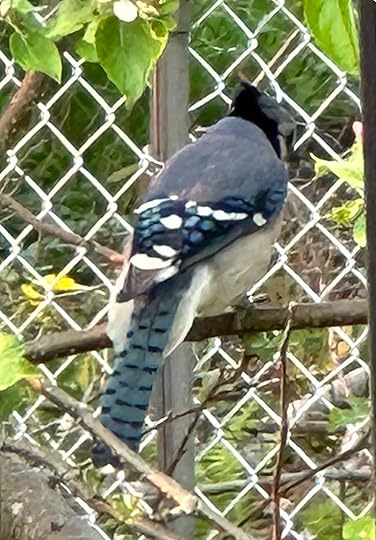
One day I saw a Blue Jay in my backyard. I’ve seen Blue Jay’s before but it was the first time I really noticed a Blue Jay. They are a little bigger than you expect. I was struck by its colors. A Blue Jay’s back looks like blue stained-glass windows and the plumage on its tail looks blocky like Legos.
I’m not quite at the Jonathan Franzen walking around with binoculars in my backyard never shutting up about birds level—although I’m not ruling that out yet, need to wait until the leaves come in so the neighbors can’t see me—but I started taking photos of the birds I could see and wanted to know more about them.
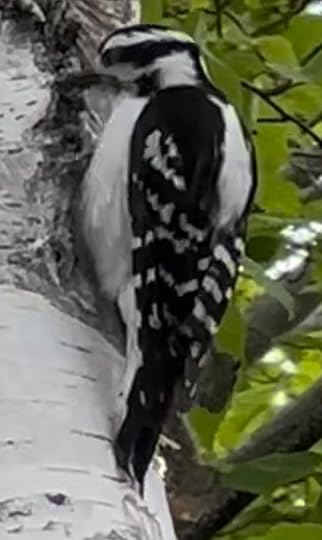
I picked up Formac Field Guide to the Birds of Nova Scotia. I’d bring it outside and put it on the table next to me. Every time I saw a new bird I’d pick up the book and try to find the bird I was looking at. Jeffrey C. Domm did a great job with the illustrations. It hasn’t failed me yet in finding what bird I was seeing. Because of this guide I can say that the woodpecker in the tree above my head was a female Downy Woodpecker. The book also includes some fun facts. That’s how I learned that Blue Jays are huge a-holes with “a bad reputation for eating eggs of other birds, and even their young.”
The only downside of sitting outside with the birds is that my deck seems to be one of their favorite places to poop. They are constantly making bombing runs. I’ll hear little splurts and splats hitting the ground around me. I’ve decided to be brave and tempt fate. I assume this is exactly how my British relatives felt during the Blitz.
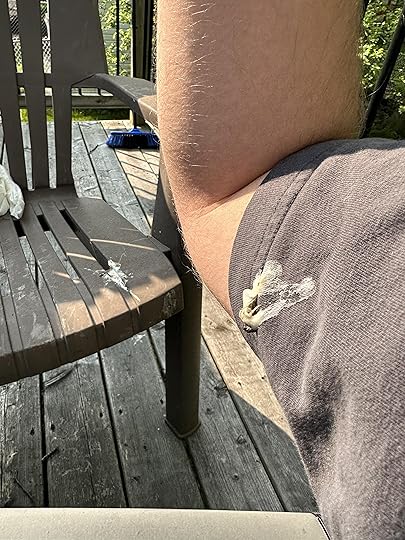
I've been pooped on three times in the last calendar year, a statistical anomaly, and a sign of incredibly bad or good luck depending on who you ask. My grandmother swears it’s good luck and maybe that’s true, because each time it just hit my arm or my lap and missed the book.