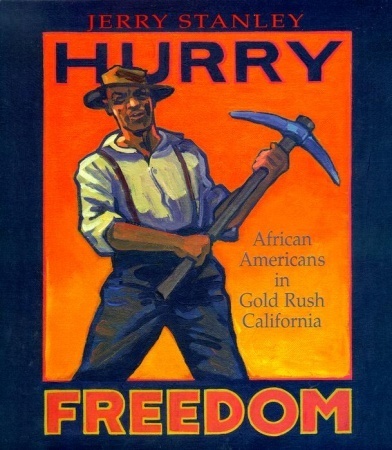
Here for the first time in a book for young readers is the story of the African American forty-niners who went west to seek fortunes and freedom in the California Gold Rush.
Among the thousands drawn west by the California Gold Rush were many African Americans. Some were free men and women in search of opportunity; others were slaves brought from the slave states of the South. Some found freedom and wealth in the gold fields and growing cities of California, but all faced the deeply entrenched prejudices of the era.
To tell this story Hurry Freedom! focuses on the life of Mifflin Gibbs, who arrived in San Francisco in 1850 and established a successful boot and shoe business. But Gibbs's story is more than one of business and personal With other African American San Franciscans, he led a campaign to obtain equal legal and civil rights for Blacks in California.
“I’ve learned there’s no such thing as wasted writing or bad writing. All writing leads to better writing.”
Jerry Stanley is the author of several highly praised books for young readers, including Children of the Dust Bowl, winner of the Orbis Pictus Award; I Am an American, an ALA Notable Book; and Hurry Freedom, a National Book Award nominee and winner of the Orbis Pictus Award. He is a former professor of history at California State University.
Being a writer is one of the great achievements of my life. As a teenager growing up in Detroit, Michigan, I hated school, all my teachers, and learning in general. When I was expelled from high school at the age of seventeen for fighting, I had passed two units—one in woodshop and one in gym. In bidding me farewell, my counselor fired his last shot at my self’-esteem: “Stanley,” he said, “you’re so dumb you couldn’t finish school even if you tried.”
It has taken a lot to prove him wrong. I joined the Air Force to get away from home and after a few years started taking correspondence courses through the mail. During the day I drove bulldozers and forklifts, and at night I learned how to write a complete sentence. I was twenty-one when I finally received my diploma from high school, which was somewhere near the base but which I never saw or visited. I was playing drums in a rock-’n’-roll band when I left the service and enrolled in junior college. This was the turning point in my life: not what I learned there, but getting the nerve to enroll.
I was the model insecure student, as hardly a day passed without my remembering, “Stanley, you’re so dumb. . . .” I can look back now with amusement and laughter at some of the things I did. For example, when I was registering on the first day, standing in a long line to get past this one station, a woman asked, “What do you think your major will be?” I had no idea of what she meant by “major,” but the girl in front of me said “English” and that got her through, so I said “English” (whatever that was) too. A month or so later, while talking about the upcoming midterm (my first), the teacher said, “Blue books are required. You can’t take the midterm without a blue book.” I spent nearly an hour in the library looking for the blue books—in the card catalog under blue, in the periodicals—until a kind reference librarian told me, without snickering, that they were in the bookstore. Though amusing now, when these things happened to me, they were proof that I would be found out: I don’t belong here.
Fearing failure, I became an overachiever. I overstudied every subject, and wrote and rewrote each term paper before finally relinquishing it. But I still lived in doubt from one grade report to the next. Making the dean’s list, graduating from junior college with honors, and being invited to join an honor society all gave me tremendous confidence—for about a day, before the old demon of self-defeat reemerged. Nevertheless, I made my second big decision and enrolled in a state university. At least I now knew what a major was, and I proclaimed “History,” but the most enduring memory of my first few weeks there was learning how to spell university (in case I suddenly had to).
When it became clear that I would get my bachelor’s degree cum laude, I vowed to continue my education until they kicked me out or until there were no other degrees to earn, whichever came first. This was the easiest decision because it came last and not because I had unshakable confidence in my ability to do graduate work. Looking back, I now see that I was not ready for school when my counselor committed that great crime against me by calling me stupid. The hardest decision was the first time I tried to prove him wrong by enrolling in junior college and showing up for my first class quite literally trembling in my chair.
Before the university said that’s it, I earned a Ph.D. and a Phi Beta Ka
My library maintains a shelf of featured nonfiction at the front of the children's wing. The topic changes periodically. When it was highlighting the diversity of California's history, I chose Hurry Freedom by Jerry Stanley.
The California Gold Rush brought in hordes of people from a wide variety of backgrounds. Hurry Freedom looks at the African American experience. The men and women who came were a mixture of slaves and free blacks. In California slavery was illegal but enforcement was lax. It was up to the slave to escape first.
Regardless of how a person came to California, there was the dangled carrot of opportunity. Most people who came to California didn't become wealthy and many ended up going home with only the clothes on their backs. Hurry Freedom has biographies of some of the rare success stories.
The book also covers the political atmosphere in California as the infant state struggled to take sides in the slavery issue. There were those who wanted to side with the slave owners and those who didn't. There were others who helped run California's very own underground railroad, something I didn't know we'd had here.
The book is short, only 96 pages, and densely packed with facts, dates and photographs. It is a good introduction to a fascinating piece of California history that I hope to read more about in greater depth.
This book is about a man’s journey from the New York to California for the gold rush, his name was Mifflin Gibbs. His journey took him from New York to Panama to San Francisco. During his travels, and his time at the gold rush, Gibbs was dealing with massive amounts of racism and segregation; some in his group were even fugitive slaves. Later in the book the author describes laws passed that disallowed blacks and other nonwhites from testifying against whites, making it a very dangerous place to be. He also states, however, that 1850’s California was a dangerous place for anyone because of the gold and the greed people had. Gibbs then wrote a petition to have the law removed, so that they may lead a safer existence. After the gold rush Gibbs travelled to Victoria where he opened a store, bought several houses, and became one of the higher members of society. Even so, he would still deal with prejudice for the rest of his life. I would have this book in my classroom, as i think it provides a unique perspective on an interesting time in our history.
Summary: Hurry Freedom recounts the life of Mifflin Wistar Gibbs. Gibbs was an African-American in California, and he was one of the few who kept a detailed account of their life. Gibbs's story is consistent through the book, but the author also includes details of the lives of other African American miners in California. The book serves to retell the story of Gibbs's life so that he will be remembered as an activist who helped other African Americans escape slavery.
Evaluation: Hurry Freedom is a narrative nonfiction that tell Gibbs's story to create a unique biography. He includes black and white photographs and illustrations to show his life in the West. The text is extensive and detailed. The reader is required to have prior knowledge about the abolitionist movement and slavery. It is best suited for the upper elementary grades due to the complexity of the text. It is rich with information about Gibbs's life and what life in the West was like for African Americans.
Teaching Idea: This book would be perfect for teaching about Westward expansion and prejudice experienced by African Americans in the west. The teacher could read excerpts of the book aloud to students to match the content to the standards. The students can discuss how Gibbs's experiences in the West related to the tensions in America relating to the abolitionist movement.
This book is a great informational book for young readers. It is very small and concise, giving the reader a quick read but leaving them with a plethora of information. Hurry Freedom also incorporates real pictures from US archives, such as the Library of Congress, providing actual visual references that the reader may see. This book also is written in third person, which allows the author to not only describe Mifflin Gibbs' actions (main character in the book) but also the people he meets along his Gold Rush journey.
Hurry Freedom is an informational children's book that follows the life of Mifflin Gibbs. Mifflin is a freed African American male searching to create a better life from himself and his future family. In search of this life, he is made aware of the Gold Rush happening in the western states such as California. Mifflin jumps on this opportunity and starts his journey from New York to California. The book accounts for his travels and his tribulations and triumphs once he reaches California. Readers also get exposure to the difference between freed blacks and blacks who are slaves during this Gold Rush.
This book is more geared toward high school students, but it could be used with middle school students. I did read this when I was going through my teaching credential, and I remember it having a lot of good themes, especially how the Gold Rush offered opportunity to so many people, including freed and formerly enslaved African Americans. The book definitely spoke about the discrimination and racism African Americans met in this new place, but also showed how the movement toward equal rights began before the Civil Rights Movement of the 1950's and 60's and even before the Civil War and Emancipation.
Thank you, Professor Stanley, for making accessible, to so many, a state history that has remained hidden from view. I want to keep learning about stories like these!
Stanley takes the readers on a journey through the settlement of California during the gold rush, but provides a perspective unbeknownst to many. The story of African Americans migrating from other parts of the United States is told; some of them having escaped slavery while others were free blacks looking for a new start. Although many stories and perspectives are told throughout the book, Mifflin Gibbs experiences are focused on. Gibbs was a free man, from Pennsylvania, who was self educated. He decided to travel to California at the beginning of the gold rush in search of something new, and in the hopes to make a difference. When he arrived in California, he discovered that the dig for gold was for whites only. Although many African Americans were mining, they were doing so as slaves or miners for white bosses. Gibbs was not surprised by this, and consoled himself by saying he did not travel to California in search of gold, but of a new beginning. The people there tolerated African American more because they fulfilled the need for businesses such as hotels, restaurants, barber shops, and clothing stores. Gibbs eventually opens up boot emporium with his friend Lester in San Francisco, and the two turn it into a highly successful business. It is revealed that the majority of the minority were selfless saving their earnings to help pay for slaves freedoms. Gibbs and Lester also begin harboring runaway slaves as a part of the Underground Railroad. As the years progress, California becomes an official state where slavery is not legal, but many laws are passed to inhibit the rights of African Americans. The political journeys of Gibbs, Lester, and many other members of California’s African American community are followed. The perseverance of this community is inspiring as they try to enhance their rights in the state of California. After many attempts, and the looming passage of the exclusion act, a law that would not allow African Americans to come into California and would require all African Americans already living in California to register with the state. This showed a rise in intolerance and their freedom and safety in the state began to seem futile. Many African Americans, including Gibbs, emigrated to Victoria, British Columbia, Canada where they would be protected by the law equally. After Gibbs and five hundred Californian Africans Americans immigrated to Canada, the Civil War broke out, slavery was abolished, California allowed African Americans to testify, and they were considered citizens of the United States. Although Gibbs thought their efforts had been futile, they helped to get the ball rolling and begin a change in the country. Although history is not my favorite subject, I enjoyed the recounting of this part of history. The author provided more of a story rather than a recounting of facts. I think that this book would be a great addition to history lesson plans surrounding many topics.
The nonfiction book Hurry Freedom by Jerry Stanley focuses on the life of an African American man named Mifflin Wistar Gibbs who went to California in search of a better life and gold in the 1800s. While detailing Gibbs’ life and stories, there are other African Americans that are noted in relation to Gibbs. These men had to work hard to get to California, and to survive in a white male dominated nation. Some African Americans had to work their way out of slavery, and afterwards they would work diligently to buy their families and friends out of slavery. Although California was a “free” state, discrimination was very prevalent and most areas were deeply segregated. Some “free” states wanted an all-white population, and wouldn’t even let African Americans enter the state boundaries. There was a bit of a gold rush for African Americans in California, but most of the time they were shrouded in poverty. There was an Underground Railroad in California, and many African Americans that had travelled to California (including Gibbs) contributed to it. Most African Americans stuck together, but they also befriended white individuals that were abolitionists. Eventually, some African Americans were able to open up stores of their own, but a lot of them suffered. Store owners like Gibbs saw many crimes within their stores, but there were laws that prohibited African Americans and other ethnicities from prosecuting white people for any crimes. Although California was considered to be a “free” state, if a slave owner took slaves into the state, they would still be slaves under the owner until they were freed. There were a series of testimonies, conventions, and petitions before Lincoln passed the Emancipation Proclamation in 1863. The information in this book was thorough and interesting because it told the stories that are not told in general history classrooms. The illustrations and pictures were also very useful and added validity to the text. This book could be useful in classrooms because of the story it tells through it's information, and it could be very useful in lessons pertaining to civil rights movements as well as the gold rush in California for students from third to sixth grade, depending on the content that is used.
This book is about a man’s journey from the New York to California for the gold rush, his name was Mifflin Gibbs. His journey took him from New York to Panama to San Francisco. During his travels, and his time at the gold rush, Gibbs was dealing with massive amounts of racism and segregation; some in his group were even fugitive slaves. Later in the book the author describes laws passed that disallowed blacks and other nonwhites from testifying against whites, making it a very dangerous place to be. He also states, however, that 1850’s California was a dangerous place for anyone because of the gold and the greed people had. Gibbs then wrote a petition to have the law removed, so that they may lead a safer existence. After the gold rush Gibbs travelled to Victoria where he opened a store, bought several houses, and became one of the higher members of society. Even so, he would still deal with prejudice for the rest of his life.
Not a history buff, I did not think that I would enjoy this book, but I did not put it down once. I definitely learned a lot from this book – a very sad part of American history. Stanley used numerous resources for his book and the quotes from Gibbs’ own autobiography were very powerful. Excerpts from local newspapers were also interesting. The author’s voice definitely comes through and this nonfiction narrative is written with a personal touch. I would recommend this book to teachers and students studying American history, African American history, and the gold rush. It would give such more insight than a textbook could.