

What do you think?

Love and Rockets Library #3
The Girl from H.O.P.P.E.R.S.
The 25th anniversary Love and Rockets celebration continues with
this, the second of three volumes collecting the adventures of the
spunky Maggie; her annoying, pixie-ish best friend and sometime lover
Hopey; and their circle of friends, including their bombshell friend
Penny Century, Maggie's weirdo mentor Izzy—as well as the aging but
still heroic wrestler Rena Titañon and Maggie's handsome love interest,
Rand Race. After the sci-fi trappings of his earliest stories (as seen
in Maggie the Mechanic, the first volume in this series),
Hernandez refined his approach, settling on the more naturalistic
environment of the fictional Los Angeles barrio, Hoppers, and the lives
of the young Mexican-Americans and punk rockers who live there. A
central story and one of Jaime's absolute peaks is "The Death of
Speedy." Such is Jaime's mastery that even though the end of the story
is telegraphed from the very title, the downhill spiral of Speedy, the
local heartthrob, is utterly compelling and ultimately quite
surprising. Also in this volume, Maggie begins her on-again off-again
romance with Ray D., leading to friction and an eventual separation
from Hopey.
(Note: A number of these stories, including a whole cycle
of wrestling stories starring or co-starring Rena Titañon, were not
collected in the hardcover Locas.)
this, the second of three volumes collecting the adventures of the
spunky Maggie; her annoying, pixie-ish best friend and sometime lover
Hopey; and their circle of friends, including their bombshell friend
Penny Century, Maggie's weirdo mentor Izzy—as well as the aging but
still heroic wrestler Rena Titañon and Maggie's handsome love interest,
Rand Race. After the sci-fi trappings of his earliest stories (as seen
in Maggie the Mechanic, the first volume in this series),
Hernandez refined his approach, settling on the more naturalistic
environment of the fictional Los Angeles barrio, Hoppers, and the lives
of the young Mexican-Americans and punk rockers who live there. A
central story and one of Jaime's absolute peaks is "The Death of
Speedy." Such is Jaime's mastery that even though the end of the story
is telegraphed from the very title, the downhill spiral of Speedy, the
local heartthrob, is utterly compelling and ultimately quite
surprising. Also in this volume, Maggie begins her on-again off-again
romance with Ray D., leading to friction and an eventual separation
from Hopey.
(Note: A number of these stories, including a whole cycle
of wrestling stories starring or co-starring Rena Titañon, were not
collected in the hardcover Locas.)
272 pages, Paperback
First published July 17, 2007
About the author
Jaime Hernández
279 books462 followersJaime and his brother Gilbert Hernández mostly publish their separate storylines together in Love And Rockets and are often referred to as 'Los Bros Hernandez'.
Ratings & Reviews
Friends & Following
Create a free account to discover what your friends think of this book!
Community Reviews
Displaying 1 - 30 of 119 reviews

February 18, 2018
If you know this comic, then you know it, and are a fan. But if you are sort of new to comics and are reading things such as Bitch Planet (or Paper Girls, [YA], Rachel Rising, and so on) and want to know about other similar all woman or women-centric comics? Love and Rockets—Locas-style, is a classic, decades-long creation of a world--eighties punk party scene, largely Hispanic, mostly L. A. (the barrio Hoppers) with a focus on girl (and boy) musical groups, women’s wrestling, strippers, relationship struggles, but features “broke”—but never broken—girls/women and their friendships and rivalries. There are men here, but they are the (somewhat) objects of affection, rather than the other way around, less important than relationships between all the women. The comics are episodic, sort of fluid, character-driven, and not about plot, really.
Love and Rockets--Hoppers is a comics clinic on how to make a world come alive, fast-paced, with lots of snarky, funny dialogue, shifting quickly from scene to scene, drawn by a master who already was on top of his game in the mid-eighties. In the first volume he was messing around with science fiction and magical realism, which he will come back to, but in this volume he leaves that crazy stuff aside and spends his main time deeply establishing the characters and scene and tone, and it is really engaging and fun.
I have said I prefer Beto’s Palomar work to Jaime’s L. A. punk stuff, but now that I am rereading them I see they are equals—and different, though related in attractive ways.
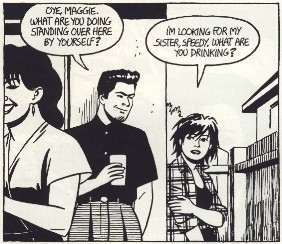
This comic features Margarita Luisa "Maggie" Chascarrillo as the central character, who is the best friend—and occasional—lover (though she is usually in pursuit of men) of Esperanza Leticia "Hopey" Glass, who is usually seen as a lesbian. I say “seen as” because this is a group of partying women in their late teens and early twenties, and sexual identity seems less the point than a sort of fluid idea of exploration and fun. They don’t all know who they are yet. Others are part of the world, Daffy, Izzy, (bombshell) Penny, Ray, Rand, and so many others.
One high point is the poignant story, "The Death of Speedy," where the end is obvious from the title, but it is still really engaging and sad.
Other eighties, alt-comix strips include Dykes to Watch Out For (Alison Bechdel), and Terry Moore’s Stranger Than Paradise, though there are many others, of course.
Love and Rockets--Hoppers is a comics clinic on how to make a world come alive, fast-paced, with lots of snarky, funny dialogue, shifting quickly from scene to scene, drawn by a master who already was on top of his game in the mid-eighties. In the first volume he was messing around with science fiction and magical realism, which he will come back to, but in this volume he leaves that crazy stuff aside and spends his main time deeply establishing the characters and scene and tone, and it is really engaging and fun.
I have said I prefer Beto’s Palomar work to Jaime’s L. A. punk stuff, but now that I am rereading them I see they are equals—and different, though related in attractive ways.
This comic features Margarita Luisa "Maggie" Chascarrillo as the central character, who is the best friend—and occasional—lover (though she is usually in pursuit of men) of Esperanza Leticia "Hopey" Glass, who is usually seen as a lesbian. I say “seen as” because this is a group of partying women in their late teens and early twenties, and sexual identity seems less the point than a sort of fluid idea of exploration and fun. They don’t all know who they are yet. Others are part of the world, Daffy, Izzy, (bombshell) Penny, Ray, Rand, and so many others.
One high point is the poignant story, "The Death of Speedy," where the end is obvious from the title, but it is still really engaging and sad.
Other eighties, alt-comix strips include Dykes to Watch Out For (Alison Bechdel), and Terry Moore’s Stranger Than Paradise, though there are many others, of course.

September 7, 2017
Is there a point in Jaime Hernandez' Locas stories where everything clicks into place and his spatchcocked collection of sci-fi satire, wrestling tales and skits of punk life coheres into the best comic in the world? (Well, for a while it was). Tempting maybe to point to "The Death Of Speedy", many readers' pick for his single finest story? It's brilliant, but it's a peak in an imperial phase, not the start of one. Maybe "The Return Of Ray D." which introduces one of Hernandez' pivotal characters? Ray adds a perspective that makes the Hoppers stories richer, and his self-doubt and well-meaning haplessness grounds the series.
But I think the moment is in the short story near the beginning of this book, with Joey Glass and Doyle roaming around the rest of the cast looking for Joey's missing Ape Sex LP, while in the background Maggie and Hopey try and work out where they're going to live. It's a simple story - a way of reintroducing the Hoppers cast after a bunch of wrestling tales - but it's delightful, and it's also Hernandez showing off the style "The Death Of Speedy", "Wigwam Bam" and others will depend on, his ability to switch and shuffle narratives with amazing speed, letting a story develop for a tiny handful of economically plotted panels before shifting perspective and checking in on something or someone else. There's always a narrative throughline (even if it's not often as obvious a MacGuffin as the Ape Sex LP) but the really vital action and development is generally happening in the background. It's a structural trick that creates the sense of a vibrant, complicated world.
Of course it all looks magnificent too - few artists are as easy on the eye. But look at the last few pages of "The Death Of Speedy" to see how much variety there is in the artwork too - Maggie's manga-esquire demon-headed freakout; the jagged lines on the panel of Speedy in shadow; the carefree, Archie-style cartooning in the flashback epilogue. It's wonderful stuff - and for all that Jaime Hernandez' style is described as clean, and that a lot of this book is gleeful character comedy, he can also produce very unsettling work. This book ends with "Flies On The Ceiling", the story of Isabel's Mexican encounter with madness and/or The Devil. Here Hernandez' clarity of line accentuates the horror, makes the crisp outline of a wall crack, a grotesque shadow or a dancer's face into something sinister but also inescapable.
But I think the moment is in the short story near the beginning of this book, with Joey Glass and Doyle roaming around the rest of the cast looking for Joey's missing Ape Sex LP, while in the background Maggie and Hopey try and work out where they're going to live. It's a simple story - a way of reintroducing the Hoppers cast after a bunch of wrestling tales - but it's delightful, and it's also Hernandez showing off the style "The Death Of Speedy", "Wigwam Bam" and others will depend on, his ability to switch and shuffle narratives with amazing speed, letting a story develop for a tiny handful of economically plotted panels before shifting perspective and checking in on something or someone else. There's always a narrative throughline (even if it's not often as obvious a MacGuffin as the Ape Sex LP) but the really vital action and development is generally happening in the background. It's a structural trick that creates the sense of a vibrant, complicated world.
Of course it all looks magnificent too - few artists are as easy on the eye. But look at the last few pages of "The Death Of Speedy" to see how much variety there is in the artwork too - Maggie's manga-esquire demon-headed freakout; the jagged lines on the panel of Speedy in shadow; the carefree, Archie-style cartooning in the flashback epilogue. It's wonderful stuff - and for all that Jaime Hernandez' style is described as clean, and that a lot of this book is gleeful character comedy, he can also produce very unsettling work. This book ends with "Flies On The Ceiling", the story of Isabel's Mexican encounter with madness and/or The Devil. Here Hernandez' clarity of line accentuates the horror, makes the crisp outline of a wall crack, a grotesque shadow or a dancer's face into something sinister but also inescapable.

February 22, 2021
The Girl from H.O.P.P.E.R.S. collects material from Love and Rockets #13-32 and The Complete Love and Rockets Volume 5.
I had such a great experience with Maggie the Mechanic that I had to pick this one up. As good as Maggie the Mechanic was, this was even better.
I thought Jaime Hernandez must have emerged from the womb being a master storyteller but the art is even better in this volume than the previous one, a little more polished, a little more confident. The writing is better too. With the science fiction elements almost completely swept away, the humanity of the characters shines even more brightly.
Rena Titanon takes center stage in the first few tales, the aging luchadora fighting to regain her lost glory and avoiding some family secrets that aren't quite dragged out into the sunlight. The rest of the story is about Maggie, Hopey, and the gang. The Death of Speedy Ortiz was brilliant and Hopey going on tour with her band, leaving Maggie behind, made for an interesting set of tales. With the fantasy stripped away, the tales in this volume feel a lot more real, a lot more personal, as Maggie and company navigate emotional jeopardy instead of running from dinosaurs and repairing rockets.
As great as Maggie the Mechanic was, The Girl from H.O.P.P.E.R.S. is event better. Five out of five stars.
I had such a great experience with Maggie the Mechanic that I had to pick this one up. As good as Maggie the Mechanic was, this was even better.
I thought Jaime Hernandez must have emerged from the womb being a master storyteller but the art is even better in this volume than the previous one, a little more polished, a little more confident. The writing is better too. With the science fiction elements almost completely swept away, the humanity of the characters shines even more brightly.
Rena Titanon takes center stage in the first few tales, the aging luchadora fighting to regain her lost glory and avoiding some family secrets that aren't quite dragged out into the sunlight. The rest of the story is about Maggie, Hopey, and the gang. The Death of Speedy Ortiz was brilliant and Hopey going on tour with her band, leaving Maggie behind, made for an interesting set of tales. With the fantasy stripped away, the tales in this volume feel a lot more real, a lot more personal, as Maggie and company navigate emotional jeopardy instead of running from dinosaurs and repairing rockets.
As great as Maggie the Mechanic was, The Girl from H.O.P.P.E.R.S. is event better. Five out of five stars.

June 20, 2020
This work is almost sublime, from mostly Latino (but many other) communities in LA, we have female wrestlers, a unique quasi-lesbian relationship, gangstas, wild Penny married to a man with horns and more. Most excellent stuff, some of it very powerful. The art is one of a kind and in my mind Jaime Hernandez is Love and Rockets style. 8 out of 12. I read an English language translated volume online. 8 out of 12.

August 9, 2014
Jaime Hernandez' contribution to Love & Rockets, Locas, is really good, and kind've total genius. I don't think the genius of it becomes really apparent till the end of this volume, roughly 2/3 of the way through the series' original run. That's when the sheer scope of the project starts becoming clear, as characters and storylines written roughly six years prior start paying off, making sense, commenting on each other. That's what's fucking crazy, that for as much as Locas is a linear story, a soap opera, a somewhat freewheeling look at the lives of Mexican Gen X-ers in southern California -- it's also a circle, an endlessly self-referencing puzzlebox of connections between its characters and the way their lives play off one another.
That's not to say that it's an overly formalist work, or an overly clever one. Sometimes it really is just about driving around town trying to track down a punk record, or it's a hamfisted Ghost World progenitor, or a weird mishmash of sex parties, gang culture, and professional wrestling.
It's not the heaviest or the most focused book on earth, but the fact that it lays so much groundwork for, like, every indie and autobio comic to follow it, AND has such a dense internal storytelling structure -- well shit. That's powerful mojo. It's a slow-burn read, but fascinating and well worth digging into.
That's not to say that it's an overly formalist work, or an overly clever one. Sometimes it really is just about driving around town trying to track down a punk record, or it's a hamfisted Ghost World progenitor, or a weird mishmash of sex parties, gang culture, and professional wrestling.
It's not the heaviest or the most focused book on earth, but the fact that it lays so much groundwork for, like, every indie and autobio comic to follow it, AND has such a dense internal storytelling structure -- well shit. That's powerful mojo. It's a slow-burn read, but fascinating and well worth digging into.

July 26, 2020
This is the one, for a lot of Locas fans. It has two of the most famous storylines – “The Death of Speedy Ortiz” and “Flies on the Ceiling,” two of Jaime’s most emotional and narratively gripping tales so far, the two that are used to convince non-believers that there’s more to L&R than just punk rock and heartbreak. They are pretty great, no doubt – Speedy Ortiz’s sad and famous death (a band even named themselves after him) unfolds with great patience and care, and the end was sufficiently opaque enough to make me say, “wait, what actually happened there?” It’s comics written to resemble great cinema. “Flies on the Ceiling” examines Izzy’s tumultuous, demonically-tinged existence before her eventual return to Hoppers and gives us more context into why she is the way she is.
These stories still aren’t my favorite, but of the three Locas collections I’ve read, this is the best one, so I’ll give it the high mark. You kind of have to read Maggie the Mechanic to get a lot of the context of how these group of friends and families came together, but if you’re only going to read one Jaime book, this is probably the one to do. Since each storyline is functionally its own world, you really can jump in anywhere.
These stories still aren’t my favorite, but of the three Locas collections I’ve read, this is the best one, so I’ll give it the high mark. You kind of have to read Maggie the Mechanic to get a lot of the context of how these group of friends and families came together, but if you’re only going to read one Jaime book, this is probably the one to do. Since each storyline is functionally its own world, you really can jump in anywhere.

May 3, 2021
7/10
Very intelligent and charming use of pure black and white. Outstanding compositions at almost every panel. Jaime Hernández's line has one foot into angular design, the other into classic cartoony roundness. The rhythm of the strip is frantic, the dialogues natural. Really impressive cartooning storytelling all around.
Story-wise, it took me a bit to understand who was who. It's a soap-operish slice of life, which mostly follows a bunch of Mexican-Californian punk girls in the 80's. In the end, I could not connect much with the characters and their lives. Yes, these girls behave in funny ways, and they are a bit crazy here and there. Hernandez's ability to portray realistic lives and realistic feelings in a comic book that reads like newspaper funnies fascinates me on an intellectual level. But emotionally, the book didn't have much of a hold on me. There is a limit on how much I can read about 20 years old girls that talk about their Hispanic aunties, say hello to the boys in the street and eat each other (sexually speaking -- this strip is incidentally a pioneer in queer comics).
My favourite story was the last one, the more out of the chorus, in which the saddest of the recurrent cast of women, Izzy, goes to Mexico and ends up meeting the devil.
Very intelligent and charming use of pure black and white. Outstanding compositions at almost every panel. Jaime Hernández's line has one foot into angular design, the other into classic cartoony roundness. The rhythm of the strip is frantic, the dialogues natural. Really impressive cartooning storytelling all around.
Story-wise, it took me a bit to understand who was who. It's a soap-operish slice of life, which mostly follows a bunch of Mexican-Californian punk girls in the 80's. In the end, I could not connect much with the characters and their lives. Yes, these girls behave in funny ways, and they are a bit crazy here and there. Hernandez's ability to portray realistic lives and realistic feelings in a comic book that reads like newspaper funnies fascinates me on an intellectual level. But emotionally, the book didn't have much of a hold on me. There is a limit on how much I can read about 20 years old girls that talk about their Hispanic aunties, say hello to the boys in the street and eat each other (sexually speaking -- this strip is incidentally a pioneer in queer comics).
My favourite story was the last one, the more out of the chorus, in which the saddest of the recurrent cast of women, Izzy, goes to Mexico and ends up meeting the devil.

December 15, 2014
This book has been sitting on my shelf for years waiting to be read. I wanted to wait till I got the first volume, but I still haven't after all this time so I thought I should get to it.
I really wish I would have read this book a long time ago. It's really good. At first I was a bit confused by all the different characters and their relationship's, but it didn't take me long to figure it out. The book mostly centers around Maggie. She has one of the most unique characteristics in comics: she starts off skinny but overtime she becomes more full figured. How cool is that? You have to give it up to Jaime for having the balls to do that. Just try to imagine what would have if an artist tried to have Wonder Woman put on a few pounds. He'd have people sending him death threats!
I also really like the very skilled and mature way Jaime deals with Maggie's bi-sexuality. I get the feeling that in most comics women are made to be gay, or bi, because male readers are excited by the idea of two women together. However, in this book, it's handle totally different. Maggie doesn't seem Bi because it will sell more books, she's Bi because she feel in love with her best friend, and her best friend is a women. Maggie even talks about how she's never been with a girl besides Hopey. I just really dug that.
The art is, or course, AMAZING!!! Seriously, it doesn't get much better then Jaime Hernandez. Not only are his lines perfect, but the way lays out his pages, to how he spots his blacks, ughhh! It makes me go crazy just to think about it. There are some drawings in this book that are very beautiful, to say the least!
This might be one of the best books I read this year.
I really wish I would have read this book a long time ago. It's really good. At first I was a bit confused by all the different characters and their relationship's, but it didn't take me long to figure it out. The book mostly centers around Maggie. She has one of the most unique characteristics in comics: she starts off skinny but overtime she becomes more full figured. How cool is that? You have to give it up to Jaime for having the balls to do that. Just try to imagine what would have if an artist tried to have Wonder Woman put on a few pounds. He'd have people sending him death threats!
I also really like the very skilled and mature way Jaime deals with Maggie's bi-sexuality. I get the feeling that in most comics women are made to be gay, or bi, because male readers are excited by the idea of two women together. However, in this book, it's handle totally different. Maggie doesn't seem Bi because it will sell more books, she's Bi because she feel in love with her best friend, and her best friend is a women. Maggie even talks about how she's never been with a girl besides Hopey. I just really dug that.
The art is, or course, AMAZING!!! Seriously, it doesn't get much better then Jaime Hernandez. Not only are his lines perfect, but the way lays out his pages, to how he spots his blacks, ughhh! It makes me go crazy just to think about it. There are some drawings in this book that are very beautiful, to say the least!
This might be one of the best books I read this year.

November 30, 2012
In volume 2, robots, dinosaurs and jet bikes had been replaced with gang warfare and drugs but if anything I loved the 2nd volume even more. Maggie and Hopey were so awesome! Beautiful, tragic and very real! Though I must admit I was not as fond of Hopey with the long hair! Her journey just seemed heartbreakingly true though. I really loved the first half of the stories, once Hopey left, while I was still enjoying them, I just found myself wondering when she was coming back! I did love that her and Maggie were officially out of the closet in this. I felt their relationship was very real. Complicated, confusing and fucked up, and I loved all the different reactions to it. I felt that the characters developed a lot more in this, while it was a little sad to see them growing up and changing it was done very well. I have to say that I think this series is rapidly becoming one of my all time favourites.

April 1, 2015
Going from the reaction given this book, I must be crazy for not enjoying it. But I didn't! Ever want to read a bunch of lower-middle class kids go through their day to day with such exhilarating conflict as trying to track down a borrowed album? I sure don't! I barely remember anything that goes on. The text throws about a gajillion characters at you in the span of a few pages. Problem is, many of them look similar and even act similar, so they're hard to tell apart. Their stories juggle back and forth, which made it incredibly difficult to follow. For such a supposedly revolutionary series, it could be so humdrum and forgettable.

April 21, 2023
I don't like Hopey very much. Should I like her more?

April 8, 2020
I love these characters and how authentic and imperfect they all feel. Even more so I love the nonlinear presentation of their stories. Non-linearity seems like it’s typically used in modern media as a puzzle box gimmick for the internet to try to “beat” and that can be neat, but I nearly forgot that it can be used for more naturalistic storytelling too.
Each story here has clear enough context on its own, the same way I might understand the dynamics of a social group I just got to know: these two know each other better than the rest, that person seems like the odd one out, these two don’t really like each other, etc. And just like with any new group of people, their old stories aren’t gonna be shared in chronological order or offering everyone’s perspectives all at once, or maybe even shared at all for a long time. Instead they’re remembered as an erratic patchwork as you spend more time around them. “Oh yeah, remember when...” and then suddenly they reveal some hugely defining event that explains something about them.
In the same way, these stories are regularly interspersed with digressions from many years earlier that don’t immediately relate to whatever else is happening, but offer a fuller impression about who all these people are by showing who they‘ve been. Time is is still generally moving forward from Maggie and Hopey’s early 20s to their mid/(late?) 20s, but sometimes with gaps of months or more between stories. Like real life, there’s often not an immediate payoff or much of an overarching narrative except the one that’s apparent in hindsight after years of people making choices that have defined their lives up to that point. One story here, “Tear it Up, Terry Downe,” is set in the distant past and barely 4 pages long, but retroactively explains more about a few characters than many books manage in 100 pages.
I can’t wait to see what the future holds for Maggie and Hopey and all the rest of this incredible cast of characters.
Each story here has clear enough context on its own, the same way I might understand the dynamics of a social group I just got to know: these two know each other better than the rest, that person seems like the odd one out, these two don’t really like each other, etc. And just like with any new group of people, their old stories aren’t gonna be shared in chronological order or offering everyone’s perspectives all at once, or maybe even shared at all for a long time. Instead they’re remembered as an erratic patchwork as you spend more time around them. “Oh yeah, remember when...” and then suddenly they reveal some hugely defining event that explains something about them.
In the same way, these stories are regularly interspersed with digressions from many years earlier that don’t immediately relate to whatever else is happening, but offer a fuller impression about who all these people are by showing who they‘ve been. Time is is still generally moving forward from Maggie and Hopey’s early 20s to their mid/(late?) 20s, but sometimes with gaps of months or more between stories. Like real life, there’s often not an immediate payoff or much of an overarching narrative except the one that’s apparent in hindsight after years of people making choices that have defined their lives up to that point. One story here, “Tear it Up, Terry Downe,” is set in the distant past and barely 4 pages long, but retroactively explains more about a few characters than many books manage in 100 pages.
I can’t wait to see what the future holds for Maggie and Hopey and all the rest of this incredible cast of characters.

July 7, 2021
Really glad that I am continuing this series. My friend Sara Baier told me that after the first book, there's not really much more science fiction, which is great for me.
I feel like I'm seeing more emotional development of all these characters that I am caring about more and more! Jaime Hernandez uses such beautiful and striking visual storytelling, some of the best I have ever seen, especially for its time! I love seeing the intricacies of the the relationship that ebbs and flows between Maggie and Hopey as well as with the other main characters! Lots of hearts bursting and hearts breaking! I am getting used to the zany elements of this which I somewhat attribute to the 1980s alternative comics world, and maybe some to the Xicana punk world in LA at the time?
Looking forward to reading more of this!!!
I feel like I'm seeing more emotional development of all these characters that I am caring about more and more! Jaime Hernandez uses such beautiful and striking visual storytelling, some of the best I have ever seen, especially for its time! I love seeing the intricacies of the the relationship that ebbs and flows between Maggie and Hopey as well as with the other main characters! Lots of hearts bursting and hearts breaking! I am getting used to the zany elements of this which I somewhat attribute to the 1980s alternative comics world, and maybe some to the Xicana punk world in LA at the time?
Looking forward to reading more of this!!!

July 10, 2011
Ah! This is the Love & Rockets I was expecting. Gone are the odd random sci-fi elements and now we get down to the (mostly) realistic stories of Hispanics/punks living in the LA area in the 80s. Anyone who's been a part of the punk scene will find the people and situations very familiar. The stories veer from funny to tragic and back again; often with throwaway scenes turning out to have very real ramifications later on. As with the earlier stories the art is absolutely gorgeous, but with the improved narrative the Love & Rockets world really comes together. I now see why some people suggest that you start with this book, even though the history from the first book is still an important part of the story arc and should be read as well. Highly recommended.

March 18, 2012
The final story in this collection, "Flies on the Ceiling" is probably the best example of what I expected L+R would be like going into the series. Probably because the label "magical realism" is thrown around in conversations about the Los Bros Hernandez quite often. anyways, if Human Diastrophism is the best introduction to Gilbert, then Girl from H.O.P.P.E.R.S. is the same for Jaime. This collection includes the "Death of Speedy Ortiz" story that the crusty old guys at comic shops across the globe consider the best thing ever, so there's that. I dunno, I think I'm a Gilbert man myself. His characters are a bit more expressive and cartoony, which speaks to me a bit more.

August 9, 2010
I first encountered Love and Rockets through this book and got a little obsessed with the lives of Maggie, Hopey, and especially Izzy, whose disturbing account about her encounter with the devil in Mexico was one of the best graphic novel stories I've ever read. I'm amazing at how Jaime Hernandez knows his characters so well, able to draw them as young punks to curvier young women. Likewise the handle he has on the wrestlers Vicki and Rena, as they go from young heroes to broken down fighters, is astounding. I stayed up several late nights reading this book. And now I have a new obsession.

October 29, 2020
I understand why people say to start with this volume now. It has some of the best cartooning I’ve ever seen and features some absolutely incredible stories. Spring 1982, Flies on the Ceiling, The Death of Speedy and the Maggie/Hopey reunion are all some of the best comics work of all time.

June 4, 2021
Love and Rockets is one of the best comics ever, definitely the best comic of the 80's. This book made me happy and hurt and everything else a great comic makes you feel. No one makes them like Xiame.

August 8, 2007
This is currently our most quality bathroom reading.

November 21, 2021
Masterful cartooning. Got a major crush on Maggot.
February 9, 2025
The second collection of the Love and Rockets Library collects Love and Rockets #13-32 and The Complete Love and Rockets Volume 5.
L&R follows two Latina Punks (Maggie and Hopey) and their circle of friends in the 80s L.A. Punk scene. Imagine a punk rock version of Archie. There’s music, drugs, professional wrestling, strippers, a dash of scifi, and a hint of horror (in one story).
I know this is a beloved series (it’s been going for decades). I know it’s important to the history of comics. I, however, found it difficult to get through. This collection is much better than the first collection, but still not incredibly enjoyable for me. I think part of the issue was the format. If I read the individual issues of these comics in the 80s as they were released, it probably would have worked. Trying to read straight through the issues, however, makes it feel so disjointed. Story arcs and characters come and go within a matter of pages.
That being said, I can see why people fall in love with Maggie and Hopey. They are often insufferable, but more often than not, beloved characters.
L&R follows two Latina Punks (Maggie and Hopey) and their circle of friends in the 80s L.A. Punk scene. Imagine a punk rock version of Archie. There’s music, drugs, professional wrestling, strippers, a dash of scifi, and a hint of horror (in one story).
I know this is a beloved series (it’s been going for decades). I know it’s important to the history of comics. I, however, found it difficult to get through. This collection is much better than the first collection, but still not incredibly enjoyable for me. I think part of the issue was the format. If I read the individual issues of these comics in the 80s as they were released, it probably would have worked. Trying to read straight through the issues, however, makes it feel so disjointed. Story arcs and characters come and go within a matter of pages.
That being said, I can see why people fall in love with Maggie and Hopey. They are often insufferable, but more often than not, beloved characters.

Read
June 17, 2022Must go to silver sprocket and acquire more Jamie Hernandez comics.

February 22, 2017
I can not get enough of the Love and Rockets library. The stories are well felt and span so much time, like a surreal telenovela. The art is simple but evocative. I am starting to like Jaime Hernandez's work over his brother Gilbert's but they are equally excellent.

February 16, 2008
The Locas series (which this and two other books encompass) is a soap in Comic Form, primarily following two girls as they have various adventures that range from Sci-Fi insanity, to Punk Rock mythologies. The stories appeared in the book Love & Rockets, along-side work by his brother, who's stories were centered around a village called Palomar. In a way, you need both to really absorb either story, but reading Locas in three-volumes, all at once is also extremely rewarding.
I will be up front: I am in love with the girls in these stories. Jamie Hernandez draws beautiful girls, and he loves to draw them, too. In many ways he manages to capture the voice of these women better than any man has ever captured a woman in comics, and it's this keen observation and well-written dialog that really drives everything forward. While there are definitely sub-stories within the Locas series, to me it seems more about the characters interacting, and less about events happening.
This is, perhaps, the only shortcoming of Jamie's work: much of it seems a little "light" compared to his brother. On the whole, it IS a soap, and people break-up and fight more often than anything else. There are other elements, true, but the stuff that sticks with me is Maggie & Hopey wandering around, having fun, while I find myself hard-pressed to find other connecting threads.
Which is fine. Light entertainment is good, too, and the art and dialog is superb. I never get sick of this guys work, and that is probably the best recommendation I can give.
I will be up front: I am in love with the girls in these stories. Jamie Hernandez draws beautiful girls, and he loves to draw them, too. In many ways he manages to capture the voice of these women better than any man has ever captured a woman in comics, and it's this keen observation and well-written dialog that really drives everything forward. While there are definitely sub-stories within the Locas series, to me it seems more about the characters interacting, and less about events happening.
This is, perhaps, the only shortcoming of Jamie's work: much of it seems a little "light" compared to his brother. On the whole, it IS a soap, and people break-up and fight more often than anything else. There are other elements, true, but the stuff that sticks with me is Maggie & Hopey wandering around, having fun, while I find myself hard-pressed to find other connecting threads.
Which is fine. Light entertainment is good, too, and the art and dialog is superb. I never get sick of this guys work, and that is probably the best recommendation I can give.

February 5, 2012
Picking up basically where Maggie the Mechanic left off, it continues the adventures of the whole Hoppers crew. However, this is where Hernandez begins to stray away from the more fantastical elements of his world, moving it more towards real life. There are still hints of the silliness and sci fi elements found in Maggie the Mechanic, but they become less evident.
What really begins to shine through is the heavy influence of Archie comics on Hernandez's art, specifically the similarities in style he shares with Dan DeCarlo, generally regarded as the man that shaped the contemporary look of the Archie characters, starting in the late 50s. Many, many panels really reminded me of DeCarlo's work, not in a bad way, but rather in a way that says to me that Jaime probably read a lot of Archie comics and really grew to enjoy DeCarlo's work, which I do as well.
A simple profile of Maggie or Hopey, an angry face, a character jumping in the air in surprise evoke the essence of Dan DeCarlo's work many times.
Part of the reason I think that I really enjoy Love and Rockets is because in many ways they are the adult version of Archie comics. Story lines are more mature and grittier much of the time, yet both comics share many of the same humour, many stories on relationships and a certain whacky chaos. If anyone has ever been a fan of Archie comics yet feels they've outgrown them in some way, I would recommend Love and Rockets as a worthy successor for mature audiences.
What really begins to shine through is the heavy influence of Archie comics on Hernandez's art, specifically the similarities in style he shares with Dan DeCarlo, generally regarded as the man that shaped the contemporary look of the Archie characters, starting in the late 50s. Many, many panels really reminded me of DeCarlo's work, not in a bad way, but rather in a way that says to me that Jaime probably read a lot of Archie comics and really grew to enjoy DeCarlo's work, which I do as well.
A simple profile of Maggie or Hopey, an angry face, a character jumping in the air in surprise evoke the essence of Dan DeCarlo's work many times.
Part of the reason I think that I really enjoy Love and Rockets is because in many ways they are the adult version of Archie comics. Story lines are more mature and grittier much of the time, yet both comics share many of the same humour, many stories on relationships and a certain whacky chaos. If anyone has ever been a fan of Archie comics yet feels they've outgrown them in some way, I would recommend Love and Rockets as a worthy successor for mature audiences.

May 8, 2010
I can't believe that I'm just now catching on to Love and Rockets. It's kind of like when I was a freshman in college and I read Weetzie Bat and I thought "where was this book when I was thirteen years old?" L&R - the comic book, not the band - is for people who are into SoCal punk rock and bisexual Latina love triangles, as well as space ships, dinosaurs, and lady wrestlers. This is the second in the Fantagraphics Books series (Maggie the Mechanic is the first), chronologically presenting the entire run of the comic, and I think there are at least two more to follow, plus the Paloma stories by Jaime's brother Gilbert (though I don't think those are related to the Maggie/Hopey universe, but I'm still finding all of this out.) If you own any X albums, or if you've ever watched lady wrestling, or dated a girl with a buzz cut who wore a trench coat, then Love and Rockets might just be for you. It's funny and weird and haunting (Izzy in Mexico - wow, I shouldn't have read that right before bed) and Lord knows I am not a comic book/graphic novel geek but I am beyond addicted to this and therefore r e a d i n g i t v e r y s l o w l y s o I c a n m a k e i t l a s t a s l o n g a s p o s s i b l e.

May 5, 2009
OK, I admit, I was at my hairdreser and some men's magazine had a list of graphic novels you should read, and that's why I picked this up. I'm not a huge fan, but, you know, I like A few here and there. All of that is by way of saying that I didn't really know what I was getting into with this.
OK, so, these are stories (apparently it's one volume out of like three) based around this set of characters, semi-focused on Maggie. This is the middle book of collected stuff; I think the comics all date from the early 80's. And if you come into it not knowing anything (like I did), you might find it a little confusing. The chronology is not linear, the town where they live is full of people who grew up together - they all know who everyone is, but it's not always explicit - and, well, comics is a different medium than text.
Having said that I think I enjoyed it, although I think I'm currently annoyed at what I *think* is going on with the relationship...I may get the other two. So.
OK, so, these are stories (apparently it's one volume out of like three) based around this set of characters, semi-focused on Maggie. This is the middle book of collected stuff; I think the comics all date from the early 80's. And if you come into it not knowing anything (like I did), you might find it a little confusing. The chronology is not linear, the town where they live is full of people who grew up together - they all know who everyone is, but it's not always explicit - and, well, comics is a different medium than text.
Having said that I think I enjoyed it, although I think I'm currently annoyed at what I *think* is going on with the relationship...I may get the other two. So.

March 20, 2015
I don't know why I left it so long before diving into the World of Love and Rockets again, but as soon as I did I fell for those "Locas" and their crazy shenanigans all over again. Funny and moving with wonderfully rounded characters (not a reference to Maggie's weight gain!) from the surreal to the very real. This volume had better connectivity and continuity than the first ("Maggie the Mechanic") whilst keeping things in bite size short stories that contribute to the whole. Slight negatives are a slightly overwhelming number of characters, which can get confusing no matter how beautifully and individualistically rendered they are timelines in the narrative can leap about, but I still want to read more and will do so soon.

May 28, 2020
This is Jaime Hernández at his absolute best. Nearly every story in this late ‘80s collection is a genuine classic. Maggie and Hopey are at their very Maggie-est and Hopey-est, and the extended cast also gets their fair share of screen time. Unrequited love, bacchanalias galore, pro wrestling, interpersonal drama, friendships, trauma, violence. The full range of experiences and tones is unmatched by anyone else in the comics medium.
For my money, this is also the best jumping-on point for those who have yet to read Jaime’s “Locas” stories.
For my money, this is also the best jumping-on point for those who have yet to read Jaime’s “Locas” stories.

May 23, 2021
I know Love & Rockets was groundbreaking in its day, but wow, does it not age well. There are approximately 100 characters in this collection with only a handful given any sense of personality or distinguishing characteristics. Characters pop in and out like you should know them even though they've never appeared before. Despite this book supposedly revolving around Maggie, she has no agency and wanders around based on the whims of others. There are a couple vignettes here and there that saved the book from a one star review, but overall, I do not understand the lasting appeal of this series.
Displaying 1 - 30 of 119 reviews