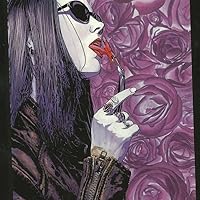
This book includes two of Moorcock's Elric stories, as well as tales of other Moorcock heroes such as Sojan, and several essays on his craft:
- Elric at the End of Time - The Last Enchantment - The Secret Life of Elric of Melnibone - Sojan the Swordsman - New Worlds - Jerry Cornelius - In Lighter Vein - The Stone Thing
Michael John Moorcock is an English writer primarily of science fiction and fantasy who has also published a number of literary novels.
Moorcock has mentioned The Gods of Mars by Edgar Rice Burroughs, The Apple Cart by George Bernard Shaw and The Constable of St. Nicholas by Edward Lester Arnold as the first three books which captured his imagination. He became editor of Tarzan Adventures in 1956, at the age of sixteen, and later moved on to edit Sexton Blake Library. As editor of the controversial British science fiction magazine New Worlds, from May 1964 until March 1971 and then again from 1976 to 1996, Moorcock fostered the development of the science fiction "New Wave" in the UK and indirectly in the United States. His serialization of Norman Spinrad's Bug Jack Barron was notorious for causing British MPs to condemn in Parliament the Arts Council's funding of the magazine.
During this time, he occasionally wrote under the pseudonym of "James Colvin," a "house pseudonym" used by other critics on New Worlds. A spoof obituary of Colvin appeared in New Worlds #197 (January 1970), written by "William Barclay" (another Moorcock pseudonym). Moorcock, indeed, makes much use of the initials "JC", and not entirely coincidentally these are also the initials of Jesus Christ, the subject of his 1967 Nebula award-winning novella Behold the Man, which tells the story of Karl Glogauer, a time-traveller who takes on the role of Christ. They are also the initials of various "Eternal Champion" Moorcock characters such as Jerry Cornelius, Jerry Cornell and Jherek Carnelian. In more recent years, Moorcock has taken to using "Warwick Colvin, Jr." as yet another pseudonym, particularly in his Second Ether fiction.
“But Stewart! If the previous book in the Elric series, Stormbringer, ended the way it did, how can there be a seventh?”
It's a fair question. It boils down to the simple fact that Michael Moorcock keeps writing Elric stories. Furthermore, he writes them out of sequence. We know how it all ends, sure. But there's plenty of room within the span of Elric's life to add details. The first six books collected stories written over the course of a decade or so, assembling them in chronological–as opposed to publication–order. But then came the day when Moorcock had two more Elric stories, one of them a crossover with his Dancers At the End of Time series …
So the book consists of about one-third Elric, one-third Sojan the Swordsman, and one-third essays and an exercise in self-parody. I speculate that the lure of further Elric money was too great to resist. Nor do I really begrudge him, especially given his remarks in one of the essays regarding how much money he lost publishing New Worlds magazine–he published it himself rather than forming a corporation, and wound up personally liable for its debts. I would probably be featuring my best-known character's name in the book's title and slapping an attractive Michael Whelan cover on it too.
So the book is a bit of a hodge-podge. “Elric At the End of Time” is fun. I particularly enjoyed seeing Werther de Goethe reacting to Elric. Obviously, being familiar with the characters and concepts of Moorcock's Dancers At the End of Time books helps. Though all you really need to know is that it's incredibly far into the future, and what remains of Humanity have essentially become gods. What do nigh-omnipotent, immortal beings do to fill their days and pass the time? The second Elric tale, “The Last Enchantment,” is more forgettable.
The essays are nice. In one, Moorcock discusses the origins of Elric and the series publishing history. In the second, he talks about his tenure with New Worlds and the origins of the Jerry Cornelius books. The final self-parody, “The Stone Thing,” is hilarious fun, sending up Elric, Corum, and just about every incarnation of Moorcock's Eternal Champion in just five pages.
Really, the weakest part of the entire book is the seemingly interminable Sojan the Swordsman. While it has its occasional moments, it's a pretty poor cross between Conan and John Carter. I lost track of how many situations were resolved by luck and coincidence. At one point, there's an airship crash. Sojan is left for dead, but his two companions are taken prisoner. He eventually regains consciousness, heads to the nearest city, convinces the local police force that he wants to join, goes through their training process, and is assigned duty at the tower where his two companions have been imprisoned, and his first shift begins just days before they are to be executed! I have no words … I certainly admire Moorcock's bravery in publishing such juvenalia.
As much as I enjoy Elric, I'd have to say that this one is probably for the die-hard fans. Read at your own risk, and don't be shy about skipping Sojan …
Well, now. Not exactly what I hoped it might be... namely, a collection of short stories featuring Elric in the fullness of his career if not epic in scope.
Indeed, I got a few essays on the state of SF and Moorcock's early career and that was fine and fun for what it is, but it read more like a reminiscence than anything else. Okay. Fine. I actually liked hearing about the push against the flippant and light junk that had been the staple of the SF community before then.
Let's face it. Moorcock is deeper than most writers. Deep mythology, deep exploration, clever and subtle cues to go right along with truly epic, storm-breaking battles between Order and Chaos bringing out multiple dimensions, vast armies, and a soul-drinking sword. Fun AND DEEP, man.
But this collection? Well, no. A hint or two here and there and a lot of ... hmmm. Maybe this isn't all that good. Win some, lose some.
This is an oddball collection of fiction and non-fiction bits and pieces by Moorcock. The cover proclaims it's the seventh book in the Elric series, but there are only two Elric stories included. I enjoyed The Last Enchantment, but I thought the titular story to be a bit forced. The longest piece, Sojan the Swordsman, previously appeared separately under that title. It's an interesting volume for hardcore Moorcock fans but doesn't live up to the billing.
I'm a big fan of Michael Moorcock, but not a big fan of this book. Most of the pieces in here are immature, either in terms of when they were written in Moorcock's career, or in terms of tone. The title story is written as a mockery of the character Elric, and is interesting in terms of bringing together several of Moorcock's characters (Werther de Goethe, Duke of Queens, Una Persson, etc). This sort of cross-polination of characters works quite well in Moorcock's later works, but this one is silly to the point of distraction. I don't hate it, but I'd rather not re-read it, either. "The Last Enchantment" is my favorite piece in this volume. It uses a transitional style moving from the more traditional Elric story toward the playfulness and experimentalism of the Second Ether trilogy (which is some of my favorite writing from Moorcock). The Sojan the Swordsman section, begun early on in Moorcock's career, is downright banal and actually a bit clumsy. A couple of essays of interest to Moorcock aficionados round out the bulk of the book. But it's at the very end, with the purple-prose pastiche "The Stone Thing," that the collection hits it's stride. Unfortunately, it's a little too late to make the book anything better than average overall.
This is one of those books I have known about for a long time although buying it has sort of broken my own rule of not duplicating books - however it is a Papertiger and so was on my hit list.
Anyway this book is the last part of my (current) Rodney Matthews run - this is a collaboration between Michael Moorcock and Rodney Matthews. It is the story of yes you guessed it Elric at the end of time which various illustrations provided by Mr Matthews. It is not a graphic novel.
That said the illustrations certainly give an extra dimension to the story - which is rather intriguing since I have seen nearly all of them in other guises and applications. They have been used as set pieces, historical examples of Rodney's work and even re-worked in to other illustrations (something Rodney has made no secret about where he re-applies art in different ways).
However this is also a Papertiger book and as such is another entry in that illustrious publishers catalogs. So for me this was a great read and at the very least gave me insight in to the collaborations between Moorcock and Matthews.
If I were an editor, I’d reject all the stories in this collection. The title story, in particular, is an example of exactly what not to do. There are a couple of interesting ideas in this book, but on the whole, it’s ill-conceived and poorly written. If you’re considering reading this, pick a book you’ve never heard of and read that instead.
I enjoy Moorcock and his Elric stories a great deal, but despite the "Seventh Book of Elric of Melnibone" billing on the cover this particular collection is pretty random and weak. It includes the title story, the Last Enchantment, a pair of Elric-related essays, a pair of Jerry Cornelius essays, the Sojan the Swordsman stories, and a short short called The Stone Thing.
Elric at the End of Time is a crossover between Elric and Moorcock's Second Aether stories. The pseudo-Victorian Second Aether stuff has never done anything for me, and the team-up here struck me as kind of clumsy. Not an essential work.
The Last Enchantment is much better, however, one of the better late Elric stories. Unlike some of the more out-there and psychedelic tales, it fits in well with the earlier Elric canon. Elric's dealings with the Gods of Chaos are intriguing, and the premise is original.
The essays were brief and not particularly essential. It also seemed odd having two essays devoted to the Jerry Cornelius character when no Cornelius stories appear in the book.
The Sojan the Swordsman stories were the highlight of the book for me. They represent Moorcock's earliest published writing and were featured in a Tarzan fanzine. The stories themselves are pretty generic sword & planet. Moorcock was probably influenced by Burroughs' Barsoom stories, but they read more like Lin Carter's Thongar the Barbarian tales. They're pretty poor, to be honest. The plotting is pretty simplistic, the dialogue laughable, and with no major setbacks Sojan's adventures tend to be tension-free cakewalks. Still, the goofy enthusiasm in the writing was fun, and it was also fascinating from a historical perspective seeing these stories. If one of the greatest living fantasists started out writing stories this silly, maybe I've got a chance, too.
The Stone Thing is an extremely brief joke story. It's funny, but kind of a weird note to end a book on.
This book seems like a bit of a cash grab, a way to make some extra cash on a mix of lesser work. It's worth a read for hardcore Moorcock fans, but only half the book is Elric-related and all the good stuff has been re-released in Del Rey's collections. Sojan the Swordsman was fun, but not something casual fans would be incredibly interested in. Far from essential Moorcock.
Even though I'm a big fan of any and all Elric stories the only one I really enjoyed was The Last Enchantment. At the End of Time didn't feel like the usual Elric story and I'm not sure that I liked it too much. I did enjoy a couple of the essays though.
Well this was really a book of contrasts. Some of my favorite Elric material is in this slim volume, and yet there's also plenty of crushing boredom stuffed in there as well.
I'm going to go through each work in this collection, but suffice to say the tl;dr version is that the first half is great, and the second half is bad and occassionally dire.
Elric at the End of Time 5/5 - This is the title story. I know that some readers haven't taken much to this - but I thought it was delightful! It's a crossover between the Elric universe and the Second Aether universe, and I thought it was absolutely hilarious. If you've ever thought that Elric was too po-faced and serious (and not to mention too gloomy and morose), then this story will be perfect for you. It was really nice to see an author like Moorcock engage in such a humorous manner with his own work.
“Aye,” said Elric darkly, “return me to my realm, so that I may fulfill my own doomladen destiny …” Werther looked upon the albino with affectionate delight. “Aha! A fellow spirit! I, too, have a doomladen destiny.” “I doubt it is as doomladen as mine.”
“You are very welcome here,” said Werther. “I cannot tell you how glad I am to meet one as essentially morbid and self-pitying as myself!” Elric did not seem flattered.
The Last Enchantment 5/5 - This one has a very different tone to the first story. For one, it's not a comedy. It's another classic adventure (although it is a short one). If you enjoy the Elric saga, you should enjoy this.
The Secret Life of Elric of Melnibone 5/5 - Well there's a whole lot of fives so far. This one isn't a story, it's an essay but it's a great essay. It's essentially Moorcock explaining how he created the Elric character, and about the life of the stories themselves. It's insightful and it doesn't overstay it's welcome. It's both in-depth and concise.
If only the volume ended here, it'd be brief, but superb.
Sojan the Swordsman 1/5 - Why? Whhhhhhy? This story held so little interest for me. To begin with, Elric isn't even in it. It concerns a sort of Conan-like character called Sojan who roams around performing all manner of deeds and slowly making a name for himself as some kind of deed-doer. This is one of the earliest Moorcock stories, and it shows. It's not so much bad (the writing is basically competent), it just isn't interesting. There's so little world-building and there's so little characterization. It's a real shame that this was included, because it's the longest story in the collection, and just isn't on the same level as the other works.
Two Essays about Jerry Cornelius 2/5 - Once again... why? These are two essays about a character who isn't in the Elric saga. I guess if you're interested in Jerry Cornelius they might be interesting. I'll leave that for a Jerry Cornelius fan to decide.
The Stone Thing 3/5 - This one was wacky. It's a very short story that parodies fantasy tropes. It's in an essentially similar tone to the title story, but it's a lot shorter and doesn't concern Elric. What it does concern however is a god called Cwlwwymwn and a wizard called To’me’ko’op’r. With these things, I can forgive the lack of the volume's titular star.
In conclusion, I think that Elric fans should read this. Well, maybe not all of it - perhaps stop half-way, but I don't agree with the assessment I've seen sometimes that this volume is worth skipping. The first half is gold. I just wish the publishers had chosen the material for the second half more carefully.
This is a collection of some of Michael Moorcock's early short stories and some explanatory essays.
The title is a little misleading since most of the content is not about his hero Elric. The most pages are given to a sequence of very short stories about Moorcock's first fantasy hero, Sojan the Swordsman, dating from when Moorcock was just 17.
I feel like I'm missing something because Moorcock has such stature. At this time, I have read several of his Elric novels spanning decades of his career, and (this book included) I am disappointed to say I don't get it.
He has said that he is concerned with writing his ideas rather than being a 'good writer'. I find this to be true. His ideas have included some good ones that got copied into pop culture, without credit. But I like good writing and since Moorcock himself says he is not offering it, I ended up skimming this book instead of properly reading it.
It might just be that his work is not for me, yet I'm reluctant to dismiss him. Maybe if I keep at it, something will click one day.
It's worth pointing out that in the essay "The Secret Life of Elric of Melnibone" there's lots of interesting stuff but also IT SPOILS THE END OF "STROMBRINGER". Beware! The wikipedia article places this book between the second and third volumes of the series, despite the cover saying it's the seventh (with Stormbringer being the sixth), and apparently I was a fool to trust it.
Meanwhile this is an oddball collection. It contains two essays on Moorcock's writing career, one on the creation of Elric, the other on his stewardship of a scifi magazine. I'd not have minded a page on the creation of this volume which holds within it: - A soso Elric/End of Time story. - A very enjoyable, short Elric story. - The essay on Elric's creation, with lots of Moorcock biographical details. Interesting! - A hundred page or so story from very early in Moorcock's career, a kind of John Carter of Mars thing that makes Lin Carter's "...At World's End" series look sophisticated. Couldn't finish it. - An essay on a four book series featuring a character you won't see anywhere else in this book, not even an excerpt. - The "Moorcock's Adventures in Magazine Editing Essay". Interesting only to people with very specific curiosities about a specific era in publishing, or maybe someone like me who volunteers at the Judith Merril speculative fiction archive in Toronto (she gets mentioned a few times). - A fun, five page joke at the expense of overwrought fantasy characters in exactly the vein Moorcock and many of his peers built their careers with. I won't ruin the punchline, but it's a good one.
THE END???
This would be an awful introduction of Elric, and as it is I - someone all keyed up to love it, who even had some interest in archaic publishing tales - got a pretty mixed result. I don't know who the hell you'd recommend this to, though I might lend my copy to a friend with some strict reading guidelines. Worth it if you can get it at the library or second-hand for maybe a dollar or two.
The title story is an easyly the best in this collection. Elric travels to the end of time, meeting characters that I'm sure are familiar to people who've read those stories but also Una Persson who appears in the Oswald Bastable novels 9and, I assume, the End of Time series). Fun commentary on who Elric is and how moody and melodramatic a character he is.
The Last Enchantment - 3/5
This story was a fun and weird non-canonical short Elric tale as the Albino Prince of Ruins is transported to a chaos realm and has to do some quick thinking to escape. Nothing stellar but good none the less.
Sojan Shieldbearer - 2/5
These stories are passable. It's interesting to see some of the first work Moorcock ever produced but he has definitely substantially improved, even by the early 60's. Nothing very good but if you like to see an author's evolution, this will give you an idea of where Moorcock started out as a teenager.
The Essay's - 3/5
The various essays were interesting to read though, aside from the Elric one, were seemingly irrelevant to the rest of the stories within, mainly focusing on Jerry Cornelius who is only briefly mentioned in the title story. Good insight into the author and the diferent things he's been invovled in such as the New World magazine.
The Stone Thing - 3/5
Funny little short that satirises many of the tropes that Elric and other fantasy heroes of Moorcock make use of. Funny, short read.
Overall - 3/5
An uneven collection that isn't really about Elric at all. The Elric stuff is all pretty good, its just a shame that the majority of the content is based around the uninteresting character of Sojan.
This is rather problematic anthology to review. There's a lot of variance in the quality and type of material included. The Elric stuff is wonderful, the Jerry Cornelius essays were informative but a little disappointing, as was the final short story, but the oddest piece is probably Sojan the Swordsman. This short novel was written very early in the author's career and it shows. Taking into account that thus is a teenaged writer who's just getting started and hasn't even established his own style yet, the short novel is fine and entertaining. Seeing some of Moorcock's themes being negotiated in such an adolescent fashion was almost enough to warrant a higher rating. But to be honest, it just doesn't hold up as more than an interesting anecdote to the writing process. Definitely something that's really just for die-hard fans of Moorcock and the Eternal Champion.
Il y a dans ce livre trois ensembles de nouvelles. D'abord, trois nouvelles sur Elric dont la première donne son titre au recueil. Ensuite, le paté des aventures de Sojan, un pulp datant de 58 où chaque aventure ne prend pas plus de cinq pages. Et enfin, une courte nouvelle en forme de blague sur les héros amputés de Moorcock. Si le dernier texte a un certain intérêt, ça n'est certainement pas le cas du premier, que j'ai eu un mal incroyable à lire (à cause d'une écriture aussi lourde et ampoulée qu'un récit du XVIIIème siècle). Quant à Sojan, le brouillon est intéressant, mais loin d'être un texte valable.
Moorcock mashes up two of his least compatible fictions, Elric the grim demon-haunted albino warrior with the sheer frivolous chaos of his End of Time series. It all goes quite swimmingly until Elric starts to suspect that the Lords of Chaos are having him on.
Really, this is for completists only - The bulk of the book isn't even Elric, but Sojan stories loosely fit together, which Moorcock wrote at an early age before refining his craft. The rest is comprised of essays, two Elric stories and a short parody of Elric and Corum.
Elric at the End of Time - 3.5 Stars The Last Enchantment - 3 Stars The Secret Life of Elric of Melnibone - 2 Stars Sojan the Swordsman - 3 Stars (written for 11-14 year old audience IMHO) New Worlds - Jerry Cornelius -2 Stars In Lighter Vein - 2 Stars The Stone Thing - 3 Stars
Book Seven of the Elric Saga (except it's not really). This anthology reprints a couple of previously uncollected Elric stories, Moorcock's first fantasy stories featuring Sojan the Swordsman and several articles in which the author relects on his own work.
This book began surprisingly strongly with the titular short story actually playfully poking fun at the seriousness and conceits of the Elric stories using the characters from the Dancers at the End of Time series. There's also an interesting essay on how Moorcock's life directly influenced how he wrote the adventures of the albino swordsman.
Unfortunately, the latter two thirds of the book are of much lower quality. The largest part of the book are taken up with the adventures of Sojan the Swordsman, which the author began writing at the age of fifteen, and they're completely lacking in complexity or engaging characters and, for all their swashbuckling, are really quite dull. Then there's another essay, but one in which Moorcock espouses his famously elitist attitudes to fantasy and SF, which reads as almost pure hubris.
Put simply, if you're looking for the conclusion to Elric's story, then you'll find it in 'Stormbringer', not here. This book is mostly a curiosity best-suited for Moorcock fans and purists.
And my Elric Reading Challenge concludes with this volume that screams Elric, but really only contains 2 Elric short stories, with an essay on the Secret Life of Elric, and other non-Elric stories. Elric at the End of Time is a charming story flitting Elric to Moorcock's End of Time era (which themes at least came back to me while reading this story) and reveals quite the revelation about one of the End of Time characters. The Last Enchantment was really only for completists sake, and, alas, I didn't quite get 'the joke'. The bulk of the book is taken up with Moorcock's early 'Sojan the Swordsman' stories wrapped up in short novel form, and is really only for rabid fans of Moorcock. It is a window on his early influences, pre-Elric, and written as they were at an early age, can be forgiven for the rookie mistakes throughout the stories. The volume finishes with an essay on Moorcock's time as editor on New Worlds, and the odd, cheeky short story 'The Stone Thing'. All in all, if you're just interested in following on from the Elric books, it's worth really only reading the 2 Elric stories (one if I'm brutally honest), and perhaps the essay on New Worlds, and forgetting the rest. Now, time for something completely different.
This is hardly essential reading, although the main story is possibly my favourite Elric adventure. It fits smartly into the Moorcock universe (or multiverse), and features characters and themes from the Cornelius Quartet and Dancers At The End Of Time trilogy (my absolute favourite of Moorcock’s work). Elric has often been dismissed as throw away sword and sorcery, a rip off of Conan, but to dismiss the character and stories as this is a disservice to both the writer and the reader. There is more going on here than you would think if you are prepared to look for it.
Also included in this collection is Sojan the Swordsman, an early work by Moorcock and follows the title character in a medieval style world which includes airships and air-pressure guns. It was written when he was a teenager and it shows, but is an interesting diversion for fans. In addition to the stories, Moorcock includes a handful of essays discussing Elric and Jerry Cornelius, two of his popular creations, and this is a great insight into the mans work and rationale which I enjoyed a lot.
While the titular Elric story is quite entertaining, it's a fairly lightweight piece, as are the other fictional offerings in this volume, including the rather good natured self-parody of The Stone Thing, the story that rounds out this collection. The series of episodic short stories that make up the Sojan collection are only there for completists or fans of Mr Moorcock's juvenilia or for people who want to track the progress of an author across his entire career. While I love a lot of the work of Moorcock, he is not that author for me. Of more interest to readers like me are the two non-fiction pieces detailing the development of Elric as a character and just how much he mirrored Moorcock's inner life and the state of play in British SF when he came to edit New Worlds. I very rarely use the expression "curate's egg" but it feels particularly apposite here.
Book#7 is quite weak, even at its best. Only two Elric stories, the rest is just Moorcock being Moorcock doing Moorcock characters, which is fine if you aren't expecting a book about Elric to be mostly NOT about Elric. Fuck, I hate when authors do this stuff, and it seems they have been doing it for quite a while. I do love that I got this for free, digitally, but the cover art for the DAW paperback is probably worth the $2 or so you’d pay for this in a beautifully dark and dusty real life actual bookstore somewhere. For completists only, and even they are probably more than a trifle angered by this one, artwork aside.
What a end to a depressing life/world. The mind of moorcock is one of those writers that can make you feel for their characters and, the world they build. From book one the struggle of life for elric is not given but is a struggle to take root. Moorcock has done a amazing job in making you love the world he has built. I say thank you for the journey. I look forward to the next by Michael Moorcock.
Worst of the series. Reads like a fever dream and is completely off the rails. I was trying to read these books in their chronological order (not the order they were written), and wish I'd skipped this one completely. It feels like Moorcock was playing around with a writing exercise and decided to publish the material for some extra cash.
Nothing that happens within this book ties back into the rest of the series, so save it for the end as a palette cleanser if nothing else.
This is probably my least favorite Elric 'novel' so far.
It is hard to call it a 'novel', as there is really just a couple of stories, one more of a novella, and some musings by the author about how he got where he is.
The largest portion of this book is a story about 'Sojan the Swordsman' and has nothing to do with Elric.
Feels like this might have been a marketing ploy ack in the day.
While the Elric stories and the couple of prose pieces are all good, the Sojan stuff that takes up almost half the book is borderline unreadable. Well, it is unreadable and I didn't read most of it. Not Moorcock's fault as he was 18 when he wrote it, but it shouldn't have been allowed to make up the bulk of a hardback book.
I finally finished the series and it just falls off a false-advertising cliff at the end. There's precious little of Elric here and what there is is written like Moorcock HATES his guts by this stage. The rest of the book includes a funny self-parody, some non-fiction and Moorcock's teenage attempts at writing fantasy - Sojan the Swordsman. This was hard to get through.