"Give me your tired, your poor, Your huddled masses yearning to breathe free..." Follow the journey of the Statue of Liberty from 1865 to today as it goes from being a mere glimmer in the eyes of two Frenchmen to becoming a colossal gift to the United States, a gesture of friendship between the two nations, a monument to the first hundred years of American independence, and a symbol of liberty for all.
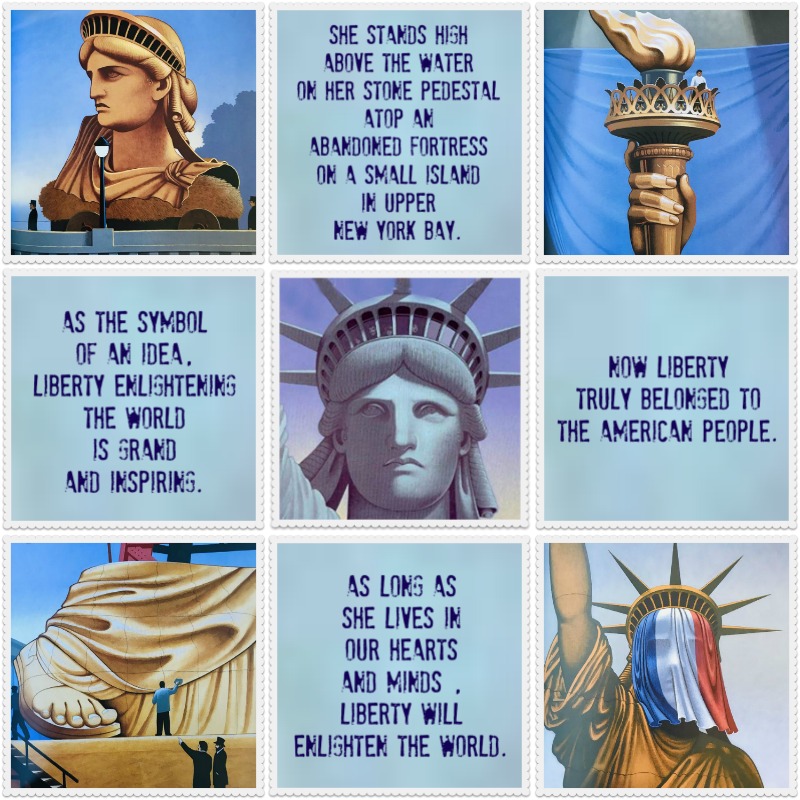
She Stands High Above The Water On Her Stone Pedestal Atop An Abandoned Fortress On A Small Island In Upper New York Bay.
As The Symbol Of An Idea, Liberty Enlightening The World Is Grand And Inspiring.
Now Liberty Truly Belonged To The American People.
As Long As She Lives In Our Hearts And Minds , Liberty Will Enlighten The World.
TRAVELED TO // New York City & France MET ALONG THE WAY // Lady Liberty, Edouard De Laboulaye, Auguste Bartholdi, Gustave Eiffel, Emma Lazarus, Joseph Pulitzer,
Content Considerations: an illustration with a nude statue in the background.
**Like my reviews? Then you should follow me! Because I have hundreds more just like this one. With each review, I provide Content Considerations, mentioning any objectionable content I come across so that parents and/or conscientious readers (like me) can determine beforehand whether they want to read a book or not. Content surprises are super annoying, especially when you’re 100+ pages in, so here’s my attempt to help you avoid that!
If you’re considering a book or looking for a new title to read, check out my highly categorized shelves, read my reviews and Friend or Follow me to spiff up your feed with clean, wholesome, living books.
Liberty by Lynn Curlee tells the story of the construction of the Statue of Liberty. Among the topics covered are the statue’s French origins, a biographical sketch of the statue’s creator, Auguste Bartholdi, the political climate at the time, the search for funding, and the technical details of the statue’s planning, construction, and restoration. Although primarily concerned with discussing an important American symbol, the book also touches upon history, engineering, and other topics. For example, Curlee describes the statue’s French heritage by explaining a bit of the historical events that led to its construction: “The French Revolution, though originally based upon ideals of liberty, equality, and brotherhood, had led instead to a bloody Reign of Terror, the disastrous wars of Napoleon, and decades of bad government. Many patriotic Frenchmen longed for a republic patterned on that of America to replace their current regime, the Second Empire of Napoleon III” (2).
Curlee provides in-depth coverage of his subject, dotting his informative text with fascinating details and thought-provoking discussion of this marvelous feat of engineering and art. For instance, readers will learn the statue is modeled after one of the seven wonders of the ancient world, the Colossus of Rhodes. A discussion of the need for funds (“statues cost money”) reveals the interesting fact that money was gathered directly from American citizens due to a plea by Joseph Pulitzer in his newspaper when the project was close to being scrapped. Detailed specifications of the statue’s cost, dimensions, the materials used, and the manpower needed for construction are provided, and are also listed in a handy reference chart in the book’s back matter. As Publisher’s Weekly notes, Curlee “is particularly adept at explaining the engineering difficulties involved in putting together and supporting a statue that soars more that 150 feet tall and weighs more than 32 tons” (Amazon.com 2004). Children will learn about construction techniques including repousse work and the designing of an internal iron framework. These rather complex techniques and others are discussed with finesse and are easily made accessible to young audiences.
Curlee has made a superb effort to maintain factual accuracy in his book. The inclusion of specific facts, details, and specifications lend credence to the work. Sources are listed at the end of the book in a bibliography, and a specific timeline is provided to help students who are trying to keep dates straight. A few direct quotes are also included. The book is also successful on an aesthetic level. Curlee’s text is free-flowing and engaging and is free from bias and personal commentary. To lend a touch of the arts to the book, Curlee includes a poem by Emma Lazarus entitled “The New Colossus”:
“’Keep, ancient lands, your storied pomp!’ cries she With silent lips. ‘Give me your tired, your poor, Your huddled masses yearning to breathe free, The wretched refuse of your teeming shore. Send these, the homeless, tempest-tost to me, I lift my lamp beside the golden door!” (Unpaged)
Curlee’s accompanying acrylic paintings are rich in color and are done in a distinctly realistic style. In many frames, as noted by Publisher’s Weekly, the perspective is such that the viewer is looking up at the statue, as if to admire her towering grace and majesty. The illustrations match the accuracy of the text. People are shown dressed in the style of the times, in suits and cravats. Illustrations of the statue’s early stages show how it would have looked before the copper weathered, while illustrations of the restoration process show it as the familiar green. A sense of the statue’s size is also provided, as we see how large the head is compared to the horses that are dragging it across a bridge.
Liberty is an exciting look at an important American symbol and would be an ideal purchase for any school or public library.
Liberty was our family read aloud on Independence Day, a great book for the occasion and a little something to make the miles zoom by faster! Lynn Curlee is a gifted illustrator and combines architecture, art, and history in a fascinating way. Though considered picture books, none of the titles I have seen have been too juvenile for an adult to enjoy. Boys who like to build things and figure out how things work will especially enjoy the Brooklyn Bridge title.
Back to the subject at hand......Liberty is the story of our own "Mother of Exiles," the Statue of Liberty, from her earliest conception to her recent renovation. It is a fascinating journey that begins in Versailles, France at a dinner party. American admirer and law professor Edouard deLaboulaye was hosting a dinner party at his home in 1865, and during the course of the evening's conversation suggested that a monument "Be built in America as a memorial to their independence...by a united effort...the common work of both nations."
His words planted a seed of vision in a young sculptor named Frederic-Auguste Bartholdi, a man who knew how to dream BIG. Building a modern day colossus, a tribute to liberty, became his obsession. Liberty details the travels, fund raising, the public relations efforts and preliminary sculpting that the young visionary had to go through in order to see his dream become a reality. One thing I found astounding was that Bartholdi began his work (on the hand and torch) before knowing HOW the immense copper statue would actually be held up. It seems he had the boldness to begin his project, and the momentum brought it forward to the point where each problem was solved in turn.
The armature of the statue was was designed by Alexandre-Gustave Eiffel, the famous French engineer known as the "magician of Iron." He would later (in 1889) go on to build his own masterpiece, the Eiffel Tower. The support system was comprised of iron beams and ribs and 600,000 rivets. All of this is intricately and clearly explained in the book.
The picture I loved best was one depicting the head of Lady Liberty being transported in a wagon of straw with 13 huge draft horses pulling her through the streets. On her way to a Paris exposition, she seemed almost alive as the movement gave her the appearance of nodding to the onlookers.
The Emma Lazarus poem, "The New Colossus" has become inextricably linked to Lady Liberty, and is quoted and explained for young readers.
I came away with a sense of awe as I closed the book~~ what a magnanimous gift our country was given. I hope someday to see her for myself. But beyond that~~my hope is that somehow, in spite of the quagmire of immigration tangles, we may continue be known as a nation equally magnanimous and wise in giving the gift of light and liberty to "the huddled masses yearning to breathe free."
In this book, children learn about the journey and the coming about of the Statue of Liberty. This book shows more details about where the pieces came from and why America was gifted this beautiful piece of art. We see how she was built and became a huge piece of not only New York but also America.
This book was very long but had a great story to it. Also talks about all the major historical events that happened. The language in this book is also very sophisticated. Lots of words of countries and very important people are listed in this book that gives a lot of historical context to younger children. This book makes me feel happy because I am reminded of the time I saw the Statue of Liberty when I was younger. I recommend this book to children who can sit still though because lots of dragged out events happen as a lot of history is!
Personal reaction. I enjoyed this book because I think the "statue of liberty" is quite fascinating. This book shows the implications and hard work that it took to build it, as well as it's importance as a symbol of freedom. There are illustrations in the book that give context to the text and make it more intriguing.
Purpose/ use in the classroom: This book would be good for an independent read to 4th or 5th graders to introduce a topic that has to do with famous monuments around the world, which would most likely be found in a social studies class. I would actually use this book in the classroom as a way to introduce a research project. Students do not typically engage in "research papers" until 6th grade or later where they will learn more about "informative structure." This activity would simply ask the students to learn about a famous monument either in America or around the world. It would be a chance for them to engage in more literature, use library resources, and work in groups to enhance their learning experience. Overall, this book is a good tool to use in the classroom because of the variety of activities you can do with it.
I liked this book because I learned something new. After all the education that I have had about the United States, this book taught me something new about the statue of liberty. It has a lot of information for children to absorb, but it should be taught to them. Maybe finding something that is really tall, compared to children, would show them how tall some parts of the statue are. That would make it fun and interesting for children.
Christian read this book because I just had my first trip to New York City with my dad. We didn't make it out to the Statue because the last ferry had just left, but I got a good view of it from the Manhattan shoreline! (Written by Mom.)
The perfect amount of information and history, not too much and not too little, to give you a quick glimpse into the Statue of Liberty. Planning a trip to New York and this was the perfect book for a quick look into the statue. Makes me want to go there!
An nice combination of architecture, art history and history of "The New Colossus" or "Mother of Exiles." A slightly technical read for older children or even adults.
AR Quiz No. 39875 EN Nonfiction Accelerated Reader Quiz Information IL: MG - BL: 8.5 - AR Pts: 1.0 Accelerated Reader Quiz Type Information AR Quiz Types: RP
Lots of words. Not for small children. The pictures are well done and it is very informational in its text. I could use it to teach with, but not in a super fun way without adaptation.