Rabbit enjoys doing rabbity things, but he also loves un-rabbity things! When Rabbit suddenly disappears, no one knows where he has gone. His friends are desolate. But, as it turns out, Rabbit has left behind some very special gifts for them, to help them discover their own unrabbity talents! This is a stunning debut picture book by author/illustrator Jo Empson. Rabbityness celebrates individuality, encourages the creativity in everyone and positively introduces children to dealing with loss of any kind.
As far as kids picture books go, this is probably the oddest one I've met so far... but also the most beautiful.
Most kids books are light and fun - playful - which makes sense.
Rabbityness... has a very mature edge to it.
The story is about a rabbit who likes to do rabbity things (burrowing, eating, etc). He also likes doing un-rabbity things (art and music). The other rabbits love him for these unrabbity things, because he fills the woods with sound and colour.
Then one day... rabbit is gone. And the woods are dark and quiet. And all that's left is a deep, dark, hole. Down the hole the other rabbits find his art and music supplies, and they pick them up in his memory and fill the woods with sound and colour once more.
We never find out what happened to rabbit.
So basically it's a child's primer for dealing with loss - a pretty sombre message for a toddler! My son is nineteen months old, and just likes to point at all the 'babbits' and say 'bouncey-bouncey!' But the sombre message definitely influences the way I read it aloud - it's hard to do silly voices and sing-song rhythms for a story like this...
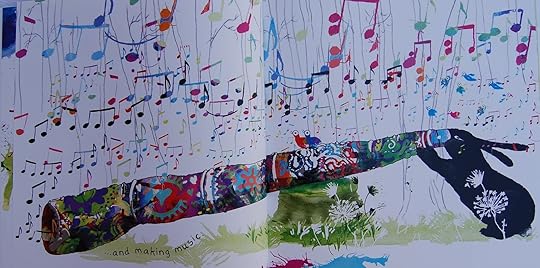
But the artwork is gorgeous! Very modern, stylised and all-round excellent. I'd very proudly put a print of rabbit playing his didgeridoo on my wall.
So a very comfortable four-star recommendation as it's a very special little book...
But Rabbityness is never going to be my first choice when Fin asks to read a book, because it's not as fun to share as something like Room on the Broom - so no fifth star from me.
I think the front cover possibly undersells the contents. The art is pretty magical.
The themes of loss, self-discovery and inheritance are all well evoked in the story line... but where is Rabbit? Did he die? Why don't the other rabbits know? Did he leave them, to spread culture to other warrens?
I reckon the lack of answer to those questions is going to bother me for some time.
Rabbit likes doing rabbity things, but he also discovers that he enjoys making music and art and dancing through the trees. He shares his love of these things with the other rabbits, who are delighted. When Rabbit disappears one day, they find his art and music making supplies and honor his memory by using them themselves. Once again the forest is full of music and color and happy rabbits (doing rabbity and unrabbity things).
This is a beautifully designed picture book – I love the endpapers with the many rabbity poses, and the brilliantly colored pages depicting the rabbits at play with their art supplies and their music and dancing. The rabbits are quite rabbity (except when they’re not). I love almost everything to do with rabbits, so I was completely taken with the illustrations. I can’t help but wishing, though, that the rabbits were more rabbit-like in behavior in their enjoyment of their non-rabbity pursuits. Like, couldn’t they have made music by thumping on hollow logs? Painted with pollen and crushed berries? Made sculptures from leaves and mud? Where did the first rabbit get all of his art supplies? And most of all, WHERE DID THE RABBIT GO? One day he just disappears and everything is quieter, emptier, less colorful without him. Did he mean to leave? Did something terrible happen to him? Did he want to see the world? I wish I knew. Also, I worry a bit about the ruckus the rabbits make in the woods – won’t they draw unwanted attention to themselves? They are PREY animals, after all. Lovely, lovely, fun book that rabbits will want to devour (mine would). Could also be shared with wee humans.
This entire review has been hidden because of spoilers.
This may not be the perfect book for explaining death to a very young child, but it could be a good book to read as part of a collection of stories that help explain life, grief, and what we keep of the people who have left us.
It does not have a strong religious message, and most adults seem to find it touching. The message is beautiful. In fact, if you were reading to an audience of grief-stricken adults, this would probably be a good pick.
When it comes to reading it to a young child, though, I think the story can be a bit confusing. It implies death but never really says it or explains it. Adults get that Rabbit died, but I am not sure if young children do. That leaves some of the explaining to be done by the adult (potentially a grief-stricken adult), assuming that adult really wants the child to fully understand the message.
It's almost like a book about the topic of death that does it's best to avoid saying death, as if the word itself or the concept should not be spoken about. I assume that's an attempt to be gentle to the youngest of readers, but for those looking to use this as a book to help a child through the death of a loved one, it's too vague to do the trick on its own.
A simple, short story about a rabbit who enjoys "unrabbity" things like painting and music. When this special rabbit disappears, the other rabbits are sad, but they find that he has left them paints and instruments and they take up unrabbity hobbies themselves.
The art explodes off the page with energy and joy. I'm sure kids will wonder what happened to the extraordinary rabbit. Did he die or just go away? This ambiguity aside, the story proffers a hopeful message to those who have experienced the loss of someone special.
Rabbit loves rabbity things. But he also loves un-rabbity things.
When Rabbit suddenly disappears, his fellow rabbits are distraught. But then they discover all the un-rabbity things he has left for them to explore, and they are filled with delight.
What a wonderful book. Another award-winner, no surprise. I really enjoyed this so much it has become one of my favorites. And it is now on my list of great gift books for kids. A chance to inspire creativity and some anthropological ideas in the kids' minds is a winner with me! I originally wrote the above on April 19, 2017. I want to add a note which escaped my mind on that day. An interesting thing about this book was to see how differently the kids responded to death. In one classroom, when I asked 'what do you think happened to Rabbit' they all answered 'I think he died', 'Yeah, I think he's dead' and 'he got eaten by a coyote'. In another classroom, the responses were totally different, as if the kids were all in denial about death: 'I think he got lost but he's coming back', 'he found another bunch of rabbits to live with', etc... It was remarkable, same school, different teacher.
This picture book was not what I was expecting at all. I thought it was going to be quite an innocent and naive children's book due to the vibrant illustration on the cover. However, I don't want to say I was deceived, but I think there is an underlying almost mature tone to the book.
The main character 'Rabbit' brings the other rabbits in the woods colour and music and then one day is gone. The abrupt exit of the character could ultimately lead children to question what happened to him and his disappearance and as children do, they are quite empathetic at a young age. Even as an adult, I got slightly confused as to the disappearance of Rabbit. Very abrupt and not explained very well, as a reader you just have to assume what has happened to him. Although that would be a good opportunity for children to discuss and produce work on an alternative ending or what they believe happened to Rabbit...I still think it could've been explained better.
Although I don't believe this book is good for children learning to deal with death, I do however think it is a good book for them to learn about grief and hope. The other rabbits in the story learned how to mourn Rabbit but still do something to cherish his memory. They adopted his way of life, learning to deal with their grief and ultimately made the forest they live in a much more colourful and brighter place to live, even though Rabbit was no longer with them.
This book is a really interesting spin on the whole liking-something-different-but-that-makes-everybody-else-like-it-too-eventually trope (seriously guys, that's an official trope. I saw it on, um, the internet). Rabbit likes doing normal rabbit things, like jumping. But he also loves all kinds of other non-rabbity things. Like painting and making music! All the other rabbits love this about him. When Rabbit disappears mid-book, the other rabbits are sad. Eventually, though, they realize that the art and music that Rabbit gave them allows them to be happy, even though he's gone.
The art in this book is really amazing. In the beginning, Rabbit is a black silhouette on a tiny island of green. He's surrounded by, and nearly overwhelmed by, a sea of white page. Once he starts making art and music, though, the page explodes with a riot of color! The other rabbit's grief is also expressed beautifully.
This is truly a great book. It deals with death without DEALING WITH DEATH, and it's really beautiful to boot.
Rabbit enjoys doing rabbity things, but he also loves un-rabbity things! When Rabbit suddenly disappears, no one knows where he has gone. His friends are desolate. But, as it turns out, Rabbit has left behind some very special gifts for them, to help them discover their own unrabbity talents!
This is a stunning debut picture book by author/illustrator Jo Empson. Rabbityness celebrates individuality, encourages the creativity in everyone and positively introduces children to dealing with loss of any kind.
I loved this book, I thought it was a great introduction to children for harder messages, that some day people will leave but that their memory can remain by doing the things they love. In this instance, when the rabbit left, everywhere went sad and grey until they began painting in his favourite colours and playing music again and it brought them happiness. I found it quite touching, even though it is just a picture book!
This entire review has been hidden because of spoilers.
This was a fun picture book for children - it kept me interested ;) Full of colour.
It would have been fun as a pop-up book (or having tabs to make rabbit move) in sections as we have rabbit enjoying hopping and other rabbity things before moving onto painting and music.
Leaving nothing but a big dark hole?! How about this book left ME in a dark hole! I did NOT see it coming, but our rabbit main character does not live through the whole book. Now, if I had read the back of the book, I would have realized this. Looking on it with new light after that, this book is kind of incredibly wonderful. 😊
eelkõige lihtsalt hästi ilus raamat. kes on elus mõnd küülikut kohanud, kindlasti nõustub, et pildid on kõik väga tabavad, sest täpselt niiviisi üks küülikvälja näeb ja liigub. ja kõik need "rabbity" asjad, mida siin loos küülikule teha meeldib, on ka väga hästi tabatud, magamisest ja urukaevamisest kõrvade pesemise ja vurrude keerutamiseni välja.
ja siis teeb küülik veel asju, mis on "unrabbity" - kunsti ja muusikat. ka need on üles joonistatud väga veenvalt ja rõõmuküllaselt.
tagakaanel lubatakse, et raamat õpetab lapsi ka kaotsutega toime tulema. kui ma päris aus olen, siis ma tegelikult ei saa aru, mis siin loos juhtus. kas küülik langes rebase ohvriks? kas tal oli naeratav depressioon? vot ei tea, aga poole loo pealt teda tõesti enam ei ole ja edasi tegeleme pärandigaja lõpuks on kõik jälle värve ja muusikat täis.
This is a lovely book about the sudden absence of someone special and about how a group or community commemorates the memory and importance of that one who is not physically present anymore. It's lovely and colorful, and, while it doesn't really cover the lasting impact of loss/grief, it does a good job showing that healing, remembering, and celebration can and do exist and coexist even with and after an absence (or hole). A good reminder for anyone at any stage of the always-ongoing grief process.
Fantastic and original artwork. The contrasts and colours are great for a young child. The story is fairly good probably lacks a bit of poignancy achieved by the likes of Oliver Jeffer's The Heart and the Bottle. I think that's because you don't see any of the other rabbits playing with Rabbit at the beginning part of the story (in The Heart and the Bottle the grandpa and grandchild are playing together).
There once was a rabbit who did unrabbity things, like painting and making music. One day he disappears and the woods are boring again. When the other rabbits find his hole, with his paints and instruments, they now do unrabbity things and make the forest come alive. One presumes the rabbit died but he might also have gone on an adventure. This book can be used to discuss death and what we leave behind but ultimately it's a celebration of life.
This book is bright and colorful and the rabbits are fun - the kids decided it is a sad and happy book. It's also about loss and taking with you what you've learned from knowing the being (in this case, rabbit) who is gone. And also continuing to live and find happiness. This concept comes across in a clear but not so dark and not so sad way that was easy for the kids to understand. Well done.
I love almost everything about this book - the bright beautiful colors, the dynamic plot, the alterations between the end pages to show how the characters developed... But what happened to the rabbit? I need to know.
The story was meh, but I liked the message and the art.
The story is a little rhythmic, and several words that end in "ness." I could see this book being used for story time and adding a painting/art/music activity to go with it.
It's a difficult book to read in many ways as it deals with the emotional side of grief, rather than trying to explain death away. For me personally it is something I occasionally read if I am needing a cathartic release for some reason.
The illustrations are stunning and the text beautiful.
This is a fantastic book to help approach the topic of death and loss with a young kid. I honestly got goosebumps while reading it. This would be a great lap book, but it also worked great for Storytime. My kids loved the bunnies, and there was lots of opportunities for dialogic reading.
I really hate this cover, and it's a shame because the content and the rest of the art is great. A sweet picture book about loss that doesn't minimize what is missing, but allows for learning from those who are gone. Encourages creativity and doing your own thing, too.
Aw this story made my sensitive girl really sad. It has a bit of a melancholy undertone, and doesn't feel fully resolved by the end, but its beautifully illustrated, and the story was sweet, although tinged with sadness. Heads up if you have a sensitive kiddo.
This a lovely book about a difficult topic, death. It has few words and color adapted to the text. It's subtle and effective in showing the sadness, but also that happiness can be regained.