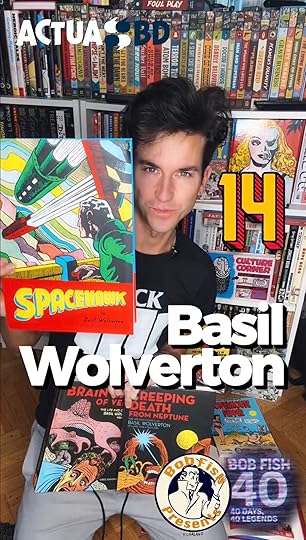
Basil Wolverton is one of the greatest, most idiosyncratic talents in comic book history. Though he is best known for his humorous grotesqueries in MAD magazine, it is his science-fiction character Spacehawk that Wolverton fans have most often demanded be collected. The wait is over, as The Complete Spacehawk features every story from Spacehawk's intergalactic debut in 1940 to his final, Nazi-crushing adventure in 1942.
Spacehawk is the closest thing to a colorfully-costumed, conventional action hero Wolverton ever created, yet the strip is infused with Wolverton's quintessential weirdness: controlled, organic artwork of strangely repulsive aliens and monsters and bizarre planets, and stories of gruesome retribution that bring to mind Wolverton's peer, Fletcher Hanks. Spacehawk had no secret identity, no fixed base of operations beyond his spaceship, and no sidekicks or love interests. He had but one mission in life: to protect the innocent throughout the Solar System, and to punish the guilty. He was a dark. yet much more visually playful. counterpart to Buck Rogers and Flash Gordon.
The Complete Spacehawk also includes the character's final and rarely-seen Earthbound adventures. As the U.S. became involved in World War II, Spacehawk returned to 20th Century America to join the United States' efforts in defeating fascism, which he does by patrolling the Earth's stratosphere, looking for wrongdoing.
This is a comic that came out in the late thirties, when the war effort was ramping up, and it is an interesting document mainly for this reason, I think. Wolverton struggled to get serialization, and he had a publisher, and the stuff was wacky but good sci fi stuff, but they pressured him to do war propaganda stuff in the comic, and as others have observed, the comic got worse, as a result. Spacehawk is a little stiff and not pc and the dialogue is odd and the premises of the stories are sometimes wonderfully odd, but he's a period piece worth looking at. Wolverton's son writes the helpful intro. This book is a great artifact, a classic we are lucky to have preserved.
Great collection of gorgeous (insofar as the grotesque can be gorgeous) Wolverton comics. The early stories are the most interesting, before Spacehawk takes off his mask and morphs into basically a standard-issue superhero. In the early stories, his mask and the mystery surrounding him make him nearly as creepy as the villains. And oh, those villains! nobody could design grotesque creatures like Wolverton. These comics offer loops science fantasy that is immensely entertaining and stunningly drawn--the oversize reproduction makes appreciating Wolverton's dynamic line and vibrant design easy. The later stories pall somewhat, when Spacehawk becomes Earthbound and a de facto American, defending the USA first against generic (if rather Germanish) European threats but soon directly from the Axis forces (Japanese and Germans, anyway). A couple of Hitler parodies add a bit of satiric bite. But this shift in tone does not fit the logic of the character so much as the politics of the publishers, so these stories don't work as well, even though Wolverton generally tries to maintain the sci-fi vibe by making most of the enemies use super-science weapons which Spacehawk can then smash. The second-last story, featuring tire thieves (!) hints a possible shift of tone/direction--even to the inclusion of a female figure who looked as if she might have legs, metaphorically speaking, as a recurring character--and might, if viewed in the right light and with a squint, be seen to offer a bit of veiled satire/critique of US policies. but it's an anomalous story and nearly the last gasp of the strip. Nevertheless, it's great to see these crazy comics in such a gorgeous collection.
never heard of him before, and as others note- he was better in space before drafted for war propaganda. images great, plot is sort of definition of comics, simple, repetitive, violent. plausibility not important. superheroic, for kids, i am coming to this as an adult, as artist, new project is to try genres of old graphics: action, crime, fantasy, scifi, superheroes, soap operas...
I do love my 1940's pulp sci fi and this in particular is fantastic (mostly). Whilst the stories are very basic - as in Saturday morning cartoon level at best - the simplicity of the era works wonderfully with Basil Wolverton's unique style of artwork. Each panel is big and bold, using his trademark grotesque style for the aliens and creatures. Buildings and backdrops tend be basic, blocky affairs but their striking colours pair nicely with the action at the forefront. In fact you could probably take away the bubble text entirely and his art could carry the story alone.
The first half of this edition is the classic space adventures, as we are introduced to the iconic hero and his quest to keep the solar system safe from evil do'ers. He's very much a space faring cross between Superman and Doc Savage given his super strength, super mind and ability to conjur up whatever he needs at any given moment. He outwits and outpowers fantastically cheesy villains and kills them in inventive ways. It's so much fun and there's no messing around.
The second half is a bit more of a problem for me in this day and age. With the Second World War going on at the time, Wolverton turned Spacehawk into the "Defender of America". Whilst it made sense back then as a powerful propagnda tool to keep the spirits of readers up and patriotic, it has aged horribly - especially given America no longer feels like the "good guys" anymore. Instead of fighting nefarious aliens, he's battling stereotypical bad guys and nazi parodies. It's not without amusement and the constant battles against Dr Gore are some of the best Spacehawk stories. These absolutely would have been inspiring at the time and you can never get bored with watching a superhero punch fascists, but it's not quite as fun shooting submarines on Earth as it is battling spaceships and monsters across the solar system.
All in all, it's a great throwback to a very different era and one I have always been drawn to. It's just a shame the wartime propaganda stuff takes over completely from the more exciting stuff.
Há um delicioso surrealismo não intencional neste comic clássico de Basil Wolverton. Conta as aventuras de um herói do tipo clássico, alienígena humanóide de queixo quadrado, dotado de enorme coragem e tecnologia que faz parecer que tem super-poderes, dedicado a proteger este sistema solar das ameaças de criminosos. São histórias deliciosas na sua inocência, típica do género à época, mas espantosas no que toca ao grafismo. Wolverton povoa o sistema solar de criaturas feéricas, disformes, bizarras como sonhos de Hyeronimus Bosch em quadricromia. As paisagens, sempre desoladas em rochedos e montanhas, dão-nos vinhetas quase abstractas. A sua visão da tecnologia e urbanismo futurista está em contraste com o barroquismo de fetichização tecnológica característico da FC. As cidades são reduzidas a planos geométricos abstractos e multi-coloridos, os artefactos tecnológicos têm uma estética simples de brutalismo industrial. São elementos que têm todas as condições para não funcionar, mas que se tornam eficazes graças ao traço e uso garrido de cor por parte de Wolverton. Spacehawk não tem o poder icónico de um Flash Gordon ou de um Buck Rogers em despertar o imaginário de mundos fantásticos. As suas premissas e mundo ficcional são muito elementares. É o traço do ilustrador, surreal e vibrante, que lhe confere vida.
Se não soubesse que se tratam de comics publicados nos anos 40 do século XX, diria que este livro se trataria de um excelente revivalismo irónico e de estilismo surreal das estruturas narrativas da era dourada dos comics. É o que mais surpreende neste livro, esta mistura de onirismo não intencional com o simplismo do género, à época. Retire-se-lhe estes elementos de imaginário à solta, e o comic perde o interesse. Algo notório na segunda parte deste livro, em que o autor coloca o seu herói cósmico ao serviço da propaganda de guerra. Frente às representações de forte toque racista dos inimigos da américa, em combate contra as forças do Eixo, nota-se que o interesse diminui. As historias são banais, e o próprio grafismo do autor, deslumbrante nas aventuras espaciais, se fica por uma ilustração rotineira dentro dos padrões estilísticos deste género de comics.
People who read early 1940's comic books for the first time are often shocked by the books' primitive and raw qualities. People who savor the Golden Age of comics often love this quality. It seems like pure, unfettered imagination let loose. Basil Wolverton later worked for Mad and has a distinctive quality to all his art. No one matches his strangeness in his unearthly early material. Amazing here as you read the complete run onfthe character, as comics moved to war propaganda, his aircraft battles are done very well. Spacehawk himself is a unique spaceman hero. He is, as described, the "Lone Wolf of the Void." He seems to have no attachments and only one friend, an occasional alien sidekick named Dork. For collectors and fans of Wolverton, this package is like a miracle. Even the Digital Comic Museum (a truly fantastic site) has not to date put together a complete run of the Target Comics in which these appeared. The reproduction is some of the best and most accurate of rare 40's material, larger than the original comics, in a handsome volume up to Fantagraphic's usual high quality.
Spacehawk, in his initially incarnation, is an authentic one of a kind. He murders villains without remorse and is comically perfect. Wolverton's art is just jaw dropping and hilarious. The Spacehawk comes to earth for WWII and things go off track. Both in the writing and art become very pedestrian and I started skimming rather than finishing each story. Still, those first stories are some wild weird comics.
The first half of the book (the space stuff) is five fucking stars. After that, where the editors step in and tell Wolverton to drop what he's doing and focus on the war, well.. the comic just starts to suck. For example, Spacehawk goes from fighting cosmic beings to tire thieves. So, yeah.
As much as I love crazy Second World War era comics, I wish Wolverton's editors had allowed him the keep Spacehawk in space. (Though I do love the name of a "European Dictator", Nitwitler.)
This would have been five-star psychedelic sci-fi madness if it weren't for Hitler. The first third or so of the book is brilliant space-opera filtered through one of the weirdest sensibilities of 20th-century comics. When I think "alien monsters," the work of Basil Wolverton flashes through my mind. There's an all-American eldritch eeriness to his space creatures, like they've been mass-produced at some cursed factory in Dubuque - and the landscapes they battle through are like something from an outsider Hollywood. As in all of Wolverton's work, the weirdness and the professionalism are fully enmeshed, and that counts for the stories too - the grotesque villains get their cruel comeuppance, sure, but despite the predictability of the conclusions, there's always an odd twist or angle that keeps them from being dull.
That is, until Wolverton was dragooned by his publishers into enlisting his nigh-omnipotent space hero to the American cause in WWII. The stories become earthbound, literally, and, while they're still highly competent (the inevitable Japanese stereotypes notwithstanding), you can just tell his heart's not in it. Some artists are galvanized by the demands of contemporary events, but Wolverton was best playing in his strange sandbox. Luckily, he had plenty more opportunities after this.
I have read a lot of old, dated comics lately and was starting to get a little jaded. Just couldn't get over the overly simple plots, the awkward poses, and the antiquated coloring. Well the plots really are pretty simple. But Wolverton's style is so unique, that anything that comes off as awkward, looks intentional. The artist just has a way of making everything he draws look massive and bulky. He supports this style with a unique shading style, thick outlines, and a way of making the limited color palette work for him. And as for those boring stories, they don't really matter because every panel is a work of minimalist art.
I really liked the early issues in this book when Spacehawk fights aliens from our solar system's planets. Fun, and I imagine at the time they came out they were good escapes for people during WWII. As the book progressed, the issues were not as fun, no more Spacehawk and aliens except for a few. One of the last ones about the tires was not good at all.
Those early issues are great! Striking primary colors, bizarre alien designs, and hilarious blunt brusque anti-ironic prewar masculine pulp writing. Some of the shine goes off once it pivots toward earthly concerns.
- (only the first 9 or so installments up until April 1941, before Spacehawk was brought down to earth) - Wolverton machinery is as dope as Kirby machinery - shades of Fletcher Hanks ("Now you are going to die by your own infernal device!") - clear thruline of revenge fantasy comics from Fletcher Hanks (Stardust) -> Basil Wolverton (Spacehawk) -> Spain Rodriguez (Trashman) - creative, genius, daring - fun installments: a politician loses an election and so decides to blow up the planet; a space cop's brain is implanted in an alien dinosaur ("It's too late to save my body! But my brain—you could save it! With your great surgical knowledge, you could graft it into one of the beasts of this jungle! Perhaps then I could avenge my men!")
Genius. If only editors hadn’t dragged the Hawk down to Earth, and the whole volume were filled with Spacehawk out among the stars and Basils weird aliens. This a very necessary compilation.