

What do you think?

Putain de Guerre! #1-2
Goddamn This War!
Created 15 years after the completion of his Eisner Award-winning World War I masterwork It Was the War of the Trenches, Tardi's Goddamn This War! is no mere sequel or extension, but a brand new, wholly individual graphic novel that serves as a companion piece to Trenches but can be read entirely on its own. Vastly different sequentially (eschewing Trenches' splintered narrative, Goddamn is split into six chronological chapters, one for each year of the war), graphically (Tardi deploys his more recent pen-ink-and-watercolor technique, with the bold colors of the early chapters fading into a grimy near-monochrome in the later ones as the war drags on), and narratively (all of Goddamn is told, with insight, dark wit and despair, as a first-person reminiscence/narration by an unnamed soldier), Goddamn This War! shares with Trenches its sustained sense of outrage, pitch-black gallows humor, and impeccably scrupulous historical exactitude. In fact, Goddamn This War! includes an extensive year-by-year historical text section written by Tardi's frequent World War I research helpmate, the historian and collector Jean-Pierre Verney, including dozens of stunning rare photographs and visual documents from his personal collection.
134 pages, Hardcover
First published November 12, 2008
About the author
Jacques Tardi
292 books224 followersJacques Tardi is a French comics artist, born 30 August 1946 in Valence, Drôme. He is often credited solely as Tardi.
After graduating from the École nationale des Beaux-Arts de Lyon and the École nationale supérieure des arts décoratifs in Paris, he started writing comics in 1969, at the age of 23, in the comics magazine Pilote, initially illustrating short stories written by Jean Giraud and Serge de Beketch, before creating the political fiction story Rumeur sur le Rouergue from a scenario by Pierre Christin in 1972.
A highly versatile artist, Tardi successfully adapted novels by controversial writer Louis-Ferdinand Céline or crime novelist Léo Malet. In Malet's case, Tardi adapted his detective hero Nestor Burma into a series of critically acclaimed graphic novels, though he also wrote and drew original stories of his own.
Tardi also created one of French comics' most famous heroines, Adèle Blanc-Sec. This series recreates the Paris of early 20th century where the moody heroine encounters supernatural events, state plots, occult societies and experiments in cryogenics.
Another graphic novel was Ici Même which was written by Jean-Claude Forest, best known as the creator of Barbarella. A satire, it describes the adventures of Arthur Même who lives on the walls of his family's former property.
Tardi has produced many antiwar graphic novels and comics, mainly focusing on the collective European trauma of the First World War, and the pitfalls of patriotism spawned several albums (Adieu Brindavoine, C'était la guerre des tranchées, Le trou d'obus, Putain de Guerre...). His grandfather's involvement in the day-to-day horrors of trench warfare, seems to have had a deep influence to his artistic expression. He also completed a four-volume series on the Paris Commune, Le cri du peuple.
Fantagraphics Books translate and publish in English a wide range of Tardi's books, done by editor and translator Kim Thompson.[3] The books released so far are West Coast Blues (Le Petit bleu de la côte ouest), You Are There (Ici Même), and It Was the War of the Trenches (C'était la guerre des tranchées); a single album collecting the first two Adele Blanc-Sec volumes has also been published.
->http://en.wikipedia.org/wiki/Jacques_...
After graduating from the École nationale des Beaux-Arts de Lyon and the École nationale supérieure des arts décoratifs in Paris, he started writing comics in 1969, at the age of 23, in the comics magazine Pilote, initially illustrating short stories written by Jean Giraud and Serge de Beketch, before creating the political fiction story Rumeur sur le Rouergue from a scenario by Pierre Christin in 1972.
A highly versatile artist, Tardi successfully adapted novels by controversial writer Louis-Ferdinand Céline or crime novelist Léo Malet. In Malet's case, Tardi adapted his detective hero Nestor Burma into a series of critically acclaimed graphic novels, though he also wrote and drew original stories of his own.
Tardi also created one of French comics' most famous heroines, Adèle Blanc-Sec. This series recreates the Paris of early 20th century where the moody heroine encounters supernatural events, state plots, occult societies and experiments in cryogenics.
Another graphic novel was Ici Même which was written by Jean-Claude Forest, best known as the creator of Barbarella. A satire, it describes the adventures of Arthur Même who lives on the walls of his family's former property.
Tardi has produced many antiwar graphic novels and comics, mainly focusing on the collective European trauma of the First World War, and the pitfalls of patriotism spawned several albums (Adieu Brindavoine, C'était la guerre des tranchées, Le trou d'obus, Putain de Guerre...). His grandfather's involvement in the day-to-day horrors of trench warfare, seems to have had a deep influence to his artistic expression. He also completed a four-volume series on the Paris Commune, Le cri du peuple.
Fantagraphics Books translate and publish in English a wide range of Tardi's books, done by editor and translator Kim Thompson.[3] The books released so far are West Coast Blues (Le Petit bleu de la côte ouest), You Are There (Ici Même), and It Was the War of the Trenches (C'était la guerre des tranchées); a single album collecting the first two Adele Blanc-Sec volumes has also been published.
->http://en.wikipedia.org/wiki/Jacques_...
Ratings & Reviews
Friends & Following
Create a free account to discover what your friends think of this book!
Community Reviews
Displaying 1 - 30 of 130 reviews

December 30, 2015
My heart is heavy. Like, real heavy.
I knew going in that reading a book devoted to a French soldier’s perspective on World War I would immerse me in a certain bit of melancholy, a certain bit of distrust in the worthwhileness of the whole human endeavor. As civilian mass shootings bloom and blossom across my nation, as unarmed men and women die at the hands of my nation’s peace officers, as the world continues to collapse into war after war—it’s always art that brings that sickness home to me.
Snow Falling on Cedars makes the plight of Japanese Americans in the days during and after WWII come home to me. Watching Winter on Fire last night made a sour pit in my gut. Grave of the Fireflies, Town of Evening Calm, Palestine, Safe Area: Gorazde, Footnotes in Gaza, Epileptic. These are the things that break my spirit and my heart. News reports of tragedy are one thing, making an art of it another. And so Goddamn This War! breaks me all over again. It’s powerful, raw, cynical, perfect.
The third time I accidentally ran into the woman who would become my wife (and the last time before I began to pursue a relationship with her), we saw a movie together—Jean-Pierre Jeunet’s A Very Long Engagement, a dark and humourous detective love story set against and amidst the French trenches of WWI. It was a wonderful film full of light and romance and the dark hideousness of war. Scenes of those depravities have lingered with me for more than a decade now. And it wasn’t until after finishing Goddamn This War! that I discovered that one of its contributers, Jean-Pierre Verney, was an expert consultant employed to keep the fantasy landscape of Jeunet’s film from straying too widely from reality. That the writer from the book I had just found so moving and important also played a role in my introduction to my wife seemed a special kind of serendipity. I’m glad I discovered this after the fact—I feel my ignorance kept me from an honest romanticism.
Goddamn This War! is my first experience of Tardi (the book’s principle creator[1]). Fantagraphics has been recently bringing his works to American audiences, but because none of us can be aware of all things, I had never before heard of him. I happened upon the book as I was browsing the graphic novel section at my local library branch. As something near a pacifist and non-interventionist,[2] I don’t tend to enjoy war narratives. I did when I was younger, but not any longer. I don’t, I believe, any longer have the stomach for glory. Still, Fantagraphics’ packaging of the book was so handsome and well done that I thought I’d give it a shot.
Bang. A shot. Fired with reckless precision.
I don’t rightly know how to describe Tardi and Verney’s book without gushing. Descriptors like tour-de-force are clichéd and dulling. Still, it is what it is I guess. It certainly bowled me over.
Goddamn This War! follows a young recruit into the French infantry at the start of the first World War. He against odds survives to the war’s conclusion—which is why he’s able to narrate the whole thing from after the fact. We see other characters as he sees them: occasionally and as fodder. The soldier-narrator is dry and cynical and wise, likely a product of having the privilege of recounting everything from well after the war’s close. And by the end we wonder, if they weren’t already steeped in savagery before the war, how the decades could unfold afterward without the human race floating belly up in a sea of barbarism.
Tardi’s writing (or at least Helge Dascher’s translation of it) is crisp and natural. The book strays from the typical revelation of the comics mode in that there are no word balloons, only narration blocks. In a way, it’s as if we’re reading an illuminated work of prose memoir. On first flipping through the book, I was skeptical. I’m generally not a tremendous fan of the technique, but the collaboration of words and pictures here is so fruitful that within pages all my misgivings evaporated and I found myself wholly invested.
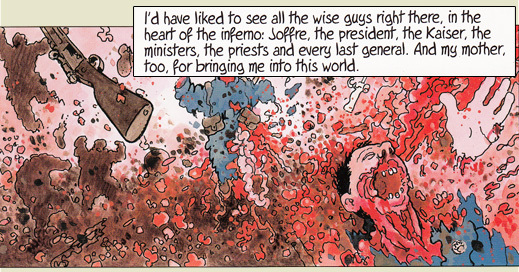
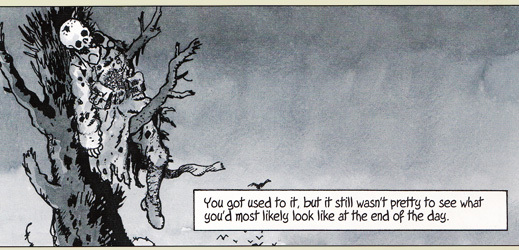
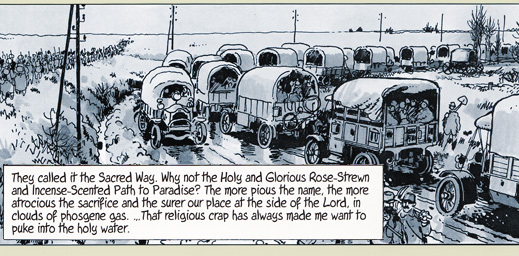
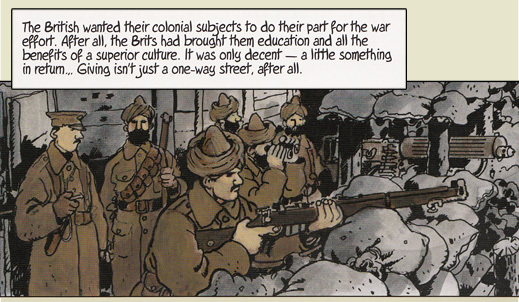
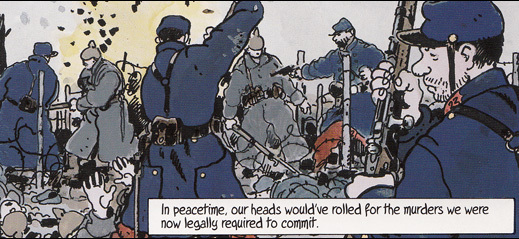
A large part of the goodwill that eventually subsumed my experience of the book is due Tardi’s magnificent illustrations. The sublime horrors of the war are more than adequately captured in every panel. He moves us from the lovely green hills and bright blue and red uniforms of 1914 through to the blue-grey muck and madness of 1918. His use of colour is exquisite. It’s a grim and human work featuring grim and human art.

While the title alone should probably be hint enough, let me underscore: Goddamn This War! is a cynical work, broadly condemning not just the atrocity of warfare but more the politicians and bureaucracy that spend so prodigally the blood of the young, the naive, and the idealistic. Damn this war, yes, but damn also those who would wage it, those who would put our sons and cousins and nephews and fathers in front of bullets and gas and bombs and missiles. For honour, for oil, for glory, for land, for God, and for country. Damn them and damn the reckless negligence that turns human dignity into a soup of viscera and terror. Or maybe, Tardi might argue, there was never any dignity to humanity to begin with.
_______
[Review courtesy of Good Ok Bad.]
_______
Footnotes
1) As I understand it at least. Initially, I believed Verney to be the writer and Tardi the artist, but the supplemental material makes it sound like Tardi is responsible for the story and art while Verney provides the rich appendix of history/chronology for the book.
2) I’m actually neither a pacifist nor a non-interventionist, but I’m certainly sympathetic to their ideologies.
I knew going in that reading a book devoted to a French soldier’s perspective on World War I would immerse me in a certain bit of melancholy, a certain bit of distrust in the worthwhileness of the whole human endeavor. As civilian mass shootings bloom and blossom across my nation, as unarmed men and women die at the hands of my nation’s peace officers, as the world continues to collapse into war after war—it’s always art that brings that sickness home to me.
Snow Falling on Cedars makes the plight of Japanese Americans in the days during and after WWII come home to me. Watching Winter on Fire last night made a sour pit in my gut. Grave of the Fireflies, Town of Evening Calm, Palestine, Safe Area: Gorazde, Footnotes in Gaza, Epileptic. These are the things that break my spirit and my heart. News reports of tragedy are one thing, making an art of it another. And so Goddamn This War! breaks me all over again. It’s powerful, raw, cynical, perfect.
The third time I accidentally ran into the woman who would become my wife (and the last time before I began to pursue a relationship with her), we saw a movie together—Jean-Pierre Jeunet’s A Very Long Engagement, a dark and humourous detective love story set against and amidst the French trenches of WWI. It was a wonderful film full of light and romance and the dark hideousness of war. Scenes of those depravities have lingered with me for more than a decade now. And it wasn’t until after finishing Goddamn This War! that I discovered that one of its contributers, Jean-Pierre Verney, was an expert consultant employed to keep the fantasy landscape of Jeunet’s film from straying too widely from reality. That the writer from the book I had just found so moving and important also played a role in my introduction to my wife seemed a special kind of serendipity. I’m glad I discovered this after the fact—I feel my ignorance kept me from an honest romanticism.
Goddamn This War! is my first experience of Tardi (the book’s principle creator[1]). Fantagraphics has been recently bringing his works to American audiences, but because none of us can be aware of all things, I had never before heard of him. I happened upon the book as I was browsing the graphic novel section at my local library branch. As something near a pacifist and non-interventionist,[2] I don’t tend to enjoy war narratives. I did when I was younger, but not any longer. I don’t, I believe, any longer have the stomach for glory. Still, Fantagraphics’ packaging of the book was so handsome and well done that I thought I’d give it a shot.
Bang. A shot. Fired with reckless precision.
I don’t rightly know how to describe Tardi and Verney’s book without gushing. Descriptors like tour-de-force are clichéd and dulling. Still, it is what it is I guess. It certainly bowled me over.
Goddamn This War! follows a young recruit into the French infantry at the start of the first World War. He against odds survives to the war’s conclusion—which is why he’s able to narrate the whole thing from after the fact. We see other characters as he sees them: occasionally and as fodder. The soldier-narrator is dry and cynical and wise, likely a product of having the privilege of recounting everything from well after the war’s close. And by the end we wonder, if they weren’t already steeped in savagery before the war, how the decades could unfold afterward without the human race floating belly up in a sea of barbarism.
Tardi’s writing (or at least Helge Dascher’s translation of it) is crisp and natural. The book strays from the typical revelation of the comics mode in that there are no word balloons, only narration blocks. In a way, it’s as if we’re reading an illuminated work of prose memoir. On first flipping through the book, I was skeptical. I’m generally not a tremendous fan of the technique, but the collaboration of words and pictures here is so fruitful that within pages all my misgivings evaporated and I found myself wholly invested.
A large part of the goodwill that eventually subsumed my experience of the book is due Tardi’s magnificent illustrations. The sublime horrors of the war are more than adequately captured in every panel. He moves us from the lovely green hills and bright blue and red uniforms of 1914 through to the blue-grey muck and madness of 1918. His use of colour is exquisite. It’s a grim and human work featuring grim and human art.
While the title alone should probably be hint enough, let me underscore: Goddamn This War! is a cynical work, broadly condemning not just the atrocity of warfare but more the politicians and bureaucracy that spend so prodigally the blood of the young, the naive, and the idealistic. Damn this war, yes, but damn also those who would wage it, those who would put our sons and cousins and nephews and fathers in front of bullets and gas and bombs and missiles. For honour, for oil, for glory, for land, for God, and for country. Damn them and damn the reckless negligence that turns human dignity into a soup of viscera and terror. Or maybe, Tardi might argue, there was never any dignity to humanity to begin with.
_______
[Review courtesy of Good Ok Bad.]
_______
Footnotes
1) As I understand it at least. Initially, I believed Verney to be the writer and Tardi the artist, but the supplemental material makes it sound like Tardi is responsible for the story and art while Verney provides the rich appendix of history/chronology for the book.
2) I’m actually neither a pacifist nor a non-interventionist, but I’m certainly sympathetic to their ideologies.

July 9, 2018

Jacques Tardi has almost made a career out of turning the First World War into bande-dessinée art. Perhaps his most acclaimed work is C'était la guerre des tranchées from 1993 (eventually translated into English in 2011, whereupon it immediately won an Eisner Award). Fifteen years later, in 2008, he came out with this variation on the theme, co-written with one of France's main historians of the conflict, Jean-Pierre Verney.

The book is organised into slim chapters, one for each year of the war, and in general each page is divided into three widescreen panels on top of one another. Tardi's shimmering artwork (his ligne claire frequently has a kind of wobble to it) somehow renders the scenes both hallucinatory and starkly, shockingly real. The bright colours of the early sections – the Poilus' bleu horizon and flashes of military red – gradually muddy out into an indistinguishable monochrome as the war drags on.

The advantage of having a historian as co-writer is that everything hits you with the force of accuracy; the disadvantage is that narrative drive suffers. Indeed, there really is no story at all in here, just a succession of scenes that get bleaker and bleaker as we struggle towards 1918. That can make it slow going – but you will see things here that few other books about the war will show you.

March 18, 2015
Unlike the first volume of WW1 comics Tardi has done, Trenches, this one has a much looser line and has watercolors over top. It's beautiful in its own right. Overall I didn't find the stories to be as strong as the first volume but certainly worth checking out for fans of Trenches.

July 11, 2014
The great Tardi adds here to his collection of anti-war graphic work as he creates a damning portrait of the almost useless WWI, the Great War, the "war to end all wars." The depictions of horrific battles are terrific, often brutal, and sometimes (as they should be) shocking in reminding us of the great sacrifices the dead and many horribly wounded made. The anti-war songs in the volume that were popular among soldiers are terrific, and sad.
For those really unfamiliar with the war except from what little they recall from a few lines in high school textbooks, Jean-Pierre Verny provides a detailed chronology with numerous photographs in an appendix. This is a superb book that can be paired with other graphic anti-war histories, including the also recent WWI poetry and graphic story collection, Above the Dreamless Dead: WWI in Poetry and Comics, edited by Chris Duffy.
Goddamn this War is a scream against the insane and useless brutality of war, a companion to his It Was the War of the Trenches. Joe Sacco's recent The Great War is another one to take a look at. For traditional novels on WWI, you would do well to check out the amazing Regeneration trilogy by Pat Barker. And there are many more, of course. August 2014 is the 100 year anniversary of WWI, so you might consider that as one reason to look into the war as a topic for reading. But that war, any war.
For those really unfamiliar with the war except from what little they recall from a few lines in high school textbooks, Jean-Pierre Verny provides a detailed chronology with numerous photographs in an appendix. This is a superb book that can be paired with other graphic anti-war histories, including the also recent WWI poetry and graphic story collection, Above the Dreamless Dead: WWI in Poetry and Comics, edited by Chris Duffy.
Goddamn this War is a scream against the insane and useless brutality of war, a companion to his It Was the War of the Trenches. Joe Sacco's recent The Great War is another one to take a look at. For traditional novels on WWI, you would do well to check out the amazing Regeneration trilogy by Pat Barker. And there are many more, of course. August 2014 is the 100 year anniversary of WWI, so you might consider that as one reason to look into the war as a topic for reading. But that war, any war.
January 19, 2022
After Jacques Tardi’s fantastic “It was the war of Trenches” , this is his second book I am reading. The style of his artwork is Ligne Claire similar to Herge which I loved.
Unlike WWII , there are very few literatures that talks about WWI . Barbara Tuchman’s “The Guns of August” , Hemigway’s “Farewell to Arms and Erich Remarque’s “All quite in the western front” are few books I have read on this topic. So, when I came across this book which visually tells the story of French Foot soldier I immediately picked it up.
WWI had so many names. War of Trenches or War of Inches (As they fought over inches of land back and forth) or War to End all wars. Also, It was one of the brutal wars fought in the recent human consciousness. Tardi’s this graphic book captures those brutality and carnage very vividly from a French foot soldier’s POV.
Every country gave a reason to participate in this 5 year long war. But Tardi, through our protagonist gives the real reason for this war.
“ It wasn’t a war about justice. That’s for sure. Nobody was saving the civilization. It was the war to protect the interests of the big guys whose treasure chest were already overflowing”
“ War wasted no time industrializing itself and huge profits were raked in over our dead bodies”
“ People called it “ War to end all wars” Bullshit!. It had been like this since the dawn of man. Whether the fight was over fire, banana or oil.”
This war field was used as a proving or validation ground for lot of war equipment and technologies. Tanks make their first appearance in this war. Even Nobel price was given to Fritz Haber for discovering the chemical synthesis process to make Ammonia from Nitrogen and Hydrogen. The irony is, even though ammonia can be used in fertilizers, it can be also used in explosives. He did experiment with chlorine and mustard gas in the battlefield to refine his process. No wonder they called him the “Father of Chemical Warfare”.
So as always in the human history. commoners gave their lives by the millions on both sides to either make rich richer or to satisfy the egos of the imperialists in the name of Nationalism.
This is a very deep book with lot of messages from that dark annals of history to forewarn us not to repeat it. A very evocative illustrations of the war butchery and carnage.
I highly recommend this book for anybody interested in history through graphic novel, or WWI history.
Unlike WWII , there are very few literatures that talks about WWI . Barbara Tuchman’s “The Guns of August” , Hemigway’s “Farewell to Arms and Erich Remarque’s “All quite in the western front” are few books I have read on this topic. So, when I came across this book which visually tells the story of French Foot soldier I immediately picked it up.
WWI had so many names. War of Trenches or War of Inches (As they fought over inches of land back and forth) or War to End all wars. Also, It was one of the brutal wars fought in the recent human consciousness. Tardi’s this graphic book captures those brutality and carnage very vividly from a French foot soldier’s POV.
Every country gave a reason to participate in this 5 year long war. But Tardi, through our protagonist gives the real reason for this war.
“ It wasn’t a war about justice. That’s for sure. Nobody was saving the civilization. It was the war to protect the interests of the big guys whose treasure chest were already overflowing”
“ War wasted no time industrializing itself and huge profits were raked in over our dead bodies”
“ People called it “ War to end all wars” Bullshit!. It had been like this since the dawn of man. Whether the fight was over fire, banana or oil.”
This war field was used as a proving or validation ground for lot of war equipment and technologies. Tanks make their first appearance in this war. Even Nobel price was given to Fritz Haber for discovering the chemical synthesis process to make Ammonia from Nitrogen and Hydrogen. The irony is, even though ammonia can be used in fertilizers, it can be also used in explosives. He did experiment with chlorine and mustard gas in the battlefield to refine his process. No wonder they called him the “Father of Chemical Warfare”.
So as always in the human history. commoners gave their lives by the millions on both sides to either make rich richer or to satisfy the egos of the imperialists in the name of Nationalism.
This is a very deep book with lot of messages from that dark annals of history to forewarn us not to repeat it. A very evocative illustrations of the war butchery and carnage.
I highly recommend this book for anybody interested in history through graphic novel, or WWI history.

February 17, 2018
I have always loved Barbara Tuchman's brilliant "Guns of August" and Remarque's "All Quiet on the Western Front". Add to that elite company "Goddman This War!" by Tardi. The artwork, normally not to my style, works well within the context of this story. War is never meant to be beautiful. It is ugly and vile. It is an act that puts to rest the childish beliefs of people who think the best of everyone and think peace is "normal". That level of violence and horror is brought directly to us through the words of the narrator. A French soldier who serves throughout the 4 year war, it is sarcastic, biting and very dry in its humor. Taking into account the various events as seen by a low ranking French Army soldier-this is a superb look at the horrors of Trench Warfare during World War 1. I can not stress how impressive this book is. Add it to the ranks of one of my favorite books.

August 19, 2016
Powerful depiction of the price of war. Technology may change the tactics, but the butcher's bill remains the same...

April 23, 2018
¡Puta guerra! del francés Jacques Tardi es una obra anti-militarista como ninguna. En ella el escritor galo hace gala de una exquisita capacidad de sintesís, añadiendo a sus bocetos, pequeñas frases con la contuntendecia afilada de las bayonetas utilizadas en la mayor carnicería y masacre (sin sentido) de todos los tiempos. La primera guerra mundial.
Es imposible no sentir la congoja que transmite ese soldado desconocido, esa voz en off que encarna a todos los invisibles y hace de narrador poco educado de todo cuanto observa, siente y percibe en medio del conflicto del cual inevitablemente; también él es carne de cañon.
Y es que, no puede existir atisbo alguno de educación o mesura en medio de tanta barbarie, el lenguaje soez y las rabietas son plenamente justificadas, la obra no pretende ser una visión poética y romantica de algo que nada tiene de rosa.
Ya desde el título de la obra se siente el alegato que vendrá, y Tardi lo expone maravillosamente.
Es imposible no sentir la congoja que transmite ese soldado desconocido, esa voz en off que encarna a todos los invisibles y hace de narrador poco educado de todo cuanto observa, siente y percibe en medio del conflicto del cual inevitablemente; también él es carne de cañon.
Y es que, no puede existir atisbo alguno de educación o mesura en medio de tanta barbarie, el lenguaje soez y las rabietas son plenamente justificadas, la obra no pretende ser una visión poética y romantica de algo que nada tiene de rosa.
Ya desde el título de la obra se siente el alegato que vendrá, y Tardi lo expone maravillosamente.

March 2, 2015
Jacques Tardi's second World War One graphic novel, Goddamn This War takes a different approach than his It Was the War of the Trenches. That older work is a collection of disconnection vignettes, jumping forward and backward in time. This one follows a single main character, a French infantryman, through the whole of the Great War.
My complaint about It Was the War of the Trenches was that it was too much of one note (despair) and that the characters were not well developed.
Goddamn This War has more of a coherent story, in that it follows the main character linearly through the war, but otherwise it's much the same in tone. The main character is disillusioned from the first moment of the war, so he doesn't go through the changes of those around him from enthusiasm to grim consent to disillusion. The side characters blend into the bleak background, such that when a character is named as having died you sometimes aren't sure who he's talking about. However, as with the prior book the imagery is very well researched, even if Tardi tends to focus is story on only the darkest elements of the war, making it more one-note than many of the novels and memoirs on which he's basing his work. After the story itself, there's also an extended section detailing the history of the war itself. This is good, but necessarily brief.
Overall, I found this interesting as I was curious about current pop-culture depictions of WW1 in France, but if you're looking for a good fiction work about WW1 I'd go to one of the other standards (All Quiet on the Western Front, Under Fire, Memoirs of an Infantry Officer, Goodbye to All That, etc.)
My complaint about It Was the War of the Trenches was that it was too much of one note (despair) and that the characters were not well developed.
Goddamn This War has more of a coherent story, in that it follows the main character linearly through the war, but otherwise it's much the same in tone. The main character is disillusioned from the first moment of the war, so he doesn't go through the changes of those around him from enthusiasm to grim consent to disillusion. The side characters blend into the bleak background, such that when a character is named as having died you sometimes aren't sure who he's talking about. However, as with the prior book the imagery is very well researched, even if Tardi tends to focus is story on only the darkest elements of the war, making it more one-note than many of the novels and memoirs on which he's basing his work. After the story itself, there's also an extended section detailing the history of the war itself. This is good, but necessarily brief.
Overall, I found this interesting as I was curious about current pop-culture depictions of WW1 in France, but if you're looking for a good fiction work about WW1 I'd go to one of the other standards (All Quiet on the Western Front, Under Fire, Memoirs of an Infantry Officer, Goodbye to All That, etc.)

November 20, 2014
Read it in the library, I highly recommend. This visual narrative in a life of a French soldier during WWI is superb without romanticizing the awful war that killed millions of people. I like how the chapters are made into years 1914 - 1919 in France/Belgium part of the war. As in those year the art of war evolved overnight from lines of soldiers in bright red pants to soldiers digging trenches and call it home for weeks on end, only to be blown up or gassed on.
At the end of the book the writer added a supplementary historical background life in WWI, with photos of soldiers etc.
I recommend this to today's teens who are not that familiar or doesn't care about the war that changes the world and how modern war works.
Drawn by legendary sequential artist Jacques Tardi.
At the end of the book the writer added a supplementary historical background life in WWI, with photos of soldiers etc.
I recommend this to today's teens who are not that familiar or doesn't care about the war that changes the world and how modern war works.
Drawn by legendary sequential artist Jacques Tardi.

June 15, 2017
Jacques Tardi can make you feel part of "the Great War," and be glad you missed it. Read this for a heavy dose of World War One, all the way through the Western Front. The book portrays from 1914 through 1919, when effects of war linger, with or without resolution. There is a quick and effective chronological history after the graphic novel. I feel translator Kim Thompson's voice especially in the song lyric in middle of the book, separating the comic narrative and historical narrative, The Song of Craonne.
https://en.wikipedia.org/wiki/La_Chan...
Thanks to my library, Atlanta-Fulton Public Library.
Highest recommendation.
https://en.wikipedia.org/wiki/La_Chan...
Thanks to my library, Atlanta-Fulton Public Library.
Highest recommendation.

March 1, 2024
no se no me he enterado
July 5, 2018
This brilliant book, about the first World War, does not glorify war or the sacrifices of selfless heroes that die for a greater good. Instead it portrays the stupidity of war and the incredible waste of human lives that goes with it. It's full of hopelessness and despair, yet I couldn't put it down. Tardi's art conveys the grittiness and horror of this war of mutilations without being realistic but in a more impressionistic kind of way.
I absolutely recommend this to anyone who has the faintest interest in WWI, be they a fan of the graphic medium or not.
I absolutely recommend this to anyone who has the faintest interest in WWI, be they a fan of the graphic medium or not.

April 14, 2020
Jacques Tardi’s two comics on World War I—‘Goddamn This War’ and ‘It Was the War of the Trenches’—are absolutely amazing in terms of the stories they tell, the art style, and their critically anti-war politics.

June 20, 2022
I wrote a review of "Zinky Boys" recently that read along the lines of "brutal, exhausting, and I'm a better person for reading it." Much the same here.

August 24, 2023
recomiendo hacer tripas corazón

September 19, 2019
This is so dark, so visceral, and so ordinary and real, it's terrifying.
If ever you were raised on the glory of war through Commando comics, Action Man, and every war movie pre-Kubrick/Lean, this is the antidote. This will shake you to your senses; a Come And See of comics.
If ever you were raised on the glory of war through Commando comics, Action Man, and every war movie pre-Kubrick/Lean, this is the antidote. This will shake you to your senses; a Come And See of comics.

June 7, 2019
A visceral and conclusive masterpiece about the insanity that drives mankind.
Not for the faint of the heart, or pretty boys who believe in politics and its virtuosity.
Not for the faint of the heart, or pretty boys who believe in politics and its virtuosity.

October 25, 2015
It too me forever to finish this graphic novel. But not because of the graphic novel itself but thanks to Varney's chronology at the end of the volume.
Don't get me wrong: the chronology was good and informative and full of picture but... I don't know, the four-column layout and the rather small print made my reading quite difficult. It was like reading an encyclopedia.
After reading the chronology I went back to the comics and some things became clearer. Some names that were dropped in the text suddenly made sense. In addition, sometimes it is useful to look at WW1 from a different perspective, the French one in this case. From what Varney wrote, it seemed that Italy didn't play a huge role in the war since it's mentioned only in passing. A couple of lines here, a couple of lines there.
I like the comics in itself but it wasn't like It Was the War of the Trenches. Here I think, the author picked up actual photos from the war and made a story around them. In fact, the comics is not a narration per se but it offers glimpses of the war, not sparing any detail. For examples, some of the gueules cassées [busted mugs] can be found quite easily on the Internet and also Paolo Cossi paid tribute to them in 1914. Io mi rifiuto!.
I think that offering only glimpses and not giving a real narration is a sort of hindrance for the reader. There's a sort of main character but is not actually there. We only have glimpses of his life in the trenches and how can you walk in his shoes if you know so little about it?
It's still a great comics book and I'm very glad that I've read it but yeah... I couldn't get into the story as I usually do.
Don't get me wrong: the chronology was good and informative and full of picture but... I don't know, the four-column layout and the rather small print made my reading quite difficult. It was like reading an encyclopedia.
After reading the chronology I went back to the comics and some things became clearer. Some names that were dropped in the text suddenly made sense. In addition, sometimes it is useful to look at WW1 from a different perspective, the French one in this case. From what Varney wrote, it seemed that Italy didn't play a huge role in the war since it's mentioned only in passing. A couple of lines here, a couple of lines there.
I like the comics in itself but it wasn't like It Was the War of the Trenches. Here I think, the author picked up actual photos from the war and made a story around them. In fact, the comics is not a narration per se but it offers glimpses of the war, not sparing any detail. For examples, some of the gueules cassées [busted mugs] can be found quite easily on the Internet and also Paolo Cossi paid tribute to them in 1914. Io mi rifiuto!.
I think that offering only glimpses and not giving a real narration is a sort of hindrance for the reader. There's a sort of main character but is not actually there. We only have glimpses of his life in the trenches and how can you walk in his shoes if you know so little about it?
It's still a great comics book and I'm very glad that I've read it but yeah... I couldn't get into the story as I usually do.

November 16, 2015
Si quieres conocer o tener una idea de lo que fue la primera guerra mundial este es tu libro. La guerra es la estupidez y la porquería más grande que existe. En palabras del gran Ralph Waldo Emerson: «Lo trágico de la guerra es que echa mano de lo mejor del hombre para emplearlo en la peor de las obras humanas: destruir».
La primera guerra mundial se valió de ideas como el nacionalismo, el racionalismo y el progreso para llevarse a cabo. Es impresionante como el ser humano es capaz de sacrificar su vida en nombre de las ideas. Esta novela gráfica tiene momentos tan emotivos que te puede llegar a desprender una que otra lágrima. Detrás de la guerra hay personas, no sólo números. Olvídate de que son alemanes, franceses, ingleses, italianos y españoles. En el fondo grandes masas de personas son capaces de asesinar a sus semejantes estimulados por ideas e intereses de unos cuantos.
Es importante recordar, ya es que es una actitud ética por si mismo. No debemos olvidar estas atrocidades, ya que olvidar es volver a caer en estos mismos huecos.
La primera guerra mundial se valió de ideas como el nacionalismo, el racionalismo y el progreso para llevarse a cabo. Es impresionante como el ser humano es capaz de sacrificar su vida en nombre de las ideas. Esta novela gráfica tiene momentos tan emotivos que te puede llegar a desprender una que otra lágrima. Detrás de la guerra hay personas, no sólo números. Olvídate de que son alemanes, franceses, ingleses, italianos y españoles. En el fondo grandes masas de personas son capaces de asesinar a sus semejantes estimulados por ideas e intereses de unos cuantos.
Es importante recordar, ya es que es una actitud ética por si mismo. No debemos olvidar estas atrocidades, ya que olvidar es volver a caer en estos mismos huecos.

September 12, 2014
Jacques Tardin "Kirottu sota! 1914-1919" (Jalava, 2014) on tunnetun ranskalaisen taiteilijan teos ensimmäisestä maailmansodasta, josta on tullut hänen tuotantonsa yksi toistuvista teemoista, ilmeisesti oman sukuhistorian inspiroimana.
Länsirintamalla sotamiehenä taisteleva ranskalainen metallisorvari toimii albumin kertojanäänenä, mutta ruohonjuuritason näkökulma laajenee albumin edetessä, ja muodostuu lopulta melkoisen kattavaksi kuvaukseksi maailmansodasta.
Sotaa kuvataan realistisesti ja raadollisesti. Sankaruudelle ei ole sijaa, vaan kuolema korjaa kirjaimellisesti housut kintuissa, kesken tarpeiden teon. Tardin kerronta on väkevää: mieleen jäivät kummittelemaan muun muassa sivut, joissa kertojanääni vaimenee kokonaan ja tekijä esittelee kasvoihin mitä hirvittävimmillä tavoilla haavoittuneita sotainvalideja.
Sarjakuva-albumin lopusta löytyy vielä Jean-Pierre Verneyn kirjoittama kokonaisesitys ensimmäisen maailmansodan tapahtumista.
Länsirintamalla sotamiehenä taisteleva ranskalainen metallisorvari toimii albumin kertojanäänenä, mutta ruohonjuuritason näkökulma laajenee albumin edetessä, ja muodostuu lopulta melkoisen kattavaksi kuvaukseksi maailmansodasta.
Sotaa kuvataan realistisesti ja raadollisesti. Sankaruudelle ei ole sijaa, vaan kuolema korjaa kirjaimellisesti housut kintuissa, kesken tarpeiden teon. Tardin kerronta on väkevää: mieleen jäivät kummittelemaan muun muassa sivut, joissa kertojanääni vaimenee kokonaan ja tekijä esittelee kasvoihin mitä hirvittävimmillä tavoilla haavoittuneita sotainvalideja.
Sarjakuva-albumin lopusta löytyy vielä Jean-Pierre Verneyn kirjoittama kokonaisesitys ensimmäisen maailmansodan tapahtumista.

April 26, 2014
Sarcastic. Utter despair. Apathetic acceptance of the fatal end of life. Rejection of God. Rejection of fate. Rejection of love of country. Rejection of the church (any). Pacifistic. Rejection of industry. Admiration of the Russian revolution.
Truly the spirit of the book from the very beginning lives up to the disgust inherent in the title.
Having recently finished several WWI memoirs this probably could have been more true if the main character has started out believing all the things this book rejects and then showed how the war changed him. Rather, from the beginning the main character damns his nation and the war. Not sure that is quite an accurate portrayal of the experience of the average French soldier and it would be amazing providence for someone with that attitude to have survived the whole war as the main character did. Except he does not believe in providence.
Truly the spirit of the book from the very beginning lives up to the disgust inherent in the title.
Having recently finished several WWI memoirs this probably could have been more true if the main character has started out believing all the things this book rejects and then showed how the war changed him. Rather, from the beginning the main character damns his nation and the war. Not sure that is quite an accurate portrayal of the experience of the average French soldier and it would be amazing providence for someone with that attitude to have survived the whole war as the main character did. Except he does not believe in providence.

September 22, 2013
War is hell. This sobering volume tells the story of World War I through the eyes of the soldiers who fought in it. No punches are pulled. People die and get injured, often in horrible, senseless ways. The artwork is superb, particularly the use of color, which becomes more muted as the book progresses, done deliberately for effect, I'm sure. A powerful work, albeit on the depressing side. Almost half the book is taken up by a detailed timeline of the war. Recommended!

September 12, 2014
The beginning of the book left me a bit confused, but then I got the hang of the way Tardi tells the story. This is a very grim, nihilistic book, but how else can you handle such a topic? The brutality and the sheer idiocy of the war becomes crystal clear. No heroics here, just a brutal meat grinder of a trench war. This is an impressive book.

March 19, 2015
Un libro que hay que leer, a ser posible en la edición integral que incluye un amplio anexo que complementa el relato con otro histórico (galocéntrico, sí, y con razón), para no olvidar la primera guerra mundial que suele quedar eclipsada por la segunda, concebida en el falso cierre de ésta. Poco más que añadir. Interese o no este periodo histórico: me lo lean.

December 18, 2016
Tardi's It Was the War of the Trenches was more affecting for me but this contains a lot more info, especially for anyone willing to pay close attention to Verney's year-by-year summary of the whole war.

April 9, 2024
Muy duro y emocionalmente difícil de tragar.
Es como si fuera un documental sobre la primera guerra mundial, desde punto de vista francés, que usa como hilo conductor la absurdez de la guerra sin detenerse a explicar motivos ni porqués. Recuerda (valgan las distancias) a la obra maestra de Kubrik 'Senderos de Gloria', pero sin la fuerza de la misma pese a mostrarse mucho más gore.
Es como si fuera un documental sobre la primera guerra mundial, desde punto de vista francés, que usa como hilo conductor la absurdez de la guerra sin detenerse a explicar motivos ni porqués. Recuerda (valgan las distancias) a la obra maestra de Kubrik 'Senderos de Gloria', pero sin la fuerza de la misma pese a mostrarse mucho más gore.
February 15, 2013
El arte de Tardí es impresionante. Verney presenta un texto más bien introspectivo que acompaña a las imágenes más como texto de apoyo que no como un guión de comic propiamente dicho. Aún así transmite angustiante experiencia de la guerra de una manera clara y rabiosa.

November 9, 2015
Hauntingly drawn, but the story didn't suck me in like I wished it would. Still, a masterpiece.

May 16, 2021
Bien sûr on sait intellectuellement que la Première Guerre Mondiale a été abominable à tous les points de vue. Mais il est difficile, plus de cent ans plus tard, de vraiment ressentir l'horreur de la situation.
Putain de Guerre vous donnera un coup de poing dans le ventre en mettant en lumière de façon brutalement honnête, sans fard, le gâchis ultime de vies humaines et les conditions de vie ignobles des soldats, et ce des DEUX côtés du no man's land.
Le sang, les entrailles, la merde, les rats et les poux, et ce sentiment d'injustice et de désespoir ultime du poilu qui se rend bien compte qu'il n'est qu'un pion dans un grand jeu de pouvoir des élites, qui se moquent bien qu'il vive ou qu'il meure, et dans quel état il reviendra après-guerre pour peu qu'il y survive.
J'ai apprécié le fait que le récit suive l'expérience d'un soldat désabusé, et qu'il ne diabolise pas l'ennemi mais mette l'accent sur l'incompréhension du soldat de base dans les deux camps. Le livre est empreint de pessimisme, certes, mais aussi d'une sorte de "tendresse" pour le poilu que nous suivons et par extension pour les soldats en général. La haine est réservée pour le haut de la hiérarchie militaire et politique (dont les seules blessures sont dues au "dégoupillage intempestif d'un encrier dans un ministère") et pour les industriels faisant leur sucre sur les piles de cadavres.
Le fait qu'il ait été écrit en collaboration avec un historien réputé fait que l'on sent qu'il s'agit d'un ouvrage sérieux sur le sujet, auquel Tardi, par ses dessins et ses textes, appose le côté émotionnel.
Tout cela converge pour donner un ouvrage à la fois instructif et poignant, qui, si cela ne tenait qu'à moi, serait une lecture imposée à tous les lycéens étudiant cette période.
Putain de Guerre vous donnera un coup de poing dans le ventre en mettant en lumière de façon brutalement honnête, sans fard, le gâchis ultime de vies humaines et les conditions de vie ignobles des soldats, et ce des DEUX côtés du no man's land.
Le sang, les entrailles, la merde, les rats et les poux, et ce sentiment d'injustice et de désespoir ultime du poilu qui se rend bien compte qu'il n'est qu'un pion dans un grand jeu de pouvoir des élites, qui se moquent bien qu'il vive ou qu'il meure, et dans quel état il reviendra après-guerre pour peu qu'il y survive.
J'ai apprécié le fait que le récit suive l'expérience d'un soldat désabusé, et qu'il ne diabolise pas l'ennemi mais mette l'accent sur l'incompréhension du soldat de base dans les deux camps. Le livre est empreint de pessimisme, certes, mais aussi d'une sorte de "tendresse" pour le poilu que nous suivons et par extension pour les soldats en général. La haine est réservée pour le haut de la hiérarchie militaire et politique (dont les seules blessures sont dues au "dégoupillage intempestif d'un encrier dans un ministère") et pour les industriels faisant leur sucre sur les piles de cadavres.
Le fait qu'il ait été écrit en collaboration avec un historien réputé fait que l'on sent qu'il s'agit d'un ouvrage sérieux sur le sujet, auquel Tardi, par ses dessins et ses textes, appose le côté émotionnel.
Tout cela converge pour donner un ouvrage à la fois instructif et poignant, qui, si cela ne tenait qu'à moi, serait une lecture imposée à tous les lycéens étudiant cette période.
Displaying 1 - 30 of 130 reviews