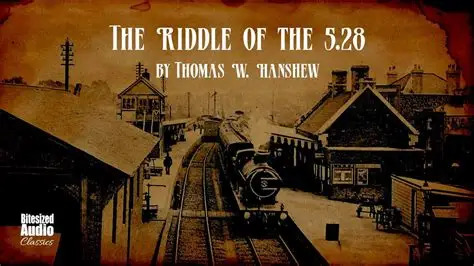
In the early part of the 20th century, mysteries featuring Hamilton Cleek by Thomas Hanshew were said to be, "the most consistent and most convincing detective stories since Sherlock Holmes." A face contortionist and former burglar now detective, he appeared in three volumes of short stories between 1914 and 1921.
A body had been found in a locked car on the Brighton line, and there didn't seem to be any way the perpetrator could have exited the scene. Scotland Yard were called with Cleek tagging along. He immediately goes to work to the bewilderment of all.
Librarian's note: many crime and detective stories, particularly those dating back to the 1900s and before, are now extremely scarce and increasingly expensive. Fantasy and Horror Classics are republishing these classic works in affordable, high quality, modern editions, using the original text and artwork.
3 Stars. Hamilton Cleek is new to me, but he only gets a limited introduction here. I found this 21-pager in Murder on the Railways from 1996. A good one. I hadn't heard of the author either, Thomas Hanshew. When I read the story, about a murder on a passenger train travelling from Brighton to London, there was very little background on Cleek. Who was he? I had difficulty even determining his first name. I was pleased that editor Peter Haining's two-page intro had it. Cleek had previously been a burglar and avoided capture by Scotland Yard because of his ability to contort his face so well that he was unrecognizable. Haining states that this story was his first appearance. He became very popular and many more were published between 1910 to 1921. The body of the young and prominent Lord Stavornell was found in a locked carriage. Shot. How had the killer escaped? Working with Maverick Narkom of the Yard, Cleek checks for tracks in the snow, for people who had exited various stations with unpunched tickets, and for answers to several other perplexing questions. Some say Cleek was a second Holmes. You decide. (Mar2025/Se2025)
A classic "locked room" railway mystery from 1910, featuring ex-criminal-turned-detective Hamilton Cleek. The story begins on the afternoon of December 9, when the 5.28 train from London Bridge to Croydon carries passengers in seemingly normal circumstances. During the journey, the stationmaster at Anerley receives a strange report: one first-class compartment is dark, and upon inspection, a dead man is discovered inside a locked compartment. The victim, Lord Stavornell, has a bullet wound between his eyes, and a revolver is found loosely in his hand, but the situation appears staged to suggest suicide, though all evidence points to murder. Hamilton Cleek arrives on the scene to assist with the investigation. He works alongside Inspector Maverick Narkom of Scotland Yard, checking for tracks in the snow and confirming that no passenger left the train between stations, making the crime seem impossible. Cleek discovers evidence such as a guard's key lying in the snow, which helps trace the murderer’s actions and escape route. Throughout the investigation, Cleek demonstrates his genius in deduction, noticing subtle details about the revolver, the positioning of objects, and discrepancies in witnesses' accounts. The murder appears impossible as the train was moving continuously, with all doors and windows locked, challenging the usual conventional detection methods. Cleek’s observations, including footprints in the snow, the timing of the train, and the placement of the revolver, highlight the story’s focus on ingenuity and deduction. Exhibiting a mix of criminal ingenuity and moral integrity, Cleek employs his knowledge of burglary and disguise to solve crimes in extraordinary circumstances.
So this is a Hamilton Cleek story. I had heard of this guy at some point in my research in pulp magazines and the roots of super heroes. Can't say I was impressed.
I know it's only a short story but, I 've only read two M. Poirot stories so far, and I found his personality and character so much more engaging.
As for the character of H. Cleek....well I found it to be a blank slate.
In fact I had no sense of personality in any of the characters in the story. They were just a jumble of stock miscreants, good guys and bad guys, a plethora of empty policemen, and random bystanders of no consequence.
The only guy with any real personality was Lord Stanel, and he had a bullet between his eyes.
By the end of the hour, (I was listening to it on "A Bitesized Audiobook") I was so bored I let my brain go bleary and just tuned in to hear how implausible the answer to the riddle was going to be.
Can't say I bought into it.
And I can't say I bought into the "genius" of H. Cleek. Whereas S. Holmes uses bits of evidence to make his deductions, I often felt that H. Cleek was just pulling the answers out of his ass.
Well, one and done. I can't see myself tuning in for any future adventures.
Sorry H. Cleek. It's that lack of personality thing that put me off.
The only murder mystery I'd read before this was by Fyodor Dostoevsky, so my first thought was that this could easily have been a 250+ page novel in that style. Haha.
This felt straight out of Sherlock Holmes, one brilliant deduction after another.
I do wish we'd gotten much more depth on the characters, especially the detective himself.
Listened to the Bitesized Audio Classics version of this. A very Sherlock Holmes sort of thing. It's short enough and interesting enough to finish, but it's not without the obvious flaws of the era; racism and misogyny.