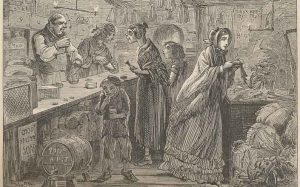
Wilkie Collins' "The Diary of Anne Rodway" is the last story of "The Queen of Hearts" and is a truly sad tale told by Brother Owen. I was hoping this ended differently but in its way it was true to itself. Owen keeps the diary to remember to keep faith in human nature.
Story in short-Two girlfriends at a boarding house run into hard times but a friendship endures.
➖➖➖➖➖➖➖➖➖➖➖➖➖➖➖➖➖➖➖➖➖➖➖➖➖➖➖➖➖➖➖➖➖➖➖
Highlight (Yellow) | Location 163694
“Number Six,” he said, “is the number that chance has left to remain till the last. The manuscript to
Highlight (Yellow) | Location 163695
which it refers is not, as you may see, in my handwriting. It consists entirely of passages from the Diary of a poor hard-working girl — passages which tell an artless story of love and friendship in humble life. When that story has come to an end, I may inform you how I became possessed of it. If I did so now, I should only forestall one important part of the interest of the narrative. I have made no attempt to find a striking title for it. It is called, simply and plainly, after the name of
Highlight (Yellow) | Location 163698
the writer of the Diary — the Story of Anne Rodway.”
Highlight (Yellow) | Location 163702
BROTHER OWEN’S STORY OF ANNE RODWAY. [TAKEN FROM HER DIARY.]
Highlight (Yellow) | Location 163704
...MARCH 3d, 1840. A long letter today from Robert, which surprised and vexed me so that I have been sadly behindhand with my work ever since. He writes in worse spirits than last time, and absolutely declares that he is poorer even than when he went to America, and that he has made up his mind to come home to London.
Highlight (Yellow) | Location 163706
How happy I should be at this news, if he only returned to me a prosperous man! As it is, though I love him dearly, I cannot look forward to the meeting him again, disappointed and broken down, and poorer than ever, without a feeling almost of dread for both of us. I was twenty-six last birthday and he was thirty-three, and there seems less chance now than ever of our being married. It is all I can do to keep myself by my needle; and his prospects, since he failed in the small
Highlight (Yellow) | Location 163709
stationery business three years ago, are worse, if possible, than mine. Not that I mind so much for myself; women, in all ways of life, and especially in my dressmaking way, learn, I think, to be more patient than men. What I dread is Robert’s despondency, and the hard struggle he will have in this cruel city to get his bread, let alone making money enough to marry me. So little as poor people want to set up in housekeeping and be happy together, it seems hard that they can’t get it when they are honest and hearty,
Highlight (Yellow) | Location 163713
and willing to work. The clergyman said in his sermon last Sunday evening that all things were ordered for the best, and we are all put into the stations in life that are properest for us. I suppose he was right, being a very clever gentleman who fills the church to crowding; but I think I should have understood him better if I had not been very hungry at the time, in consequence of my own station in life being nothing but plain needlewoman. March 4th. Mary Mallinson came down to my room to take a cup of
Highlight (Yellow) | Location 163717
tea with me. I read her bits of Robert’s letter, to show her that, if she has her troubles, I have mine too; but I could not succeed in cheering her. She says she is born to misfortune, and that, as long back as she can remember, she has never had the least morsel of luck to be thankful for. I told her to go and look in my glass, and to say if she had nothing to be thankful for then; for Mary is a very pretty girl, and would look still prettier if she could be more cheerful and dress neater. However, my compliment did no
Highlight (Yellow) | Location 163720
good. She rattled her spoon impatiently in her tea-cup, and said, “If I was only as good a hand at needle-work as you are, Anne, I would change faces with the ugliest girl in London.” “Not you!” says I, laughing. She looked at me for a moment, and shook her head, and was out of the room before I could get up and stop her. She always runs off in that way when she is going to cry, having a kind of pride about letting other people see her in tears. March 5th. A fright about Mary. I had not seen her all day, as she does
Highlight (Yellow) | Location 163724
not work at the same place where I do; and in the evening she never came down to have tea with me, or sent me word to go to her; so, just before I went to bed, I ran upstairs to say good-night. She did not answer when I knocked; and when I stepped softly in the room I saw her in bed, asleep, with her work not half done, lying about the room in the untidiest way. There was nothing remarkable in that, and I was just going away on tiptoe, when a tiny bottle and wine-glass on the chair by her bedside
Highlight (Yellow) | Location 163728
caught my eye. I thought she was ill and had been taking physic, and looked at the bottle. It was marked in large letters, “Laudanum — Poison.” My heart gave a jump as if it was going to fly out of me. I laid hold of her with both hands, and shook her with all my might. She was sleeping heavily, and woke slowly, as it seemed to me — but still she did wake. I tried to pull her out of bed, having heard that people ought to be always walked up and down when they have taken laudanum
Highlight (Yellow) | Location 163731
but she resisted, and pushed me away violently. “Anne!” says she, in a fright. “For gracious sake, what’s come to you! Are you out of your senses?” “Oh, Mary! Mary!” says I, holding up the bottle before her, “if I hadn’t come in when I did—” And I laid hold of her to shake her again. She looked puzzled at me for a moment — then smiled (the first time I had seen her do so for many a long day) — then put her arms round my neck.
Highlight (Yellow) | Location 163735
“Don’t be frightened about me, Anne,” she says; “I am not worth it, and there is no need.” “No need!” says I, out of breath— “no need, when the bottle has got Poison marked on it!” “Poison, dear, if you take it all,” says Mary, looking at me very tenderly, “and a night’s rest if you only take a little.” I watched her for a moment, doubtful whether I ought to believe what she said or to alarm the house. But there was no sleepiness now in her eyes, and nothing drowsy in her
Highlight (Yellow) | Location 163740
voice; and she sat up in bed quite easily, without anything to support her. “You have given me a dreadful fright, Mary,” says I, sitting down by her in the chair, and beginning by this time to feel rather faint after being startled so. She jumped out of bed to get me a drop of water, and kissed me, and said how sorry she was, and how undeserving of so much interest being taken in her. At the same time, she tried to possess herself of the laudanum bottle which I still
Highlight (Yellow) | Location 163744
kept cuddled up tight in my own hands. “No,” says I. “You have got into a low-spirited, despairing way. I won’t trust you with it.” “I am afraid I can’t do without it,” says Mary, in her usual quiet, hopeless voice. “What with work that I can’t get through as I ought, and troubles that I can’t help thinking of, sleep won’t come to me unless I take a few drops out of that bottle. Don’t keep it away from me, Anne; it’s the only thing in the world that makes me forget myself.”
Highlight (Yellow) | Location 163759
“Your father and mother were honest people,” says Mary, obstinately. “My mother ran away from home, and died in a hospital. My father was always drunk, and always beating me. My step-mother is as good as dead, for all she cares about me. My only brother is thousands of miles away in foreign
Highlight (Yellow) | Location 163761
parts, and never writes to me, and never helps me with a farthing. My sweetheart—” She stopped, and the red flew into her face. I knew, if she went on that way, she would only get to the saddest part of her sad story, and give both herself and me unnecessary pain. “My sweetheart is too poor to marry me, Mary,” I said, “so I’m not so much to be envied even there. But let’s give over disputing which is worst off. Lie down in bed, and let me tuck you up. I’ll put a stitch or
Highlight (Yellow) | Location 163765
two into that work of yours while you go to sleep.”
❌❌❌❌❌❌❌❌❌❌❌❌❌❌❌❌❌❌❌❌❌❌❌❌❌❌❌❌❌❌❌❌❌❌❌❌❌❌❌❌spoiler alert
Anne lives in a boarding house and has made friends two years ago with Mary, who is no now 18, Anne is 26. They both are very poor and must do needle work to earn their living. Anne has a boyfriend who is in America trying to make his fortune so they can marry someday but he has not succeeded and looks to be coming back home. Anne notices a bottle of laudanum at Mary's bedside and thinks she is going to kill herself. Mary is depressed but tells Anne not to worry. Mary has a brother who works abroad and has not heard from him in a long time. Her father was killed by a terrible man. Her step mother is mean and has been receiving letters from Mary's brother that included money but did not forward them. Mary left her home and never wrote to her step mother. She has a debt to the landlord because of her rent. Anne is worried when Mary doesn't return home but the police brought her half dead having been hit in the head and lying in the street. The doctor is called but it is hopeless and she dies without telling how it happened. Anne found a torn cravet in Mary's hand a gives this to the police but it is useless and the inquest tells of accidental death but Anne doesn't believe this. Anne doesn't want her friend to die without a decent burial and has used her money and has a collection drawn up. The landlord threatens Anne about the need to pay for Mary's past rent, seeing she paid for the burial, he wants his money and will make her give it no matter what. Anne has no friends except the doctor and the pastor, since the doctor is on calls, she sees the pastor who tells the landlord off. While Anne is shopping for a candle she sees a shirt that is a rag at the store, she knows it is the same material from the cravet and has it wrapped with her candles. She finds out that it is from a lady whose husband is a mean ingratiate, a cab driver, Anne soon finds the man who reluctantly tells of the story of Mary being pushed and hit by a man, that happened to be the man who ruined her father and she grabs the cab drivers shirt collar which is torn and held by Mary. Anne's fiance comes back to London and she tells him the story which interest him completely and he looks to get the information needed for the police which end up arresting the murderer. I am ashamed to think the fiance had something to do with the murder but I am glad I was wrong. Mary's brother had read about the trial and come to see Anne. He had been sending money to his sister at the step mother's address and when he returned to London, he found out that Mary had not received the money and could not find his sister. He had been looking for two years. He wanted to repay Anne but she accepts because she is poor but tells him how much she loved his sister. He found out about Anne's fiance and the delay in marriage because of lack of money. A year later he found a job for her fiance and they soon married.