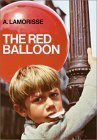
A magical book that has become an enduring children's classic, The Red Balloon is the story of a young boy and his best friend--a bright red balloon. Chock-full of photographs of the boy, the balloon and the captivating city of Paris.
A New York Times Best Illustrated Children's Book of the Year.
If, like me, you think Paris is beautiful, whether in your dreams or memories, pick up this classic.
I loved it as a child and didn't know why. Did I want to be that boy running through the streets of Paris? No one asked. I can't remember. Yet, I retain a fondness for the scent of rubber to this day.
Open the book with its stills from the film of the same title and ask yourself "Would I like to be there?"
Have you ever had an imaginary friend? Perhaps a secret friend, but one whom nobody but you ever sees? Usually such a friend disappears for ever when a real friend comes to take their place. But what if this friend can be seen by all: it is not human - not even a living creature - but an inanimate object?
Such is the twist in this tale. A lonely little boy, Pascal, has a friend who is loyal, spirited, brave and naughtier than he is, and everyone can see this friend. They react with envy or annoyance, as is their wont. But the friend is free, and above their reach. It is a bright red balloon.
The Red Balloon is a classic French short film from 1956. Once you have seen it, you never forget it.
This oversized book is full of stills taken during the filming of The Red Balloon(“Le Ballon Rouge”), and originally published just a year later, in 1957, although it has been reprinted many times. The huge photographs capture the memory of watching the film, and there is also text to accompany these, so that it can be read as a story book.
Pascal is a young Parisian boy, who is sad and lonely. He has brought home a stray cat, and a homeless puppy, hoping to be friends with them, but he has never been allowed to keep them by his house-proud mother. One morning, Pascal discovers a large, bright, red balloon tied to a gas lamp, on his way to school: But this is no ordinary balloon. It follows him all the way to school, behind the bus! Pascal begins to realise that the balloon has a mind, and a will, of its own. It begins to follow him wherever he goes, and even when his mother pushes it out of the window, it just stays there and waits for him, floating outside his bedroom window. When he could, Pascal opened the window, caught the balloon, and hid it away in his bedroom.
Each day Pascal would let the balloon out of the window, and then call to it to come when he was outside. The balloon behaved just like a little dog, never straying very far. But sometimes it would be naughty, and skip away in the air. Then Pascal would pretend he was lost, and hide, so that the balloon would get worried and hurry to catch him up.
It must have looked very funny to all the passers-by, a bright red balloon racing along behind a bus. The balloon was naughtier than ever at school, causing an uproar from Pascal’s classmates. All the children were really noisy; so uncontrollably excited that the headmaster locked Pascal up in his office, while he tried to catch the balloon. However, it was all in vain, and the balloon skipped off merrily.
All the children in the streets of Paris, know of Pascal and his balloon, and how the bright red balloon regularly follows him. The pair draw a lot of attention and envy from these other children, as they play in the streets. One day Pascal sees a large painting of a little girl, on a market stall, and thinks it would be nice to have a friend like her. Later, he meets a real little girl, Sabine, who has a bright blue balloon. What’s more, her balloon also seems to have a mind of its own, just like his does:
Pascal begins to worry though, because his balloon does not behave itself. Some of the children were trying to catch it, but the balloon was usually too quick, and clever and would fly back to Pascal an safety, at once.
But the balloon is disobedient. One Sunday, Pascal told his balloon to stay home while he and his mother went to church. However, the balloon followed them through the open window, and into the church. The beadle was furious, and Pascal and his balloon had to run away from him. How can Pascal train his balloon to be obedient, and keep safe?
One day, Pascal goes to the bakery and tells the balloon to wait outside for him. But a gang of older boys, who were envious of the balloon, managed to steal it while the balloon was sunning itself. They wanted to show the magic balloon at the fair, but luckily Pascal managed to call to the balloon from the other side of the wall, and the balloon quickly flew back to him:
But the boys were not beaten
The film is magical; thirty-five minutes of pure wonder, and the ending is heartbreaking - and very French! I first saw this as a young child, when televisions were all in black and white, and I did not know until years later that the solitary balloon is filmed in red, against a monochrome background; the blue balloon in blue, and the “heavenly” balloons at the end in multi-colours.
The director, and author of this book, was Albert Lamorrise, a former auditor at a French Film Institute. The entire crew who made the film were graduates of his school. Lamorisse used his own children as the actors: his son Pascal in the main role, and his daughter, as the little girl. He filmed in the Ménilmontant area of Paris.
After the Second World War, the Belleville area of Paris had fallen into decay, and was due to be demolished as part of what they called slum clearance. Some of what is seen in the film no longer exists, such as the school, the bakery, and the marvellous quaint shaped staircase just beyond the café. Even the steep steps of the passage where Pascal finds the red balloon, and the waste ground at the end are now all gone. Some landmarks are still there, such as the apartment where Pascal lived with his mother, the church, and the bus stop all still exist.
The film is a masterpiece of photography, providing an historical record of the area, as well as being an allegorical fantasy. It has won numerous awards, including an Oscar for Best Original Screenplay in 1956 and the Palme d’Or for short films at the Cannes Film Festival. It remains the only short film which has ever won these awards.
The story is a tribute to childhood imagination and innocence. Although the ending tugs at the heart, the balloon’s bright colour is a symbol of hope and light, contrasting with the loneliness and solitude. There are even some humorous moments within the film.
Although I would award the film of The Red Balloon five stars without question, this large format book is just a reminder of that film, rather than being an outstanding work in its own right. Thus, for me, this book remains a three star read.
Gorgeous visual storytelling that certified the short film as a classic from which it was wise to fill the pages with so many artful stills; somewhat trivialized by the rote storybook narration.
I'm not sure why I bought and read this book. Mastery over trauma? Because when I was in elementary school, whenever it rained and we couldn't go outside into the play yard for the bulk of our lunch period, they'd herd us all into the auditorium, and show us the film The Red Balloon. To me, it was a sad story about loss whose ending did not console me at all. Ah well.
This was a childhood favorite book of mine and I still love it to this day. A sweet story about a young boy and his best friend who happens to be a red balloon. What makes this book so special are the photographs of Paris as the boy wanders around the city. Highly recommend!
Based on the 1956 movie, Le Ballon Rouge, this adaptation of the film with photographs follows a boy’s friendship with a red balloon in Paris. Pascal espies a red balloon and after catching it spends the day with the balloon. However, the balloon has a mind of its own and despite efforts to separate them, the red balloon follows and protects Pascal. Friendships come in all packages and shapes if you believe. A charming and moving tale of the innocence and the imagination of a lonely boy.
فان فکتس: ۱.این کتاب از دل یه فیلم بیرون اومده. ۲.که فیلمنامهش هم اسکار گرفته هم کن. ۳.که تنها فیلم کوتاهیه که فیلمنامهش اسکار گرفته. ۴. و کرکترها هم بچههای خودشن. ۵. و از قضا نویسنده این کتاب همون طراح بوردگیم ریسکه! ۶.و حالا حدس بزنید این نویسنده، کارگردان، بازیساز کجا جوون مرگ شده؟ کرج. ۷. چجوری؟ سقوط هلیکوپتر موقع ساختن مستند باد صبا. ۸.و اگه گفتید کی این کار نیمه تموم رو تموم میکنه؟ همین آقا کوچولو.
I have read this book since I was in elementary school and now have read it to my grandson several times. I remember also seeing the movie version made of it. Although written in 1956, it has weathered well and stands the test of time. The big difference in the years is that probably the principal would not lock Pascal in his office in this day and age. Essentially it is a story of friendship and support. The end is a little fantasy, but one which most children would enjoy thinking of.
é na infância que encontramos a verdadeira amizade. devido a inocência e simplicidade da criança, se cria a mais pura amizade. Lamorisse expressa perfeitamente a primeira amizade na infância, simples, sincera e sem medo algum de demonstrar afeto. The Red Ballon me emociona de uma forma inexplicável, a amizade entre um garoto e um balão vermelho me traz sentimentos que ainda não tenho palavras para descrever. nada no mundo é para sempre, mas a verdadeira amizade, fica para sempre no coração. 🤍🎈
This was one of the most beautiful and memorable books that I remember from my childhood. I wanted it read to me over and over. Eventually, I read it myself over and over again.
I am visiting Paris and listening to an adult biography called Paris to the Moon about life in Paris. The author Adam Gopnik lived in Paris during his childhood and mentioned the Red Balloon.
“The Red Balloon” is actually a French film short that was released in the 1950’s. I saw the film a few years ago but did not remember much from it. Reading the book brought back memories of the film.
I loved this book. I love the relationship between Pascal and his friend the red balloon. The balloon is an inanimate character that has animate qualities. The balloon accompanies Pascal everywhere and often lands him in a lot of trouble. The story is told with humor and sensitivity. I predict children will immediately like Pascal and will have mixed feelings about the red balloon.
The story is set in France. I did not note any language that may require further explanation for the reader. The intended audience for the story is children, not just children in France but children universally. Children from any nation will empathize with Pascal as his friend the balloon gets him into hot water. The balloon is much like a pet that a child would desire to take with him/her everywhere they go. Sometimes the pet is obedient but sometimes the pet is not, just as the red balloon is in the story.
My rating for this book five stars. This is well written book and the movie is worth seeing as well. I recommend both. Teachers will enjoy reading this book with their students and students will absolutely love hearing it.
"The Red Balloon" is a fanciful picture book that captures the imagination of primary readers. The book tells the story of a lonely little boy, Pascal who becomes friends with a big red balloon. They have many adventures on the streets of Paris. The strength of their friendship is tested and proved to be true. I gave the book a 4-star rating for several reasons. The pictures are beautiful still photographs taken from a film entitled "The Red Balloon" that was produced in 1956. Many of them are black and white prints that give them a very "classical" look, while several others are color prints that dramatically portray the brilliant red balloon and its charming friend, Pascal. The plot of the story takes the reader along on the adventure of these two unique, and often misunderstood friends. Some of their encounters are fun-filled and silly, while others are a little more tense as some bullies try to kidnap the balloon to use for their own purposes. The themes of friendship and loyalty are effectively woven throughout the story. I am sure that the book would be appealing to young readers. The combination of beautiful pictures, a fast-paced plot, and the universal theme of friendship and loyalty will be enjoyed by readers - young and old alike!
I got this book 29 years ago from my forner mother in law when I began my student teachinbg assignment with Kindergarteners. it had belonged to my former husband and she said it had been one of his favorites. Well, one day I brought a blown up red balloon (helium) to school inside of a box (I called it my magic box) and sat the children down at circle time. I told them that something very special was inside of the box and had them guess. When I opened the box and the balloon popped our everyone jumped up and began trying to catch it. Once the excitement simmered down I got everyone settled and read them the story of the red balloon. For the rest of the day after the story- the children shared the red balloon and treated it nicely- not trying to grab it or fight over it. Of course I had a timer to help with the turn taking. ;) The rest of the semester whenever trouble would brew- with unkind acts to one another I would remind them (and sometimes they would remind each other) about the red balloon.
It is a timeless tale and I think there is now even a movie about it.
I bought this for my kids when they were little. I was intrigued by the photographs and story, as I was really into French culture at the time. But my kids absolutely hated it. They thought it was so weird and creepy. They could not relate to it at all. I feel it’s not really a children’s book. It’s really for adults who like artsy things. It was a very wacky story indeed. (It’s actually from the movie of the same name.)
This is the first book I ever read in the school library that wasn't on the shorter shelves specifically for kids. I remember asking the librarian to take it off the shelf for me in first grade because I couldn't reach it. I don't really remember anything about this book except that I loved it. I should find a copy and revisit it now, 23 years later
Is it possible for a red balloon to become your friend? The magic happens in this classic story of a young boy who finds a red balloon. I was reminded of this story by my grandson holding a red balloon. Some things just don’t go out of style.
A rather odd story about a boy and a magical balloon that follows him around a bit like a pet. The photo's are from the film that the book is based on.
I remember seeing a movie that mirrored this book; not sure which was made first? I had a little-girl-crush on the boy in the movie and whose picture is in this book.
The Red Balloon by Albert Lamorisse-Hindi language translation by Arvind Gupta- Children’s Illustrated Picture Book- The book narrates the story of child named Pascal. He resides in France. He has no brothers and sisters. Therefore, he feels lonely. He brings home a stray cat, and a homeless puppy, hoping to be friends with them, but his mother throws them out the house. One morning, Pascal discovers a large, bright, red balloon tied to a gas lamp, on his way to school. But this is no ordinary balloon. It follows him all the way to school, behind the bus. Pascal begins to realise that the balloon has a mind, and a will, of its own. It begins to follow him wherever he goes, and even when his mother pushes it out of the window, it just stays there and waits for him, floating outside his bedroom window. When he could, Pascal opened the window, caught the balloon, and hid it away in his bedroom. Each day Pascal would let the balloon out of the window, and then call to it to come when he was outside. The balloon behaved just like a little dog, never straying very far. But sometimes it would be naughty, and skip away in the air. Then Pascal would pretend he was lost, and hide, so that the balloon would get worried and hurry to catch him up. It must have looked very funny to all the passers-by, a bright red balloon racing along behind a bus. The balloon was naughtier than ever at school, causing an uproar from Pascal’s classmates. All the children were really noisy; so uncontrollably excited that the headmaster locked Pascal up in his office, while he tried to catch the balloon. However, it was all in vain, and the balloon skipped off merrily. All the children in the streets of Paris, know of Pascal and his balloon, and how the bright red balloon regularly follows him. The pair draw a lot of attention and envy from these other children, as they play in the streets. One day Pascal sees a large painting of a little girl, on a market stall, and thinks it would be nice to have a friend like her. Later, he meets a real little girl, Sabine, who has a bright blue balloon. What’s more, her balloon also seems to have a mind of its own, just like his does. Pascal begins to worry though, because his balloon does not behave itself. Some of the children were trying to catch it, but the balloon was usually too quick, and clever and would fly back to Pascal for safety, at once. But the balloon is disobedient. One Sunday, Pascal told his balloon to stay home while he and his mother went to church. However, the balloon followed them through the open window, and into the church. The beadle was furious, and Pascal and his balloon had to run away from him. How can Pascal train his balloon to be obedient, and keep safe? One day, Pascal goes to the bakery and tells the balloon to wait outside for him. But a gang of older boys, who were envious of the balloon, managed to steal it while the balloon was sunning itself. They wanted to show the magic balloon at the fair, but luckily Pascal managed to call to the balloon from the other side of the wall, and the balloon quickly flew back to him. Rowdy boys find Pascal and the balloon. They chase Pascal with the balloon. They are able to catch the balloon and tie it with a thick thread. Pascal views the balloon from the other side of the road. He unties the thread and release it free in the air. The boys throw a sharp stone so that the balloon bursts. The situation is sad. In order to please Pascal, all balloons from France come together at that spot. They tie their threads, pick up Pascal and show him round the skyline. The story is a tribute to childhood imagination and innocence. Although the ending tugs at the heart, the balloon’s bright colour is a symbol of hope and light, contrasting with the loneliness and solitude. Illustrations help the reader in relating to the story. I have read the Hindi language translation of this book.
In the book The Red Balloon, there is a little boy who is having a hard time with friends and wants more. He then finds a huge red balloon and they immediately become "best friends". This little boy goes throughout his regular day, but he can't take the balloon with him in some places like on the train or while he's at school. He finds ways to hide the balloon or give it to other people to take care of. He builds a great friendship with this inanimate object. Friendship can be strengthened when you persevere through your hardships together. It says balloon repeatedly throughout the entire book because it can be made very relatable. In the dictionary, the definition for "balloon" says "a brightly colored rubber sac inflated with air and then sealed at the neck, used as a children's toy or a decoration." In the story, this definition would need to be changed if you were to have a more accurate meaning because the boy becomes best friends with this balloon. Sometimes, the mean boys come and try to steal or pop the balloon and the boy has to run for his life so he can stand up for his friend. This changes the book and makes it more relatable because we should be standing up for our friends even to the point when we need to run away from others to protect them. I really loved this book because it can show what goes on in a person's head at a younger age and it really demonstrates the author's creativity. I can relate to this book because when I was younger I would always pretend, with the toys that I played with, that they were my friends and that they would come to life. It was pretty great and this book got me really thinking about my childhood and I love that about books! 5 stars!