

What do you think?

Take Me Out
?A funny and troubling look at athletes and identity . . . Take Me Out is a dynamic, involving play.? ?Donald Lyons, New York Post
Darren Lemming is the star center fielder for the champion New York Empires. An extraordinary athlete, he fills both his fans and his teammates with awe at his abilities and his presence on the field and off. When he makes the matter-of-fact announcement that he?s gay, he throws his team into turmoil and confusion, while he also emboldens his closeted accountant, Mason Marzac, to come to terms with his own sexuality?and to fully experience the pure joy of watching great athletes play a sport as well as it can be played. But Darren?s announcement brings to the fore the confused and twisted hostilities of the Empires? brilliantly talented but deeply racist and homophobic pitcher, Shane Mungitt?from whose rage tragic consequences ensue.
The American premiere of Take Me Out took place at the Public Theater in New York City in September 2002. It will move to the Walter Kerr Theatre on Broadway in February 2003.
Darren Lemming is the star center fielder for the champion New York Empires. An extraordinary athlete, he fills both his fans and his teammates with awe at his abilities and his presence on the field and off. When he makes the matter-of-fact announcement that he?s gay, he throws his team into turmoil and confusion, while he also emboldens his closeted accountant, Mason Marzac, to come to terms with his own sexuality?and to fully experience the pure joy of watching great athletes play a sport as well as it can be played. But Darren?s announcement brings to the fore the confused and twisted hostilities of the Empires? brilliantly talented but deeply racist and homophobic pitcher, Shane Mungitt?from whose rage tragic consequences ensue.
The American premiere of Take Me Out took place at the Public Theater in New York City in September 2002. It will move to the Walter Kerr Theatre on Broadway in February 2003.
69 pages, Paperback
First published January 1, 2002
About the author
Richard Greenberg
38 books20 followersRichard Greenberg was an American playwright and television writer known for his subversively humorous depictions of middle-class American life. He had more than 25 plays premiere on Broadway, off-Broadway, and off-off-Broadway in New York City and eight at the South Coast Repertory Theatre in Costa Mesa, California, including The Violet Hour, Everett Beekin, and Hurrah at Last. Greenberg is perhaps best known for his 2002 play Take Me Out.
Ratings & Reviews
Friends & Following
Create a free account to discover what your friends think of this book!
Community Reviews
Displaying 1 - 30 of 80 reviews

June 12, 2017
“I have come to understand that baseball is a perfect metaphor for hope in a democratic society. It has to do with the rules of play. It has to do with the mode of enforcement of these rules. It has to do with certain nuances and grace notes of the game.
Richard Greenberg ~~ Take Me Out

I recently reread Richard Greenberg's Take Me Out after 12 years of sitting on a shelf. I'm considering directing it in the near future after a friend suggested it to me. My opinion of Greenberg's play has changed considerably over time. I've seen Take Me Out staged twice both had very different interpretations. Both were quite good. I was swept up in the Take Me Out fever that had engulfed the theatrical world.

Random thoughts: Darren is not a likeable hero. He's not really a hero at all, and his irresponsible act sets the tragedy that is about to happen in motion. Shane is not as vile as the first act would have you believe. Shane is a victim ~~ a victim of his parents, a victim of the foster care system, a victim of Kippy's misguided efforts to help him, and a victim of Darren's reckless act of vengeance ~~ yes Shane is a victim. Sadly, Shane is also drawn as a one dimensional character. It's as if Greenberg wants the audience to hiss when we first see Shane. Forgive me ~~ I'm thinking as a director now.

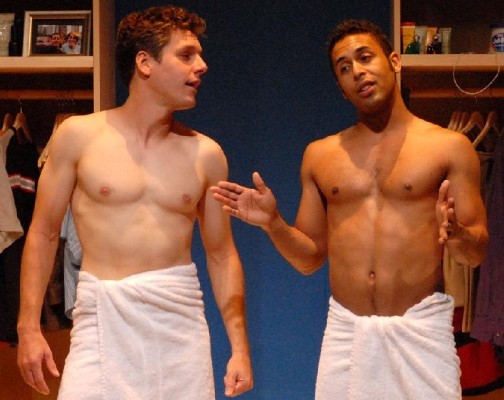
Many have argued that the nudity in Take Me Out is gratuitous. I disagree. There is extensive full frontal male nudity in this play, but it is necessary to set up the shower confrontation between Darren and Shane. To randomly throw in nudity to this scene without having built up to it would have been too jarring. Forgive me again ~~ I'm thinking as a director once more.

The one major fault I see in Take Me Out is the Mars subplot. As the second act progresses and throughout the third act, Mars begins to take center stage. Greenberg looses focus on the story of Lemming as the relationship between Mars and Lemming is explored. This relationship is used to make Darren seem more human, less aloof, but it only muddies the waters. Forgive me for a third time ~~ I'm thinking as a director more and more.
The plot hinges on the coming out tension between Darren and Davey Battle, who is, up to this time, Darren's best friend, a player on an opposing team who becomes very self righteous and preaches morality and damns Darren to hell; unfortunately, the scene is none-too-believable. It plays as if it were written for a movie of the week in 1979. That this conversation is enough to set the tragic actions of act two into motion is not believable.

So why you ask have I given this script ****'s after having found so much fault with it? I couldn't tell you. All I know is after all these years, I'm still drawn to Take Me Out and I will be directing it in the near future.
Richard Greenberg ~~ Take Me Out
I recently reread Richard Greenberg's Take Me Out after 12 years of sitting on a shelf. I'm considering directing it in the near future after a friend suggested it to me. My opinion of Greenberg's play has changed considerably over time. I've seen Take Me Out staged twice both had very different interpretations. Both were quite good. I was swept up in the Take Me Out fever that had engulfed the theatrical world.
Random thoughts: Darren is not a likeable hero. He's not really a hero at all, and his irresponsible act sets the tragedy that is about to happen in motion. Shane is not as vile as the first act would have you believe. Shane is a victim ~~ a victim of his parents, a victim of the foster care system, a victim of Kippy's misguided efforts to help him, and a victim of Darren's reckless act of vengeance ~~ yes Shane is a victim. Sadly, Shane is also drawn as a one dimensional character. It's as if Greenberg wants the audience to hiss when we first see Shane. Forgive me ~~ I'm thinking as a director now.
Many have argued that the nudity in Take Me Out is gratuitous. I disagree. There is extensive full frontal male nudity in this play, but it is necessary to set up the shower confrontation between Darren and Shane. To randomly throw in nudity to this scene without having built up to it would have been too jarring. Forgive me again ~~ I'm thinking as a director once more.
The one major fault I see in Take Me Out is the Mars subplot. As the second act progresses and throughout the third act, Mars begins to take center stage. Greenberg looses focus on the story of Lemming as the relationship between Mars and Lemming is explored. This relationship is used to make Darren seem more human, less aloof, but it only muddies the waters. Forgive me for a third time ~~ I'm thinking as a director more and more.
The plot hinges on the coming out tension between Darren and Davey Battle, who is, up to this time, Darren's best friend, a player on an opposing team who becomes very self righteous and preaches morality and damns Darren to hell; unfortunately, the scene is none-too-believable. It plays as if it were written for a movie of the week in 1979. That this conversation is enough to set the tragic actions of act two into motion is not believable.
So why you ask have I given this script ****'s after having found so much fault with it? I couldn't tell you. All I know is after all these years, I'm still drawn to Take Me Out and I will be directing it in the near future.

October 29, 2011
(2.5 / 5)
A baseball player decides to come out while at the peak of his career, and finds that the relationships around him change because of it.
It is difficult to judge plays at times, because dialogue that sounds stilted on the page can be emotional and moving on the stage (forgive the rhyme). Take Me Out definitely suffers from appearing stilted, especially as characters tend to lapse into soapbox mode and give melodramatic diatribes - all building to what comes across as a rather soap-operaish ending.
The problem is that you really don't like any of the characters, and it is because they come across more as caricatures. There's the redneck racist homophobe, the preachy Christian who is anything but, etc etc. I know these people exist in real life, but in this play they come across as barely-disguised totems for ignorance and therefore negate a lot of the dramatic tension.
A baseball player decides to come out while at the peak of his career, and finds that the relationships around him change because of it.
It is difficult to judge plays at times, because dialogue that sounds stilted on the page can be emotional and moving on the stage (forgive the rhyme). Take Me Out definitely suffers from appearing stilted, especially as characters tend to lapse into soapbox mode and give melodramatic diatribes - all building to what comes across as a rather soap-operaish ending.
The problem is that you really don't like any of the characters, and it is because they come across more as caricatures. There's the redneck racist homophobe, the preachy Christian who is anything but, etc etc. I know these people exist in real life, but in this play they come across as barely-disguised totems for ignorance and therefore negate a lot of the dramatic tension.

July 9, 2015
The book introduces the reader with the history and how it became part of Broadway Populaire. The author provides a list of characters which facilitates readers for following along. “Take Me Out” is broken into Acts in the script like style. Initially it holds the main narrator and then slowly characters are introduced as in a way that as the reader I felt myself standing there during the conversation. To enhance the feel and mood there is also transitional notes to emphasize focal point and sounds.
The story is not just about a baseball team and winnings of the world series. Greenberg incorporated several controversial subjects that are always under fire. Racial prejudices within a team also were addressed in conjunction with pay grade. The issue of homosexuality and male inert behaviors also comes into question. The main character seems to have begun the falling of events. His interpersonal relationships shift and then we witness how not everyone reacts the same regardless of what may be social acceptable or polite. It is a journey of maintaining individuality and becoming more accepting of others. This is all wrapped and presented in a docile manner that triggers less defensive reactions.
I feel Greenberg took these social issues and used an American game to bring it all to light in a way that most can nod. He takes the issues and humanizes. Taking others beliefs and religious teachings that can condone or damn the issues at hand. Greenberg brings out the true nature of a person. Plays with elements of race, gender orientation, wealth, religion, and passion for life and success to address social issues. Well done!
The story is not just about a baseball team and winnings of the world series. Greenberg incorporated several controversial subjects that are always under fire. Racial prejudices within a team also were addressed in conjunction with pay grade. The issue of homosexuality and male inert behaviors also comes into question. The main character seems to have begun the falling of events. His interpersonal relationships shift and then we witness how not everyone reacts the same regardless of what may be social acceptable or polite. It is a journey of maintaining individuality and becoming more accepting of others. This is all wrapped and presented in a docile manner that triggers less defensive reactions.
I feel Greenberg took these social issues and used an American game to bring it all to light in a way that most can nod. He takes the issues and humanizes. Taking others beliefs and religious teachings that can condone or damn the issues at hand. Greenberg brings out the true nature of a person. Plays with elements of race, gender orientation, wealth, religion, and passion for life and success to address social issues. Well done!

January 12, 2010
There's this thing about plays nowadays- they have to have all this "meaning." This is (to put it mildly) stupid bullshit. Baseball in a America also has all this meaning and one of the characters keeps talking about it. I almost feel like there is a degree of satire in this, because everyone who should think it has meaning(eg the baseball players), they don't really feel that anymore. They might be reminded of it, but it isn't the focus. Not to say that this play doesn't have any meaning, it's more like it doesn't care if it has any meaning. As well, I felt like it used racism and homophobia in a manner that didn't seem pretentious. Perhaps I'm reading too much into it, or I'm seeing something that isn't there, but I really enjoyed this all the same.

August 31, 2025
Baseball is so romantic. It’s also very gay

September 23, 2025
this was so good! i want to see it on stage now

June 29, 2023
For when you want a play about …baseball? But actually sexuality and race and family trauma.

June 10, 2012
An interesting look at identity, a far as it goes, but until the playwright acknowledges that identity neither can nor should be formed individually--that is, without regard to the surrounding culture--his plays will always be lacking.
At least the story moves, which is more than I can say for many of these Tony-winning plays. And an early monologue about the fundamental Americanness of baseball is one of the best and most beautiful I've read on the subject.
At least the story moves, which is more than I can say for many of these Tony-winning plays. And an early monologue about the fundamental Americanness of baseball is one of the best and most beautiful I've read on the subject.

February 2, 2012
A compelling, funny look at identity, politics and America's pastime. One of my favorite modern plays. Mason's monologue about democracy being the representation of hope in a democratic society is classic and wonderful.

July 30, 2014
A suggestively dark little play about a New York pro baseball team. Explores the accidental death of a team mate by the pitcher and the turmoil of another player on the team, their star athlete, coming out. Homophobia and racism come to light while team mates discover their own identity.

June 24, 2010
Very fun and funny. And it captures everything I love about baseball.

May 2, 2017
I wish I had seen this play when it was in Portland years ago. Also wish I had read it in one afternoon. (Are you sensing a theme here? I either need to read more often, or read more quickly!)

May 10, 2018
Enjoyed revisiting this play after seeing the original Broadway production 15 years ago!!
2023: Four years plus later, I enjoyed rereading this play again.
2023: Four years plus later, I enjoyed rereading this play again.
January 10, 2022
Funny and thought-provoking. Examines many social dynamics through the lens of baseball.

June 10, 2022
Watched this at the Hayes Theater on Broadway, with Jesse Williams as the lead.

Read
October 25, 2021I'm going to go ahead and say that is not a play that can be read but should instead be seen. I'll be looking forward to the upcoming tv and Broadway adaptation with Jesse Williams - that will likely make the story easier to digest.

April 27, 2018
ReRead 24 Feb 2026
---
ReRead 1 September 2023
Still like it. Probably would like it better if I saw it performed.
---
ReRead 1 March 2021
I liked it better the second time around. Still a little...I dunno, there's something lacking here, but I can't put my finger on it. The ideas and characters are great, the discussions interesting and resonant, but nevertheless something, SOMETHING, feels lacking in substance.
---
Eh. I felt mostly indifferent to this play. Too much to say and not enough action to justify it.
At its core, Take Me Out concerns Darren Lemming: a star baseball player who has recently decided to come out as gay. Though this news troubles some and warms others, Lemming appears largely indifferent to whatever response that decision garners. Appears, at least. With the addition of a new team member--a relief pitcher to help Lemming's team out of its slump--we find that Lemming may not be as calm and collected as he appears to be.
And that presented "coolness", though interesting, unfortunately resulted in a tepid response to this play. I wanted to care about these characters, but the majority of them seemed at least one degree emotionally removed from the plot, at least until the end. And there's nothing inherently wrong with that coolness, especially if it serves a narrative purpose. My problem with it was that it interfered with Take Me Out feeling like a real, fleshed-out world.
I like symbols and metaphors. I like discerning the bigger picture, grander themes and greater ideas, from recurring images, motifs in a given text. I don't even mind a certain amount of explicitness when it comes to that sort of analysis. But take me out just felt too cerebral for its own good. Take Me Out has things to say about baseball: not just as an American institution, but as a way of life. Neat, except characters halt the plot to discuss that meaning of baseball at length. And when most characters adopt a certain loquaciousness when talking about their "role" in this grand sport, it feels less like characters talking with one another and more the author talking to himself.
Add to all this the fact that one of the characters "narrates" the majority of the play to us. Telling instead of showing. It just feels lazy.
I've read plays by Richard Greenberg before, and he is a fine, fine playwright. But with Take Me Out, it feels like he's phoning it in. Certain characters are fleshed out more than others, and the end result is just . . . unsatisfying. There's not enough of a payoff to justify the journey. Perhaps the ideas expressed in here necessary and important and game-changing when the play first premiered. (It DID win the 2003 Tony Award). But to me, it just reads stale. A strike-out.
---
ReRead 1 September 2023
Still like it. Probably would like it better if I saw it performed.
---
ReRead 1 March 2021
I liked it better the second time around. Still a little...I dunno, there's something lacking here, but I can't put my finger on it. The ideas and characters are great, the discussions interesting and resonant, but nevertheless something, SOMETHING, feels lacking in substance.
---
Eh. I felt mostly indifferent to this play. Too much to say and not enough action to justify it.
At its core, Take Me Out concerns Darren Lemming: a star baseball player who has recently decided to come out as gay. Though this news troubles some and warms others, Lemming appears largely indifferent to whatever response that decision garners. Appears, at least. With the addition of a new team member--a relief pitcher to help Lemming's team out of its slump--we find that Lemming may not be as calm and collected as he appears to be.
And that presented "coolness", though interesting, unfortunately resulted in a tepid response to this play. I wanted to care about these characters, but the majority of them seemed at least one degree emotionally removed from the plot, at least until the end. And there's nothing inherently wrong with that coolness, especially if it serves a narrative purpose. My problem with it was that it interfered with Take Me Out feeling like a real, fleshed-out world.
I like symbols and metaphors. I like discerning the bigger picture, grander themes and greater ideas, from recurring images, motifs in a given text. I don't even mind a certain amount of explicitness when it comes to that sort of analysis. But take me out just felt too cerebral for its own good. Take Me Out has things to say about baseball: not just as an American institution, but as a way of life. Neat, except characters halt the plot to discuss that meaning of baseball at length. And when most characters adopt a certain loquaciousness when talking about their "role" in this grand sport, it feels less like characters talking with one another and more the author talking to himself.
Add to all this the fact that one of the characters "narrates" the majority of the play to us. Telling instead of showing. It just feels lazy.
I've read plays by Richard Greenberg before, and he is a fine, fine playwright. But with Take Me Out, it feels like he's phoning it in. Certain characters are fleshed out more than others, and the end result is just . . . unsatisfying. There's not enough of a payoff to justify the journey. Perhaps the ideas expressed in here necessary and important and game-changing when the play first premiered. (It DID win the 2003 Tony Award). But to me, it just reads stale. A strike-out.

December 5, 2011
Like most plays about sports, Take Me Out is not about sports. It has baseball players, and they play baseball in it, but it is not about baseball.
There were some problems with the pacing of character development. I think the framing narrator, Kippy, began as a strong, enigmatic character. He carried the play's clarity of purpose, he was the message. That was okay because he was a spectator. It didn't feel like a cop-out that he saw everything so clearly because he wasn't actively moving events along. It was not until the so-called climax of the play that I think Greenberg took the easy way out by exclusively using Kippy to make the point of his play. The scene was as satisfying as it had to be to convey the very important conclusion. I just didn't buy the message of this play, and I was so on the way there. Thankfully, I do feel that Greenberg maintained the momentum of everything that led up to the climax scene.
I understand that theatre is a fundamentally different medium of dramatic expression than film, which I think is an attribute that made certain characters feel a little devoid of conviction. Greenbeg makes up for it, though. His incredibly poignant dialogue captures the romanticism of baseball in a way that didn't feel forced while still conveying a message about what it means to look beyond the surface of life's very ordinary activities. The ending brought a sense of relief and exhaustion that I think no one reading or watching the play even realized they were being primed to feel. I thought the ending of this play was perfect, which is not something I feel inclined to say very often. (Kudos to Greenberg for that alone!)
Greenberg opened up a dialogue about the responsibilities and assumptions of meaning-making behaviour that I think is important to our understanding of knowledge, of ourselves and our lives. Lastly, I adored the character of Mason. I will continue to insist that creating an extraordinarily likable character, possibly beyond reasonable comprehension, is awesome.
There were some problems with the pacing of character development. I think the framing narrator, Kippy, began as a strong, enigmatic character. He carried the play's clarity of purpose, he was the message. That was okay because he was a spectator. It didn't feel like a cop-out that he saw everything so clearly because he wasn't actively moving events along. It was not until the so-called climax of the play that I think Greenberg took the easy way out by exclusively using Kippy to make the point of his play. The scene was as satisfying as it had to be to convey the very important conclusion. I just didn't buy the message of this play, and I was so on the way there. Thankfully, I do feel that Greenberg maintained the momentum of everything that led up to the climax scene.
I understand that theatre is a fundamentally different medium of dramatic expression than film, which I think is an attribute that made certain characters feel a little devoid of conviction. Greenbeg makes up for it, though. His incredibly poignant dialogue captures the romanticism of baseball in a way that didn't feel forced while still conveying a message about what it means to look beyond the surface of life's very ordinary activities. The ending brought a sense of relief and exhaustion that I think no one reading or watching the play even realized they were being primed to feel. I thought the ending of this play was perfect, which is not something I feel inclined to say very often. (Kudos to Greenberg for that alone!)
Greenberg opened up a dialogue about the responsibilities and assumptions of meaning-making behaviour that I think is important to our understanding of knowledge, of ourselves and our lives. Lastly, I adored the character of Mason. I will continue to insist that creating an extraordinarily likable character, possibly beyond reasonable comprehension, is awesome.

April 2, 2019
for class

May 17, 2017
Some interesting theatre nerd trivia: All three 2003 Pulitzer nominees were nominated for Tony Awards, albeit in three different years (2002, 2003, and 2004). Of those, the Pulitzer winner, Anna in the Tropics, lost the Tony while the two runners-up took home the prize.
(I told you it was nerdy.)
One more nerd fact: Despite being a play about that most American of pastimes, baseball, Take Me out premiered at Donmar Warehouse in London.
Take Me Out is about Darren, a star baseball player for a fictional version of the Yankees. Without warning, one day he announces he’s gay, which sets off ripples through the rest of the season.
On the plus side, Mr. Greenberg avoided many of the expected clichés. The play does some creative things and has some nice twists.
The problem is the focus. Darren either needed to be the star (one of his teammates, Kirby, is the narrator and much of the play is from his perspective) or be supporting with less from his perspective and persona life. The decision to split focus between the two men weakens the narrative, as does the inclusion of Darren’s new business manager.
There’s a lot to like about Take Me. But it left me with the feeling that the more interesting play lurking in its pages was one that attempted to tell the story from the perspective of a baseball-loving homophobe. It would have made for an insanely uncomfortable night of theatre, albeit more ambitious and unexpected. Quasi-recommended.
(I told you it was nerdy.)
One more nerd fact: Despite being a play about that most American of pastimes, baseball, Take Me out premiered at Donmar Warehouse in London.
Take Me Out is about Darren, a star baseball player for a fictional version of the Yankees. Without warning, one day he announces he’s gay, which sets off ripples through the rest of the season.
On the plus side, Mr. Greenberg avoided many of the expected clichés. The play does some creative things and has some nice twists.
The problem is the focus. Darren either needed to be the star (one of his teammates, Kirby, is the narrator and much of the play is from his perspective) or be supporting with less from his perspective and persona life. The decision to split focus between the two men weakens the narrative, as does the inclusion of Darren’s new business manager.
There’s a lot to like about Take Me. But it left me with the feeling that the more interesting play lurking in its pages was one that attempted to tell the story from the perspective of a baseball-loving homophobe. It would have made for an insanely uncomfortable night of theatre, albeit more ambitious and unexpected. Quasi-recommended.
May 18, 2018
It's a play about identity set in the backdrop of baseball. It's baseball, so of course I like it. And let me tell you, this took a dramatic turn, which you are clued in on at the beginning, but not what I expected. I audibly gasped at what happened and frantically turned to my father and then my aunt because I couldn't believe it. There were a few twists in here that shocked me. I also found Darren's characterization interesting, believing himself invincible and invulnerable when he comes out. Darren is so *good* at baseball that he truly believes he is above pity. The ending hit me in the gut and man, I just really enjoyed this.

November 8, 2010
"I've been watching baseball nonstop since the day I was told you were coming to me. And at first it was a chore. I understood nothing. I couldn't tell one player from another. And then I could. And it wasn't a chore any longer, it was…this…astonishment! This…abundance. So much to learn, so much to memorize. …when you're not playing now, I watch whoever is; when there's no one playing I watch tapes from twenty years ago; when I'm out of tapes I read books."

December 31, 2007
I hadn't yet seen it on stage when I read this play and, as so often happens to me, just didn't get it from the reading alone. But I loved the production I saw about a year later and would undoubtedly enjoy reading it much more now.
March 11, 2008
Very few plays make me laugh out loud while reading them, this one did. It's a great show and there are some good scenes in there for scene study, etc. [I'm also a little partial because I was the lead when we did it so sue me.] Good Book.

August 21, 2008
I'd say this rating is slightly generous, and largely due to having previously seen a production. Had I read it cold, I'd likely be rather indifferent, but such is the nature of initial play reading, it seems...

November 17, 2010
Strange but enjoyable play. When I saw it I was put off by how much more emphasis there was on baseball than on being gay particularly on the part of the closeted accountant. But you gotta love a Broadway play that involves a working shower room!

June 2, 2011
Almost a play without a point or a resolution but interesting nonetheless. I am a fan of nonlinear story telling and this play jumps around in time often. It's about ignorance, homophobia and the consequences of being a prominent athlete and coming out. Not my favorite but definitely interesting.

March 3, 2013
Compelling and interesting look at when a sports person "comes out" at the peak of their career - and the potential ramifications and consequences of this. Utterly engaging and memorable characters - particularly "Shane", which is an interesting and somewhat disturbing end to the play.

February 24, 2018
I am biased, having played Mason "Mars" Marzac in 2007; but it survives the test of time a decade later. I also enjoyed his short-lived play with Linda Lavin in 2016 and know he has more hits in him...

June 12, 2018
very enjoyable play. Have to admit, I saw this on Broadway years ago when it had its first run and Dennis O'Hare was in it, etc. Of course, it really comes alive on the stage and his performance (as well as the other actors) was magnificent. Still well worth reading!
Displaying 1 - 30 of 80 reviews