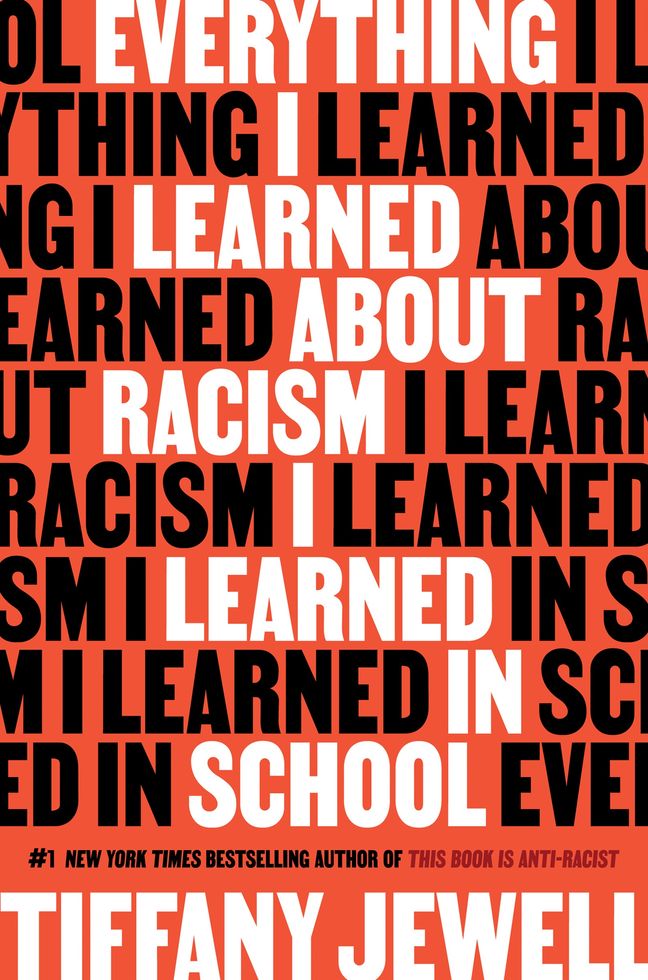
From the #1 New York Times bestselling author of This Book Is Anti-Racist and The Antiracist Kid , Tiffany Jewell, this YA nonfiction book, highlighting inequities Black and Brown students face from preschool through college, is the most important, empowering read this year. From preschool to higher education and everything in between , Everything I Learned About Racism I Learned in School focuses on the experiences Black and Brown students face as a direct result of the racism built into schools across the United States. The overarching nonfiction narrative follows author Tiffany Jewell from early elementary school through her time at college, unpacking the history of systemic racism in the American educational system along the way. Throughout the book, other writers of the global majority share a wide variety of personal narratives and stories based on their own school experiences. Contributors include New York Times bestseller Joanna Ho; award winners Minh Lê, Randy Ribay, and Torrey Maldonado; authors James Bird and Rebekah Borucki; author-educators Amelia A. Sherwood, Roberto Germán, Liz Kleinrock, Gary R. Gray Jr., Lorena Germán, Patrick Harris II, shea wesley martin, David Ryan Barcega Castro-Harris, Ozy Aloziem, Gayatri Sethi, and Dulce-Marie Flecha; and even a couple of teen writers! Everything I Learned About Racism I Learned in School provides young folks with the context to think critically about and chart their own course through their current schooling—and any future schooling they may pursue.
I found myself at times reading this and thinking to myself . . . I would find the author's arguments more persuasive if this. Or, I understand what the author(s) are saying, but if trying to persuade other people of their views, this isn't really going to work.
And then I realized . . . how incredibly White of me.
This book isn't about me. Although as a woman, there are definitely overlaps between institutionalized racism and institutionalized sexism, at the end of the day this isn't my story. So as a story to other people of the Global Majority, this book did an amazing job of saying - you're not crazy, and you're not alone. I found the placement of poems and other writings throughout the primary author's memoirs to be very well placed in a way I wouldn't have appreciated if read on their own.
Thank you to the publisher for the free ARC of this book.
If there is one thing that high school students are experts on, it’s school. They have figured out the loopholes, scams, and games involved in the day-to-day operations of their institutions of learning. They know that some educators are awesome, some are well-intentioned but ineffective, and others are downright mean. Students of color are especially tuned in to all of this, and they know that their schools frequently disenfranchise them.
Tiffany Jewell’s provocatively titled Everything I Learned About Racism I Learned in School is a young adult nonfiction book making the case that racism is pervasive in American schools, not only in overt attitudes but in our schools’ systems and structures. Everything I Learned About Racism I Learned in School explains how even schools that seem diverse and integrated from the outside perpetuate inequality and racism within their walls through tracking, disciplinary procedures, curricular materials and approaches, grading and testing, military recruitment, and other official and unofficial policies.
Everything I Learned About Racism I Learned in School includes research and first-person accounts written in teen-friendly language about situations and practices commonly experienced by Black and Brown students in their elementary, middle school, high school, and college years. The primary voice in this book is Jewell’s, but other contributors tell their stories and encourage young readers to push back against the oppression they encounter in classrooms, hallways, and curricula.
This book is good for everybody. BIPOC students will read Everything I Learned About Racism I Learned in School and understand that they have allies and advocates. Because this book is so authentic, White students will, hopefully, see their schools more accurately and take away new understandings of their marginalized peers.
Back matter includes templates for respectfully requesting exemption from standardized testing and removal from military recruitment databases, recommended reading with many YA titles, thorough documentation for the book’s research, and contributor bios.
As a long-time educator, this book forced me to reflect on whether I have been complicit in the systemic racism described in its pages. My conscience is relatively clear, but there are definitely things I would have done differently, things I cannot take back or undo. I freely admit that I’ve had some unlearning to do in my life, and these words of Maya Angelou have provided me with grace more than once: ““Do the best you can until you know better. Then when you know better, do better.” The gift of Everything I Learned About Racism I Learned in School is that Tiffany Jewell makes her readers “know better.”
After reading books like The Anti-Racist Writing Workshop, We Want to Do More Than Survive, Caste, Why Are All the Black Kids Sitting Together in the Cafeteria, and Pushout: the Criminalization of Black Girls in School, which discuss the facts and the history of American schools, this book is something a bit different. Author Tiffany Jewell mainly focuses on the personal stories (though Jewell does weave the facts and history into some of her sections). Many authors of the global majority come together to share their school experiences, and it’s not pretty. I was upset while reading this book. The experiences of what education was like for Jewell and others were often demeaning and just wrong. Kids were knocked down instead of lifted up. No child should be made to feel worse about themselves while (supposedly) getting an education. All children, no matter their race, should be learning about more than just white, male, Eurocentric history. Read their stories about what they went through. Compare their experiences to your own. You’ll see the problem is not just with certain individuals, but the whole American school system, which needs a complete overhaul.
As Jewell says, “the culture of White domination is inescapable…and when we let it be our normal, it divides us from other people and communities” (153-154). When we are taught histories, we learn about topics like enslavement, not the stories of the people who were enslaved and what they actually went through. This harms us all, White people included, and when we know how it harms us, we can actively resist. This book shares the stories missing from our textbooks. Readers may feel uncomfortable by some of them, but “upholding the belief that only some have a right to comfort, that people in power have the right to emotional, physical, and psychological comfort while others do not, is another characteristic of the culture of White dominance” (157). This is how many children of the global majority feel in classrooms, and they are often silenced when issues are raised that veer from the traditional.
I read an ARC of this book, but I’ve already pre-ordered a physical copy. I’ll be thinking about this one for a long time, and it’s one I’ll go back to as I think about, and revise, my teaching philosophy and methods. It’s a necessary read for everyone. Be sure to check out the helpful resources at the end!
Essential reading for us all, especially if we are educators.
The book offers deep insights into the multiple ways racism is taught or normalized in schools. It is a thought provoking read for anyone willing to enter the invitations this book holds for to rethink how racism and schooling work at odds and in tandem, too.
got an ARC from NetGalley Should be required reading for all teachers in America. This Book is Anti-Racist was really great, and I'm glad to get to continue to read the words of Tiffany Jewell.
As an educator I find books like these to be invaluable. Even teachers who don’t teach primarily Black and brown students need to be aware of how their pedagogy and the systems in which they teach continue to oppress those of the Global Majority even indirectly.
should be required reading across the board. As a white person, I was jolted, disturbed, distressed, angered, and engaged and gripped by the voices who spoke through this book (there are letters from many other writers interspersed with Jewell's own narration).
This book is a valuable account of structural racism that is baked into our education system, and the author told many stories that were (rightfully) upsetting and eye-opening.
This book had a lot of interesting perspectives and experiences - I really enjoyed the interspersed excerpts by other authors. The message itself was poignant and obviously very important, but the writing style of this author was. just. so. repetitive. Like, I don't need to have you repeat the full name of your college course seven times within two pages to understand the gist - it really took me out of the story that she was telling. There were also a few portions of the book that seemed a little...underdeveloped? Like I just couldn't make the connection between the example she was describing and the overall theme of the book - the author clearly meant them to relate but I either couldn't follow her train of thought or it wasn't explicitly stated enough. Like I don't understand how the way in which your school told you a classmate had passed away was related to racism in the education system, or how being graded on how quickly children complete multiplication tables stems from white supremacy. (I am by no means saying that these aren't factors, just that the connections weren't actually stated in the book.) I also was underwhelmed by the way this book wrapped up, with the listing of all the questions with no concrete ideas or suggestions for readers, and the seemingly endless Webster's definitions.
A good read overall, and a valuable book to add to the tbr if you are interested in understanding how structural racism and inequity impacts society and learning.
A good starting point for HS students but would be fine for adults (and sometimes the more easily digestible YA version IS a better starting place for adults!)
The layout and framing are Jewell's own personal experiences but she includes ample other voices in poems, letters, and short essays. The included friends get long bios to learn their context, which I appreciated. I also like the actionable back matter - templates to remove yourself from JAMRS or exempt from your state's standardized testing and a pretty thorough recommended reading list, along with lots of references.
Teens are smart and naturally enthusiastic questioners and disruptors, so learning early to question systems and structures is important.
Excellent book. I was surprised to see it was a YA title. Grabbed it off the new shelf at the library recently. Great for an adult reader. Would be good for a junior high or high school reader too. Would help members of the Global Majority feel less othered. The stories and situations were interesting and eye opening for me in some cases. I liked how it talked about systemic problems and gave form letters or ways for parents and students to communicate with their schools to change things for themselves too. “The culture of White domination is the underlying constant of so many of our stories because it’s a part of the very foundation we f our country and the institutions we are a part of.” Enjoyed reading about the authors at the end too. Makes me want to read more by the author and contributors.
Loved this! So important for educators, anyone who works with children, anyone who’s been in school, professors, or any one in any education capacity K-grad school. Loved the stories, examples, and challenges the author brought. Although this book could go deeper, this complex issue could be unending pages, so this book is a wonderful and focused read.
Eye opening and in my personal opinion a must read for anyone working with children, in school systems, or that live in a predominantly white community. Hearing other perspectives is what forces personal growth.
This is a YA version of her book and is focused on how kids receive and identify racism in schools. It’s a great book for middle and high school readers. It would help White parents talk to their kids about racism and should be great also for kids of color too.
Tiffany Jewell’s “Everything I Learned About Racism I Learned in School” is an essential and powerful work that not only reflects on the realities of racism, but also offers an accessible guide to understanding and addressing it. As one of my favorite authors, Jewell’s ability to blend personal experience with knowledge, while focusing on the empowerment of youth, shines through in this impactful book. She uses her own life lessons and expertise to help young readers critically engage with the topic of racism and recognize the need for change—both within themselves and society as a whole. Even many adults would benefit from this simplicity of language and direct connections of themes and concepts.
Through this insightful book, Jewell takes readers on a journey through her experiences with racism in the school system. She explores how many of the biases, stereotypes, and prejudices that shape society are rooted in institutions like schools, and she doesn’t shy away from the painful truths that often go unspoken. At the same time, Jewell offers information, hope, and guidance. She doesn't just dwell on the problem, but instead, she empowers young people to become active participants in the fight against injustice.
What stands out most in “Everything I Learned About Racism I Learned in School” is Jewell's ability to speak directly to young readers, encouraging them to think critically and question the world around them. The book is not only informative but also offers a sense of agency—showing young people that they can be the ones to make a positive difference, as well as how to do that in a meaningful way. She even gives them a voice through the book in the form of poems, essays, and other means of representation, where they can share their own relevant experiences as well. It’s so powerful and moving. Jewell balances vulnerability with strength, sharing both personal stories and factual information, which makes this book relatable, relevant, and educational. There are so many wonderful quotes, lessons, and visuals to really help synthesize the information and also leave an impact.
Jewell’s commitment to using her knowledge for social change is evident in every page. Her focus on youth is especially relevant, as the next generation plays a pivotal role in creating a more just and equitable world. This book is a call to action, urging young people to understand their power and take responsibility for shaping a future where racism is no longer tolerated. She also emphasizes the importance of having open conversations about race, helping to normalize these difficult yet necessary discussions. It’s an amazing follow-up to her former book, “This Book is Anti-Racist.”
In terms of relevance, this book couldn’t come at a better time. As conversations around racism continue to grow, Jewell provides an invaluable resource to guide the younger generation in navigating these difficult topics. This is not just a reflection on the past—it’s a hopeful message for the future, with actionable steps and insights for creating real, lasting change. I think this is a vital resource for teachers, classrooms, libraries, and so much more.
Tiffany Jewell’s work is a gift to readers, especially youth who are looking for tools to understand and confront racism in their lives. Her voice is both soothing and challenging, urging us all to do better while showing that, with knowledge and intention, we can break the cycle of systemic racism. It’s a timely, important read that encourages young readers to recognize their own capacity for change and to carry that hope forward. These are the books that give me hope for the future.
I was so excited to receive this arc. Educating myself on the issues we face with racism and prejudice has been high in my list for a long time. Something I think the whole world should be doing. But this book gave me so much more than I expected it to. Looking at it from the eyes of a white woman, I learned a great deal. But I also looked at it from the eyes of a teacher and this book brought to light so many things wrong with the education system that as teachers we are just expected to accept. Things like tracking and control. Things like out of date literary texts being used as excellent examples despite the majority being written by dead, white men. Where is the freedom in our curriculums? Why does a government of people who have no teaching experience get to decide what is taught to the young of today? Do they bare in mind diversity? I can honestly so i don't think so As a Teacher, you do like to believe that you're making a difference the children you teach but I see now you can just as easily damage them without even knowing it. Reading the stories from individuals as well as Tiffany was heartbreaking. Noone should be made to feel the way they did in an environment that is meant to feel safe and nurturing. I'm glad this book is out there in the world. Tiffany does more than share stories. She also provides a great deal of information and the rights that individuals have within a school/college setting. I'm glad that it's accessible for all children and students from every race to be able to read and feel safe in the knowledge that if they need to, they can stand up for themselves, protect themselves and be protected by policies and basic human rights.
Probably a 4.5. So many good topics- bias, segregation, educational debt, the lost goes on- and super accessible. The integration of other voices really brought issues to life and humanized aspects she brought up elsewhere. My main problem is that she says black and white thinking is part of white domination but then does that same thing :( I didn't realize this was for YA until I finished but she doesn't make good arguments when contradicting herself.
Everything I Learned About Racism I Learned in School by Tiffany Jewell February 27, 2024
🔥MUST READ 🔥
From preschool to higher education and everything in between, Everything I Learned About Racism I Learned in School focuses on the experiences Black and Brown students face as a direct result of the racism built into schools across the United States.
The overarching nonfiction narrative follows author Tiffany Jewell from early elementary school through her time at college, unpacking the history of systemic racism in the American educational system along the way. Throughout the book, other writers of the global majority share a wide variety of personal narratives and stories based on their own school experiences.
Contributors include New York Times bestseller Joanna Ho; award winners Minh Lê, Randy Ribay, and Torrey Maldonado; authors James Bird and Rebekah Borucki; author-educators Amelia A. Sherwood, Roberto Germán, Liz Kleinrock, Gary R. Gray Jr., Lorena Germán, Patrick Harris II, shea wesley martin, David Ryan Barcega Castro-Harris, Ozy Aloziem, Gayatri Sethi, and Dulce-Marie Flecha; and even a couple of teen writers!
Everything I Learned About Racism I Learned in School provides young folks with the context to think critically about and chart their own course through their current schooling—and any future schooling they may pursue.
You nailed this one… school is supposed to be a safe place, so why it is so dangerous for our Black and Brown babies?
Why does nobody listen or care when a Black or Brown student speaks up about how they are treated or feeling?
Why do Black and Brown students have to be schooled at home by their parents to learn the accurate history of the United States of America?
Why do white teachers feel so threatened when a Black or Brown student presents a different point of view or corrects a statement that a white person has gotten incorrect?
Jewell highlights the white systems in which our school system is built upon and discusses how Black and Brown people are affected by the continued ignorance of white teachers and administrators.
Through her personal experiences and the experiences of her friends, Tiffany Jewell lays it all out in black and white. This is a must-read for all teachers and educators.
I knew that as a white male American, I enjoyed many advantages without any effort of my own. This book disturbingly jarred my eyes open by helping me realize that the problems faced by People of Color, especially so-called African Americans are far greater than I realized. This book uncovers how blatantly unfair our entire social system is. It demonstrates how people are deprived of many advantages simply due to the color or perceived color of their skin. There are many specific examples and accounts by various people to illuminate the issues involved. It even shows that just by changing the labels of an individual their whole future is changed. Whether someone succeeds or fails is largely determined by what groups, for example, reading levels or racial identity are assigned to them. It is shocking that people must be ever aware and careful whenever they leave their homes. Understanding the depth and breadth of the problem helps in the attempt to solve that problem.
Read this while wearing Q in the course of 90 min nap. Structured as a memoir which traces the author’s life through the American educational system and its intersection with racism at each step. Interspersed with short essays about various ways that teens experience racism in / around school. Was featured in a women’s history month display and the cover caught my eye. However the real hook that caught me was that the author grew up in Syracuse!
This book is for teenagers so I can’t be too critical but the author made some curious omissions particularly in regards to the names of her schools which is fine but then would include citations clearly indicating the names of those schools. Also felt it was missing a section on the default homophobia of modern American education. But as an introduction to critical thought/race theory there are worse introductions. Pretty solid list of additional resources to learn more.
Reading to moderate a panel of "Good Trouble" Jewell does it again with a collection of perfection-- using her own experience and voices but interweaving stories of others, the approach is easy to follow, understand, and think about. Definitions are used when necessary and the changes in voice lend itself to a variable experiences of the Global Majority who have been underrepresented and oppressed.
Jewell gives readers quite a bit to chew on from how we educate youth (as an educator myself) to questioning what we read in school to working to support others whether it be in roles of advocacy, changed behavior, or shared experiences to better prepare ourselves to share a world that is antiracist.
Really interesting perspective on how racism plays into the school systems as a whole versus at the individual level and I enjoyed seeing how the integration of schools in the North wasn’t the fix all solution that many people higher up thought it would be after the civil rights movement. There were a few topics that the author brought up that I would have loved to read more about but she briefly mentioned them and didn’t go deeper like the story about how they were told about their classmate who had passed I wished she discussed deeper the relationship between racism and mental health/suicide rates among the global majority.
Overall I think it’s a great read for anyone, especially educators that work directly with children and students of color.
While this is a perfect book for educators to help them reflect on their practices, it is also useful for students. Students of the global majority, upon reading Jewell's (and others) stories, will see a reflection of their own lived experiences that are a result of the systemic systems that have so terribly affected our schools. White students can reflect on how they can be upstanders and help interrupt racist practices that take place in classrooms, sports arenas, etc. Back matter includes resources, recommended reads, acknowledgements, references, about the contributors, and about the author.