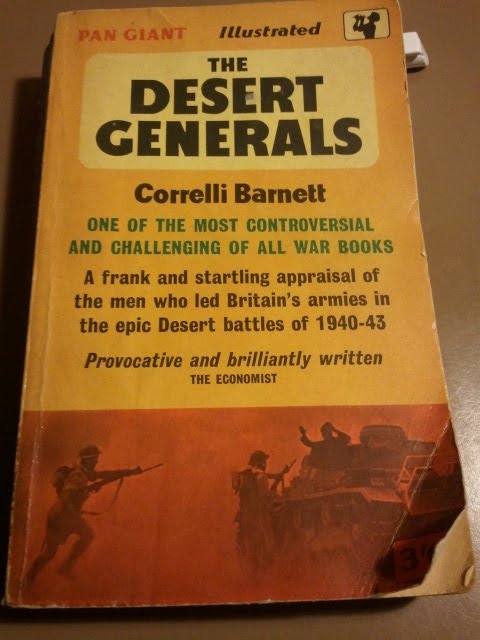
This book is a key account of the Desert War. Following the campaigns of five British commanders, distinguished military historian Correlli Barnett gives a complete account of the Desert Campaign 1940-43 – the ‘pure’ warfare of tanks in a barren wasteland which gave Britain its first land victories of the Second World War. Correlli Barnett is the author of 6 non-fiction titles. In 1970 he won the Royal Society of Literature Award for Britain and her Army. He has been historical consultant to three BBC Television series, including The Great War (1964) which he part wrote. In 1980 he was appointed the first Defence Lecturer in the University of Cambridge.
A freelance historian and writer, Correlli Barnett was educated at Trinity school and Exeter College, Oxford, where he took a degree in modern history. After national service in the Intelligence Corps from 1945 to 1948, Barnett worked for the North Thames Gas Board until 1957, then in public relations until 1963. He was historical consultant and part author of the BBC series 'The Great War' and won the 1964 Screen Writers' Guild Award for best British television documentary script.
This is a riveting book that I think would be an outstanding read for everyone from the WWII novice to an attendee at the US Army War College. However, if you are a fan of either the former Prime Minister, Winston S. Churchill or Field Marshall Bernard Montgomery than you may want to brace yourself. The Desert Generals doesn’t paint a very flattering picture of either of these two British icons. I love Winston but did he ever blow it in the desert. Oh well, even the great ones are wrong on occasion. I think I need to be a little more positive in this review so I will put it another way: Had it not been for Winston S. Churchill, the desert war may have ended two years earlier before Rommel and his vaunted Afrika Korp could have been fully deployed in theater. Winston’s insistence to aid the Greeks robbed Richard O’Conner (the original Desert Fox) and his boss Archibald Wavell of further resources. Winston congratulated Wavell and ordered him to “make [the Army] secure in Benghazi and to concentrate all available forces in the Delta in preparation of a move to Europe.” Units were diverted to Greece in a lost cause! What’s worse is that everyone in the British Military understood it to be a lost cause. These same units could have been used to kick the Italians off the continent quite possibly before the Germans arrived in force. Barnett summed it up as follows:
The Greek question was a major crisis in grand strategy; by his decision to intervene, the Prime Minister showed for the first time in the war that although he was a Churchill, he was not a Marlborough. Instead of his ancestor’s cold and long-sighted sagacity, he displayed emotional impulse; sometimes generous, sometimes ruthless, always overwhelming. Greece was the first occasion in the war that these impulses had worked disastrously. It was a mistake the more disastrous because of the alternative objective of Tripoli, which O’Connor believed he could obtain.
So what is good about this you ask? If you are a lover of the legend of Erwin Rommel and the Afrika Korps; if you ever begged your mom to allow you to stay up late so you could watch reruns of Rat Patrol in your pajamas; If your favorite war movie of all time was Patton and in your mind George C. Scott is Patton….than you will thank the PM for that stupid, stupid move of sending O’Conner’s best units to Greece, in a lost cause, only to become POWs when complete victory was in sight! If it wasn’t for Churchill the war on the African continent very well could have been over! Barnett’s book would have been a mere pamphlet!
There is another piece to this story. It is that of the UK’s self-proclaimed Messiah, Field-Marshal the Viscount Bernard Law Montgomery. Only about 20% of this book is devoted to Monty – the last 20%. The Desert Generals defrocks Monty. He was the original Desert Sloth who at best didn’t understand mobile desert warfare and at the worst was a braggart, a liar, and maybe slightly autistic with his habit of repeating everything he said twice! Everything he said twice!
There appears to be three Desert Generals that understood how to fight tank battles in the wide expanses of the desert: Erwin Rommel, Richard O’Conner, and Chad Auchinleck. O’Conner, by a bad stroke of luck, is taken prisoner by the Germans after making a wrong turn in the desert. Enter Auchinleck who appoints two unsuited candidates for command of the 8th Army prior to taking the job himself. Like O’Conner, Auk understands desert warfare or at least he “gets it” or is “getting it” prior to the 1st battle of El Alemein. After Auk saves the day the PM visits 8th Army and fires Auk and several members of his staff. Again, looking at this in a positive light, Having Monty take the helm of 8th Army helped to cement Rommel’s reputation for an eternity. Had Auk been left in charge Rommel would have likely been a POW.
I think you will love Correlli Barnett’s writing style. He splits the Desert War into six parts and after each part Barnett adds a commentary section during which he critically analyzes the actions of each of the desert Generals. I think even Monty would agree that this is a tidy way to keep track of everything. Tidy way to keep track of everything. Also, his sarcasm is very humorous at times.
The Desert Generals is packed with information but one fact stood out. At no time did Rommel have more than 4.5 divisions of Germans under his command. At the same time, the German’s had 190 divisions deployed in the East. The Desert War was in fact a side show of the big show. The author wonders what would have happened if Germany would have sent a few more Panzer divisions over to the desert rather than have them swallowed up on the Russian Steppes. Would things have been a little different?
In the end Monty had 2-3x more tanks, men, planes etc. than the Axis. If you just count German tanks Monty had about 6x more than Rommel…but who can forget the Italians…going to war without the Italians is like going deer hunting and not bringing along your accordion. Monty could do nothing because he never understood how to fight a tank battle in the desert. He could not think as fast as Rommel. He did not understand how to integrate tanks and infantry like the Germans did or like Auk. He attacked on too narrow a front and sacrificed too many tanks. He didn’t understand that putting infantry behind fixed fortifications was worthless….Oh Monty. Was he really that arrogant ass portrayed in Francis Ford Coppala’s Patton played by Michael Bates? Yes, according to Barnett, I’m afraid he was but he did help to propagate a legend.
This is a riveting book that I think would be an outstanding read for everyone from the WWII novice to an attendee of the US Army War College. I decided to download this book to my kindle when I read that The Desert Generals was one of British Historian, John Keegan’s top 50 favorite books regarding WWII and the only book of the 50 about the war in the desert. Also, Rick Atkinson quoted from this book in his masterpiece: Army at Dawn.
You will enjoy the book. Enjoy the book. Oh shut up Monty.
As they say: a darn good read! I picked it up at Skook books which rewarded me so well on my first visit this weekend.
The desert war has always fascinated me. It's the topography of the battlefields, as Barnett says, almost empty and therefor best suited for a clash of generalship. Here the operational genius of Rommel and O'Connor would stand out against the mediocrity of most others. But there's also the strategic side, the long distances and the logistic challenge (where Rommel showed less brilliance, perhaps, but which he tried to make up for with bluff and sheer willpower).
This book is not so much about the operational and strategic issues as about the character and ability of the commanders of the Eight Army and its predecessor, the Western Desert Force. Obviously, Barnett favours O'Connor and Auchinleck, while he writes Cunningham and Richie into the ground, even if with some sympathy.
But the venom is in the tail. Barnett's account of Montgomery's command is a textbook character assassination. After exposing him as a mean but before everything else a self publicising monomaniac who furthers his carreer at the expense of others (as opposed to modest men like O'Connor, Wavell and Auchinleck of course), he then destroys Monty's military reputation.
Not only (and this is Barnett speaking, not me) does Monty steal the good ideas for Alam Halfa and Alamein from Dorman-Smith and Auchinleck, he then also bungles the planning for Alamein (presumably counting on the effect that Rommel would have to withdraw anyway due to the Torch landings) and only saves it by superior resources and bloody single mindedness. He then finally fails to catch Rommel in pursuit. And at all times Barnett implicates that Montgomery tries to shift the blame and claim the glory.
In the appendices there's also an eulogy for Eric Dorman-Smith, obviously a highly talented, but non-conformist staff officer. Barnett sees him as the creative element during much of the successfull operations who was perfectly teamed with commanders like Wavell and Auchinleck, who appreciated his talents and knew how to employt them constructively.
However, after Auchinleck's removal, Dorman-Smith's carreer went downwards and at several times he was removed from commands. Barnett claims he was doing well in all those positions and that the reasons behind his repostings had to do with his intellectualism and intolerance for the mediocrity of others.
Whether or not this explanation is 100% correct I don't know, but there is clearly a pattern in the British army of WWII where visionary and intellectual officers (think also Hobart) lost out to more practical and especially more conformist ones.
Most surprising to me is that Wavell has no more prominent role in this book. While he maybe was always more than only a desert general, his presence in the background was highly influential in the first two years of the war. Barnett is generally favourable to Wavell.
Barnett is an excellent writer, despite his biases. I'm only now becoming aware of the factionalism in British military history writing, and it's still a bit fuzzy for me, but I get the impression that Barnett is part of the Liddell Hart group.
The problem for me is that I have always instinctively taken sides with O'Connor, Wavell (I even named him my favourite general) and Auchinleck. And Barnett's story of the bright elite losing out to the mediocre establishment makes them the natural underdog and plays on my self image as talented and non-conformist (Stop laughing, please!).
But I am also wary of totally discounting Montgomery's ability. He was obviously not a nice person to be associated with professionally, but he's always seemed solid to me. I've also grown suspicious of black and white characterisations.
So while enjoying this book very much, it leaves me not entirely convinced of the characterisations of the people involved.
A very nivy nice piece of historical revisionism. It doesn't so much undermine Montgomery's reputation, as restore the reputations of those who preceded him -- especially 'The Auk': General Claude Auchinleck.
Correlli Barnett gives an account of the war in the North African Desert from 1940-43, as the book title suggests it looks at the five Generals who commanded the allied armies in that area. It looks at their triumphs and their defeats, but it also looks at the character of the men and how well or otherwise they coped with the strain and lonliness of command, and the pressures they were under from outside influences. Correrelli Barnett is obviously a fan of O'Connor and Auchinleck and even more obviously not a fan of Churchill and Montgomery, indeed his dislike of Montgomery, for me casts a shadow over the latter section of this otherwise excellent book, he may be right in his criticism of Montgomery but his constant sniping becomes wearisome eventually. Overall however a good read.
I had the earlier edition of this book when I was younger but I didn't read it. I picked up this edition which has notes about how enigma decrypts aided the commanders. A very good book. The author does a lot to clear up the Monty myth and gives credit to the previous commanders, O'Connor and Auchinleck. All of that is justified. As a Monty fan I agree wholeheartedly!
An important and at the time it was originally published controversial book. I don't agree with all Barnett's conclusions. Could have been far better edited and the maps are a joke.
CONTROVERSIAL. IMPORTANT. BIASED TO THE EXTREME. CAPTIVATING. MAGNIFICENTLY WELL WRITTEN.
Could a beginner read this as a 101? Yes. Should they? I would not recommend it.
That said, if you are interested in the controversies over the events (controversies that lasted for decades) then start HERE.
This one is easy to read, wonderfully written, and crystal clear about what is happening and why. The flaws come in with the biases, though that arguably makes the book more entertaining since Barnett has a highly readable caustic style when he is passionate or angry.
The core weakness of Barnett's arguments is over lionizing the Auk and overdoing the Monty hate (at times you can feel the vitriol in the prose). As understandable as the instinct is, given Monty's unscrupulous lying, it does disservice to the good decisions Monty made like restoring good discipline and training or bringing up the 44th division from the delta. Yes, Monty used Chink's plan for Alam Halfa as a basis. He also modified it enough so that we don't know if the original version would have had the same result. Both are correct, and both Chink and Monty deserve parts of the credit for Alam Halfa.
Corelli Barnett may have set out to savage Montgomery and lionize the Auk, but what he actually accomplished was something more worthwhile. He shed an important light on the ever-interfering Churchill, who could never give his generals the space to win, and helped slay the sacred cow of Winston's war time leader status. On this, at least, he was successful.
An older book (1960), this tells of the North African Campaign from the viewpoint of five generals who commanded the Western Desert Force and then the Eighth Army through the capture of Tripoli. It wasn’t easy following the action, but then I’ve encountered few campaign narratives of any war in which that was easy without a lot of maps. This work has several maps and they appear as if they were sketched by hand; yet they work for the most part.
It won’t be hard to tell that author Barnett likes (he’s still alive and 90) O’Connor and Auchinleck and is not a great fan of Montgomery, although he acknowledges his strong points. There’s not much new here; Monty attracts much praise and damnation from other writers. The enjoyment for this reader comes from learning more about Cunningham, Ritchie, and especially the Auk. I don’t think this book should serve as one’s first read about the African campaign but is recommended for anyone wanting to learn more about the British travails and triumph.
Correlli Barnett's intriguing account of the North African campaign during WW2 depicts the see-saw of fortune and command in the desert. This is highly recommended to anyone who is interested in the Britsh strategy during that campaign.
I was left with considerable sympathy for General Auchinleck (later promoted to Field Marshal) as, from Correlli's account, Auchinleck prepared the way for the German defeat in North Africa with his success at the First Battle of El Alamein. However, the subsequent badgering by Churchill who wanted faster results in the aftermath of the battle led to his replacement as Commander-in-Chief Middle East Command by General Sir Harold Alexander and the appointment of General Montgomery as Commander Eighth Army.
What a great book. I read the 2nd addition in the early 80’s and 40 years later found it amidst several 100 books that I inherited. After a few pages I remembered the criticism of Churchill and Montgomery that were a bit scandalous when they were first written.
Highly recommended to anyone interested in the Western Desert Campaign from the British perspective. I also found the lack of worship for Rommel a nice change from the usual narratives.
A brilliant review of the actions of 5 British Generals who lead the way in the desert. It is clear Cunningham and Ritchie were out of their depth. Auchenlick and O'Connor came same close but we're undermined by Churchill. Whereas Montgomery was lucky and built his reputation on plans of Auchenlick.
A clear and concise history of the desert campaigns of WW2. it has an interesting take on teh achievements of General Auchinleck and how these were forgotten in the politcal machinations of General Montgomery.
A fascinating book, well written but unfortunately with the Enigma as footnotes. The author shows the opportunist brilliance of O'Connor who along with Wavell mounted an incredible campaign against the Italians in North Africa only to be lost by Churchill. The failures of Auchinleck appointees Cunningham and Richie, the brilliance of Auchinleck. The author however does a hatchet job on Montgomery possible caused by Mongomery not co-operating with the author, the only negative part of an otherwise great book. The enemies in North Africa were Rommel, Churchill and the desert and Monty defeated them all. The previous victories were all stopped by Churchill. I suggest any reader wanting to understand Monty and his methods read All in a Days March by Major General David Belchem, a thourghly good read which shines light an man other operations including Overlord, Canne, and the Battle of the Bulge.